Saturday, 19 November 2022

Terraforming Mars: Ares Expedition


The Game

Ares Expedition is the card game version of Terraforming Mars, and this is a statement you can take literally. It is basically Terraforming Mars with the board play removed. You are mega corporations participating in the Mars terraforming project. You need to create oceans, raise the temperature and increase the oxygen level. When you have done all three sufficiently, the project completes and the game ends. Whoever has scored the most points wins the game. 

Like its predecessor, Ares Expedition comes with many cards. You can almost argue that Terraforming Mars is a card game with a board. 


Every player has his own player board, for tracking production capacity and resources on hand. You start the game with a mega corporation card, which gives you some unique abilities. During the game you will play many cards before you. They will be new technologies and buildings which increase your production capacities, allow certain actions and give you victory points. 


Cards you play come in three types - red, blue and green. The number at the top left corner is the cost to play the card. Cards have various icons and they mean different things. Some abilities give you discounts for specific icons. Some abilities let you score points based on the icons. 


These are called phase cards, and they are the core engine of the game. This game mechanism is similar to that in Race for the Galaxy. Everyone has a set of five phase cards. At the start of a round, everyone secretly picks one card to play, and then you reveal your choices simultaneously. The phases which have been picked are executed in a predetermined order, and every player gets to perform the relevant actions, not just the player who picked the phase. If you are the one picking the phase, you enjoy a small bonus. One element that is different from Race for the Galaxy is you can't pick the same phase in two consecutive rounds. That creates an additional challenge. It is also additional information you can use to guess what your opponents will pick. 

Player interaction comes through guessing your opponents' intentions and making use of them. Let's say you want to play a green card and you also want to perform card actions. If you are pretty sure your opponent is going to select the perform card action phase card, you will select the play green phase card yourself. If you are right, you will be able to do both of the things you want. You also want to minimise helping your opponents. When they are dirt poor, it is probably safe to select the phase cards which allow playing cards. They probably can't afford to pay for playing cards. 


The game board is a glorified tracker keeping track of four things - the number of oceans, the temperature, the oxygen level and player income (which will be victory points as well when the game ends). The gold, silver and copper cubes are generic counters for all resources in the game. This is a clever and convenient way of tracking resources. 


As the game progresses, everyone will have more and more cards in play. Your choice of phase card can have huge repercussions. You know what your opponents can potentially do in each of the phases.  


Every time you create an ocean, you receive a small bonus, which is shown at the front of the ocean tile you flip over. The temperature and oxygen tracks are divided into four subsections. Some cards can only be played when the level is within a certain range. 

The Play

Ares Expedition at its core is a card combo game. A tableau game. You are constantly trying to make effective combos of cards you draw. You want to get cards which jive well and boost one another. When you put together a nifty combo, you try to utilise it as much as possible. All these combos exist to help you produce efficiently, and convert resources efficiently to victory points. Player interaction comes from the phase card selection mechanism. You do have to watch your opponents and try to minimise assisting them. There is a race element, and you need to get a feel of your opponents' tempo. 

You generally feel like you are building your own little empire or engine. There is little aggression. Although this is a competitive game, the setting is completing the Mars terraforming project together. Everyone is working towards the same goal. This is an efficiency game. How do you contribute more to the cause than the rest? You will use various small tactics to gain small edges. You try to build a more efficient combo than others. You adjust your strategy as you watch your opponents' engines evolve. 


Sometimes you place cubes on cards to represent specific resources as described by the card. Cubes on this Livestock card are livestock. Each cube is worth 1 victory point (VP) at game end. Whenever you increase the temperature on the surface of Mars, you get to place a cube on this card. 


This is one of the mega corporation cards. The bonus here is being able to produce plants right from the get go. When converting plants to forests, you need one fewer plant than usual. 

By late game you may have more than 20 cards in play. 

It is important to put together combinations of cards which help one another.

The Thoughts

There is a sweep of history feel in Ares Expedition. After all you are terraforming Mars over many generations, developing new technologies and completing huge projects. Despite being a card game, it is not a short game. It took me about an hour and a half. The core mechanism is different from Terraforming Mars. Ares Expedition uses the phase card mechanism. However the overall feeling is the same as Terraforming Mars. The main thing is still card combos you make to efficiently generate and convert resources to be used for the terraforming effort. I imagine if I had bought Terraforming Mars I wouldn't buy Ares Expedition, because it doesn't feel necessary to me. It is not shorter by much and doesn't deliver a significantly different experience. Take this with a pinch of salt though. For the fans of Terraforming Mars, this may be exactly what you want - a variant of a game you love. It really is Terraforming Mars presented in a card game form. 

Thursday, 10 November 2022

Dancing Queen preorders closing soon


This is an exciting time for me. My first physically published game will be out soon - Dancing Queen. The whole journey took close to two years. I hadn't specifically planned for this to be my first published game. It all started with participating in the 9-Card Nanogame game design competition on BoardGameGeek.com. I started the design process in January 2021. Dancing Queen later won the Best Overall Game. 

The actual publishing project started early in 2022. By this stage the core game mechanism did not change any more. However there was much more we had to improve and adjust. We tried out different concept art. We explored how to better communicate the card powers. We revisited and rearranged the rulebook. We still had to do more playtesting, including cold playtesting, to tease out what else were problematic and needed to be addressed. There was production planning and quality checking to do. Costing. A lot of detailed work went into the project, and I now have a much better appreciation of the intricacies of creating a good product. It is much more than just game mechanism and nice art. 

Preorders for Dancing Queen will close on 27 Nov 2022. You can preorder at Cili Padi Games. Dancing Queen will be at the Anigames convention 9 - 11 Dec 2022, which will be at GMBB Mall in the Kuala Lumpur city area. 

These are proofs using final art, and not the actual product yet. There were still some corrections and adjustment needed. The game printing is in progress now. 

I like how the colours turned out. 

We are printing on PVC - sturdy and waterproof

The rulebook is full-colour

The rulebook went through many revisions

Eventually the cards will all be die cut and have rounded edges

The whole game will be packaged into one small box that can fit into your pocket

Preorder Dancing Queen at Cili Padi Games by 27 Nov 2022! 

Saturday, 29 October 2022

Jekyll vs Hyde


The Game

Jekyll vs Hyde is a two-player trick-taking card game. This is unusual. Most trick-taking games support around 4 players. I was a little doubtful whether a two-player trick-taking game would work. Julian suggested I give it a go, so I did. 


A game is played over three rounds. One player plays Dr Jekyll, and the other Mr Hyde. Mr Hyde is the second personality of Dr Jekyll who is trying to take over to become the dominant personality. Dr Jekyll, the original personality, wants to maintain control. The board is mainly a tracker to see how far Dr Jekyll has fallen. There are 10 steps on the track. If Mr Hyde can advance the pawn to the end of the track within 3 rounds, he wins and becomes the dominant personality. How far he advances at the end of a round depends on the difference in the number of tricks taken by the two players. The bigger the difference, the further the pawn moves. Mr Hyde wants to make sure one player wins many more tricks than the other, be it himself or his opponent. Dr Jekyll tries to keep things balanced, ideally each player winning 5 tricks. 


There are 25 cards in the deck. There are 7 cards each in 3 suits - green, red and purple, and there are 4 potion cards. Every round each player is dealt 10 cards, so there will be 5 cards not known to the players. Before each of the three rounds starts, players must pass cards to each other, starting with just one in the first round, and eventually passing three in the third round. You will be revealing more and more information to your opponent. 

In case you are not familiar with trick-taking - when playing a trick, every player must play a card. Whoever has played the strongest card claims all these cards just played - i.e. the trick. 


When one player starts the trick by playing a card, the opponent must play a card of the same suit if he has one. Only when he doesn't have a card of that suit he may play any other card. If the cards played are of the same suit, the larger number wins the trick. If the suits are different, the stronger suit wins. Suit strength varies from round to round, and may even change in the middle of a round. The first suit being played in a round becomes the weakest suit. When a second suit is played for the first time, it becomes the second weakest suit. The suit which has not yet been played automatically becomes the strongest suit. 

A potion card triggers the special ability of the suit of the other card played. When the purple power is triggered, the winning player claims an additional trick from his opponent. When green is triggered, the players exchange two cards. When red is triggered, the suit strengths are reset. All these powers can greatly affect the outcome of a round. 

This pawn used for tracking Dr Jekyll's fall from glory is beautiful - a bust with two faces. 

These round markers are used for keeping track of suit strengths.

For Mr Hyde to advance 10 times within three rounds, he more-or-less needs to have two rounds of 7:3 and one round of 6:4. The trick difference would be 4 + 4 + 2 = 10. 

The Play

This little game gives you a decent mental exercise. If you play Mr Hyde, one difficult decision is who do you want to position to be taking more tricks. When I started playing, I instinctively thought that it would be easier to play Mr Hyde, because I just needed to make things go out of whack. I didn't need to maintain such a strict balance. The more I played, the more I realised it wasn't that simple. 

The information glimpsed before the start of a round can be crucial. You use this to guess your opponent's hand and his intentions. The potions are crazy powerful. You must defend against them, and you must use them wisely. 

That basic tactic in trick-taking games - getting rid of one suit as soon as possible - still holds true here. This is important because you will have freedom to play what you want. 

I get a feeling that I have more control in a 2-player trick-taking game compared to a 4-player one. Because of that the game feels more strategic. However I am not really an expert in this genre. For the pros, a 4-player game is probably just as strategic as a 2-player game, because they understand trick-taking deeply and can read their opponents well. I am nowhere near that level yet. 

I like the art

We arranged the tricks we won this way, so that it was easier to keep track and count. 

When the pawn enters the red zone, the Hyde player becomes the start player for the new round. 

The Thoughts

Now that I have played Jekyll vs Hyde, I must say 2-player trick-taking games do work. If you are into trick-taking games, this is worth checking out. It is quick, clever and strategic. It is a game in which you can orchestrate killer moves by reading your opponent and planning ahead well. Since this is a 2-player game, it can also serve as a filler on game nights when you are waiting for everyone to turn up. 

Wednesday, 12 October 2022

Cthulhu Coinsides launching 31 Oct 2022


EX1ST GAMES will soon launch a new Kickstarter project for the Cthulhu version of Coinsides - a boardgaming accessory which looks absolutely stunning. This one coin can serve as 9 different dice. 

Friday, 30 September 2022

Regicide


The Game

Regicide is a game that can be played with a standard deck of poker cards. It is a cooperative game. You are warriors working together to defeat twelve powerful enemies. These enemies are the Jacks, Queens and Kings in the deck. If any player is killed in battle, everyone loses. To win, you must defeat all twelve enemies. Whenever you defeat an enemy, it joins your ranks and helps you in fighting the remaining enemies. 

When setting up the game, you shuffle the enemies to form a stack, with the Kings at the bottom, the Queens in the middle and the Jacks on top. You know you will fight them in this order, but you don't know the exact order of the suits. To start playing, you reveal the first Jack. 


Every enemy has a health value and an attack value. Jacks have a health of 20 and an attack of 10. Queens are health 30, attack 15, and the powerful Kings are health 40, attack 20. On your turn, you play a card to attack the enemy, reducing its health. If its health is reduced to 0, it is defeated. As long as the enemy survives, it counter attacks, using its attack value. You have to discard cards from your hand to meet or exceed the attack value. If you fail to do so, you are defeated, and everyone loses. For example if the enemy's attack value is 10, you must discard cards worth at least 10 points to block the counter attack. 

The four suits mean something, and they are a most important aspect of Regicide. When you play hearts, you get to reshuffle some cards from your discard pile to the bottom of the draw deck. E.g. when playing a 9 of hearts, you will randomly move 9 cards from the discard pile to the draw deck. When you play diamonds, everyone gets to draw cards. E.g. play an 8 of diamonds, and everyone takes turns drawing cards until a total of 8 have been drawn or until everyone is at his hand limit. Cards are your resources. You use them both to attack and to defend. When you play clubs, your attack value is doubled. This is certainly helpful in quickly defeating an enemy. When you play spades, you reduce the enemy's attack value. By doing this you reduce the number of cards you need to spend on defense. 

The suits on the enemies mean something too. An active enemy of a particular suit temporarily cancels the power of that suit. For example when fighting a spade enemy, any spade cards played will not reduce its attack strength. That is certainly bad news. The enemy will always be counter attacking at full strength. 

Whenever you defeat an enemy, it joins your ranks. It is placed in your discard pile, so the next time you move cards to your draw deck, the former foe will become a powerful weapon. Now if you are able to defeat an enemy with precision, i.e. you play a card with the exact value to reduce the enemy health to zero, you get a bonus. This enemy is placed on the top of your draw deck instead. This is great news. You will soon draw it and you can use it for the next enemy. Players are not allowed to discuss their cards, so this is not exactly easy to do this. 


There is a Regicide app which you can download for free. You can use it to track the health level and attack strength of the enemies. It calculates card strengths and applies card powers for you. Not absolutely necessary, but it is handy. 


There are special rules for aces and jokers. This is not exactly a simple game. The strength value of an ace is just 1. However you can play an ace together with another card. You sum up the values, and apply the powers of the suits of both the cards, assuming they are of different suits. This can be very useful. Jokers have a value of 0, but they cancel the suit of the enemy. That means the enemy no longer disables the suit power. When you play a joker, you do not attack or suffer the counter attack. You also get to pick the next player. Jokers can be a lifesaver. 

You can play multiple cards of the same value, as long as the total doesn't exceed 10. That means this is limited to 2's to 5's. When you play multiple cards, you add up the numbers, and you apply the powers of all the suits. 

The Play

I played 3-players. Han had taught Allen before. I was the only first-timer. When they played previously, they misinterpreted the spade power and made the game much harder than it was supposed to be. This time we played with the right rules. However we didn't manage to beat the game. We only went as far as the kings. This is not an easy game to beat. 

At first I thought the toughest enemies would be the spade enemies, because they would always attack at full strength. We couldn't use spade cards to reduce their attack strength. They would severely deplete our cards during the defense stage. I later realised that enemies of other suits must not be taken lightly either. All aspects of the game presented challenges. In one of our games we lost due to not having any diamond cards in hand. No diamonds means no more card draws. That's a death sentence. It's only a matter of time to run out of cards. You have to remember to keep replenishing cards from the discard pile to the deck, and also to maintain the ability to draw cards. 


You are forbidden from discussing your cards. You aren't even supposed to give hints. This is crucial. Without such rules the game may not work quite well. However there is a solo version of the game, so maybe the game does still provide a challenge even if you have perfect information. 


The Thoughts

This is a game which can be played with any regular deck of poker cards, but I think it's fully worth buying a copy from the designers. Not just because of the pretty art. It is an excellent design. I greatly admire the game and find it better than most recent games I've played. It is creative and unique. Having been playing boardgames for many years, I sometimes despair because new games I play often feel similar. I often feel I'm seeing the same game over and over. Regicide is a game that gives me hope. There is still originality out there. There are still new ideas. There are still new worlds to explore. Being able to design such a wonderful game with just a standard deck of cards is no small feat. Two thumbs up! 

Friday, 9 September 2022

Lisboa


The Game

Lisboa is one of the most popular games from the well-known Portuguese designer Vital Lacerda. It is a heavy Eurogame about the rebuilding of Lisbon after the major earthquake in 1755, which triggered a tsunami and also led to a great fire that ravaged the city for three days. 


The game board is huge and contains a lot of information. The right half mainly features the four streets of Lisbon. This is where you will build shops and public facilities. The left half features the three important nobles - the builder, the minister and the king. Actions you can take when visiting them are shown on the game board. 

The game is played in two halves. You have a hand of 5 cards. On your turn you play a card to perform some actions, and then you draw a card from one of the four draw decks. The decks are face-up so your opponents know what card you are picking. Three of the four decks are related to the three nobles. When an opponent picks a card related to a particular noble, chances are he intends to take actions related to that noble. The fourth deck is an event deck and these cards have various powers. One half of the game ends when three decks run out. Player choices when drawing cards affect how quickly the game progresses. Another way a half ends is when a player collects a specific combination of rubble. In this game, rubble from the earthquake can be reused for the rebuilding efforts. 
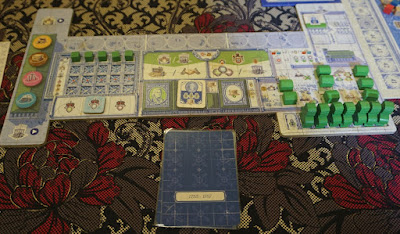

This is the player board. When you play a card, you play it on the main board or on your player board. If played on the main board, you will visit one of the nobles or trigger an event. If played on your player board, you improve your abilities. The indents along the top and bottom of your player board are for you to tuck cards. You can tuck up to 3 cards horizontally from the top, and up to 3 cards vertically from the bottom. 

The most common action type in the game is probably visiting a noble, which requires playing a card on the main board. When you perform this action, other players may follow. They can spend a favour token to join you in visiting that same noble. As the active player you perform two actions related to the noble. Others piggybacking on your visit get to perform one. 


The icons at the top and bottom of the cards are what will be showing when you tuck cards below your player board. These icons will be the permanent benefits you gain after you play a card at your player board. 


This is the area where you do the actual rebuilding of Lisbon. There are four streets (the coloured stripes) and five rows of shops (well, technically the five rows of empty spaces where you can build shops). Along the north, east and west edges there are spaces for public buildings. When you build a shop, you place a shop tile next to one of the streets. Every shop tile has a little opening which represents the front door. When you place your shop, the street the door faces determines which kind of goods your shop produces. Of the five rows where you can build shops, when you build in the centre three rows, you always have two options. If you build in the first or last row, the door can only face one specific street - the yellow or the blue. 

Those red, blue and natural cubes are rubble. When you build a shop, the cost is determined by rubble in the row and column of the shop. In the early game building shops is expensive. It gets cheaper gradually because every time you build a shop, you will remove (and reuse) a rubble cube. You want to collect sets of rubble (a set is three colours). It improves your abilities, e.g. your warehouse capacity. 


These on the right are public buildings. To construct them you need to have obtained plans from one of these two architects, Mr Blue or Mr Green (sorry I don't remember their names). You don't need to spend cash, but you have to spend people (officials). That's essentially another currency. 


Below each of the three nobles you can see three different actions. When you visit a noble, you must perform the main action, and you may perform one of the two secondary actions. The main actions are building a shop, claiming a decree and constructing a public building. Decrees are cards which score points for you at game end, if you fulfil the conditions specified. 

The secondary actions are claiming two officials, taking an architect's plan, buying a ship, producing goods, moving the cardinal and taking a favour token. You produce goods to be sold for cash or to barter actions from the nobles. Goods are produced at shops, so you need to build shops before you can produce anything. Selling goods for cash requires ships, but you can use other players' ships, just that they will gain points for shipping those goods. 


Here are some decree cards. Wigs in Lisboa mean victory points. Most decrees here score 5VP if you have the most of something. The decree in the centre scores 2VP for every public building designed by Mr Green Architect on the west side of the city. 


That pawn at the top left is the cardinal. He moves around this track. Whenever you move him, you can claim one of the clergy tiles next to where he stops. Clergy tiles give you various abilities and bonuses. You can also discard them for points. 


The four goods are worth between $4 and $6 at the start of the game. Selling goods by shipping them off is one way to make money. Every time anyone produces goods, the prices drop. Goods will be worth less and less as the game progresses. However in the later game you will produce more and also you will be able to ship more. That offsets things somewhat. 


When you claim clergy tiles, you have to place them in this corner of your player board. There are only four slots. When this gets full you will have to discard clergy tiles. 

The artwork and graphic design is done well. I love the attention to detail. 

The Play

Lisboa is a typical heavy point-scoring Eurogame. There are many ways you score points. You'll do scoring during the game, and you'll also do a bunch of scoring at game end. In our game, almost half of the final scores came from game-end scoring. The main thing you do in the game is you build shops and public buildings. Making money, claiming architectural plans, recruiting officials are all things you need to do in order to build stuff. Producing goods, buying ships and shipping goods is one other major process flow, and you do that mainly to make money. That brings you back to using the money to build shops. 

During play you must remember to claim decrees. This is basically positioning yourself for the end-game scoring. You claim decrees sometimes not just for yourself. You may also claim some for the sake of denying your opponent. As players collect different types of decrees, they priorities diverge. They will tend to focus on fulfilling the criteria on their respective decrees. 

Cards, decrees and clergy tiles come in a huge variety. Every player gets a booklet listing all of them and their powers. When we played we had to refer to the booklet all the time. Learning this game takes a fair bit of effort. 

On your turn, the broad stroke is you play a card then pick a card. Where you play that card determines what actions you perform. The basic actions are those 9 printed on the board, plus selling goods, for a total of 10. None of these are particularly complicated. However many of them are related to other rules and mechanisms, like how to calculate the cost of an action, whether your opponents get to follow, what the restrictions are. There is a lot to digest. 

There is plenty of player interaction. You fight over building lots on the map, both for shops and public buildings. It's first come first served. You station your officials at the offices of the three nobles, to make it more costly for your opponents to visit them (aah bureaucrats). You also fight over decrees. With decrees which reward points for being top in certain criteria, you can deny your opponents the points even if you don't claim the decree. You just need to do better than them in those criteria. 
 

At this point I had two ships tucked along the top of my player board. I had one card tucked at the bottom, and it makes red rubble cheaper by $1, i.e. being discounted from $2 to $1. Those little houses at the bottom right are used for marking shop ownership on the main board whenever you build a shop. When you remove houses from your player board, you unlock new abilities too. 


Whenever you build a shop, you claim one rubble cube. If you build a public building, you claim two.  Whether you are building a shop or a public building, you will gain a one-time benefit as specified on the space of the building. 

A shop may earn victory points up to three times, if it matches up with the right type of public buildings. When you build a public building, it may help your opponents' shops earn points. 

We did a 3-player game - Han, Allen and I. Han had played before, so he taught us the game. Our scores were close throughout most of the game. However when we did the final scoring, Han's score sprinted ahead and he won by a large margin. He had more shops than us. 

The Thoughts

I have come to a realisation, or perhaps I should say I am finally admitting it to myself, that I'm drifting away from heavy Eurogames. For many years I have identified as a hardcore gamer primarily playing heavy strategy games, and I am solidly in the heavy Eurogame camp. In recent years, I find myself less and less patient with these games. Games which spark my interest are no longer games in this genre. I think the problem is there is less innovation in games of this genre. But I may be wrong. Maybe the problem is with me. Maybe my taste has changed. 

I find Lisboa tiresome. Sorry to all the fans, and I know it has many. It's not bad, just that for me the effort I have to put in is higher than the enjoyment I get out of it. It has many rules and mechanisms, and I don't think all of them are necessary. I would enjoy it more if it were more streamlined. But perhaps it would not be what it is were it streamlined. If someone else at a table is keen to play, I'll probably agree. Now that I know the game, it will go more smoothly. 

I'm pretty sure this is a story-first-mechanism-later game. Many important elements in history are retained. If this game were a mechanism-first game, I'm pretty sure it would be less complicated. Which comes first, story or mechanism, doesn't decide whether a game is good or bad. The story is a big part of many games. It is part of the play experience that the designer creates for the players. 

Friday, 2 September 2022

boardgaming in photos: Category 5 / 6 Nimmt, Attika


In August I made a trip back to my hometown Kota Kinabalu. My previous trip was more than two and a half years earlier, before the start of the COVID-19 pandemic. Due to the pandemic, I didn't visit my parents for two and a half years. The whole family returned to KK - my wife and my daughters too. Younger daughter Chen Rui said she wanted to play Category 5, so I brought it along. She had played it before, but it had been some time ago so she had forgotten the rules. She just remembered it was fun. When we played, I asked my mum to play with us. So we had three generations playing together. 


Another game I brought on this trip to KK was Attika. This was the first time elder daughter Shee Yun played. I rarely play this with four (the highest player count). The mahjong table we used was barely large enough for it. There was enough space for the land tiles to be set up, but the play area would grow during play. 

I have played a fair bit of Attika last year and earlier this year. When I taught younger daughter Chen Rui how to play, she liked it, so we played a lot of it. We became quite familiar with it. 

The amphoras in Attika let you take extra actions. 

During game setup the temples are placed at the corners of the play area. 


When the game started, Chen Rui (blue) and I (green) were lucky because the black buildings we drew were our respective capitals. Capitals allow many buildings to be constructed for free next to them. 


As the land expanded, it encroached upon our player boards. If it continued to grow, we would need to shift our player boards out of the way. The player boards are not an optional reference sheet. They are an essential part of play.

Shee Yun was new to the game and needed more time to think and plan. Chen Rui was a little impatient and suggested that Shee Yun placed her buildings here and here. That didn't look right to me at all. If Shee Yun placed at those locations, she wouldn't have much to gain, but Chen Rui would benefit from less competition. So I said to Shee Yun not to trust her sister. Chen Rui was just being cheeky, suggesting something that wouldn't make sense if you played properly. Shee Yun was swamped by suggestions from both camps, Chen Rui and devil and I the angel (ahem). My wife Michelle told us to back off and just let Shee Yun play whatever way she liked. 

Later in the game, when Chen Rui placed a new land tile, she positioned it to create a golden opening for Michelle. Michelle's turn was next, and she placed three buildings to create a highway between two temples, thus winning the game. 


The two temples at the top left and bottom left were now connected with Michelle's (red) buildings. Chen Rui saw that her positioning wasn't great, while mine was generally better. She felt it was hard for her to catch up, and thus decided to throw the game to Michelle, just for the fun of it. Shee Yun frowned at me distrustfully and asked, I thought you said connecting temples is hard to do? I defended saying, well if Chen Rui plays crazy like this then anything goes! 

This was one silly game ending in sudden death. We didn't get to see it go all the way to anyone completing all buildings. However it was great to have the whole family sit down for a game together. My daughters are in their late teens now, one doing pre-university and one finishing secondary school soon. They have their own hobbies and interests and their own friends. We are not playing boardgames together as much as when they were little. I am glad that from when they were young boardgames has always been part of our family life. It gave us many happy memories.