The Game
Fate of the Fellowship is a game I am keen to write about. When I
first noticed it, my first thought was, what? Another Lord of the Rings
game? Then I noticed the designer is Matt Leacock (Pandemic). As I
read the rules, I noticed many elements which are similar to
Pandemic. That got me curious. How does the Pandemic system
work for a Lord of the Rings game?
This is a cooperative game. To win the game, Frodo needs to get to Mount Doom to destroy the One Ring.
In the game, this is presented as the last of four missions that the players
must complete. The other three are randomly set up. All the missions are
related to the story. For example, there is one mission in which you have to
capture Isengard. Sorry I forgot to warn you that this post will have
spoilers if you have not seen the movies or read the books. Too
late!
The final mission, which is always in play
Every player gets to play two characters from the story. On your turn, you get
to use one character to perform four actions, and the other to perform just
one action. After each player’s turn, cards are drawn for bad things to
happen. This is just like
Pandemic. There is an intense sense of
urgency and a feeling of impending doom. The most common bad things which can
happen are troops being raised in enemy strongholds and enemy troops marching
towards ally strongholds. The board has a complex network of paths for enemy
troops to move. All the paths start from an enemy stronghold and lead to an
ally stronghold. However, because they crisscross, you cannot reliably predict
how the troops will move. A group heading towards one stronghold might get
hijacked by another card and change direction to another stronghold. It is
important to battle enemy troops and prevent them from capturing ally
strongholds because each time an ally stronghold falls, you lose two Hope. And
Hope is the most important thing in the game. When you lose all Hope, you lose the
game. Wow, this is motivational quote poster material.

In Pandemic terms, Hope in this game is Outbreaks, but they are not
exactly the same. In Pandemic the Outbreaks track is just a count of
the number of Outbreaks that has happened. It will only ever increase. In
Fate of the Fellowship, Hope can go up or down. Bad things will reduce
Hope, but great feats like capturing an enemy stronghold increase Hope. In
Pandemic there are three ways to lose, and you need to watch out for all of
them. Here, these are all linked to Hope. When the draw deck runs out, you
lose Hope for each card you must draw but can’t. When all enemy troops are
deployed to the board and you need to deploy more, you lose Hope for each one
you must deploy but can't.
That ugly red splash is an ally stronghold captured by the enemy. Red are
enemies, other colours are allies.
All characters have unique powers, and it is absolutely crucial to utilise
them well. In general, characters can move about the map to raise troops, lead
troops to move (ally troops can’t move by themselves, they need to be
commanded by a player character), order troops to fight. Cards come in four
suits and are used in different ways. One suit is for raising troops, one is
for die rerolls, one is for guaranteed kills during battle. Many character special
abilities require cards in specific suits. Battles are resolved by die rolls.
The dice determine how many ally and enemy troops are killed.

You have Nazgûl’s in the game! They try to hunt down Frodo. They can be
particularly deadly in battle. There is an Eye of Sauron token in the game,
representing where the evil lord Sauron is paying attention to. Mostly Sauron wants to
find the One Ring (which is with Frodo) and the Eye attracts Nazgûl to help
hunt down Frodo. The Eye is attracted to where evil troops are being attacked.
Sometimes you want to attack not for winning the battle but for distracting
the Eye from Frodo and helping Frodo get to Mount Doom to destroy the ring.
This is all very thematic.
Frodo‘s mission is ultimately how you win. Carrying the ring is a
constant burden and risk because unless Frodo discards a hiding icon card
when moving, if there are enemy troops or Nazgûl where he is, he must roll
dice and suffer bad effects. He can lose Hope this way and this may eventually cost you the game.

The Play
So far I have played four games, all on the easiest difficulty, and I have only won once. This game is hard! You have four missions to work towards. At the same time you must handle the merciless advance of enemy troops. This is more like War of the Ring than Reiner Knizia’s cooperative Lord of the Rings. At first I thought I should just focus on completing the missions as efficiently as possible. Battling was futile anyway. I felt it was more worthwhile to spend my efforts on destroying the ring. Boy how wrong I was! The military aspect cannot be neglected. In fact it is crucial to fight back to delay the deterioration of Hope in order to give Frodo a fighting chance. I found out that the good guys are actually pretty good at fighting. Many characters have abilities that help them battle. Legolas and Gimli do perform like Marvel superheroes. You have to fight and delay the advances of the enemy troops while at the same time make progress in your missions.
I was very hardworking, more so than when I play Pandemic. I checked and noted down cards which were in the discard pile, so that when they were reshuffled back to the top of the deck, I had some idea what to expect next. I could better assess the risk of enemy troops attacking specific ally strongholds.
I took this screenshot to keep track of cards in the discard pile.
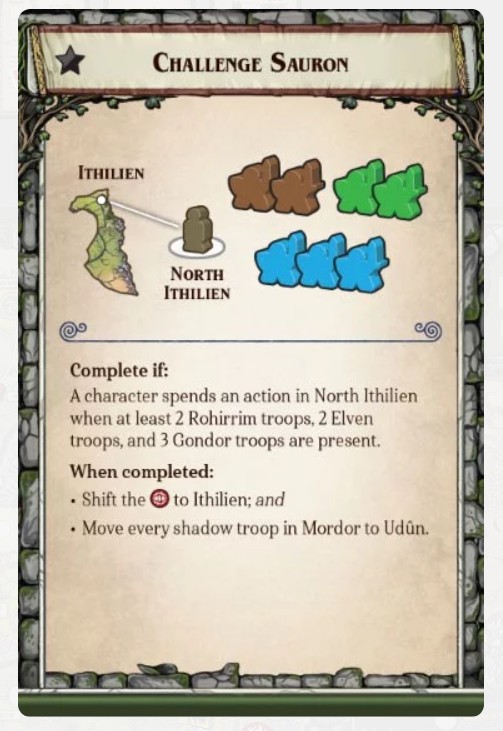
I want to talk about this specific mission which must be completed at North Ithilien. You need to assemble ally units of three types in order to do this. North Ithilien is a space at the gates of Mordor, the enemy's heartland.
The part of the story this mission relates to is how the allies assembled a somewhat big army to threaten Sauron. However Sauron has a much bigger army, and the resulting battle from the allies issuing this challenge is not expected to go well. The allies do this only to distract Sauron and to give Frodo a fighting chance to destroy the ring. This is a noble and heroic feat. This is about sacrifice for the greater good.
Here you can see the allies are already sharing the North Ithilien space with some enemy (red) troops. Frodo and Sam are the yellow piece. In this game they always travel together and they are played as one character. Enemy troops are all over the place and it is hard for Frodo (and Sam) to avoid them.
Now that the challenge to Sauron has been issued, all the enemy troops in Mordor congregated at Udun. You can't even read the text because it has been covered by enemy troops. Now Frodo has a clear path to Mount Doom.
Enemy troops in Udun have advanced to North Ithilien, resulting in a huge battle. At the same time, Frodo sneaks into Mordor and heads towards Mount Doom. This last leg of the journey is difficult because many of the paths require discarding hiding (green) cards or tokens.
Now we are at Mount Doom and Frodo attempts to destroy the ring. He must discard 5 ring (yellow) cards or tokens, and then do a final die roll. The number of dice depends on the Hope level, the lower your Hope, the more dice you must roll, which translates to a higher risk of failure. Managing the Hope level is crucial. You want to keep as high a Hope level as your can.
This was my final die roll. All blanks meant I did not have to suffer any damage. The ring was destroyed, and we won!
This is the die face distribution. Two thirds of the time you expect something bad to happen.
Seeing this victory screen was a hugely satisfying moment for me. Woohoo!
The Thoughts
I am amazed that the Pandemic framework works so well for Fate of the Fellowship. This is certainly not just pasting on a theme. There are many elements which makes this game different from others using the Pandemic system. The way enemies advance is from Pandemic: Fall of Rome, and it works well here. This is a Pandemic-system game that does not feel like Pandemic. This is a Lord of the Rings game.
Fate of the Fellowship is a complex game. I would categorise it as a heavy game. It is highly thematic. If you like the source material, you will enjoy this a lot. There are many details you will appreciate. I find the game hard to win, and I think that's a good thing. That anxiety of not knowing whether you are going to survive is what makes the game exciting and engaging.
I wonder whether the game will feel scripted after a while. So far of the four games I have played, we have been using the same set of mission cards, which showcase important events in the story. Due to the starting positions of the characters (which are fixed every game) and the locations of the missions, we generally complete them in sequence. Then it might feel like we are playing through the same story every game. However there are 24 mission cards in the game. The last mission is destroying the ring and that's fixed. So of the other three, you have 24 cards to randomise from. That sounds like a lot of variety. Also variability comes from the Shadow cards. Depending on how they turn up, the distribution of enemy troops on the board, and how they move, can be very different. Your own card draws will also shape the challenge presented to you. I am confident there is much replayability in this game.