The Game
War Room is a wargame from Larry Harris, designer of the Axis & Allies series of games. The setting is World War 2. It has a complexity level higher than Axis & Allies, but the granularity is the same. Quite a few core mechanisms are different, so this is certainly not an Axis & Allies variant.
The map is round and huge. It takes up a lot of space. The game contains a number of scenarios, and the global war is just one of them. There are 7 countries, which can be played by up to 6 players. The same player would control both the USA and China. Other scenarios include the European war, the Pacific war, North Africa and the Eastern Front. These smaller scenarios use only certain sections of the map. When broken up, the map pieces have very odd shapes.
The centre of the map is a tracker which indicates the political stability of each country in the game. All countries start off stable, but as casualties mount and territories are lost, stress builds up, and eventually leads to stability deteriorating. At different stages of instability, countries suffer different penalties, and these penalties are cumulative. In the worst case, the government collapses and that country is out of the game. If you manage to capture enemy territories, you can reduce stress for your country. Good news cheer people up.
Every country has a little planning booklet.
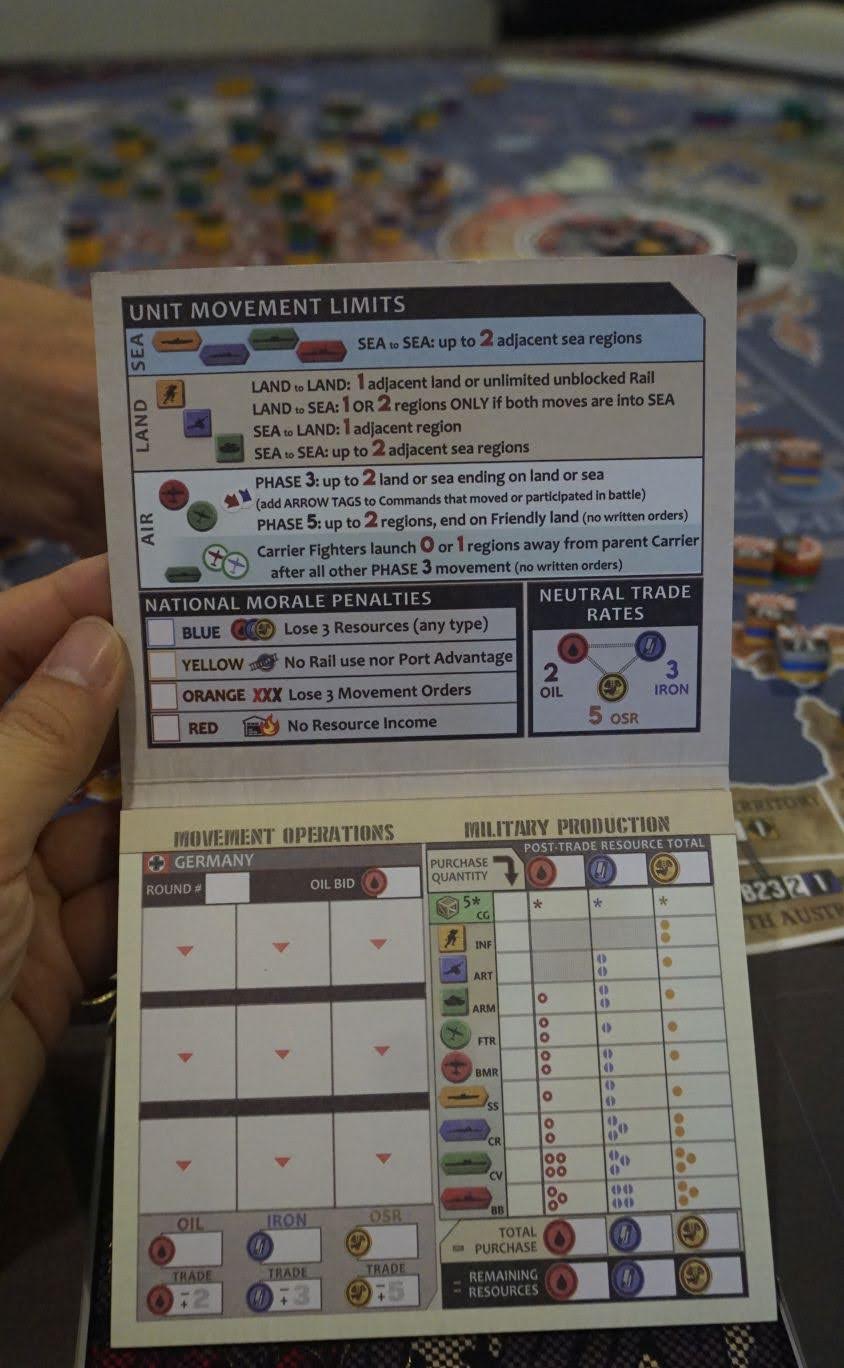
This is what the inside of the planning booklet looks like. Every page is a planning sheet. You need to use one planning sheet per game round. These sheets will get used up quickly.
The left half of the planning sheet is for you to plan which command stack to go where. This is your movement planning and all players do this simultaneously every round. You won't know how your opponents are planning to march their troops. Units on the board come in three types - land, sea and air. Every command stack has at most 8 units. You can issue at most 9 orders. So every round at most 9 stacks of units of yours can move.
One important thing you do with this planning sheet is to bid for turn order by spending oil. Turn order affects the execution of your orders. If you have units which are trying to avoid battle, you will need to fight for an earlier turn order. Else if they get attacked and pinned down by enemy units, it would be too late for you. You might not be able to execute all the orders you issue. Sometimes you may not want to execute them all.
The right half of the planning sheet is for planning your new unit purchases. There are three resource types in the game - oil, iron and other strategic resources (OSR, and I will just call it "stuff"). You need different combinations of resources to buy different units. Not all territories produce resources. It is possible to trade with neutral nations.
Units are stacked to form command stacks. Square units are land units. Round units are air units. The elongated hex units are naval units. All command stacks are topped with a command token, indicating the command number and the country. The command number is used when you plan movement. Every territory and sea zone on the map is numbered, and these are used for planning movement. The sea zone to the north of Australia is P-17. P series sea zones are in the Pacific Ocean area. The Australian territories range from B21 to B24, B series representing British territories.
At the start of the game there are already some American units in the UK. UK has a factory, which means the British player can produce units here. The 8 chimneys mean UK can produce up to 8 units per round.
Game setup is time consuming. Thankfully the command pieces are designed to make this process slightly easier. Command pieces used during setup have their starting locations and compositions specified on the pieces themselves. For example that British 7th fleet in the photo above starts in sea zone A-7, and it has a blue cruiser and a red battleship.
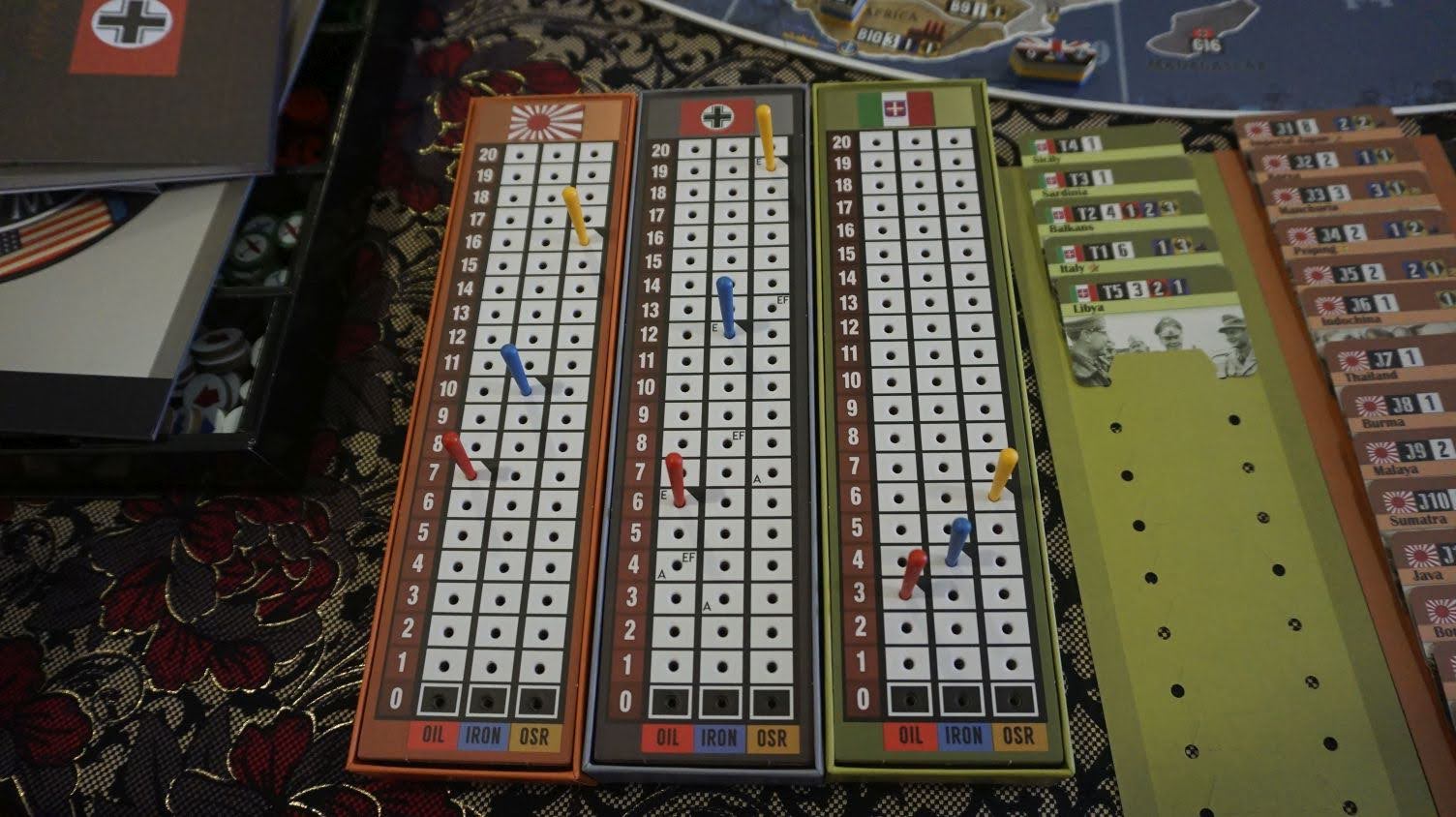
Every country has a tracker for resources. Red is oil, blue is iron and yellow is stuff. There is a territory card for every land territory on the board, which indicates resources produced. You need to align your territory cards this way so that you can see easily how many of each resource you produce in total.
Information on the territory cards include the serial number (black background), the strategic value (white background) and the production value of the three resource types. The strategic value affects stress and stability. Losing territories with strategic value causes stress.
When you capture an enemy territory, claim the corresponding territory card from your opponent. E.g. here Japan has conquered a Soviet territory.
In War Room battles are only fought for one round, as opposed to as many rounds as the attacker wishes in Axis & Allies. If both sides still survive after a battle round, that battle would continue in the next game round, and the territory would remain in an embattled state. The territory owner uses the embattled side of the territory card, which has lower resource production. See that card with a red and white border.
There are only 9 unit types in the game. You have bombers and fighters in the air. You have tanks, artillery and infantry on land. You have battleships, aircraft carriers, cruisers and submarines at sea.
Battle resolution is done using a battle board like this. Both combatants place all their units on the board. Axis on the left and Allies on the right. There is no different strengths based on whether you are attacking or defending. Instead, you can pick stances for some troop types. The stance you pick affects the abilities of the units. E.g. a cruiser in a defensive stance fights more effectively against air units and can take hits for other capital ships.
Battles are conducted in two stages - air then surface. During the air stage, only planes can be damaged. Surviving planes then participate in the surface battle. Different unit types have different strengths against air and surface units. Strength is defined as the number of dice you get to roll.
The dice are 12-sided. The sides include black, white, red, yellow, blue and green, and the distribution is not even. Yellow appears the most. The colour you roll determines the unit type you hit. This is of course subject to the presence of that unit type. If there is no such unit type, your hit is wasted. Normally a unit is only damaged upon the first hit, and is destroyed on the second hit. White die rolls can be applied to damaged units. Black die rolls are jokers and can be treated as any colour.
One side of the battle board is for sea battles, and the other side is for land battles. This photo above shows the start of a battle. You get to roll at most 30 dice. If your strength is above 30, the surplus is wasted.
This is the aftermath of the same battle. The units pushed to the edges are dead units. They are not removed immediately because you need to keep records of your casualties.
This is the morale board. This is where you place casualties from battles. At the end of the game round, your casualties determine the stress your country takes, which may in turn worsen your political stability. Different countries have different stress tolerances. Japan has a high tolerance and only worsens its stability at 7 stress. USA already worsens at 5 stress.
The standard victory condition is to capture two enemy capitals. For the Axis this normally means Moscow and London (Washington is rather unrealistic). For the Allies it's Tokyo and Berlin. I think it would usually be unnecessary to get to this point. Well before the fall of two capitals, the imbalance in strength would have been obvious. The losing side should just surrender rather than stretch the game on when the outcome is inevitable.
There is another way of ending the game which I quite like. You play a set number of rounds, and then compare scores based on political stability. Political stability is actually a good measure of how well each country is doing.
The Play
I did a 2-player game with Allen. We were both new to the game. We had played Axis & Allies before, but War Room differs in many ways. We needed to relearn most of the systems. I was in charge of reading rules and teaching. Although it was just the two of us, I suggested to go for the full global game, because I wanted to experience the game in full. I knew we likely wouldn't finish the game, despite allocating almost a full day for it. We played from about 10am to 6pm. I had hoped to play about 6 rounds and then determine victory by comparing country stability. In the end we only managed to complete 2 rounds. It isn't as big a gap as it sounds, because the first two rounds in the game tend to be long with many hotspots to resolve. As the dust settles after the initial flurry of activities, the situation becomes cleaner and simpler. I certainly didn't regret having experienced the full worldwide war.
I asked Allen to play the Axis. I think the Axis being the aggressors is more fun to play. The point in history at the start of War Room is already after Pearl Harbour (unlike in Axis & Allies). The Americans and the Japanese are already fighting in Guadalcanal.
China (yellow with red star) has only land armies. No aircraft and no ships.
The Solomon Islands are already embattled at the start of the game, thus the embattled marker.
Naval battles in the Pacific were intense, involving the Japanese, the Americans and the British. There are no transport ships in War Room. The mechanism for transport ships is streamlined and abstracted. Land units are allowed to enter sea zones, and when they do, they are considered to be loaded onto transports. They become defenseless and need to be protected by friendly naval units.
The British (me) decided to produce troops in India and coordinate with China (also me) to fight the Japanese (Allen). That stack of units under the red factory token are under production. When you buy (i.e. start producing) units, you need to wait for a full game round before you can deploy them. In case the territory producing these units gets captured, you lose your units to the invader.
I like the simultaneous and secret movement planning in War Room. It creates a double guessing game. It offers opportunities for smart play for the weaker parties. In Axis & Allies players take turns moving units and resolving the resulting battles. Movement orders are absolute. You can't run and you can't hide. In War Room there are opportunities for weaker parties to avoid battle or to attack where the opponent least expects it. This makes movement interesting and less predictable. It opens up more possibilities. There is a cost though. The whole process takes more time.
On the left, the Americans (me) unexpectedly took control of the Solomon Islands. The islands were embattled right from the start. However both Japan (Allen) and USA (me) had few troops, so it wouldn't be easy for either party to kill off the other. We didn't have many dice to roll. I imagine this as both of us being lost in deep jungle and shooting randomly under low visibility. However the Americans got lucky and scored enough hits to kill off the Japanese soldiers.
China (me) inadvertently took advantage of the Japanese (Allen). In our first round, Allen mistook the Chinese troops as Japanese troops, and issued commands to them. Imagine the confusion of both the Chinese soldiers and the Japanese generals shouting orders at them, in Japanese some more. Naturally, all his orders were wasted and he didn't manage to get anything done in China in the first round. As China, I tried guerilla warfare, trying to focus the units I had on Japanese weak points and where he wouldn't expect an attack. The secret order mechanism in War Room allowed me to do this.
I headed south and managed to capture Vietnam (photo above). The Japanese had to send reinforcements from Malaya to Thailand to fight with me. Peiping (north east of China) is an important territory for China which is already under Japanese control when the game starts. It is the only Chinese factory on the map and China needs to recapture that in order to be able to produce artillery and tanks. Without it, China can only produce infantry.
One crippling weakness of China is it cannot bid for turn order. As long as Japan is willing to spend one oil, it can guarantee an earlier turn order than China. If Japan doesn't want to spend even one oil, then the turn order is left to chance. If Japan is determined to exterminate China, there is not much China can do to stop it. It is just a matter of how long China can last, buying time for its allies.
The Solomon Islands were captured by USA (me), thus the USA token placed on it. The Solomon Islands had strategic value (number on white background), so Japan received stress from losing the territory.
Fighting broke out all over China. My Chinese solders got cocky and strutted about like they owned the place, just because of Allen's wrong footing in Round 1. I caught Allen off guard and managed to take down Peiping. That allowed me to steal his units under development, which was a huge bonus for China. Japan (Allen) headed north to attack the Soviets (me), which surprised me. There was a Russo-Japanese treaty, the breaking of which entailed a heavy stress penalty. I think Allen forgot about it. I hadn't expected him to attack. Japan's diversion into Soviet territory was what allowed China to be more daring.
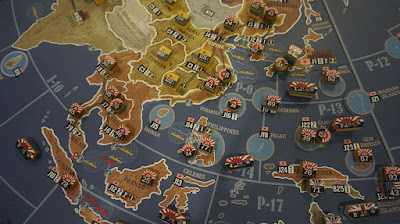
At the bottom right a huge naval force had assembled. A huge sea battle was imminent. The British had captured Burma. More troops would be supplied from India to reinforce Burma and the British push against the Japanese Empire.
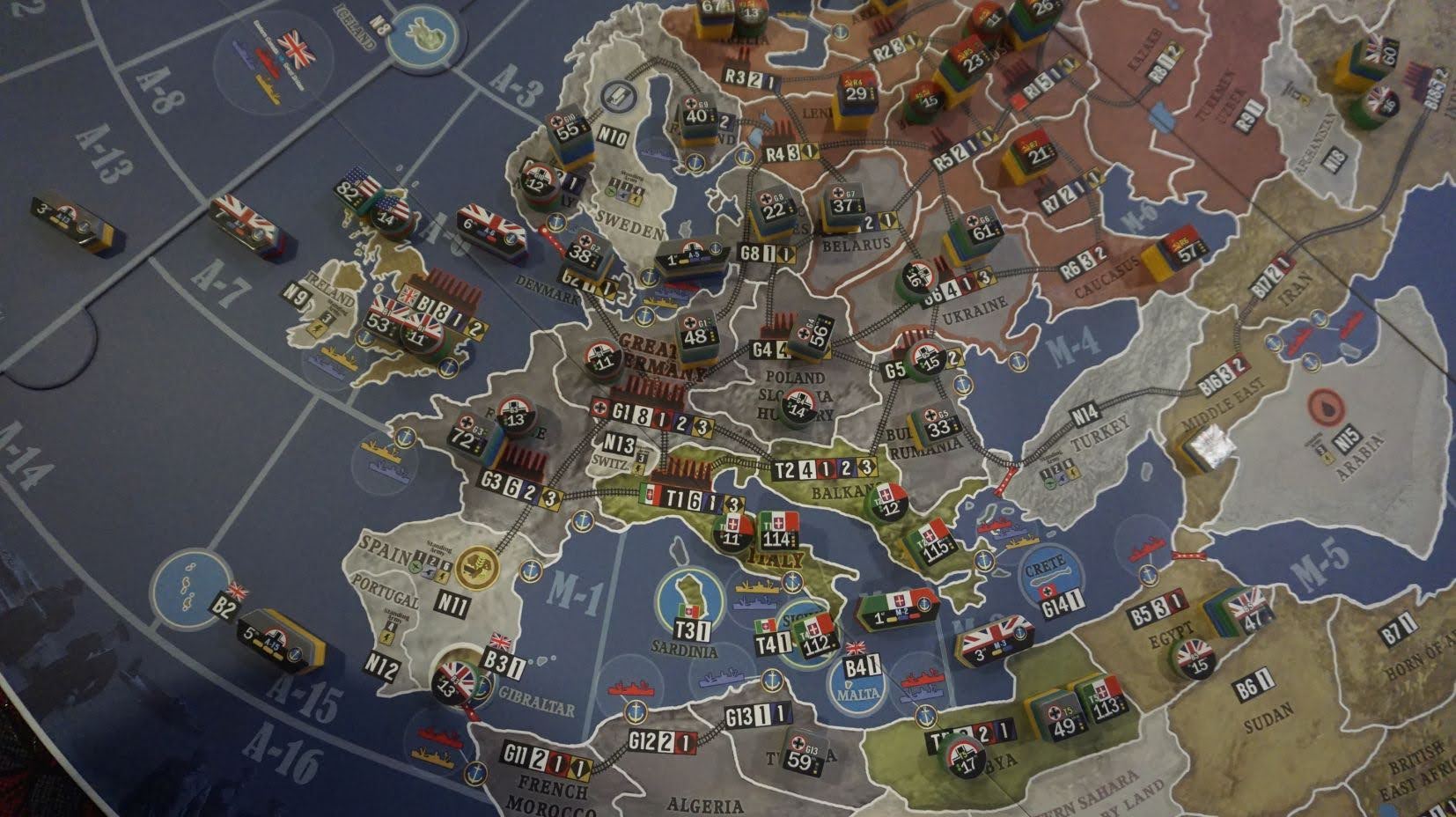
In Europe, Germany (Allen) was a juggernaut. Compared to them, the British and American land forces (me) were paltry. Invading the European continent looked impossible. The Allies would need a lot of patience and discipline to plan and coordinate an effective Normandy Invasion. There are railroad tracks in War Room, which allows troops to be transported quickly to the front lines (compared to Axis & Allies). However train tracks can be damaged by strategic bombing. This is an aspect to consider.
In the Mediterranean, Italy (Allen) started off stronger than the British (me). The British had troops in Egypt and the Middle East, but their production centres were far away, in India and in South Africa. Replenishing troops was going to be difficult.
Italy and Germany didn't do well in their attempt to take Egypt. The British lost many units too, but managed to hold on. However the Italian navy dominated the Mediterranean Sea now.
The Axis powers - Japan, Germany and Italy.
On the eastern front both Germany and the Soviet Union started with tons of land troops. It was going to be bloody and brutal.
Turn order can be crucial. It can determine whether the orders you want to execute can be executed at all.
This was our Ukraine War in the game. Italy came to help Germany. A command stack has at most 8 units, so when the scale of the battle is more than 8 units, you need 2 or more command stacks. Air units are separate stacks from land units so if you want combined arms you need even more command stacks.
The Soviets (me) were aggressive and took the fighting to Germany. I left many of my territories behind the front lines ungarrisoned.
The Americans (me) couldn't do much at the start of the game. They were far away and didn't have many units yet. However they had a large production capacity. Playing USA was all about planning and building up a pipeline to supply troops to the front lines, to help its allies before it was too late.
War Room has one similar problem as Axis & Allies - for USA to build troops and ship them across the Atlantic or the Pacific to the front lines takes too long! I call this a problem, but perhaps this should be called a feature instead of a problem. Expect a long lead time for American troops to reach the action. That means you have to do planning far ahead.
As America, I decided to put more effort into the European theatre, thus the concentration of troops on the eastern seaboard of USA in the photo above. For American units to cross the Atlantic and get to UK it takes 3 rounds. We played a whole day and only completed 2 rounds. I guess once the pipeline of units was set up from USA to Europe this would no longer be an issue. I just needed some patience.
Similar to Axis & Allies, War Room is at its core an economic game. When you have a higher production capacity, you will have more units and in the long run you will overwhelm your opponents. You need to take the long-term view. What new units will you buy? How are you deploying them? How do you steadily secure a stronger economic base than your opponents?
Japan was first to have its political stability drop, mainly because it broke the treaty with the Soviet Union. We placed the conflict tokens (explosions) and flight tokens (arrows) at the centre because they were used frequently.
Two game rounds taking a full day sounds scary. It was partly because we were new to the systems. Also one big factor was we did this 2-player. The game speeds up with more players, because everyone can do movement planning at the same time. Allen and I had to do this one country at a time. Thus we needed at least triple the time, and suffered some split personality disorder.
There were some features we hadn't explored, e.g. bombing factories and railroads, trading with neutral countries, attacking convoys and invading neutral countries. The game was large and complex, and the core rules already took a fair bit of effort to digest. We didn't want to get into the minor and secondary game mechanisms. Allen (as Germany) almost invaded Spain, but there was an error with the orders so the invasion was delayed.
Having played the first two rounds, I felt the units being produced were far from enough to replenish what was lost. I imagine the countries would become more and more frugal as the war wore on. As the Soviet Union I was aggressive in counter-attacking the Germans, but after two rounds I realised my attrition was too high and my position was probably not sustainable. The Germans still had many units they could transport to the eastern front. The Americans and the British were nowhere near ready to put pressure on the western front.
The Thoughts
War Room is certainly a gamer's game. It's the kind of ceremonial game which you allocate a full day for. It is difficult for me to not compare it against Axis & Allies. Same designer, same historical background, same granularity. War Room is more complex. Many mechanisms differ. They may feel similar in many ways, but they are quite different in execution. One analogy is the various Batman movies by different directors.
If you are not into Axis & Allies and similar games, War Room will not be your thing. It is still a heavy game based on World War 2. It is medium-light compared to the typical serious wargame, but compared to the average Eurogame it is pretty heavy and complex.
I like the secret orders. It allows interesting tactics and it is a challenge for the combatants. There is uncertainty and psychological play. I like the concepts of stress and political stability. In war, we are not machines which fight to the death. We are human beings of flesh and blood which fight till our spirits are broken. I like the battle resolution mechanism. It is logical yet at the same time can produce unexpected results. You know good positioning and combined arms will help you, but sometimes you can still get unusually lucky or unlucky. That's war.
I don't like the three different resources in the game. It adds some complexity but I don't find it much more fun. Perhaps I haven't played enough to better appreciate it.
Is War Room an advanced version of Axis & Allies? I would argue they are different games. A more complex game is not necessarily an improved or better game. I see these two games as different ways World War 2 is being presented. Yes, they are from the same designer, but they are independent games.
War Room is that kind of game that you schedule once a year to play with a group of close buddies. Something commemorative and anticipated. I know this sounds weak. Only once in a year?! Gotta pump up those numbers, rookie!