Showing posts with label fantasy. Show all posts

Thursday, 27 November 2025

Stonespine Architects

Stonespine Architects is a game about building your own dungeon. It is a drafting game. You start a round with a selection of tiles. You pick one to add to your dungeon, and pass the rest to your neighbour. You receive tiles from your other neighbour to choose your next tile. 

Your dungeon is a 4x4 grid and you build it row by row over four rounds. Tiles have various features and they help you score points. Every tile has a pathway. Ideally you want all your tiles to be connected. Along the top edge of your player board you have your dungeon entrance. Along the bottom you have your exit. You want your entrance and exit to be connected to as many tiles as possible, and to each other as well. This is basic for any architect, but in this game this is not easy to do. 


Tiles you pick have different gold values. You collect this gold, and at the end of each round you can spend it to buy features from the market (top right corner in the screenshot above). This is not done in turn order. It is always the richest person who buys next, until everyone passes. You buy stuff from a common pool, so if there is something you desperately need, you’d better try to be rich. When you eventually pass, you get to pick a scoring condition card which will be evaluated at game end (those challenge cards along the top in the screenshot above). You will score points if your dungeon fulfils the condition on the card.


Everyone has a blueprint (top right in the screenshot above). Think of it as the user requirements. This can be in the form of specific features at specific positions of your dungeon, or the tile type at specific positions (earth or stone). The more requirements you fulfil at game end, the more points you will score for your blueprint. This gives you some direction when you choose tiles. You can also buy features to help you with the blueprint. 

I am very close to connecting my entrance and exit

The theme might be fantasy and dungeons and monsters, but this is very much a Euro-style tile-laying game. You are always puzzling out how best to build your dungeon, to fulfil the various scoring conditions. You are torn in different directions and it's rare to find that perfect tile. You often need to prioritise. Pick the tile type which fulfils your blueprint, but its pathway may suck. Pick the tile with the goblin which will fulfil a challenge card, but its gold value may be low, or the tile itself  may even come with a point penalty. 

You should watch your opponents. You can see their blueprints so you know what tiles they want. You can also see the challenge cards they have picked. You should deny them tiles which help them. The same principle applies when buying features. So there is some player interaction, although it's not direct. 

Sunday, 23 November 2025

Duo Quest


Rizal's 1+1 Studio is a computer game development studio. Developing a computer game is a long project, and while his team is working on their first game title, they went on a side quest and turned it into a physical board game. That was how Duo Quest was born. Rizal joined our ranks of local Malaysian indie game publishers this year, and has been going to many of the same fairs and events as us. Duo Quest always does well, and his table is always one of the most happening. He has explained the game to me before, but I never had the chance to sit down to play, because I was busy with my own booth. Only when we went to the Thailand Board Game Show together that I had a chance to try the game myself. Neither of us spoke Thai and we had to depend on our local assistants to teach our games. Because of that we had more free time. 


Duo Quest is a cooperative game. Despite the fantasy theme, this is actually a party game. The box says two players, but it works well with three or four. This is a game which tests how well you know your friends. Or it can be a game that helps new friends get to know one another better. Quickly, and with some depth. 

Since this is fantasy, you will have to fight a monster. The monster has life points, and so does your team. The goal is to defeat the enemy by reducing its life points to zero. Every round you take the top card from the monster deck to place in the active area. This will be the monster's action for the round. You also take cards from the player deck. These are your possible options. The active player picks two cards, reads them, and decides which action to attempt. You can tell the action type and card value from the card back, but you don't know the question on the front. The higher the card value, the harder the question. 


To be able to execute the selected action, everyone must be able to write down the same answer (of course, without any discussion). The question is posed to the active player, and he must answer it by writing it down and not showing anyone. The other players must then guess what that answer is, simultaneously writing down their answers. If everyone guesses correctly, this action will be executed. However, if anyone gets it wrong, then this action will become the monster's action. Things can go south very quickly. You might be planning to deal the killing blow, but if you fail to execute the action, the monster will hit you hard instead. 

The game system has a basic card deck and many themed decks. Questions in the basic deck are more general, for example, are you an introvert or extrovert? Which is more important, art or science? Do you like children? The themed decks will have more specific questions, for example about love and relationships. There is even one deck which requires some physical exertion. All these questions will test how well you know your friends. If it is a new friend, the game reveals how you perceive them. 


After the players have chosen their actions, it is the monster's turn to pose a question. If everyone is able to write down the same answer to the monster's question, its action strength is reduced. Getting this right can be crucial. After all questions have been dealt with, you execute all the actions. Defences block part or all of the attacks. Anything which gets through deals damage. Potions heal. I only tried the basic game. In the more advanced decks there are other card powers and the advanced monsters have more fanciful abilities too. 


Now I can appreciate why Duo Quest triggers so much laughter. This game sparks much discussion. It gives you that feeling of "so you're that kind of person".  This is a simple game which non-gamers can easily get into and enjoy. I find this is a great game for chasing girls (or boys) too! 

Tuesday, 28 January 2025

Dungeon Roll


The Game

Dungeon Roll is fantasy dungeon crawling designed as a dice game. You play three rounds, in which everyone takes a turn to explore and plunder a dungeon. After three rounds, you compare points to see who wins. 


White dice are the player dice. They represent the party of adventurers you explore the dungeon with. Black dice are the dungeon dice. They represent the monsters and also the treasures you encounter. Most faces of a white die are different adventurer types, like fighter, cleric and thief. They have different abilities. They are used to defeat black dice. Treasures and potions on the black dice need to be "defeated" too. You need to spend white dice to open treasures and to quaff potions. However you do get something in return. 

Exploring a dungeon means fighting through it level by level until you are defeated or decide to retreat. There are 10 levels, and every level is harder than the previous one. You only roll one black die for the first level, two for the second level, three for the third, and so on. Every time you clear one level, you have to decide whether to retreat and keep the score you have so far, or to attempt the next level and hope to score more. In case you fail to fight through a level you are attempting, you won't score points for the whole adventure. The next level will have more black dice. You will gradually use up your white dice. Some abilities let you restore some of them. At the moment I can't imagine how you can get to Level 10. By around Level 5 it already feels like the max. Maybe I need to learn to play better. 

The different types of adventurer have different abilities. By default they can always defeat one monster. However they specialise in certain monster types. E.g. a single cleric can defeat any number of skeletons. So if you roll many skeletons, and you have one cleric, you're in luck! 

When you use white dice to open treasure chests, you get all sorts of treasures and equipment. A thief can open any number of chests. Some items behave like a specific adventurer type. You keep them for future use. Some items have point values. Potions you quaff let you restore white dice. One of the black die faces is the dragon. Rolling a dragon means you are starting to disturb it. Dragon die faces are set aside. Once you reach three dragons, you wake the dragon and must fight it in order to complete the current level. Defeating the dragon requires three different adventurer types, so it's not easy. If you manage it, you score points and gain a treasure. 

Scrolls, which appear on white dice, let you reroll. Sometimes this can be a life saver. Sometimes it makes things worse. 


Every player gets a character card. You have one ongoing ability, and one once-per-excursion ability. When you reach a certain experience level (which is also your victory points), your character upgrades and both your abilities change. 

The Play

This is mostly a solo game. Only one player is actually playing at any one time. The others spectate. The only player interaction is thinking about well your opponents are doing and deciding how much risk you want to take in order to catch up to them or stay ahead of them. Rolling dice is exciting. There's an element of surprise and uncertainty. The game is tactical in nature. You do your best with what you roll. Overall it's pretty straight-forward. Still, the dungeon crawling theme comes out pretty well. You do feel like you're fighting your way through monsters and traps. The fact that you need to roll dice makes the experience one of risk-taking. 

The character card being tilted 90 degrees means you've used your single-use power.

The Thoughts

Dungeon Roll is a light and brisk dice game, and it's flavourful as a fantasy adventure game despite the simplicity. 

Friday, 13 September 2024

Elemana Chronicles


The Game

Elemana Chronicles is a fantasy themed tactical battle game from local game designer Darius Tan. This is a squad level battle arena game that draws inspiration from online battle arena games like Mobile Legends. It is a 2-player-only game. Each player controls a team of three fighters - one hero and two monsters. There is a mana pool on the board which players try to dominate to score points. You also score points by killing an enemy character. Killed characters respawn and come back to life next round. The game is played over 6 rounds. You win if you have more points by the end of the 6th round. 


There are several factions in the game, each with its own characteristics. Your team must be made up of characters from the same faction. Your hero is usually smaller in size compared to your monsters. 


The miniatures are quite detailed. This is one of the selling points of the game. The miniatures look fantastic. They are all 3D printed. 

This fighter is good at fire related magic and attacks. 

This miniature has been painted

During a round, players take turns activating one of their fighters. Every fighter has some action points, which are spent to perform various actions. Fighters have various characteristics, e.g. movement range, attack strength, armour strength. The common actions a fighter can perform include moving, attacking and casting spells. Attacks can be melee or ranged. You need to use tape measure when moving and attacking. You have to adhere to attack and movement ranges.  

You have to buy your own tape measures

Battles feel, for the lack of a better word, "physical". In that what's physically on the table matters a lot. You use a tape measure to check distance, for both movement range and attack range. You need to physically check line of sight to see whether someone you are trying to shoot is blocked from view. When you need to move, if there's someone physically blocking your way, you have to detour. The white circle on the board is the mana pool. At the end of a round, if you have a fighter next to it and your opponent doesn't, you will control the mana pool and score points. If both players have fighter next to it, then no one controls the mana pool and no one scores points. The mana pool basically forces you to get near each other and to fight. It is not easy to score points so you don't want to allow your opponent any easy points. 


You roll dice for both attack and defense. A successful roll is normally whether you roll a particular number or lower. If the attacker makes more successful rolls than the defender, he inflicts damage on the defender. Every fighter has a health bar. If it gets reduced to zero, the fighter dies (and will respawn next round). 

The health bars of your three fighters.

Every fighter has a character chart which lists its stats, abilities and possible actions. They can cast spells. Some powerful spells are limited to a single use per game. 

There are two types of mana in the game, and they can be used in different ways, e.g. making rerolls for your dice. One type of mana gets recharged every round, so you will usually try to use it all before the end of a round. It will get refilled anyway. It is a matter of how you want to use it. The other type needs to be used more carefully, because you may want to leave some for future rounds. Mana is stored at player level and not fighter level. Your three fighters share the same mana. 


You can upgrade your fighters, increasing their stats and abilities. You also collect gold to buy equipment. These are done between rounds. 


This is an NPC (non-player character). I think of them as monsters, as opposed to my hero's sidekicks being called monsters (what kind of boss calls his assistants monsters?). These NPC's get activated after all the players' fighters have been activated. They will move towards and attack the nearest fighter. So generally you want to stay away from them, or kill them swiftly before they start attacking you. But then there are other complications - e.g. your opponent. 

The Play

This is a miniature wargame, so the simulation level is high. The precise positions of the fighters are important. They affect line of sight, attack range, blocking and movement range. You have to juggle all these details as you play. Because of that, it feels real and immersive. You can imagine yourself on the battlefield. Whatever you can do in real life, you probably will be able to do in the game as well. Or at least something equivalent. For example, when I played, I had a general strategy of getting all three of my fighters to focus their attacks on one particular enemy fighter. The idea was this was the most efficient way to kill one enemy. Once that was done, my opponent will lose one third of his power. But soon I realised this was a rather simplistic strategy. My opponent could tell what I was trying to do, and he simply used a tough warrior type to block and engage some of my fighters. If I ignored that tough warrior completely, it would keep pounding my fighter. I might end up losing a fighter even faster! 

This rock golem was one tough nut to crack. 

Each fighter has its unique characteristics. Within each faction, there are synergies you can make use of. To play well you must discover and understand them. You need to understand your fighters well to make good use of their abilities. 


My tall guy fighter (left) wanted to rush Darius' petite hero (middle), but the rest of my team couldn't catch up. Darius had a monster-class fighter (right) nearby protecting his hero. 


Fighting is resolved using die rolls, so there will be some luck. However the game is still primary about tactics. You must use your fighters and their abilities well. Dice will be rolled many times, and each time multiple dice will be rolled. The luck evens out. Sometimes you'll be luckier, sometimes otherwise. Ultimately you still need to make the right moves to be victorious. Luck won't save you if you play poorly. 

Three-headed dog and rider. 

This guy looks hangry. 

The Thoughts

Elemana Chronicles is a miniature game. It is a tactical battle game like Warhammer. Many aspects of fighting are simulated in detail, so it feels realistic. At the same time this level of detailed simulation also means more work for the players. It can be a little tedious. This is unlike boardgame type tactical battle games, where many aspects are abstracted and simplified. In Elemana Chronicles, the battlefield is not abstracted to a chessboard grid or a hex map. Every millimeter on the map counts. 

The game concept is similar to online battle arena games (MOBA games) like Mobile Legends. You have two competing teams fighting. If you get killed, you respawn. The factions and the individual fighters have their own characteristics which you need to understand well to play well. Now I must admit that squad level battle games are not really my thing, regardless of the boardgame type or the miniature game type. Nevertheless, it was an interesting experience for me to try a genre I don't usually play. 

Darius and I have chatted several times about tabletop games and the tabletop game industry in Malaysia. Making and selling a miniature wargame in Malaysia is difficult. In fact, making and selling casual boardgames and card games in Malaysia is already difficult. Most Malaysian do not know boardgames other than a handful of mass market games. So miniature wargames are a niche within a niche. Elemana Chronicles is aiming to go overseas eventually. If you are interested to give it a go, contact Magick & Drumstick Games

Friday, 19 April 2024

Gloomhaven: Jaws of the Lion


The Game

Gloomhaven was once the #1 game on BoardGameGeek.comGloomhaven: Jaws of the Lion is a standalone game set in the same universe and not an expansion. It uses similar mechanisms and is slightly simplified. It is currently ranked #9 on BGG, which is amazing. Whether Gloomhaven and Jaws of the Lion should be ranked so high is debatable. They are legacy games, which means to truly experience it, you need to be committed to play through the whole campaign. Players who are willing to make that kind of commitment are probably big fans of the genre. They are already inclined to like the games. Those who are not very interested will not likely buy or try the game. So legacy games naturally filter out players who may not rate them high. This is how they have some advantage over non-legacy games in the BGG rankings. The Pandemic Legacy games which I like have this advantage too. 

Jaws of the Lion is a fantasy-themed roleplaying tactical battle game. This type is not really my cup of tea, but given the opportunity to try this popular game, I was happy to give it a go. The game is scenario based. One game is playing a specific scenario in the scenario book. Every scenario has its own map setup and objectives. The game comes with 25 scenarios. That's not as many as Gloomhaven, but if you manage to get 25 plays out of a game, it's great value for money. 


I picked this character to play - the bomb guy. There are four characters to pick from. Every character has its own deck of cards. Your actions in the game are all driven by your deck. At the start of a game, you hold all your cards in hand. Every turn you play two cards to perform actions. Each card has two halves. You must use the upper half power of one card, and the lower half power of the other. As you play, you will eventually run out of cards. You will then need to perform a reset to take your played cards back into your hand. As you do this, you randomly lose one card. You go through this cycle multiple times and you will have fewer and fewer cards. You must complete the mission before you run out of cards. This is the time pressure you have to face. 

This is a cooperative game, so you are working together with your fellow players to complete the mission. As you gain experience and money, you upgrade yourself and buy equipment. These are the legacy elements of the game. 


The tutorial (learning scenarios) in Jaws of the Lion are well done. You don't need to read through the whole rulebook to start playing. You just follow the tutorial booklet. There are five tutorial scenarios, and they introduce rules to you bit by bit. By the end of the 5th scenario, you will know the full rules. The first two scenarios are a little simple, but from the third one onwards this very much feels like the full game. Map setup is easy, because the maps are already printed in the booklet (see photo above). You don't need to assemble scenario maps using multiple game pieces. You still need to place some monsters and treasures, but overall it's not much work. 


The cards are the core of the game. At the centre you see an initiative number. Of the two cards you play on your turn, the one with the lower number determines your initiative. Lower means you go earlier. The monsters have initiative values too. If theirs are lower, they will move and attack before you do. On this card above, the two tiny numbers on the left, at the corners of the upper and lower sections, are the basic actions. You may choose to forgo the main actions for these instead. The basic actions are moving two steps and melee attacking at strength 2.  


This is an event card. These cards have story elements. You read the passage, then decide what you want to do. The outcome can be good or bad, and is only revealed after you make your decision. These events are mostly random and generic. You draw them from a deck after all. 

One of the four characters you can play.


There are different types of monsters, and within each type there are different levels. The yellow and white bases represent monsters at different levels. 


This game component is used to keep track of monsters in play. It shows the health points, movement range and attack strength. The six sections on the sleeve are used to track injury dealt to up to six monsters of this type. Slot number 4 has two round tokens, which means monster #4 on the board has been dealt 2 damage. 


These two are equipment cards. You spend money to buy equipment. Any leftover money can be kept for future games. This is part of the legacy element of Jaws of the Lion. Some equipment are worn, e.g. the boots. You can't wear two pairs of boots at the same time. You can't carry too many weapons at any one time, since you only have one pair of hands. 


This little board is used to keep track of elements in the game. Elements are a kind of magic force. There are six types of elements. Some actions you take generate specific elements. You shift the marker for that element to the rightmost position, signifying that this element type is available. Certain actions when taken with the presence of specific elements become stronger. At the end of every round, the element markers shift one step left, representing the elements waning. Eventually the markers will return to the leftmost position, which means the corresponding elements are no longer active. Characters can generate elements for themselves and for one another. This is one way you cooperate and boost one another's abilities. 

The Play

The learning scenarios in Jaws of the Lion are very well structured. I could start playing very quickly. Although the first two scenarios were short and simple, the experience of learning the game was smooth and easy. Now I am not a particular fan of fantasy roleplaying battle games. Jaws of the Lion doesn't feel particularly different. To me, it is mostly just another one of this type of game. The core mechanism of managing your cards is interesting. This is a little different from other games of this type that I have played. You don't roll dice. Sometimes you draw from card decks. There is still some luck. However you can plan out many steps in detail. Much of the game is deterministic, like how the monsters behave and the effects of your actions. You can plan meticulously. Completing a mission is like solving a complicated puzzle. It is planning a long sequence of actions, taking into account how the monsters will react to your actions.  

Allen and I ganging up on a monster

Some maps have treasure chests

These acolytes in red are a pain

Water snakes

The golem is slow, but incredibly strong


For some scenarios, the booklet is not big enough for building the entire map, so a supplementary booklet is used (see the lower part of this photo). 

This time it is he hero being surrounded by monsters

The Thoughts

A few years ago when Gloomhaven was still the #1 game on BoardGameGeek, I almost started a campaign with a few other friends. The pandemic was still happening then. We never got around to start our campaign because we were busy with all sorts of different things. Now that I have tried Jaws of the Lion, I consider that item on my to-do list checked. Jaws of the Lion is pleasant but not surprising for me. Take that with a grain of salt, since it is not my type in the first place. The card mechanism is interesting. The scenarios are immersive. I'm not sure yet whether I'll continue. I still have not done tutorial scenario 5. Since I have only played a handful of scenarios, I can't comment on the overall legacy campaign and the story. That should be an important part of the experience. I'll share more if I do continue the campaign. 

Tuesday, 4 April 2023

War of the Ring: The Card Game


The Game

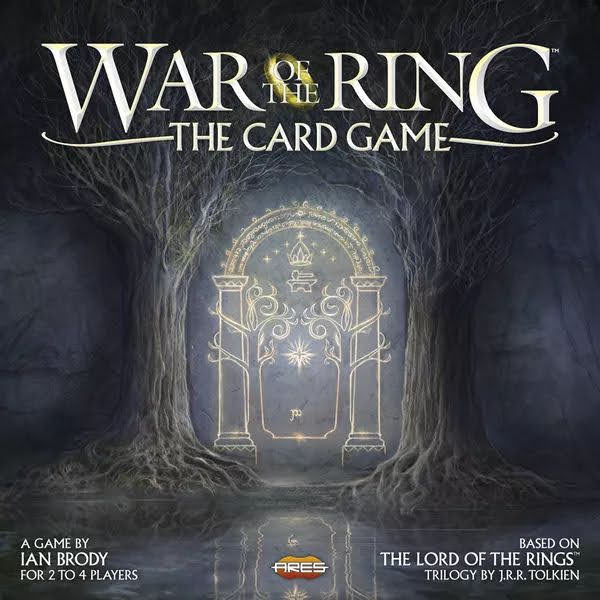
War of the Ring: The Card Game is a complex card game for 2 to 4 players. It presents in game form the story of Lord of the Rings. Although also called War of the Ring, I would say the only similarity to the boardgame version is it is divided into two aspects - the story of the hobbits attempting to destroy the ring and the military campaigns in Middle-Earth. The card game is very different from the boardgame. 

You have two factions in the game, the Free People and the Shadow. Within each faction there are two groups. In a four player game, each player will play one group. Normally all four groups will be in play, even if there are fewer than 4 players, for the sake of completeness of the story. Some players will control two groups. The four groups operate fully independently, having their own draw decks, discard piles and hand cards. 

The game is played over 9 rounds. Every round represents one stage in the story of Lord of the Rings. The Free People and the Shadow compete and score points. By the end of the game, the faction with more points win. During the game, sudden death victory is possible if one faction outscores the other by a large enough margin. 


When setting up a round, normally you have one battleground card and one path card. The battleground is where war is waged. The path represents the story of Frodo and the fellowship of the ring. The Free People and the Shadow play cards next to the battleground card and the path card to achieve superiority. They take turns playing cards until they all pass or run out of cards. They can at most carry over two cards to the next round. When a round ends, the battleground card and the path card are scored by the faction with higher strength. 

This photo above is a little unusual because there are two battleground cards. This happened because of the special power of the first battleground card drawn, which required that an additional card be drawn. 


Aragorn is an important character. Some characters can only be sent to fight battles. Some can only be sent to advance the story in a favourable way. Some can do either. One important element in this game is when characters are sent to do their jobs, they usually die, even if they are successful. Cards are a precious resource. Your deck will gradually thin, and that's something you must manage carefully. 

Cards can be played face-up in a reserve area, ready to be deployed in a future round. Some cards give a bonus when in the reserve area, like Aragorn. You put them in reserve more for this bonus than because you intend to send them out to fight. However they are available in case the situation becomes desperate. Sometimes it's a tough choice whether to deploy such cards. 

Playing a card normally requires another card to be discarded as payment. This payment goes to the discard pile, which means it will be reshuffled and returned to the draw deck when the draw deck is exhausted. If you have a card which you can't utilise well yet, you can use it as payment for another card. Some cards are only fully effective under certain situations or at certain times or locations. Your job is to manage the luck of the draw to utilise your cards to their fullest potential. 

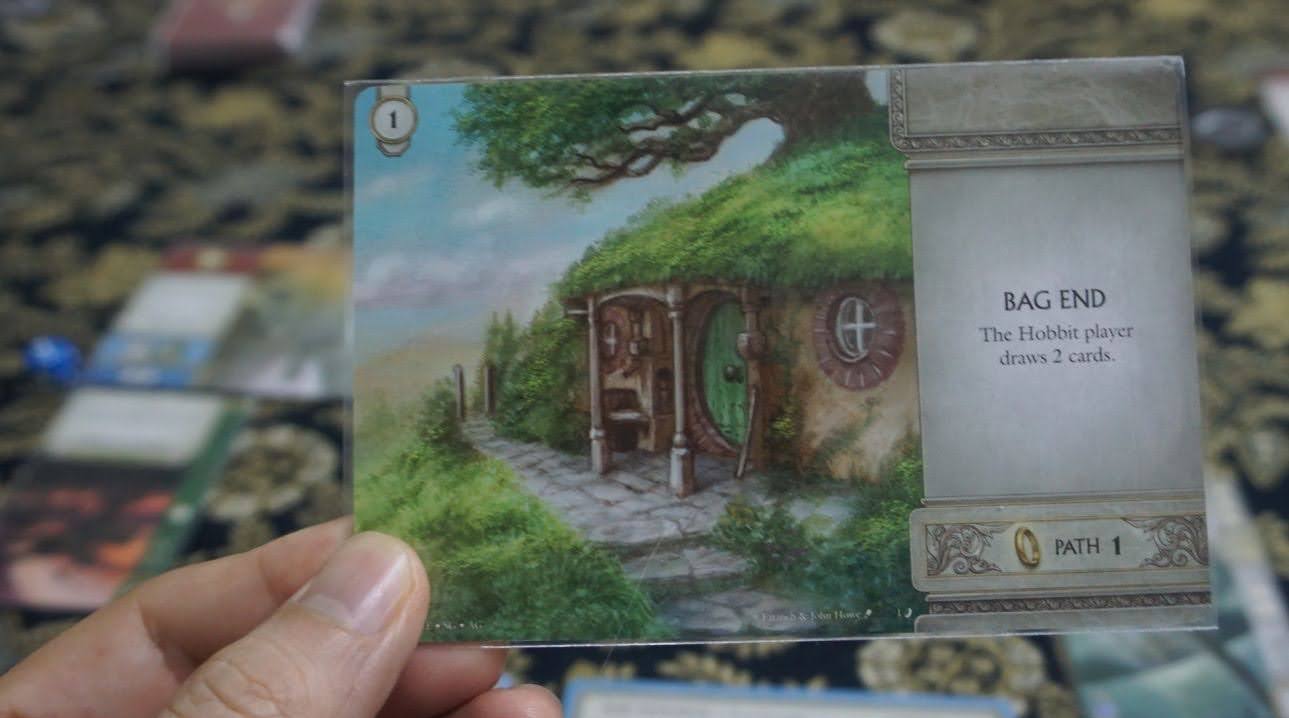
This is one of the path cards. Path cards are numbered at the bottom right. The number at the top left is the victory point value. Characters who can be assigned to path cards have a number range specified. For each number there are three path cards and you will only use one per game. This creates some variability. 

We used dice to keep track of our strengths. In each faction (Free People and Shadow) there are two groups. Each group is further divided into nations, e.g. Rohan, the Hobbits, the Wizards, Isengard, Mordor. Each nation has its own emblem. Battleground cards (left) specify which nations may participate in the battle. You can't just send anyone you want. 


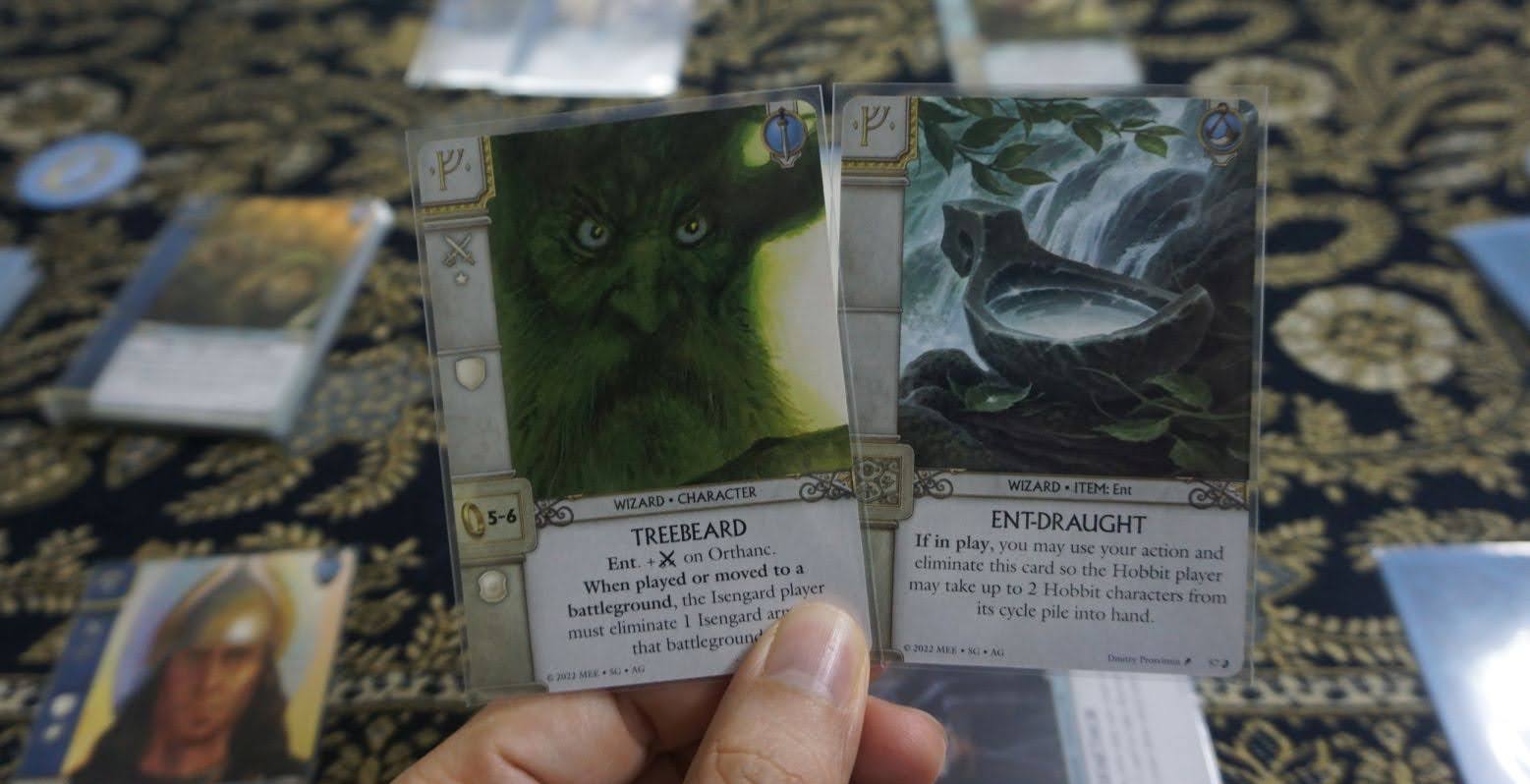
A character card on the left, and a matching item card on the right. Items can only be attached to specified wielders. From the storytelling perspective, this is nice and thematic. From the gameplay perspective, this is an additional challenge for the players. When you do manage to get a character to wield their item, whether it is by sheer luck or by good hand management, it is satisfying. 

The Play

War of the Ring: The Card Game is a highly thematic and story-rich experience. Every card covers some aspect of the Lord of the Rings lore. The core of the game is hand management. How do you make the most of your cards? How do you control the thinning of your deck? How do you decide which cards to use and which to sacrifice? You need to plan ahead and prepare your cards for upcoming battles and stories. You will draw cards at unsuitable times. Your task is to make the best out of the predicament you are put in. 

One key theme that keeps coming up in this game is sacrifice. You regularly sacrifice your cards, removing them permanently from the game. You lose cards in battle, even in the ones that you win. When you get desperate to play your one last card but you no longer have another card in hand to use as payment, you can choose to permanently remove the top card from your deck. It is risky, because it may turn out to be a powerful card. So how desperate are you? The game is full of difficult decisions. 

There is a sense of escalation for each battleground card and path card. Sometimes when both factions commit many cards to the same fight because both are adamant on winning it, it can become a very costly contest. This is also a game of deciding when to fight and when to concede. Resources are scarce. 

It is important to be familiar with your deck. One unique thing about the Hobbits is they don't die easily. Often when they are supposed to be removed from the game, they go to the discard pile instead. They will come back after the next reshuffle. That is nice, and that is something you want to make good use of. Knowing your decks will help you in strategic planning. 

The face-up cards in front of the players are the cards in reserve. I played the Free People and Han the Shadow. You can see I only had two cards in reserve (bottom of photo), while he had a ton (top of photo). We had a huge difference in power. I feel I didn't conserve my resources well. I didn't fully utilise my cards. In the early game I had some lucky wins because Han's card draws were atrocious. However he did better hand management and planning. Moreover, the natural tendency of the game is the Shadow faction becomes more powerful towards late game. In our game eventually I could not keep up and lost by sudden death. 

This was one of my groups. That huge face-up stack on the left are the cards permanently removed. The face-down card is actually my draw deck. The card at the top right the discard pile, and at the bottom right the only card left in reserve. I was running out of cards. I didn't have any more resources to continue fighting. 

The Thoughts

War of the Ring: The Card Game is without a doubt a gamer's game. There is a lot of text and many card powers to digest. The core game mechanism is not too complex, but there is a fair bit of rules to handle. It will take some time to get familiar with the decks. If you like Lord of the Rings, you will enjoy the details you find in the game. 

The game feels a little like a deck-building game, but you are removing cards from your deck, not adding to it. This reminds me of Lincoln from Martin Wallace, but in Lincoln the cards are more generic and have much less text and fewer special rules. The main impression I get from playing War of the Ring: The Card Game is the pain of making sacrifices. You are constantly forced to sacrifice some cards in order to play other cards. The life of every soldier fighting for you is precious. As a general, who are you going to send to their deaths, and for what strategic purpose? How do you make their sacrifices most worthwhile?