Showing posts with label puzzle games. Show all posts

Tuesday, 9 September 2025

Unlock! - Game Adventures


There are two highly successful escape room game series. One is Exit, and the other is Unlock! There are two main differences between these series. Unlock! doesn't require you change or damage any of the game components, which means after you are done with the game, you can give it to a friend. Or if you have very bad memory, you can play it again. The other difference is Unlock! must be played together with a phone app. It is a timer, you can use it to check whether some of your answers are correct, you ask ask for clues, and so on. 


This box of Unlock! - Game Adventures contains three games. They are independent games, set in three different game universes - Ticket To Ride, Mysterium and Pandemic. I have written about how the game system works, so I won't repeat. I'll just share about my experience with these three. 

You don't need to have played the original games to be able to play the Unlock! versions. That's what the rulebook says. However I think it helps a little if you have played the original. It is certainly more fun if you are familiar with the original, because you see so many familiar elements in the puzzle version. The three games in the set go from easy difficulty to hard. I played the games with my two daughters (18 & 20), and we played them in order. Ironically, we didn't do so well in Ticket To Ride, but we did best with Pandemic. I think it is because we had not played the Unlock! series for a while and we were rusty. Having practised our problem-solving skills with the first two games, we did better with the third. 


We only scored three stars in Ticket To Ride. The game comes with a solution handbook, and we sometimes referred to it. When we got really stuck, we had to. We tried using hints from the app first, but when those didn't work either, or they told us what we already knew, we had to go for the handbook. Sometimes we solved problems too far ahead. By piecing together other pieces of information, we skipped ahead and solved a problem which we were not supposed to be able to solve yet. This created a deadlock, because before we got to that point, we should have obtained a few other pieces of information. Now we were stuck because we were missing those pieces, which were needed for solving other problems. 


The first row are some of the cards from Ticket To Ride, and the second row are cards from Mysterium. The art is great and evocative of the original games. This is a big part of the enjoyment. 

App interface of Ticket To Ride

App interface of Mysterium

App interface of Pandemic

The puzzles in Unlock! - Game Adventures are interesting and challenging. The app is used in creative ways, and the game challenges you to think out of the box. Not literally, so don't go destroying the game box please. If you like solving puzzles and riddles, and especially if you like the original boardgames, go for it. This is a great family game too. 

We scored 5 stars in Pandemic

Friday, 18 July 2025

Point of View: Circus Island


This is a microgame. This was given away for free at the 2024 Essen game fair. I should call this a brochure game, because it was given away by a guy walking the halls just like how brochures are given away. It's an advertisement. It's a free sample. Maybe this should be called a sample game. The idea is if you like the sample game, you'll visit the publisher's booth to try other games or buy the main game. 


These are all the game components - that small deck of cards above. Even the "game box" is just a folded card. This is a cooperative game. The key idea is four players are looking at the same scene but from different angles - north, south, east and west. Due to the different perspectives, what they can and cannot see are different, and they have different understandings about the situation they are looking at. The players are given several questions which they must answer together. They each get one card which they have to study and cannot share with others. They can only discuss what they see on their card. The more answers you get right, the higher you score. 


Point of View: Circus Island is just a demo game. The story is about a circus troupe stranded on an island. This photo above shows the perspective of the player to the north of the island. The three other players get different pictures. A question posed to the players may ask them to count a certain item. Some are only seen by only one player and blocked from view from the others. The player who can see it must alert their teammates. Some items might be visible to two or more players. When counting these, you have to be careful not to count them twice. Some questions may ask you about what you think has happened. You will need to look at clues in the pictures to piece together what might have occurred. 

This is a puzzle game and everyone works together to solve it. Everyone must contribute, because you are the only one who can see your picture. The copy I have is in German, so I needed to use my phone to translate while I played. If this sounds interesting to you, go look up their main game. 

Tuesday, 9 July 2024

boardgaming in photos: more Exit games


Around the end of last year I bought four different games in the Exit series at one go. I'm not actually a super big fan of the series, or of puzzle games in general. However my family enjoys games in the series. When my wife Michelle suggested that we get some to play as a family, of course I agreed enthusiastically. I have played quite a few Exit games before. I didn't buy every single game, but I consider myself a veteran. However it had been a while, so I decided to get one easier game among the four to ease us back into playing. Thus this one The Enchanted Forest. Difficulty level is 2 of 5. This one is interesting because it uses many fairy tale elements. 

A typical Exit game is essentially a series of 10 riddles. Many are quite creative. You play in a cooperative manner trying to solve all the riddles in as short a time as possible. In case you get stuck, you can read hints provided. If you still can't solve the riddle, you can look at the solution so that you can move on to the next riddle. This is really a puzzle and not a game. I guess it depends on what you define as a game. 


One common element in Exit games is that round device at the bottom right. Every game has something like this. It is not a riddle. It is a mechanism to help you check whether your answers for the riddles are correct. The solution to every riddle is a three digit number. Every riddle has a shape associated with it. For example, if you want to check whether the answer for the triangle riddle is 375, you need to line up the triangle, 3, 7 and 5 on the round device, then check the number visible through the little window. This sounds a little complicated, but once you play with it, you'll quickly grasp how it works. Anyway, it's not a riddle in itself. It's just a mechanism to facilitate playing the game. 

The other components in the photo are all unique to this particular Exit game. Every Exit game has quite a few unique components needed for its riddles. 

The Enchanted Forest is indeed rather easy. It is too easy for my tastes. Some riddles felt more like following a procedure to calculate the answer. They were clear as daylight. There was nothing to be puzzled about. Thankfully there were some harder riddles. Eventually we had to use some clues too. If you are an experienced Exit player, I'd suggest you skip this one. If you are new, this is a good one to start with. 


It was easy, but we didn't score the full 10 stars. We used the free mobile app for timekeeping, score calculation and background sound effects. 


The Deserted Lighthouse is a little different from other Exit games I have played. It contains jigsaw puzzles. Yeah, there are puzzles in this puzzle. The box is larger. Difficulty level is 4 of 5, so this is a bit more challenging. 


These are the game components. One difference compared to other Exit games is it doesn't come with a deck of cards. Normally the cards are used for checking answers and for reading hints. In The Deserted Lighthouse these aspects are done in a different way. You still have the round device. When you use that to check your answer, you will get a sequence of shapes. If you can find that sequence on one of the booklets, it means your answer is correct. Else, you go back to the drawing board. As for the hints, they are written at the back of the rulebook. You can look them up there if you need help. The slight disadvantage is you need to resist the temptation to read other hints on the same page. Not a big issue though. 

The Deserted Lighthouse is quite tough. It really tests your problem solving ability and creativity. Unfortunately for me, it was also tough in the sense that I didn't fully enjoy the experience. We played in the evening, and as the game went on, we felt tired. When we encountered some of the more difficult riddles, we gave up easily because we didn't have patience to think harder or longer. We went for the hints, and sometimes the answers. Had we played during daytime, it might have been more enjoyable. Another problem I had was related to the colours and the text. I found some colours on the drawings hard to tell apart, and some writing hard to read. Better lighting or playing at daytime might have been better. 


It took us two and a half hours. No wonder we felt drained. I must say the riddles here are creative and interesting. If you like a challenge, this will satisfy that need. Just be prepared if you have poor eyesight, the game will be hard in an additional way. Have your reading glasses ready. Maybe even a magnifying glass. 

Tuesday, 29 March 2022

Escape Team


The Game

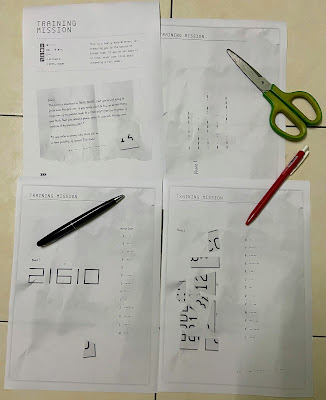
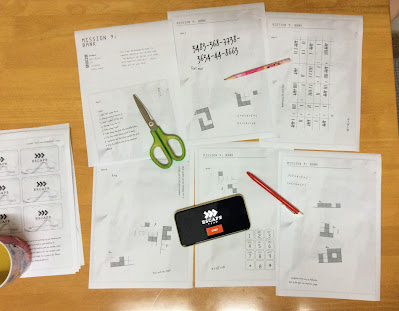
Escape Team is an escape room game, like the Exit and Unlock series. You play it with the support of a mobile phone app. This part is similar to Unlock. What I find interesting about the game is it does not provide any game components. This is a clever publishing model. You download the app. You print out sheets of paper yourself and you prepare your own pens and scissors. 

A game is a series of puzzles which you need to solve within a time limit. The puzzles are all laid out in the printouts. The answer of each puzzle is a 5 digit code which you need to key in to the app to check whether you are correct. The app is also your countdown timer. So far there are 11 missions released. Each mission is one complete game. The easy ones only take 10 minutes. Complex ones go for 40 minutes. Two introductory missions are free. The rest need to be paid for. You can download and print the puzzles, but without unlocking the missions in the app, you won't be able to check your answers or get clues. I find this a very clever business model. There is no need to worry about physical components, warehousing or shipping. Players download the app and prepare their own physical components. 

This is one of the free missions. Just four sheets of paper.

The Play

One thing the app provides is background music. It creates quite a tense atmosphere and I like it. It certainly made me nervous. At certain internals clues are provided. You don't have to read the clues. You will see a notification and it is up to you whether you want to open the clues screen. I only use the clues when I feel truly stuck. When I played with younger daughter Chen Rui, most of the clues were not helpful to us because we had already thought of what those clues suggested. Only one clue truly helped us solve one of the puzzles. Chen Rui complained about the useless clues. I guess another way to look at it is we are clever and don't need those clues which most other people would find helpful. 

The game is recommended for 2 to 4 players. Technically it can be played solo. I did that for the easy missions. However it was a little dull. I didn't have anyone to discuss with or bounce ideas off. Some of the work can be divided, e.g. cutting out pieces of paper. It's just tedious work and having someone being in charge while others continue to work on other aspects is a good thing. The different puzzles within a mission can also be distributed to different players. If someone finds the solution to Puzzle 2 while Puzzle 1 is still being solved, you can write it down to be entered later after you solve Puzzle 1. This certainly helps in completing the missions within the time limit. 

The early missions were rather easy. After trying those I directly skipped to Mission 9, which had the highest difficulty rating. We lost that one. We failed to solve all the puzzles within the time allotted. This time though there were some challenging puzzles. It was more interesting. It had the kind of puzzles which required some creativity and lateral thinking, and not just problems that took time to solve, like piecing jigsaw puzzles together. 

Mission 9

The Thoughts

I am not specifically fond of escape room games or puzzle games. I played many games of Exit only because my wife Michelle suggested to buy more to play as a family. Escape Team is certainly convenient. Some of the puzzles are clever. I didn't like the easier missions, especially those that required a lot of cutting. It felt tedious. I can understand that the free missions are easy so that they are a good introduction to the game. New players get to learn the system. They feel happy when they are successful in completing the mission. I just wonder whether it might have the opposite effect on some players. In my case had I tried only the first two missions, I would not have paid to unlock further missions, because the first two weren't all that interesting to me. The publisher invited me to review the game and gave me access to all the currently available missions. Since I had said yes, I continued playing and picked the hardest difficulty level the third time around. It was certainly better than the easy games. If this sounds interesting, check out the game at https://www.escape-team.com/.

Friday, 26 February 2021

MicroMacro: Crime City


The most succinct way to describe MicroMacro: Crime City is it is an advanced version of Where's Wally / Where's Waldo. The main component is a humungous drawing which is full of details. Although classified as a cooperative game, which can be played solo as well, I consider this a puzzle game instead. The drawing depicts a busy city, with multiple crimes being committed. Gameplay is about solving these crimes by finding clues in the drawing. There are 16 crimes in total for you to solve, and all of them happen in this same huge drawing.


On the box cover you already get a bonus mini crime to solve. This helps potential buyers decide whether it's something they will enjoy. It is a good preview of the play experience. This bonus crime is relatively easy to solve. The answer can be found on the box cover itself. The crime is related to the murder of the burger vendor. 

The box cover is part of the main drawing, and already contains much detail. The burger stall is at the top left.  

When you first open the game, you need to organise the cards by case and put the set of cards for each case into a separate transparent envelope. 


Each case has between 5 to 10 cards. The first card is always an overview of the case. The rest of the cards are questions you need to find answers to. By correctly answering all questions, you will solve the case. A question is posed on the front of a card, and the answer plus further details of the case can be found at the back. When playing the game with two or more players, one person plays the lead investigator. When you are confident with your answer, the lead investigator checks the back of the card to see whether you've got it right. If you are wrong, everyone except the lead investigator needs to continue investigating. The lead investigator already knows the answer, and has to wait until the rest of you find the right answer. Once that's done, you proceed to the next question together. 

There is an advanced rule where you only look at the case overview, and then try to solve the whole case without looking at any of the questions. When you are confident you know all there is to know about the case, you check through all the questions at one go to see whether you have indeed found all the required answers. This is a more challenging mode, and I find it more fun. Once you have played the first few cases and are familiar with how they work in general, you should switch to the advanced rule. Unless you are playing with children. Or players new to the hobby. 


The drawing takes up three quarters of my dining table. You need to lay the whole thing out, and you need good lighting. Don't allow any other game component obstruct any part of the drawing. It contains many small details, and anything obstructing any part of the drawing may just happen to cover a crucial clue you need to solve your case. Playing this game can be tiring to the eyes if you have poor eyesight. For one of the cases I had to use a phone to take a photo then zoom in, in order to see a specific piece of detail.


The art style is simple, cute and clean. Sometimes I get an urge to pinch and stretch part of the drawing, as if I am using a smart phone and will be able to enlarge the drawing. 

The game comes with a microscope, which can be handy - less stressful for the eyes. 

To imagine how big the drawing is, compare the next four photos below. Focus on the guy dressed like Batman in the centre. In each subsequent photo, I zoom out a little to show more of the drawing. 

Here's Mr Batman on a rooftop. 

Now you can see the roads around the building he is on top of. 

Zooming further out, you can see other city blocks. 

Going even further out, you can now see the riverside at the bottom right, and the factory at the bottom left. And this is just one quarter of the drawing. 

When I look at the drawing in the game, it reminds me of a display in a Japanese museum. In the series of photos below, focus on the lady hanging laundry. This will give you a sense of scale. 


The Play

The first time I played, I solved 7 cases in one go, and it took about an hour and a half. I completed the rest of the cases in two more sessions. By around the 6th case I started using the advanced rule. I like it that way - no hand-holding from the step-by-step questions. 

The fun in MicroMacro is in finding and connecting all the clues to form a coherent story. Every case has multiple segments in the drawing, and when you can find them all, you will be able to stitch together all the who, what, where, why and how. Almost all the segments will give you some hint where to find the next segment. Sometimes you work forward, sometimes backward. All in all it is not a difficult game to play. You just need some logical thinking, and the patience to comb the drawing for clues. 

The cases have difficulty ratings from 1 to 5, 5 being the hardest. 

This poor guy was crushed by a piano. What a "grand" way to go. 

The Thoughts

MicroMacro is somewhat like the Unlock and Exit series. You can only play it once. Once you know the solution, you can't unknow it. However you don't destroy or alter any game component, so once you are done with the game, you can give it to a friend. 

The idea is refreshing and novel. That was what made me decide to get a copy. It is fun to see how the various stories are told through drawings. When you manage to find all the relevant segments, you will be able to reconstruct the whole story. Some of the stories are fairly complicated. The game does test your logical thinking. 

I wondered whether this game would work well on a tablet computer, because you'd be able to zoom in and zoom out easily. After some thought, I decided it was better to play with the physical piece of paper spread out on a table top. It just feels more real. I guess I like the grandeur of seeing the drawing spread across the table. Playing the game is like studying details of those gigantic classical paintings in museums. And finding that little boy peeing into someone's soup.  

I recommend playing this on a table and not on the floor. Because back pains. 

Sunday, 14 June 2020

more plays of Exit: The Game

By now I have played 9 games in the Exit: The Game series. I like them well enough, but I'm not a particularly big fan (I know, after 9 games, that doesn't sound convincing). Exit is a good family activity. I played all nine with my wife and children. These three - The Mysterious Museum, The Sinister Mansion and Dead Man on the Orient Express - were bought in Sep 2019. They were unplayed for a rather long time. I only played them in May 2020, all three of them. The COVID-19 Movement Control Order in Malaysia started mid March. I had plenty of opportunities since then to play the games, since everybody was stuck home almost all the time. Maybe the games were out of sight and thus out of mind, so it was only in May that we brought them out to play.


The Mysterious Museum is of difficulty level 2 (of 5). The difficulty levels of the three games in this batch are 2, 3 and 4, so naturally I started with 2 and progressed from there. I wanted to build up to a climax. Level 2 was indeed easy, especially since we had played 6 other Exit games before. We already had a grasp of the styles of the puzzles and the typical tricks. We managed to complete The Mysterious Mansion within 1 hour without much difficulty.

The background stories in the Exit series are somewhat linked. They are written in such a way that they assume you have played previous games in the series (which is true for me). So you have experienced many dangerous situations from which you needed to escape. You keep getting yourself into such situations. The story writer pokes fun at that - why do you keep getting yourself into trouble? For people who have indeed played previous games, the references to those previous games are relatable and humourous. For people playing a game in the series for the first time, no harm done.


When I play I prefer to use the timer in the official app, because of the background sound effects. It's quite atmospheric. Younger daughter Chen Rui finds the background sound effects scary and asks me to lower the volume.

The Sinister Mansion (Level 3) took us more than an hour. I had thought with our experience we would complete it within an hours, since Level 3 is medium difficulty.


Dead Man on the Orient Express (Level 4) was of course inspired by Agatha Christie's detective novel Murder on the Orient Express. This Exit game has something a little different from others in the series. There really is a crime you have to solve based on clues you collect throughout the game, e.g. accounts given by the suspects, objects you collect, details you observe. In usual Exit games you are basically solving ten puzzles. There are logic puzzles, word puzzles, puzzles based on patterns and shapes, and mathematical puzzles. In Dead Man on the Orient Express, you get these puzzles too, but they all build up to an overarching crime you need to solve. When you solve certain puzzles, you gain access to the cabins of specific passengers, in which you will find more clues to help you solve the crime. This is a nice thematic touch.

If you have read the original story, don't fret. It wouldn't spoil this game for you. You get a very similar setting, but the story and the details are different.

If you are a casual Exit games player and do not intend to play every single one, then I recommend this, because it's something a little different, and it's challenging enough. I think as a general rule, if you have played games in the series and already have some familiarity, don't go for games at Level 1 or 2. They would be too easy for experienced players.

Dead Man on the Orient Express despite being a Level 4 game did not feel as hard as I expected. It was about the same difficulty as The Sinister Mansion (Level 3). It still took us about an hour and a half to complete, and we did need to use hints.


Daughters Shee Yun and Chen Rui now play the Exit games with Michelle and I as equals. It is no longer two adults leading two children. In fact sometimes they take the lead, and we are happy to let them do so. Often they are the ones who come up with the solutions.

Saturday, 18 November 2017

Unlock!

Plays: 2Px1.

The Game

I have just written about the escape room game series Exit. Now it is the turn for Unlock. Unlock is an award winner too - the French Golden Ace award (As d'Or Jeu de l'Année), for 2017. I have only played one game in the series - The Formula.

Playing Unlock requires using a smartphone app. It acts as a countdown timer. Sometimes you are required to enter a passcode and it tells you whether it is correct. You can ask for hints. When you make mistakes, you may be penalised. You apply the penalty using the app - it reduces the time you have to escape the room.

Other than this app, what you use is just a deck of cards. There are different numbers and alphabets on the card backs. You start the game with just one scenario card. You read the scenario description aloud, start the timer, and flip the card over to see the room you are in.

This is the room. Those numbers and alphabets you can see mean you get to draw and reveal the cards from the deck with these numbers and alphabets. They are the objects you see in the room. The information on the cards are further details of the objects.

Your end goal is to escape the room in which you are locked. To do that you need to enter the right passcode into the app. To get to this final passcode, you need to solve a series of puzzles and riddles. You need to picture yourself in the room as depicted on the scenario card. There are many objects in the room. All of them will help you escape. Your task is to decipher the clues, and to make use of the objects to get more clues and more objects, until you eventually find the final passcode. Some objects combine to give you another object. Most objects are associated with a number, e.g. a lock is #10, and a key is #11. You may try to unlock this lock with this key. You do it by adding up the two numbers. The total is 21. You look through the deck for card #21. If the #11 key is indeed the right key for the #10 lock, the card #21 will tell you so, and give you a new clue, or a new riddle. If it is not the right key, the card #21 will tell you too, and you will be penalised. Usually you are asked to press the penalty button at the app, which shortens your remaining time. Because of this penalty, you must not randomly combine objects by summing up their numbers, hoping to eventually get a right answer. When you try to combine two objects, it has to make sense. You should only do it if you are confident and you have a logical explanation why the two objects should be combined. Sometimes the sum for two objects don't exist in the deck. Then you know for sure these two objects do not combine. Don't waste your breath.

You need to look closely at the cards. Sometimes there are hidden numbers or alphabets. Some cards require you to enter a passcode. This can happen in the middle of the game and not only at the end. Some cards require you to solve a puzzle where the answer is a number, and this number can be added to the number of another object. Some riddles can only be solved when you have all the necessary data, and the data is spread across many cards. Before you reveal them all, the partial information is not enough. There can be multiple riddles and puzzles at the same time. You can't be sure whether you already have all the necessary information. You need to work smart. If one path looks blocked for the moment, try something else and revisit this path later when you have more information.

You will not know which piece of information is for which riddle. In fact sometimes you may not even know whether a piece of information is a riddle or a clue for a riddle. You need to sort these out yourself. You always have a pool of information, and you need to keep breaking through to learn more, to get more riddles and to solve them too, and eventually get to the final passcode. Sometimes some cards will tell you you can discard specific cards, because the information on them is no longer needed. This helps keep you sane. If you feel stuck and need help, you can ask the app for hints. Naturally, it is most satisfying if you can solve everything without using any hints.

This is what the app looks like.

The Play

I played The Formula with just Allen. Han taught us the game. He had played before and couldn't join us. Allen and I managed to beat the game quite quickly, well under the 1 hour mark. We didn't use a single hint. That was satisfying. Han did help us along the way. He didn't directly give hints, but he did remind us to look at the cards closely, and also sometimes when he saw us spend much time checking things which he knew would yield no result, he told us flatly not to bother. So he did save us some time. Afterwards my children tried the game, and a group of friends too. I didn't give them any hints, only minor nudges, and it took them much longer to beat the game, about one and a half hours. What I find interesting is different people get stuck at different riddles. There are some which I found difficult and took long to solve, but others managed to solve quickly. Some which I found easy took others a long time to solve. Most riddles are logical in nature, as opposed to needing general or specific knowledge. In the cases of those which do require general knowledge, it is common knowledge that almost everyone should know. This is a good thing. There is little cultural barrier.

10 Sep 2017. The children struggled with the game, because it was just the two of them playing. I couldn't join them because I had already played it.

Halfway through the game Chen Rui gave up and left the table. They were stuck at the same riddles for a long time so Chen Rui was fed up and decided to go do something else. Shee Yun was determined to solve the riddles, and eventually did manage to beat the game.

There is time pressure when playing Unlock. You do need to use the app quite often, so you can't help noticing the timer. Each time you make a mistake and are penalised, you are reminded that time is running out. Exit has the same one-hour time limit, but in Exit you don't bother with the stopwatch until you are done with the game. You only check it after you are done to see how long you took. In Unlock there is no buzzing when time is up. You play on until you finally solve the final riddle, just that the app will tell you afterwards that you have done poorly.

The pleasure in Unlock is in analysing the wealth of data before you and sorting out which are the riddles, which are the clues, and which clues are for which riddles. You need to work out how to piece together the clues to solve the riddles. Step by step you solve the riddles and get more information, until you manage to reach the final passcode. There is always discussion at the table, throwing out ideas and bouncing hypotheses off one another. Due to the time penalty, before you reveal a new card you often need to think twice whether it might be a mistake.

The Thoughts

If you like riddles and IQ tests, I think you will like Unlock. In fact, to me, it feels more like an elaborate set of interdependent riddles than a boardgame. It is very different from what you'd expect a boardgame to be. When you work together with a group of friends to solve a difficult puzzle, you get a strong sense of comradeship.

If you ask me to compare Unlock and Exit, Unlock feels more thematic because it tries to make you imagine you are in that room, and the cards are actual objects you find there. The puzzles in Exit are more creative. Some of them downright amazed me. In Exit you may need to write, tear, fold, destroy and irreversibly change game components, so there is more freedom in coming up with puzzles. Unlock does make use of the app, so it has some elements which Exit is not able to support. If forced to pick which is better, I favour Exit slightly over Unlock. That said, I find these two series similar in the kind of experience and fulfilment they give you. If you like one, I'm confident you'll like the other.