Showing posts with label Old Town Kopitiam Cheras. Show all posts

Sunday, 12 September 2010

Nuns on the Run

The Game

Nuns on the Run is another game played with the Old Town Kopitiam gamers. This is a game for 2 to 8 players. Most players will play novice nuns, and one or two players will play the abbess and the prioress. Let's just call them novices and nuns. It is evening at the abbey. The novices are supposed to be in their rooms. But each of them has a secret wish. To fulfill her secret wish, a novice needs to first locate a key, then proceed to a secret location, and finally make it back to her room safely, all without getting caught by the nuns. Whoever manages to do that first wins. If time runs out before any of the novices can complete her mission, the nuns win. If the nuns manage to catch the novices a certain number of times, they win instantly.

There are only 15 rounds in the game. Every round the novices move first by selecting one of four movement cards. They can run, or walk, or sneak, or even stay still. Once done moving, a novice rolls a die to determine how much noise she makes, and checks whether it is heard by the nuns. The only way to reduce your noise is by moving slower. However even if you stay still, it is still possible for you to make some noise and draw attention to you (no farting jokes please). This is a hidden movement game. Each novice uses a movement sheet to note down her location. The two nuns are always on the board, so the novices will always know where they are. If the noise made by a novice when moving can be heard by a nun, the novice must indicate the direction of the noise on the board. A level 6 noise can be heard up to 6 steps away, a level 5 noise can be heard up to 5 steps away, etc.

The novice I played, Margaret, and the four possible movement cards I could choose from.

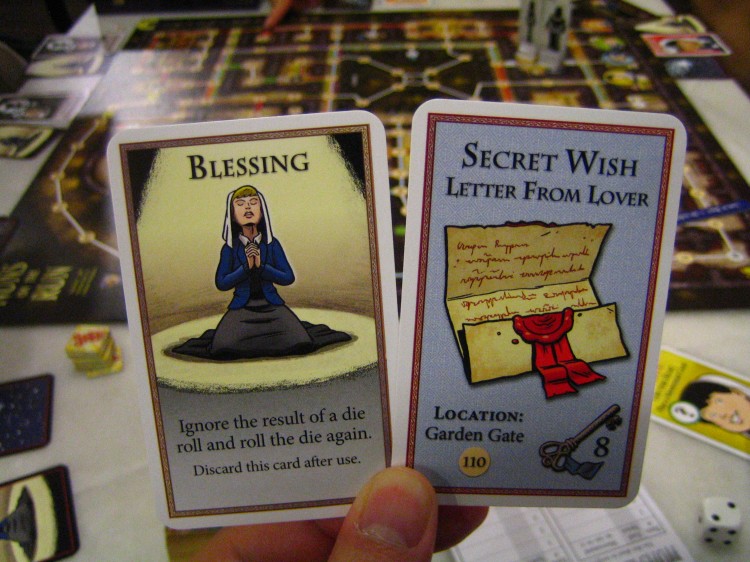
My blessing card and secret wish card, both randomly drawn at game start. The blessing card was a one-time-use special ability card. The secret wish card was basically my secret mission. It specified two locations I need to visit in order to fulfill my mission.

The prioress and the abbess. The abbess looks like a man. Like a weight-lifter. Look at those huge hands.

When the novices move, they also need to check whether they can be seen by the nuns. If they enter the line-of-sight (ooh... wargame term in a Eurogame...) of one of the nuns, they must indicate so on the board. When they disappear from the nun's line-of-sight, they must indicate the direction they have moved towards.

The nuns normally have to move along some pre-determined routes on the board. However if they hear or see anything suspiscious, they can leave their normal routes to pursue the novices. The nuns can move faster than the novices (max 6 steps compared to max 5 steps). After a nun moves, she rolls a die to try to listen for any nearby novices. This works the same way as the novices making noises. E.g. rolling a 6 means the nun can hear a novice up to 6 spaces away. Any novices heard this way must indicate the direction of the noise on the board.

The game board. The novices' rooms are on the right side. The coloured lines are the normal routes that the nuns will take when they make their rounds.

That's basically the game. There are quite a number of other small rules, but the basic gameplay is very straight-forward: novices move, novices make noise, nuns move, nuns listen.

The Play

In the game that we played, we had 6 players. Henry read the rules and volunteered to play the two nuns. The other 5 of us played novices. My secret wish was to retrieve a love letter at the garden gate. In the first round, all novices can move twice. I made a mad dash to collect the blue key that was a prerequisite for collecting my love letter. It was precisely 10 steps away from my room, and 10 steps was the max distance with a double movement. Heng was the first to be almost cornered. In the first round when he was still in the novice quarters area he was already heard by the tall nun. His choices were rather limited, but somehow he managed to escape.

I ran a lot, and in one of the earlier rounds was seen by one of the nuns. However I was quite far and she never bothered to come after me. Alvin had a close encounter, being seen and then chased by the short nun. He was rather unlucky with the die rolls and kept being heard. At one nail-biting moment the short nun stopped precisely one step away from him. Nuns run faster than novices, so a one step gap usually means you are in big trouble. In Alvin's case, he was lucky there were quite a number of doors (which block line-of-sight), rooms and corridors nearby, and he managed to run and hide in one of them. Henry had gambled on the wrong turn and missed Alvin. That was really close.

That "Vanishes" token in the foreground was where Alvin was last seen by the short nun. Alvin had just collected the green #4 key at location 107 the previous round.

The short nun had been chasing Alvin, and found him squatting in a corner of the chapel. The novice token is placed on the board when she is in the line-of-sight of a nun.

I mostly stayed quite far from the nuns, and had no problem reaching my destination and collecting the love letter. However, I had to walk through a garden to go back to my room. This was where the short nun had been chasing Alvin. Also this was a very open area and I could be seen easily if any nun was nearby. So I waited for my chance. Eventually the short nun gave up chasing after Alvin, and decided to go back to her regular route. It was time for another mad dash! I sprinted across the garden. I was far enough from the short nun (who was now inside the chapel - out of sight) that she couldn't hear the noise. Then suddenly Heng placed a noise marker near the chapel door leading to the garden! WHAAAT?!! I was standing in wide open space, and this?! The short nun immediately came out to take a look, and caught me, in a manner of speech, with my pants down. Big. Fat. Red. Target.

I had hoped to pull off something like what Alvin did, but after some assessment of my surroundings, I realised I would not be able to trick the nun and escape. So all I could do was to lure her to catch me at a position further away from my other fellow novices. We all had a good laugh over my unexpected capture. When the nun stepped out of the door and caught me in mid-stride crossing the garden, Heng wasn't even in sight at all. He had just stepped inside a doorway and had closed the door behind him. Talk about twist of fate!

I was sent back to my room. I could attempt to achieve my secret goal again, but unfortunately there wasn't enough time. Although I didn't need to get the blue key anymore, to visit the garden gate again and make it back to my room would take too long. Eventually it was Jeff who managed to achieve his secret wish and win the game.

I was cornered by the grumpy-looking nun.

This is the log sheet used by novices. The number is the location. You also record how quickly you move, and the instances when you collect your key, or achieve your secret wish.

Location 110, just before the garden entry, was where my love letter was.

The Thoughts

The game seemed complex at first, when we went through the rules. It was a new game and we had opened it on the spot to learn and play it. Probably not such a good idea. Better to have someone read the rules beforehand, or to have someone who has played before. Some things were a little confusing when going through the rules. However once the game started, I realised it was actually very straight-forward. Every round was quite quick. Being a novice is quite exciting. Being a nun is probably more challenging.

Nuns on the Run is a family game with an unusual setting and gameplay. Some call it a reversed Scotland Yard. I find Scotland Yard to be more heavy on deduction. The detectives discuss openly their options and the possible locations of the fugitive. In Nuns on the Run the novices have no idea where the others are. There's probably a bit more luck, because of the noise die rolls, but it isn't something you can't mitigate. I find the higher uncertainty (when playing a novice) and the risk-taking exciting. The game also has more flavour than Scotland Yard which is simpler. Nuns on the Run is more similar to Pyramid - the single mummy trying to catch the multiple treasure hunters. It has more elements - the noise, the line-of-sight, known paths for the nuns etc.

Some downsides that I can think of - once a novice gets caught, it may become very difficult to achieve her secret wish. Also, it seems the game is quite hard for the nuns. I wonder whether they are the fun-provider for the rest of the players, like how it is in Pyramid. I think the game will be most fun with the max number of players. One good thing is that novices can take their turns simultaneously, so having more players doesn't increase the play time much.

13 Sep 2010. Important correction (thank you Bay for pointing this out): If a novice gets caught, she has to walk towards her cell. However, once out of sight of any nuns, she can already try again to go for her secret wish (or her key if she doesn't even have it yet). In our game, we misunderstood that by placing my novice token back at my room once out of sight I was being teleported there. The novice token is actually meant to represent the last known location of the novice to the nuns, not necessarily the real location. This means I actually still had a chance to win the game, because I wasn't too far from my secret wish location when I got caught. It also means getting caught is not really as big a disaster as I had thought.

If you are in Malaysia, you can order the game here. No, I don't get a commission. Yes, it's a friend's online store. Discount? Why do all Malaysians ask this?

Saturday, 4 September 2010

boardgaming in photos

23 Aug 2010. A vs-AI game of Race for the Galaxy with all 3 expansions. I was lucky to draw 6-, 7-, 8- and 9-defense military worlds and having military power of +9. But then this lucky streak was probably not necessary for the win. I "fried" them (it's a Malaysian Chinese slang direct translation) at 83-33-16.

27 Aug 2010. Heng (left) has been interested to try Automobile, but we always miss each other when we visit Old Town Kopitiam for the Friday gaming sessions. Finally the stars aligned and I was able to show him the game.

We played a 4-player game. Look at how orderly we were. Not a single car model space (the outer track) was left empty as we developed our cars. Not that there weren't any jumps. Michael once developed a car model that was 4 generations ahead of the latest model then, paying 10 (!!!) R&D cubes. I'd never seen this before. You can see that clump of white R&D cubes on the top right. Those were his cubes that he was toying with while contemplating whether to go for it. Afterwards the no-longer-latest models were claimed by other players, filling up the gaps.

Alvin (left) caught in an Analysis-Paralysis moment. See that yellow factory on the high-end (silver blue) car model which is 4 generations more advanced than the next car model? That's Michael's.

Alvin, Heng and Michael seriously pondering the game board. We had pretty fierce competition among our distributors.

Michael caught in the act of strangling one of his non-performing employees. Just kidding.

The distributors.

31 Aug 2010. I finally got my hands on a physical copy of Race for the Galaxy: Brink of War expansion, after having played the AI-version so many times. First impression - the Prestige (purple circle) token is huge. Much larger than the (hexagonal) victory point token. And Michelle said the 5 Prestige token is like a sakura (cherry blossom). The tile in the centre is the marker for Prestige Leader (i.e. player with most Prestige).

Wednesday, 11 August 2010

boardgaming in photos

31 Jul 2010. Castle, played with Chong Sean, Wan and Shan. Bruno Faidutti's games usually don't click with me, not even the hugely popular Citadels. But I enjoyed Castle the last time I played it (a long time ago). I taught the game after a quick skim of the rules. There weren't many rules anyway. Most of the important text are on the cards themselves. Our game was a bit too peaceful. We simply tried to play our own cards as quickly as possible, and did not meddle with one another much. Chong Sean, who was start player, ended the game (playing his last card) before any of us could stop him. We only started interfering with one another towards the last quarter of the game. The game would be more interesting if we had been more aggressive earlier. Still, I like this more than Citadels.

6 Aug 2010. I joined the Old Town Kopitiam group to play. Henry, Jeff (pictured), Wai Yan and I played Endeavor while waiting for Han. Henry and Jeff look so darn serious.

Although I had played Endeavor once before, I didn't quite remember the details, and I didn't do so well. E.g. not getting enough people in the early game to fully utilise my buildings, getting more pouches (remove people from buildings) than I really needed. From my previous game I remembered most how one of Allen's well-timed attacks gained him a lot and costed me a lot. So in this game I made sure I had a Barracks that would allow me to attack. And this time I decided not to spend too much effort on cards.

The game turned out to be very very close. During the game I thought Jeff was going to beat all of us soundly, but surprisingly he came in last. He was familiar with the rules and Wai Yan and I kept asking him rules questions. That might be why I kept thinking he was doing best. Henry won at 52pts. Wai Yan and I had 51pts. Jeff had 46pts. I still liked Endeavor after the second play. This is one game I would have bought if not for my self-imposed game purchasing quota.

I brought Hansa Teutonica and taught Jeff, Wai Yan, Henry and Han to play. I have played it only once before (4P) and was keen to play again with 4P or 5P. Of all things that they learned, what they remembered most was how to screw with other people's plans. See how the routes are multi-coloured because of blocking. Well, admittedly that green cube in the foregound was mine, blocking Han's (purple) route. I guess I wasn't setting a "good" example myself.

More blocking. In this game when you block others, it doesn't mean they won't be able to complete their trade route. It only means they are forced to displace your cube before they can complete their trade route. Doing so is expensive for them (costing extra cubes), and is beneficial to you (you can move the displaced cube plus another one from the general supply to another path next door). So you are effectively forcing your opponent to use his action to bring your cube onto the board.

Even more blocking. We even had a tri-coloured path (purple-red-blue / Han-Jeff-Henry)!

I had established an office in the city giving extra actions, and business was good. I earned many 1VPs this way, until later when Han established an office and took over as city controller. You can still see a lot of blocking here. There's a tri-coloured path again (yellow-red-blue / Wai Yan-Jeff-Henry). I had to remind them the game was not just about blocking. If a Eurogame can be so vicious the way we played, we probably shouldn't play Diplomacy, lest we end up fighting.

Near game end. I (green) was leading in in-game points, at 19VP. Han (purple) was at 18VP. However after end-game scoring I came in a pretty distant 4th place. I had built early offices in lucrative locations, attracting many 1VPs when others completed trade routes next to my cities. However I never bothered to upgrade my number of actions much, which became a big disadvantage later. Once the others stopped their crazy blocking, they were able to very quickly build up their office networks. With four actions, it's basically place cube x 3 plus complete trade route. Han did not have a big network, but he had gained many 1VPs by controlling the improve-actions-skill city and completing trade routes there himself. He maxed out on two skills, gaining 8VP. Jeff won the game at 40VP, because of his large network and many cities controlled. Han was second with 37VP, followed by Wai Yan 34VP, me 28VP, Henry 26VP.

I'm still very keen about exploring the many possibilities in Hansa Teutonica.

8 Aug 2010. Latest version of the Race for the Galaxy program is out (keldon.net), and it now contains the Brink of War expansion. It also supports playing against other players over the internet. I have been enjoying the new expansion a lot. I have already ordered a physical copy. Prestige is an interesting new aspect. The special search power is very useful. I don't have a very good grasp of the strategy yet, but I am enjoying it a lot. Many of the new cards have quite unusual powers.

In this particular game, I had Rebel Sneak Attack and could take over worlds from either red AI (left) or green AI (right). I targeted Rebel Outpost of the green AI (5VP), because that's worth many points, and also because that AI was leading.

To my surprise, although I succeeded in taking over Rebel Outpost from the green AI, red AI (which was previously trailing by a big margin) won the game, beating me by 2VP! It had also taken over a world from the green AI. Within that last round, it gained 13VP: 3VP from the two new cards, 2VP from the 2 prestige gained for the successful takeover, 6VP from two first-to objectives, and 2VP from becoming sole winner of a most-of objective. I checked that if I had targeted the red AI instead, I would not have won anyway. It had Pan-Galactic Security Council that could have denied my takeover anyway.

Monday, 31 May 2010

Die Handler

I have heard of Die Handler (The Trader?) before, known to be a good Eurogame that was never published in English and never republished after going out of print, but never tried to find out what it was about. At the Wesak Day game session at Old Town Kopitiam Cheras on Fri 28 May 2010, Jeff brought it, and taught Afif, Han and I to play.

Note: Some photos are courtesy boardgamecafe.net.

The Game

In this game the players are traders trying to make money by delivering goods from one city to another. The money earned is then used to increase your social standing. The catch is once you've achieved a certain status, you will need to pay an upkeep cost every round, depending on how high you are on the chart. We joked that it's not cheap being a Datuk. You need to maintain a good income. At the end of the game the highest ranked player wins, tie breaker being cash on hand.

Some background: Tun, Tan Sri and Datuk are Malaysian honourary titles awarded to people who have made significant contributions to the country. Tun is the highest title and is very rarely awarded, followed by Tan Sri and Datuk. In some states there are lesser titles in addition to these.

There are six cities on the board, linked by roads. Every city produces 3 types of goods. There are 3 wagons which start in different cities, and these are shared by all players. At the start of every round each player produces up to 3 goods. This can be all done in one city or split up. If there are wagons in cities waiting for cargo loading, the players do a blind bid to become wagon master. The wagon master can load up to 3 of one type of goods. The others can only load up to 2 of other types of goods, but this is subject to negotiation with the wagon master. They have to agree on a price. The wagon master may choose not to load your goods. Due to the rules for loading goods, sometimes you can guess your opponents' intentions by looking at the number and types of goods they have in the city. Two players each with two red goods may actually hope that a 3rd player with only white goods will become wagon master, so that they won't have to spend on the bidding, and they will still be able to load their goods. But then, the 3rd player may decide to be nasty and not load any of their goods.

The whole game board.

Once loading is done, players start moving wagons. Each player has 4 movement cards numbered 1 to 4, and every round you can only use one of them. Once used they are turned face down, and will only become available after all 4 are used. The wagon master has no control over wagon movement. Anyone can move any wagon. Wagons can only move in one direction, so if you drive a wagon into a road leading to one city, it cannot turn back. This is important because goods can be sold at a higher price in a city not producing the same goods type. Also you may have goods waiting to be picked up at that city.

When a wagon reaches a city, all goods are sold. There is a market mechanism in the game. All goods start cheap, but the prices can increase up to 4 times. However, once the price hits the peak, if someone tries to increase it again, it will crash back to the bottom rung. Before any goods are sold, every player secretly assigns 0, 1 or 2 goods to boost the prices of.

The stock market chart for the 6 goods types. The number on the left is the buying price, and on the right the selling price.

On the left, a wagon, for illustration purposes only. In the real game no one can load 3 types of goods. The shields on the sides of the wagon tell which goods belong to who. On the right, the courier. At the bottom, the disk which you use for secretly assigning two goods types to increase the prices of. You can decide not to push any by pointing both hands at your shield (like in this photo). You can move the game goods type twice, or you can move two different goods types once each.

After you make money, you first pay for upkeep of your title, before spending money to increase up to two steps on the social standing chart. The cost to move up increases as the game proceeds. If you can't pay upkeep, your social standing crashes down to the level which you can pay upkeep for. This can be very painful.

The social standing chart. The number on the left is the upkeep cost to maintain your status.

There are some special powers auctioned off at the start of the game, allowing players to do various fancy stuff, e.g. extra moves for the wagon, adjusting market price, buying goods cheaply. There is a courier piece (a horse rider) in the game. If on your turn you can move a wagon to meet the courier (or vice versa), you get to choose a one-time-use bonus card. These cards have various cool abilities and there are only 3 copies each. They are discarded from the game once used.

The game ends at the end of a round after a certain number of deliveries have been made. For 4 players, it's 8 deliveries.

The Play

Our game started peacefully enough. All goods get loaded, sometimes after some haggling. There were some "misdirecting" of wagons to deny one another the bonus selling price of goods, or to secure it for one's own goods. I was the ambitious one, taking two steps on the social standing chart, when the rest were more conservative and only took one step. Jeff and I monopolised the courier the whole game. We both had special abilities to move the courier and to make the wagon move extra steps. We were the only ones getting bonus cards.

Early in the game, at the city of Genoa. The track above the city indicates the bonus price margin if you deliver goods that are not produced here. This bonus increases every round that no delivery is made, and resets when a delivery is made.

As the game proceeded, I continued to stay in the lead, with everyone else one step behind. This was probably a bad thing, since I was directing all the negative Qi at myself. Advancing early had its benefits, because the cost to advance was cheaper, but then I also had to manage the upkeep cost. Things started going bad when the Broken Axle card struck, played by Jeff. It, of course, hit the wagon which I needed most urgently. The wagon could not move that turn, and my unhappy customers wouldn't pay me because of the delay, despite my pleading and my perfect past record. Ungrateful peasants! Thankfully that round I was still able to pay the upkeep cost. I retained my Datukship, but had no money to progress any further. Everyone else was catching up or overtaking me. Without the Broken Axle, I think the game would have ended that round, and I probably would have won. So the Broken Axle was a very well-timed move by Jeff, who was in last position at that time.

Broken Axle was played on this wagon. I (orange shield) had two black goods, Jeff (blue) had 1 red good, and Afif (pink) 1 red and 1 purple. The track on the left tracks the number of deliveries made and also the cost for promotion. It is also the countdown timer for game end.

Things became quite interesting in the last round. I had the bonus card that allowed me to "naik pangkat" (get promoted) for $1200 per level. In the final round it would cost $3000 per level. However, I was quite low on cash. I had enough cash to pay the $1000 upkeep for the Datukship, and should be able to earn some money that round. Han was a Tan Sri (2nd highest title), and the rest of us were Datuks (3rd highest title). If I could earn some money, I would be able get promoted, possibly even by two levels to Tun. $2400 was not a lot of money. I had been keeping that bonus card precisely for this purpose.

Han (yellow) was the only Tan Sri at the start of the final round. The rest of us were Datuks.

The wagon that had the Broken Axle repaired would hopefully reach its destination (unless Jeff had yet another Broken Axle card). There was another wagon at another city which could load goods and had a chance of making the delivery within this last round. Jeff, Han and Afif all had goods in that city. I had none. When it was time to bid, I thought: although I had no interest in loading goods, from the experience in previous rounds, it was not unusual to spend money to win the wagon master privilege, and then earn back most of it by collecting (cough*bribes*cough) loading fees; then why not try to win the privilege, and charge all of them an arm and a leg? I might make a profit. Afterall it was the last opportunity they had to deliver goods. The other Broken-Axle-fixed wagon had 1 of Jeff's goods and 2 of Afif's. If they decided my price was too high, I could just deny them the loading rights and this last chance of making a delivery. I think I surprised all three of them when I won the wagon master privilege.

This was the wagon that I won wagon master privilege for. I (orange shield) had no goods in this city. From left to right, Afif (pink) had 3 browns and 1 purple, Jeff (blue) had 2 purples and 2 blacks, and Han (yellow) had 3 blacks.

I asked for $900 from each of them to load their goods. Han didn't have enough money and declined. Afif and Jeff discussed for quite some time. The wagon would need at least two players moving it to be able to reach another city, so it was either they both loaded goods (so that they both had an interest in it), or the wagon wouldn't complete a delivery. I think Jeff wanted to load, but Afif decided no. So there was no loading afterall. I was actually secretly hoping to receive this $1800 bribe, although I put on a "take it or leave it" air, lest they try to haggle. When Afif said no, my heart sank. I think I spent $1100 on that privilege which did me no good at all, even though I ruined everyone else's plans.

After the final delivery, Afif could afford to move up one more step to Tan Sri (2nd highest rank). The rest of us only managed to retain our statuses. Afif was winner by tiebreaker, $700 to Han's $500. Jeff at 3rd position beat me by tiebreaker too. He had $1200 and I had $600. If Afif and Jeff had paid me that $1800, I would have had exactly $2400 to upgrade myself two levels to Tun! Too bad they didn't take the bait. Of course they would have made money, but I suspect neither of them would have been able to reach Tun.

What a tense last two rounds it was! My head was actually throbbing a bit from all that scheming and strategising and double guessing.

One hilarious moment in that last round was the market manipulation. I had two black goods delivered, and I knew everyone would be trying to crash the price, to minimise my profit. The black goods price was around the middle of the market chart, i.e. it could easily be pushed over the top and crash. I made a gamble, pushing its price up twice myself. When all the market manipulation disks were flipped over, so many people pushed black that it not only went over the top and crashed, it climbed the whole chart again all the way to the highest price! I raised my arms in exultation, and probably would have howled in delight if we were not at a public place. Then Jeff reminded me - Afif had the Large Office, which could push the price of one good after all the price movements done by the players. Needless to say, black crashed all the way to the bottom. Aarrgghh! Who said Eurogames are all nice and tame? Why am I getting saboteurs wrecking my wagon and unscrupulous market analysts crashing my stock prices?

The Thoughts

Die Handler is a game with quite a number of moving parts - the goods production and delivery, the wagon master bidding and negotiations, the goods prices manipulation, the social status chart, the courier and bonus cards, and the unique abilities auctioned off at game start which impact all of these areas. Thankfully none of these are complex, and amazingly everything ties together quite well.

There is blind bidding / simultaneous secret selection in the game, for the wagon master privilege and for the market price manipulation. So you need to read your opponents. You can try to psycho them to do what you want them to do, via table talk. There is no randomness, since the choices are all made (albeit secretly) by the players. Sometimes your guess will be lucky, sometimes not. This aspect reminds me of Alladin's Dragon, Dungeon Lords and the selling phase of For Sale.

Negotiations is also an important aspect of the game. How much do you charge to let others load their goods? Quite often players need to cooperate due to vested interests in the same things. E.g. they want to move the wagon on which they have goods, or they want to push the price up for a goods type that they are selling this round. There is a tension between cooperating and competing, and also in the negotiations. Negotiation in games can sometimes cause hard feelings (e.g. in Quo Vadis, Greed Incorporated, Chinatown) due to unfairness (perceived or otherwise), so not everyone likes it. It isn't the central mechanism in Die Handler, but it is an important part.

I was surprised to later find out that this game was designed by the team of Wolfgang Kramer and Richard Ulrich, who also designed the highly regarded Princes of Florence and El Grande. Die Handler is a pretty decent medium complexity game. There is zero randomness in the game. It is a very high player interaction game, and cooperation and competition among players are very fluid. We played with four players, and I suspect this is the ideal count. I can't imagine playing this with 2 players. I think it would be rather boring.

Saturday, 8 May 2010

Dune

Jeff of boardgamecafe.net / Old Town Kopitiam Cheras gamers organised a session to play the classic and out-of-print (and very expensive) Dune, a game based on the famous science fiction novel series. He had never played it before, although he had had it for some time. This was the French version published by Descartes Editions. On Labour Day, 1 May 2010, we played a 5-player game at Old Town Kopitiam.

The Game

I read the first two books of the Dune series a few years ago, but don't remember the details very well, so some details written here may not be accurate. Dune the boardgame is played on a map of Arrakis, the planet where precious spice is harvested. Multiple factions are vying for control of Arrakis, and they have different agendas, strengths and weaknesses. There are 5 strongholds on the map. You need to control a certain number of strongholds to win the game, that number depending on the number of players and the size of the alliance you are in, if you are in one.

You need military units to control a stronghold, and military units in this game are very simple. You have a total of 20 tiny round tokens. Depending on the faction you play, some start on the board, some start off board and need to be deployed later. Every round, you can do exactly one shipment of units from off board onto the planet, and exactly one movement of one group of units from one space to one other space on the board. I was surprised how simple this was when I read the rules, and was later surprised again how well the game works in spite of this simplicity.

The battle system is simple. Three factors come into play - units, leaders, and treachery cards. The number of military units is known when two armies clash, but each side secretly commits a subset to actually fight. The loser loses all units, and the winner loses only the committed units. Both sides also secretly commit a leader (every faction starts with five), and some cards. Leaders boost the total strength. Cards are used for killing the enemy leader, or protecting your own leader.

That's me teaching the game. Left to right: me, Arm, Wai Yan (game spectator, whom, in hindsight, we probably should have asked to be the 6th player playing Bene Gesserit), Ainul.

Many photos here are courtesy of Jeff of www.boarddgamecafe.net.

That's me handing a battle disc to Arm. The battle disc allows you to secretly select a number, which will be the number of units you want to commit in the battle. That little round recess is the spot to place your leader.

Leaders are round discs. These are Jeff's Harkonnen leaders. The numbers are the strength that these leaders contribute to a battle. The strength 10 Harkonnen leader should not be in play. It's part of an expansion.

One twist in battles is traitors. During game setup, each faction secretly gains a leader from another faction, a traitor. If you end up fighting an army lead by this traitor secretly serving you, you automatically win the battle, which is cool. However you also will not know how many and which of your leaders are secretly serving other lords.

For most of the actions that you can take in the game, you need spice. This is the key currency in the game, and it is scarce. You need spice to ship units onto the board. You need spice to bid for cards. You need spice to revive dead units. You start with some spice, but once the game starts, you have to harvest spice yourself. Every round some spice will be discovered in one region. The players need to rush there to harvest the spice. Other factions are not the only thing you need to worry about. There is a raging storm which will wipe out your units together with any spice if it hits you when you are in the desert, and Arrakis is 80% desert. There are also giant sandworms which will eat up your units and the spice. They tend to appear in the region most recently found to have spice, so it's a dilemma between getting there before other factions and waiting for an extra round until it's safe. Life is tough.

This was my player shield. You hide your spice under this. The artwork is comic-style and very 80's.

The Play

In our game, Jeff played the Harkonnen, master of treachery (more treachery cards and more traitors than others). I played the Atreides, the faction of the main character in the story. I could see some extra information, e.g. whether a sandworm was coming, where spice would appear next, the opponent's leader in a battle. In the novels the Atreides and the Harkonnen were sworn enemies. They each started the game controlling two important strongholds near each other. Ainul played the Emperor, rich because bids for treachery cards were paid to him, but he started with no units on the board. Arm played the Guild, who monopolised transportation, and was nicknamed DHL. The Guild was rich because unit shipment costs were paid to them. Ken played the Fremen, the natives, nicknamed orang asli (which means aborigines). They were poor but numerous. They popped up freely near a particular desert as opposed to needing to be shipped from orbit. They also get revived for free when killed. They moved faster.

The first round of the game. Atreides (green, played by me) started in Arrakeen, and Harkonnen (black, played by Jeff) started in Carthag. These two cities are important because having units present here mean you have access to ornithopters (something like helicopters) and your units anywhere on the board can move 3 steps instead of 1.

When we played, the French in the game posed a bigger difficulty that we had expected. The English rules we had referred to region names in English but the names on the board were in French. The card texts were in French and we had to look up the English reference sheets. Despite this, we had a fun game and quite a number of interesting stories.

The Tleulaxu tanks, where dead leaders and units go to, and can be revied. Ken (Fremen, yellow) was first to have casualties.

Some spice appeared right next to my (green) home base of Arrakeen. Ainul (red) attacked Jeff's (black) home base of Carthag, shipping his army in directly from orbit. This is one thing that you always need to be careful of. If your enemy has enough spice (i.e. money), he can ship a large army directly to any space on the board (unless it is under storm, or it is already occupied by two factions).

Ainul (Emperor, red), Jeff (Harkonnen, black), Ken (Fremen, yellow), Arm (Guild, orange). Look at how much spice (money) Arm has under his screen. He's filthy rich because all payments for shipping units from orbit get paid to him.

Jeff (Harkonnen) was aggressive from the start, since he had an advantage. Strangely, he reduced his defenses at Carthag, his home base, moving his units to threaten Ken (Fremen). Later, we realised it was because he had a treachery card which would blow up the Shield Wall which protected Carthag and Arrakeen (my home base), making them vulnerable just like deserts when the storm passed over. I was conservative and kept reinforcing my units already in Arrakeen, and when I realised Jeff's plan, I had to mass migrate hurriedly before my army got wiped out by the storm.

Amidst the chaos of my house-moving, I carelessly neglected to notice that Ainul was already in control of two strongholds, and would immediately win when he captured a third. When my huge stack of units stepped out of Arrakeen, leaving a token garrison, he shipped in a huge stack from orbit. It would be the battle to end the game. I was heavily outnumbered. Then I remembered something. One of his leaders was a traitor secretly loyal to me, Comte Hasimir Fenring, a strength 6 (i.e. very strong) leader. If he chose this leader for the battle, I would win regardless of my numbers. When the battle discs and leaders were revealed, I almost shouted with joy. It was Comte Hasimir Fenring! What a dramatic twist of fate. Ainul lost his whole army. Then he saw my leader, and guess what, my leader was a traitor secretly loyal to him too! So it was mutual annihilation. Neither of us gained any spice. All soldiers were killed. Arrakeen became an empty town.

I (Atreides, green) temporarily vacated my home base of Arrakeen to seek refuge at the polar sink (centre of board), which was always safe from storms and safe from attack.

Ainul (Emperor, red) plopped down an army from outer space. Ouch...

The leader he committed to this battle was a traitor secretly loyal to me.

Mutual destruction left Arrakeen deserted. My huge army watched helplessly from the polar sink.

And this was not the only battle ending in mutual annihilation. There was another battle where Jeff attacked Ken with a tiny army, which was literally on a suicide mission. Jeff had both a laser gun treachery card and a shield treachery card. If both these came up in the same battle, everyone died. The rules didn't forbid the same player from playing both these cards, so we agreed this was allowed. The revival tanks (where units could be brought back to life) became rather crowded.

The giant sandworm made an appearance in our (relatively short) game. A huge pile of spice popped up in a desert just outside of one of the strongholds that Ainul was holding. Some of Ken's Fremen troops were also in range to come harvest the spice. Ken sent in his troops. I expected Ainul to send his troops to fight over the precious spice, but he decided to stay put. Then on the next round, the sandworm came! What a lucky decision for Ainul. I was about to start laughing at Ken for his greed. Then I realised that the Fremen were not afraid of sandworms. In fact they rode sandworms, and Ken's troop took a free ride to another region.

In the fourth round, when the sandworm appeared, it also meant a Nexus would occur. This was the time players could form, join, or leave alliances. Ainul's Emperial troops were doing well, and Ken's Fremen orang asli too, and they agreed to become allies. Jeff and I decided we needed to form an alliance too. Arm had to leave by then to catch a flight. In that same round, Ainul and Ken together reached 4 strongholds, and Jeff and I could not stop them. So the original lead hero and lead villian of the novels were sidelined, and the nobility + orang asli pact won control of Arrakis.

Last round of the game. I could not move quickly enough to reoccupy Arrakeen. Ken (Fremen, yellow) and Ainul (Emperor, red) were allied and had units in 4 strongholds. Jeff (Harkonnen, black) was still contesting one of the strongholds with Ken, but eventually could not beat Ken's superior numbers.

Another shot of the final round. The Tleilaxu tanks were pretty full.

The Thoughts

We played only 4 rounds out of the max possible 15, and yet we had so many memorable events and exciting twists of fate. Despite the very simple core rules, the different factions play very differently. Their unique powers give them very different strengths. They also have very different starting positions, and they require different strategies to play. I was surprised how thematic and immersive the game was, despite the simple core rules. A lot of this come from the treachery cards, and of course the varying faction special abilities.

The game is very dynamic. Spice is always scarce. Every round some spice turns up, and the players have to decide whether to scramble after it. Then there's the ever-moving storm. You can never be sure how quickly it will sweep across the deserts, and you have to be careful your troops don't get caught unprepared. There is one weather control treachery card which allows a player to move the storm between 0 and 10 steps, as opposed to the normal possible range of 2 to 6. If you have planned your troops to be a "safe" 7 steps away, and an enemy has the weather control card up his sleeve, you can be royally, ahem, disrupted.

I quite enjoyed Dune, and I think it truly is a classic. Too bad it is out-of-print. I found out that it was designed by the same team behind Cosmic Encounter. I enjoyed Dune much more, but I could see some similarities between the games - simple core rules, but the unique faction powers make a very big difference and create very interesting interactions among the players.

Tuesday, 12 January 2010

Greed, Incorporated

On 8 Jan 2010 I joined the Old Town Kopitiam Cheras gamers again, to play Greed, Incorporated. We had 5 players, the full complement, and it was the first game for all of us.

Greed is a game about businessmen building up companies, then wrecking them in order to gain personal profit in the form of big severance packages, and ultimately using this personal wealth gained to buy status symbols, like art collections and private jets. Everyone starts the game with no personal wealth, but each player is the CEO of a new company with $100 million cash. To make money, the companies can gradually acquire up to four assets. Some assets produce goods, which can be sold for profit, and some assets convert goods to other types of goods, which can usually be sold for even more profit. Companies can trade goods with one another. Every year (round), if any company does not earn more money than the previous year, there will be a blame game, and the CEO, CFO and COO will each pick a person to blame. Anyone blamed will be fired, and will get a severance package, and this is how the players gain personal wealth. Every round there are two status symbols that are available to be purchased, via open auction. The players bid for these using their personal money.

You can also start up new companies using your personal wealth. A player may control (i.e. be CEO of) any number of companies. A player can also be CFO, COO or board member for any number of companies. So trying to get yourself into positions of power and into profitable companies is important.

The red boot marker is placed on a company if it doesn't make more profit than the previous year. It means someone will be sacked.

Most of the main game board is for tracking the prices of the 11 types of goods. On the right (i.e. bottom of this photo) are the price change trends. The bottom of the board (i.e. left of this photo) are the two stacks of status symbols, and the starting bids.

The board of a company consists of CEO, CFO, COO and three more board members. The high-heel shoe, sports car and neck tie are player markers.

The rules are a little complex and there are many steps in every round. This reminds me of Die Macher. You really need a reference sheet for this. We all started the game without much clue. Henry was the first to have a decent company, producing valuable assets and making good profit. I think Jeff was the first to gain control of two companies. He started a lot of creative (i.e. dubious) business deals between his two companies. Later on Allen controlled 3 companies! There were even more creative business deals among those companies, e.g. goods being sold at dirt cheap prices. Heng was one of the earlier ones to be controlling no company (after getting himself fired, i.e. cashing out). Henry and I also at some point had no companies. Baaad idea. We watched in despair as Jeff and Allen's companies prospered and made profits that were unimaginable based on the kind of profits that we had seen in the first few rounds of the game.

Jeff was the first among us to discover the trick of populating the board with your own family members. It's a fantastic way of milking the company dry. Every year that the company is doing poorer, just point fingers at your CEO son, sack him by giving him 40% of the company's cash, then have your CFO son take over as CEO. The next year, just employ your next son (or son-in-law or daughter-in-law or nephew or neice etc) to the CFO position, ready to pull the same trick. There is a rule that penalises this, but the penalty (at least in our game) was small.

Towards the end game, no one could beat Allen's riches. He kept winning the gold status symbols, and Jeff kept getting the silver status symbols. Henry, Heng and I had no chance by that stage. I think we didn't even have enough cash for the starting bids. At game end, Jeff won the game with 29pts, from 4 status symbols won. He had started gaining status symbols earlier than Allen, who had 27pts from 3 status symbols. Henry scored in the teens, with 2 status symbols. Heng and I both had 9pts, he had one status symbol and I had two, but I think I had less cash, which meant I was dead last.

"I worked for this company for 10 years and all I got was some lousy corporate training!"

From right to left: one of the silver status symbol cards won; 2 asset cards (showing card back); currency (in small font: In Greed We Trust).

This is the game board for a company. The card on the top right is the company name. The four cards on the top left are assets of the company. Some produce goods (Coal Pit and Steel Magnate in this photo), some convert goods (Railroad and Builder). The bottom section are the three money buckets. The dollar sign token is always placed on top of the Last Year's Income bucket to remind the CEO never to touch this bucket. Money always goes out from the right (Free Cash) and comes in from the left (This Year's Income). The yellow Railroad card and the grey Steel card are goods that the company currently has. There are 4 slots along the right edge representing warehouses. From one round to the next you can store one good for free without selling it. Any additional warehouses used will cost you money.

Game in progress.

At one point we had 8 companies in play. The table at Old Town barely fit.

Greed, Incorporated is quite a tricky game. You really need to think ahead, analysing the types of assets available, the needs and products and situations of all the companies, who's who on the company boards, etc. Trying to manipulate your company to intentionally do poorer so that you can get yourself fired can be tricky. Each company has three buckets of money - (1) Free Cash is what the company can spend; (2) This Year's Income is whatever the company has earned this year, and money in this bucket cannot be spent; (3) Last Year's Income is money earned in the previous round, which the company also cannot spend. So cash flow can be quite tight because a lot of money can be tied up in this pipeline. Only once a round the money in the buckets are shifted forwards towards the Free Cash bucket.

The game is quite complex. I'd say more so that Indonesia (another complex economic game by the same publisher), and about the same as Die Macher. One thing that makes it feel more complex to me is the two layers in the game - the companies and the players. You need to switch between mindsets. While you are playing the role of company CEO's, you have to remember that making the companies profitable is only the means to an end - your own personal wealth and earning status symbols. You are playing two very different roles at the same time. I have a feeling I won't do very well in 18XX train games, because they too have two layers, the players owning shares in railroad companies, and the companies themselves. I struggle with managing these two layers. Chicago Express has these two layers, but then it's a very streamlined design so I can still cope.

Timing of when to cash out and when to bid for the status symbols is important. This depends a lot on how the group plays. You really need to watch your opponents and guess their intentions. There is pressure to cash in early and gain some cheap status symbols before others can afford them. However cashing in too early may leave yourself vulnerable, being unable to build up your earning power for later rounds. You may become uncompetitive in the later game, when the status symbols are worth more points.

How to wreck a company before you get yourself fired is a skill. You don't want your successor to milk more out of the cash cow. When you have an opportunity to take over another company, e.g. the company did poorly and your superiors are bailing out, do you want to take over as CEO, hoping you can turn the company around and eventually in the long term make more money for yourself, or should you just take a cut now and abandon ship?

The game is quite brutal. It seems to be very hard to recover if you've made some bad decisions in the early game. I felt that from mid-game onwards I was already doomed. Well, this was my first game afterall, so maybe if I play again I won't repeat such fatal mistakes.

There is opportunity for negotiation and trading in the game. I think this is meant to play an important role. In our particular game this didn't play a big part though, at least not for me. I did strike some deals, e.g. selling a good for less than what it was worth, because I wanted to find an excuse to fire myself. However for most of the game I was floundering, and the trades I did didn't help me much.

Overall I didn't like Greed, Incorporated as much as I expected. I'm probably a little biased because I did really poorly in the game. For me the sarcasm and humour from reading the rules didn't turn out to be so funny in an actual game. I guess I didn't really enjoy being evil CEO. Another recent Essen release that has caught my attention is Power Struggle, which also pokes fun at the business world, specifically the politics within a company, bribery, corruption etc. Now I have second thoughts about trying it out.

...

Oh who am I kidding, if I get a chance to play it I'd jump in without hesitation.