Showing posts with label 4X. Show all posts

Wednesday, 4 February 2026

Altay: Dawn of Civilization


Altay is a civilisation and 4X game built on a deck-building engine. It is played on a simple map. Each player starts with just one small village. They defeat barbarians around them and build new settlements, expanding their territory. 


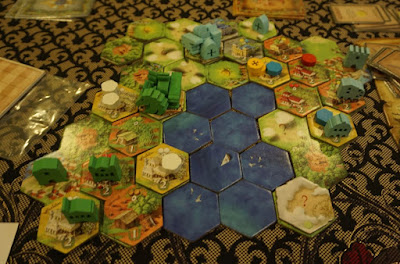
The map shows different terrain types. Specific terrain types that you control can help you boost your production of certain resources. Some territories with banners are worth bonus points and may be contested more fiercely. In this screenshot many territories still have defense tokens. These are the barbarians you need to defeat before you can settle those lands. These tokens are worth points, and some give you a resource when you claim them. 


There are four different tribes in the game, and they have different starting decks. You can categorise this as a deck-building game, because everything you do is subject to the cards you draw. During the game you can buy better cards to improve your deck. There are ways to remove weak cards too. 

Some cards simply generate resources for you. Resources not spent at the end of your turn will be converted to gold. In future turns, you can spend 5 gold to buy any single resource. It's a poor exchange rate, so ideally you try not to have any leftover. Some cards allow you to build a new village or to upgrade one. Every player has a number of village tokens, and the game ends when one player uses all his tokens. In battle, when you defeat your opponent you take one of his village tokens from the map. These are worth points. 


This is one example of a card you can buy. Some cards have point values (purple banner). This Worker card can produce one of three resource types. It gives you good flexibility. 

Some cards allow you to attack or defend. You can attack either a neighbouring barbarian, or a neighbouring opponent village. The village you attack from counts for your attack strength, for example when attacking from a size 2 village (you can call that a town), your base strength is 2. When you are attacked, you can play military cards to defend yourself too. 


You are going to construct buildings for your civilisation. These are divide into three tiers. Each higher tier building must be supported by a lower tier building. You can never have more buildings of a higher tier than a lower tier. All buildings have special abilities, and the gold tier ones help you score points at game end. You also get your own unique gold tier building, and that's something you can plan for from the start. You don't necessarily have to build it, but since it's something you already know from the start, you probably want to customise your play around it and plan to score many points from it.


The Triumphal Arch is a gold tier building - a monument. Buildings often take several turns to complete, as you accumulate the required resources. You can only work on one building at a time. 

So far I've played two games of Altay, and both were 3-player games. The first one was rather lopsided. Han and Jon started next to each other, and fought a lot in the early game. That left me free to develop my civilisation without any interference. I happily bought better cards and grew my empire on my side of the map. By the time they declared a truce and separately expanded towards me to contain me, I already had a strong lead and proved unstoppable. The second game was more normal. 


It is tempting to build big cities, because of their military strength. They are easier to defend, and they are strong in attacking adjacent territories. You can effectively create kill zones next to them. However  one way you score points is based on the number of territories with your villages, so if you are only controlling a few territories, you will lose out on this part of scoring. This is a little tricky. Building many small villages can give you many points, but they are more vulnerable. 

The deck-building mechanism is simple, compared to typical deck-building games. It is the core engine of the game. It's nothing fancy, so if you like deck-building games, you may not find this particularly interesting. It is linked to the board play, and not many other deck-building games have this. As a civilisation game, it feels a little generic and symmetrical. The tribes do start with different decks, and depending on which tribe you use, certain strategies might work better. The game system works. You get a decent civ game built on a deck-building engine. Come to think of it, I can't think of any games done this way, so I applaud this. I just get the feeling that the game works but it doesn't excite me. Logically and mechanically sound, but it doesn't tug the heart strings. Maybe the fictitious tribes don't work for me. Your mileage may vary. 

Friday, 24 December 2021

Brazil Imperial


The Game

Brazil Imperial is a game of colonisation and nation building set in the age of exploration. It is a 4X game and a civilisation game in which you start with a humble capital and grow into an empire, competing with other players for territory and resources. You construct buildings and cities. You produce resources and use them to expand your empire. You discover unknown secrets of the land. You raise troops and conduct battle to seize opponent cities, buildings and resources. The game is played over three eras. Every player gets one mission card per era. An era progresses to the next the first time anyone completes a mission of that era. Once anyone completes a mission of the third era, the game ends. Many things you do in the game give you points. The highest scorer at the end of the game wins. 
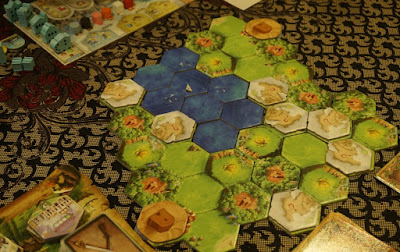

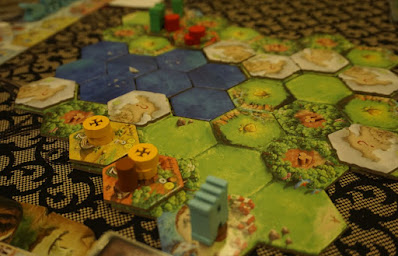
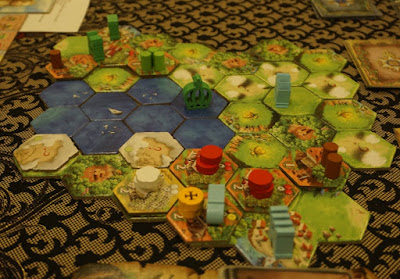
The game comes with many different setups. This above is one of the 2-player setups. The starting locations of the two capitals are fixed. The fog tiles are secrets you get to explore. They are usually good and the benefits are claimed on a first come first served basis. The map has different terrain types - plains, forests, gold deposits and lakes. Different terrain types allow different buildings. 


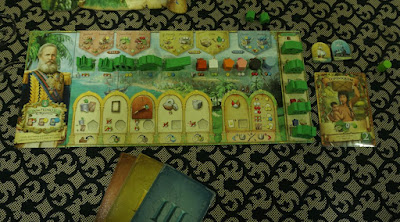
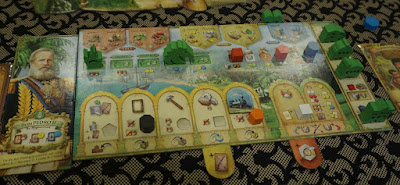
Everyone gets a player board like this. The large tile on the left is a monarch tile. You have a few options and every monarch gives a different bonus. The player board is mostly identical between players. The only differences are the army composition and costs. Each different coloured player board comes with a set of monarchs. 


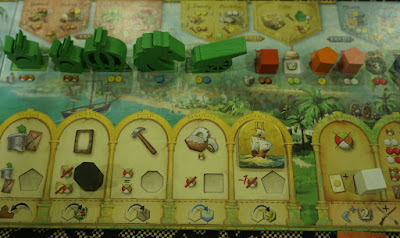
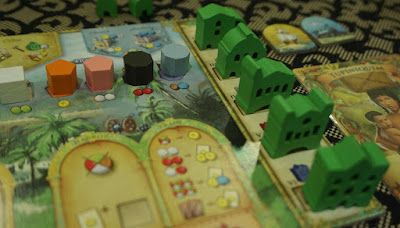
The green player has two archers, a monarch, a cavalry and a cannon. The icons below the units are the costs to raise these troops. The units have different combat strengths and are also worth victory points the moment you create them. They never die. If they lose a battle, they just go to a waiting area. The next time you perform the deploy action, you may deploy them to your city or capital for free. 

The monarch unit is the only unit type which can establish a new city. The cavalry unit brings along any number of other units when it moves, which is very handy. The cannon can initiate a battle from an adjacent space. Normally you need to enter a space occupied by an opponent to initiate battle. 


A player turn is short and simple. You pick one action, and you march once or twice. You can always march a unit once. Whether you get a second march depends on the action you pick and what kind of extra march it gives. E.g. the buy painting action gives an extra march if a unit is going to march into an adjacent forest. So it's situational. 

The 7 action options are shown in arches on the player board (see above). You can deploy troops, buy paintings, construct buildings and cities, collect resources and convert resources. Paintings give you special abilities and are worth points. They augment your abilities and are good investments. There's one action called manufacturing. You spend resources to move a cube, a pentagon or an octagon (see above) to one of the action arches. This enhances the action designated by the arch, e.g. waiving the payment for producing goods. This is also good investment especially when you enhance an action you plan to perform many times. 


There are three types of paintings and two of each type will be made available at all times. The rightmost two are free, the others require payment. The leftmost two are the most expensive because you need to pay science. The blue resources are science, the most precious resource in the game. 


These are mission cards. They are what drive the core progression of the game. Think of them as a countdown mechanism. Whenever a mission of a particular era is completed and announced, everyone progresses to the next era. You must work on your missions so that you don't miss out on the point value and also the reward of building a palace. There are 6 types of palaces in the game. The first one is free and is used to mark your capital. The rest can be built only when you complete missions. They give various bonuses, and often these come in the form of extra victory points based on specific criteria being met at game end. Your choice of palace determines how you play. 
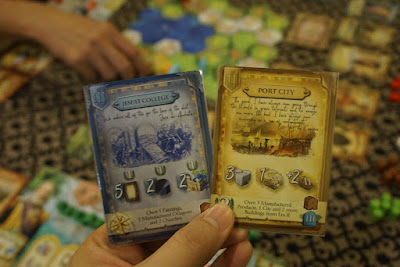
These are the palaces you get to build during play.


When you construct a building, it immediately produces resources. You place the resources on the building itself and you can use them any time. Once you exhaust them, you can make the building produce again by picking the renovate action. It's called renovate and not produce because before you produce, you may flip the building to the other side, transforming it into another building type which produces a different resource type. 


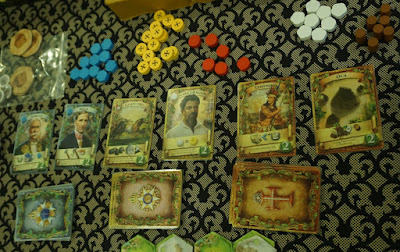
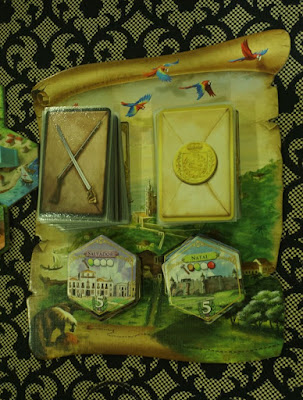
This little side board is for organising some of the components. At the top left you have the combat cards. You draw a combat card when you deploy a unit. Combat cards give you extra combat strength. During combat, the strength of units, buildings and cities are open information. The strength of combat cards is hidden information. Both combatants commit combat cards face-down. They are revealed when combat resolution is done. 

At the top right you have the gold cards. They have various abilities. Some may score you points at game end based on certain conditions being met. Some give one-time powers. If a gold card is not useful to you, you can simply spend it as a gold coin. 

The two stacks at the bottom are city tiles. When you build a city, you must pick from the top of one of these stacks. Cities are worth 5VP each, which is a lot. They are also expensive to build. 

Brazil Imperial is a game where you race to grow your nation, producing more resources which you then spend to construct more buildings and cities. Almost every other thing you do in the game scores you points - buildings, cities, military units, paintings and so on. Whoever does the best overall job of building his empire will be the ultimate winner. 

The Play

I did a 2-player game with Allen, so our map was small. We were both new to the game. 


Allen (light blue) picked the capital location at the bottom right, so I took the other one at the top left. One thing unique about the light blue empire is most military units are built with gold coins, so Allen focused on constructing buildings which produced gold coins. A new building can only be constructed next to a capital, a city or another building. Only new cities can be constructed without being adjacent to your territory. 

The mission of the first era was not very difficult and I completed it quickly. I had a strict focus and minimised the number of steps needed to complete the mission. The speed surprised Allen a little. However for both Eras 2 and 3 he beat me to the missions. 
 

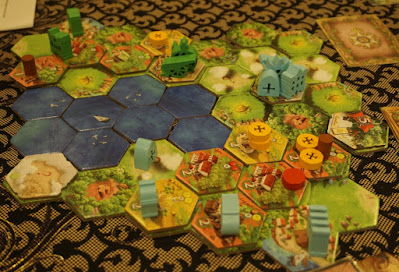
This piece in the middle is Allen's monarch. The monarch is a military unit and has combat strength. Its most important function is to build new cities. 


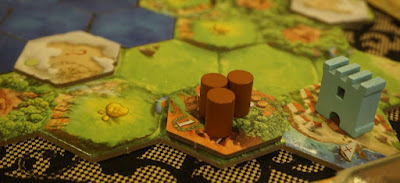
My (green) monarch was now deployed too and sailed towards the group of unexplored territories (fog tiles). Allen and I competed to uncover the secrets of these unexplored territories. He was faster than me in building construction. By now he had five buildings while I had only three. 


When you perform an action, you place your action marker inside the corresponding arch. This reminds you not to perform the same action next turn. You use a different action marker every era. When an era ends, you flip over the expired action marker and place it below one of your action arches. This boosts the action from then on. In the photo above you can tell this is the third era, because two action arches now have been boosted, with old action markers placed below them. 

My monarch tile (on the left of the player board) gave me resources when I purchased paintings. I picked this particular monarch because one of my missions required collecting many paintings. I wanted to create synergy.


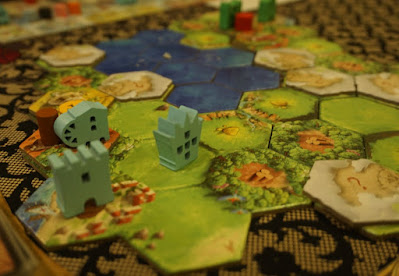
At the top right Allen and I were now in a stalemate situation. We had both built cities, and now we both had armies stationed in our cities. No one dared to attack, because whoever attacked would be at a disadvantage. The defender could rely on the combat strength of his city. Fighting never broke out between these two cities until the end of the game. 

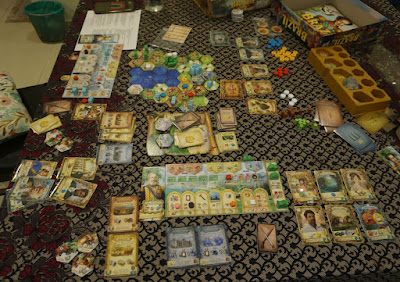
The map doesn't take up much space, but the rest of the game does. 


One of my (green) palaces scored points based on the number of cotton farms I had, so I build as many cotton farms as I could, and also renovated foundries to become cotton farms. The white resources on the map are cotton. 


When we did the final scoring, Allen and I both scored 76! I fell behind Allen in expanding my empire so I was not optimistic. I was the one who read the rules and I was more familiar with some of the intricacies. That gave me some advantage in some detailed execution aspects. The tiebreaker was science (blue resource) on the map. Allen had two and I had none, so he was the victor. I wasn't able to start constructing Era 3 buildings, and he already had two. 

The Thoughts

A turn in Brazil Imperial is very simple, and it makes the game feel accessible. You only perform one action and you may march up to twice. Down time between player turns is minimal. You always feel engaged. Actions are simple, and you usually have to plan a few steps ahead to complete a certain objective, e.g. renovate a certain building to produce resources, then spend those resources on manufacturing a product to enhance the deploy action, and then perform the deploy action to be able to deploy two units at once. 

You are always in a cycle of producing resources then spending them to expand your empire, be it in enhancing your abilities or building more and more stuff - buildings, military units and cities. You are always hungry and growing. That said, being big does not guarantee victory. You may have more space to construct cities and buildings, but smaller empires which are efficient in utilising their buildings can still do well in scoring points. 

There is a delicious tension between upgrading your abilities and racing to complete missions. On one hand it seems a no-brainer to upgrade your abilities in the early game, so that you get to enjoy the advantages for the rest of the game. But how far should you go? There is time pressure in completing the missions. If you spend too much time on upgrading many different abilities, you may not be utilising all of them enough. You may fall behind your opponents. Yet if you only focus on the race without developing a competitive edge, you will likely be outpaced by your opponents. There is pressure to grab land and to explore the unknown territories too. Finders keepers (usually)! 

Brazil Imperial is the type of game with many different ways to score points. Sometimes when playing such games I feel my strategic planning doesn't matter much. No matter what you do, you will score points. It's just a matter of being efficient and being clever with tactical execution. As long as you are efficient, you will end up scoring more points than your opponents. You try to be lazy. You want maximum gains with minimum effort. It comes down to an efficiency game. This is something that nags at me when I play. 

I like that the game makes me feel that there are many things I want to do, and I have a tough time deciding which I should do first, and which I may have to give up. You can't take your sweet time and do everything you like. There's a race going on. You need to pick a few areas and make sure your actions synergise well. Brazil Imperial is a development game. It is fulfilling to see your empire grow. You progress to construct better and better buildings. You accumulate wealth. You push your borders outwards. There is some combat but it won't be your primary focus. Raising troops gets you victory points, but killing opponents' soldiers doesn't. It takes much effort to capture your opponents' cities and buildings. It may not be worthwhile. The military aspect is an arms race. You can't afford to fall behind too far because your opponents are still threatening to steal your resources and points. You may not want to spend too much effort on planning an offensive because you may not get much out of it. It's not too hard to play defense and to match an aggressive neighbour in strength. 

The production of the game is top-notch, from the art to the game components. Allen said he decided to buy it because of how pretty it was, and that was before he even read the rules. 

I like how Brazil Imperial maintains a sense of urgency. You don't know your opponents' missions and how close they are to completing them. The clock is ticking and you always worry about falling behind and being unable to complete your own missions. Era 3 missions are broad and thus not easy to fulfil. You are often torn between focusing only on the main missions and going off on lucrative side quests. You want to do everything, and you are constantly worried you won't have enough time. 

Wednesday, 4 February 2015

boardgaming in photos: Tragedy Looper, Eclipse

14 Dec 2014. Chen Rui (7) wanted to play UNO. I'm not a fan, but I said yes. I treasure the time when my children still ask me to play games with them. This particular game took a very very long time. We exhausted the deck twice and played some more before someone (I don't even remember who) finally won by playing the last card. I told Chen Rui next time we must use a variant of ending the game as soon as the deck is exhausted for the second time. Whoever has fewer cards win.

23 Jan 2015. No Friday gaming night at Boardgamecafe.net this day, so Ivan, Dith and I arranged to play at my place instead. I was keen to bring out Tragedy Looper again, and to play as one of the protagonists. We didn't manage to get a fourth player, but the game worked well in 3P mode too. As protagonist I could still discuss with Dith, and work together to guess Ivan the mastermind's intentions and secrets. The mastermind is at a slight disadvantage with fewer than three protagonist players, since one player will be controlling more than one protagonist, so the chances of two Forbid Intrigue cards getting played is less (which is good for the protagonists because when this happens the cards cancel each other out).

Playing as a protagonist feels very different. I can openly discuss strategies (just short of coordinating card play) and exchange theories. The buzzwords "teamwork" and "synergy" flash by. It is very satisfying to find clues and piece together the main plot and subplots. One thing I find is the mastermind role seems to be very hard to play. The mastermind always plays cards first, so the protagonists can react accordingly. The mastermind needs to place enough paranoia markers on a culprit to trigger an incident. The protagonists can see this coming and can work towards preventing the characters from reaching their paranoia threshold. In the game we played, Ivan was not able to trigger any of the incidents because Dith and I worked hard to get rid of paranoia tokens, some by using our cards and some by using character goodwill abilities. I later discussed with Ivan, and his view is that the mastermind needs to fully utilise the information available to him and all the incidents, plots and secret roles in the scenario. It was his first time playing the mastermind role and he had not played optimally, which gave Dith and I an early victory in Loop 2 (of 3). We were able to prevent the tragedy, despite still not knowing quite a few roles. However we did have some idea of what plots were likely in play.

Tragedy Looper is fun and I look forward to play again.

What are you looking at your pervert!

I wonder what this journalist (rightmost) is doing at the school. He already has one Intrigue token, and the mastermind has played a card on him. Time for the protagonists to Forbid Intrigue I guess?

Ivan wanted to play Eclipse. This was my first time playing the physical version. I had played a few times on the iPad, and was lukewarm about it. Now that I have played it face-to-face, I find it much better.

Dith was white, Ivan was yellow, and I was green. We all played alien races and not the vanilla humans. Dith picked Planta, which could expand very quickly, and scored extra points for each star system (tile) controlled at game end. We were still in the first round, and he had already explored four tiles. We played with some of the expansion modules, and one of it is these three ancient ships in the starting setup, each two tiles away from our homeworlds.

The tile at the lower left is my homeworld. It is connected to the next tile via a complete wormhole, i.e. that target-like icon formed by the edges of both tiles. An edge allows passage only when there is a complete wormhole. That means I have no access to the ancient battleship on the right yet. Not that I'm particularly eager to say hi.

This is my player board. The row at the top are the blueprints for the various classes of spaceships. I have not yet upgraded any of them, so there are no tiles placed here. The middle section is for the technology tiles. There are three categories, and for the fourth tech onwards in each category you will gain bonus VP. The section with cubes indicate your production of money (to pay for actions), science (to buy techs) and materials (to build spaceships).

The round discs are action discs. There are six action types, and whenever you execute one, you move a disc onto that space. The number next to your rightmost unused disc is how much you have to pay at the end of the current round. The more actions you take, the more you have to pay. Action discs have another function, which is to stake your claim on a tile (star system). That means the more star systems you control, the fewer discs you will have on your player board, and the most costly your actions will be.

Now all three of us had spaceships next to the automatic defense system at the galactic core. I (green) had two dreadnaught class spaceships (the largest type), but mine were technically inferior compared to Dith and Ivan's. Ivan (yellow) was now attacking a weaker ancients spaceship.

This is the tech board. Depending on the number of players, some tech tiles will be added to this board at the start of the game and at the start of every round. That means the techs available, and also the number of tiles for specific techs will differ from game to game. Sometimes a highly desirable tech may only have one tile turning up, and players need to race to grab it. Sometimes it may not even appear at all. Since we played with expansions, there are some bonus tiles on the left, and some special tech tiles on the right.

This stack of three ancients warships and the tile they are on are an expansion module. I was shocked to run into this when I was exploring the backwaters near my homeworld. I didn't know this expansion was in play. In fact I didn't even know what it was until Ivan explained it to me. This is how it works: After discovering this tile, three ancients warships are placed here. At the end of each round, one of them will randomly move into an adjacent tile, ignoring the need for wormholes. This is contrary to the behaviour of normal ancients warships, which are passive. I had three star systems next to this ancients hive, and they were poorly defended. In fact, some were undefended. This was a moment so tragic that it was funny. I was already no match for Dith or Ivan, and had to put up as much defenses as I could afford at the frontlines. Now I had these hostile warships popping up behind me.

Now Ivan (yellow) had captured the galactic centre. During our game, both Ivan and Dith upgraded their ships very quickly, and they were ready to attack the ancients much earlier than I was. My pacing was rather off. I wasn't much of a threat to either of them throughout the game, but at least I didn't score too poorly at game end. In balance, that ancient hive probably helped me more than it hurt me. Ivan and Dith didn't really want to bother to attack me. They were more concerned about each other. I pulled back my spaceships and attacked these ancients, which gave me some points. Many of the other ancients had already been wiped out by Dith and Ivan by the time I was ready to take them on. So these three ancients ships that turned up in my backyard were mine mine mine.

I had finally upgraded my ships, but they were still nothing impressive. I didn't upgrade my hull (circle with seven-point star in it), which meant just a few hits would destroy my ships. The plasma cannons (orange square with two black dots) meant every hit caused two points of damage.

I think the spaceships in Eclipse are rather ugly. I don't mind it much. They are functional enough, easy to tell apart.

Finally Ivan (yellow) struck at Dith (white). They had been building up towards this big battle. We all knew it would happen sooner or later. Dith's race had an advantage in exploring and in scoring for star systems controlled, but had slightly less customisable spaceships. However he still managed to arm his ships quite well. Unfortunately he could not beat back Dith's invasion force.

Later, after the game ended and we summed up our points, Ivan won by just a handful of points. If he had not attacked at the opportune moment, Dith might have outscored him due to the power of Planta. Never underestimate this margarine.

In the last round, since Ivan still had some spaceships remaining, and they were conveniently positioned next to one of my star systems, he decided to attack me too for some quick points. This was the final battle of the game. I could summon some reinforcements, and outnumbered him 3:1, but I knew it was a rather lopsided fight and I would likely get wiped out in no time. My ships were much too inferior. It turned out that I came very close to repelling him. Too bad, I was just short of that little bit of luck. I lost the star system, and I lost more points than he had gained. Not that it impacted the end game positions at all. We just wanted to have one climactic space battle.

Face-to-face Eclipse is better than the iPad version. For one thing, I can choose to be green. On the iPad, I can be green, but it limits me to specific races. When playing the electronic version, the computer handles many details. I did the tutorial but didn't read the rules. I could play but didn't fully understand every rule detail. That detracts from my enjoyment of the game. I can only blame myself for being lazy and not reading the rules. In the boardgame version I am forced to understand the rules (I read them before we played), and I find that I can plan better and I feel more in control.

It is primarily a wargame. You know you are building up to fight. Most of the techs are for fighting. There is exploration, production and economy to manage, but they are mostly supporting your military. You do score points via peaceful means, but without a strong military to deter attackers and defend against aggression, you will soon find yourself losing system after system. So you need to play with this mindset. Within the military aspect, there is much variability and many strategies to follow. You can customise your fleet in many different ways. Some players may not focus on the big, lumbering dreadnaughts (like what we did in our game), and may instead upgrade the small but numerous fighters, giving them a mobility boost and getting them to sneak past the front lines to wreak havoc in the enemy's territory.

The balance of the economic system and the number of rounds feel just right. You start small and gradually build up for some big conflicts in the mid and end game. The 9 rounds are enough for the players to have developed very different technologies and empires.

I may not seek out Eclipse to play, but if anyone suggests it, I would be happy to play.

Saturday, 8 November 2014

Impulse

Plays: 2Px1.

The Game

Impulse is a Carl Chudyk (Glory to Rome, Innovation) design. It is a 4X game built on cards.

This is your universe. Well, at least the part you will be fighting over or operating in. It is made of 19 cards arranged in a Settlers of Catan-like layout. The sector core is a special card which allows transport ships (the upright rockets) to score points by landing there, and cruisers (the reclining rockets) to score points by patrolling the paths leading to it. When you explore a face-down card (i.e. unknown space), you take it into your hand, and then pick a card from your hand to place face-up on that space (which can be the same card you just picked up). This is called exploration. Naturally you want to place a card with a planet that helps you.

Cards have three main features. The most important is the action - the written text. What you do in the game is mostly driven by such card text. In addition to that, every card also has a colour, and a value between 1 to 3 (the icons on the left). The colour is used when you perform mining, which is investing in a way to boost your future actions. The values, among other things, are used is a dice-like way to resolve battles. 50% of cards are of value 1, 30% are 2's, 20% are 3's.

You can do most of the things you do in 4X games - explore, build ships, fight, exploit the planets within reach. You can spend resources on mining, which will boost your actions in future. You can trade, which is sacrificing cards for points. Ultimately, your goal is to reach 20 victory points. This is a race. The sector core is a source of points, and everyone starts the game only one step away from it (your cruiser can reach it in one move). That's as good as having a countdown timer for the game. Players compete with a clock ticking in the background.

This is called the Impulse. It is a row of cards which every player plays cards to. On your turn, you must append one card to it. Then you may execute every action in it, in the specified order, and finally you must discard the oldest card from it. So the Impulse is constantly changing, and its composition depends on what players have collectively contributed. You want to play cards which allow you to do what you want, but you have to be careful lest they help your opponents even more. Ideally you want to play cards which are useful to you but are worthless to your opponents.

This is your player board. It lists what you do on your turn, and also the battle resolution procedure. One action in the game is to tuck a card below the left side. This is called Mining. The colours and icons showing indicate what action types you can boost, e.g. building more than one ship, moving more than one fleet, trading more than one card. One action allows you to place cards on the right side of your player board (no example in this photo I'm afraid). This is called Planning. You are basically reserving actions for a future turn. The lower section of your player board are two basic techs, or basic actions that you can always do. One of them is common for all, the other is unique depending on your faction. You can develop new techs by placing a card on top of the basic tech, like in this photo. Doing this overwrites your basic tech.

The game is all around managing cards and the actions they allow. Other than the basic techs on your player board, every action relies on the right card being available, be it in the Impulse, on the board as a planet, on the right side of your player board as a Planned action, or covering your basic techs as an advanced tech. You need to manipulate cards and try to make combos work for you. You end goal is hitting 20VP before anyone else.

The Play

Ivan taught me the game, and we did a 2P game. It was the first play for both of us, so we expected very much a learning / exploration game. Carl Chudyk's designs are a little quirky and are not the sort of run-of-the-mill medium-weight games which you feel like you've already played before after hearing a 2-minute elevator pitch.

In the early game I found that I had some cards in my hand which could boost my battle strength, so I grabbed the opportunity and attacked Ivan's cruiser. The early victory gave me a small lead. However Ivan soon built more cruisers and destroyed my raider, and caught up in points.

The Impulse is the engine of the game. Every turn you get to do one basic action, and then up to four actions from the Impulse. Managing the Impulse is very important. It will drive the pace of the game. If everyone does similar things, the game can speed up because all the actions will always benefit everyone. If players go in opposite directions, the Impulse may become irregular and bumpy, with cards often being unutilised.

Our game escalated into a military one, starting with my early probe. Once the threat of war was in the air, neither of us dared to fall behind in military strength. I found a planet with a Sabotage action, and made use of it to sneak robot bombers onto Ivan's ships. Some even succeeded in their missions. That's 1VP per destroyed ship! I had two planets near my home world which allowed ship movement. That gave me much mobility. I could chain actions. When transport ships landed on these planets, they could trigger movement for other transport ships and cruisers, and those transport ships could again land on Movement planets to trigger further movement. Busy busy busy!

At this stage we had explored most of the sector.

In a nail-biting battle just a few turns before this, I defeated Ivan's fleet, and found myself having a free reign in the central area. I quickly built a bunch of cruisers and dispersed them to claim every path leading to the sector core. That's 6 points every turn! Ivan could not stop me in time from reaching 20VP to win the game, even though he tried to send a fleet of three cruisers to challenge me.

The Thoughts

With just one game, we have only partially tasted what Impulse has to offer. There is still much we have not yet explored, like how to make use of the Planning action (to seed actions for future turns), how to Trade more effectively (selling cards for points), and how to Mine more effectively (Mining boosts actions). I think there are many possibilities to take advantage of the card mechanism and to make combos from the cards. This is what I like most about the game. It's like pouring out a box of LEGO and imagining all the things you can do with the many colourful bricks. It is quite strange how the dramatic and story-heavy setting of a space opera is represented using a bunch of essentially abstract card mechanisms. It is amazing how this works.

One thing left me a little uncomfortable - the military escalation. This seems to be a common problem with many civ games and 4X games. If one player decides to play the military game, no one else can afford to ignore military. Civilisation descends to violence. Impulse encourages players to interact because the sector core is such a lucrative source for VP's, and players are near one another. If every game becomes a wargame, then it can be rather dull. I need to explore more to see whether non-military strategies can be more efficient in scoring points, and also how well a non-military player can hinder or fend off a military one.

If you are a fan of Carl Chudyk, you must give Impulse a try.

Monday, 3 June 2013

iOS boardgaming

Approx 24 Apr 2013. In this particular game of Ascension, both the strength-7 and strength-8 monsters were in the card row at the same time. This was the first time I witnessed this after more than a hundred plays, but then I did have many plays of the base game before I bought the expansions, and the strength-8 card is from an expansion. I managed to get a hand with strength 7 to defeat the strength-7 monster Avatar of the Fallen, whose power in turn allowed me to defeat the strength-8 monster Samael the Fallen. This was 12VP in one turn, 4VP and 8VP respectively for the two monsters. If I didn't get the right combination of cards, I would likely have lost. Eventually I won this game with a margin much smaller than 12.

30 Apr 2013. Eclipse is one of the hottest games in recent years, reaching the BGG top ten list quickly. However neither Allen, Han nor I were interested enough to buy a copy. Allen wasn't so keen on the space theme. I thought it sounded like just another multiplayer conflict game, albeit one with cleverly streamlined rules. However when the iPad version was released, all three of us jumped in.

This particular game was still my first practice game against two easy level AI's. I was green, the AI's were red and orange. Green planets produce materials that can be used for building spaceships and monoliths, the latter being worth VP's. Pink planets produce science, which can be spent to buy techs. Orange planets print money, which is needed to execute actions. Tile borders which have full target-like icons (which are wormholes) allow passage. Those with half a wormhole or none at all do not. The seven icons along the bottom are the possible actions you can take - pass, explore, exert / withdraw influence (i.e. marking / unmarking ownership of tiles), research (i.e. buy new tech), upgrade ship design (install / uninstall techs for spaceships), build ships, and move ships. This was the last round, and the orange AI had built quite a few monoliths. These are the black upright rectangles, that can be seen in the centre tile and also in the one to its lower right.

I had been doing poorly throughout the game, managing my space empire like the noob that I was. Both the AI's were more efficient than me. However, in the last round I exploited the undefended border of the orange AI and sent my long-range fighters into its territories to quickly capture a number of tiles, many of which had monoliths. Because of this, I jumped from last place to first. But I felt dirty. The green-owned tiles on the right half were mostly captured in the last round.

The top left panel holds all available techs. Every round some random techs become available. Because of this the techs and their quantities differ from game to game. The middle panel on the left is for the techs you own. There are three tech tracks, and once you know at least one tech from a track, you get discounts for other techs of the same track. The bottom left panel is for reputation tiles earned through combat (i.e. VP's). The right panel shows your ship designs. You can adjust the abilities of your ships by using the Upgrade action.

I only played against human factions, which are the vanilla factions. There are many alien factions with different special abilities and limitations.

I have only completed one game, and I am in the middle of two others, so I'm not ready to do a proper review yet. But I can share some initial thoughts. It does feel like other multiplayer conflict games that I have played before, despite the clever and clean bookkeeping mechanism. You can call the overall package a civ game. It does have exploration, settlement, development, tech and warfare. However I find that the peaceful or development part of the game to be quite limited. Most techs are military techs, and you really cannot neglect your military. Even if you do not intend to attack, you need defenses to deter your opponents. Among games of the same period, at least for now I prefer Clash of Cultures.

16 May 2013. In this particular game of Ascension against Han, I went for a Mechana construct-heavy strategy. I knew with such a strategy I would score fewer in-game points but would score more at game end when adding the point values of my cards. However when Han widened the in-game score gap to almost 30pts, I despaired. To my surprise, when the game ended, I outscored him by even more in card value. But it was a close one.

16 May 2013. I bought the iPad version of Puerto Rico quite some time ago, when it was on sale. I put off playing it because my friends said the interface sucks. When I finally got around to play it, I thought the interface was not too bad. You see almost everything at a glance. The only problem I have with it is when you are not yet familiar with the buildings, it is troublesome to look up what they are and what they do. One aspect I like is how the lighted doorways indicate people working in the buildings.

I played with the expert AI's, and won, but it was close. I was only 2VP ahead of the 2nd placed AI. Thankfully I had ended the game without giving them a chance to operate their large buildings. Else I probably would have lost.

17 May 2013. Cafe International is another game that has been giving me a good challenge. I play the hardest AI's, and they beat me most of the time. I do have some suspicions that the 3rd positioned AI tends to play poorly and sets up good moves for the 1st positioned AI. There is definitely a left-right-hand neighbour thing in this game, like in Puerto Rico. A poor player can inadvertently benefit the player after him.

The San Juan AI's beat me frequently too! I'm starting to have doubts about my intelligence. This scoring screen may look dull, but the San Juan interface is done very well. Very intuitive and clear.

18 May 2013. Beaten by an AI in this game of Puerto Rico. The winner scored 32VP from shipping! I can only blame myself for not paying attention. The game plays quickly because the iPad does all the calculations and game component logistics for you. I become lazy and often don't bother to watch closely what the AI's are doing or to guess their intentions. That's one drawback of playing boardgames electronically, and it is not the fault of the computer. It is the fault of human nature.

Another game of San Juan that I lost by tiebreaker. Aaarrgghh!

26 May 2013. Ascension with Han. By the start of Round 3, I already had three cards with the Banish ability - Personal Wormhole, Shadowcaster and Abolisher! Deck thinning and making your deck more efficient by keeping only powerful cards is an important tactic in deck-building games. This was a windfall for me.

By the time the game ended, I only had 12 cards in my deck (number on the green coloured deck at the bottom left). Two of them were constructs (number in circle at bottom left), which were played on the table, which means effectively I had ten cards in my draw deck - the same as when the game started! I think I had banished all the starting cards.