Warning: Previously when I wrote about
Pandemic Legacy: Season 0, in order to avoid spoilers I omitted many
details about the game. This here will be more-or-less a session report, and it will
be full of spoilers. If you have not completed the game and intend to play,
stop here. It's not safe to go any further. If you have completed the game or
you are sure you won't be playing it, let's chat.
I played the Pandemic Legacy series in order of publication, i.e.
Season 1, Season 2 then Season 0. I did the first two seasons with Benz, Ruby,
Edwin and Xiaozhu. At the time we worked at the same company, and usually
played on Friday afternoons just before the end of the work day. Now some of
us have moved on to different careers, and it is harder to arrange for all of
us to get together again, especially in the past two years when the pandemic
in real-life has put many things on hold. So we changed plans. I played Season
0 with my family - my wife and two daughters. They had not played the first
two seasons. My wife Michelle had played a few different versions of
Pandemic. My daughters had not. We had played other legacy games
together - Betrayal Legacy and Machi Koro Legacy. We
completed Season 0 within one month, playing 1 prologue game and 16 campaign
games. Here are our experiences.

At the prologue we already had to pick characters. I let the children pick for
us. When we started the campaign proper, we continued to use the same characters as
in the prologue. The most outstanding character was younger daughter Chen
Rui's. Her ability was to move other players on her turn. When she did that
she could move our pawns up to three steps away. This was very handy. She was
our taxi driver. Whenever we needed to go somewhere far, we asked her to send
us there. When we had to end our turns at a city with Soviet surveillance, we
asked her to move us out of harm before the start of our next turns. Sometimes
she spent almost her whole turn just moving the rest of us all over the place.
That sounds a little sad for her, needing to play chauffeur at the beck and
call of the rest of us, but hers was an important role. She was the MVP in our
campaign.

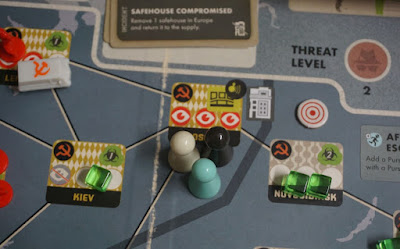
Chen Rui used the black pawn. We built a permanent safehouse in Moscow early.
Being the capital of the Soviet Union, it was a high security place with three
Soviet surveillance (red eyes), the highest level. However with a safehouse in
place, we no longer feared surveillance. We were protected. One new ability
Chen Rui picked allowed her to give cards to anyone when she was located in a
particular city. She picked Moscow. She also got herself a visa to Moscow,
which allowed her to fly to Moscow directly as an action. Most of the time her standard itinerary would be to fly to Moscow, and then she would send us
speeding all over the board and give us the cards we needed. She just sat in
Moscow and played backend support.
Michelle's ability allowed her to give any card to any player in the same
city. Normally you can only pass the card of that particular city. Other
players may also take any card from her if in the same city, regardless of
which card. Initially we thought we would be using Michelle's ability
frequently. However Chen Rui's new ability was even more powerful. She could
give cards to anyone anywhere on the board. We didn't use Michelle's ability
as much as we expected. My ability allowed me to assemble teams with one card
fewer, i.e. four cards. Elder daughter Shee Yun's ability allowed her to build
a safehouse without playing a card. Normally you need to play the card of the
specific city you are in. We declared that she could lay bricks anywhere
(okay, we said she could s*** bricks anywhere).
All these were our early abilities. Later when we obtained our second and
third identities, we developed some other powerful abilities. However we still
used our first identities the most, especially Chen Rui's.
In the late campaign, Shee Yun used her Soviet identity more. By then we had a
few permanent safehouses around the world so we didn't need her to be building
new ones. She put together a powerful combination for her Soviet identity. She
could walk into any Soviet city and instantly kill all Soviet agents. When
she treated diseases, she could treat all at one go instead of one cube at a
time. She was an effective sweeper, clearing off both spies and
diseases.

We built a permanent safehouse in Lagos. I always remember Lagos because of my
experience in Season 1. One important character Kawasaki died in Lagos, and we
were devastated. By now I have forgotten many details of my Season 1 campaign,
but I still remember Kawasaki died in Lagos. This is how memorable a legacy
game can be. In terms of timeline, the events in Season 0 happened before those
in Season 1, so Kawasaki was not born yet in Season 0. I imagined this safehouse
built in 1962 happened to be near Kawasaki's final resting place many years
later. There's a poignancy to that.

One new mission type introduced after the campaign started was disrupting
virus trials. Trials were done in multiple cities, and we only had one chance
to disrupt them. If we wanted to disrupt trials in multiple cities, we needed
teams in place at all those cities at the same time when we carried out the
operation. Cities in which we disrupted the trials were protected from future
troubles. Cities which could not be saved suffered virus infections from the
next game onwards. The infections worked in the same way as those in standard
Pandemic and in Season 1. This was a nice touch. We saw how Season
0 transitioned to Season 1.
When we encountered the earliest missions requiring disrupting trials, we were
100% successful. It seemed hard but somehow we managed it, stopping the trials
in all cities. That saved us a lot of headache because it meant we didn't need
to worry about infections for quite a few games. Yes there were those green
cubes (diseases) introduced, but we didn't need to touch them at all. Only by
the third time we had a disrupt trial mission that we failed. We failed that one completely, not managing to save any of the four cities. However we also
failed in a super lucky way. All four of the impacted cities were adjacent to
Warsaw. There was one asset we bought which allowed us to recruit a medic in a
particular city. The player employing the medic could treat diseases in any city
adjacent to the medic for one action. Michelle recruited the medic, and from
then on easily treated diseases in all four cities whenever she felt like it.
The diseases in our campaign never troubled us much because we were very lucky
with those early missions. By the end of the campaign, we only had one contaminated city.

We never had to worry about the diseases popping up around Warsaw. Michelle
could treat them at any time without needing to fly over.
Beijing (i.e. Peking) was the only city that was contaminated, i.e. we had
outbreaks there. We were lucky. Few contaminated cities meant much less
trouble moving about the board. Outbreak tokens were the same as the incident
tokens. We added outbreak stickers to the other end of the incident tokens. A
token would be used whether we had an incident or an outbreak. The eighth
incident or outbreak would end a game. We had two outbreaks in Beijing, thus
two tokens there.

We loved using this Diversion event card. It allowed us to move three incident
tokens to any city. When a game ended, we had to add a surveillance sticker
(red eye) to every city with one or more incident tokens. We were reluctant to
end our turns in cities with surveillance because at the start of our next
turns we would get exposed. If we could move multiple incident tokens to just
one city, it meant we reduced the number of cities we needed to add surveillance
stickers to. Also we could decide where we'd rather have the surveillance
sticker.
Santiago in South America was a backwater city, far away and hard to reach.
We decided to make it our dumping ground for incident tokens, i.e. to have it
take one for the team. Later on, we realised this was completely unnecessary.
We should have just used Diversion on Moscow. Moscow already had Level 3
surveillance so we wouldn't need to add any more surveillance stickers. We had
to issue a formal apology to the citizens of Santiago. We were stupid.
It didn't matter if Moscow had many incident tokens. It already had Level 3
surveillance. We built a permanent safehouse there so we weren't afraid of the
surveillance. When we played Diversion, the KGB agents must have been
extremely frustrated that their investigations led them to their own HQ. They knew they had been fooled again by false leads.
We were always active in Moscow. Chen Rui always camped there. Later when we
had multiple missions requiring infiltrating the site in Novosibirsk (right
next to Moscow), Moscow became our transit point.
Chen Rui became friends with a gangster in Shanghai. She could ask him to kill
Soviet agents in Shanghai or any city next to it. That's what friends are for!
We named the gangster Hui Man Keong (許文强 - the character played by Chow
Yuen Fatt in the classic Hong Kong TV series Shanghai Bund). He helped
tremendously in keeping East Asia clean.
I got myself a visa to Manila so that I could fly there at any time. If
anything urgent came up in South East Asia, I could get there quickly and try
to defuse the situation. Also we had a permanent safehouse in Manila, and
Manila was a neutral city, so I could quickly assemble a neutral team there whenever I
had enough cards to do so.

The blue fugitive tokens and the brown roadblock tokens are for yet another
type of mission - hunting missions. A fugitive would start in a specific city
during game setup and try to reach a Soviet city. Fugitive tokens spread to
all neighbouring cities whenever an escalation card is drawn. If any fugitive
token ever reaches a Soviet city, the fugitive successfully escapes us and our
mission fails. Roadblocks prevent the spread of fugitive tokens. To eliminate
the fugitive tokens themselves we need teams of affiliations matching the
cities. To complete a mission we need to eliminate all fugitive tokens, i.e.
we have to catch the guy, not just stop him from reaching a Soviet city.
We usually tried to complete the hunting missions as early as possible,
because if we let the fugitive tokens spread out, it would be a real pain in
the neck to try to contain them. Also we needed teams matching the city
affiliations to be able to remove the fugitive tokens. If we had fugitive
tokens in both neutral and allied cities, we would need at least two teams to
do this clean-up.
This particular hunting mission had the fugitive starting in Los Angeles. We
stopped him very early and he didn't even manage to leave LA. Within the first
round, Chen Rui sent Michelle (pink) and I (green) to LA using her power. We
then played an event card which let every player set up two roadblocks. That
was enough to completely seal off LA. After that, it was only a matter of time
to assemble an allied team to catch the poor guy.

These two stickers in Bombay (modern day Mumbai) are a satellite control
centre and a bug (listening device). Some missions required that we acquire a
target in a particular region, and when we completed it, we were instructed to
add these two stickers to the city where the mission was completed. At first I
thought this was strange. Why have two separate stickers when we always had to
add one then the other? Might as well have just one sticker with both icons.
Only later we realised that if we were unsuccessful, we would only add the
control centre but not the bug. We did well in our satellite control centre
missions, and for the first five such missions, we were always able to bug the
centres. We only failed to bug the centre in the Asia Pacific region.

Later on these Satellite Launch cards turned up. Whenever we drew such a card
from the player deck, the Soviets would launch a satellite in a specific
region. All cities in that region would then be considered to have one more
surveillance level. If any of us were in the region and not protected by a
safehouse, we would be at risk of exposure by our next turns. This was
scary. It felt like there was no place to hide. The bugs from the
earlier missions allowed us to disable the satellites of specific regions. We
still had to visit the control centre to be able to disable the satellite, but
sometimes this was worth the effort.
These round tokens remind you that big brother is watching you from the
satellites. That is unless you are hiding in a safehouse.
The European satellite control centre happened to be in Moscow, which was
perfect for us. Chen Rui always camped there anyway so disabling the satellite was
easier than walking down the street to buy newspaper from the corner
shop.
When it rains it pours. I once drew both an escalation card and a satellite
launch card.
This was yet another type of mission - infiltration missions. We had to visit
a specific city, then get inside a specific building, go to a specific room
and do something in that room. In between the rooms there were doors with
codes. To open those doors we needed to have player cards which had the
required numbers. This was a new use of the player cards. Those numbers at the
bottom left mattered. It was not just about the affiliation or the city. The
door codes were initially face-down. When we first entered a room we could
flip over the codes to see what was needed. If we happened to have the right
cards and we still had actions, we could continue to move through the
building. If we didn't have the right cards, we would need to come back
another time with the right equipment.

As the infiltration missions became more complex, we had different paths to
pick. The rooms had different effects, some good some bad. In the photo above,
the office at the bottom left gives an action token. Action tokens are
important. When you infiltrate a site, at the end of your turn you always exit
the building and return to the city. If you want to infiltrate again you start
at the front door next turn. You can't stay overnight inside the building.
Sometimes without extra action tokens you simply can't reach deep enough
inside a building to complete your mission.

This was the mega complex that appeared in the late campaign which we had to
infiltrate. This was in Novosibirsk. In the Season 0 story, one important
character was Agent Sabik. He was a CIA operative sent to the USSR. The CIA
lost contact with him and feared he had been captured by the Soviet. He
managed to escape, but the CIA was not sure whether they could trust him. He
might have become a counterspy. During our campaign there were a few times we
got in contact with him, and we had to decide whether to trust him. When he
was deep in the USSR, he had asked to be extracted but his handler Cooper refused and
asked him to stay on to gather more intelligence. He was eventually captured
by the KGB in Novosibirsk, and this mega complex was where he
was detained. He was tortured and experimented on. He was patient 0 of the
virus developed by the Soviets, that very virus which went out of control
later in Season 1. This was an oooh moment for me because I have played Season
1.

Finding the Novosibirsk building blueprint was one of the highlights of Season
0. It was hidden in a secret chamber at the bottom of the game box. This was
fun. Gimmicky, but I like it.
The mega complex in Novosibirsk was called the Pearl Compound, and to enter we
must use our Soviet identities.
Initially we had no information about any of the rooms in the Pearl Compound.
We could only remove the seal of a room when we stepped inside. It was a huge
complex with many possible paths. We had to guess where the room we needed to reach was. The various infiltration missions across different games all required different actions to be taken at
different rooms of the Pearl Compound. Each time we had to go deeper to find the next room we
needed.
Some of the paths we took brought us to dead ends. Getting into dead ends
meant wasting a turn. We could only try another route next turn. With the
Pearl Complex so huge, we needed to stockpile action tokens before going in.
Else we wouldn't have enough actions to go where we needed to be.
Some of the rooms had useful abilities, like switching door codes and
disabling satellites. However these were nice-to-have things we could do if we
happened to be on the way. We didn't have the luxury to go in for the sake of visiting the rooms. We had to conserve our resources for completing the infiltration
missions themselves.
Later on we were able to create paths using air vents. Two originally
unconnected rooms could be linked up. The sticker in the photo above is a
newly created path between two air vents.
After completing our campaign, we removed the seals of rooms which were still
intact. We realised how lucky we were. We had managed to avoid the rooms with
multiple surveillance icons (red eyes).
This rightmost card is a symptom card. If you enter a city with disease cubes,
you catch the disease and take a symptom card. Symptom cards take up space in
your hand and reduces your hand size. Assembling a team requires five cards,
and your hand size is 7. If you get very sick and have 3 symptom cards, you
won't be able to assemble a team. Thankfully as the campaign progressed we
were able to get ourselves treated. If we were at a safehouse, we could spend
actions to discard symptom cards.
There are many different symptom cards. The flavour text differs, e.g.
coughs, fever, numbness in hands, nausea, but the in-game impact is the same.
They just clog your hand. Whenever I took a symptom card I coughed loudly,
getting into the spirit of the game. It is probably not a good idea if you are playing in a public place though.
One of our missions required two allied teams on site. My Lee Kum Kee identity
allowed me to bring along teams whenever I moved. In one particular move, I
took a flight to the city where the mission was to be completed. Based on how
I interpreted the rules, I could bring both teams along. Picturing this was
crazy though. I was taking an Air Asia flight and checking in two vans as
luggage, and the lady at the counter smile sweetly at me and wished me a great flight. Best baggage allowance ever!
I brought two allied teams to San Francisco. I left them there to do their thing and moved to
Toronto to disable the Soviet satellite flying over North America. The control
centre was in Toronto and we had bugged it.
Lucy Wong, the bodybuilding housewife, was my first identity and also the one I used the most. I was a
frequent flyer to Manila. I befriended a shop owner there which let me swap
two cards with any card from the discard pile. This of course was to help me
with assembling teams, which I could do with one card fewer.
These were our passports by the end of the campaign. Our MVP was definitely
Chen Rui's first identity (top left). She was exposed many times, and we
were quite worried whether she'd eventually burn that identity. Thankfully
that didn't happen. She had two liabilities (dark brown stickers), both due to
being exposed.
Shee Yun (top right) had a friend Dr Robert who lived in Moscow. When Dr
Robert first appeared, Chen Rui wanted him as an asset. When a player starts
a turn in the same city as Dr Robert, she gains two action tokens. This was
perfect for Chen Rui, because she always camped in Moscow and rarely left.
Also she could use those extra actions to move us about efficiently.
Unfortunately by that time she had already filled up all her asset spaces.
She said she was willing to tear off an existing asset for Dr Robert. I
insisted no. She was disappointed. We gave Dr Robert to Shee Yun later. It
was helpful to her too later on when she became the designated player to do
infiltration. Infiltration missions often needed extra actions.
In addition to the medic, one other important asset Michelle had was the
gunbrella. When she killed Soviet agents, she could kill two with one
action. She was our "cleaner".
This was the Moscow Incident, the most memorable one in our campaign. Our
safehouse in Moscow was destroyed by an incident, and at the time three of
us were in Moscow! Moscow had three surveillance icons and if we weren't
able to move out of harm's way before our turns came, we would be exposed three times! At
the time Shee Yun (white) was not using her identity which allowed her to
immediately build a safehouse. To switch to that identity she would need to
find a safehouse first to change. We had taken our safehouse in
Moscow for granted. In hindsight, we should have built a second safehouse in Europe as
backup. Moscow was the lion's den and we should not have taken that
lightly.

This was our map at the end of the campaign. Generally we did well. We
suppressed many of the Soviet surveillance icons around the world. There was
no more in Asia. We had another permanent safehouse in Novosibirsk. Although
Novosibirsk was right next to Moscow and another safehouse so near the one
in Moscow seemed like overkill, it did save us some trouble and helped us
somewhat. The control centre in Tokyo was the only one we failed to bug. We
had a permanent safehouse in Paris. Michelle had a visa to Paris and she was
ready to fly there whenever anything bad happened in West Europe.
These are player aids, front side on the left and back side on the right.
The back side was initially blank. We added stickers during the campaign
whenever new actions became available to us. By the end of the campaign the
back side was full.
The legacy deck asked us to fill in questionnaires like this. They were
psychological tests asking behavioural questions. How we answered later led
to different types of restrictions imposed on us. This was basically random.
We couldn't determine from the questions what kind of restrictions would be
imposed. We had no basis when deciding how to fill the questionnaires. I
see this as just a story and role-playing element.
We generally got the tougher restrictions. Yes, we looked up the
debrief book and the operations deck to see what we would have received
had we answered the questions differently. Chen Rui was adamant we did so. We had some infighting and I-told-you-so moments. One of the annoying restrictions was when we passed a card to another player we were required to discard an additional card. Cards were precious so this was a high price to pay.
These are all the event cards in the game. At the start of every game we could pick which ones we wanted to use. The most we could have in a game was 10. I assigned Shee Yun to be responsible for picking event cards. We looked at the missions of the upcoming game before deciding which events to use.
Some of the components added after the campaign started were the green disease cubes and the outbreak tokens. The out break tokens were not really new components. They were just the incident tokens with outbreak stickers added to the other end.
This page in the rulebook initially only had that small section at the top. The rest of the page was blank. By the end of our campaign this page was filled up by stickers. These were all the player actions which were added during the campaign.
Late in the campaign there came a point when we had to decide whether to help Sabik. CIA considered him a traitor and wanted to hunt him down. He told us he was just trying to save the world. This new disease developed by the Soviets had no cure. Even the Soviets could not control it. We decided to trust him and to assist him. When we did this, the rest of our legacy deck was discarded and we were given a new deck to replace what was discarded. This was the only major fork in the storyline.
The December month was only played once, regardless of how successful we were with the missions. Two of the missions involved stopping the disease from spreading, which meant saving the world from disaster. The third mission was more of a personal vendetta thing. Sabik wanted to meet Cooper, his previous handler who left him in Siberia. We prioritised saving the world, and we managed to complete both of those missions. We then turned to the last mission. This was a climactic moment. When Sabik met Cooper (i.e. we were successful), he was overwhelmed with emotions. He looked like he was going to kill Cooper on the spot. We never found out whether he would have done so, because we shot him dead. It was a pitiful sight, watching him die. He looked like a biology class human anatomy model. His skin had turned transparent due to the side effect of the disease. He was restless and violent, very unlike a trained agent. Chen Rui was rather sad that we had to kill him. I said it was the right thing to do. Was it?
We read the final passages of the story, and found that the four of us went on to become a powerful hidden force within the CIA, the same one which was behind the events in Pandemic Legacy: Season 1. We were the founding members of that evil secret organisation - Zodiac!