Showing posts with label team games. Show all posts

Saturday, 6 June 2026

La Famiglia: The Great Mafia War


La Famiglia is a little unusual. It is a game for exactly four players (like mahjong!), and it is played in teams of two. You are mafia families in Sicily, and you compete to control the most regions. You win immediately when you control 5 regions, or your team controls 6 regions. If no one achieves this after four rounds, the team controlling more regions wins. 


Every region on the map has three spaces. You need to control two out of three spaces to control a region. On the map the cubes are your gangsters. You can build drug factories which help you make money and boost your defence. You have cars which help you in offense. You have boats that give you mobility to attack more distant spaces. 

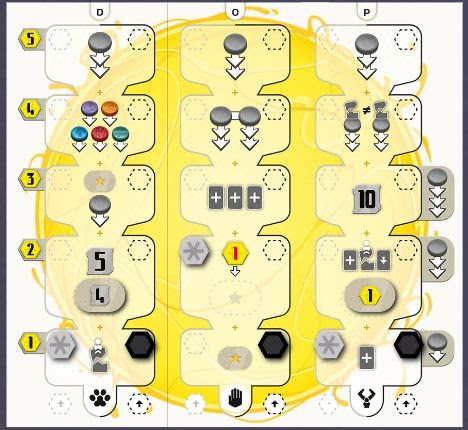
Every round consists of a planning phase and an execution phase. Two planning boards are used in the planning phase. There are player discs and neutral discs on one board, and on your turn you must move one to the other board. The space you move it to determines the action you get to perform, for example earning money, recruiting gangsters, deploying gangsters, buying cars and placing order tiles. Depending on whose disc you move and the space you move it to, there may be costs involved. This mechanism is actually worker placement but a little more elaborate. 

In the execution phase you reveal order tiles that have been placed on the map during the planning phase, and you execute them. This is when attacks take place. Not all order tiles are for attacking. Some are for defending. Fighting involves no dice. Being the attacker you can choose to use a brute force approach to resolve the attack, which is deterministic. However if you want to achieve better results, e.g. losing fewer people in the process, you can take a gamble and play a little mind game. This involves players playing cards face down and then they choose how to apply the opponent's card - to the opponent or to themselves. The end result might be better, or it can also be worse than using brute force.


Every player has a player board. One of the things you can do is to remove discs from your player board. This upgrades your abilities, for example making your car bombs more destructive. When you improve beyond certain thresholds, you unlock new order tiles that are better than the basic ones you start with. Notice that the families in the games are a little different. They have different advanced order tiles. 


When you control regions, you enjoy special bonuses, for example, allowing you to recruit more gangsters. You can choose these bonuses but you need to coordinate this with your partner because you can’t both take the same one. These region bonuses allow you to customise your play.

This is generally a dudes on a map game, an area control game. You have to manage two important resources - money and gangsters. You attack, you defend. You do your best to control regions. There are neutral pieces on the map. In our game, I didn’t attack them much, because the other team was the bigger threat to me. In hindsight I should not have taken such a simplistic approach. After all, the goal is region control, not killing enemies. This is almost a perfect information game. The main uncertainties are the order tiles which are placed face-down, and the little mind game you can choose to play when you attack. There is much strategising and planning you can do. The game is confrontational. It is also calculative due to how deterministic most of the game is. The art is colourful, but make no mistake. This is a pretty serious game. 

I first saw the game at Essen 2024, and it's pretty!

Wednesday, 20 August 2025

Cat & Chocolate


Cat & Chocolate is a game from Japan first published in 2010. It is an award winner in Japan. This is a party game and it is of the type where you need to be a convincing speaker. This is partly a social deduction game. Players are divided into two teams. You know which team you belong to, but you have no idea who your teammates are. When the game ends, your team identities are revealed, and each team adds up their points to see who wins. What this means is throughout the game you want to do your best to score points, because that will help, regardless of which team you are on. 


Every round, one player will be the storyteller, and the others the judges. As the storyteller, you reveal one situation card from the deck, and you must play one, two or three item cards from your hand which can be used to resolve the situation. You have a hand of only three cards. Your job is to convince everyone that the item or items you play will help you get out that particular difficult situation. After you explain, everyone else votes and this determines whether you score one point. The game keeps going like this, until the game end card turns up. The game end card is inserted roughly in the middle of the deck before the game starts. 

The two factions, and some of the situations

The scenarios are all horror movie type situations. Everything happens in an old mysterious mansion. You have ghosts, monsters, zombies and so on. In most cases you are simply trying to survive an attack. 

When we played, the key question asked by Alex was how were we going to know who was on which team. There is nothing in the rules or game components which will help the players determine who is on which team. It is all up to the players themselves. You can tell others which team you are on. You can lie about it too. This part of the game has unreliable fun, and by that I mean whether it is fun depends a lot on the players. It can be fun, and it might also be boring. In my opinion the designer should do a bit more work to make the fun more reliable. 

If through discussion you manage to figure out who is friend and who is foe, the storytelling part of the game may become pointless. You should always vote yes for your teammates, and no for your opponents. I feel the intention of the designer is you should not figure out your teams during the game. It is only meant for the end-game revelation. 

The game is disappointing to me, especially since this was an award winner. However this was back in 2010, and at that time there probably weren't that many modern games designed in Japan in the first place. Japanese game design certainly has come a long way since then. Cat & Chocolate is that type of party game which depends on the creativity and expressiveness of the players. The kind with performances and judges. Not really my cup of tea. Also the design feels a little dated, now that I have seen many better Japanese games. 

Monday, 18 August 2025

Farter Knows Best (屁者先知)


Officially the name of this game is Pizhe Xianzhi, which is just gibberish if you don’t know Chinese. So I’m going to give it my own name - Farter Knows Best. When I came across this game in Taiwan, my first thought was that the Thai farting game made it to Taiwan. That game is Betakkuma’s Fart and Furious. However, upon closer inspection, I realised this was not a retheme, but a completely different game designed in Taiwan. Both the games are about farting in a lift (elevator). Is this an Asian thing or what? I should design a Malaysian farting game to complete the Asian farting game trilogy.

The other Asian farting game which is from Thailand

Farter Knows Best and Fart & Furious play very differently, despite the same setting. Farter Knows Best is a social deduction game and a team game. You need at least five players. Maximum is ten. At the start of the game everyone will be given a secret identity card. This tells you which team you are on. 


These are the various identities in the game. Most of the time you play with just the first row. Most players will be regular passengers, and they are all on the same team. The other team is the farters. The farters have the green balloons. In the photo above you notice that the English translation of the farter is "liar". That's because in Taiwan "farting" is a slang for "lying" or talking rubbish. Depending on the number of players, sometimes the farters don't know who their teammates are. In most cases the farters will know their teammates and they can collaborate. 

The game is played over at most 8 rounds. Your objective is to eliminate the other team, by either voting them out, or having them pass out from smelling too much fart. Everyone starts with a health bar and you take damage whenever you smell fart. There are always more passengers than farters, so the farters need to hide their identities or risk getting lynched. 


The 8 rounds in the game represent the 8 floors the lift will stop at. At four of the floors, nothing will happen. At the other four, someone will fart. The most important concept in this game is that the farter team knows on which floors someone will fart.

These above are the fart and no-fart cards. Among the fart cards, some are regular farts, and some are power farts. There will always be at least one power fart card in play. It's up to you what kind of mix you want to use. Power farts may deal more damage, or they may have lingering effects. 


Every round, before the fart card (I'll call those no-fart cards as fart cards too) is revealed, everyone gets to decide whether to play an action card for the round. This is played face-down. Once everyone has decided, the fart card is revealed. You then resolve the round in turn order. If there is no fart, generally nothing happens. If there is a fart, generally everyone will take damage. Most action cards only take effect when there is a fart. These can protect you, or they can deal damage to others. 

If there has been a fart, you most do a vote to eliminate a player. You can discuss, but voting is done in a simultaneous manner. During discussion, only those who have played an action card may speak. Anyone who hasn't played one must keep quiet. When a player is voted out, the identity is not revealed. Players who are eliminated can check their cards, and they will tell the surviving players whether the game has ended, i.e. all on one team eliminated. 


Drawing cards is hard. You only start with a hand of 4 cards, which is not enough to last you 8 rounds. You need to think carefully when to play an action card. The deep breath card lets you draw 2 cards, but only if no one farts. If someone does, you take double damage. So this is a high risk card. Some other action cards may also help you draw cards, if they are played at the right time. 

Since the farter team knows when there is fart, they hold very powerful information. They know exactly when they should or should not play a certain card. Anyone who happens to play the right cards at the right time, especially when doing this several rounds in a row, will become a prime suspect. 

If you like games similar to Werewolf, this is certainly one to check out. You get all the accusations and reasoning flying around, and here you have more basis for meaningful deduction. Why is she attacking me instead of him? They must both be in the farter team! And he seems to know when exactly to play this card. He must be on the farter team. The identity of the eliminated player not being revealed adds to the challenge of the game, and I think that's a good thing. My friends and I played several games in one sitting, and often the identities of the farters were still being debated when the game ended. 


If you have a large group of casual players, this game works well. Although the game is in Chinese, we are able to play with friends who don't know Chinese because there are only a handful of cards to remember.


One thing I am amazed by is the character cards which come with the game. When I played with my friends, I intentionally left out the character cards. Normally you'd play with them, and they give you all sorts of special abilities. Since my group was all non-gamers, I decided to leave these out. I find the game works just fine without them. Once you know the game well, there is a ton of characters you can play with. Just look at that whole deck of cards in this photo above. So much artwork done! 

Friday, 14 March 2025

Zenith

The Game

Zenith is a two-player (or two-teams-of-two) card game about exerting influence across the solar system. It will be released mid 2025, and it is already available on www.BoardGameArena.com. In addition to Earth, four other planets in the solar system are now colonised and populated. Your goal is to exert enough influence to form an interplanetary government. 

The main board shows five tracks representing the players’ influence. These are tugs of war.  You want to pull the tokens to your side of the board and your opponent tries to do the same to his side. When a token reaches your edge of the board, you claim that token. A new token is then placed at the middle of the track, and you start competing again for this new one. To win the game, you need to collect three tokens of the same colour, or four of different colours, or any five tokens.

On your turn, you just play a card and then refill your hand. A card can be used in three different ways. The basic usage is to pull a token towards you. Most cards have secondary effects, so you can gain something else in addition to pulling the token. Some effects are conditional so you want to play the card only when the condition is met, so that you gain more. The second way to use a card is to play it to advance yourself on a tech track. You gain some benefit, and this benefit is cumulative. When you advance further, you also claim benefits of all previous steps. The third way of using a card is to just exchange it for some resources, depending on the card type. 


Cards come in five different colours, one each for the five planets. The colour determines which planet you can influence. Cards also come in three types - humans, robots and animods. The type determines which tech track you can advance on and also what resource you can exchange the card for.

Cards you play to your side of the board stay there. This is an important part of the game. The cards you have in play give you a discount for the next card you play to the same planet. There are card powers which manipulate these played cards, e.g. discarding your opponent's cards, getting some free cards, and even stealing your opponent's cards. 

The Play

Zenith plays smoothly. There are many cards with many different powers and it is fun to see what you can do with your cards. You have two currencies to manage. Money is needed to pay for card plays to exert influence. Another premium currency zenithium is needed to advance on the tech tracks. Both currencies are tight and need to be managed carefully. There are five different colours and three card types, so you don’t always get what you need. That is an interesting challenge to manage.

One interesting mechanism is the leadership token. Some actions allow you to claim the leadership token, and when you control it, you can take take an action to upgrade it. The leadership token increases your hand size to five or six, depending on whether it is upgraded. This gives you more flexibility. There is only one leadership token in the game so you are fighting with your opponent over it.

There is some engine building in the tech track aspect of the game. If you invest effort in it, in the late game, the tech actions are very powerful. The tech tracks are not static. They can vary from game to game, so there is variability.

This is a resource management game. There is some luck in what cards you draw, and you do your best with what you get. It is an everchanging puzzle to figure out. At the same time you must watch your opponent and which planets he is aiming for. Although this is a game about maximising efficiency, sometimes you must sacrifice efficiency to prevent your opponent from sneaking in a early win. 

Hand size is 6 when you control an upgraded leadership token, but once your opponent steals it away, you go back to 4. 

The Thoughts

Zenith is a well polished mid-weight strategy game. Don't let the cartoonish box cover fool you. This is not a simplistic or light game. It has plenty of tactics to keep the gamer in you engaged. 

Friday, 31 July 2020

Betrayal Legacy

Betrayal Legacy was published in 2018. It is based on Betrayal at House on the Hill, published in 2004. The original game already has an interesting premise. A group of friends explore a haunted house. The game starts off in a cooperative mode. They explore the house and pick up items they discover. Then something triggers a haunt, and this is when the twist occurs. One player will turn traitor, and the game transforms into a one vs many conflict. The traitor will be given an objective, and the others - the heroes - will be given a different objective. Sometimes it can be as simple as killing the other party, sometimes it can be more complicated. Whichever side achieves its objective first wins. The game comes with many different scenarios, and they are all horror stories and thrillers.

With the legacy mechanism added, in Betrayal Legacy, the group of people exploring the house will be family members and descendants from five different families. The campaign story starts in 1666, and spans 14  games - a prologue game (tutorial) and 13 campaign games. Each time you play, it will be a different year, about 30 years after the previous game. You will play a different family member, perhaps a son, daughter,  nephew or grandson. Or if the previous family member is still alive, you can play him/her again. The finale game will be in 2004, which is the publication year of Betrayal at House on the Hill. Nice touch!

When setting up a game, you lay out only a few tiles - the doorway in front of the front door, the downstairs corridor, one upstairs room, and one basement room. These tiles have doors and paths leading to other rooms and tiles, for you to discover (and add tiles) as you play. The house map grows as you explore it. Each time you play, the house architecture will be different. This may not sound logical, but hey, it's a haunted house. Or think of it as being regularly renovated or rebuilt.

In the photo above, the colours of the character bases represent the families they are from. The game supports 5 players, so you have 5 families.

Green is one of the family colours, so I picked that - my favourite colour. This is the player board. The tracks along the four edges are four attributes of your character - Might, Speed, Knowledge and Sanity. If any of these attributes fall to the skull icon, your character dies. Some equipment and events in the game modify your attributes. Might is used for fighting. It determines how many dice you roll. Speed determines how many steps you may move on your turn. Knowledge and Sanity are used to operate certain equipment. Sometimes the outcomes of events depend on die rolls, and the number of dice you roll is determined by these attributes.

There is one heirloom mechanism which I quite like. If your character picks up an item, you may decide to name it and make it an heirloom of your family. You do this by attaching a sticker with your family emblem. In future games if your family member draws this item, it becomes more powerful because it is an heirloom. If the item is drawn by another player, you can try to persuade him to give it to you so that you can unleash its full potential.

The legacy story is driven by a very thick deck of cards. They tell you what to do, which section of which booklet to read, and how to make permanent changes to the game components depending on the decisions you make. Other than the prologue, the stories for the legacy games can differ. Your decisions, and incidents in each game, will have implications on future games you play. If a character dies, he or she leaves behind a ghost icon (you add a skull sticker to the tile). In future, spooky things tend to happen where many people have died. Sometimes new cards will be added to decks, sometimes some cards will be removed.

So far I have played three games with Benz, Ruby, Xiaozhu and Edwin, and one game with Moon, Charles and Plabon. The game with Moon's group was played using the same set, just to let them experience the game. After they tried it, they immediately decided to buy a copy so that they could launch into their own campaign. The copy I bought was mainly intended to be played with Benz's group.

During play, the period before the haunt can be dull, since you don't know the story yet. You are just exploring the house and picking up as many items as you can. At this stage nobody knows who will be the traitor, so your best course of action is buffing yourself up. If you turn out to be the traitor, then you'd be strong and your odds of winning are better. If you are on the hero team, your improved skills will be useful to the team.

When the haunt is triggered, the traitor needs to go to another room to read a specific section of the traitor's scenario book. The rest of the players, the heroes, stay put to read a specific section of the heroes' scenario book. Both parties will learn what they are supposed to know about the story at that point, including how to win. The passages are usually different, and there is usually information which one party knows but not the other. Such information is only revealed at an opportune moment. I've had some such surprises sprung on me.

One difficulty my group has is the rules reading. I'm the only gamer in the group who has familiarity with boardgames and boardgame mechanisms. The rest are casual players. Usually I am the one teaching games. During play I explain the game rules when there is confusion, and I remind people about rule details. With Betrayal Legacy, I can't do this for my opponent team, because I haven't read their part of the rules. My friends on the opponent team need to read and interpret the rules by themselves, which is a little challenging. We spend quite some time digesting rules when the haunts start, sometimes even needing a dictionary. Be aware of this if your group is not used to reading English rules or game rules in general.

Dice in the game are customised - two faces with 0, two with 1 and two with 2. You roll dice when you fight and when you resolve events. This customised distribution reduces the range of possible outcomes and reduces luck somewhat. In one of our games, we came to one situation where we needed to roll 4 to win, and we only had two dice. That meant we only had one ninth of a chance. To our surprise we rolled two 2's! Everyone cheered. I was so excited I asked everyone stop for me to snap a photo.

The game comes with many different types of markers. There are many different stories and story elements, thus the need for various markers. In this photo you can see an animal marker, and a nest marker.

Spooky music coming from an unfinished room...

The water drop shaped markers are monsters. Many scenarios involve monsters of some kind, and monsters are typically controlled by the traitor.

So many monsters! We were getting overwhelmed!

The legacy campaign in Betrayal Legacy is best played with the same group of friends. It would be a shared journey, a story which spans four centuries and many generations. This is certainly an experience type game. Nothing spectacular about the game mechanisms. They are pretty straight-forward. And straight-forward is good. On your turn you typically just move some steps, then perform an action, e.g. attacking someone. The game mechanisms being simple means you can focus on and enjoy the story. There are quite many different scenarios, so you will be experiencing many different stories. By the time you play all 14 games in the campaign, it's almost like have played 14 different games. Good deal, yes? After completing the campaign you can still play in a free play mode. There will still be some scenarios you haven't seen. However the game components won't change much after the campaign is over.

When playing Betrayal Legacy, it is best to get into the role-playing mood. It is an immersive experience.

I am still halfway through the campaign. Unfortunately now it's a bit harder to arrange to meet up and play. I wonder when our next game will be.

Saturday, 3 March 2018

Pit Crew

Plays: 7Px1.

The Game

Pit Crew is a simple team-based real-time game. You are pit crews of 2 or 3 racing teams, and you compete to complete the pit stops in the shortest time possible, allowing your team's race cars to speed off as early as possible.

The game supports up to 9 players. You play in 2 or 3 teams. Each team has between 1 to 3 members. The game is played over 3 rounds. When a round starts, all teams repair their respective cars simultaneously. Once you complete your repairs, your car drives off and tries to go as far as possible. When the slowest team finally completes repairs, their car doesn't get to drive off. Instead they cry halt, and all cars already on the race track stop. The distances they have traveled are their scores. Now you do the end-of-round scoring. All cars are inspected for errors and imperfections. Penalties are applied. When you are penalised, all your opponents get to move their cars forward.

In Rounds 2 and 3, you use different cars, and your team also gains special abilities. After the third round, whoever's car has traveled the furthest wins.

Everyone uses the #27 car in Round 1. The 27 means something. I'll come to that. In Round 1, you need to replace all four tyres, and you need to refuel. Every team has its own deck of cards. Cards are numbered from 1 to 10. The total hand size of a team is 6. In a team of three, everyone holds 2 cards. In a team of two, everyone holds 3 cards. In a team of one, you hold all 6 cards. You perform repairs by playing cards. To replace a tyre, you need to play four cards next to the tyre, one after another. Each card you play must be numbered one higher or lower than the previous number. In the photo above, if you want to replace the tyre at the lower right, you start by playing a 1 or a 3. Let's say you have played a 3. The next card you play must be a 2 or a 4. The big 27 on the roof means the fuel tank capacity. To refuel, you play cards to the rear of the car. There is no restriction when playing cards, but at the end of the round, if the sum of the card values differs from 27, you are penalised. The bigger the difference, the larger the penalty.

The board is not your main playing area. It is mostly a scoring track. You do not race to complete five laps. Instead you try to move as far as possible within the three rounds. You are just trying to score as high as possible.

You use these 6 cap cards to mark sections which are fully repaired. There is one cap card for the engine, one for the fuel tank, and four for the tyres. The engine card is used in Rounds 2 and 3 only. Whenever you complete the repairs for one part of the car, you must place the corresponding cap card there. Once the cap card is placed, you cannot change the cards already played to that part of the car.

Take a closer look, and you will notice that some numbers are white, and some are black. If all cards played to a section have the same colour, you gain a turbo bonus. Your car moves two additional steps. It's not easy to do though. When you are scrambling to find the right numbers, sometimes you don't have the luxury to get the exact colour you need. In this photo you can see we have failed to assemble consistent colours in all six sections.

Car #31 is for Round 3. The XX YY at the engine means you need to play two pairs of cards to repair the engine. We have played a pair of 3's and a pair of 9's. All of them are black, so we are getting the turbo bonus.

When you don't have any cards you can play in hand, you may discard and draw. In fact, you must. However for every two cards in your discard pile at the end of the round, you suffer one penalty point, i.e. your opponents get to move one step forward.

These special ability cards (called Monkey Wrench cards) are gained at the end of Rounds 1 and 2. A number of cards are drawn according to the number of teams in the game. Each team picks one card, starting with the one furthest behind. So this is for balancing in addition to spicing up the game. That card on the left can be used as a 4 or a 5 during a round. The card on the right increases the hand sizes of two team members.

You "drive" your race car by rolling a die. When your team is done with repairs (and you are not the last to do so), one of you becomes the driver, and you keep rolling the die to move your car. You move one step ahead each time you roll a 6. This can be nerve-wracking if you keep failing to roll a 6. If there are three teams, the second team gets to move their car too in the same way. Once the last team is done with repairs, they declare the end of movement. You then do the round-end scoring.

The Play

We did a 7-player game. I was on the same team as Abraham and Allen. The other two teams had two players each. Having three players is probably more challenging, and I'm not saying that just because we lost horribly. Really. With three players, there is a higher need for coordination and communication. Playing Pit Crew is a tense experience. There are multiple parts of the car you need to worry about. You need to coordinate your card plays to avoid getting stuck with no card to play. Finding a valid move doesn't mean it will be a good move. You shouldn't blindly play any card which is technically valid. You need to consider the other cards your team has in hand, and whether your next move can help getting those cards played, and will keep your options open. Then there is also the colour to think about. None of these are particularly complex, but when you are under time pressure, it becomes very hard to keep your cool and to stay rational.

If you find that you really are stuck, waste no time in finding impossible moves. Just discard and draw. Time is precious.

The most stressful part of the game turns out to be also the most brainless part - when you are driving. It's just rolling a die over and over hoping to roll a 6 as many times as you can. There is no skill and no strategy (unless you are trying to cheat). It's all luck. Yet this is when you and your teammates will be holding your breaths, or cheering, or groaning.

My team had a poor start. We were last to complete our repairs in Round 1, and we also had a huge discard pile. Our opponents sped far far ahead of us. In Round 2, we managed to not be last. I took the driver's seat, and hard as I tried, I could not roll a single 6! By the time the bell sounded, I was still in the pit. What a waste! Needless to say, despite having first picks of the Monkey Wrench cards in both Rounds 1 and 2, we still came last. By far.

The Thoughts

Pit Crew is a party game. I think it will be best with 9, i.e. the full complement. The more chaotic the better. The rules are simple so you can easily get casual gamers and non-gamers to play. It will work as a children's game too. It is not a particularly deep game. You shouldn't be looking for depth here. It's a face-paced, heart-pumping fun kind of game. There is also a sense of satisfaction when your team manages to work well together.

Sunday, 6 August 2017

Not Alone

Plays: 5Px1.

The Game

Not Alone is a one-vs-many game. The many is a team of space explorers stranded on the mysterious planet Artemia, waiting for rescue. The one is a powerful and malicious alien creature which controls all life-forms on Artemia, and which now wants to assimilate these unexpected visitors into the local hive-mind ecosystem. Can the explorers stay sane and away from the creature long enough for their rescuers to arrive?

This is the countdown track. The pawn on the left is the rescue counter. It marks how much longer the humans need to wait before the rescue ship arrives. The pawn on the right is the assimilation counter. It marks how close the creature is in assimilating the humans. This is effectively a race game, whoever manages to get his pawn to the star position first wins.

The three discs at the top belong to the creature. They are the Hunt tokens used for hunting the humans. The disc in the middle is the creature token which represents the physical presence of the creature itself. This token is always in use every round. The other two tokens are available to the creature under specific conditions, e.g. the play of a Hunt card. When playing, we joked that the token with an A looked like an Avengers token, and thus must be super powerful. The A actually stands for Artemia, the name of the planet.

The cards with the green back are the Hunt cards. The creature always has a hand size of three, and normally gets to play one Hunt card per round.

This is how the game is set up. The 10 cards arranged neatly at the bottom form the game board and represent the 10 locations on Artemia, each with a different ability which the humans get to use. At the start of the game, each human player has one each of cards numbered 1 to 5, which means he can only access the first five locations. At the top of the photo you can see a pool of cards numbered 6 to 10. During the course of the game the human players may claim these cards to increase their options.

At the start of a round, each human plays a location card from his hand face-down, committing where he will be for the round. The humans may discuss how they want to play, but the creature is listening, so they can't be too explicit. The humans have to hope that their teammates know what they are thinking and will play in a cohesive manner. After the humans are committed, it is the creature's turn to decide where to hunt. This is done by placing the Hunt tokens on the location cards where it thinks the humans are. Then you check whether any humans are caught. They will suffer penalties. Depending on the Hunt token, they may lose Will counters, they may lose cards, they may be denied the ability of the location, the assimilation counter may advance, etc.

The most crucial part of the game is advancing your counter on the countdown track. The rescue counter automatically advances at the end of every round. The humans can perform certain actions, e.g. using location abilities, to make additional advancements. The assimilation counter advances when the creature catches a human using the creature token, and also when a human loses his last Will counter. Every human starts with three Will counters. Will counters can be spent to return played location cards into your hand, but it is a risky thing to do, because you will get closer to losing them all. When you lose them all, the creature's assimilation counter advances, and you reset your character by taking back all your location cards and your three Will counters. You can use location abilities to return location cards to your hand, thus delaying the usage of Will counters, but in the long run it is a matter of stalling, not completely avoiding.

The locations on Artemia help the humans in different ways. They can speed up the rescue ship. They help you reclaim played location cards. They give you new location cards. They give you Survival cards. Survival cards are usually powerful, similar to the creature's Hunt cards. Each human may play at most one Survival card per round. One key difference between Survival cards and Hunt cards is the humans need to perform an action at a location to draw a Survival card, while the creature automatically draws back to three Hunt cards every round.

These are some of the creature's Hunt cards. Those target icons on two of them mean when you play these cards, you get to use the target Hunt token for the round.

The Play

Ivan taught us to play. He had played before, as the creature, so this time he wanted to try being human. He asked me to take the role of the creature. So I was public enemy in our game. There were five of us in total, thus four human players. At the start of the game, having four human players seemed very beneficial to the creature player. They only had five locations to pick from, and I felt I would have to be very unlucky to miss all four of them. Also one of the five locations, #5, was particularly attractive - it allowed the human player to gain a new location card. This was very useful. It was best to get such additional cards early, so that for the rest of the game you'd have more options. It was natural that the human players would be very tempted to make use of this location in the early game. I missed one consideration though. Location #1 was the creature's lair, and if a human made use of it, it could trigger the location ability of the location of the creature. So if I hunted at location #5, the humans could just go to location #1 and still trigger the ability of location #5.

Playing the creature was all about guessing where the humans were. I could see what location cards they had played to determine what options they had remaining. I had to remember which new location cards they managed to claim. I looked at how many Will counters they had to guess what they would try to do. For me the tension came from the ever ticking countdown clock - the rescue team was on the way. I had to assimilate the humans before time ran out, and the ticking clock often jumped ahead by one or even two extra steps. It was nice being omnipresent and powerful, but that didn't mean assimilating the humans was easy. I had a deadline to meet. The humans were stressed out as well, like mice being stalked by a monstrous cat, occasionally supported by devilish kittens (the extra Hunt tokens). Every round they played location cards, leaving fewer and fewer in hand. They could take cards back but that usually meant spending Will counters. Doom approached from both directions, or in Manglish (Malaysianised English) - turn left die, turn right also die. They struggled to survive and were often torn between lying low and waiting patiently, and being bold and helping the rescue team arrive sooner.

Both the creature's Hunt cards and the humans' Survival cards are powerful cards. They create drama and twists. Without them, I believe the game would be a little staid, because all other information is open - the location cards that have been played, the number of Will counters remaining, the available options of each human. Hunt cards and Survival cards create opportunities and help make impossible saves. I would say they help address a weakness in the core mechanism. They make the overall package better. They are powerful but not so much that you feel you win or lose by the luck of the draw. These cards are a supporting element, not the core.

Despite the difficulty in coordinating their actions due to the ever listening creature, the humans still have many ways to collaborate and help one another. They can choose to apply the ability of a location card or a Survival card on a fellow player who needs it more than themselves. Often a human can take one for the team, suffering injury to protect a teammate. The humans do feel like a team playing a cooperative game.

In this particular round, as the creature, I could use two Hunt tokens. Location #4 comes with a yellow marker. This marker starts the game off-card. When a human player triggers location #4, he may move the marker on- or off-card. Moving it on-card means charging up a beacon, and moving it off-card means activating the beacon, which causes the rescue counter to advance by one step. So it takes two human actions at location #4 to speed up the arrival of the rescue team by one step. It is possible to achieve this within one round if two humans come here (and are not caught by the creature).

The human player on the left had played location cards 1, 2, 3, 5 and 9, which meant it was much easier for me to guess where he was going. But beware the Survival card. There just might be one which could save this player from such a sticky situation.

This was near end game, and it was going to be a close finish. On the rescue team track, some spots have an A. If the rescue counter stops at these spots, in the next round the creature gets to use the Artemis Hunt token. The human players will try to avoid these spots. Most of the time it is ideal to move two steps per round, to completely avoid the A spots. That means moving one extra step on top of the one free step every round. However sometimes it is worthwhile to move three steps, even if it means landing on an A. In fact sometimes it is necessary. This is a race game after all.

Our game was close. The tension built towards a climax, and I think this is how most games will be. As the creature I tried to focus on humans who were already low on Will counters. Every step towards assimilation was precious. In the late game, when the rescue ship was about two rounds away from arriving, we came to a situation where one of the humans had only one Will counter remaining, and also only two location cards in hand. Big Red Target, in my eyes. My assimilation counter was two steps away from victory. If I could catch him in person (i.e. using my creature Hunt token), my assimilation counter would move one step for catching him in person, and another for reducing his Will counters to zero. That meant victory for me. Since he had only two cards left, I had a 50% chance of winning this round, assuming no Survival card upset my plan. Of his two locations, one was very enticing, because it would let the rescue counter advance an extra step. The other one was meh. I could decide to prowl the yummy location, since it was obviously the better location. However the human would know I was thinking this way, and might thus choose the meh location just to stay away from danger. So maybe I should pick the meh location so that I would catch him. He would deduce that I would think this way too, so the most dangerous location might actually be the safest one. Then why not just go for it? This is the kind of double guessing which happens all the time in this game. Eventually I decided the human must be having a do or die mindset by this stage. So I placed my creature Hunt token on the yummy location. I was right! Game over for the humans. Welcome to the warm embrace of Artemia.

The Thoughts

Not Alone is a light-to-medium weight game. It takes 30-45 minutes to play. What makes it attractive is the cat-and-mouse mechanism and how the creature and the humans need to guess one another's intentions. Even among the human players they need to guess what their teammates are thinking. The humans are under constant pressure. Their location cards dwindle, their Will counters dry up, they slowly slide towards the hive mind. They fight to survive till help arrives. The creature is mighty, but also has a heart-pounding urgency to assimilate the humans before they escape its grasp. This game has great atmosphere!

Wednesday, 1 February 2017

Secret Hitler

Plays: 8Px3.

The Game

Secret Hitler is a Kickstarter game. It's a secret identity team game. Most would call it a social deduction game. There seems to be more and more such games nowadays. Werewolf and BANG were among the earlier ones. Then there were The Message: Emissary Crisis and Saboteur. More recently we had Don't Mess With Cthulhu and Templar Intrigue. The popular ones which I have not played are Coup and The Resistance.

Secret Hitler is loosely based on Germany before World War II. The game supports 6 to 10 players. I played with 8, so I'm going to explain the game based on 8 players. On the surface, everyone is a liberal. However in secret, three of the players are fascists. One of those three is Hitler himself. During the course of the game new laws will be enacted. Some laws are fascist laws and some are liberal laws. The liberals win if 5 liberal laws are enacted. The fascists win if 6 fascist laws are enacted. Both sides have an instant win condition. If the fascists manage to get Hitler elected as chancellor, they win immediately. If the liberals manage to kill Hitler, they win.

At the start of the game everyone gets an envelope like this. It contains two cards, a party membership card and an identity card. For the liberals, there is only one type of identity card, but for the fascists, you might be a regular fascist party member or you might be Hitler.

Before the first round starts, everyone closes his eyes. The two fascist party members open their eyes to identify each other. Then Hitler raises his thumb (eyes still closed) so that his supporters know who he is. Hitler knows he has two supporters, but not who they are. The liberals know nothing at all.

Every round one player becomes the president. You take turns to play president, in clockwise order. The president must propose another player to become chancellor, and then everyone casts a yes/no vote. If the candidate fails the election, the round ends early. Otherwise, the president and the newly elected chancellor proceed to enact a new law. The president draws three law cards, then discard one facedown. The remaining two are passed to the chancellor, who then discards one facedown, and enacts the last one. Most cards in the deck are fascist laws. If the law being enacted is fascist, the president might bemoan that all three cards he had drawn were fascist, so he had no choice. The chancellor might say the same. However, the president might say to the chancellor, hey I gave you a good and a bad law, why did you pass the bad one? The chancellor might retort, what? You gave me two bad laws, and now you are trying to frame me? If such a thing happens, one of these two is probably a fascist. Even if the two legislators are in alignment, you can't be sure both are liberals. They might both be fascists and they might have have discarded liberal laws without anyone else knowing. Or the chancellor might be fascist, and he is passing the liberal law so that he doesn't arouse the suspicion of the president.

These two boards indicate how many fascist (red) and liberal (blue) laws have been enacted.

When a new fascist law is enacted, special actions need to be performed, or new rules come into play. These are indicated on the board. When the second fascist law is enacted, the president gets to see the party membership card of another player. When the fourth and fifth fascist law is enacted, the president gets to kill another player. This is how the liberals can kill Hitler. Naturally, this only works if they manage to find out who Hitler is, and also if the president that round happens to be a liberal. After three fascist laws are enacted, if Hitler gets elected to be chancellor, the fascists immediately win. From mid game onwards, you need to be much more careful when voting.

The procedure in the game revolves around electing a chancellor and then passing laws, but throughout all these actions, what is most important for the liberals in to find out who is who. For the fascists, it is best to stay in hiding for as long as possible, and use deceit to mislead and to sow mistrust among the liberals.

The Play

We played three games one after another. I experienced being both liberal and fascist, and the feeling is very different. There are more liberals, but the fascist has one important advantage - the party members know who is who. It is crucial they make good use of this information, and even more crucial that they make use of the ignorance of the liberals. The fascists need to sow doubt and stay hidden. Hitler doesn't know who his supporters are, and needs to be alert of clues. There are ways for his supporters to communicate with him. E.g. when Hitler is president and he has picked a fascist member to be chancellor, he can pass one fascist law and one liberal law to the chancellor to test him. The fascist member knows Hitler's identity, and will safely pass the fascist law while bemoaning that both the laws given to him are fascist laws. Upon hearing this, Hitler will know the chancellor is his fellow fascist.

The liberals need to find out who the fascists are. It is not easy to pass 5 liberal laws, since the number of liberal laws in the deck is low. They need to be careful not to allow fellow liberals to be killed when the fourth and fifth fascist laws are passed, and they need to make sure Hitler doesn't get elected to be chancellor. When the president and the chancellor say different things, it is usually a good sign. It normally means one of them cannot be trusted. If you want to play safe, trust neither. The fascists will do their best to appear liberal, even to the extent of passing liberal laws. The liberals need to discuss openly and be critical of every little clue and suspicious action. There will be paranoia, as the fascists try to complicate matters by throwing accusations and suggesting reasonings on why so-and-so should not be trusted.

The president's job of proposing a candidate for the position of chancellor is a heavy responsibility.

The most impressive game components in the game are the hefty wooden signs for president and chancellor. You can kill a cat with them.

Kareem was the unluckiest player in our game. No one ever believed what he said. When he was a liberal and spoke out against a fascist, providing sound reasoning, everyone thought he himself was the suspicious one. When he was a fascist and tried to frame a liberal, everyone trusted the liberal instead. It was all because he already had a reputation as a strong player, so everyone was wary of him, even though what role got assigned was completely out of his control. It was hilarious (but maybe not to him) how many times he was frustrated.

During the setup phase of one of our games, when everyone except for the fascist party members had their eyes closed and the moderator announced that Hitler was to make a thumbs-up sign, one player responded "OK". The rest of us burst into laughter. Did Hitler just inadvertently reveal himself? We almost restarted that game. Eventually, the person who OK'ed was not the real Hitler. He was probably just trying to sow confusion even at the setup phase of the game. Jeez... these gamers... so calculative and cunning!

Secret Hitler is a noisy game, with speculations and accusations flying everywhere. The fascists are a minority, but they have important information which gives them an edge. The liberals need to work together and pay attention to every detail to root out the fascists. They rely on open discussion and they need to be careful in judging who can be trusted.

The Thoughts

Secret Hitler is a fine social deduction game. I had expected that having played quite a few of these, any new game would feel similar. I was pleasantly surprised that I found something new to like in this game. If you don't like this genre, Secret Hitler won't change your mind. If you like this genre, I encourage you to give it a go. Throughout the game you can observe and collect little tit bits to help you deduce who is who. However logic alone is often not sufficient. Often you need to make judgement calls on who to trust. You need to rely on your instincts. This is how psychology comes into play. This is where the human interaction is.

If you ask me what's different about Secret Hitler compared to other social deduction games, I would say it's the chancellor election and the law passing. These are its ways of presenting information for you to work on. Some social deduction games give you little to work on, e.g. Templar Intrigue, Werewolf. Some give you more, e.g. BANG, Saboteur. How they differ is the control of information - who knows what, who doesn't, and how the the information is gradually revealed to more players. The game progresses to a climax as more and more information becomes known.

In Secret Hitler, the two sudden death victory conditions - executing Hitler and Hitler becoming chancellor - make the game exciting. Regardless of the number of laws passed, the game can take an unexpected turn at the last minute. I find the game slightly more complex than other similar games, in particular the special actions and additional rules that come into play when a specific number of fascist laws are enacted. That will take a while for new players to digest and incorporate into their strategic planning. When teaching the game, one needs to regularly remind the new players to take into account these actions and rules.