Showing posts with label solo gaming. Show all posts

Sunday, 16 November 2025

TGI Friday!


There has been a 7 year gap since my previous play of Friday. I needed to reread the whole rulebook when I picked up the game again recently. I have written about the game before (in 2012!), so I won't repeat. You can read the write-up here


Lately I am playing boardgames mostly online, so it's good to play a physical game once in a while so that I don't lose touch with my roots. Friday is a solo game, so I don't get to sit opposite a physical opponent. However it still feels nice to be shuffling cards and fiddling with game components. Even the chore of packing the game away makes me feel good. Feels human. 


I played two games, and lost both. In the first game I didn't even manage to reach the pirates. I was already eaten by wild animals on the island. I did a little better in the second game. I reached the pirates, and even defeated the first one. Unfortunately the second one got me. 


This was the pirate I lost to. I had too few life points left - not enough to draw more cards to beat the pirate. 

Sunday, 8 June 2025

The Guild of Merchant Explorers

The Game

This is a game about exploration. You start at the capital at the centre of the map, and you place explorer cubes extending from there to various parts of the map. There are different things to discover and to score points for. The interesting part is how your progress will reset at the end of every round. All your explorer cubes will be removed. To protect yourself from losing all progress, you need to establish outposts, so that in future rounds you can start exploring from these outposts as opposed to starting at the capital again. 

This is mostly a multiplayer solitaire game. It also feels like a roll and write game, despite having no rolling or writing involved. Everyone plays the same map, but you have your own board and you place cubes on your own board. The game comes with different maps so there are different scenarios you get to play with. Every turn, a card is revealed from the deck, and it tells you how you can place your explorers. You know the basic exploration deck, but every game there will be some random advanced cards added which help you explore in powerful ways. There are cards for each terrain type. Usually a card will tell you how many explorer cubes you can place, and on which terrain type. Since you know most of the deck, just not what order you will draw the cards, you can somewhat plan your exploration. 


When you explore, you establish an outpost by completely filling a region, i.e. a connected group of similar hexes. You place your outpost on one of these hexes, and it will stay there permanently. Some hexes have coins, and coins are your victory points. You score points by placing a cube on these hexes. Some hexes contain treasure chests. You draw a treasure card when you access these hexes. They give various benefits. This is a blind box gacha thing. Some hexes are trading posts. You need to connect two of them to score points, and the point value you score is their individual values multiplied. 


These purple buildings were my outposts (technically called villages). This was the start of a new round, so all the explorer cubes had been removed. However with outposts having been set up, I had many options. 

The game is played over four rounds. In the first round only one random advanced exploration card will be introduced. In the second round, this same card stays in the deck, so you know what it is just not when it will show up. A new advanced card will also be introduced, and you won't know what it is yet. In the third round, the previous two remain, and yet another new one is introduced. In the fourth round… You think I’m going to repeat the same thing right? Then you’re wrong. A new card will NOT be introduced in the fourth round. However one repeat card is added which lets you use one of the three previous advanced cards one more time. After four rounds are completed, the highest scorer wins. 

The Play

I learned the hard way about the need to plan for the future. A round ended much quicker than I expected and I hadn’t set up any outpost. The map is large, and you can’t try to do everything. You will probably need to focus on some areas and sacrifice others. This will somewhat depend on the advanced exploration cards that turn up in your game. It also depends on where you have set up your new bases for exploration, and the order the cards are drawn. 

It is fun to plan your adventure. You can’t make exact plans since you have no control over the order of the card deck. The advanced exploration cards always bring some excitement. They are the big breaks. Sometimes you make bets, hoping the cards turn up in a certain order. Sometimes you win, sometimes you lose. Sometimes you need to adjust plans. 

The Thoughts

The Guild of Merchant Explorers is a pleasant family game. It’s multiplayer solitaire for sure. Think of it as a solo game that you play together with friends to compare how well you do given the same conditions. The exploration is an interesting puzzle to solve. You decide how much risk you want to take. You try to grab opportunities that come your way. 

Friday, 8 March 2024

Super-Skill Pinball 4-cade


The Game

Super-Skill Pinball is a roll-and-write game about pinball machines. It is essentially a solo game, just that up to four players can play at the same time, and you compare scores to see who wins. Pinball machines are a relic now. People who have experienced the pinball machine era should be doing regular medical check-ups now. 

The game is pretty simple. Every turn you roll two dice, and you move the ball around the board to score points. The longer the ball stays on the board, the more points you will score. Eventually you'll lose the ball as it falls to the bottom. That's when a round ends. You get to play three rounds, and after that you compare to see who has the most points. 


You set up your player boards like this. The horizontal piece above is mostly decoration. Only the segment on the left is for scorekeeping. The vertical piece is your actual game board. That's where the ball moves about. 


You play using dry erase markers. During play you will cross out boxes and also erase your crosses. There are dice icons on the board. When you use a die value to move the ball to a particular dice icon, you cross out the icon. You've used that icon and it cannot use it again, unless there is a way to erase the the mark. Gradually you'll run out of dice icons to cross out. Then the ball won't be able to go anywhere except down to the bottom, i.e. you will end the round. 


The board is divided into four sections from top to bottom. The ball enters at the top section. Normally each time you move the ball, it must go to a lower section. It's called gravity. The ball can only go upwards or stay in the same section if specific components allow it. 


At the bottom section there are two levers, red and yellow. If you manage to catch the ball with one of these levers, on the next turn you can flick the ball upwards to a higher section. Just like in real life. 


The various components in the pinball machine have different behaviours and provide different benefits. This yellow duckies component is a set of three. If you manage to hit all three, they reset (i.e. you can send the pinball here again) and also you get to activate one special power. For example you can get an additional ball, or you can use the red and yellow levers interchangeably. Star icons scattered around the board mean victory points. In this game you will be scoring points all the time. It's a little tedious. 


That silver sphere is the ball. It's actually just half a sphere, so it stays still and doesn't roll about. At the top left you can see the numbers 1 to 6. This is a feature called the skill shot. When you hit all three of the Ferris wheel cars near the top, you gain a skill shot. You may circle one of the numbers. From then on, if there is a specific number you want to roll but fail to do so, you may choose to set a die to a circled skill shot number. This gives you some control and predictability. Once you use the skill shot, you erase the circle. If you hit all three Ferris wheel cars again, you can claim a new skill shot. You can save multiple skill shots of different numbers if you complete the Ferris wheel set multiple times. 

Resets are helpful. Whenever you reset a group of components, you are reopening opportunities for your ball. You'll be able to last longer and score more points. 


The game has a nudge feature, just like in real pinball machines. This basically allows you to cheat. If you really want a specific number, you can change a die to that number by performing a nudge. Doing a nudge comes with some risk. If you nudge hard, i.e. you change the number by a lot, you may lose the ball next turn. If the difference between the dice rolled is smaller than how much you nudged on a previous turn, you lose the ball. In the whole game you may only nudge three times. 


This set of three components allow the ball to bounce between them instead of rolling down to the next section, provided you roll the numbers needed. If you manage to cross off all twelve dice icons, they reset. Notice in this photo I have two balls in play. 

The game comes with four different pinball machines, with different themes and art styles. There are some common features in all the machines, but each of them has some unique elements too. The circus themed machine is the simplest one. The others are more advanced. 

The Play

Super-Skill Pinball is a risk management game. You will gradually run out of spaces to cross out and eventually you'll lose the ball. You try to prolong the play as much as possible. You plan ahead a little, strategising where you will move the ball depending on what numbers you roll. You try to make use of the resets as much as possible. A turn is simple. The game mechanism matches the theme well. 

You do some long term planning, e.g. saving up the skill shots, and making conscious effort to complete sets. You roll dice a lot, so there is certainly some luck. Your job is to manage that luck as best you can. 

When special powers are activated, I circle them


At this point if the ball is to fall to be bottom section and I roll a 1 or 5, I can still catch it with the right (yellow) lever. If I roll neither, I will lose the ball. 

These are the other three pinball machines which come with the game: 

A hacker / cyberpunk machine

A disco themed machine. It used to be called "disco". Now it's called "clubbing".

Fantasy / dragon-slaying theme

The Thoughts

Super-Skill Pinball has a unique setting, and it is designed to capture many elements of pinball machines. That part is certainly done well. It is a theme first game. It is mostly a solo game. There are some tactics to explore. Give it a go if you find it interesting. I'm not specifically a fan of pinball machines, so for me the theme is novel but not compelling. I'm not a big fan of solo games either. I'm content to have tried it out to understand how it works. 

Friday, 22 July 2022

ROVE


The Game

ROVE is a game with only 18 cards. It is a solo game. Rove is an exploration robot which has just crash landed on an unknown planet. Your job is to help it get to safety to await rescue.   


This is how a game is set up. The 6 cards in the centre represent the 6 modules of our robot. You have 5 action cards in hand. Your mission is at the top left. Action cards and mission cards come from the same deck, at the bottom left. One side of the cards is the action card side, and the other side is the mission card side. 

To complete a mission, you need to rearrange the 6 modules into the formation as specified by the mission card. The position of one particular module will be specified, and the other 5 modules must be arranged in a certain pattern around it. To win the game, you must complete 7 missions before running out of actions. Every module has its own movement capabilities. They can move in specific directions, some orthogonally, some diagonally, some both. One module must jump over another when moving. One module pushes other modules when moving. 

Whenever you complete a mission, you get a new one from the draw deck. If you have fewer than 5 cards, you draw a card before continuing. 


The number at the top left of the action card tells you how many actions you get when playing the card. You spend actions activating modules to move. The pattern at the centre is a bonus criteria. If the modules specified by the criteria are arranged in the configuration shown, you get more actions when you play the card - that number at the bottom right. Thus you are not only trying to arrange the modules according to the mission cards, you are also constantly evaluating whether you should make these patterns on the action cards. 


Every module has a single-use power, which is quite strong, e.g. swapping two modules. Once you use a power, you flip the card over. 

The configuration shown at the top right of the mission card is what you need to achieve.

The Play

This is a challenging game. Your cards are your resources, and your job is to complete 7 missions before you run out of resources. You are under pressure to conserve resources and use them wisely. This is a logic puzzle. Information is mostly open. You need to work out a most efficient way of using your cards. The only unknown is future missions. The next mission is known and you can plan for it, but if there are more after the next, they are still in the draw deck and you don't know yet what they will be. There are many factors to consider and it's tricky to find an optimal move. Since there is some uncertainly you can't work out the perfect sequence of actions. You want to make use of the higher action values, but it is not always feasible. Sometimes you need to sacrifice the opportunity. 

There is no time limit, so you can think for as long as you like. There is no opponent impatiently telling you to hurry up. When I played I didn't try to be exhaustive. I played in a relaxed manner. I did take my time to find a good move, but I did not calculate every possible path. I barely managed to complete the 7th mission. I suspect I might have made some mistakes which gave me an advantage. I might have drawn more cards than I was supposed to. Oops.

Game in progress. I place used cards on the right. 

Once the single-use power of a module is used, the card is flipped over and the power is now in red. 

When you line up all the completed missions, they form a nice story. 

The Thoughts

ROVE is a lovely little puzzle. It is small and convenient, and thus a good travel game. Also good for  when you are waiting for your date. 

Sunday, 9 August 2020

revisiting Robinson Crusoe


I recently brought out Robinson Crusoe for some solo gaming. The previous time I played it had been 6 years ago in 2014! The game comes with 6 scenarios, and I had never completed them. Since it had been quite a while, I decided to start all over again from the first scenario. In this game, you are shipwrecked on a deserted island. You need to first survive, and then complete the objective of the specific scenario you are playing, within the time limit. The first scenario is straight-forward. Within 12 rounds you need to learn to make fire, and you need to stockpile enough wood for a bonfire. You are going to light it up to attract a passing ship, so that you can escape the island.

I played the solo rules, as opposed to playing multiple player characters. It makes a difference. Playing solo means you only need one food per day. As long as you camp on a hex which produces food, you no longer need to worry about starving. With two or more characters, you need more food. On the other hand, if you are to hunt or you get a large amount of food at one go, the food will probably be wasted because anything not eaten within the same day usually spoils.

Playing solo means I get Friday (the native) and Dog to help me. I picked the carpenter character because of his specialised knowledge in making the Snare tool. It is for catching small animals and it provides one food daily.


This is the scenario board. By Round 3 I had stockpiled three pieces of wood (brown cubes). Winning the game requires 15 pieces of wood, and the wood must be stockpiled in batches, at most one batch per round. The third batch requires three pieces of wood, as can be seen in this photo. From Round 4 onward the rainy season will be here and you'll need to roll the rain die. From Round 7 onward you need to roll the beast die and the snow die too. If you don't improve your shelter enough to protect you from the weather, you may end up burning wood to keep warm. This will slow you down in building the bonfire.


These were the two starting bonuses I drew. The Biscuits on the left is good. I have insurance for lack of food for two rounds.


You always land on the island at the leftmost hex, the beach. You then move inland to explore the island. So far I had moved camp twice, and was now camped in a mountain cave at the bottom right. In this photo you can see some black and blue cubes, blocking resource and terrain icons. These were due to event cards which I drew. Some resources became inaccessible. Some previously discovered terrain became unknown. Discovering terrain was important because many tools required having discovered such terrain. Losing the discovery meant losing the ability to make such tools. I would have to explore more to find the required terrain type again, in order to make these tools.

Many times I ignored the events which caused me to lose access to terrains and resources. I had other things to worry about and I had to prioritise. As a result, I lost even more access on other hexes, or some access became permanently lost. Had I spent effort on handling the events, I might have been able to reverse the effects of some of the events. Too bad. Life is about tough choices.


My head was injured twice (green and brown markers), once from a fall, and another time bitten by a snake. Both these injuries threatened to worsen. When they did worsen, if I had not created the Cure (a tool), I would suffer even more. I hurriedly made a Cure and kept it on me. Unfortunately, I never needed that Cure, because something else killed me well before those head injuries came back to bite me. I had been enthusiastically planning for shelter upgrades and wood production, and I neglected taking care of myself. I underestimated how quickly my life points dwindled. I didn't rest or take other actions to restore life points, and I had let the various events take their toll. Then a few unexpected events got me killed before I could do anything to heal myself. Lesson learnt: Don't be a workaholic and take care of your health!

Saturday, 8 July 2017

Onirim

Plays: 1Px12.

The Game

Onirim is a solitaire card game with an unusual setting and unusual mechanisms. You are trapped in a nightmare, and you need to unlock eight doors to escape. You must do this before daybreak. Else you will be forever trapped inside the nightmare. This sounds a little disturbing.

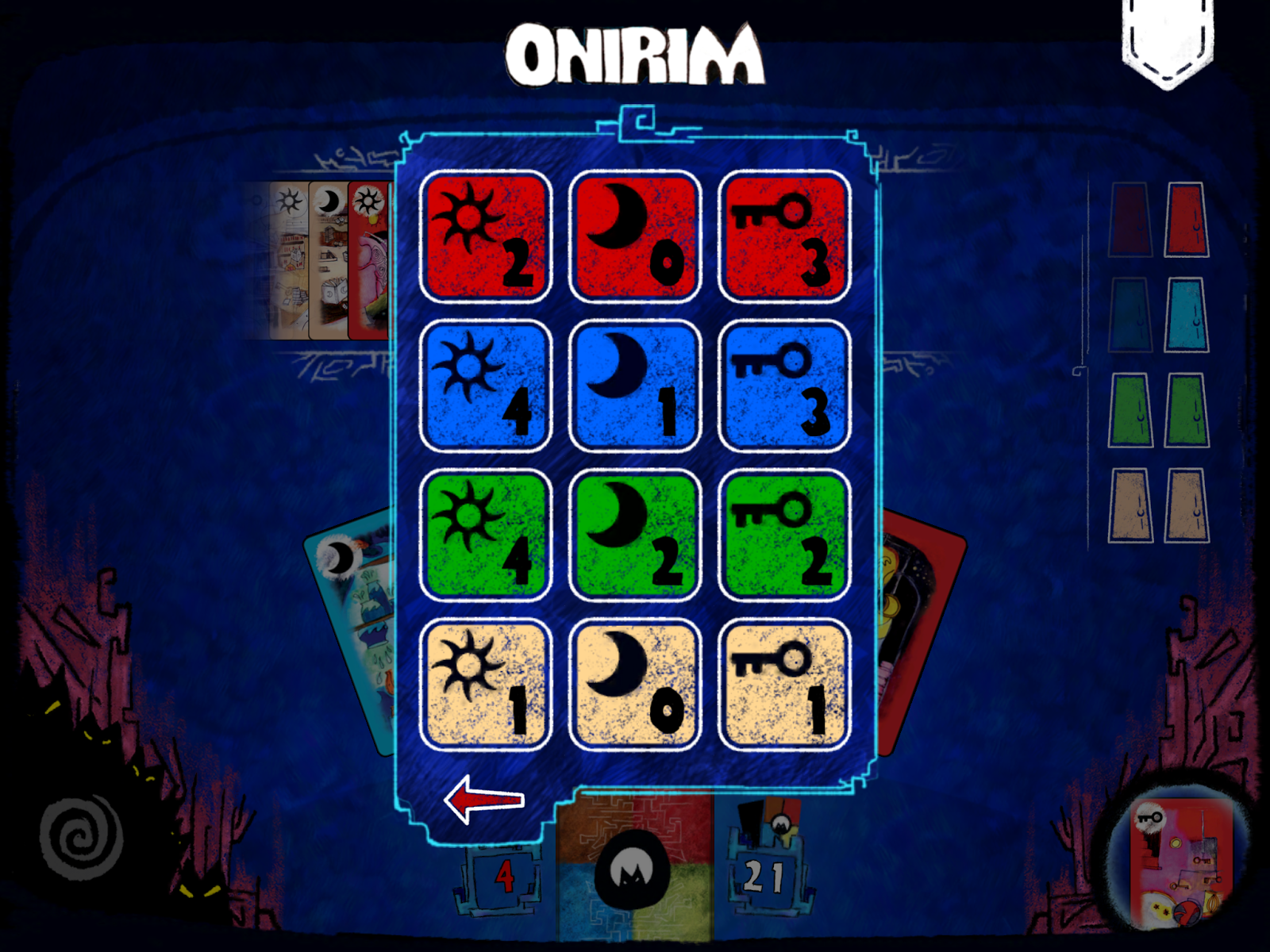
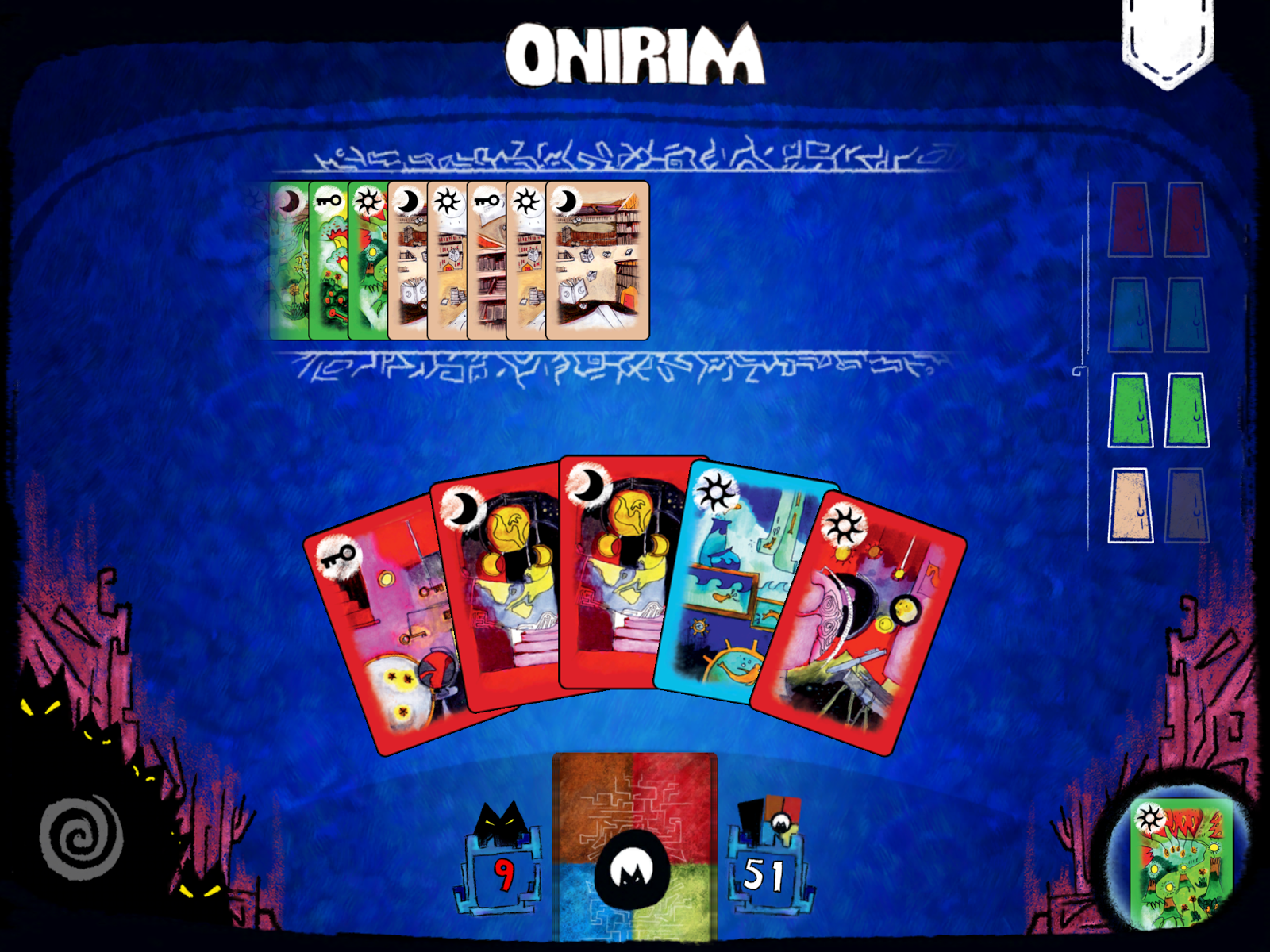
The card deck has 76 cards. Most cards are in one of the four suits - blue, red, green and beige. 10 of the cards are Nightmares. Your hand size is five. You always draw back to five at the end of a turn. The draw deck is your countdown. If you exhaust it before unlocking all eight doors, you lose. In the screenshot above there are two numbers to take note of. The red 10 means there are still 10 Nightmares in the deck. The white 71 means there are 71 cards in the draw deck. This number is your timer.

There are four types of normal cards - sun, moon, key and door. Sun cards are the most common, followed by moon cards. Keys are rare and are the most precious.

At the start of a turn, you have two simple choices - play a card or discard a card. If you decide to play a card, it is played in the play area at the top of the screen. You may play a sun card, a moon card or a key card. The only rule here is the symbol on the card being played must differ from that of the previous card. There is no restriction in colour. If you manage to play three cards in a row of the same colour, you unlock a door in this colour. You find the door card from the deck and set it aside, then reshuffle the deck. In this screenshot above you can see that one of the green doors was unlocked by having three consecutive green cards.

The second way to unlock a door is to have the matching key card in hand when drawing the door card. In the screenshot above, I had the red key card in hand when I drew the red door. The rules say that in this situation you may choose not to unlock the door, but so far I have never done such a thing. I think you would do this only when you are doing well in a particular colour and you feel you have surplus keys. Not unlocking the door means you can save the key for a different purpose. Key cards do have a powerful ability. If you discard a key card, you trigger a Prophecy. You draw five cards from the deck, discard one, then return the other four to the top of the deck in any order you wish. You can use this ability to discard a Nightmare card. Rearranging the other four cards can be very helpful too.

When you draw a Nightmare card, this is what you see. You have four options, and usually none are appetising. (1) Discard all hand cards, (2) Discard five cards from the top of the draw deck, (3) Discard a key card from your hand, (4) Return an unlocked door.

You may examine the discard pile at any time. This helps you assess probabilities and make decisions.

The last card in the play area is a beige moon card. So the next card to be played can't be a moon card. It has to be a sun card or a key card.

The Play

Onirim is a little weird, both in the backstory and in the mechanisms. I have not seen anything quite like it. It is certainly refreshing. At first I kept winning, and I thought it was rather easy. Only after a few more plays I realised at times it can be quite challenging. There are little tactics to learn here and there. The game regularly forces you to make tough decisions. Sometimes you can roughly gauge the probabilities to make a logical decision, but probabilities are just that, unexpected things can and do occur. Sometimes you don't have enough information to make a sound decision, you just have to gamble. The 10 Nightmare cards are like bombs buried in the deck. You never know when the next one will come. This makes the game tense. There is always a sense of urgency. The times you draw a Nightmare card are often when you need to make the most difficult judgement calls. Sometimes you hesitate to discard your hand cards because they are good, but then you also worry if you discard the top five cards from the draw deck they may turn out to be good cards too. This is a clever little game that gives you a decent challenge.

One blue door away from victory.

The winning screen.

The Thoughts

Onirim is a solo card game that takes only a few minutes to play. It is a filler. It is unconventional and an interesting diversion. Don't expect it to be a game you can spend an afternoon on. At the moment it is still free on Playstore and Appstore, so if you have not tried it, I encourage you to give it a go. I say this with a tourist mindset. Onirim is an exotic local delicacy you should taste, even if it's not something that will become a staple. I believe you will be happy to have experienced it.

Saturday, 21 February 2015

hooked on Samurai Spirit

I have been hooked on Antoine Bauza's Samurai Spirit recently. I first played it at Boardgamecafe.net, lost (it's a cooperative game), and was keen to try again. My second and third games were played back-to-back at Boardgamecafe.net too. Still no win. Since then, I have bought a copy and now I am up to my 12th game. Even when there was no one interested to play with me, I played it solo, controlling four characters and using the normal rules (as opposed to the official solo game rules). I was that desperate. I finally managed to win, but unfortunately I later found out that I had made some rules mistakes. So I still have not had my first real victory yet. The game structure is simple, but it can be easy to miss some rule details.

One important rule which I missed out was this: when a samurai is overcome by bandits (i.e. total strength on the right side exceeds the samurai's limit), one barricade must be destroyed. I didn't do this. In hindsight it was a silly mistake. The flame icon on the player mat should have reminded me of this. One other mistake I had made earlier was when a bandit penalty forces a samurai to draw a bandit card to give to another samurai, that bandit card must be played on the right side of the player board, and not on the left. Here's another one. When using Daisuke's Kiai power to move a bandit card from one samurai's battle column to another samurai's player mat, that bandit card can be placed on the left side if so desired. It can even be "given" back to the giving samurai himself to be placed on his left side. Samurai Spirit has a simple structure, but the magic is all in the samurai talents and Kiai powers.

I have tried the 2-player rules. It feels a little different, and works fine. You include the talent tokens of the five absent samurais. Either player can use them at the start of a turn, but these tokens are single-use-per-game. Use them wisely.

Kyuzo has a very cool ability. If the bandit card you draw has the same number as one already on the right side of your board, you immediately defeat the new bandit and put him in the discard pile. I explained to my children than this old man is very experienced, so when he sees a similar enemy as before, he easily defeats him with little effort.

This samurai has transformed into a warrior beast. Two other samurai has lent him their talents (the small rectangular tokens). He is near his limit, but with Kyuzo's talent (light blue), he can straight-away reject any card numbered 1 to 4, since he already has those.

This was my first "win". I hadn't discovered some of my rules mistakes then. I played four characters using the normal rules, as opposed to using the solo rules. Three of my samurai had transformed into warrior beasts. Only one guy was still in human form (bottom right). At the end of the game, I still had four houses and four barricades. If I had played with the correct rules, I might have won anyway.

Sturdy Gorobei was still in human form, but he was the MVP. He took on three bosses (strength 6) before he was forced to retreat from the fight.

Another "win", but with this one I am sure I would have lost had I played with the correct rules. I had only two houses remaining, and from this photo I can tell they would have been burnt down since all four of my samurais had to pass. I actually did quite well in the first two rounds. In fact I might have done too well for my own good, because only one of my samurai were injured enough to have transformed into animal form. Despite the unfair win, it was very exciting at the time. I had ten intruders at the end of Round 3, and it was a nail-biting experience flipping them over one by one to see whether they had enough fire to burn down the village.

The top row is the ten remaining intruders which I could not defeat. I was lucky - only four of them had fire.

When playing such a difficult-to-win game, the foremost question is probably whether a victory is earned through good play or it is due to good luck. If it all comes down to luck, then the decisions made by the players would become pointless. I think it is important for players to feel they deserve the win. There definitely is luck in Samurai Spirit, but I think there is a lot that players can do to mitigate risk and to improve the chances of winning. Decisions do matter very much. If you have very bad luck, then you will probably lose no matter what you do. I think in this game after setting up all the bandits (the only randomness and uncertainty in the game), there is a certain probability that you will win. Your actions will change that probability (hopefully increasing it, of course). So it's a matter of doing your best to increase your chances, and relying on a little luck (or the lack of very bad luck) to win. There are many clever ways to mitigate luck. Sometimes you can set up a situation where the active player can do something good no matter what card he draws. In such situations you have eliminated the luck factor completely. You can't do this all the time, but sometimes being able to do this at a critical moment can be very helpful.

I like to remind others to pause and think before drawing a card. The turn structure is so simple that I think many players automatically reach for the draw deck at the start of their turns, as opposed to putting some thought into whether it's time to lend support to another player. I think some players dismiss this game as luck-heavy due to the apparent simplicity. I believe the game has some subtlety and offers many opportunities for clever play. You should not just take the narrow view of what to do on your turn. You need to take a macro view and think longer-term strategy. E.g. when do you want your warriors to take injury and transform? Do you focus on preventing barricade destruction or preventing injury (you lose the game if one samurai dies)? Which warrior's Kiai power do you want to make use of (i.e. you want to boost his combat column and get others to help him achieve the Kiai value)? Within a simple decision of whether to place a bandit on your left or right, there are many considerations. If you hope to achieve your Kiai value quickly, then maybe right. If the bandit strength is high, maybe left. If the bandit has a penalty icon but your talent allows you to ignore it, then maybe right (to make the most of your talent). If from a previous round you see that a certain defense icon is rare, then maybe left. This is a simple game? Not at all!

Now I'm curious to try Ghost Stories again. It's an older cooperative game also by Antoine Bauza, and it too has a reputation for being quite hard to beat.