Showing posts with label Living Card Games. Show all posts

Friday, 20 October 2023

revisiting Android: Netrunner

Android: Netrunner is a 2012 game, originally designed by Richard Garfield, who created Magic: The Gathering. The original Netrunner was published in 1996. That version had only two decks, corporation and runner, and no expansions. The 2012 Android: Runner was designed to be a living card game with many expansions. It is similar to but not exactly the same as a trading card game. Expansions are fixed packs instead of random packs. You don't need to spend a lot of money buying many blind packs hoping to get the specific cards you want. Android: Runner used to rank very high on BoardGameGeek.com. In 2018, Fantasy Flight Games decided to terminate the game series. I was quite surprised at the time. I thought the game system was still very popular. Although there are no more official expansions and no official support, some players have organised themselves to develop and publish new expansion packs. There are still people actively playing the game. 

I've always had some hesitation going into a game with such depth as Android: Netrunner. These are what people call lifestyle games. Like Chess, Go, Magic: The Gathering, you can be a player who plays just one game. Just one game is enough to keep you busy and happy. In fact, you need to devote enough time to such a game to truly enjoy it and appreciate it. The analogy is friends with deep and meaningful relationships. In boardgame terms, I tend to be the extroverted socialite and I prefer discovering and playing many different games. 

I have played Android: Netrunner before. I own the base game and quite a number of expansions. So far I have only used some basic decks and decks designed by other players. I have not yet ventured into building my own decks. That means I have only skimmed the surface. It had been quite a while since I last played. I remembered the game fondly, but by now I had forgotten most of the rules and had to read the rulebook all over again. I decided to try to get back into the game because I bought more expansions this year. I have been buying expansions when I come across them on discount. I can't resist. I keep telling myself I'll get back into the game some day. I asked Allen to join me in learning the game system. He lives nearby so it's easy to arrange to play. We have both been playing games less in recent years, busy with work and life. If we set a goal, it may help us to get back into more regular gaming. Middle aged uncles need to be reminded to allocate some me time, or we time. Making a living should not make us forget to live a life. 


I asked Allen to play the runner (hacker). I think it's more fun playing runner. Android: Netrunner is a 2-player-only game, about hacker vs corporation. The corporation has some agenda to complete, and the runner is hacking into the corporation's servers to try to find and steal them, before they are completed. The photo above shows the play area of the corporation player. The row of cards near the bottom represents the various servers. The horizontal cards above the servers are shields protecting them. In game terms they are called ICE - Intrusion Countermeasure Electronics. Servers can be cards played by the corporation player. Hand cards, draw deck and discard pile are also servers which the runner can attack. 

The game is not just runner attacking and corporation defending. Some ice are traps and can cause damage to the runner. Although the initiative lies with the runner, the corporation certainly has many ways to trick, trip and hurt the runner. 


Allen looks troubled. This is a game with quite a lot of text to read and digest. When you get more familiar, it will be much quicker. The runner's play area is much simpler. You have your draw deck and discard pile, and three rows of various equipment (in this photo he only had two types of equipment, thus just two rows). 


As the corporation player, having agenda cards in hand is anxiety inducing. The runner can decide to attack your hand cards, and if he is successful, he randomly draws a card. If it is an agenda, it is claimed and scored by the runner. The runner needs to score 7 agenda points to win the game. In this photo I had two agenda cards, the first and third cards, and they are worth 3 and 2 agenda points respectively (number on left edge). 


This wasn't my first attempt at relearning Android: Netrunner. I think not even the second time. It had been a while, so I couldn't even remember for sure which attempt this was. This time round it felt easier to get into. It didn't feel as complicated as I remembered it to be. Both runner and corporation need to find ways to earn a steady income, because many actions require money. The corporation is generally defensive, always needing to protect the agendas and needing to put on a poker face. Sometimes the corporation plays aggressively, setting up traps to catch the runner unprepared. There is greed and risk-taking on the runner's part, and the corporation tries to make use of that. The corporation sets up ice (shields). The runner installs programs to overcome them. The corporation advances agendas to score them, before they get stolen by the runner. 

An agenda card

A piece of ice


Playing ice is free, unless you have more than one ice at the server. You only pay when you activate it to stop or hurt the runner. The more powerful the ice, the higher the cost. 


I bought two preset decks which were the winning decks in the 2016 Netrunner championships. I am lazy to build my own decks, so using the best player's deck is great, even though it'll take time for me to learn to utilise it well. This above is the winning corporation deck. 

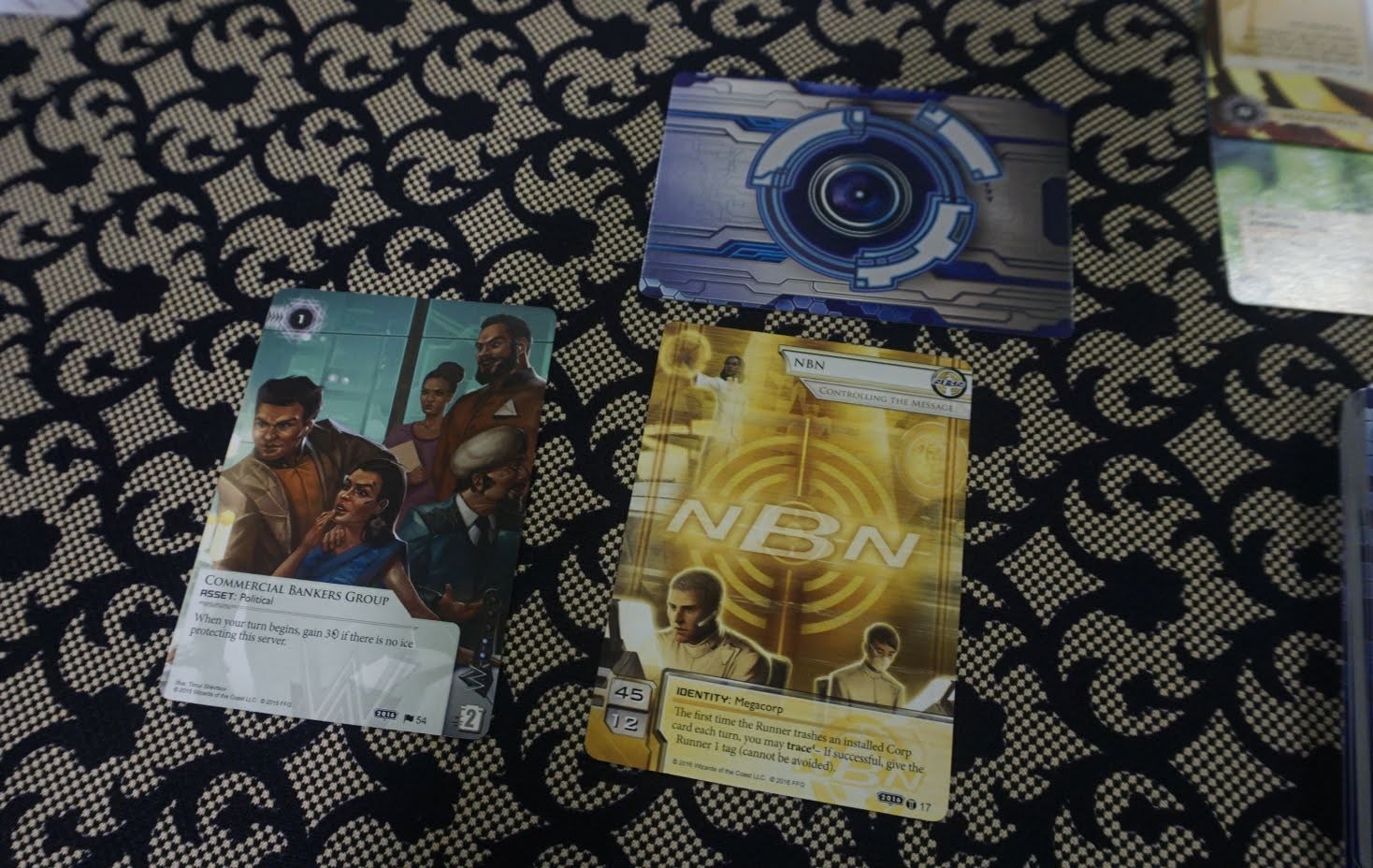
I notice the graphic design has changed. The card on the left is the newer version. The image is zoomed in and enlarged, but the font is smaller. I find the text too small. Both Allen and I struggled to read the text. This design is not senior citizen friendly. 

Thursday, 31 July 2014

appreciating Android Netrunner

Over the Raya holidays (Aidilfitri / Eid al-Fitr) I arranged with John to play Android: Netrunner, hoping to continue to learn this game. He's a veteran, and he actually started playing it at Spartan Games Arena, where I visited recently to play and learn from Nik. John still follows the latest expansions, but feels a bit tired of the chasing after new cards, and wants to return to basics - building decks using only the cards from the core set. That suits me just fine. I want to learn starting from the basics. We spent an afternoon at Starbucks and played five games. He taught me quite a bit about deck building, and I realised how poor my two deck builds were. By our third game I switched to playing with his decks, and actually managed one win game. As I learned more, I found that there was so much more I didn't know and needed to learn. It was a little daunting. Perhaps it's a good sign. It means I'm improving and I'm able to appreciate the depth of the game better. I hope. Here are my miscellaneous thoughts after this enjoying session of running.

  • I suddenly have an urge to sleeve all my cards. I think most if not all serious runners do this. I suddenly have this urge because I realise this game has a lot of replayability even with just the core set, and there is a lot of fiddling with the cards because of constructing and reconstructing decks. I suddenly see that even just the cards from the core set is a cultural artifact that needs to be preserved. I can't explain why I don't feel this way about Race for the Galaxy, a game I love and have played hundreds of times, until some of the cards are obviously frayed at the edges.

    I was playing John's Criminal runner deck. He uses red-backed sleeves. I'm thinking of getting transparent ones.

  • I learned that there are three main types of ice (firewalls protecting the servers), and thus also three main types of icebreaker programs to break their subroutines. In hindsight it's amazingly dumb of me how I never bothered to check this. No wonder my first attempt at deck-building was laughable.
  • John taught me to run naked (and I must explain before your imagination runs wild). Running naked means hacking at the corporation's servers in the early game when you don't have any programs installed yet. The corp doesn't have a lot of money yet, so it will not be able to rez (turn on) any powerful and dangerous ice. You don't have any program at risk of getting trashed. You can force the corp to reveal the newly placed ice, which is useful information to you. If the corp player doesn't rez his ice, you run successfully and if lucky you may even score an early agenda. So running naked is a very viable tactic.
  • To play well, you need to know almost every detail of every card. Remembering the names of the many cards is not something you force yourself to do. It actually comes naturally after you spend much time playing, discussing with your friends, and deck-building. Tell a veteran an icebreaker-and-ice pair, and he can probably immediately tell you how much it would cost for the former to break all subroutines of the latter. It's like having memorised the multiplication table. After an afternoon with John, I've learned to remember some of the more powerful cards to watch out for, like Snare and Scorched Earth.
  • Some cards can be particularly powerful, even to the point of becoming game-winners, under specific situations. The game is very much about trying to create such situations to play these cards, and also preventing your opponent from doing it to you. I have learned this in Hearthstone, but I still need to learn the cards in Netrunner better to be able to do the same. One thing that I wonder is whether this will result in groupthink. If everyone thinks a card is best used in a certain way, then the group may become stuck in a narrow mindset and not explore other viable tactics, possibly even more creative ways to use the card.
  • I am amazed at how consistent the setting and the mechanisms are. The core mechanisms are not exactly simplistic, but are not overly complex either. There are servers, firewalls, programs, subroutines, tagging, viruses, bad publicity and so on. All the card powers tie back to this handful of core elements, yet there is much variety.
  • John thinks the default decks in the core set are weak, but decent decks can be built using only cards in the core set. One just needs to tweak the decks a little and use some cards from other factions. He shared with me his deck builds. I'll probably just use them as they are for now, until I get a better feel for the deck-building aspect.
  • In one of the games where I played the Jinteki corp using a deck I built, John played the Criminal runner with a deck he built. One of the powerful Jinteki cards is Snare. If the runner accesses Snare when hacking into a server, the corp may spend $4 to discard three of the runner's hand cards. If the runner doesn't have enough, he is flatlined and loses. John was very careful about not getting caught by Snare. There were a few times when he managed to reach my server, but because I kept at least $4 on hand, he hesitated and jacked out at the last minute, deciding not to access the server after all. That saved me a few times. I actually didn't have any Snare waiting for him. I was just bluffing. In fact, after the game (which I eventually lost) I realised I hadn't put Snare into my deck at all! No wonder I didn't draw it even after half my deck was gone.

Sunday, 13 July 2014

Learning Android Netrunner

I've been neither here nor there on Android Netrunner. I think it would be a very interesting game to learn, but I don't play it frequently enough, and I don't put in enough effort to learn it in depth. I don't have a convenient opponent who is particularly keen, yet I don't actively seek out the active players, despite knowing there are some in the Kuala Lumpur vicinity.

I recently picked up the courage to put out a request for some coaching games, and Nik from Spartan Games Arena invited me to come over to play. I opted to play a runner. I played Kate of the Shaper faction, an easy-to-play character. I used mostly the basic deck with just a little customisation. Nik showed me Haas-Bioroid first, and then Jinteki for our second game. Both were custom decks.

I asked many questions when we played, on overall strategy, the do's and don'ts, tactical considerations under various situations, and the different play styles of the factions. Nik was very generous and shared many insights. It was an eye-opening experience. I was amazed by the many nuances in the game. I was a little overwhelmed, not by the rules complexity or by the variety in card powers, but by the many strategic considerations that a good player needs to make when playing. Understanding and appreciating these intricacies is one thing, digesting them and applying them will take more time and effort. I felt like taking out a notebook to take notes, for fear of forgetting the insights I managed to glimpse.

  • I learned that it's perfectly normal for the runner to spend two or three turns just collecting money and drawing cards to build up enough resources for a big run (attack), or even a series of runs. There is a tempo to Netrunner - preparing and building up, and then attacking, and then regrouping and planning for the next assault. Players have to manage this timing and know when it's best to attack. For the corporation player I guess it's making sure you are well-prepared for the next time the runner attacks. For the runner it is quite pointless and can even be dangerous to attack when you are not fully ready, e.g. not having enough cash or not having enough cards in hand. The corporation will fear you when you have accumulated enough money and cards, because money usually means being able to break through ice (firewalls / defenses) and reaching the servers.
  • Managing the money aspect is not just about making money as efficiently as possible. It is also about forcing your opponent to waste money, or luring him into doing so. Nik applied this to great effect in our second game. When I had built up a small fortune, he revealed two remote servers which were big money-makers. The Jinteki identity he used required me to run against a central server (regardless of outcome) within the same turn before I could run against any remote server. His discard pile and draw deck were lightly defended, which was tempting. So I took quick snipes against them (didn't find any agenda though), and then went for his money-making assets at the remote servers before he could fully realise their benefits. Little did I know these were all part of his plan. He actually had three agendas in his hand of four cards. If I had attacked his more heavily defended hand (HQ), it could have been devastating to him. Instead, I spent most of my money running against other servers, some of which looked like low-hanging fruits and some of which looked like urgent threats. Needless to say soon afterwards he played agenda after agenda and reached 7 points before I could muster enough cash again to stop him.
  • Cards in the game do have various strong powers, but I feel the core of the game is still the psychological battle between the players. The cards are nifty tools, but ultimately you still need to outguess and outsmart your opponent. In contrast, in Hearthstone sometimes I feel that at any one time by looking at the table and at your hand, it is obvious how you should play your current turn. There really is not much to think about. It feels like the the game is mostly in how you have built your deck, and in what cards you happen to draw. There is not a lot to think about during execution. But then perhaps that's precisely what the design of Hearthstone is aiming for - a fast-paced and accessible game. In Netrunner I find that you need to keep thinking of your opponent's intentions. Why is he doing that? Is he trying to lure me into a trap? Is he merely bluffing?
  • Nik advised me that it is usually a bad idea to run using the last action (click) of the runner. If something goes wrong, you won't have time to react. E.g. if you get tagged, the corporation player will destroy your resources on his turn. Also some ice subroutines can be broken by spending actions, so having some spare actions is good.
  • Actions is an important currency too. An asset that lets you make money without needing to spend any action is more valuable than one which requires actions.
  • In Hearthstone I have reached the stage where I can appreciate the characteristics of each hero, the kind of cards they have, and the general strategies they gravitate towards. Netrunner has this too. I'm nowhere near there at the moment, but I feel it will be even more interesting than Hearthstone if I do get there.
  • I realised I have played one important rule wrong all this while. When installing ice, if the server already has other ice installed, you need to pay $1 per existing ice. It's embarrassing that I got this wrong all this while. I actually have this in my own rules summary.

Sunday, 28 July 2013

Android: Netrunner

Plays: 2Px3.

Netrunner is a 1996 game by Magic: The Gathering designer Richard Garfield. Fantasy Flight Games republished it in 2012 with some modifications, and gave it the same setting as the boardgame Android, thus the new name. I have heard good things about this game even before the re-release, but never quite got interested enough to try it. It was only after the March Madness tournament on BGG this year that I started considering this game seriously. I was surprised that this reprint won, and also that it had reached 5th place in game rankings.

The Game

Android: Netrunner is a two-player card game. One player is the corporation, the other the runner, i.e. a hacker. The corporation's objective is to complete agendas worth a total of 7pts, while the runner's objective is to hack into the corporation's servers to steal agendas worth a total of 7pts. The corporation sets up servers to advance its agendas, and protects them with ice (anti-intrusion software). The runner attempts to invade to steal agendas and to destroy the corporation's assets. If the corporation's deck of cards runs out, it loses. If the runner is forced to discard cards and doesn't have enough to do so, he is flatlined and loses.

The corporation's play area is made up of servers. The draw deck is a server. The discard pile is a server. Even the hand of cards, represented by the corporation's identity card, is a server. The corporation can create new servers (called remote servers) during the game. Agendas need to played as a server for the corporation to advance and then score them. Assets can be played as servers too. Assets usually give some benefit to the corporation, or act as a diversion or a trap to confuse the runner. When the corporation plays any card, it is played face-down. So the runner will not know what it is until it is activated (flipped over) by the corporation, or exposed by the runner. The same applies to ice which the corporation plays in front of servers to protect them. Only after the runner has encountered a piece of ice for the first time will he know what it is - how powerful it is, what is required to bypass or neutralise it. There is a cost for the corporation to activate any card, so it is important to have cash on hand. Non-activated cards have no effect.

I'm playing the corporation. The row at the bottom are my servers. The first three from the left are remote servers, i.e. servers played after the start of the game. The third server is an asset and has been activated. It is giving me $1 per turn now. The fourth server is my corporate identity card, which represents my hand of cards, called my HQ. The fifth server is my draw deck. The rightmost server is my discard pile.

Most servers have ice protecting them now (the horizontally played cards). However none are activated yet. Usually you need to pay money to activate a piece of ice, and you can do it when the runner is approaching it.

The runner's play area is much less structured. Only those cards in the top right corner need to be organised into three rows by type, and this is only for convenience.

On a player's turn he takes four actions. For the corporation player the first action must be to draw a card. Other actions include playing a card, collecting $1, removing a virus, and destroying a resource card of the runner (which can only happen if the corporation successfully traces the runner). The runner has some action types which are similar to those of the corporation. The most important action type of the runner, which is also the centre of the game, is making a run, i.e. attacking a server. The runner picks a server to attack, and tries to work past all the ice protecting it to access it. The runner has hardware cards and program cards to help him do this. Icebreakers are programs which are needed to penetrate the corporation's defenses. An icebreaker first needs to have sufficient strength to interact with a piece of ice, and then often it also needs to be able to disable subroutines that the ice will trigger. Subroutines do things like terminating the run, causing harm to the runner, and tracing the runner. If the runner can work past all active defenses, he accesses the server, and gets to reveal, or steal, or remove the card. This is how agendas are stolen.

For the corporation to complete an agenda, it needs to do an action called advancing the agenda. When this is done, $1 is placed onto the card. An agenda is completed only after a certain number of coins are placed on it. It usually takes more than a turn to complete an agenda, so there is always some time when it is vulnerable to attack. The corporation can't play and then complete an agenda within the same turn. What is tricky for the runner is guessing which remote servers are agendas and which are not. Often the corporation can set traps, or diversions. This game is very much about double-guessing.

The Play

I played twice against Allen, and once against my wife Michelle. In the first session I thought it would be more fun playing as the runner, so I let Allen play that side. It turned out it was tougher than expected. In the first game I caught him unprepared for my traps, and he was flatlined (required to discard card but he had run out of cards) and lost the game. He was more careful the next game, and this time I won by scoring 7pts on agendas. The most memorable moment was a run that he made against my hand of cards (which is called the HQ in the game). At that point I had four cards, and three of them were agendas! I had no decent ice protecting my HQ and was already trying hard to appear calm. He easily hacked through. He randomly picked a card from my hand, and picked one of the agenda cards. I pretended to be frustrated with his good luck. He decided he was lucky, and didn't bother to attack my HQ again, assuming that there wouldn't be such a coincidence of me holding more than one agenda card. Had he pressed his attack, he probably would have won that game. That was an almost-peed-in-my-pants moment.

Playing the corporation, I felt exposed and vulnerable. My hand and my draw deck were defenseless at the start of the game so I had to scramble to get some ice up. Agendas are a love-hate thing. I need them to win, but they make me nervous. I try to play them as casually as I can, pretending they are just regular assets. But of course when I start advancing them, the runner will be like a shark smelling blood. Thankfully the corporation has some traps which can be advanced too, which can be used to confuse the runner and lure him into traps. I don't have a good grasp yet of whether a wider defense is better, or a deeper one. A wider one means it's harder for the runner to guess which servers hold agendas, but less ice per server means weaker defenses. A deeper defense means it is more costly for the runner to attack, or even impossible if he doesn't have the appropriate icebreakers yet. I think different situations will warrant different approaches.

Allen feeling very at home. Well, we were playing at his home.

When I played the runner against Michelle's corporation, I felt the pain of poverty. I managed to get many hardware cards and program cards in play, but I was poor most of the time. I wonder whether I shouldn't have spent so much money so quickly on equipment. Michelle on the other hand maintained a decent treasury most of the time, anticipating my attacks. Having many programs was handy, and I managed to hack into many of Michelle's servers, destroying assets, exposing decoys and stealing some agendas. However being short on cash meant I was conservative about attacking heavily protected servers. Eventually Michelle managed to score 7pts of agenda before I could get organised enough to stop her.

It's not easy to beat an accountant at moneymaking.

The Thoughts

Android: Netrunner has a rare setting, and it's not window-dressing. I find it quite interesting. The mechanisms click with the setting. I like how you need to constantly try to read your opponent's intentions. It's psychology. Is he bluffing? Is he gambling? Is he making a feint or is this for real? Will he take the bait? How do you use your actions to lie, to lure, to distract, to terrorise? This is a very interactive game and you need to pay attention to what your opponent is doing, and adjust your strategy based on what you think he's trying to do.

The game is an LCG - Living Card Game. After the initial base game, many expansions have now been released. The base game already comes with enough cards to play four different corporations and three different runner factions. However there aren't enough cards to explore the deck-building aspect of the game. When you pick a corporation (or faction) to build a deck for, you can pick any number of cards belonging to that corporation and any number of neutral cards. You can add a limited number of cards from other corporations. With the base game, you have limited choices in cards, so there really isn't a lot of deck-building you can do. I have only played three games, and have only seen one corporation and one runner faction in action, so I'm nowhere near considering buying expansions. But I do see there is much to be explored. Nowadays I am less interested in trying many games and more interested in exploring fewer games but more deeply. Android: Netrunner is a good candidate. I look forward to play more.

Sunday, 21 June 2009

A Game of Thrones LCG, and games with too much work

I recently played A Game of Thrones LCG again, with Han. This time we did deck-building. Well, it's a rather limited deck-building, since we only had two basic decks for each House. He had lent me his Lannister and Targaryen decks, and I had lent him the Stark and Baratheon decks. The basic decks come with less than 60 cards. When doing deck-building, you need to have 60 cards, and there can be at most 3 copies of the same card. So we didn't really have much maneuver space using only 2 basic decks. Anyway, this was just our initial foray into deck-building.

On 13 Jun 2009, we played Stark (Han) against Lannister (me), just like in the novels. This was our 3rd game, but our first time trying deck-building. The deck-building aspect didn't really come out very much, at least it didn't feel so to me. Well, maybe having two copies of Jaime Lannister (a powerful character) in the deck did help to increase my chances of drawing him (which I did). The Lannisters are very rich, and managed to get more characters in play quickly. They also won many intrigue challenges, which meant I kept discarding cards from Han's hand. The Starks are strong militarily, and tend to win military challenges, which meant Han was more successful in killing my characters. Thankfully I had some cheap characters and could afford to have some getting killed. Knowing that the Starks have a Valar Morgulis plot card (which kills all characters of all players), I was wary not to have too many strong characters in play when Han had few. He would play that card and just reset everything. So I guess I'm starting to see how players adjust strategies based on knowledge of the House decks.

As the game progressed, the Starks could not keep up to the Lannisters' wealth, and could not bring in enough characters to compete with the Starks. The Lannisters won the duel.

Having played 3 games, and having started dabbling in deck-building, I still feel like a newbie (which is probably not surprising). The game has so many special powers it is difficult to remember all. When you have many cards in play, and almost every card has some special power, it is daunting. It felt like so much work trying to keep track of all of them. The basic rules are not complicated, it's the special powers that make the game rather tiring to play, at least for a newbie like me.

I suspect the base game is much less fun than when you have more cards to do some proper deck-building. My guess is the base game just gives you a flavour, but you really need to buy more cards for the game to shine. I may be wrong, since I have not yet played with more than 2 players. The game will likely be much better too with 3 or 4 players, because the titles will come into play. I am hoping to play a 3P game with Han and Chong Sean when I return to Kota Kinabalu. I look forward to seeing how the titles affect gameplay.

Playing A Game of Thrones LCG reminds me of games which have too much work, so much so that it is starting to lessen the enjoyment of the players. For AGOT LCG, this is the case for me at least for now. I compare it with Blue Moon, and at least for now I prefer Blue Moon, because there are less special powers, and less rules, and yet every deck still feels unique and has a lot of flavour. It is impressive that this is achieved with such (relatively) simple rules. That's Knizia for you. And no wonder. He admitted that he spent a lot of effort in creating Blue Moon.

Another game with too much work is Indonesia, but maybe that's just because we played 2P. I'm not sure whether it is possible to reduce this "work". Perhaps it is not possible. Perhaps it is just the price you have to pay to play the game. Think of all the setup you need to do for Through the Ages. So today to save some setup effort (for the 2nd game), Michelle and I played two back-to-back games of Through the Ages. In the evening she fell asleep at about 9pm.

Monday, 20 April 2009

A Game of Thrones LCG

I can probably count A Game of Thrones LCG as the 3rd time that I am trying a CCG (collectible card game) or CCG-like game, the previous two being Blue Moon (not really a CCG but an "expandable card game") and Magic: the Gathering (free copy of a Romance of the Three Kingdoms-themed starter set). I have played 30+ games of Blue Moon, and own all 11 decks (8 main races and 3 special expansions). I quite like it, and am starting to grasp some of the strategies, but I don't really play it often enough to be able to fully enjoy it. I have only tried Magic once, and can see how its simple system can expand to be very rich and interesting, but am far from appreciating the strategies involved. And of course, I have not tried deck-building at all (unless playing Dominion counts as a simple form of deck-building).

I was interested to try AGOT LCG mainly because of the novels, and also because of its new LCG format, that publisher Fantasy Flight came up with. I wouldn't say it's a completely new idea. This idea may have come from the Blue Moon model (also published by them). Han also likes the novels. Both of us bought AGOT LCG. When Han was in town on 17 Apr 2009, we gave it a go.

In AGOT LCG, you need to gain 15 power to win. The game starts with no power. Power comes into the game in different ways. You can earn them. You can grab some from your opponents. Sometimes power also exits the game, e.g. a character which has power tokens on him/her gets killed.

At the start of a round, all players select 1 plot card (out of 7) to play. Plot cards determine how much money you get for this round, initiative / turn order and how big the effect is when you win challenges (e.g. how many opponent characters you get to kill). All plot cards also have special rules which often affect all players for that round. Knowing your plot cards and your opponents' plot cards is an important aspect of the game, and you should plan the usage of your plot cards well.

You then put new cards into play by paying their costs. There are four types of cards. Character cards are the main type. They participate in challenges against your opponents. Attachment cards are things like weapons, pets, titles etc that can be attached to characters. Location cards usually give you extra money, or influence, and sometimes also some other benefit. Event cards do not have costs. They are usually powerful one-time-use cards. After everyone has put characters in play, each player take a turn to initiate up to three challenges. If you win a military challenge (as attacker), one (or more) of your opponent's characters get killed. If you win an intrigue challenge, you randomly discard a card from your opponent's hand. If you win a power challenge, you take one power from your opponent. Characters that have been involved in a challenge are "knelt", which means "used up for the round" (equivalent to "tapped" in Magic). After every player has had the chance to issue challenges, there is a dominance round where the player with the highest remaining strength among standing (i.e. not knelt) characters gain one power. That's basically how the game works.

However, almost every card in the game has some special text, describing some special power. Many cards also have one or more keywords like Renown, Deadly, Lord, Night Watch, Creature, Stalwart, describing some special ability or trait. Some cards also have an icon, e.g. a ring meaning noble-birth, crossed swords meaning an army. There is a lot going on, a lot to read, a lot to learn, a lot to remember.

Han and I played two games, in the first one he played House Stark and I played House Lannister. I was lucky with my early draws, getting Tywin Lannister (head of the house, and very powerful) and being able to play him. I was quite rich (Lannisters are rich). However, Han played the Valar Morgulis plot card, and killed off all characters, mine and his. That was painful. In hindsight I should have thought of that, since I had read all the cards beforehand. I should not have played so many good characters so early, or I should have tried to protect them from getting killed. After this "reset", House Stark's strength started showing. They are militarily strong, and tend to win military challenges. So they kept killing off my characters, and I could not slow their momentum. Han won decisively with about 16 power. At the time I only had 2 I think.

In our second game Han played House Targaryen and I played House Baratheon. Again I was quite lucky with my early draws. I had the three Baratheon brothers in play from quite early on - Robert Baratheon (the king), Stannis Baratheon and Renly Baratheon. I also managed to get many location cards early, which helped in providing additional income and influence. Han was not so lucky with his early cards. However we both had many cards in the early game. Han played a plot card that allowed us to draw extra cards.

House Baratheon has many characters with the Renown keyword, which means when they win a challenge, they earn a power in addition to the normal reward, to be placed on the character card (instead of the house card). Robert Baratheon's Renown power is double the normal! So I gained power at a great speed. House Targaryen has some characters which are hard to kill, or can easily come back after getting killed. It also has dragons, which are quite powerful. Gradually, Han started killing off my characters, and I could not keep up in trimming down his characters. One decisive play was him being able to take control of one of my armies of strength 6, which has both military and power challenge abilities. That was painful. Eventually, Robert Baratheon was killed (i.e. I lost all the power that he had accumulated), and then Renly Baratheon (I have been making use of him a lot, because he could stand up and fight again and again by paying influence), and finally Stannis Baratheon as well (also a lot of power on him). At the time Han was leading at about 9:6, but I conceded defeat. He had around 11 - 13 characters in play, and I only had a few left. No way I would be able to catch up. The closest I ever got was 12 power I think. I think House Baratheon's best strategy is probably to gain power quickly and reach the finish line before your opponents could do anything to stop you. Also you need to protect those characters who are accumulating a lot of power. I should have protected them better. Not sure whether I could have, but I think I should have worked harder at it.

I played House Lannister. The top row are the character cards, and the bottom row the location cards. There is one event card attached to Tywin Lannister on the top right. In this instance the event card is also treated as an attachment. Normally event cards are played once and discarded.

Stannis Baratheon. Top left corner is the cost to play this card. The flag icon on the left of the card name mean this is a unique character, and that if he dies, there can be no other Stannis Baratheon. The shield on the right shows the house this card belongs to. The number in the shield on the left is the strength. The red and blue icons below it means Stannis can participate in military and power challenges. The "B 72" on the right is a serial number. The ring icon on the lower right means Stannis is a noble.

Han looking through his cards. This was our second game, where he played House Targaryen and I played House Baratheon.

The three Baratheon brothers. There are two copies of the Robert Baratheon card in play, which means if something is going to kill him, you can discard one card and keep him alive. Stannis currently has one power token on him.

This was probably the peak of the game, when Han had 9 characters in play, and I had 7. I had 6 location cards in play. Soon after this things went downhill for me, and I never recovered.

Having played two games, I don't know yet whether I like the game. I definitely enjoyed seeing the many characters and aspects of the novels come to life in the game. The gameplay is more complex than I expected. Much more complex than Blue Moon or the version of Magic that have I played. This is because almost all cards have special text. This is daunting for first-time players, and I think it will turn off non-gamers. Having played the game now, I can completely give up hope of ever being able to convince my wife to play this. I'm not complaining about the game being complex. Just stating a fact. I wonder whether having special powers for every card is a tendency of CCG's. Afterall, a small pack of CCG is not cheap, so maybe having special powers (and not ones that exist for the sake of existing) helps publishers make customers feel the cards are worth their cost.

One thing I can definitely say about AGOT LCG is it is very rich. Maybe that's a more positive way of saying it is complex. I find that there is a lot to explore, and I am interested to explore it further. I think the game will get better when we get more familiar with the various cards and their powers, very much like Blue Moon. We will be able to anticipate what cards will come. We will learn the strengths and weaknesses of each house. The different houses play differently, and feel quite different. I like that. At the moment the many different powers of the cards are daunting to me. Our 2 games progressed very slowly because we need to read all those text, and also let each other read the text on our cards, or at least explain what the cards do. But my gut feel is each card has its uses, and there won't be many (if any) cards that are completely useless. I have a feeling that there will always be a strategy that you can weave a card in.

Han suggested that we try deck-building. He lent me his Lannister and Targaryen decks, and I lent him my Stark and Baratheon decks. So we focus on learning to play two houses each. We'll only have at most 2 copies of the same card (rules allow up to 3), but I think that should be good enough for our exploration. This will be the first time that I truly dabble in deck-building.

I have some doubts about whether I will be pursuing AGOT LCG further. I found out that their chapter packs cost RM55 (~USD16) each, which is not cheap, and each chapter pack will have 40 cards, 3 copies each of 10 cards, then 1 copy each of 10 other cards. That means you only see 20 new cards in each chapter pack. I think there are already about 8 to 10 chapter packs already released. And I am sure there are many more to come. That looks like a very deep hole to get sucked into, the very reason that I am not keen about CCG's. I will probably just stick to the core game for now, until I have played it many times and get very familiar with it. If I like it well enough, then I probably will buy some chapter packs or other forms of expansions that interest me, e.g. getting cards for House Martell and House Greyjoy.

AGOT LCG may be quite different, and probably better, with more players. With two players, some cards lose some effect. Also the gameboard and the titles are not used. Titles give special bonuses and abilities for the round in which they are chosen. You can use them to prevent an opponent from attacking you. You can use them to gain additional rewards when you attack someone. I think the game will be more interesting with more players, because there will be alliances and betrayals (just like the novels), and it is harder for one single house to dominate the game because the other houses will work together to stop the leader.

So, no verdict yet for AGOT LCG from me. I'll write more thoughts after I play more.