Showing posts with label wife. Show all posts

Sunday, 15 November 2015

Russian Railroads

Plays: 2Px5.

Russian Railroads won many awards, the most prestigious one being the Deutscher Spiele Preis (2014). It also won the 2013 Meeple's Choice Award and the 2014 International Gamers Award. It was nominated for the 2014 Kennerspiel des Jahres too. I had read positive comments and was interested to try it out. Unfortunately when it was played at Boardgamecafe.net I couldn't make it, so I missed that opportunity. Then for my birthday this year my wife Michelle said she wanted to buy me a game. This was the game she had her eyes on. She seldom plays boardgames now. She has other interests and hobbies. However since this was a birthday gift, naturally it came with "play with me" vouchers (figuratively speaking).

The Game

Russian Railroads is a worker placement game and a development game. You are industrialists building railroads, developing steam engines and growing industry in Russia. The design is very Euro, very multiple-ways-to-score-points-y. There are four main paths you can pursue - the three rail lines plus industrialisation.

This is the player board. There are three railroad tracks, and the series of purple hexagons at the bottom is the industrialisation track. The black markers on the three railroad tracks indicate how far you have extended the railroads. Some spots on the tracks indicate benefits you gain once your markers reach those spots. After you build your railroads, you can upgrade them. Black is the lowest grade. You can upgrade it to grey, then brown, then biege, and finally white. Upgrading must be done starting from the left, just like how you advance the black markers. Higher grade markers may never overtake lower grade markers, so you need to push your lower grade markers ahead before you can do upgrades to higher levels.

The Trans-Siberian Railway (the topmost) currently has two trains valued 2 and 1. That means my train can only reach the 3rd spot on the track. Some of the benefits on the tracks can only be claimed if your trains can also reach the specific spots. Thus the need to upgrade your trains.

To advance along the purple industrialisation track at the bottom, there is a type of industrialisation action you can take. It's just a simple matter of advancing the purple hexagonal marker, which scores points for you every round depending on where it is. However the higher half of the industrialisation track is broken up, and you need to build factories to link up the fragments before your industrialisation marker can advance further. Factories that you build (for now there's only one here) give benefits when your marker lands on them.

This is the main board. This is a worker placement game, so most of the board is spaces for you to place workers and take corresponding actions. This side is for 2 players. The other side is for 3 and 4. The actions on the left section are for building tracks of specific grades. The actions on the upper right are for things like developing better trains, building factories, collecting money, and advancing industrialisation. The characters on the lower right are the engineers. Engineers are additional spots to place workers on to execute actions. These actions are usually stronger. Every round there is one engineer offering an additional placement spot on the main board, and there is also one engineer who becomes available for recruitment. If you recruit him (by paying money), or her, you get a private worker placement spot. At game end there is a bonus scoring done based on everyone's engineers too.

The game comes with many engineers. These are but a subset.

Some spots take one worker, some spots require two. There's one here which requires one worker and one coin.

The train tiles are at the same time also factory tiles. The back side is the factory side. The factory ability is shown as an icon in the top left corner of the train side, for the convenience of the players.

The number of rounds is fixed. You try to maximise your scoring within this limited number of rounds and actions. There are many ways to score, but to score big you need to specialise. There is no direct conflict. Competition is mostly of the I-got-it-before-you-nyah-nyah-nyah type.

The Play

When I played with Michelle, I only realised I had made a rule mistake by our third game. We had played with too many train tiles. The number of train tiles in play depends on the player count. Having too many in play meant our train development was very slow. When you claim a new train, you must take the lowest one available. So having more in play meant we were stuck with lousy trains for a long time. Our first few games were a bit off.

The worker placement element is not particularly outstanding. It works, and that's about it. The track upgrading mechanism is something new, but that doesn't carry the game. What makes the game attractive to me is the many little nooks and crannies in the strategy space. Yes, you do keep returning to one or two of the four broad strategies, the three railways and industrialisation, but within these broad strategies there are many very specific tactics which you can exploit to score you many points. To make the most of such special powers or scoring categories, you need to do much aligning of stars. This means you can't afford to try to do everything. You need to do a few things that synergise very well, and you need to be disciplined in pursuing your strategy. Flail about, and you'll end up neither here nor there.

In the strategy space there are many small corners to explore, and it'll take many plays to try every one of them. You can try to start a game with one particular tactic in mind, but it will not always work out. It depends on the kind of engineers available, and the actions of your opponents. Also some bonus scoring cards are randomly removed at the start of every game. You may anticipate to claim a particular card only to discover at mid game that it is not in play.

In this game I focused on the Trans-Siberian Railway. My black marker is at 11 now, getting ready for the final push to the end. The grey, brown and beige markers are chugging along. The Trans-Siberian Railway has 8 slots for x2 markers, which double the railroad track score for the corresponding sections. A beige section has a base value of 4VP. When doubled it's worth 8VP. I have 3 beige sections now, which is 3x8=24VP, a quite respectable amount. There is a price to pay for all this though. My other two railroads are completely neglected. The black markers are still at 1.

The factory on the left allows all engineers you own to score once, so usually you trigger this after you've employed some high valued engineers. The factory on the right gives you two x2 markers.

In this particular game I focused on the third railway and industrialisation. I have completed the railway (black marker at 9), and my train (level 9) is able to travel all the way to the terminal station.

The orange discs are special ability discs, all very powerful. Everyone gets a set of six, and you will be able to use at most four in a game, if you meet all the criteria. In this photo I have triggered two of them and thus I have placed them on my player board.

I find that I tend to prefer working on the Trans-Siberian Railroad. In this photo, the orange special ability disc I have picked increases the base values of my brown, beige and white tracks. Their values are increased from 2 / 4 / 7 to 3 / 6 / 10. This works very well with a Trans-Siberian strategy because it has the track score doublers. That said, upgrading tracks to the max level takes much effort and persistence, so usually you only get to score big by the last or second last round.

In this particular game I emphasised the first and second railroads. At the top right corner I have three engineers and I have assigned workers to work with some of them.

The Thoughts

Russian Railroad is a very Euro Eurogame. That can be good or bad depending on your personal preference. It's a medium-heavy strategy game. The game quality is solid. It is not ground-breaking or particularly innovative, but there is decent depth and replayability.

Michelle has yet to win a game. In the last two games we both thought she was going to win, but after the final tally it turned out that I was victorious again. I probably want to keep it this way. It seems that the longer that she doesn't win, the more keen she is to play and to beat me. Nowadays getting 5 plays out of a new boardgame is a minor achievement worth celebrating. I look forward to more plays and experimenting with tactics I have not yet tried.

Wednesday, 25 February 2015

my family's top tens

In 2012, I asked two of my gaming buddies to make our top ten lists simultaneously. It was an interesting exercise for me, because despite gaming together regularly, we never really discussed what kind of games we liked and we never gave much thought to what our top ten games were. I recently thought why not do this with my family. Maybe that would bring out some interesting findings (at least to me). And it did. I didn't ask them to write any essay on what kind of games they like. I just asked for their list of top ten games. So the thoughts below are mine, not theirs.


Michelle

When I asked my wife Michelle about her top ten games, her immediate response was "those simple card games". We used to play many games in the past, but she has been less active in the past few years. Many of the games on her list are games we used to play a lot of in the past. She didn't rank them. From my records, she has played 278 different games, which surprised her when I told her so.

  • Race for the Galaxy / Roll for the Galaxy - She combines these two into one entry. They feel similar enough to her. Roll for the Galaxy is new and we have only started playing it this year. We have played a ton of Race for the Galaxy in the past, using the advanced 2-player rules.
    Race for the Galaxy

  • Through the Ages - Another game which we have played a lot of. Almost all my games of Through the Ages and Race for the Galaxy are played as 2-player games against Michelle. If you ask me to play these with others, it would feel weird. I am too used to playing only with her. I am quite sure despite our many plays, we have not explored the full strategic space because we are limited to what only the two of us can think of. We don't read strategy articles on the net. We don't play these games with others so no new ideas are injected into our gameplay. I think we have also established some unwritten rules, or conventions, and we may not even be consciously aware of some of these because we have become too comfortable with them.
  • Mystery Rummy #1: Jack the Ripper - A rummy-like card game for 2 to 4 players, but I think it's best with two. It's a game we can play on auto-pilot.

    Mystery Rummy #1: Jack the Ripper

  • Carcassonne - Our first spouse game. However we did play this with many of our friends in Taiwan. It was a big hit with them.
  • Agricola - There was a period when we played this heavily.
  • Ticket To Ride and games in the series, but not including the card game (which I own) or the dice game (which I don't).
  • At the Gates of Loyang - I was a little surprised by this entry. It must be the cute components...
    At the Gates of Loyang

  • Power Grid - 2-players is far from the best way to play, but we've done quite a few 2-player games. I own many expansions, and I'm glad I've played every single one at least once.
  • Mystery Rummy #4: Al Capone and the Chicago Underworld
  • Hacienda

Shee Yun

Elder daughter Shee Yun is 9, and has played 127 different games. There are four cooperative games on her list. I wonder whether she really does like them, or I just happen to have introduced many such games to her.

  1. Escape - We played a lot of this last year.
    Escape

  2. Forbidden Island - I don't own this. Our plays were at Meeples Cafe.
  3. Love Letter
  4. Machi Koro - I should consider getting a copy. We are still playing the copy Allen lent us.
  5. Samurai Spirit - She only played this for the first time recently.
  6. Robinson Crusoe - She has played a few times, but it has been a while since we last played.
  7. Zombie! Run for your lives! - I was surprised by this. Perhaps it was because I didn't like this much, so I didn't expect it to turn up on her list.
  8. Cloud 9 - Also played at Meeples Cafe.
  9. Tales of the Arabian Nights - We have not played this for a long time. She says she wants to play again.
  10. At the Gates of Loyang - When she was much younger I invented simplified rules to play it with her. Now that she is older, we can use the proper rules.

Chen Rui

Younger daughter Chen Rui is 8, and has played 107 different games.

  1. Machi Koro - This is probably the children's favourite game this year.
    Machi Koro

  2. Mat Goceng - I quite like it, but too bad my regular kakis (fellow players) don't fancy it.
  3. Dixit - Our copy at home was a birthday present for her.
  4. Love Letter - During the Chinese New Year break I persuaded my mother to play with us. I said it was quality time with her grandchildren. She was reluctant and said our games were too complex, but I managed to convince her to try it out. We had great fun and quite a few hilarious moments.
  5. Pickomino
  6. Uno
  7. Pandemic: The Cure - Chen Rui played this for the first time this year. I didn't expect this to be on her list. I thought she found the rules explanation and the gameplay too long, too complex, and boring. She seemed impatient when we played.
  8. Samurai Spirit - I was rather surprised by this too, especially when it beat the next two entries, which I know she likes. I had thought she wasn't particularly interested in this game.
  9. Spot It - She has played quite many games of Spot It.
  10. Chicken Cha Cha Cha - She often asks for this, but I wonder whether she is starting to outgrow it.

Monday, 2 September 2013

boardgaming in photos: do not unto others...

11 Aug 2013. Playing Android: Netrunner with Michelle in Kota Kinabalu using the mahjong table at my parents' home. By now Michelle has played this with me 7 times. I have been hoping that we can make this our next spouse game, but unfortunately she doesn't like it, so it's not going to work out. I guess I should be thankful that she has humoured me for 7 games. I should not foist on her a game she does not enjoy. She finds the game rather stressful. She plays the corporation, and she keeps complaining that when I make a run, I don't get penalised even when the run fails. I try to console her that when I spend so many clicks (actions) and money and don't gain anything from the run, that's considered a big loss to me. We did play one important rule wrong for quite many games, which benefited me (the runner, i.e. hacker). When the runner is unable to or does not wish to spend money to interact with a piece of ice (anti-intrusion software), the subroutines on it do execute and thus harm the runner. Earlier on I thought they have no effect if the runner is unable to interact with the ice. Actually interacting with the ice is only the minimum requirement for the runner to break subroutines. The runners inability to interact with the ice doesn't stop the ice's subroutines from executing. I had inadvertently taken advantage of Michelle.

Michelle finds Android: Netrunner too confrontational. The games that worked for us as spouse games are usually VP-scoring games, e.g. Race for the Galaxy, games from the Ticket to Ride series (we don't play proactive blocking), Mystery Rummy: Jack the Ripper, Carcassonne, Agricola, Through the Ages. Games that I tried but failed include Innovation and Blue Moon. They have elements of robbing something from your opponent or attacking your opponent. Michelle doesn't like Lord of the Rings: The Confrontation either. Even the title has "confrontation"! Now I'm thinking of trying to get 7 Wonders to work as our next spouse game. I have played the 2-player variant with her before and she doesn't dislike it. I didn't pursue it further because I felt 7 Wonders is best played with 4 or 5 players. That's coming from the perspective of the game. If I come from the player count perspective, among games that can be played by two players, 7 Wonders is not a bad choice. Let's see if this works out.

Coming back to Android: Netrunner, after playing 9 games in total, I still feel I am barely scratching the surface. I have played all three runner factions. I have played against three of the four corporations - Jinteki, Weyland Consortium and Haas-Bioroid. I have no exposure to NBN. My favourite runner faction for now is the Shaper, but not because of what it's like but because I'm not yet comfortable with the other factions. The Anarchists are a bit too extreme for me. I have won before, but at the cost of taking brain damage (I mean in game terms). The Criminal faction seems a bit difficult to play well, but I like the Inside Job card (bypass first ice protecting server). I've just started tinkering with deck-building, adding Inside Job and one other card type from the Criminal deck to the Shaper deck. I need to find an opponent. I know there are some veteran players in Kuala Lumpur. I'm still thinking whether to go swim with the sharks or to find an opponent among my more regular kaki (fellow players). I have bought two of the expansions now, What Lies Ahead and Future Proof, and intend to get a third, Humanity's Shadow. That's no small investment after adding up the costs.

I am at the stage where I feel Android: Netrunner should be a 20-30 minute game, i.e. can be played quite briskly. Once you are familiar with the cards, you spend very little time reading and digesting the text. One particular game lasted less than 10 minutes for me. That was due to pure bad luck. I was the runner and I had no icebreaker cards at all in the early game. No icebreakers means no running. Michelle completed her agendas very quickly.

It has been quite a while since I took such photos of Race for the Galaxy. Nowadays Michelle and I don't play this game anywhere near as much as when it was our main spouse game. It was fun to bring it out again. There is always angst about which cards to use and which to sacrifice, hoping to be able to create effective combos, hoping to draw the right cards. When things work out, it feels wonderful.

In this particular game I focused on Development. By game end when I picked a Develop action, I would get a discount of 5, and I would draw a card, and after doing the Development I would draw yet another card. I would be gaining cards even if I developed a 6-cost card! I managed to play four 6-cost Development cards. I still had three in hand and could not play them before the game ended.

23 Aug 2013. I played Urban Sprawl with Allen and Wai Yan at OTK. OTK had a theme night focusing on GMT games. Most of GMT's games are wargames, so it's not exactly easy to find games that are suitable for 3 or more players, and do not take a long time to play. Friday night gaming starting at 9pm is not exactly the right occasion for Here I Stand.

I have played Urban Sprawl once before, with Allen. Not a big fan, but I don't mind playing. I think most decisions are quite tactical, because you have to see what buildings are available on the board to be built, and you try to make the best of your turn. Your actions are mostly driven by what cards come up. There are longer-term strategic elements that you need to think of, e.g. having majority in the four building colours, having majority in rows and columns, and having the most vocation tiles. However I find that most of the time you have to build the building that works best for you on your turn. You turn to the strategic considerations when all building options are so-so, or poor.

I did quite well in the early game. There were many turns when I used up my hand of cards, leaving me with less flexibility for my next turn. However on those turns there were just very good opportunities that I couldn't pass up, even if it meant I had to use up my cards to construct those buildings. Towards late game things started going downhill for me. The game's catch-up mechanism came into play. Allen was the trailing player, and gained the contractor role which allowed him to demolish and build over other players' buildings, and at the same time prevented others from doing the same to him using Urban Renewal cards. Quite a few of my buildings were torn down. I tried to compete with Wai Yan in collecting vocation tiles, which were used to fight for the mayor role. I was no match for her. The roles that came into play at mid game were very useful, and she managed to dominate quite a few of them. At game end, I had not a single role, while Wai Yan and Allen had three each. Wai Yan's score overtook mine and shot ahead, because of the end-game bonuses from the roles. This photo shows our final score, Wai Yan was white at 188, I was green at 151, Allen was pink at 121. This was Wai Yan's first game!

24 Aug 2013. Shee Yun (8) asked to play Lord of the Rings, and requested to be Frodo. We have played once before. We still played at the easiest difficulty level (Sauron at 15). She had her own ideas about how to play, so I let her make her own decisions, only reminding her of her options now and then. She liked to draw cards and didn't use her cards much. Her hands are small and she couldn't hold too many cards at the same time, so she had to hold some and leave some face-down on the table. Because of this, she sometimes forgot what cards she had. In a few precarious situations I had to remind her to check her cards and not just keep drawing more, and indeed she actually already had the right cards that could save us. Eventually we won the game quite comfortably. I think it's time to move on to a higher difficulty level.

I made my daughter Chen Rui (6) cry when we played Mamma Mia. This is a game about making pizza. Players take turns contributing cards (representing various ingredients) to a pool, and when you are confident that the pool has enough ingredients for a specific pizza recipe in your hand, you play that recipe card, which will potentially use up many ingredients that are already in the pool, and thus possibly deny your opponents from completing their recipes. In our game, Chen Rui was quite conservative and kept counting ingredients carefully before committing any of her recipes. Shee Yun (8) and I on the other hand were more willing to take risks, knowing that even if we were short of ingredients when it came to pizza-making time, we could add ingredients from our hands. There were quite a few times that I played my recipe card just before Chen Rui was about to play hers. That completely spoiled her plans. A few more times of this happening, and she started to frown and pout. We told her that's poor sportsmanship. Eventually we did finish the game, but she wasn't happy.

Later when my wife Michelle and I played Race for the Galaxy, Michelle heard Chen Rui crying quietly upstairs, and went upstairs to investigate. Poor girl. She was so upset that she couldn't stop crying. Michelle had to console her for some time before she finally calmed down. She complained that I kept using up her ingredients. I guess having me being her right-hand player was tough. I didn't mean to bully her or to ruin her plans. I just did my best when playing, which I believe is the right way, even when playing with children. I don't believe it's right to intentionally let your children win all the time. Chen Rui is lovable. She is true to herself. She did not get angry and she did not leave the game. She was just upset that things didn't work out the way she wanted them to.

Friday, 2 November 2012

exploring Antiquity

I am a lucky man. My wife Michelle has played four games of Antiquity with me so far (and also 55 games of Through the Ages in the past). One reason that I bought Antiquity was I hoped it would be a game I could play as a 2P game with her, so - mission accomplished! I was a little nervous about teaching her the game at first. Afterall this is one very merciless game system. The game punishes you much more than your opponents do. She did well enough, and even beat me in 3 of 4 games. I can say it's partly because she only picks San Christofoni as her patron saint, which she finds easiest to play, and I keep trying different patron saints (and usually failing to play them effectively). But when I look at how spectacularly I failed, I think a big part of the failure lies with me and not with my adventurous approach.

I should have learnt a lot from my mistakes. Famine is the biggest threat. It increases every round, and it increases whenever anyone discovers a food resource in the wild using an Explorer. If you don't have enough food, you earn graves for your cities. You need to stockpile food to stay afloat, and you need to win the game before you are overwhelmed by the famine level. I keep making the same mistake of not producing or stockpiling enough food. Another mistake is failing to plan ahead for my second city. I sometimes wait until it's too late to prepare for my second city, e.g. when my first city is already full and my building resources are rotting away. Yet another mistake is not having a clear strategy that fits my chosen patron saint. You don't have much space in your cities (especially when you keep having to dig graves!), so you need to be picky about which buildings to have. I find that I sometimes construct buildings on a whim, depending on what looks attractive at the time, without making sure that they really do fit well into a coherent strategy. The result is I end up having to scramble to build a second city to have more space for other buildings I desperately need.

In contrast, Michelle by now has a pretty well-tuned San Christofoni strategy. It's almost a formula. She builds a stone mine in round one, and uses the stone mined to build her cathedral in round two, to be dedicated to San Christofoni. She doesn't build a Store because by round two she will have infinite storage. She likes the Market, which lets her exchange for goods types she doesn't have. She likes the Faculty of Alchemy too, which does clean-up and allows her to reuse land and lakes.

No matter which patron saint you pick, you need to have a clear strategy so that you can progress towards the victory condition efficiently, i.e. before famine destroys you. Despite the many spectacular failures, I am enjoying this journey of discovery. I may not have discovered the best ways to play each patron saint, but I do have some rough ideas on what to try next time, and I do know what I should not do (I just hope I remember them next time I play).

One worry I have about Antiquity is the replayability. The game is quite solitairish for about the first half of the game, and it can feel like an efficiency contest with little you can do to affect your opponents (like swimming?). Only in the second half when players' zones of control start overlapping will there be some player interaction, like dumping rubbish in your opponent's forests, peeing in his ponds. If there are more or less ideal approaches to play each patron saint, then the game may become rather formulaic. At the start of the game you check out the landscape, decide on a patron saint, construct a blueprint in your mind, and then just execute based on that blueprint, with some adjustments in the second half of the game as you come into contact with your opponents. I don't know whether this will be the final conclusion after I master all the patron saints. My worry may turn out to be unfounded. Even if my worry turns out to be true, I would have spent many games reaching that conclusion, and by then I would have already gained my money's worth. I think even after that Antiquity will still be an enjoyable game to bring out once in a while to exercise my brain.

The predetermined blueprint worry is the problem I have with the solitaire version of Town Center. It is why I am only interested to play multiplayer Town Center now.

I recently played The Great Zimbabwe (also by Splotter Spellen) and enjoyed myself a lot. It has much more player interaction than Antiquity, and it made me think about the multiplayer solitaire characteristic of the early game in Antiquity. Splotter is becoming one of my favourite publishers. I enjoy many of the games designed by the design team of Jeroen Doumen and Joris Wiersinga. The games are intricate, merciless and unapologetic. You need to know the game well to play half decently. I would even argue that the games have player elimination, because if you don't know what you're doing, you can easily doom yourself in the first few turns. I think this has happened to me in every single Splotter game. It was what scarred me on Greed Incorporated. It recently happened to me in The Great Zimbabwe. I find Splotter games very unique. There are many other long and complex Eurogames, but Splotter games have a signature that sets them apart. I find that there are always big-stroke strategies which if your opponents do not know how to counter, will let you trample over them. The games are not about doing many small things efficiently and making many clever tactical choices. They are about crucial moments that make or break you. You need to learn to spot such moments, to grab the opportunities and to avoid the pitfalls.

These four recent games of Antiquity against Michelle made me think about how gamers should be gaming. This may actually be the best way to game - to apply the Game of the Month concept. Pick a game with good depth, and play it many times to fully appreciate it, before moving on to the next good game. Skipping some good games is a worthwhile sacrifice. It is better to fully appreciate one good game than to have brief introductions to five good games, right? Well, it's easier said than done. Many boardgame hobbyists tend to get easily distracted by the next shiny new game. Aaah... the bane of our lives.

21 Oct 2012. This was my third game and Michelle's second. It was the second time we played against each other. I picked Santa Barbara this game. The privilege is being able to rearrange buildings, and the victory condition is to construct every building type. I build a large Store (bottom left) which let me store many food resources.

I won this game. I needed a third city in order to have enough space for all my buildings. I was probably lucky in this game. Michelle had forgotten about a particular goods type. If she had been more careful and had planned better, she might have reached her victory condition (collecting 3 each of the 8 types of food and luxury resources) sooner.

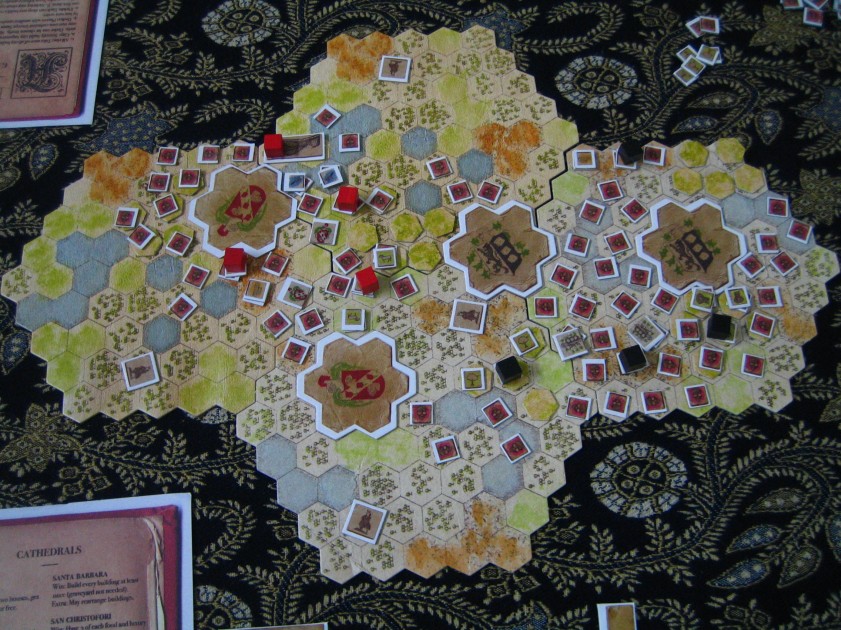
The main gameboard. I (black) tend to like harbours so my cities tend to be next to lakes.

27 Oct 2012. Our 3rd game. This time I picked San Nicolo, privilege is "buy 1 free 1" (ask a Malaysian) when building a house, victory condition is to build all 20 houses. At this point I had actually built a harbour at the right edge of the city, but it was now covered by graves.

The main gameboard. I (black) was a little slow in building my second city near the centre.

Once my second city was ready, I hurriedly built a Hospital to remove graves and a Faculty of Alchemy to clean land. I was close to suffocating by then. I also built a Faculty of Philosophy to let me ignore the variety requirement when building houses. The more expensive houses always require food and luxury items of different types, which is a hassle to collect. So the Faculty of Philosophy is very useful for the San Nicolo player.

These were Michelle's cities. She rarely bothers to build Fountains (not a single one in sight), which reduces the Famine level by one and also reduces pollution. She doesn't need them as much as I usually do. So I end up building lots of them, which helps her to some extent.

By game end, she had only used 5 squares in her second city. She likes the Market because she can use it to swap two goods for one of any type. She plans which buildings to construct much better than I do. Very little waste.

In contrast, my cities were a mess. 13 graves, and this was after I had already removed some using the Hospital. I still had 7 houses to go, which was still a long way away.

28 Oct 2012. A second game of Antiquity over the same weekend! Woohoo! This time I used yellow, hoping it would be more auspicious than black. It didn't work, but the blame was on me, not the colour. This time I picked San Giorgio - privilege is one free fish whenever anyone builds a cathedral, victory condition is completely covering one opponent's zone of control with your own. This was the first time I made use of the Stable, which increases your zone of control from two steps from every city and inn to three steps instead. It is obvious from the number of graves in this photo (even covering my cathedral in the top right corner) that I did not win this game.

I had six fountains, so no pollution from cities themselves now (usually 3 per city). But of course farming, mining and fishing still leave behind pollution.

Michelle's cities when she won the game. She didn't even need a Market this time, and she barely needed the Dump. The Dump reduces pollution by four, and her second city produces three pollution. The Dump also prevents your opponent from dumping pollution in your zone of control. I wonder whether she built it more for defensive purposes.

The game board. I (yellow) managed to spread my inns (small square markers with yellow shields) to the centre of Michelle's start terrain tile. I would probably need another two or three turns to completely surround her. But the question is whether I would survive another two or three turns.

Friday, 19 October 2012

boardgaming in photos

22 Sep 2012. This is the Mayfair Games version of Automobile, with different artwork and components from the Treefrog version that I own. I taught the game to 4 newbies. I did rather poorly and came a quite distant third. I was the only player who didn't need to take a loan, but now I realise that's probably a bad sign - I was not doing enough business!

23 Sep 2012. A vicious 2P game of Carcassonne (with some expansions). Michelle and I had many meeples, because the Abbey and Mayor expansion added some special meeples, but we used them up quickly because many of them got locked up in incomplete features.

Michelle managed to complete that big city at the centre, which gave her a lot of points.

24 Sep 2012. A solo game of Town Center which I started with a blueprint in mind and mostly managed to build the city according to the blueprint. I scored 90pts, which is a Level 8 achievement out of 10 levels. The highest level is 100pts or more. After this game, my interest in solo play dropped significantly, because it feels like I have solved the puzzle. I wonder whether this will impact my enjoyment of the multi-player game.

26 Sep 2012. Le Havre on the iOS against Han and Allen. I lost by 3 points! I had many buildings (that row in the centre). I focused on buildings in this particular game.

30 Sep 2012. I downloaded the latest version of Triple A, a free software that lets you play various Axis & Allies-like games. I played two games against the AI's, playing the Axis in Axis & Allies Europe 1940 (AAE40) and then the Allies in Axis & Allies Pacific 1940 (AAP40). The AI's are rather weak unfortunately, so I recommend only playing against your human friends. At first I thought the AI's appear weak in AAE40 because I played the Axis and thus had the initiative. Afterwards I played AAP40 as the Allies, and the AI did much worse as the Axis. How can Japan be not spending money on transports in AAP40? Did I set up the AI's wrong?

This is a screenshot of a combat resolution. This was the fall of France in Axis & Allies Europe 1940.

In North Africa, Egypt fell easily to the Italians because the Allies vacated it! What the...? Italy is dark brown, UK is light brown, France is blue. Sicily was captured by the UK, but I (as Italy) was taking it back.

This screenshot shows the game interface, with a minimap on the top right, and action details in the lower right section. The Soviet Union amassed troops at Novgorod. My Germans were steadily marching east. I even vacated Normandy and Holland. The Allies had no transports in the Atlantic to threaten me with an amphibious assault.

Germans assaulting Moscow.

USA had built up an impressive fleet containing 15 destroyers, which were now parked in the English Channel. The USA fleet had no fighters (on carriers) to defend itself. I attacked it with my smaller German fleet supported by a big air force. I had captured Scotland, but the time was not yet right to launch an attack on England (and London).

The final attack on London. I had transports shipping troops over, and also had units coming down from Scotland.

This is AAP40. I only took one screenshot of this game against the AI. This was the USA fleet attacking Japan.

3 Oct 2012. Ascension on iOS. Han had six (!!!) constructs in play (that number 6 in a circle at the top centre). Constructs are cards that you keep on the table (as opposed to being discarded to your personal discard deck) which give benefits every round. Needless to say I was quite happy to be able to defeat the Sea Tyrant (the highlighted card on the right) which forced him to discard all but one construct.

6 Oct 2012. I have been wanting to buy myself a copy of Antiquity since I first played it in Dec 2011. I have been trying to find a copy at a not-too-unreasonable price. The game was out of print for some time, but was back in print last year. However I still could not find a copy at a reasonable price. The publisher Splotter was planning to update their website to support game purchases in early 2012. It was only in Sep 2012 that they managed to launch the new website. I didn't hesitate long. I ordered a copy. The total cost (including shipping) was the highest I have ever paid for a boardgame (that I know of). I have heard a number of horror stories about how Splotter doesn't shrink-wrap their games and doesn't pack their games well when shipping them. So I was a little worried. However the game arrived in a good condition. The game was shrink-wrapped. There was protective foam. There was a little damage to a corner of the shipping box but no damage to the game box itself.

Upon opening the box, this was what I saw. Half the components had come off the sprues. I think the sprues are originally much larger than the box, with the large terrain tiles being the centre part. So when the game is being packed, a sprue is taken apart - the terrain tiles are separated, and the left and right thirds of the sprue become two separate sprues that can fit in the box. There are many many many small components. Thankfully only a few of them were damaged (bent, or pressed from one side), and the damaged ones were generic pieces, not those one-per-player building tiles. Overall I am very pleased.

14 Oct 2012. I managed to convince my wife Michelle to play Antiquity with me. In the past few years she has not been keen about boardgames, especially learning new ones. I persuaded her that it was a bit like Through the Ages (which we used to play a lot), so at least I set her expectations that it was going to be a long game.

This was my first city. I had built my houses in a way to leave space for my cathedral (top left).

There is no green player colour, so I picked black. Usually my second choice is white, but no white here either. The city in the foreground was my first city. I had just built my second city, in the background, and it was approaching Michelle's area.

I bought these three plastic boxes, which could store most of the non player-specific game pieces. I only needed that small tin box to store the Cart Shop and Store pieces. I put player-specific pieces in ziplock bags, one bag per player. That means one set of buildings are in each bag.

Near the end of the game. We made a number of rule blunders, but it wouldn't have changed the result. Michelle picked the patron saint San Christofori which let her store an unlimited number of goods, and her victory condition was to collect 3 goods in each of 8 types (food and luxury). I decided to try the greatest patron saint Santa Maria, which gave me the benefits of all the other four saints, but required me to fulfill two different conditions to win. I really floundered in this game, expanding and growing, but never quite focusing on an end goal. It might be my own poor showing, but I think picking Santa Maria is the hardest way to win. Although I have played the game before, this time I underestimated the time pressure caused by the ever increasing famine level. I had the nice buildings that removed graves, reduced pollution and cleaned pollution, but eventually the famine level got so high that I couldn't avoid graves. I realise in Antiquity you actually never get off the slippery slope. You never reach a breakeven point and stay there. Even if you get to a safe position, it is only temporary. You need to race against time to end the game before all hell breaks loose.

The best thing that came out of this game is Michelle is willing to play again. Woohoo!

I had not yet started using my third city at all.

One thing that I think went very well in this session was how I taught Michelle the game. She cannot stand long (or even medium) game rules explanations. She prefers to just get going and figure out how things work along the way. I, on the other hand, tend to prefer to cover everything important before starting a game. It's the "I did tell you about this rule" mentality. This time, in order to minimise her suffering throughout the game (the game mechanism is punishing enough), I just went through the 10 phases of a round quickly, explained a few basic buildings, and then we started playing. I didn't describe 90% of the buildings, and didn't even describe the patron saints. That information is available on the player mat, albeit in a summarised form. During the game, under appropriate situations, I gave her pointers on what buildings she might want to consider. She also checked out the player mat herself during play, figuring things out herself and asking questions (as opposed me feeding her information). This worked out really well. She explored the game herself, at her own pace.

I realise this learn-as-you-play approach works very well. My gamer friends and I often joke about any first game being just a learning game, as in those who lost can justify the loss and the victory of the winner doesn't count. Now I realise the learning game concept (the real one, not the joke version) can be very effective in teaching a game and making sure everyone has fun. I recently applied this successfully teaching Thebes to my 7-year-old daughter. It was unplanned and the success surprised me.