Showing posts with label trains. Show all posts

Saturday, 9 May 2026

Lightning Train


Lightning Train was described as Ticket To Ride with deck-building, but I think that will paint an inaccurate picture. It is indeed played on a map of USA, and you do compete to build tracks between cities. The core mechanism is indeed bag-building (a form of deck-building). However I find this a much more complex game. It's a mid- to heavy-weight game. 


This is the game map. In this game you will be laying train tracks, building train stations, and delivering goods. One important project which everyone is working on is completing the transcontinental railroad connecting New York and San Francisco. The game ends when this is achieved, or at the end of 12 rounds. Several things that you do score points. When the game ends whoever has the highest score wins. 


This is the player board. The two red backed cards on the right are secret objectives. If you complete them, you will score points. Some of them are like Ticket To Ride. If you can connect specific cities, you score points. There are other types of objectives too. Your player board has various slots for placing train carriages. Whenever you fill a section, you get to use the action or benefit specified. The two sections at the bottom are upgrades. When you upgrade, you gain permanent abilities. 


These tiles here are the bag-building mechanism of the game. You have your own bag of tiles, and every turn you draw five to place in this section of your player board. There are five regular spots, and once you fill them all (like in this photo above) you stop drawing tiles from your bag. These tiles you have drawn allow you to perform actions. Money lets you buy new tiles. These new tiles go into your bag the next time it is exhausted. The train carriage with a lightning icon means you immediately take a carriage. You can see I have taken two. These carriages can be placed in sections of your player board to do various things. If you don't have enough, you can keep some here for actions in future turns. Carriages can also be used to lay tracks on the main game board. The goods icon let you deliver goods. The non-white tiles are contracts. You need contracts of specific regions to be able to lay tracks or build stations in them. 

Notice that two spaces on the left have a plus sign. Some tiles have a plus sign, and they can be placed in these special spaces. That means you may be able to draw more than five tiles on your turn. You can upgrade your player board to get two more plus sign slots. In the best case you can draw and use nine tiles. 


The round tokens are goods. There are several types. During game setup, some are already placed on the map. Every round, some are added. Stations that are build have one or two demand icons. You can deliver the goods they need to them. Once the demand is satisfied, the station no longer wants this good type. When delivering goods, every stretch of train tracks used scores one point for their owners. The owner of the station scores a point too. This is one way you score points in the game. 


You will start on the eastern seaboard. There are five cities here which allow you to start building tracks. Also initially you only have contracts for the three regions in the east. To build beyond that, you will need to buy new tiles which are contracts for other regions. 


I did a four-player game, and our progress felt slow. We didn't seem to be racing towards San Francisco. Maybe it was because we were all new to the game, and we needed time to digest how the game worked. This is certainly more complex than Ticket To Ride, so I feel like I need to do a lot of work to build just one stretch. Laying tracks and building stations are restrictive. You need to have drawn the right tiles with the right contracts. You need to have enough trains drawn that turn. You can only save one train from the previous turn to use for laying tracks. You cannot lay tracks anywhere you want. They must extend from your existing tracks or from a station you own. 


We did eventually manage to connect to San Francisco. That triggered a one-time bonus scoring. In our case since it was a four-player game, the game did not end yet. We needed to connect to both Houston and Seattle to trigger game end. We did not manage to finish our game because it was late and one of us had to leave. We didn't have any obvious leading player at that point. Our scores were close. 

Lightning Train is not that complex once you understand it. I had fun buying tiles and seeing how they helped me on future turns. The tile market works like Ascension. There are always six tiles available, and whenever one is bought, the market is refilled with a random new one. I'd call this a deck-building game with board play instead of a boardgame with deck-building. The deck-building part drives what you can do. You must buy smartly and coherently in order to be able to execute the strategy you have in mind. There is tactical competition in claiming routes and delivering goods. You need to fight for these. One fun element in the game is how you keep improving your abilities. Buying better tiles let you do more within the same turn. You get to upgrade your player board too. You unlock some abilities when you build stations and when you surpass certain victory point thresholds. There is a satisfying feeling of acceleration. 


I has been a while since I joined a BoardGameCafe.net Friday night session. I used to be a regular, showing up almost every Friday. That was up till before the pandemic. After those few years of on-and-off lockdown, I got busy with other things and now don't game as much as before. It's nice to be back learning a new game in person and playing with others across a physical table. 

Wednesday, 18 February 2026

Irish Gauge


Irish Gauge is a game about developing the train network in Ireland. It is an open information game. It is an investment game, and almost but not really a stock-control game. Players invest in railroad companies and hope to make money as the companies they are invested in do well. You don't own companies. You only own shares in them. It sounds a little like 18XX games, but this is much simpler and abstracted. It reminds me a little of Chicago Express / Wabash Cannonball


Five companies are in play, and as part of game setup, the first share of each company is auctioned off to the players. During the game, more shares may be auctioned off. Holding shares of a company means that whenever that company makes money, you'll get some. The earnings are divided among the shareholders based on their holdings. 


One of the things you may do on your turn is to build railroads. You can only do this for a company you are invested in. You place train markers on the board to represent your company's railroad network. You get to spend 3 action points for building railroads. The action points needed to build in a hex depends on the terrain type, whether it is urban, and whether others have built there. You want to connect your companies to towns and cities, because these help them make money. Towns are upgraded to become cities when you place a cube in them. You get to choose the cube colour when you do this. 

There are cubes in three different colours. They represent different goods. You already have 8 cities on the board at the start of the game. Cubes are all placed in a bag. They are drawn from the bag when you want to trigger dividends. The game ends when the bag runs out of cubes. 


When you want to trigger dividends, you blind draw three cubes from the bag. The cube colours determine which companies issue dividends. If a company is connected to at least a city with one of the colours and a town, it will make money, which means the shareholders will make money. So this is a game about setting up your companies to be able to make money, hopefully from all three colours, and then you want to trigger dividends to make lots of money. Auctioning a share means an additional player may get into the company and share its profits. This is normally an act of aggression, when you want to get inside a company to get a share of its profits. If there is only one current shareholder, they are not going to make any more money by buying this new share. They are only preventing others from also making money from this company in future. For other players who want to get it, it is about evaluating whether the money you spend to bid on the share is justifiable. Are you going to make back that money? 

Irish Gauge is a pretty straight-forward game. The actions are simple. However the strategies are not simplistic. In the game we played, there were four of us, and at the start of the game, I was the only player who controlled two companies. In hindsight, that might not have been a good idea. I couldn't grow two companies equally well. 

The game is a tight fight. This is a perfect information game. You can think many steps ahead. You know exactly how your opponents can respond to your move, if they choose to do so. In this sense the game is almost chess-like. The only uncertainty is when dividends are being issued. You don't know which colours will come out. The ultimate winner is the richest player. Issuing dividends is not about you making money, it is about you making more money than others. If your companies are positioned well to make money, you are in no hurry to take the dividend action, because when others do it, it will likely benefit you too, and hopefully more than them. 

Irish Gauge is the kind of game for smart and strategic people. It's serious and skill-driven. I also find it a little dry, maybe because of  how serious it feels to me. There is a little variability in the game setup, but the map will stay the same every time you play. Only the cube colours of the starting cities will differ. 

Friday, 2 January 2026

Steam Power


Steam Power is Martin Wallace’s magnum opus Age of Steam simplified to become a family game. Well, not exactly. Indeed much is simplified, but some elements in Steam Power are just different. Some are a little like Brass


In Steam Power, you build your own rail network. You also build factories. Every city allows one specific factory type. When you build a factory, you place five goods next to it. Anyone can use these goods for fulfilling contracts. Your factory will score points at game end only if all its goods are used up. Your railroad network doesn’t score points directly, but they give you access to factories. When you fulfil a contract, you can use any goods accessible by your network for free. You can use goods outside your network but you’ll need to pay for using your opponent’s railroads to bring these goods to your network. 


The game ends when a player completes his 11th contract. You score points for completed contracts, fully utilised factories and major cities you connect to. During game setup, two unused city tiles augment the values of specific factory types. This creates variability from game to game.


Network building is competitive. You want to claim territory and access to cities. Access to major cities does give you points, but it is access to factories which is more important. You get to use goods at these factories for free. You are not limited to build factories within your network. You can build in others’ networks if you foresee there is demand for your goods and your opponents will be willing to use your goods even when they know they will be helping your factory score. 


This is a very clean design. Building factories is free. Building tracks is free as long as you avoid hills and mountains. You don’t use cash often, and this cuts down a lot of tedium. There is much board play. You have to analyse the distribution of goods production to decide how best to start and grow your network. There is a race to expand your network. There is also a race to fulfil contacts. You must watch your opponents and make sure the game ending doesn’t catch you off guard. 

Steam Power is quite a different beast from Age of Steam. It is lighter and the pace is brisk. It is not as unforgiving but it is still competitive. This works as a family strategy game. This deluxe edition that I played is very pretty and welcoming. 

Sunday, 6 August 2023

Isle of Trains (2014)


The Game

Isle of Trains: All Aboard won the best card game (strategic) at the 2023 UK Games Expo. When I saw the news, I thought the name of the game sounded familiar. I thought I had the game in my collection, but the box cover looked different. I dug up my copy, and realised it was an earlier version from 2014, named Isle of Trains. It was designed by the same design team - Seth Jaffee and Dan Keltner. The newer version introduces a new element - passengers. Allen gave me Isle of Trains quite some time ago, and I still hadn't brought it to the table. Now that the new edition had just won an award, I had a good justification to bring it out and see what it's about. 

Isle of Trains is a pure card game. Players manage their own trains, using the trains to deliver goods and fulfil contracts. You need to upgrade your train in order to be able to carry and deliver more goods. Contracts are the main way you score points. When the game ends, your train itself will score points. So do the goods you still carry on your train. The most points will likely be from your completed contracts. Highest scorer wins. 


During setup, you use six of the cards to form this island. These six are contract cards. They specify what goods you need to supply to claim them, and they are worth points. The island is just an aesthetic element and has no gameplay purpose. Every player starts the game with one basic engine which can pull carriages with a total weight of 4. If you want to be able to pull more, you need to upgrade your engine. 


On the back of these six contract cards, there are two more advanced contracts you can fulfil. They are worth more points but they also require more goods. When you fulfil a basic contract, you claim it and put it in front of you. You must proceed to fulfil one of the two advanced contracts before you can claim another basic contract from the island. The basic contracts are free for all so they are first come first served. Once you claim a basic contract, the two associated advanced contracts are yours and they are protected. However you are committed to them too. 


A card can be used in three different ways. If you build it, it becomes your engine, carriage or building. You can only have one train. Your train may only have one engine. It can have many carriages, as long as your engine is powerful enough to pull all of them. The most common function of carriages is to carry a specific goods type. Carriages have other functions too. You can only have one building. Buildings help you score bonus points at game end. 

In order to build a card (engine, carriage or building), you need money, and the second way you use cards is as money. If a card costs $4 to build, you have to actually pay 4 cards. To build a $4 carriage, you need to have 5 cards in hand, the carriage card itself, and 4 more cards which will be your payment. 

The third way you use a card is as goods. A card tells you what kind of goods it can become. Normally it's either coal, oil or boxes. Some cards are jokers and can be any type. when you load goods, you place cards onto carriages. 

On your turn you may perform two actions. You options include drawing a card, building, loading one goods card, and delivering any number of goods. When you do loading, you don't necessarily load goods onto your own train. You can load onto an opponent's train, and that's an important part of gameplay. When you load for an opponent, you gain benefits as specified on their carriage. Sometimes you get to draw more cards, sometimes you get to load or deliver more goods. Loading goods for others is often an attractive option, so much so that when you build carriages yourself you will worry about others taking advantage of the bonuses on your carriage. You will have an urge to fill up your own carriages quickly so as not to benefit your opponents. 

Sometimes you need both your actions to do something difficult. Your hand size is 5. If you exceed that at the end of your turn, you are forced to discard down to 5 cards. If you want to build something large, of cost 5 or more, it will be difficult. You will need to spend the first action on your turn to draw more cards (by loading goods for an opponent). Only then by your second action you will have enough cards to pay for expensive cards you want to build. 

This is a building. It helps you score more points at game end. 

The last action type you have is to deliver goods. With one action you get to deliver as many goods on your train as you want. What this means is you can discard goods to draw 2 cards per goods discarded, and you can also discard goods to fulfil contracts.  

Once a certain number of contracts forming the island has been claimed (which depends on player count), the game ends, and the highest scorer wins. 

The Play

I played with younger daughter Chen Rui. We were both new to the game. Isle of Trains is an engine building game. Your engine is literally that small train engine everyone starts with. It won't get you far. You build your train by upgrading that train engine and by adding carriages to it. You may also construct a building to help score more points. All these are part of the game's engine-building. As in most engine-building games, the tricky part is deciding when and how to transition from engine-building to point-scoring. Your engine is your means, but your objective is the points, not the engine. Your engine doesn't have to be perfect or to be the strongest. It is more important to utilise it as much as you can before the game ends to score the most points. If you focus too much on building the engine, you may not be doing enough of point scoring. If you start scoring points too early, your engine may not be strong enough and you will be inefficient. 

In Isle of Trains, your train itself, i.e. your game engine, does score points. The train engine and the carriages have point values. The contracts are the most effective way to score points, but they do nothing to help build your engine. Although it may seem inefficient to start scoring points too early, there is a counter point to that. Contracts on the island are first come first served. So there is an element of racing to get to the one you want before it gets snatched away by your opponents. 

In our game I concentrated on building my game engine, because that's what I enjoy doing. I focused so much on that that I didn't realise the contract I was working towards could be fulfilled by Chen Rui. When she took that contract from the island, she knocked my pacing off. I had to switch to work towards a different contract which needed a different combination of goods. I had to further develop my train before I could claim the other contract. My tempo never quite caught up with Chen Rui's. By the time she completed two advanced contracts, I only had one basic contract done. It was too late for me. When she took the next contract from the island, she would trigger the end of the game. By the time our game ended, I barely managed to complete my advanced contract. The contract I had was a higher-scoring contract, but it was not enough to compete against the quantity Chen Rui had. She had claimed three contracts from the island I had only one. She fulfilled five contracts to my two. My train did score more points than hers, because I did more upgrades, but the point difference in contracts was bigger. 


The half circles at the bottom right corners of the cards mean capacity (yellow) or weight (red). The train engine has capacity to pull weight, and the weight of all the carriages added up must not exceed this capacity. Carriages have different capacities for carrying goods, and usually a carriage can only carry one specific goods type. 

I upgraded my train engine to the highest level. I could pull a weight of 8. 

The Thoughts

I read the rules to Isle of Trains a few months ago, together with the rules of a few other Dice Hate Me card games which Allen gave me. At the time it didn't get me very excited, because it seemed like just another resource collection and contract fulfilment game. Now that I have played it, I would say indeed it doesn't break much new ground, but one thing I do enjoy is that element of how you want to help your opponents load goods. Those are golden opportunities which will likely help you even more. The engine-building aspect of the game is done well and enjoyable. 

Isle of Trains is a mid-weight strategy game, despite being a pure card game. There is some depth to it. The various carriages, buildings and goods are designed to have some character, so the game feels flavourful and not generic. 

Friday, 6 May 2022

Imperial Steam


The Game

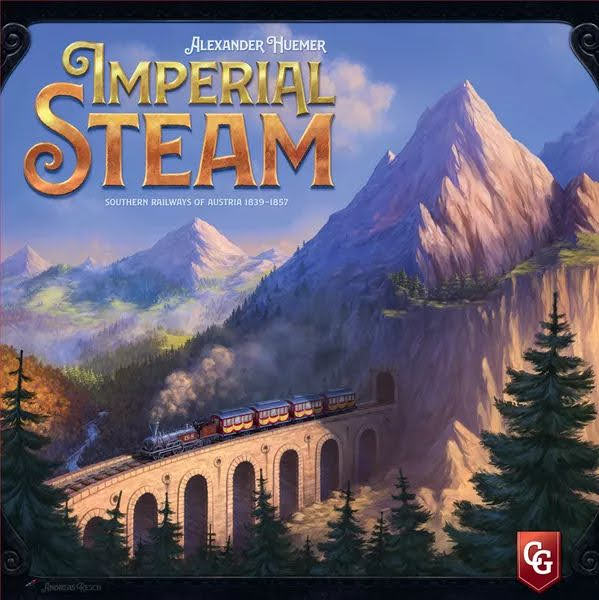
Imperial Steam is a heavy Eurogame for 2 to 4 players, about developing the railroad network in Austria. Everyone starts in Wien (Vienna), and in general you develop your network towards Trieste in the south, which is a city in North Italy. There are many cities along the way. You will lay tracks, buy trains, upgrade trains, build factories, sell goods from your factories to the cities, and sign contracts. When the game ends, the richest player wins. The game ends either after 8 rounds, or when any player reaches Trieste. 


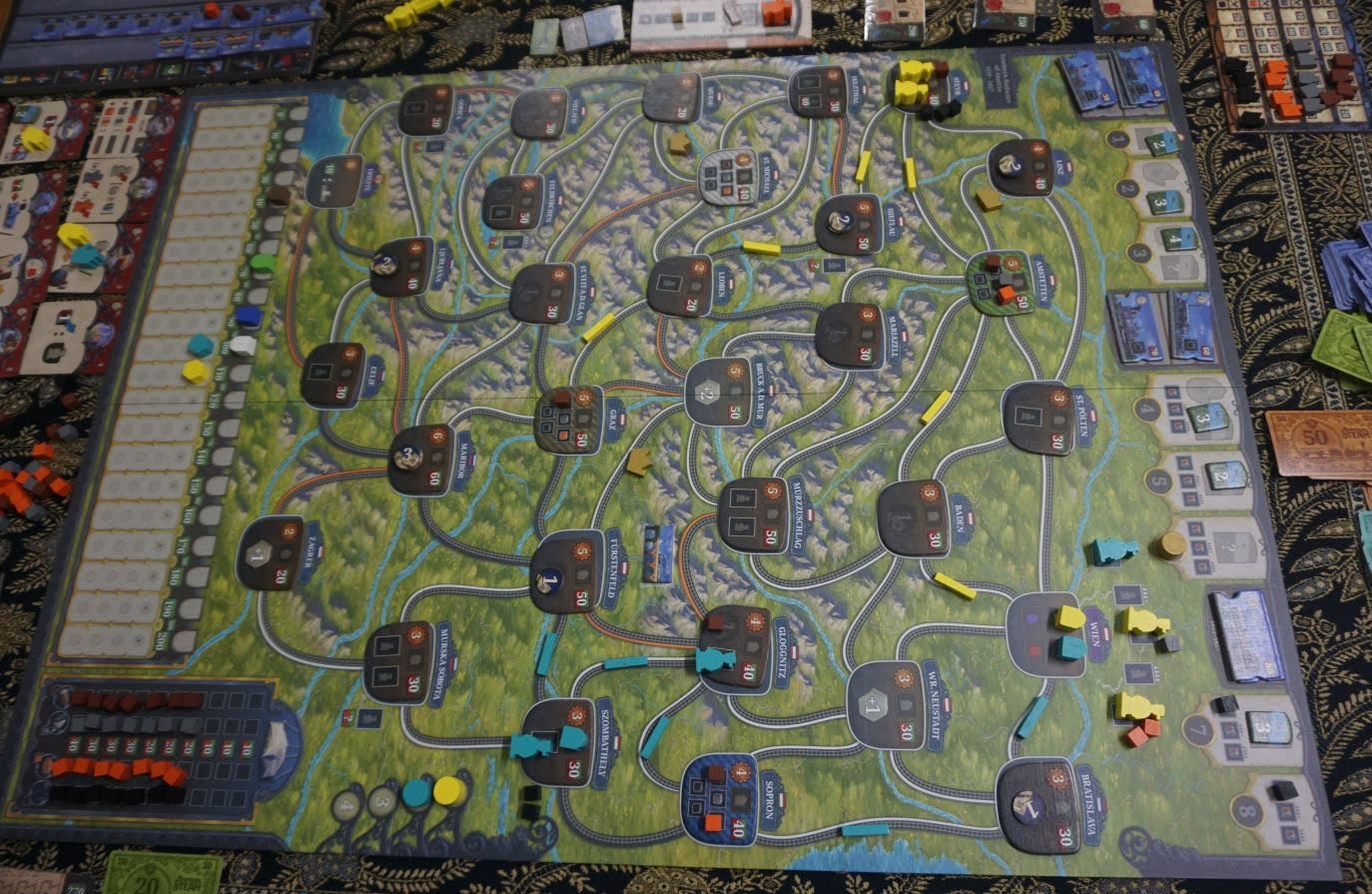
This is the main game board. At game start every player has a station at the bottom right of this photo where Vienna is. Everyone starts there, and generally builds towards Trieste, which is at the top left. 


This is the player board. At game start you have one small train which can pull only three carriages. The engine stores one coal. Each carriage can store one resource. Those at the bottom left are workers. You use them for laying tracks and building factories. When you build factories you expend workers, which means you need to recruit again to replenish. 


There are four types of resources, and also four types of factories producing them. The four colours represent wood, stone, iron and coal. Resources produced at factories can be sold to cities. This is an important source of income. Money is tight in this game. I say this a lot when I describe games, but with Imperial Steam I really mean it. Okay I sound like the boy crying wolf. I swear this is a game where it gets drilled into you that being poor sucks big time. It is downright tragic. 


This is the progress track. The golden token is the round marker. Those hands are players' action tokens. In rounds 2 to 4 you collect a new action token, which means you get to perform more are more actions per round. Eventually you'll have 5 actions per round. The trains set up on the progress track indicate what are available to you at what time. Improved trains become available in Round 4. Those white numbers on the river tokens mean something. They tell you how many resources you may preorder when you perform the action to buy resources for the next round.  


That city at the top right with two station tokens, yellow and green, is Vienna, i.e. the starting city for all players. Those rectangles above it are the limited slots for factories. You will notice only some other cities have such slots. You need to be connected to these cities to use their slots. Cities offer different benefits and you need to connect to them to use them. The city at the top left is a major city which has demand for resources. If you can connect your network there, you may sell resources to the city to make money. This is important for your cashflow. 


The hexagonal markers are your reputation markers. They determine turn order and also where you may recruit workers and engineers. The four shields represent four major cities where you may recruit. For example, the yellow player may now recruit at the brown and the green cities. The shields will advance when resources are sold to the corresponding cities, which means you will need a higher reputation level to be able to recruit at these cities. 


These are the 11 different actions you may perform on your turn. Place your hand token to perform an action. This is not a worker placement game. Your hand doesn't block other players' hands. However if you place your hand on a spot which already has your own hand, you will lose reputation. This discourages you from performing the same actions within the same round. 


This is the recruitment board. These are the four cities where you may recruit engineers (those along the top) and workers. Recruiting an engineer always costs $30. Workers start cheaper at $10 but they get more and more expensive. 


These are contracts. They are set up randomly before the game starts. When you sign a contract, you attract investors to your company. They will be willing to buy shares. However by signing a contract you must reserve some train carriages, and thus lose storage capacity. Completing a contract requires having built factories producing specific resources. Also, someone needs to connect to Trieste. If no one connects to Trieste, contracts are ignored. If someone does connect, and you complete your contracts, they grant you a handsome profit (top right corner of the contracts). However if someone connects to Trieste but you fail to complete your contract, there is a steep penalty. 


On the board there are some special features. Routes with crowns are imperial routes. You need to pay for a permit before you can lay tracks on these routes. That rectangular token represents the Semmering Railway. If you are first to lay tracks here, you claim the token. At game end, your basic income is doubled. These are little quirks added for flavour. 

White routes are regular routes. Orange routes are tunnels. Black routes are bridges. To lay tracks on the tunnel and bridge routes you need to pay more resources. You also need to have recruited the right engineers. 


Building a factory consumes a worker. You will put that worker on the main game board like this. This is permanent. The factory immediately produces resources, and it will only produce just this once. When the resources are used up, you'll need to build a new factory to produce new resources. 


When you recruit, you get junior workers and place them at the bottom left box. Your workers who are idle for the round attend short courses to improve themselves. They move right and become more skilled. They can go up to Level 3. Those who are put to work will move upwards. When the next round starts they move back down, i.e. they will stay at the same level. Higher level workers work more efficiently on railroads and also produce more resources when building factories. 


When you sign a contract, you attract potential investors (the little green men). They don't immediately hand you money. This side board shows the current market price of your company shares. It's $40 now, which is not a lot. The position of an investor indicates how much they are willing to pay, but they will still buy shares at the current market price. So it is better to increase the market price before you sell shares to these investors. Selling shares is one way to get cash. You need cash to run your business. Every time you sell shares, you are selling 10% of your company. You place the investor in the box at the top left. When the game ends, you hand over a percentage of your final score to them. Every investor costs you 10% of your final score. Bringing in investors is not a decision you take lightly. Yes, cashflow is always a pain in the neck, so sometimes you have to rely on investors.
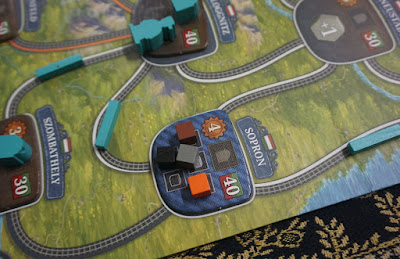

When you sell resources to a major city, you place them onto the city like this. This particular city only wants one wood, one stone, one iron and two coals. You make money from wood, stone and iron, but you only earn victory points with coal. 

Your final score is the cash you have in hand. You start the game with a little money. The whole exercise in Imperial Steam is how you turn that little capital into a large sum of money. You must spend wisely and manage your growing business meticulously. You need to keep expanding and monetising the next opportunity. Your factories will run out of goods. Your clients will run out of buying capacity. You have to keep moving forward to survive. You must keep finding opportunities and upgrading your capabilities. All this while you must carefully plan whether to let the game end by completion of 8 rounds or having someone connect to Trieste. 

The Play

I think of Imperial Steam as a carefully managed marathon. You are always short of money and you are constantly worried about how to maintain your cashflow. It is quite high stress. You need money to expand, and you want to make sure you are expanding into the right areas which will get you more money for the next cycle of expansion. Money seems to run out very quickly. When you are short on cash, you find that your actions become highly inefficient. One particular action you can take is to earn $10. At first I thought this was pathetic. This was not much better than begging on the streets. Demeaning! It was like asking the boss to do part-time Grab Food delivery to earn some spare cash. I said that too soon. In the game I turned out to be the boss who needed to do Grab Food delivery. There was one round when I was precisely short of $10 to perform an action I had planned. It was either I waited until the next round, or I spent one precious action for that measly $10. I was desperate enough to do it. 

Due to how scarce money is, player interaction can be brutal. Everyone needs cashflow. If your opponent's action disrupts or delays your plan to make money, you can be royally screwed. If you ask me how much player interaction there is, I would say it's complicated. Sometimes when you are developing in different directions, it doesn't seem you can interfere with your opponents much. Yet at critical moments a little got-here-before-you aggression can cause a major setback. 


Han (yellow) expanded west. I (green) decided to head south to avoid too much head-to-head competition. Unfortunately later there was a major city near the centre of the board which we both wanted to get to, and he beat me to it. He was able to supply resources to the city before I could, and that messed up my plans. 


I signed a contract, and three of my carriages were reserved. Emblems were placed on them to block them off. I had less space to store resources. Some carriages had been converted to passenger carriages, and they gave me $10 each at the start of every round. These also could no longer store resources. 

When I signed my second contract, I blocked off two more carriages.


I would have been able to complete both my contracts, and they would earn a total of $510, a tidy sum. Unfortunately I failed to manage my cashflow well and could not reach Trieste before the game ended. Han held off signing contracts. He did build quite a few factories, and if he signed contracts he would likely be able to complete them all. He had the ability to connect to Trieste. However since doing so would help me, he decided not to. He was giving up the opportunity to make money from contracts, but he hadn't spent actions signing contracts yet. He could spend his actions on other ways of making money. 


I wasn't doing so well, and decided to go for the Semmering Railway. It wouldn't help me all that much, other than making me feel a little better, like I've achieved something noteworthy. 


By late game I had both types of engineers (grey and orange figures), so I could lay tunnel tracks and bridge tracks. I was short on cash and couldn't afford many workers. I wasn't able to replenish them. 

The Thoughts

Playing Imperial Steam is like walking a tightrope. You have to be constantly careful with how you spend your money and you are always worrying about how to earn the next month's income. You are always struggling for survival. You watch your opponents because they may create potholes in your highway. How tight money is creates a kind of despair I rarely see in other games. This is a little like Splotter games. If you don't manage your finances, you will suffer the consequences. The system is unapologetic and won't pity you or help you catch up. This is certainly a gamer's game, not something you want to traumatise newbies with. 

One thing about the game gives you an idea how brutal it is. The rulebook specifically recommends a set up for your first game. It advises that the normal random setup should only be used after you are familiar with the game. The newbie setup is to give you a gentler introduction to the game, so that you won't die too spectacularly. 

Initially I wondered whether one game would feel similar to the next once you play a few more times. After all you always start in Vienna and you are generally heading towards Trieste. Now I realise the random setup will create different problems and different opportunities. The cities will be different. There are a few other randomised elements. I think even after you learn to handle the tough economy, Imperial Steam will still give you replayability. 

Friday, 18 December 2020

boardgaming in photos: Ticket To Ride Nordic Countries, Ticket to Ride Marklin, Traumfabrik (Dream Factory)

5 Dec 2020. Ticket to Ride: Nordic Countries is for  2 or 3 players only. It was first published in 2007, and over the years it has been kept in print. I guess it continues to be popular. Or maybe it's the whole series that's popular, thus helping every variant and expansion. Elder daughter Shee Yun is not so keen about boardgames nowadays, but younger daughter Chen Rui is usually willing to play. So we brought this out for a spin when there was only three of us. The player colours in this variant game is unusual - black, white and purple. I told Chen Rui this game features Santa Claus - that guy on the box cover. 

Christmas is coming, and this game has much Christmas atmosphere. 

This is a standalone, complete game. You don't need to use components from the base game. On all the train cards you get snow, which is nice. In Nordic Countries, jokers (locomotives) can only be used on tunnel routes or ferry routes. You can't use them on normal routes. Because of this, when taking a face-up joker you are not considered to have taken two train cards. 

All the main cities are in the south. When we started our game, all of us needed access to some of these main cities, so we were a little nervous about getting blocked. 

I (white) had initially planned to head north via a coastal path along the Atlantic Ocean. However my way was blocked by Michelle (purple) so I had to switch to the other path along the Baltic Sea. Chen Rui (black) took the same path to head north, which made me bite my nails. We might get into each other's ways. 

On that middle path Chen Rui (black) and I (white) had claimed different stretches because we didn't want to get blocked. We tried to claim routes as quickly as we could, lest the other was collecting the same colours and aiming for the same routes. Claiming routes in such a matter is dangerous. All these disjointed stretches can be easily blocked and cut off. 

One special element about this map is that 9-train grey route at the top left. It is worth 27 points! This is a regular route, which means you can't use jokers. However there is a special rule allowing you to treat any four cards as one card of any colour you want. When we played, Chen Rui contemplated claiming this route. Unfortunately by the time the game ended, she didn't manage to do it. Two turns before the game ended, if she had claimed one of the face-up green trains, by her final turn she would have enough green trains and other train cards to claim this 9-train route. Unfortunately on that crucial second last turn she chose to draw cards blind from the deck, and she didn't manage to get any useful cards. Had she chosen differently, she would have won the game, beating me by 1 point. 


6 Dec 2020. Traumfabrik is a Reiner Knizia design first published in 2000. The first version was in German, and the setting was movie-making from the 1930's to the 1950's. Since then the game has been reprinted in different versions, including an English version Hollywood Blockbuster. The English version used more modern movies, directors, actors and actresses, but in order to avoid legal issues, all the names were tweaked, and cartoonish caricatures were used instead of proper portraits or photos. I didn't like that. Between Traumfabrik going out of print and the publication of the second version, a fan created this version above using movies circa the 1990's. I liked this and could relate to these movies much better than the original, so I downloaded the files and made my own copy. 


The game is played over four rounds, and each round has eight auctions, in which you bid for various movie industry professionals in order to make movies. You bid for directors, actors and actresses, cameramen, special effect experts and musicians. Different screenplays require different combinations of professionals to complete. 

The game has a closed economy. If you win a set of tiles (professionals), the money you pay is divided equally among the other players. So the money only flows between the players, none coming in and none leaving the system. The fourth and eighth auctions of a round are handled differently. These auctions are called parties. As many tiles as the number of players are drawn, and you take turns claiming one tile for free. The turn order is determined by the total star power of actors (and actresses) you have recruited. So there is good reason to recruit many actors. First pick is always desirable. It is more likely you'll get something you need, or something of better quality. 


I had the honour of producing Lord of the Rings and I managed to get Peter Jackson to direct it! In this game it is not often that things turn out like in real life. Lord of the Rings had 18 stars, which meant at game end it would score 18 points. It became the best movie when it was released, and remained so until the end of the game. It helped me win two best movie awards (5 points each) for Rounds 2 and 3. In Round 4, there was no overall best movie award. Instead it was broken down into categories - best drama, best adventure and best comedy. Lord of the Rings won best adventure. 

Austin Powers being directed by Ang Lee was rather questionable I admit...


These were Chen Rui's movies. She had just completed Titanic. That day we had just joked about that "draw me like one of your French girls" scene, and she had complained about that huge floating door scene. By the end of the game, she managed to complete all three of her initial movies and also all those she drew during the course of the game. Not a single one wasted. She also had the most star power throughout the game and always had first pick at parties. She won the game. Although she did not make the best movie ever, the average quality of her movies was high. 

That clapboard on the right is the start player marker. 


These were my movies. Lord of the Rings was respectable, but the others were so-so. I didn't manage to complete Chicago (leftmost). If I had managed it, I might have won. 


The Marklin edition of Ticket to Ride was a collaboration with Marklin, a model train company. Every train card in the game features a different model train locomotive or carriage. All of them are gorgeous. The most unique part of this version is the passengers. Every player has three passengers, and throughout the game you have three opportunities to score points using your passengers. During game setup, you place victory point chips on every city on the board. Some cities only get one chip, some get multiple chips of different values. During play, when you claim a route between two cities, you may place one passenger at one of these cities. On your turn, you get one more option - to move your passenger and claim one victory point chip from every city he visits. Normally he can only use your train tracks, but for each passenger card you spend, he can use one track of another player. The tension in the passenger element of the game is between spending time to build long paths so that your passengers can collect more chips, and using your passengers earlier than other players so that you get to claim the higher valued chips and claim more chips before your opponents snatch them up.   


All score markers have an M on them, for Marklin, but I always associate that M with M&M chocolate. The player colours in this game are different from standard Ticket to Ride - black, white, red, yellow and purple. 


The train cards are absolutely stunning. The card at the top left is a passenger card. That joker (locomotive) at the bottom right is a special type of joker which can only be used for routes of length 4 or more. When you claim such a joker from the face-up pool, you are not considered to have claimed two cards. I think that's a good deal! 


In the early game, Michelle (red) and Chen Rui (black) developed their tracks in the west (bottom of the photo), and things looked precarious for them as they seemed to be overlapping a lot. Shee Yun (yellow) and I (white) developed our networks along the central north-south path. Shee Yun was rather unlucky in this game, and kept getting blocked by either Michelle or me. It wasn't intentional. We did need those routes which she had intended to claim. Michelle started using her passengers early and collected many chips. 


Towards late game we expanded towards the eastern (top of the photo) part of the map. Chen Rui (black) extended her network to Berlin mainly because she wanted to get those high valued chips there. She eventually claimed a 7VP and a 6VP chip from Berlin, using two separate passenger runs. When we did end-game scoring, she did well in chips despite not having many of them.