Showing posts with label education. Show all posts

Wednesday, 27 May 2026

My Grand View Garden - a game about Dream of the Red Chamber


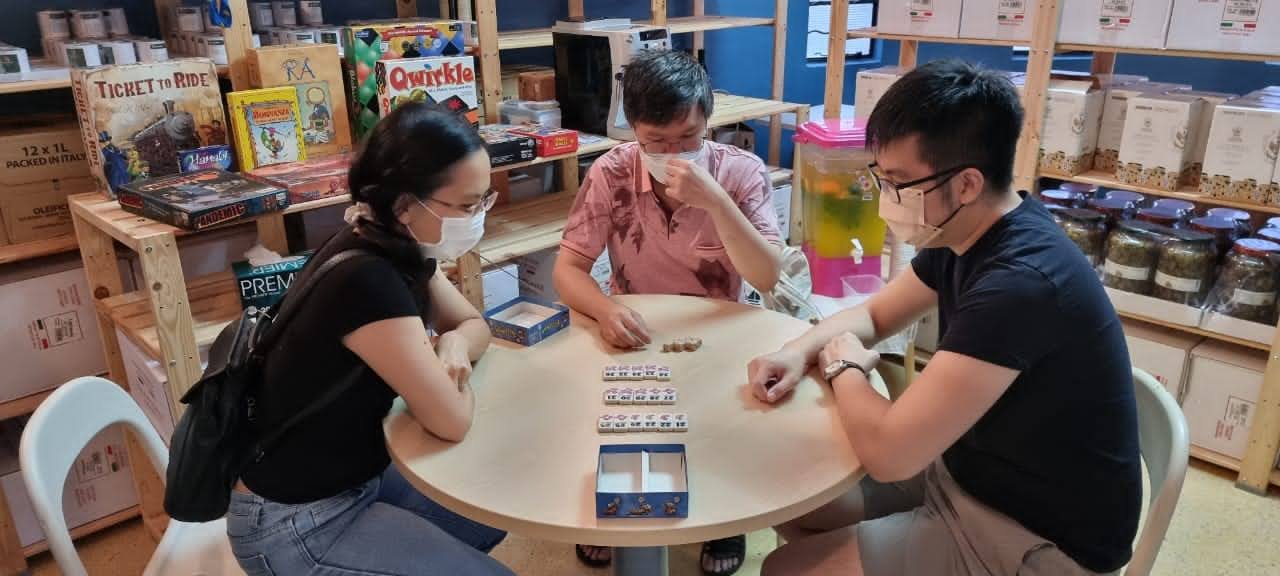
This game My Grand View Garden (我的大观园) is made by the Dream of the Red Chamber Society of University Malaya. I recently met a teacher Pey Ling who specialises in the four major Chinese literary works and runs courses analysing them. She is planning to great boardgames for them, to make her lessons more interesting to her students. She contacted me after reading about my blog post on my prototype for Dream of the Red Chamber. She was interested to meet up and exchange ideas. She had a copy of My Grand View Garden, which she hadn't had the chance to play till then, and we gave it a go when we met up. 


This game has already been produced properly. I am not sure how many copies. It has a proper box and production components. The game is in Chinese and Malay. No English. This is a Malaysianised version of Dream of the Red Chamber. The characters are in Baba and Nyonya costume instead of traditional Chinese costume. The Baba and Nyonya are Chinese who came to Malaysia centuries ago and have since developed a unique culture. Most of them are in Melaka. 


The game is a simplified version of Monopoly. Up to four players can play. You start with some money. You roll dice to move your pawn. You will have opportunities to buy land, build houses and collect rent. The game ends when one player goes bankrupt. Whoever is richest by then wins. Alternatively you can agree to play for a fixed amount of time. 


The board is double-sided. One side is Chinese and the other Malay. It's not actually a board. It's poster paper. Most spaces feature specific buildings from the book, which is nice. Some spaces trigger mini games. You can test one another's knowledge about the novel. One mini game even requires singing. 


The two types of cards are fate cards (pink) and chance cards (blue). If you land on a fate or chance space, you draw a card and do what it says. The fate cards feature many characters in the book. This is one way you learn about and discuss the book. 


The chance cards feature other elements in the book, for example objects and poetry. 


Each space is numbered (in Chinese), in the top left corner. This is helpful when you play the game. The land titles, houses and rent work differently from Monopoly. When you land on an opponent's property, the rent you have to pay is the same as the price of the property. So your return on investment is fantastic. The rulebook is not precise about how all this is handled, but we interpreted it this way. 

We had a group of players with very different experiences. Other than me, we had one highly experienced gamer, one moderately experienced gamer, and one non-gamer. For those of us experienced with modern boardgames, My Grand View Garden is clearly designed by inexperienced game designers. And that is no surprise. The society is of people who study literature, not people who study game design. We shared with Pey Ling our suggestions for the game, so that she could give this feedback to the society. One problem we found was people went bankrupt too easily. We didn't start with much money, and just a few bad events can make you lose all your money. 


These are the land title cards. Gameplay aside, the game does contain many elements from the novel, and thus can be a useful tool to learn about the story and trigger discussion about the characters. 


These dice are not for movement. These represent the houses you build on your land. When you build your first house, you place one die showing the house. When you build more, you turn the die to the appropriate number. 


One gameplay suggestion we gave was removing this fate card on the right. The card effect is to draw another fate card. From the gameplay perspective, there is no meaning or value. I am not familiar with this character on the card though. Maybe there is meaning behind this. 


It is encouraging to see people interested in creating boardgames. It means there is more and more awareness in Malaysia. 

On a separate occasion, I-Van (HR Game), Jon (King & Peasant) and I had a chat with a history lecturer who is thinking of asking her students to create a boardgame as their assignment. Now you can easily use AI to write long essays for you. Assignments in the form of essays may not be very effective. It is not easy to get students interested to properly do their research. So creating a boardgame might be a more engaging way to get students interested in the subject matter. 

Friday, 14 April 2023

Reef Stakes


The Game

Reef Stakes (2018) is a game designed and produced in Malaysia. It is designed by four marine conservationists with the aim of bringing awareness to the masses. This is an educational game and it is now in its third edition. 


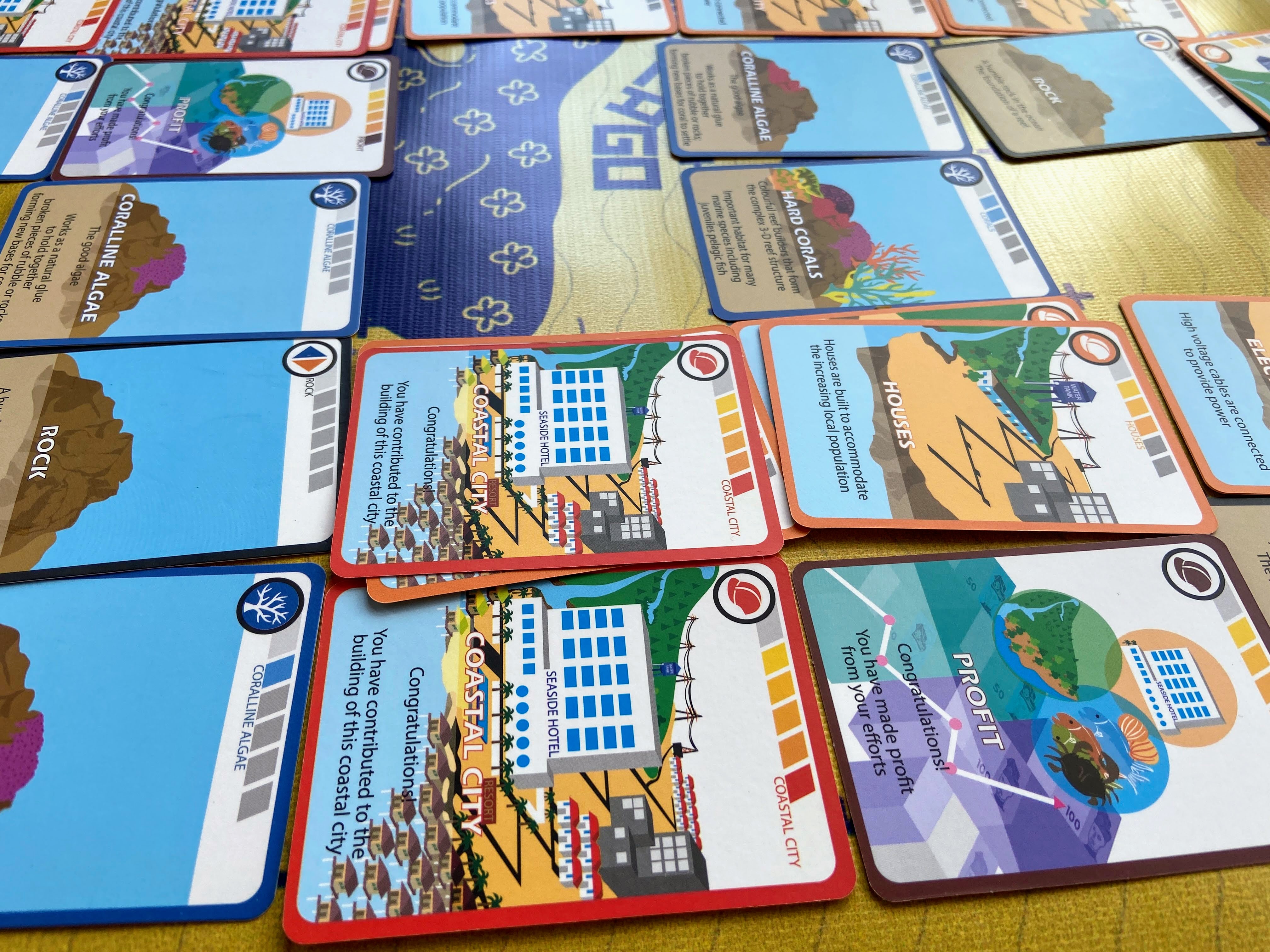
During setup, every player gets a role card. Your role determines which three missions you get assigned. The first player to complete all three missions by playing them onto the board wins the game. The missions are Level 5 cards, and they are either nature missions or development missions. The tourism operator above has one nature mission and two development missions (icons at bottom right). 


The game board (well, actually a mat) is a 7x7 grid on which you get to place your cards. Most cards in the deck are cards of Levels 0 to 4. The Level 0 cards are simply rocks. These are the only cards which can be placed directly onto the game board without any restriction. Level 1 to 5 cards come in two types, nature or development. Level 1 cards can only played attached to a Level 0 card. Level 2 cards must be attached to Level 1 cards, and so on. You can attach a Level 1 nature card or a Level 1 development card to a rock (Level 0). The rock itself doesn't have a type. From Level 2 onwards, the card type must match. A Level 2 nature card can only be attached to a Level 1 nature card, and not a Level 1 development card. 

If a card is directly on the board, you can attach a card to its north, south, east or west, as long as there is space for the new card. You can even stack the new card on top. However if a card is resting on top of another card, the only way you can attach a new card is on top of it. The easy way to imagine this is when you are on the ground floor, you can grow in any direction, but once you are on the first floor, you can only go up. Side note: this is the British way of naming floors. The American way would be first floor in any direction vs second floor and above only upwards.  


There are some action cards in the game, e.g. the rightmost card in this photo. They have various powers, and some of them let you remove cards from the game board. In the most severe case, you remove a series of cards from Level 5 tracing a path of destruction all the way back to the Level 0 rock. This can be disastrous, but it also means an opportunity to start over and space freed up for new expansion. Space is a finite resource after all. 

The game ends once a player plays his or her third Level 5 card and wins the game. 

The Play

We did a 6-player game, which is the highest player count. The game is simple. On your turn you just draw a card and play a card. The cards have flavour text, and they are all related to challenges in preserving our oceans and marine life. 

One issue we had with the game was it was highly risky to play any Level 4 card, because you would be setting up for your opponent to score. When one player first played a Level 4 card, the other players quickly played their mission cards (i.e. Level 5 cards) attached to this Level 4 card. By the time it was this player's turn again, there was no more space for him to play his own mission card. All he had was gratitude from the others. 

The players' remaining missions is open information, so before you play any Level 4 card, you can see who will benefit from it and count whether there would be any space left for yourself by the time your next turn comes. Still, I find this Level 4 card conundrum an issue. 

There is some variety in the action cards. They create some unpredictability and player interaction. 

Cards can be stacked on top of other cards. 

The board can get quite crowded. 

The Thoughts

Being a jaded old-timer, once I tried Reef Stakes I could quickly tell this was not a game designed or produced by a game company. It is a game created for educational and awareness purposes, and not a pure game product. It works for non-gamers and casual gamers, but it may not be very interesting for hobby gamers. 

If you are interested to explore the topic of marine conservation through game form, check this out at http://reefstakes.com/ . 

Friday, 27 May 2022

the joy of light games


I recently organised a game night for my BNI community of friends, and these were the games I brought. It was a mix of light and medium complexity games. I had played with a few of the friends in this community previously, and they seemed to want a bigger challenge, thus the medium complexity games. I also brought a few of my game prototypes. Most of the attendees were new to boardgames, so this was an introduction to the world of boardgames for them. They mostly came for spending time together and not all were specifically interested in boardgames.  In the end, we didn't play any of the medium weight games. We stuck to the light games all evening. We had great fun and lots of laughter, and this wonderful experience made me appreciate the beauty of light games. I told my friends I hadn't laughed this hard for a long time. Originally I didn't intend to play. We had about 15 people, so I had expected to be just teaching different groups to play while I watched and stayed on standby for rule clarifications. However they asked me to join, so I did play a couple of games.  


I started with Category 5 (a.k.a. 6 Nimmt), before we had dinner. This is a classic from Wolfgang Kramer. It works for up to 10 players so this is very good for big groups. 


Heng (middle) is a gamer friend and since he was there, he helped in teaching some of the games. That helped tremendously. Otherwise some of the groups would be waiting for me while I taught other groups. They played Pickomino, a dice game by Reiner Knizia about taking risks and eating worms. No kidding.


Janette (right) is an avid chess player and brought her chess set. They looked rather serious. Well, this was one game I didn't need to teach.  


We played Werewolf. I don't have a copy. Yik Weng brought his copy. I only know the basic version of Werewolf so I taught them that. The werewolves were Danny, Tommy and John. The young lady in school uniform is Danny's daughter, and she happened to sit between Tommy and Danny. One funny moment in the game was Danny's daughter singling him out. She said to the room she was sure her father was a werewolf, because when he was nervous he would stutter. She caught him stuttering. Danny was not able to weasel out of this. 

Another funny moment was when she voice her suspicion that Tommy was a werewolf. Her explanation was that when she spoke to bad guys, she had an urge to cry; and when she was speaking to Tommy just a moment ago, she had that urge. Tommy is normally quick-witted and eloquent. He was caught off guard by this reasoning and didn't know how to respond. He turned red, and when Vivian pointed that out, he became even redder. The room roared with laughter. Being a werewolf is not easy! Surprisingly during that day phase the villagers did not pick Tommy to be lynched. Somehow the werewolves managed to divert attention to another innocent villager. 

This was our dinner, prepared by Clifford. Classy! 


Dyan (centre) was the youngest at the Halli Galli table and completely slaughtered the rest. This is a game of speed and reflexes. She was undoubtedly the quickest. 


Hanabi is a cooperative card game with communication restrictions. You can't see your own cards, but you see everyone else's cards. Angela (3rd from left) was not familiar with games and struggled with grasping some of the concepts. This led to some funny moments. In Hanabi you give clues to your teammates to help them play or discard the right cards. There is an action cost to it so you have to give clues efficiently. As you play, you will develop some conventions and mutual understandings. If you tell your teammate a certain card is a 4, and on the table only green has progressed to 3, he would know that 4 which he cannot see is likely a green 4. He wouldn't need another player to tell him it's green. There was one moment during the game when we quietly worked out something like this in our minds. I knew a certain 3 in my hand was blue, through a few steps of reasoning. When Angela's turn came, she solemnly pointed at that card and said to me, this card is blue. That was when Tommy and Clifford started laughing. We felt bad for doing that. Angela chided us for teasing her and we totally deserved that. 


Many enjoyed Ticket to Ride. It was good to have Heng there. He helped to teach some of the games. Janette won this one. Next time I'll probably bring Ticket to Ride: Europe. Ticket to Ride is almost a guaranteed hit with newbies. It amazes me. 


I brought Qwirkle because it was like Scrabble. So it would be easy to learn. Seet Han had played this before so they only needed minimal help from me. 


We should do this more. It is a joy to spread the fun of boardgames to friends who are new to them. The beauty of light weight games is everyone gets to participate competently and confidently, and the time spent is on actually playing the games, gaming the people and bonding with friends, as opposed to struggling with learning rules. Simple rules are a joy. 

I didn't bring out any of my own prototypes. I wanted to give them a more proper experience with real published games and professional art work. Art and components are part of the playing experience. However I am hopeful in future sessions with this group of friends I will be able to get my prototypes playtested, because most of them are light games. 

In Malaysia the COVID-19 restrictions have only been lifted recently. Well, most of them anyway. Getting back to having a bit more face-to-face boardgame sessions feels great. 


I continue to teach the HABA Learning Program. My group of kids is lively and energetic. It is like going back in time to when my own daughters were at that age. That's more than 10 years ago. If you are interested in this learning programme for children, whether you are a parent, a teacher or an education business, reach out to us at Play With Purpose

Thursday, 22 July 2021

Tuesday, 30 March 2021

children games: Little Bird Big Hunger, To Market, Act Fast

I recently tried a number of children games designed for young children aged 3 to 5. It was an eye-opening experience for me. I normally don't seek out games for young children, so I am unfamiliar with this genre. These game won't be interesting to adults. In fact I would say they won't work at all. However when I look at them from the perspective of a 3-year-old (as best I can) or from that of a teacher of a 3-year-old, I realise they are cleverly designed and deliberately crafted to teach things to children which we adults take for granted. 

One game I tried was Orchard. This is a classic which I have never heard of. It is an evergreen title and has celebrated its 35th anniversary. It even has a number of spin-offs. Yet I am unaware of it because I rarely look into games for young children. 


Little Bird, Big Hunger is a game about baby birds growing up. You need to feed them specific types of food so that they can grow up to become full-fledged adult birds. This is probably a good game to convince kids to eat their vegetables.


During game setup, everyone takes one set of four tiles. There are flowers of different colours on the back of the tiles, so that you can tell which tile belongs to which set. 


Players take turns rolling a die. The die faces are various food types. Regardless of who rolls the die, everyone gets to collect the food type as indicated by the die, if his bird needs that food type. In the photo above, the die face shows two food types. In this case you pick one from the two options. The food types are flies, worms, seeds and berries. 


The face-down tile indicates the food types you need for your bird to grow to the next stage, which is on the front of the tile. Initially the baby bird only needs two food types. In the second stage (photo above) it needs three. Eventually in the third stage it will need four. At this point in the game, the little bird had eaten seeds, and it still needed worms and berries. A mechanism similar to The Settlers of Catan is used here. Regardless of who is rolling the die, every player has the chance to collect something. This keeps everyone engaged. It's a clever concept. 


We did a full 4-player game. Now all the birds were in Stage 2, i.e. they all needed three types of food. 

Worms! Yummy! 


This bird is at Stage 3 now, and has eaten flies. It still needs two servings of seeds and one serving of berries. 


The first player to have his bird fully grown-up wins the game. The fully grown bird flies into the sky (photo above). Others may still continue to play until all the birds are grown up. One thing I didn't notice until after our game was that every picture of the birds featured a bee. That's something the teacher can point out to the children, or ask the children about. Children may notice these details more often than adults. 


This game is To Market. The game box is turned into four shops. Each shop accepts only one particular form of payment. The yellow shop only accepts thick coins. It has a big coin slot. The blue shop accepts credit cards only. It has a long thin slot. In real life, when you pay using a credit card, the shop does not keep your card. In this game, this aspect is simplified. Your card will be confiscated by the shopkeeper. Don't try to explain this to your child. 

Every player starts the game with three coins and a credit card. You also get a notepad - your shopping list. Your goal is to buy all four items on your list. On your turn you roll a die to see which shop you get to visit. You pay using the required payment method, and then you claim the tile representing the item on your shopping list. This is mostly a luck-based game, but a small decision element is injected. Two of the die faces are wild. You get to choose which shop you want to visit. For adults, this is a no-brainer. You simply visit any shop which you have not yet visited. However for a 3-year old, this is a meaningful decision that teaches logic. 


This is Act Fast, by Wolfgang Kramer (Take 6, The Princes of Florence, Tikal, El Grande). This is a speed game in which you compete with your opponents to claim tiles from the table. Every round, a player rolls the four dice, and they will tell you which tiles are up for grabs. However, if a fire is rolled, you are not allowed to claim any tile. If you accidentally claim any, you are penalised. You must return one previously claimed tile. In fact, if you make any mistake, you will be penalised in the same way. If the four dice all show icons of tiles which have already been claimed, you race to claim the rainbow tile instead. The player who wins it immediately swaps it for one other unclaimed tile. When the only tile remaining is the rainbow tile, the game ends. The player with the most tiles wins. 

This is a very simple game, but I was completely surprised by how well it works for adults. This is an engaging and exciting game. Even adults will easily make mistakes, especially when the fire is rolled. Adults will claim tiles by mistake, because everyone is tense and keen to grab tiles as quickly as possible. In the early game there are many tiles on the table, so finding the right one is not easy. In the late game, although there are fewer tiles, the twist introduced by the rainbow makes things tricky. You have to be very careful in making sure none of the icons rolled can be found before grabbing the rainbow tile. If you make a mistake, you will be penalised. 

As a party game, this is a riot! I think this would be a wonderful drinking game. Just don't do it when kids are around.