Showing posts with label Catan series. Show all posts

Tuesday, 30 December 2025

Catan: New Energies


Catan: New Energies is a variant and a standalone game in the Catan universe. 95% of the original The Settlers of Catan is still here. Some elements have been added. The additions are a social commentary. This game explores the concept of sustainable development. In order to do well, you must develop your cities and towns in an environmentally-friendly way. Otherwise you will be penalised. 


You start the game with one town and one city. Every turn, the active player rolls two dice, and they determine which hexes produce resources. If a producing hex is next to one of your settlements (town or city), you gain a resource. Resources can be spent to build roads and new settlements, or to buy development cards. You can trade resources with others. You can also trade with the game supply. Your goal is to get to 10 points. Towns are 1pt, cities 2pts. Some development cards are 1pt. Having the longest road is 2pts, and having played the most clean-up cards is 2pts. These are all the same as base Catan, just that some resources and components have new names. 

Here are the new stuff. At the start of every turn, event chips are drawn from a bag. When a specific number of chips for a particular event type is drawn, that event is triggered and players suffer (or enjoy) the effects. The bag starts with bad events, but when players build clean power plants, good events will be added to the bag. A new way the game ends is the bag being exhausted. Depending on how polluting the players are as a whole, the number of chips being drawn from the bag differs. The pace of the game is affected by player actions. 

Player board

Cities no longer produce double the resources. Instead they produce one resource and one science. Science (lightbulb icon) is a new resource. You can spend science to build power plants. Dirty power plants are cheaper than clean power plants. Dirty power plants, towns and cities all increase your carbon footprint, while clean power plants reduce it. It is always good to have a smaller carbon footprint. Many events penalise players with the largest footprint. Power plants produce yet another new resource - power. Power can be spent to increase your storage, remove pollution, remove dirty power plants or take resources. 

With these elements added, the game is a bit more complex than the standard Catan


Along the edges of the board there are spaces for event chips. Whenever a set is completed, the corresponding event is triggered. Brown events are bad. 


This track indicates how polluting everyone is as a whole. At different pollution levels, the number of chips being drawn from the event bag differs. 


Towns can have at most one power plant, while cities can have three. The town pieces have only one curved indent, while the city pieces have three. These indents remind you of the number of power plants allowed. 

The game instantly feels familiar because almost all of what you have seen in The Settlers of Catan are also here, just that some are called different names. I like Catan, so this game works for me. I'm just playing Catan with some additional rules. Do they make the game better? At the moment it's hard to say. I'm certainly fine with basic Catan, so the additions are not a necessity. To me it's just a variant, and it is nice to have some variety if you have played a game many times. 

I played this online at BoardGameArena.com, and I think it's not very well suited for asynchronous play, because this is a trading game. The trading aspect is slow and tedious. If playing face-to-face, or playing a live game with Zoom on, we will be able to negotiate and conclude trades very quickly. In asynchronous mode we have to wait till the next time we login, only to see our trade proposal declined, and then we try to propose another trade, and then we have to wait again. I want to play this game again, but not in async mode. 

This is how you do trading when playing in async mode

I call this game social commentary because it feels like I am being preached to. It is more expensive to build clean power plants, but if you build dirty power plants and have a large carbon footprint, you will cause bad events to happen more frequently, and you will likely suffer from them more too. Pollution slows your production. More towns and cities mean more production, but also more pollution. Still, I think it is a good thing that they make a game to create more awareness about sustainable development and clean energy. Catan is a huge brand, which means they have social impact. 

Our game ended unexpectedly (to me), due to the bag running out of chips. This is a new way the game ends, and I was not prepared at all. We were all still far from the 10 points winning condition. I feel I was unlucky with the die rolls, and often couldn't do much. My progress was slow. Overall we became pretty green. When you are very green, the game actually speeds up, with two event chips being drawn instead of one. I didn't pay close attention and was caught unprepared. When the chips run out, the greenest play wins the game. 

Friday, 11 August 2023

boardgaming in photos: Deluxe Catan, Regicide, Android: Netrunner


When Jeff had the Klaus Teuber commemoration gaming day, he brought out quite a few versions of The Settlers of Catan to be displayed, and this 3D version was the grandest of them all. 

The three stooges at the centre are the robbers. 

Here you can see a city and a harbour. 

The tile which looks the most 3D is naturally the mountain. 

This wooden box is not for the 3D version but for another deluxe edition. 


I have the Android: Netrunner base game and quite a number of expansions. However I have only played it a handful of times, and I never learned to play it in depth. By now I have forgotten most of the rules. Recently Meeples Cafe did a clearance sale. I went to take a look, and found some Android: Netrunner expansions at 80% off. How could I resist? And I still don't know when I'm going to go back to learn the game properly. 

These two above strictly speaking are not expansions. I can't find them as game entries on www.boardgamegeek.com. They are preconstructed decks used by the 2016 world champions. One deck for the runner and the other for the corporation. 


These are expansions. I didn't look up the reviews when I bought them. They were cheap. Buy now, think later. 


After many attempts at solo mode Regicide, I finally managed to win. From these attempts I certainly learned some tactics. Afterwards I taught younger daughter Chen Rui the game. On our first attempt, we won! It felt almost too easy. I have tried 2- and 3-player games before, and they were tough. I am a little frustrated that my game with Chen Rui felt easy. I had promised her a challenging game. Was she super smart or did my experience with the game help? Maybe a bit of both. 


I was so happy with my first ever victory at Regicide that I had to take a photo. The final boss was the king of hearts. Regicide is a great game! If you haven't tried it, go support it! 

Thursday, 13 July 2023

Die Siedler von Nurnberg

The Game

Die Siedler von Nurnberg (1999) is designed by Klaus Teuber, creator of The Settlers of Catan. It is a special Catan series game commemorating the founding of the city of Nuremberg. Although many refer to it by the name The Settlers of Nuremberg, there is actually no English version of the game. The game has only been released in German. It is a standalone game and not an expansion in the Catan game series.  


One big difference compared to the original The Settlers of Catan is the game board is fixed and not modular. There are no tiles to randomly arrange, and no numbers to randomly set up. The game board has two halves. The right half is similar to the original. You have land plots which produce resources. These are lands surrounding Nuremberg the city. You build settlements and roads here. The left half zooms in to the city itself. You build workshops here, which help you sell goods at higher prices. You also get to build the city wall. 

You objective is to be the first to reach 13 points. The first person to do so wins. However the game has a timing mechanism too. If time runs out before anyone reaches 13pts, the highest scorer wins instead. Your settlements and workshops are worth points. Controlling trade routes and contributions to the wall-building too. 


These are the white player pieces. Roads in the foreground, workshops on the left, and settlements on the right. 


The robbers make an appearance too, similar to The Settlers of Catan. When they occupy a plot of land, it doesn't produce resources until they leave, infuriating settlement owners who have an interest. You also use the robbers to steal a resource card from any one other player. Sometimes the robbers are dispersed by the authorities, and they go back to their lair. 


On the main map, Nuremberg is represented by one hex. There are five trade routes which start in Nuremberg and extend in different directions. In this game, building roads actually means fighting for control of the trade routes. When you place roads, you must start from Nuremberg and extend from there. The colours can be mixed. Whoever has the most road pieces on a trade route controls it. Some events specify that tolls are to be paid. Trade route owners get to collect money from settlement owners who have settlements on their routes. The more settlements you have, the more you pay. When players sell goods, they are delivered via specific trade routes depending on the goods type. The trade route owners take a cut of the profit. Controlling trade routes can be highly lucrative. 


This reference chart here lists the five things you can build in the game - settlements, workshops, roads, walls and towers. In addition to the four resources in Catan, there is a fifth resource - gold. 


Within the city of Nuremberg, the locations where you can build workshops are marked with big red dots. The pictures in ovals are the various goods you can produce and sell to make money (earn gold). When you have a workshop next to a goods icon, it means you can sell this goods type at double the price. Everyone can produce every goods type. The difference the workshops make is just in doubling the selling price. 

There are two central hexes in Nuremberg. The one on the right (Hauptmarkt) is the market. If you build a workshop next to the market, you can trade resources at a better rate. Normally you can trade four of the same resource to one different resource you want. With presence at the market, you can trade 2 for 1. This is equivalent to the ports in Catan

The other central hex (Bauhof) allows you to build towers along the walls of the city. Towers are worth 2 contribution points, compared to 1 contribution point of one piece of wall. If you want to compete to be biggest contributor, towers are a more efficient way. 


Walls and towers are cardboard pieces placed along the edges of the city. Halfway playing we discovered a mistake. Towers are supposed to be placed at the peaks, not the valleys. 


The five awards on the right are for the controllers of the five trade routes. Each is worth 1pt. The three on the left are awards for the three biggest contributors to wall-building, i.e. those who have the most contribution points. These are worth 2pt to 4pt. Awards are not permanent. The competition is always active. Whenever a laggard surpasses the leader, he wrests the award from the leader. 


This is the time schedule in the game. Die Siedler von Nurnberg is a Catan game without dice. Instead of rolling dice, you draw cards from a deck. The decks are numbered between 2 and 12, and the distribution follows that of two dice. The cards also trigger some events. Some cards specify that you advance the time marker, and this can lead to all cards being reshuffled and the deck being reset. You likely won't get to the bottom of the deck, and you won't know exactly when the reshuffle will happen. Game length is not deterministic. The third time the deck needs to be reshuffled, the game ends instead, because the marker would reach Year 1400, the final year. If by that time no one has reached 13pts, whoever has the most points wins. 


Armour is one of the goods you can produce. You need three ore and one wood. You sell it for 6 gold. Armour is sold to Prague, so you have to pay the corresponding trade route owner 3 gold. This is quite steep. 50% going to the trade route controller. If you have a workshop specialising in armour, you will be able to sell at 12 gold instead. Then the 3 gold to be paid to the trade route controller does not sound that bad. Of course if you yourself control the trade route, that would be best. You don't need to pay anyone. 


The rulebook has a recommended setup for first time players. Since some of us were new, we used this setup. In this photo you will notice the roads consist of a mx of colours. They are not actually roads. They represent the strengths of players at each of the trade routes, which determine who control the trade routes. 

The Play

Having played Catan, Die Siedler von Nurnberg is familiar and fresh at the same time. It is a slightly more complex variant. This is a game from the 90's, so it doesn't have the kind of complexity that many recent heavy Eurogames have. This is a plus in my book. I'm getting a little tired of some of the contemporary Eurogames, because I think they are complex for the sake of complexity. They are creating work for the players. But then some do find fun in this kind of work and this kind of complexity. 

Die Siedler von Nurnberg is not simple. It is still a medium weight strategy game. It takes some effort to understand how the various moving parts work and how they relate to one another. You need to build settlements to collect resources. You then use the resources to build more settlements, compete at the trade routes, and build walls and towers. You build all these to gain points, and that's how you win. 

There is some randomness in resource production. You may not always get what you want at the time you want them, so you try to make do and use your resources as efficiently as possible. Sometimes you trade with your opponents to mitigate luck. By trading for the resources you need, you will be able to make use of your resources more effectively. You often need to prioritise between multiple options. There is spatial competition on both maps. The trade routes and wall-building are long-term, ongoing contests. If you don't keep up, you will be overtaken. There is much player interaction in this game. 

In the game we played, I fell behind in wall-building from the get go, because I was short on money. When I decided to deprioritise wall-building in the early game, it became harder and harder to catch up later on as the other players built more and more stretches of walls. I had even less incentive to compete because it would take a lot of effort and I wasn't even sure I would be able to catch up. Why not focus my resources in other areas, and let the rest fight and expend their resources? The three awards for biggest contributors changed hands frequently between Rachel, Wai Yan and Julian, while I played spectator. 

As the game went on, I found myself stuck in a difficult situation. Even if I built all my settlements and workshops, that would only give me 9 points. To win, I would need to control 4 of the 5 trade routes to reach 13 points. That was close to impossible. Giving up on wall-building was not exactly a good idea. Unfortunately I couldn't see through to the end of the game. I had to leave before the game ended, and I asked Jeff to take over my not-exactly-enviable position. What was surprising later on was that I (well, Jeff) did not come dead last. Julian reached 13pts, and the scores were close. 


The number icons indicate how frequently we can expect those numbers to turn up. 8 is one of the most common numbers, so it is in red. The background is fully coloured beige. 10 can be expected often, but not as much as 8. The background is about two thirds beige. 12 is quite rare. You will notice the text size is much smaller, and only a fraction of the background is beige. I like this visual cue. 

The settlement rules are different from Catan. In Catan, settlements must be at least 2 steps away from one another. Here, this minimum distance only applies to settlements on the same trade route. Between settlements on different trade routes, you don't need to worry about this distance. 


The more settlements you have, the higher the odds of harvesting resources. However it also means you may be paying more toll fees. If you have many settlements on a particular trade route, it probably makes sense to invest effort into controlling that trade route, so that you won't need to keep paying toll to someone else. Another way to think of this is if you control a particular trade route, you may prefer to build settlements along this route. 


We made a mistake when playing. We forgot that we needed a workshop touching Bauhof before we could build towers. All of us fought for slots at the market for the better trading rates. 


Towards late game, there were fewer and fewer spots for settlements. What were left were not very enticing. Every player could build at most five settlements. 

If you look at the trade routes above, you will notice there are a few instances of players building two or three roads at one go. This usually means they are overtaking the previous controller of the trade route. You don't wrest control if you only catch up to the controller. You need to overtake. 

The Thoughts

Jeff says this is his favourite game in the Catan series. After playing it Julian agrees. Indeed this is a slightly more complex game, so it appeals to gamers. The whole Nuremberg setting is nice and thematic. In contrast, the original feels generic and bland. In Die Siedler von Nurnberg, there is no modular board, which means less variability from game to game, but the player setup stage does still create some variability. I prefer the original Catan, mainly because I prefer more variability. 

In Die Siedler von Nurnberg, dice are removed, and this reduces the luck factor a little. One more luck element removed is the 1 point cards in the development card deck. The original Catan has such cards, and these 1 point cards are highly valuable. They can't be stolen from you. I can certainly appreciate why Die Siedler von Nurnberg is attractive to seasoned gamers. Less luck, more strategy. 

Negotiation and trading are an important aspect. This is what makes player interaction fun. You can have temporary alliances to try to catch up to the leader. No one likes trading with the leader because you'd be helping him get even further ahead. 

Our particular game felt a little long to me. I had thought 2 hours should be more than enough, but it took longer than that. That was why I had to leave before the game ended. I had another commitment. Our end game was a draggy stalemate because of the constant back-and-forth fighting over wall contribution. The awards kept changing hands. By then most of us had built most of our settlements and workshops. It was the competition over wall-building which would give us the edge to hit 13 points. Another reason the game went long was we drew the reshuffle cards very late. It was almost at the bottom of the deck. Be prepared that a 4-player game will be more brutal and may take longer. 

Klaus Teuber passed away on 1 Apr 2023. BoardGameCafe organised an event to celebrate his life and his contributions to the board game hobby. All games at the event were his designs. Catan is a modern classic and it was one of the earliest games I played when I entered the hobby. I'm grateful that Klaus Teuber has made so many great games for us gamers. 

Saturday, 26 May 2018

boardgaming in photos: Unlock! The Island of Doctor Goorse, Bonnie and Clyde, Catan Card Game

6 May 2018. Unlock! The Island of Doctor Goorse is the third Unlock! game I have played. This time it was a 4-player game. I asked my wife Michelle to join us this time because this particular game needs to be played in two teams. I didn't want to have solo teams, so we needed at least two players per team. I wanted a cooperative experience and not a solo puzzle solving exercise. Doctor Goorse was much harder than the previous two. The publisher rates it 3 of 3 on the difficulty scale. The other two games, which I found moderately easy, are 2's. I was surprised how tough this one turned out to be. This is a good thing. Challenging is good. We had to use hints many times because we got stuck.

This was our score. It took us more than two hours to finish this one hour game (first row, left side). We had to ask for hints 7 times (first row, right side). We revealed two incorrect cards and were penalised 6 minutes (second row). We entered wrong codes 7 times and were penalised 14 minutes (third row, right side). Our final rating was 0 stars (out of 5). If you are interested to try an Unlock! game, do NOT start here! Nevertheless, this was a fun experience, because of how difficult it was. The puzzles here are quite clever, I must say.

The story is that you have crash landed on an island belonging to a rich archaeologist. Your group is split into two during the crash landing. You need to reunite before trying to escape the island together. One team is the yellow team and uses the cards with yellow numbers and alphabets. The other is the green team. Teams may not discuss or share information, at least until they find each other.

Wed 9 May 2018 was an important day in Malaysia's history. It was election day, and this election was the first time we had a change in government since independence 61 years ago. I casted my vote early, and was home by 9am. I had the rest of the day as free time, since it was a public holiday. In the afternoon I played some games with younger daughter Chen Rui. This game here is Bonnie and Clyde, one of the games in the Mystery Rummy family. This was the first time Chen Rui play this. I hadn't played it for a long time, and needed to read the rules again.

All games in the Mystery Rummy series use a few basic gin rummy mechanisms. At the start of your turn, you always draw a card. At the end of your turn, you must discard a card. In between, you may play melds and layoffs. A meld is a set of 3 or more similar cards. After a meld has been played by anyone for a particular number, cards of that number can then be played as single or double cards. These are called layoffs. A game is played over several hands. For each hand, you play until one player plays all cards from his hand. You then score, reshuffle, and start the next hand. Once anyone reaches a certain total score, the game ends. Bonnie and Clyde refers to the famous criminal couple from the 1930's. This version of Mystery Rummy comes with a long game board consisting of 10 locations. During setup, 10 cards are placed face-down along the board. Two of them are Bonnie and Clyde. During the game, if you are able to find and catch them, they each give you 10pts.

This car is an important element in the game. It starts at the #1 location. When you play melds or layoffs, you get to move the car. To catch Bonnie or Clyde, the car needs to be located where they are, and you need to play a card matching that location number too. Throughout the game you will be manipulating the car to your advantage. In addition to helping you catch the criminals, when you play cards which match the car location, they score double points. These are the key elements in Bonnie and Clyde which differ from other games in the family.

The cards played horizontally are those which will score double. This is the convention used to indicate cards which are played when the car is at the matching locations. It is usually better to play melds and layoffs when the car position is right, but it's not always easy to do. Sometimes you hold on to cards waiting for the car to move to the right locations. Sometimes you can't risk the wait, lest your opponent suddenly plays all cards and ends the hand. Sometimes you play some cards without getting double points to move the car to the right location to allow you to play other cards to score double points. Finding Bonnie and Clyde is tricky. When you to play a meld or layoff, you get to peek at the face-down card at the location matching the meld or layoff. This helps you find them. However you need to match the car location to actually catch them.

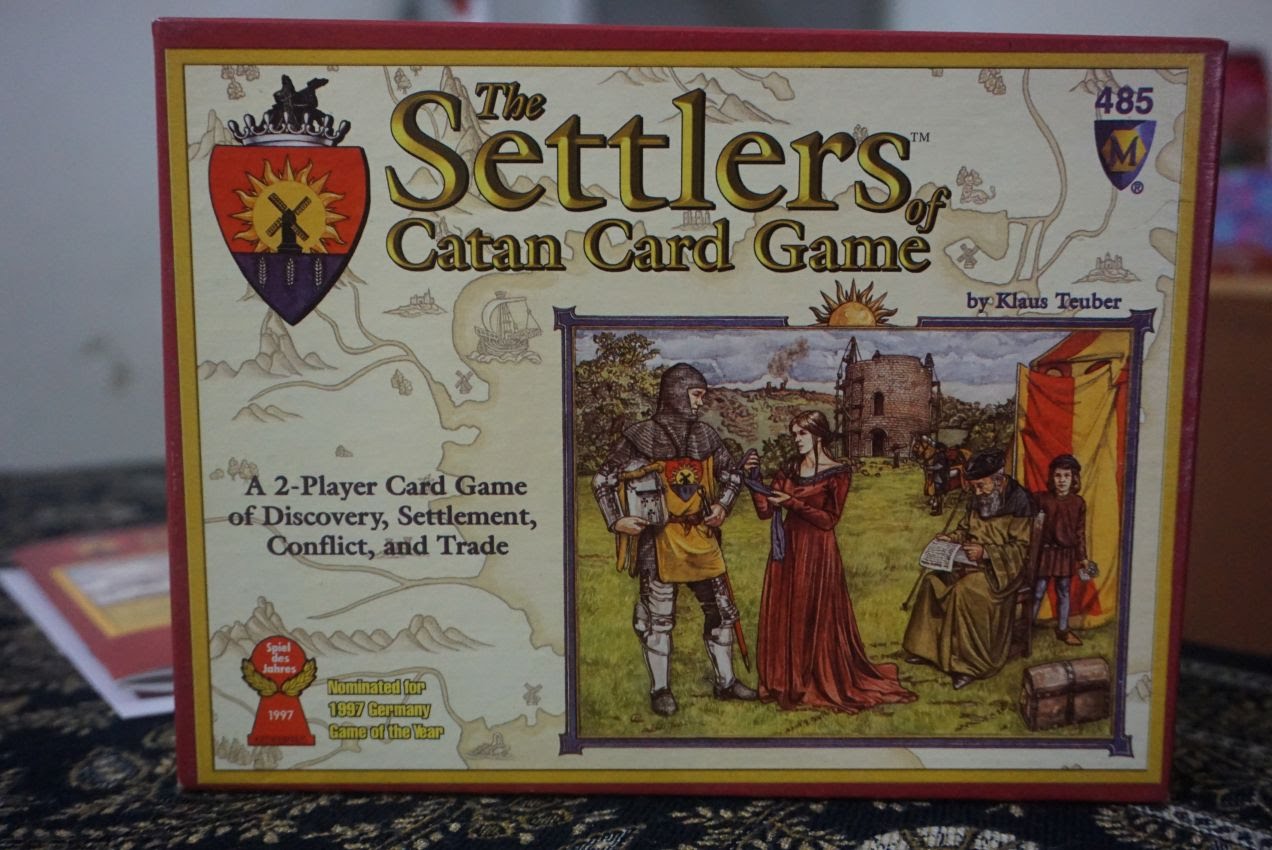
This is the Catan Card Game. It is the first edition, which is quite old. The newer edition is called Rivals of Catan. Normally when a successful boardgame gets a card version treatment, the card game version is simpler. In the case of The Settlers of Catan, its card game version is more complex. Also, it is a 2-player-only affair. It has some elements where the equivalents are in the Cities and Knights expansion of the boardgame and not the base game.

Older daughter Shee Yun is usually not interested to play boardgames, and only younger daughter Chen Rui is more willing to humour me. So I looked for a 2-player game, and decided on this. According to my records, the previous time I played this was 10 years ago!

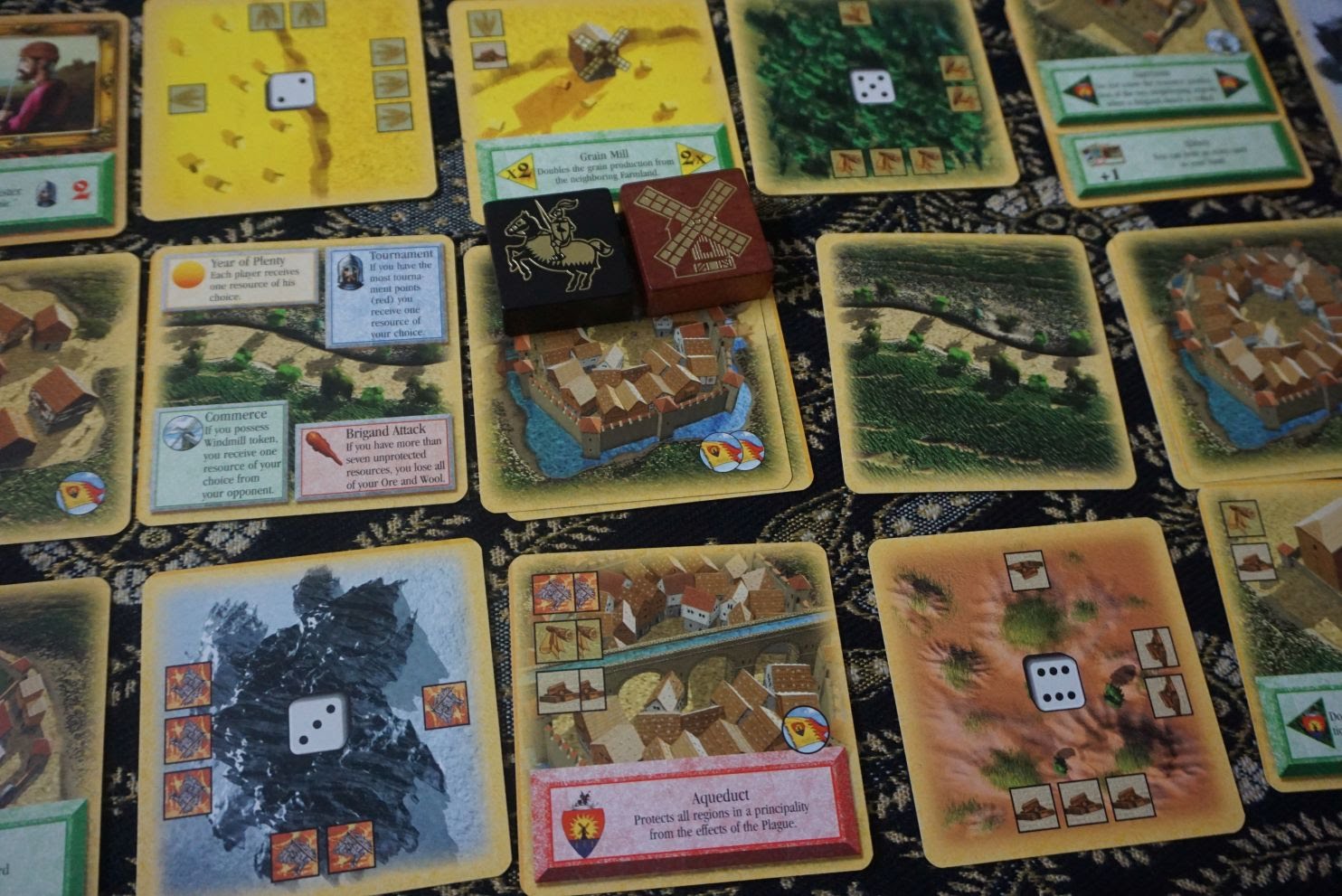
This is the starting setup. Those cards in the middle are the draw decks. The two players each have their own areas, called principalities. You start with two towns and a road connecting them, and six production terrains surrounding them. Your objective is to reach 12 victory points. Towns are 1VP each. If you upgrade a town to a city, it is then worth 2VP. Some buildings you can construct in your towns and cities are worth VP. If you are militarily or economically stronger than your opponent, you get to control the military token and the economic token respectively. These are worth 1VP each.

Your principality looks like this at the beginning. That road card in the centre contains useful reference information. On both of the town cards at the two ends of the road, you can see a flag icon at the bottom right. These icons are the victory points. As for the six terrain cards, pay attention to the upper edge only. The cards are oriented this way specifically to indicate there is one resource at each terrain card. Whenever a terrain card produces, you rotate it counter-clockwise, so that the upper edge will show one more resource. When you spend resources, you rotate the terrain card clockwise. A terrain card can store at most three resources. Once it has three, it is full and it can't produce more.

Catan Card Game is a development game. You collect resources, then spend them to build more things, which help you collect more resources, to build more others things, and eventually collect enough victory points to win. It feels good because you are progressing, you are collecting stuff, you have a purpose, you have a plan to execute. In this photo I had expanded my principality from the original two towns to two cities and two towns. I now had 10 terrain cards compared to the original 6. During the game I told Chen Rui there were only 5 new towns that could be built, and players needed to fight for them. Usually one would get three and the other would have only two. Naturally whoever had the third new town would enjoy an advantage. It meant two extra terrain cards and thus more production. I was surprised that Chen Rui managed to beat me to it. I was so close. Unfortunately, in other areas of development, she fell far behind. She had a few strong knight cards, which were expensive to play. Quite a few times when she had accumulated many resources, the brigand event was rolled and she lost all her ore and sheep. Those were major setbacks. I played some garrison cards to protect my resources and I rarely fell victim to the brigands. As I developed more, my progress only accelerated compared to hers, and I eventually won with a big margin.

The two square wooden blocks are the tokens for military dominance and economic dominance respectively. I controlled both of them.

Despite being a card game, the luck of the draw in Catan Card Game is low. There are five draw decks in the game. When you need to draw a card, you may spend two resources to look through one entire deck to pick the one card you want. When you do this, it means you get to see every card in the deck. You will know whether there are other cards that suit your strategy which you will want to cherry-pick again later.

Playing this again after ten years felt great. It has a same enjoyable tempo like The Settlers of Catan. Every turn dice are rolled, and both players get to produce stuff, not just the active player. You keep producing until you have enough resources to build something. I have the expansion to this game, which contains 5 modules. If Chen Rui is still interested to play, there is plenty more we can explore.