Showing posts with label one vs many. Show all posts

Saturday, 20 June 2026

This Game is Killer: Frozen Horror


During the lifetime of a game taster, once in a while we stumble upon unheard of games which take us by surprise. This Game is Killer: Frozen Horror is one such game for me. It is not a ground-breaking genre nor is it a highly unusual setting. It is just how well the game is put together in a concise way, plus some genius ideas thrown in. 


First and foremost, this is a one-vs-many secret identity game. One of the players is the horror, and the rest are humans. The game is played until the horror kills all the humans, or the humans manage to kill the horror. You win if you are still alive. The twist in this game is you draw identity cards every round. Every round, the horror might be any of the characters still alive. Imagine a ghost which jumps from body to body to possess them. 

The setting is a research station in the Arctic. You can start in any of the four rooms. They are connected to other rooms via doors in specific colours. The colours are important because movement cards let you move through doors in specific colours, and some cards let you temporarily lock a door in a specific colour. 


Every round you draw two cards and you will play them both. One must be played for movement, and the other for its power text. After all cards are played, you check whether the horror is in the same room as any human. If so, the horror kills some or all of these humans. When you are human, you need to try to guess who the horror is and you want to avoid him. If you are the horror, you normally want to go to where the most people are, or where at least one human is. You want to kill. 

When you are human, the behaviour of the other players will give you some clues on whether they are the horror. The horror will try to be subtle. He may pretend he suspects another player is the horror, and that's why he's coming to your room. He may try to make excuses for questionable actions. By default, the horror kills someone sharing the room. For a human to kill the horror it is much harder. You rely on having drawn certain cards. For example there's a card which lets you shoot a person who enters your room. Now that poor fellow might actually be human. There is a card which lets you shoot someone in your room then leave. If the horror uses this card well, he can kill twice. 


As the number of players dwindle, some rooms will be destroyed. It's hard to run away from sharing a room. 


When you are eliminated as a human, you don't participate anymore, but you can still cheer on the remaining humans. This is a player elimination game, but it is short and entertaining that even watching others play is fun. 

I like that this game distils the genre into something so minimalistic while still retaining the psychological play. In fact, I feel you get extra doses of this excitement because every round the identity of the horror may change. You are constantly wondering who the horror is. You question every action of your fellow players. Are they laying a trap? Are they trying to avoid danger or are they trying to trick you? Who can you trust? 

Sunday, 6 August 2017

Not Alone

Plays: 5Px1.

The Game

Not Alone is a one-vs-many game. The many is a team of space explorers stranded on the mysterious planet Artemia, waiting for rescue. The one is a powerful and malicious alien creature which controls all life-forms on Artemia, and which now wants to assimilate these unexpected visitors into the local hive-mind ecosystem. Can the explorers stay sane and away from the creature long enough for their rescuers to arrive?

This is the countdown track. The pawn on the left is the rescue counter. It marks how much longer the humans need to wait before the rescue ship arrives. The pawn on the right is the assimilation counter. It marks how close the creature is in assimilating the humans. This is effectively a race game, whoever manages to get his pawn to the star position first wins.

The three discs at the top belong to the creature. They are the Hunt tokens used for hunting the humans. The disc in the middle is the creature token which represents the physical presence of the creature itself. This token is always in use every round. The other two tokens are available to the creature under specific conditions, e.g. the play of a Hunt card. When playing, we joked that the token with an A looked like an Avengers token, and thus must be super powerful. The A actually stands for Artemia, the name of the planet.

The cards with the green back are the Hunt cards. The creature always has a hand size of three, and normally gets to play one Hunt card per round.

This is how the game is set up. The 10 cards arranged neatly at the bottom form the game board and represent the 10 locations on Artemia, each with a different ability which the humans get to use. At the start of the game, each human player has one each of cards numbered 1 to 5, which means he can only access the first five locations. At the top of the photo you can see a pool of cards numbered 6 to 10. During the course of the game the human players may claim these cards to increase their options.

At the start of a round, each human plays a location card from his hand face-down, committing where he will be for the round. The humans may discuss how they want to play, but the creature is listening, so they can't be too explicit. The humans have to hope that their teammates know what they are thinking and will play in a cohesive manner. After the humans are committed, it is the creature's turn to decide where to hunt. This is done by placing the Hunt tokens on the location cards where it thinks the humans are. Then you check whether any humans are caught. They will suffer penalties. Depending on the Hunt token, they may lose Will counters, they may lose cards, they may be denied the ability of the location, the assimilation counter may advance, etc.

The most crucial part of the game is advancing your counter on the countdown track. The rescue counter automatically advances at the end of every round. The humans can perform certain actions, e.g. using location abilities, to make additional advancements. The assimilation counter advances when the creature catches a human using the creature token, and also when a human loses his last Will counter. Every human starts with three Will counters. Will counters can be spent to return played location cards into your hand, but it is a risky thing to do, because you will get closer to losing them all. When you lose them all, the creature's assimilation counter advances, and you reset your character by taking back all your location cards and your three Will counters. You can use location abilities to return location cards to your hand, thus delaying the usage of Will counters, but in the long run it is a matter of stalling, not completely avoiding.

The locations on Artemia help the humans in different ways. They can speed up the rescue ship. They help you reclaim played location cards. They give you new location cards. They give you Survival cards. Survival cards are usually powerful, similar to the creature's Hunt cards. Each human may play at most one Survival card per round. One key difference between Survival cards and Hunt cards is the humans need to perform an action at a location to draw a Survival card, while the creature automatically draws back to three Hunt cards every round.

These are some of the creature's Hunt cards. Those target icons on two of them mean when you play these cards, you get to use the target Hunt token for the round.

The Play

Ivan taught us to play. He had played before, as the creature, so this time he wanted to try being human. He asked me to take the role of the creature. So I was public enemy in our game. There were five of us in total, thus four human players. At the start of the game, having four human players seemed very beneficial to the creature player. They only had five locations to pick from, and I felt I would have to be very unlucky to miss all four of them. Also one of the five locations, #5, was particularly attractive - it allowed the human player to gain a new location card. This was very useful. It was best to get such additional cards early, so that for the rest of the game you'd have more options. It was natural that the human players would be very tempted to make use of this location in the early game. I missed one consideration though. Location #1 was the creature's lair, and if a human made use of it, it could trigger the location ability of the location of the creature. So if I hunted at location #5, the humans could just go to location #1 and still trigger the ability of location #5.

Playing the creature was all about guessing where the humans were. I could see what location cards they had played to determine what options they had remaining. I had to remember which new location cards they managed to claim. I looked at how many Will counters they had to guess what they would try to do. For me the tension came from the ever ticking countdown clock - the rescue team was on the way. I had to assimilate the humans before time ran out, and the ticking clock often jumped ahead by one or even two extra steps. It was nice being omnipresent and powerful, but that didn't mean assimilating the humans was easy. I had a deadline to meet. The humans were stressed out as well, like mice being stalked by a monstrous cat, occasionally supported by devilish kittens (the extra Hunt tokens). Every round they played location cards, leaving fewer and fewer in hand. They could take cards back but that usually meant spending Will counters. Doom approached from both directions, or in Manglish (Malaysianised English) - turn left die, turn right also die. They struggled to survive and were often torn between lying low and waiting patiently, and being bold and helping the rescue team arrive sooner.

Both the creature's Hunt cards and the humans' Survival cards are powerful cards. They create drama and twists. Without them, I believe the game would be a little staid, because all other information is open - the location cards that have been played, the number of Will counters remaining, the available options of each human. Hunt cards and Survival cards create opportunities and help make impossible saves. I would say they help address a weakness in the core mechanism. They make the overall package better. They are powerful but not so much that you feel you win or lose by the luck of the draw. These cards are a supporting element, not the core.

Despite the difficulty in coordinating their actions due to the ever listening creature, the humans still have many ways to collaborate and help one another. They can choose to apply the ability of a location card or a Survival card on a fellow player who needs it more than themselves. Often a human can take one for the team, suffering injury to protect a teammate. The humans do feel like a team playing a cooperative game.

In this particular round, as the creature, I could use two Hunt tokens. Location #4 comes with a yellow marker. This marker starts the game off-card. When a human player triggers location #4, he may move the marker on- or off-card. Moving it on-card means charging up a beacon, and moving it off-card means activating the beacon, which causes the rescue counter to advance by one step. So it takes two human actions at location #4 to speed up the arrival of the rescue team by one step. It is possible to achieve this within one round if two humans come here (and are not caught by the creature).

The human player on the left had played location cards 1, 2, 3, 5 and 9, which meant it was much easier for me to guess where he was going. But beware the Survival card. There just might be one which could save this player from such a sticky situation.

This was near end game, and it was going to be a close finish. On the rescue team track, some spots have an A. If the rescue counter stops at these spots, in the next round the creature gets to use the Artemis Hunt token. The human players will try to avoid these spots. Most of the time it is ideal to move two steps per round, to completely avoid the A spots. That means moving one extra step on top of the one free step every round. However sometimes it is worthwhile to move three steps, even if it means landing on an A. In fact sometimes it is necessary. This is a race game after all.

Our game was close. The tension built towards a climax, and I think this is how most games will be. As the creature I tried to focus on humans who were already low on Will counters. Every step towards assimilation was precious. In the late game, when the rescue ship was about two rounds away from arriving, we came to a situation where one of the humans had only one Will counter remaining, and also only two location cards in hand. Big Red Target, in my eyes. My assimilation counter was two steps away from victory. If I could catch him in person (i.e. using my creature Hunt token), my assimilation counter would move one step for catching him in person, and another for reducing his Will counters to zero. That meant victory for me. Since he had only two cards left, I had a 50% chance of winning this round, assuming no Survival card upset my plan. Of his two locations, one was very enticing, because it would let the rescue counter advance an extra step. The other one was meh. I could decide to prowl the yummy location, since it was obviously the better location. However the human would know I was thinking this way, and might thus choose the meh location just to stay away from danger. So maybe I should pick the meh location so that I would catch him. He would deduce that I would think this way too, so the most dangerous location might actually be the safest one. Then why not just go for it? This is the kind of double guessing which happens all the time in this game. Eventually I decided the human must be having a do or die mindset by this stage. So I placed my creature Hunt token on the yummy location. I was right! Game over for the humans. Welcome to the warm embrace of Artemia.

The Thoughts

Not Alone is a light-to-medium weight game. It takes 30-45 minutes to play. What makes it attractive is the cat-and-mouse mechanism and how the creature and the humans need to guess one another's intentions. Even among the human players they need to guess what their teammates are thinking. The humans are under constant pressure. Their location cards dwindle, their Will counters dry up, they slowly slide towards the hive mind. They fight to survive till help arrives. The creature is mighty, but also has a heart-pounding urgency to assimilate the humans before they escape its grasp. This game has great atmosphere!

Friday, 28 October 2016

revisiting Tragedy Looper

After trying the Bio-Terrorist Challenge in Pandemic: On The Brink with my colleagues, I thought it would be interesting to teach them Tragedy Looper, which is also a one-vs-many game.

Protagonist players: Benz, Xiao Zhu, Edwin. Observers: Jeixel, Tyle. We started with the first scenario. I was, of course, the evil mastermind. We decided to play 3 loops, which was easier for the protagonists. I had forgotten many details, and more importantly I had forgotten the techniques and tactics. I had to recall and reconstruct them while I played. Since I was rusty, I had to rely on the mastermind strategy guide in the mastermind handbook. One thing that I did remember, and felt again, was the tension of being the mastermind. It was nerve-racking. After playing Tragedy Looper, I felt drained - that kind of feeling when you are suddenly released from a long period of being tensed up. As mastermind, I needed to fully utilise every piece of informational advantage I had over the protagonists. Most of these advantages can only be used once, because once the protagonists learn of your weapon, they will also learn to disarm you. I needed to be prudent with how I used my weapons. I needed to avoid revealing too much, while still making sure I could trigger the tragedy before the current loop ends. Otherwise I would run out of reliable weapons. I had to plan ahead too. Many incidents and character actions could only be triggered if the relevant characters had enough paranoia or intrigue tokens placed on them. I needed to make sure I had enough turns to place the required numbers of tokens.

The strongest masterminds will be able to make good use of not just the main plots, subplots and incidents in a scenario. They will make use of even the main plots and subplots not in the scenario. The protagonists do not know which plots are in, so they need to consider all possibilities. If the mastermind can use this to throw red herrings, he can keep the protagonists off the right trail for longer. I am nowhere near that level yet. I already struggle with juggling in my head the main plot, subplot and incidents that are in the scenario. I need to keep finding ways to trigger the tragedy without getting disrupted by the protagonists. It feels like being hunted. As the protagonists uncover clue after clue, I see my options dwindling and I feel the net closing up.

A funny situation occurred in Scenario 1. In one of the loops, I had carefully planned a series of events that would trigger the tragedy. The protagonists didn't know yet how I was going to do it, but the actions they took got people killed (which was not what I had in mind), and ultimately ruined my plan. I needed the right people at the right place at the right time, so when some of them got killed at inopportune moments, my plans were foiled. I had to scramble to find another way to trigger the tragedy. Bad things happening can actually be good for the protagonists. Also, the best laid plans can be spoilt by the protagonists unintentionally.

Eventually it came down to the last day of the last loop. I had only one last chance to trigger the tragedy. There was only one method remaining to kill the character I needed dead, but in order to do that, I needed two specific characters to meet up. In Tragedy Looper, the mastermind plays his cards first, so the protagonists can always react. Also if both the mastermind and a protagonist have played movement cards on a character, the character often ends up moving in a direction neither party intended. I gambled on the second point, intentionally trying to send one of the key characters in a wrong direction. To my pleasant surprise, the protagonist did indeed play a movement card on him too, and the result was he moved in the true direction I wanted him to go in. I managed to trigger the tragedy once again, and won the game.

Protagonist players: Benz, Jeixel, Tyle. Observer: Eva. After the first game, Xiao Zhu and Edwin didn't seem too keen. Deduction games may not be their thing. However Jeixel and Tyle who had been watching us play looked interested. So Benz suggested they join the table to play the next scenario. The second scenario was a bit more complex. It had 5 days per loop, and we played 4 loops (easier for protagonists). Despite it being longer, we were able to play more quickly because we had a better grasp of the game mechanism.

This time victory was again decided on the final day of the final loop. By then I (mastermind) had almost run out of options. The protagonists knew most of my tricks and how to neutralise them. On that fateful final day, I could only pin my hopes on one particular character, who had the ability to place an intrigue token on another character. Each round (i.e. each day) I only had 3 action cards to play, and the three protagonists also had one each to play. Since I had to play my cards first, they could see where I played them and then play their cards on the same characters to try to foil my plan. Having that particular character was akin to having a fourth action card. The protagonists needed to decide which three among my three action cards and this character's ability to try to neutralise. Eventually they decided the character was too risky to leave be, so they moved him, and negated two of my three action cards. Thankfully, the most critical action I needed to execute was precisely the one they ignored. The game character was but a feint. The protagonists failed to save the day.

Both Scenarios 1 and 2 are introductory scenarios, so the number of characters in play is low. In standard scenarios there are more characters and more plots. I wonder when I'll get to Scenario 10. The base game has 10 scenarios. I think I've only played up to Scenario 3. I don't remember whether I've read the solution to Scenario 4 (which is a good thing - that means I can play it). I have already ordered the expansion. I hope I will eventually get to that. I still have not yet taught my children this game. I hope they will like it. Shee Yun (11) should be able to play it, but I think not Chen Rui (9).

Tuesday, 6 January 2015

Tragedy Looper

Plays: 4Px1.

The Game

A tragedy has just occurred (usually someone is dead). You have a time machine and you can reset time back to before the tragedy. You want to prevent the tragedy. However there is a mastermind orchestrating the whole business, and despite your best efforts, things still go wrong and the tragedy still occurs. You can reset time again using the time machine, but you can only do this a limited number of times. Your objective is to simply prevent the tragedy. Failing that, after the tragedy repeats for the last time, you have one chance to guess the secret roles of every character in the game. If you get this 100% correct, you win a marginal victory.

In Tragedy Looper, one to three players play the protagonists who need to prevent the tragedy from happening. One other player plays the mastermind, who needs to trigger the tragedy loop after loop. The game plays for a predetermined number of loops, each loop starting at the same point in time, and having a fixed number of days, unless the tragedy occurs early. One day corresponds to one round, in which the mastermind gets to play three cards face-down on three characters and/or locations, and then the protagonists get to do the same (but not necessarily on the same three characters / locations). The cards are revealed simultaneously and resolved by the mastermind. The mastermind and the protagonists get to use the characters' special abilities where possible and if desired. Finally the mastermind checks for whether an anticipated incident occurs. That's all there is to a round - card play, triggering character abilities, and triggering an incident if applicable.

The game from the perspective of the mastermind - upside down. The board consists of four locations. There are only six characters in play in this learning scenario.

Here are what you can do with the cards. You may move a character from one location to another. The protagonists may increase the goodwill level of a character. When the goodwill level of a character reaches a certain value, the protagonists may use his or her goodwill ability, which is usually useful to the protagonists. The mastermind may play cards to increase the paranoia level or the intrigue level of a character or a location. When a character reaches a certain paranoia level, if he happens to be the culprit of an incident, the mastermind can trigger this incident. A high-enough intrigue level can also allow bad things to happen, depending on the scenario being played. The protagonists and the mastermind have cards that prevent the other side from manipulating the goodwill, paranoia and intrigue levels of the characters and locations. The tricky thing is sometimes you may end up wasting a card play trying to prevent something which your opponent is not trying to do in the first place. Movement can be tricky too. When both sides try to move a character to a different destination, he will end up going to the third unexpected location.

Four characters are at the hospital now - the shrine maiden, the office worker, the doctor and the patient. There are now two goodwill tokens on the doctor, which means the protagonists can trigger one of his character abilities. There is one paranoia token on the patient. His paranoia limit is two. If he gets another paranoia token, and if he is the culprit of an incident, he will be able to trigger the incident.

Some of the mastermind's cards.

How does the deduction come into play? Everyone gets this one reference sheet which lists down all the possible plots, subplots, incidents and roles in the game. In each scenario, only a small number of plot, subplot and incidents are in play. They determine what secret roles are in the scenario, and also what constitutes a tragedy. The mastermind knows exactly which plot and subplot are in effect, and which character has which secret role. The protagonists do not know these, but they have the full list of possibilities. They do know the incidents which are in play and the days on which they may occur, but they do not know who the culprits are, i.e. who are the characters who can trigger the incidents by reaching a certain paranoia level. The mastermind needs to make use of the plot, subplot, incidents and secret roles in the game to trigger the tragedy loop after loop till the end of the game. The protagonists need to work out all this information so that they can use it to prevent the tragedy. When bad things happen, the mastermind only needs to tell the protagonists that they have happened, but need not explain who triggered it or which incident led to it. These are for the protagonists to figure out from reviewing all the possibilities on the reference sheet. Throughout each loop, the protagonists need to try different things so that they can gather as much information as possible, which will help them in the next loop, and hopefully eventually help them completely divert the flow of events from the tragedy.

This is the reference sheet that you need to mull over. It lists the possible plots and subplots in play, the possible secret roles in play and their abilities, and details of the expected incidents. This page is for learning scenarios. The other side is for standard scenarios and is more complex.

The mastermind has a challenging job. In his storyteller role, he is responsible for making sure all the rules are played right and effects applied correctly. A small mistake can completely invalidate the deductions made by the protagonists and spoil the game. In his game player role, the mastermind needs to make sure the protagonists lose every single time. This becomes increasingly difficult as the protagonists learn more about the scenario and start taking steps to preempt the various events that lead up to the tragedy.

Some of the characters. The rich man's daughter (middle) has a paranoia level of 1 (top left number) which means she goes bonkers quite easily. The boss (right) on the other hand is a cool guy and only becomes vulnerable to the mastermind when his paranoia level hits four.

The Play

I bought a copy of the game and brought it to Boardgamecafe.net. Coincidentally Ivan had also bought a copy and brought his copy. We had both expected to teach others to play, and to play mastermind for the first learning scenario. Since we both knew the solution to the first scenario, we could not both be in the same game playing this scenario. One of us would be a protagonist. So we decided to play the second scenario instead. I played the mastermind while he led the team of protagonists. Our other two protagonists were Dith and Wai Yan.

We started off a little clumsily. I had forgotten that some of the characters were not allowed at certain locations. E.g. the patient was not allowed to leave the hospital at all. When I played a movement card on him, I wasted one valuable action. The card had no effect. Scenario 2 had 4 loops, and each loop had at most 5 days. I was a little sloppy and hadn't planned ahead carefully how to defeat the protagonists in each loop. Baaad idea. Lesson learnt - it is not easy to improvise a clean murder plan on the spot. In one of the early loops, I allowed the protagonists to last all the way to the fifth day. That was too much information leaked to them. Was I mastermind or masterfoot?! As they learned more, it became harder and harder for me to get things going. They knew who the culprits were and made sure I didn't place enough paranoia tokens on them. They knew the danger locations and made sure I didn't place enough intrigue tokens on them. I tried to feint, placing paranoia tokens and intrigue tokens on unimportant characters and locations, but I wasn't sure whether they fell for it. I had to keep a straight face and nod thoughtfully no matter how they teased me.

Not only the protagonists needed to examine the reference sheet meticulously to look for possibilities. As the mastermind I too had to read it carefully to make sure that the feints I made made sense. If they didn't make sense the protagonists would easily see through them. As the mastermind I must try to keep the possibilities open. If a bad event could be caused by many different things, that was good. That meant the protagonists still had much work to do to narrow things down. It is a dilemma when deciding whether to make use of a powerful character ability or a powerful event. These can help you quickly trigger the tragedy, but they can also give away much information. It is not easy being the villain!

As the third loop dragged on, I started to get more and more uneasy. Ivan, Dith and Wai Yan had worked out many details. They knew who to watch out for, which locations to guard. They had even forced me to reveal the secret role of one of the characters. Thankfully his was only a minor role. Still, this was very useful to them because they had one less character to worry about. As I combed the reference sheet desperately for other ways to trigger the tragedy, I suddenly realised I had missed out the special ability of one of the secret roles in the game. It was a very handy power which I had neglected thus far. I used it, and successfully triggered the tragedy for the third loop. Now was the critical moment, the final loop. If Ivan, Dith and Wai Yan could figure out what I had done in the third loop, they would be able to easily prevent me from applying the same technique in the last loop. There were other ways I could try to trigger the tragedy, but they were not easy to pull off. Even if the protagonists didn't work out what I had done in the third loop, if they inadvertently rearranged the positions of the characters on the board, I might miss the opportunity to make use of that character whom I used in the third loop. It was a nail-biting moment for me.

They didn't figure it out! I pulled the same move on them, and then crumbled in relief. I did it! I was lucky. My oversight of this particular role's ability had diverted the protagonists' attention away from it. If I had made use of it earlier, I would surely have aroused their suspicion. It was an "Ahah!" moment for them when I explained what had happened.

There are some face-up action cards next to the board. These are powerful single-use-per-loop cards. Once used, they are set aside face-up until the start of the next loop.

Wai Yan, observer, Dith and Ivan. Mr Observer had played this scenario before, and when he saw my situation, he understood how precarious it was.

The Thoughts

I had a great first session with Tragedy Looper. It's a deduction game so when playing as a protagonist you need to do a lot of logical thinking and investigative reasoning. It's a complex puzzle to figure out. I imagine this type of gameplay may not be interesting for everyone. One thing good about the investigation you are doing here is it is an urgent, live situation. You are not a detective arriving at a crime scene where clues are laid out for your leisurely examination. You are thrown into the middle of a crisis and the clock is ticking while you try to gather clues and prevent the tragedy. You need to remember that your ultimate goal is to prevent the tragedy, not to completely solve the case. It is possible to save the day without working out all the details. Events can unfold rather differently from loop to loop, so you need to be on your toes, trying to guess the intention of the mastermind.

If playing as the mastermind, I think it is roughly half about executing a script, and half about participating as a competitor. You do know the plot and subplot in play, and the secret roles in play. They are your arsenal of weapons to trigger the tragedy. Playing the mastermind well means you need to prepare well, planning ahead how to defeat the protagonists in each loop, and preparing response actions for situations that may come up. If you do all these, it can feel like you are just a storyteller following predetermined procedures. However it is not possible to anticipate all the protagonists' moves, so you still need to stay flexible and you still need to react to what they do. You need to know when to fall back to Plan B (or C, or D). You can be better prepared than the protagonists because you have more information. You should make use of this advantage. You want to give the protagonists a good challenge.

I like how the tension builds up for both the protagonists and the mastermind as the game progresses. The protagonists get more nervous because they are gradually running out of loops to try to prevent the tragedy. The mastermind gets more jittery because he is gradually running out of options to defeat the protagonists. The protagonists are learning and are preempting his moves better and better with each new loop.

The game comes with 2 learning scenarios and 8 standard scenarios. I've seen the solutions to the first two, so there are eight more to go for me. If I get eight more plays out of this game that would already be worth the money. There are more scenarios that can be found on the internet, and hopefully in an expansion. There is already an expansion in Japanese for the original Japanese version of the game. I now look forward to playing Tragedy Looper again, this time as a protagonist.

Sunday, 12 September 2010

Nuns on the Run

The Game

Nuns on the Run is another game played with the Old Town Kopitiam gamers. This is a game for 2 to 8 players. Most players will play novice nuns, and one or two players will play the abbess and the prioress. Let's just call them novices and nuns. It is evening at the abbey. The novices are supposed to be in their rooms. But each of them has a secret wish. To fulfill her secret wish, a novice needs to first locate a key, then proceed to a secret location, and finally make it back to her room safely, all without getting caught by the nuns. Whoever manages to do that first wins. If time runs out before any of the novices can complete her mission, the nuns win. If the nuns manage to catch the novices a certain number of times, they win instantly.

There are only 15 rounds in the game. Every round the novices move first by selecting one of four movement cards. They can run, or walk, or sneak, or even stay still. Once done moving, a novice rolls a die to determine how much noise she makes, and checks whether it is heard by the nuns. The only way to reduce your noise is by moving slower. However even if you stay still, it is still possible for you to make some noise and draw attention to you (no farting jokes please). This is a hidden movement game. Each novice uses a movement sheet to note down her location. The two nuns are always on the board, so the novices will always know where they are. If the noise made by a novice when moving can be heard by a nun, the novice must indicate the direction of the noise on the board. A level 6 noise can be heard up to 6 steps away, a level 5 noise can be heard up to 5 steps away, etc.

The novice I played, Margaret, and the four possible movement cards I could choose from.

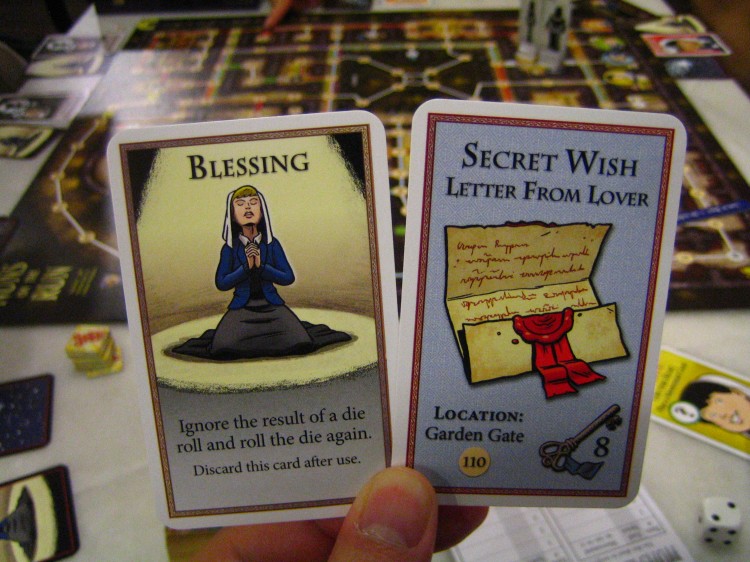
My blessing card and secret wish card, both randomly drawn at game start. The blessing card was a one-time-use special ability card. The secret wish card was basically my secret mission. It specified two locations I need to visit in order to fulfill my mission.

The prioress and the abbess. The abbess looks like a man. Like a weight-lifter. Look at those huge hands.

When the novices move, they also need to check whether they can be seen by the nuns. If they enter the line-of-sight (ooh... wargame term in a Eurogame...) of one of the nuns, they must indicate so on the board. When they disappear from the nun's line-of-sight, they must indicate the direction they have moved towards.

The nuns normally have to move along some pre-determined routes on the board. However if they hear or see anything suspiscious, they can leave their normal routes to pursue the novices. The nuns can move faster than the novices (max 6 steps compared to max 5 steps). After a nun moves, she rolls a die to try to listen for any nearby novices. This works the same way as the novices making noises. E.g. rolling a 6 means the nun can hear a novice up to 6 spaces away. Any novices heard this way must indicate the direction of the noise on the board.

The game board. The novices' rooms are on the right side. The coloured lines are the normal routes that the nuns will take when they make their rounds.

That's basically the game. There are quite a number of other small rules, but the basic gameplay is very straight-forward: novices move, novices make noise, nuns move, nuns listen.

The Play

In the game that we played, we had 6 players. Henry read the rules and volunteered to play the two nuns. The other 5 of us played novices. My secret wish was to retrieve a love letter at the garden gate. In the first round, all novices can move twice. I made a mad dash to collect the blue key that was a prerequisite for collecting my love letter. It was precisely 10 steps away from my room, and 10 steps was the max distance with a double movement. Heng was the first to be almost cornered. In the first round when he was still in the novice quarters area he was already heard by the tall nun. His choices were rather limited, but somehow he managed to escape.

I ran a lot, and in one of the earlier rounds was seen by one of the nuns. However I was quite far and she never bothered to come after me. Alvin had a close encounter, being seen and then chased by the short nun. He was rather unlucky with the die rolls and kept being heard. At one nail-biting moment the short nun stopped precisely one step away from him. Nuns run faster than novices, so a one step gap usually means you are in big trouble. In Alvin's case, he was lucky there were quite a number of doors (which block line-of-sight), rooms and corridors nearby, and he managed to run and hide in one of them. Henry had gambled on the wrong turn and missed Alvin. That was really close.

That "Vanishes" token in the foreground was where Alvin was last seen by the short nun. Alvin had just collected the green #4 key at location 107 the previous round.

The short nun had been chasing Alvin, and found him squatting in a corner of the chapel. The novice token is placed on the board when she is in the line-of-sight of a nun.

I mostly stayed quite far from the nuns, and had no problem reaching my destination and collecting the love letter. However, I had to walk through a garden to go back to my room. This was where the short nun had been chasing Alvin. Also this was a very open area and I could be seen easily if any nun was nearby. So I waited for my chance. Eventually the short nun gave up chasing after Alvin, and decided to go back to her regular route. It was time for another mad dash! I sprinted across the garden. I was far enough from the short nun (who was now inside the chapel - out of sight) that she couldn't hear the noise. Then suddenly Heng placed a noise marker near the chapel door leading to the garden! WHAAAT?!! I was standing in wide open space, and this?! The short nun immediately came out to take a look, and caught me, in a manner of speech, with my pants down. Big. Fat. Red. Target.

I had hoped to pull off something like what Alvin did, but after some assessment of my surroundings, I realised I would not be able to trick the nun and escape. So all I could do was to lure her to catch me at a position further away from my other fellow novices. We all had a good laugh over my unexpected capture. When the nun stepped out of the door and caught me in mid-stride crossing the garden, Heng wasn't even in sight at all. He had just stepped inside a doorway and had closed the door behind him. Talk about twist of fate!

I was sent back to my room. I could attempt to achieve my secret goal again, but unfortunately there wasn't enough time. Although I didn't need to get the blue key anymore, to visit the garden gate again and make it back to my room would take too long. Eventually it was Jeff who managed to achieve his secret wish and win the game.

I was cornered by the grumpy-looking nun.

This is the log sheet used by novices. The number is the location. You also record how quickly you move, and the instances when you collect your key, or achieve your secret wish.

Location 110, just before the garden entry, was where my love letter was.

The Thoughts

The game seemed complex at first, when we went through the rules. It was a new game and we had opened it on the spot to learn and play it. Probably not such a good idea. Better to have someone read the rules beforehand, or to have someone who has played before. Some things were a little confusing when going through the rules. However once the game started, I realised it was actually very straight-forward. Every round was quite quick. Being a novice is quite exciting. Being a nun is probably more challenging.

Nuns on the Run is a family game with an unusual setting and gameplay. Some call it a reversed Scotland Yard. I find Scotland Yard to be more heavy on deduction. The detectives discuss openly their options and the possible locations of the fugitive. In Nuns on the Run the novices have no idea where the others are. There's probably a bit more luck, because of the noise die rolls, but it isn't something you can't mitigate. I find the higher uncertainty (when playing a novice) and the risk-taking exciting. The game also has more flavour than Scotland Yard which is simpler. Nuns on the Run is more similar to Pyramid - the single mummy trying to catch the multiple treasure hunters. It has more elements - the noise, the line-of-sight, known paths for the nuns etc.

Some downsides that I can think of - once a novice gets caught, it may become very difficult to achieve her secret wish. Also, it seems the game is quite hard for the nuns. I wonder whether they are the fun-provider for the rest of the players, like how it is in Pyramid. I think the game will be most fun with the max number of players. One good thing is that novices can take their turns simultaneously, so having more players doesn't increase the play time much.

13 Sep 2010. Important correction (thank you Bay for pointing this out): If a novice gets caught, she has to walk towards her cell. However, once out of sight of any nuns, she can already try again to go for her secret wish (or her key if she doesn't even have it yet). In our game, we misunderstood that by placing my novice token back at my room once out of sight I was being teleported there. The novice token is actually meant to represent the last known location of the novice to the nuns, not necessarily the real location. This means I actually still had a chance to win the game, because I wasn't too far from my secret wish location when I got caught. It also means getting caught is not really as big a disaster as I had thought.

If you are in Malaysia, you can order the game here. No, I don't get a commission. Yes, it's a friend's online store. Discount? Why do all Malaysians ask this?

Saturday, 6 March 2010

Fluch der Mumie

Fluch der Mumie (also sold as Pyramid) is a game about treasure hunters collecting treasures from a pyramid, while trying to avoid being caught by the unhappy blind mummy roaming the corridors. It is not a cooperative game. Each player has the chance to win the game as an individual, including the mummy player. However there is a nice tension among the treasure hunters, who have to compete with one another, and yet at the some time cooperate to prevent the mummy from winning.

The Game

The game has an upright magnetic board. The mummy sits on one side, and the treasure hunters on the other side. The mummy's piece has two parts, each on one side of the board. These two parts always move together because they are attracted to each other by magnets. The treasure hunters can see where the mummy is. A treasure hunter only has one piece, and there is no corresponding piece on the other side, so the mummy cannot see where the treasure hunter is.

Each treasure hunter is dealt a hand of 5 cards, dictating the 5 different artifacts he needs to collect to win the game. On his turn, he throws up to 5 dice, and chooses one die for his movement. He must move the exact number of steps, so he may not always choose the biggest number. He can reroll, but there is a risk. Whenever a die shows the mummy side, it is temporarily locked and becomes unavailable to all treasure hunters. Each such die adds to the mummy's movement on the mummy's turn. A treasure hunter can reset/unlock these locked dice only by giving a bonus turn to the mummy. To collect an artifact, the treasure hunter must land exactly on that spot. He then reveals the card depicting the artifact, and this is when the mummy finds out the position of the treasure hunter.

The mummy wins the game by catching treasure hunters a certain number of times depending on the number of players. A treasure hunter is out of the game if he is caught 3 times. Often in the early game the treasure hunters will try to help the mummy catch or hinder other treasure hunters, to give themselves a better chance to win. However if the mummy scores many captures, the treasure hunters will need to work together to prevent the mummy from winning.

It is a pretty simple game, suitable for families, and the idea is quite novel.

The game board from the treasure hunters' perpective. Light and dark blue are the treasure hunters, white is the mummy. At the bottom of the board are the dungeon (where the mummy starts and where captured treasure hunters go to) and the pyramid entrance (where the treasure hunters start).

Close-up of a treasure hunter piece and the mummy piece, and also some of the spots with artifacts.

Claimed artifacts are turned face-up. Those two below are life tokens. Every treasure hunter has three at game start, and loses one every time he is caught. Lose all and you're out of the game.

Card backs of the artifact cards. There are artifacts in 5 different colours and at the start of the game you draw one of each colour.

Close-up of the mummy piece, the one on the mummy side of the board.

The mummy side of the board.

The Play

Chong Sean, Michelle and I played this twice. Chong Sean has played this a few times, and often had to play the mummy, so in both games we let him be a treasure hunter. Michelle was the mummy in the first game. In the early game Chong Sean showed us how a treasure hunter could easily harm another treasure hunter. On one of my turns I calculated that even if Michelle were to roll the highest number on the mummy die, she would be one step short from catching me. So I bravely stopped at a spot just outside of Michelle's reach. Then on Chong Sean's turn, he did the locked dice reset, giving Michelle that exact one step to catch me. Eeeevil!

As the game progressed, I collected four artifacts (one more to go) and Chong Sean three. Michelle had caught us a total of three times, and only needed one more catch to win. There was one very tense moment, when Michelle was near both of us, and it was her turn to move. She rolled well, and would have enough moves to make a catch. As she started moving her piece, Chong Sean and I fell very silent, staring at the white mummy piece taking one step after another towards us, trying to keep our faces expressionless, while we were screaming inside. The worst part was when Michelle suddenly paused. I think Chong Sean and I both held our breath and probably skipped a heartbeat as well. Was she going to charge ahead? Or change direction? Then Michelle continued on, and SNAP!, caught one of us (I don't remember who). Game over! And Chong Sean and I immediately burst into laughter. That was one climatic horror-movie moment!

In the second game I played the mummy. It was rather lonely playing the mummy, because I couldn't see anyone else on my side of the board. I only managed to make 2 captures, but Chong Sean and Michelle later told me that there were some very close calls, in one of which I was only one step away from catching Michelle, and I turned back at the last moment. Eventually Chong Sean won by collecting his 5th artifact.

I think the game will be more fun to play with more players, because there will be more captures (which are exciting for both mummy and treasure hunters), and with more artifact cards in play and being revealed after the artifacts are collected, it is easier for the mummy to narrow down the remaining artifacts to protect. With more players, the treasure hunters also have more buffer in trying to get another treasure hunter eliminated, without risking a mummy victory too much.

The Thoughts

Chong Sean commented that Fluch der Mumie is a reversed Scotland Yard (or New York Chase), and I find it very true. It is one hunting many as opposed to many hunting one. The game is easy to teach and easy to learn - quite straight-forward. Very suitable for non- or casual-gamers and families. It is an exciting and funny game. I think the game is more fun if you are a treasure hunter. The mummy player is mostly there to provide entertainment and excitement to the rest of the players, but I think even playing the mummy can be quite fun if there are more players. It is very satisfying to hear that snap when you capture a treasure hunter, and his player piece snaps onto yours on the other side of the board.

Tuesday, 30 June 2009

New York Chase / Scotland Yard

I played a 5-player game of New York Chase at Carcasean boardgame cafe on 26 Jun 2009. Chong Sean was Mr. X (game owner / cafe owner is normally asked to do the honours of being on the lonely one-man team), Han, Kevin, Choo (2 new friends) and I played the detectives.

I actually intended to try Scotland Yard (played on a map of London), which is the older game and is very similar. Chong Sean has both Scotland Yard and New York Chase. Somehow we ended up playing the latter. Maybe it was because it has more elements - the helicopter and roadblocks.

New York Chase is a game about a team of detectives trying to catch Mr. X, the fugitive. Mr. X moves secretly and records his trail secretly on a piece of paper. The only clues he leaves are the modes of tranportation used to get from one location to the next (taxi, bus or subway). In specific rounds, Mr. X must reveal his location, making himself vulnerable. The detectives need to make good use of such opportunities to quickly surround and corner Mr. X.

Each detective has a limited number of tickets for the 3 types of transportation. Once he uses up his tickets, he cannot move anymore. If Mr. X can last until all detectives are unable to move anymore, he wins. If he is captured (by simply being on the same spot as another detective), he loses.

There are some twists. Mr. X has two double-move cards which can help him to get out if tight spots. He also has some black tickets (wild cards) which can hide his mode of transportation, and can also be used to take a ferry, which the detectives can't take (NYPD forgot to buy them some ferry tickets I guess). The detectives have a helicopter which can be used 3 times in the whole game to transport one detective quickly to any place in the city. There are also road blocks (if you play with less than the maximum number of detectives allowed) that can be set up when a detective leaves a location.

The game is a lot of deduction (for the detectives) and bluffing (for Mr. X to try to escape) and double-guessing. The detectives need to work together, just like in any cooperative game. The game mechanics is quite simple. Scotland Yard would be even simpler, without helicopters or roadblocks. The game is also a lot about planning. Mr. X needs to plan ahead for the rounds when he has to reveal his location. He needs to make sure he is at a place with many escape routes. The detectives need to plan for these rounds too, to make sure they are at strategic locations to be able to react quickly the moment Mr. X's location is revealed.

Chong Sean. The game comes with this hat-like thing, to allow Mr. X to hide his eyes, so that the other players cannot see which part of the board he is looking at. Something like this is useful for Ticket to Ride too.

New York. Four detectives at their randomly drawn start positions. Mr. X is off the board for now. His location is secret.

Close-up of the streets of New York. The pawns are half transparent, so that you can see the numbered locations.

Mr. X is the white capped pawn. The yellow pawn is riding the helicopter and is about to disembark to the spot on the left of Mr. X. The yellow disks are the roadblocks. When a detective leaves a spot, he can leave behind a roadblock. Depending on the number of detectives in play, the number of roadblocks differ. Once they are all on the board, you can still set up a new roadblock, but you'll have to take down one of the existing roadblocks.

Chong Sean was nervous in the game, because all of us were plotting aloud how to trap him and catch him. There was nothing subtle about it. He probably felt like a goat listening to the butchers discussing how it was going to be slaughtered. We had him trapped by about Round 18, just past the mid point of the game. So the detectives won. Chong Sean checked that the last time he played, Mr. X was also captured at about that time. The helicopter was a tremendous help. We had used up all three of our helicopter flights, and if we hadn't caught Chong Sean at that point, we might not have been able to do so anymore for the rest of the game. Roadblocks did not seem very helpful. Maybe we haven't learnt to use them well yet.

Quote of the game: "I hate helicopters" by Chong Sean.

I enjoyed the game. This is suitable for families, and I'll probably try to get a copy. I'll likely get the Scotland Yard version though, because my wife used to live in London, so the nostalgia factor may make her enjoy it more.

Tuesday, 22 July 2008

Shadows Over Camelot

Shadows Over Camelot is a cooperative game with a twist. There may be a traitor among the players. Camelot is threatened, and the knights of the round table need to go around fulfilling various quests to protect Camelot from downfall. The traitor (if one exists) needs to pretend to be a good guy, and to secretly thwart the good knights. At the start of the game, the role cards are shuffled and distributed. There is a same number of loyal cards as the number of player, and one traitor card. That means usually there is a traitor among the knights, but the players can never be sure. It is possible no one got the traitor card.

The round table has space for 12 swords. To win the game the good knights need to complete quests to earn white swords to put on the table. The good knights need 7 white swords to win when the table is filled. Failed quests give black swords. If the traitor exists and is never discovered until game end, 2 white swords became black. If a wrong accusation is made, that's another black sword. Other than having black swords on the table, the traitor can also win by having all knights killed, or putting 12 siege engines on the board.

The quests are all handled by card play. Bad things also happen via cards. Normally, you draw a bad card at the start of your turn, and bad things happen, usually at one of the many quests, e.g. Viking forces build up and threaten to attack. If you are at Camelot, you can draw good cards, which you need for fulfilling quests. Often it is beneficial for the knights to work together on quests, in order to complete it quickly, making use of one another's strengths. Also knights who are present when a quest is completed get one life point.

Chong Sean, Simon and Han, and a very full-house Carcasean.

That's me, and the knight I was playing in front of me.

The good looking board and components of the game.

Three of the knights in our game. I was black, and I keep getting confused with the green piece. Too used to being green.

The good cards in my hand. Numbered card are fight cards, used for most types of quests. The holy grail cards can only be used for the holy grail quest. There are some special action cards too.

All four knights, hand in hand, looking for the holy grail.

I think the most interesting aspect of the game is the possible traitor aspect - how the good knights have to try to catch the traitor (which might not exist), and how the traitor needs to avoid detection and at the same time try to spoil the plans of the good knights. The rest of the game mechanics are nothing very interesting to me (just some problem solving), and their role is to support this interesting game of psychology. Maybe Saboteur has done this better, with quicker gameplay and simpler rules. But then of course in Saboteur there is always at least one saboteur.

In our game, in which two have played before (Han and Chong Sean) and two have not (Simon and I), everyone appeared to be a loyal knight. We could not detect any wrongdoing or treachery. It felt like playing Lord of the Rings, when everyone was focused on how to solve the problem together. We gave up on some quests, getting some black swords, and focused on others, completing them successfully. Towards game end, it became obvious there wasn't any traitor. The knights were on track to win the game, and even if the traitor had intentionally made a wrong accusation, or had stayed undetected, there would not have been enough black swords on the table for the knights to lose the game. So we won the game. It was a little anticlimatic, since there was no traitor.

Tuesday, 15 April 2008

Lord of the Rings: Sauron

Lord of the Rings is one of my favourite games. It has three expansions, all of which I have bought, and only one that I have not played, the Sauron expansion, until Sat 12 Apr 2008. Officially the Sauron expansion requires a minimum of 3 players, 2 to play the hobbits, and 1 to be Sauron. However since I was keen to play it, we played with just 2 players. I played 2 hobbits, Frodo and Sam, and Michelle played the dark lord Sauron, since that would be easier, and I guess also devilishly fun. Of course, we used the easiest difficulty level (for the hobbits) - Sauron at 15.

In the Sauron expansion, there are new challenges for the fellowship, and also new help. What the bad guys get:

  1. Sauron - Now instead of the game system, the hobbits have a living, breathing, thinking, listening and scheming opponent playing Sauron. At the start of every hobbit's turn, even before he starts drawing event tiles, Sauron can do something bad. Sauron can play a nasty card on the hobbit, or draw more nasty cards to be used later. In addition to that, when the die is supposed to be rolled (which would be the case in the base game), Sauron is activated instead, and the effect of the card play in such situations is more severe.
  2. The black rider - He starts at Mordor at the start of every scenario board and moves towards the Ringbearer. If he meets the Ringbearer, and then makes it back to Mordor before the end of the scenario, the hobbits lose the game.
  3. There are 4 more bad event tiles added.

What the good guys get:

  1. The hobbits each have a one-time-use special ability.
  2. One new Gandalf card and one enhanced Gandalf card.
  3. Resource tokens placed on the minor activity lines of the first 3 scenario boards.

There are some other optional elements that can be added to the game. There is a set of the dark event tiles, which when used allow you to skip some tiles. There are also two special cards - Watchful Peace and The One Ring - that can be used to help the fellowship. We played with the two special cards but not the dark event tiles.

Setting up Lord of the Rings: Sauron and getting ready to start.

The hobbits have a one-time-use special power.

Now Sauron has a pet - a headless horseman.

The Sauron character card is on the right. It summarises what Sauron can do. Sauron starts with 2 Nazgul cards. Nazgul cards are powerful cards, and there are only 9 of them in the game, of course, because in the book there are 9 Nazguls.

Two of the resource tokens. Some of them come with corresponding cards, like these two. Others give awards like shields, or hobbit cards, or recovery from corruption.

In our game, the hobbits were pretty much surviving from day to day, trying to minimise damage, but unfortunately not really having a long term plan. At least that's what I felt. By the time we reached Mordor, the last scenario board (yes, we managed to get there with both hobbitses still alive) (hey, why am I talking like Gollum, using "we", when it was only me playing both the hobbits), we were low on cards and resources. I wonder whether the game was designed to force you into such a situation, which is exactly what it was like in the story, or whether better planning would have helped to avoid such a situation. I tend to think the latter.

Sauron fumbled a little at the start, being new to the job of dark lord of Mordor where the shadows lay. She spent some effort on moving the black rider, which I felt was not worthwhile, since the distance was still so big in the early game. There was also some confusion with Sam's power of only suffering one of the icons of the Sauron cards. Basically Sauron's moves were not fully optimised, due to being under new management.

However that did not matter, as the exhausted hobbits were eventually overcome by events in Mordor. The Watchful Peace had been used to push Sauron back three steps. Frodo, who had been carrying the Ring throughout the first 3 scenario boards and only handed it to Sam upon entering Mordor, succumbed to the evil forces. Sam didn't have much resources left. Before Frodo fell he had used up his shields as much as possible to summon Gandalf's help, to give Sam a better chance. 5 out of 6 Gandalf cards were used. In the end, the last event - the Big Eye - was reached. Game over... there will be no dawn.

The game ended when the last event on the Mordor scenario board was encountered - "The Ring is Mine!"

Having finally played the Sauron expansion, I think playing Sauron would be delicious. I also think it is better not to be played as a 2 player game. It was a bit of an information overload when I juggled both Frodo and Sam's cards. Also it would be more interesting and challenging for the hobbits if they were played by different players, because they would have to discuss their cards and their plans aloud in front of Big Brother Sauron. Sauron, although having more turns than the hobbits, can play his turns quite quickly, unlike the hobbits who have many more cards, resources, life tokens, shields etc to manage. In fact while I was struggling with the tough decisions, Michelle helped me with the admin work, collecting shields for me, discarding unneeded feature cards, clearing off resource tokens. But I don't think playing Sauron would be boring or too easy. I think it will be interesting.

I wonder whether playing the Sauron expansion is particularly hard when you have only two hobbits. I find this is the case for the Friends & Foes expansion, but after one game of the Sauron expansion I cannot tell for sure whether this also applies. When Reiner Knizia designed the game, two ways of balancing the difficulty when playing with different numbers of players are the life tokens and the shields required for Gandalf cards. With more players the hobbits will together have more cards and "lives". However because the life tokens are limited, it will be harder to collect those. And since Gandalf cards can only be activated by individual hobbits, they will also be harder to activate because it is harder for individual hobbits to collect 5 shields. More plays are required to tell whether two hobbits is too difficult.

The Sauron expansion certainly feels quite different from the other two expansions. I think there is still a lot more for us to learn and to explore. Sauron can definitely be played more viciously. Having lost so decisively even when Sauron was not at top form, and at easy difficulty level, makes me dread how scary it will be when Sauron is his usual self. Also consider that in our game Sauron was not able to eavesdrop on the conversation between Frodo and Sam going on in my head. Hmmm... We startsss to sound like Gollum and Smeagol.