Monday, 19 November 2012

boardgaming in photos

22 Oct 2012. I continue to play Ascension regularly on my iPhone. In this particular game I tried a construct strategy, and it was a fine strategy. I had 5 constructs in play. Most were Mechana constructs and they jived well with each other. I find that I'm enjoying Ascension more and more. The designers have definitely done something right with it, although I can't quite put my finger on it.

28 Oct 2012. Another game of Fauna with the children. This time the whole family played. The children are not as keen about this game now, so I think it will be a long long time before we even get to use one side of all the animal cards.

9 Nov 2012. Another game of Ascension in which I used the construct strategy. This time I was very lucky with the card draws and with the cards appearing in the purchase area. I had 6 constructs!

Usually constructs themselves are worth many points (which are totalled at game end), but they don't always help with scoring during the game itself. In this particular game, they helped me tremendously with in-game scoring. By the last round, I had outscored Han 44 to 18 (in-game points only). Han actually had some constructs too, but I defeated some monsters which forced him to discard all of them. He would need to draw his constructs again to put them back in play. The final score was 87 vs 62, so our construct and card points were actually very close. It was the in-game scoring that won me the game.

15 Nov 2012. Shee Yun (7) wanted to play At the Gates of Loyang with me. We play with simplified rules that I invented because she can't handle the full rules yet, and I was not very keen to play these rules. So I suggested Agricola. She said OK, so we played the family game (i.e. without occupations and minor improvements). She managed to understand the rules well enough. Agricola is not exactly a simple game. I think what helps is that the actions in the game are mostly intuitive. Shee Yun was very careful with making sure she had enough food to feed the family. They did not starve even once. She enjoyed identifying the disks as the father, the mother, the son, the daughter and the baby. Thankfully she did not ask me much about the family growth action and how babies came about.

This was the farm she built. 28pts, which I thought was not bad for a beginner. I did guide her a little, e.g. making that 5-space pasture on the left. It greatly reduced the number of unused spaces and thus reduced the penalty at game end.

She loved the game! She soon asked to play again.

18 Nov 2012. Chen Rui (5) has been playing the iOS Ticket to Ride heavily lately, having discovered it only recently. Shee Yun (7) has been playing it longer. Chen Rui asked me to play the physical copy with her, so we played. I have no idea who taught them these annoying victory poses. It certainly was not me.

In this game I inadvertently blocked Shee Yun's way to Houston, and made her cry. She needed to go from Dallas to Houston, but the single-train route had been used by Chen Rui. So she had to painstakingly collect 4 red train cards and 6 green train cards to take a longer way. I had completed my tickets and was just wasting time to give the girls more time to complete their tickets, and I claimed one of the routes Shee Yun needed only for the sake of the points. When she saw that she had been completely locked out of Houston, she started crying. I consoled her, but I did not take back my move. I asked her to look at other actions that could better her position, and to just accept that she would have to take the 5pt penalty for failing to complete one ticket. 5pts was not much, I told her. I think learning to cope with frustration and with failure is something children can do in boardgames.

The card holder was quite necessary for Chen Rui. Look at how many cards she had! These are the first edition cards, which are smaller. Hey, I bought Ticket to Ride before it won the Spiel des Jahres (in 2004).

I recently bought Nightfall on iOS. Soon afterwards, after a few games against the AI's, I realised I didn't really like it much afterall. I find that I don't like the restriction in buying cards. Chaining cards is a key mechanism in this game, and to be able to chain your cards, the cards you buy need to have main colours, chain colours and kicker colours that match one another. I find that I need to decide on which few types of cards to buy early in the game, and then stick to the plan. If I try to change my mind halfway, I may end up with cards that don't work well with one another. I feel I don't have the freedom to buy any card I want at any stage of the game. I wonder whether it's just that I don't know the game well enough yet.

The iOS implementation was done by Playdek, so the interface is good. This is the purchase interface. Cards you can afford are highlighted with green borders.

This is a chain in progress of being resolved. The card on the right is the active card being resolved.

The interface was intimidating at first, but once I started using it, I found it intuitive. Maybe I'm already used to the interface style of Playdek. Similar to other games by Playdek (Ascension, Summoner Wars), to view you draw deck or discard pile, just touch it and the list of cards will pop up (the bottom row in this screen).

The victory screen. No I didn't take a screenshot of the defeat screen.

Sunday, 18 November 2012

The Great Zimbabwe

Plays: 5Px2.

The Great Zimbabwe is Splotter Spellen's new Essen game. Jeff was at the Essen game fair October this year, and brought back a copy to be played at OTK. I gladly grabbed the opportunity to do so.

The Game

The Great Zimbabwe is about building great monuments in ancient Zimbabwe. Players are kings competing to build the most impressive monuments. The modular game board is randomly set up every game, and it has four types of resources and some lakes and rivers. Resources are needed for manufacturing ritual goods, which are required for upgrading monuments to increase their values. Rivers (and lakes) ease the transport of ritual goods to the monuments where they are needed.

On your turn, you pick one main action out of three options. (1) You can build a new Level-1 monument for free. (2) You can do craftsmen-related actions. This usually means claiming a technology card and building the workshop type allowed by the tech. Claiming the card increases your victory requirements. The default points required for winning is 20, but it can increase up to 40 if you claim many useful cards. A workshop must be within range of the resource type it needs, and in future every time anyone buys a ritual good from this workshop, one resource will be depleted for the round. You set a ritual goods price at any new workshop, and can also increase the prices at your existing workshops. You can build new workshops of the same type as you already own. (3) You can upgrade one or more of your monuments by one level. Upgrading a Level-1 monument to Level-2 requires one ritual good; upgrading a Level-2 monument (to Level-3) requires two different ritual goods; and so on. The highest you can go is Level-5, since there are only 4 types of ritual goods in the game. You need to deliver the ritual goods to the monument you are upgrading. If they are too far away, you can use other monuments (yours or other players') as hubs to establish a delivery route, paying $1 to the bank for each hub used. Rivers can help in increasing range, because each connected body of water is treated as one space. Taking one step from a river bank space into a long river is one step; going ashore at the other end of the river is just one more step. Upgrading monuments is the main way of gaining points, because tall monuments are worth many points.

The game board is modular and randomly set up every game. 9 pieces are used for a 5-player game.

The single square icons printed on the board are the natural resources which are needed to manufacture ritual goods. The 2x1 and 2x2 tiles are the workshops which produce the ritual goods. The round disks are the monuments. The natural coloured wooden pieces are the depletion markers, indicating resources that have been used in the current round. That very very long river in the background would have been very helpful for transporting ritual goods, but no many people built workshops or monuments along its banks. Sigh... noobs... (and indeed we all were newbies in this particular game).

There is a concept of obsolescence of ritual goods. For three of the ritual goods types, players can build secondary workshops. These workshops further process the ritual goods from the primary workshops, creating more valuable versions. E.g. sculptures are the better version of simple wood carvings. Once a secondary workshop is built, the primary version of its ritual good type is no longer acceptable for monument upgrading. Anyone wishing to use this ritual good type must now pay both the primary craftsman to produce the basic good and the secondary craftsman to upgrade the basic good. He may also need to pay transportation fees to send the basic good to the secondary workshop. Using secondary ritual goods also consume more natural resources, since both primary and secondary workshops consume one resource each. This makes competition for resources tighter, and thus competition for turn order becomes more fierce.

Money is important (of course!). You not only need to think about making money, you also need to consider how money flows into the game, out of the game, between the players, and even between your left and right pockets. At the end of every round you earn money based on your tallest monument. Some god cards and specilist cards also let you make money. These are the only ways money enters the system. When you build workshops and when you pay for transportation costs, money leaves the system. When you use others' workshops, money is flowing between players. When you use your own workshops (yes you need to pay your own minions, a.k.a. craftsmen), it is money flowing from left to right pocket. You must still pay the full price, and you only get the money back into your hand at the end of the round. Making money is important, for buying ritual goods to upgrade monuments, and also for bidding for turn order.

The bidding for turn order is interesting. Every bid made is immediately paid in full to a pool. If you don't or can't make a higher bid than the previous player, you go to the last available slot. After the bidding is done, the bid money in the pool is distributed as evenly as possible to all players. So this is another way money is flowing between players.

The above are the basic structure of the game. What can shake them up a lot are the gods and the specialists. On your turn you can take a god card or a specialist card for "free". You can only ever worship one god, but you can have multiple specialists. These cards have various abilities, e.g. the toll booth god collects all transportation fees, the hardworking god reduces the victory requirement when taking tech cards, the rainmaker specialist (a bomoh! - which roughly translates to "witch doctor" in Malay) grows rivers, the banker specialist gives 50% interest for money banked in. The "cost" of taking these cards is your victory requirement will go up. So you better make sure they are worth it.

In addition to monuments, workshops are also worth victory points. The game ends after at least one player meets his victory requirement. If more than one player achieves that, whoever exceeds his victory requirement by the most points wins.

The board in the centre is the scoring board. The round disks mark the victory requirement for each player, and the cubes mark the current scores. The big square tiles on the left are used during turn order bidding. Bid money is evenly distributed on them, going from left to right. After the bidding concludes, every player takes the money on his tile.

The Play

I have played two games, both were 5-player games. In both games we made some mistakes. The impact was quite severe in the first game, and it made the game much tougher than it should have been. Splotter games are already unforgiving, and we made it worse. Imagine that! In the first game all players were new to the game. I spent money on getting a better turn order, and quickly built a workshop near a long river and also three resources. I thought it would get much business, but it didn't. It was off-centre and thus not near any of the start monuments, and no one built monuments along that long river. Another player who built an exact same workshop had many more customers than I did, because he built in near the centre of the board. I tried to right my wrong by building the secondary workshop of the same ritual goods type. However that secondary workshop was near only two resources, which meant I could only sell at most two ritual goods per round. My money engine never picked up momentum. We misunderstood the restrictions about placing workshops, thinking that primary and secondary workshops must not be in range of the same resource, and that workshops of the same level and resource type must not be in range of the same resource. The correct rule is a 2nd or 3rd workshop of the same level and resource type need to be in range of at least one resource not already in range of existing workshops, but it can "share" resources with existing workshops. Due to this misunderstanding, we only ever had two vessels (secondary ritual good using the clay resource) in any round, and we could not build the sculpture workshop (secondary workshop using the wood resource).

The card on the left is a god card. This god reduces my victory requirement (VR) increment when I take tech cards. However, in hindsight, it was a waste of time picking this god in this particular game. Taking the god increased my VR by four, and eventually I only saved 4VR from the two techs I took. Now I feel stupid.

The two cards on the right are tech cards that allow building workshops. The laurel icons are the victory points worth per workshop built, and the cattle icons are the costs per workshop. The cattle tiles are the prices I set for the ritual goods produced by the workshops. The top tech card is for a primary workshop. It consumes one clay resource and produces a pot. The bottom tech card is for a secondary workshop. It consumes one clay resource, needs a pot to be delivered to it, and upgrades the pot to a vessel.

Sheng had the god which allowed him to upgrade monuments while ignoring the different ritual good types requirement. Wood carvings were cheap and abundant, and Sheng himself owned two of the three wood carving workshops. He kept the price low, was able to cheaply upgrade his monuments, and no one could stop him. In hindsight, if we had understood the rules correctly, we could have tried to slow him down by building sculpture workshops and setting high prices. Sculptures would consume more resources, and would be more expensive too.

I tried to build more monuments, and hoped to upgrade many at one go. However my money engine sputtered and coughed and never quite started running. I came in dead last.

If you examine this photo closely, you will find that every resource is in range of at most one workshop (i.e. can be reached within 3 steps including diagonally). We had misunderstood the rules and made workshop placement more restricted than it should be. In this photo you can see that all the wood resources (single purple squares) have been "locked" by the three wood carvers (purple 2x1 tiles). We thought we were not allowed to build sculptor workshops (the secondary workshop) because there were no unclaimed wood resources.

In the second game, three players had played before and two were new. This time I remembered the pain of poverty, and told myself I wanted to be rich, rich, rich! I picked the toll booth god, which let me collect transportation fees whenever anyone (even myself) needed to pay such fees. Unfortunately in this game we had a massive river and the bomoh too. The bomoh grew the river, making transportation very easy for everyone. Many players built monuments on the riverbank. I made little money from my toll booth god. Wrong career choice! I built three different workshops, two of which were secondary workshops. Surely investing in business would let me become rich. It did. But I completely underestimated how quickly the game would end. Just when I started counting my hard-earned money, game over.

Black (sorry I forgot your name) had been steadily upgrading his monuments. When secondary workshops started popping up, increasing the cost of monument upgrades, he plonked down a diamond workshop (which was expensive but had no secondary workshops) which could access most of the diamond resources on the board. He set a moderate price, made some money from it, and also made good use of it himself to upgrade his monuments. I had misjudged the pace of the game, and I came in dead last again! I took many tech cards and had a high victory requirement.

This game, the god that ignored the requirement of different ritual good types (picked by Sinbad) did not help much, probably because the other players all tried to deny him cheap and abundant ritual goods. Heng worshipped the horny god which let him build two free new monuments instead of one. He went for the rabbit strategy, hoping to litter the land with monuments and then upgrade many at one go. Unfortunately he was cash poor, not having any workshop of his own. Allen joked that he could try building two free monuments every round until he reached his victory requirement.

This was the second game I played. In the south there was a big river, which had now been further grown by the rainmaker (bomoh) specialist and linked up with two lakes. Quite many monuments were built on the river bank.

My god on the right, Qamata, who claimed for me any transportation fees paid for using hubs. I call him the toll booth god. I had built two workshops at this point, and later built a third one.

Look at all those yellow monuments! This was the game end situation. Black was the one player to have met his victory requirement (VR). The rest all had the same number of points. However the absolute score is not important. What is important is how far you are from your VR. Allen (red) and I (green) had the highest VR, so we were last. He was ahead of me in turn order, so he had the 4th place, and I was 5th.

The Thoughts

I kept thinking about The Great Zimbabwe after playing it. I was quite the smitten kitten. Jeff brought a few copies back from Essen, and asked if I wanted to reserve one. I said I'd try-before-buy, even if it was a Splotter game. Allen decided to buy a copy, so I thought I didn't need to own it, because I game with Allen frequently anyway. I thought I had made up my mind. However I kept thinking about it, wavering and teetering at the edge, to the point of almost losing sleep. In the end, I decided to buy it. Even if I may not get many plays out of this physical copy, I feel it's a show of support to this great design. And I can sleep better now.

To play The Great Zimbabwe well, you need to grasp the full situation of the game, and you need to understand every moving part and what each opponent can do to affect the game situation. You need to be able to see the threat and the opportunities beyond what's immediately visible on the board. This is not a game where you just try to do your own thing and hope to win by being efficient. You have to understand the economic situation, the game dynamics and the pacing. There aren't that many rules in the game, but the various god and specialist abilities, the board setup, and the players' actions can create very different game situations.

This is not a game for casual gamers. It needs repeated plays to shine. It is unforgiving, like many other Splotter games. Despite being shorter and seemingly simpler than other Splotter titles that I like (Indonesia, Antiquity), I feel that The Great Zimbabwe has just as much depth as the other games. It's the same goodness with less fiddliness.

I just hope I don't come last again the next time I play. But maybe that's a good thing. This game is a temptress, always staying just out of grasp and making me want to come back to explore it more.

Sunday, 4 November 2012

family boardgame outing

The children are growing up (5 and 7 now), and there are more and more games that I can play with them. Some are children games, but many are "normal" games not designed specifically for children, or games that adults can enjoy too. We are no longer playing with the components, and I seldom need to invent simplified rules for grown-up games. They often request games. I hope they continue to enjoy them as they grow up, and that they'll continue to play with me when I get old and senile.

20 Oct 2012. Chen Rui playing Viva Topo!, a game about mice racing to grab the biggest pieces of cheese without getting caught by the cat.

Shee Yun only has one "strategy" - no one gets left behind. She moves all her mice evenly, like a family sticking together. In this game, this is not always a good idea. She is too kind and cannot bear anyone being left behind.

On 26 Oct 2012 we visited Meeples Cafe again. We stayed three hours, playing a total of 9 different games, some new to us and some not. It was a fun outing.

Captain Clueless. I teamed up with Shee Yun again, and Michelle teamed up with Chen Rui. The children didn't want to be blindfolded, so Michelle and I played the captains. My team (red) had very lucky cards. All our destinations were nearby (Roatan, then Montego Bay, then Kingston), and we quickly completed our voyage and returned home.

Forbidden Island, the family version of Pandemic by the same designer. It is a cooperative game where players need to collect four treasures and fly off in a helicopter before the island sinks. The core mechanisms are the same, but the game is streamlined and slightly simplified. There are some differences. The game is very well designed. It is still quite tense. We played the lowest difficulty level.

The treasures look very good.

We made a rule mistake in the first half of the game, which caused the island to sink more slowly than it should. So the game was even easier than Very Easy level. Still, the tension did build up and I felt that we were not far from the verge of losing. This was late in the game. Quite a number of areas were flooded (the blue and white tiles) and some had sunk. Later even more areas sank into the ocean, but we made it eventually.

When playing this game, Michelle and I guided the children most of the time. It was still a little beyond them. But they felt they had participated and they enjoyed it. We presented to them the few better options, or if they were making an obviously poor move or missing a golden opportunity, we gently suggested the better approach. I think they liked working together as a team.

I didn't expect much from Forbidden Island, because I thought it would be just a simpler little brother to Pandemic. However it turned out to be quite refreshing. I don't need to own it, but I enjoyed it more than I thought I would. It's a good gift choice for non-gamers.

Ubongo Extreme, where the shapes are made of hexagons. The general idea is the same as Ubongo, which I own. The scoring is a little different, simpler in fact. The puzzles are tougher. There was one I simply couldn't get after trying for a long time. Eventually it was Michelle who solved it.

Similar to Ubongo, the puzzles are two sided. This is the easier side, needing 3 pieces. The harder side needs four pieces.

Escape: The Curse of the Temple was a hot game at the recent Essen game fair. It's a 10-minute, real-time, cooperative, dice game. To win, players need to explore a buried temple, collect enough gems, find the exit, and all must leave the temple before time runs out.

All actions are done using action dice, and everyone gets five of them. You do your own thing using your own dice, all in real-time. You can coordinate with your fellow players, because some tiles need multiple players in order to fully utilise.

Three had escaped from the temple. When we played this, Michelle and I had no time to guide the children so we had to let them fend for themselves. We were busy enough managing our own dice and actions. They knew the basic idea and played on their own, although I don't think they strategised much. Chen Rui (5) mostly enjoyed rolling the blessing side and she kept asking who needed a blessing (to get rid of curses). Shee Yun (7) went off in a different direction exploring the temple by herself. Or maybe I should say we moved too fast and left her behind. Both the children seemed to enjoy themselves. I think this being a cooperative game helped. We all won together.

Actually we probably didn't win. We did "beat" the game by collecting enough gems and exiting the temple, but we didn't use the soundtrack that comes with the game (which is a timer) and I'm quite sure we spent more than 10 minutes.

Toss Your Cookies is basically a card game. Everyone has a hand of seven cards, and the goal is to collect 5 biscuits of the same type plus the milk card, of which there is only one in the game. In this photo, the two leftmost cards are jokers.

Every turn a player rolls two dice, and everyone follows the instruction given by the die roll. This combination here means the person with the milk card must give it to another player, and then get another card in return.

This combination means everyone passes two cards left. If the "TOSS" word were face-up, then everyone would toss two cards face-up onto the table, and race to grab the cards they want (still restricted to the hand size of seven).

Michelle won. Toss Your Cookies is a simple game suitable for children and casual players. Mostly a party game.

Dixit. I have played this with the children before. This was my turn to be the storyteller. The clue I gave was "animal". Since this was such a generic word, I was sure there would be others contributing cards with animals, and it would be difficult for everyone to guess the correct answer (the goal is to only have some players guess your card correctly). It turned out that all cards contributed had animals. A dragon is considered an animal, right? Albeit a mythical one. However, that turn everyone guessed my card correctly! What are the odds of that?!

Apples to Apples. First time for all of us. The idea is that every round a player takes the role of judge, and flips over a green adjective card. Each other player then picks a red noun card from his/her hand to play. The judge decides which noun card is the best, and whoever played it gains 1pt. The contestants can try to be creative in picking nouns. They can also try to present their reasoning to persuade the judge to pick their cards.

My hand of noun cards.

The game didn't quite work with the children. Too many concepts and words they are not familiar with. Even I don't know much about Clark Gable. There is a children's version of Apples to Apples. Maybe that would have worked better. At least it wouldn't have any adorable oil spills.

I thought my Infomercial card would surely win. It didn't. Gall Bladder won.

We also played two dexterity games at Meeples Cafe, Hamsterrolle (which we have played before) and Bamboleo. We didn't even last one round of Bamboleo. Shee Yun toppled the platter on her first turn. The game took less than 20 seconds. Chen Rui sulked and said this game sucked.

All in all, it was a wonderful outing and a great way to spend time with the family.

27 Oct 2012. Playing Uno at home with the children. I bought two card holders (which was suggested by a reader here - thank you!). Only my younger daughter Chen Rui (5) really needed one, but I bought one for elder daughter Shee Yun (7) anyway.

Chen Rui used to spend a lot of time peeking at her cards one by one because she couldn't hold them properly and had lay them face-down in front of her. Now she spends a lot of time trying to stick her cards into the card holder instead. So the end result is we still need to wait for her when he turn comes. Hopefully she'll get better at using the card holder soon.

This is a very old copy of Uno from my childhood. I counted the cards once, and one was missing. Doesn't bother me though. I don't even remember which card it is.

Once when I was about the shuffle cards, this little mischief Chen Rui intentionally blocked my way. So I shuffled the cards on her forehead. She thought that was funny, and since then she has been requesting me to do this whenever we play Uno.

Friday, 2 November 2012

exploring Antiquity

I am a lucky man. My wife Michelle has played four games of Antiquity with me so far (and also 55 games of Through the Ages in the past). One reason that I bought Antiquity was I hoped it would be a game I could play as a 2P game with her, so - mission accomplished! I was a little nervous about teaching her the game at first. Afterall this is one very merciless game system. The game punishes you much more than your opponents do. She did well enough, and even beat me in 3 of 4 games. I can say it's partly because she only picks San Christofoni as her patron saint, which she finds easiest to play, and I keep trying different patron saints (and usually failing to play them effectively). But when I look at how spectacularly I failed, I think a big part of the failure lies with me and not with my adventurous approach.

I should have learnt a lot from my mistakes. Famine is the biggest threat. It increases every round, and it increases whenever anyone discovers a food resource in the wild using an Explorer. If you don't have enough food, you earn graves for your cities. You need to stockpile food to stay afloat, and you need to win the game before you are overwhelmed by the famine level. I keep making the same mistake of not producing or stockpiling enough food. Another mistake is failing to plan ahead for my second city. I sometimes wait until it's too late to prepare for my second city, e.g. when my first city is already full and my building resources are rotting away. Yet another mistake is not having a clear strategy that fits my chosen patron saint. You don't have much space in your cities (especially when you keep having to dig graves!), so you need to be picky about which buildings to have. I find that I sometimes construct buildings on a whim, depending on what looks attractive at the time, without making sure that they really do fit well into a coherent strategy. The result is I end up having to scramble to build a second city to have more space for other buildings I desperately need.

In contrast, Michelle by now has a pretty well-tuned San Christofoni strategy. It's almost a formula. She builds a stone mine in round one, and uses the stone mined to build her cathedral in round two, to be dedicated to San Christofoni. She doesn't build a Store because by round two she will have infinite storage. She likes the Market, which lets her exchange for goods types she doesn't have. She likes the Faculty of Alchemy too, which does clean-up and allows her to reuse land and lakes.

No matter which patron saint you pick, you need to have a clear strategy so that you can progress towards the victory condition efficiently, i.e. before famine destroys you. Despite the many spectacular failures, I am enjoying this journey of discovery. I may not have discovered the best ways to play each patron saint, but I do have some rough ideas on what to try next time, and I do know what I should not do (I just hope I remember them next time I play).

One worry I have about Antiquity is the replayability. The game is quite solitairish for about the first half of the game, and it can feel like an efficiency contest with little you can do to affect your opponents (like swimming?). Only in the second half when players' zones of control start overlapping will there be some player interaction, like dumping rubbish in your opponent's forests, peeing in his ponds. If there are more or less ideal approaches to play each patron saint, then the game may become rather formulaic. At the start of the game you check out the landscape, decide on a patron saint, construct a blueprint in your mind, and then just execute based on that blueprint, with some adjustments in the second half of the game as you come into contact with your opponents. I don't know whether this will be the final conclusion after I master all the patron saints. My worry may turn out to be unfounded. Even if my worry turns out to be true, I would have spent many games reaching that conclusion, and by then I would have already gained my money's worth. I think even after that Antiquity will still be an enjoyable game to bring out once in a while to exercise my brain.

The predetermined blueprint worry is the problem I have with the solitaire version of Town Center. It is why I am only interested to play multiplayer Town Center now.

I recently played The Great Zimbabwe (also by Splotter Spellen) and enjoyed myself a lot. It has much more player interaction than Antiquity, and it made me think about the multiplayer solitaire characteristic of the early game in Antiquity. Splotter is becoming one of my favourite publishers. I enjoy many of the games designed by the design team of Jeroen Doumen and Joris Wiersinga. The games are intricate, merciless and unapologetic. You need to know the game well to play half decently. I would even argue that the games have player elimination, because if you don't know what you're doing, you can easily doom yourself in the first few turns. I think this has happened to me in every single Splotter game. It was what scarred me on Greed Incorporated. It recently happened to me in The Great Zimbabwe. I find Splotter games very unique. There are many other long and complex Eurogames, but Splotter games have a signature that sets them apart. I find that there are always big-stroke strategies which if your opponents do not know how to counter, will let you trample over them. The games are not about doing many small things efficiently and making many clever tactical choices. They are about crucial moments that make or break you. You need to learn to spot such moments, to grab the opportunities and to avoid the pitfalls.

These four recent games of Antiquity against Michelle made me think about how gamers should be gaming. This may actually be the best way to game - to apply the Game of the Month concept. Pick a game with good depth, and play it many times to fully appreciate it, before moving on to the next good game. Skipping some good games is a worthwhile sacrifice. It is better to fully appreciate one good game than to have brief introductions to five good games, right? Well, it's easier said than done. Many boardgame hobbyists tend to get easily distracted by the next shiny new game. Aaah... the bane of our lives.

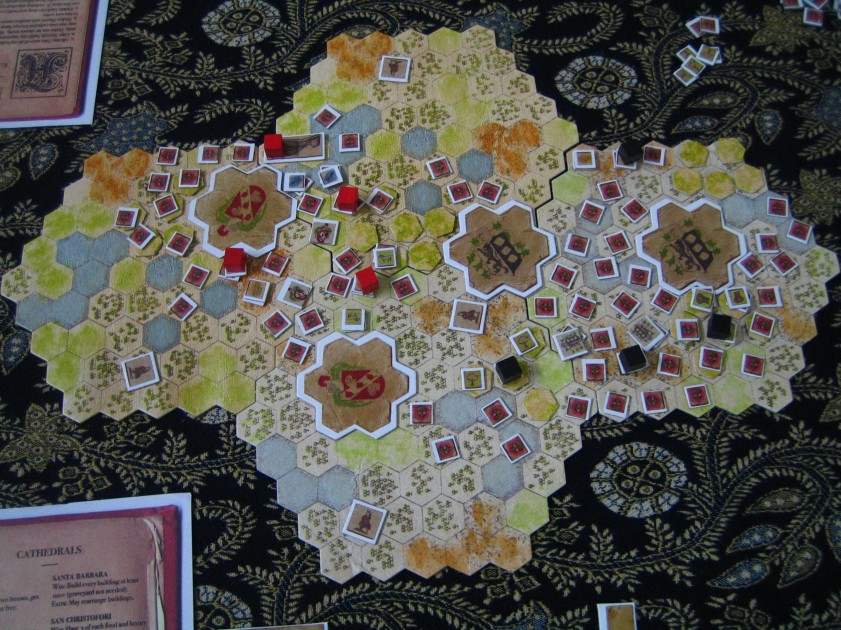
21 Oct 2012. This was my third game and Michelle's second. It was the second time we played against each other. I picked Santa Barbara this game. The privilege is being able to rearrange buildings, and the victory condition is to construct every building type. I build a large Store (bottom left) which let me store many food resources.

I won this game. I needed a third city in order to have enough space for all my buildings. I was probably lucky in this game. Michelle had forgotten about a particular goods type. If she had been more careful and had planned better, she might have reached her victory condition (collecting 3 each of the 8 types of food and luxury resources) sooner.

The main gameboard. I (black) tend to like harbours so my cities tend to be next to lakes.

27 Oct 2012. Our 3rd game. This time I picked San Nicolo, privilege is "buy 1 free 1" (ask a Malaysian) when building a house, victory condition is to build all 20 houses. At this point I had actually built a harbour at the right edge of the city, but it was now covered by graves.

The main gameboard. I (black) was a little slow in building my second city near the centre.

Once my second city was ready, I hurriedly built a Hospital to remove graves and a Faculty of Alchemy to clean land. I was close to suffocating by then. I also built a Faculty of Philosophy to let me ignore the variety requirement when building houses. The more expensive houses always require food and luxury items of different types, which is a hassle to collect. So the Faculty of Philosophy is very useful for the San Nicolo player.

These were Michelle's cities. She rarely bothers to build Fountains (not a single one in sight), which reduces the Famine level by one and also reduces pollution. She doesn't need them as much as I usually do. So I end up building lots of them, which helps her to some extent.

By game end, she had only used 5 squares in her second city. She likes the Market because she can use it to swap two goods for one of any type. She plans which buildings to construct much better than I do. Very little waste.

In contrast, my cities were a mess. 13 graves, and this was after I had already removed some using the Hospital. I still had 7 houses to go, which was still a long way away.

28 Oct 2012. A second game of Antiquity over the same weekend! Woohoo! This time I used yellow, hoping it would be more auspicious than black. It didn't work, but the blame was on me, not the colour. This time I picked San Giorgio - privilege is one free fish whenever anyone builds a cathedral, victory condition is completely covering one opponent's zone of control with your own. This was the first time I made use of the Stable, which increases your zone of control from two steps from every city and inn to three steps instead. It is obvious from the number of graves in this photo (even covering my cathedral in the top right corner) that I did not win this game.

I had six fountains, so no pollution from cities themselves now (usually 3 per city). But of course farming, mining and fishing still leave behind pollution.

Michelle's cities when she won the game. She didn't even need a Market this time, and she barely needed the Dump. The Dump reduces pollution by four, and her second city produces three pollution. The Dump also prevents your opponent from dumping pollution in your zone of control. I wonder whether she built it more for defensive purposes.

The game board. I (yellow) managed to spread my inns (small square markers with yellow shields) to the centre of Michelle's start terrain tile. I would probably need another two or three turns to completely surround her. But the question is whether I would survive another two or three turns.