Wednesday, 1 November 2023

Ali Baba at MYBOGADECO 2023


Ali Baba and the Forty Thieves won a consolation prize at the 2023 Malaysian Boardgame Design Contest (MYBOGADECO). Absolutely tickled that the judges loved the sus aspect of the game. Glad to be recognised as the most interactive game.

Full results here.

Saturday, 28 October 2023

King and Peasant


The Game

King and Peasant is a local Malaysian game, designed by Poon Jon. It is a 2-player-only microgame, which uses only 18 cards. This is a limited edition, and in fact it is out of print by now. However Jon is working with a local publisher to release a new version of the game soon, with new artwork and a new name. 

One player plays the king, and the other plays the disgruntled peasants. The people are unhappy and are close to open rebellion. They are plotting to assassinate the king. The king knows something is brewing, and tries to catch the assassin. 

The game is played over up to five rounds. The first to win three rounds wins the game. Within the same game, you play the same role - king or peasant. No role swapping. At the start of a round, each player holds 5 cards. The draw deck will only have 8 cards. Some of the starting cards are fixed. The peasant starts with the assassin and the decoy. The king starts with the sentinel. Players take turns performing one action, until one of them achieves the winning condition, or the draw deck runs out. If the deck runs out, it means the peasant has missed the opportunity to assassinate the king. So the king wins. 


These two cards are the decoy and the assassin. They always start in the peasant player's hand. The player has to draw three more cards to form the starting hand of five cards. 

As part of setup, the players may play cards before them. The king always plays cards face-up, while the peasant plays them face-down. The actions in the game are mostly straight-forward. You get to draw cards, play cards and use card powers. When the king uses a card power, that card is discarded. For the peasant it works differently. The peasant reveals a face-down card to use its power. Once revealed, the card cannot be used anyone. However it can be taken back into hand, and then played again, in order to be used again. 

After the king performs his action, he always draws a card. In fact that's the only time he draws a card - at the end of his turn. The peasant may use his action to draw a card, but he doesn't get a free card draw. So the king always performs an action then draw a card, while the peasant only performs one action, which can be drawing a card.  

So how do you assassinate the king? If the king draws the assassin from the deck, he is killed. The peasant has ways to insert the assassin card anywhere in the deck. Since the king must always draw a card at the end of his turn, seeding the assassin in the deck is one way to kill the king. Another way is to activate the face-down assassin when the king has no guards protecting him. The king wants to find the assassin and discard it, but not to draw it. The king also tries to get through the deck. One special action the king can perform is to condemn. This is a life-and-death decision. The king accuses a specific card to be the assassin. It can be one of the peasant's face-down cards, or the top card of the deck. If it is indeed the assassin, the king wins. Otherwise, the peasant wins. 

The Play

I first played King and Peasant when it was still in development. I found it unique and refreshing. When I saw that it was going to be released, and it was a limited edition, I quickly ordered a copy. This time playing the production copy I did not have the designer teaching me. I had to read the rules myself. It had been a while since playing the playtest version, so I had to read the rules all over again. I asked younger daughter Chen Rui to play with me. 

This time round, my impression is there's a lot of text to read. There are only 18 cards, but every card has a different power. In fact most have two powers, one for the king one and for the peasant. We played rather slowly because we were still learning the card powers. This is a game which requires some effort to learn and digest. 

Playing king and playing peasant are very different. One is in the open, the other is hidden. The king has more resources, because he always draws a card for free. Drawing that card can be risky, because it might be the assassin seeded by the peasant. The king is always on the hunt for the assassin. He needs to protect himself with guards. He needs to avoid being forced to draw the assassin. The peasant needs to strategise how to use the assassin. The peasant knows where the assassin is, and hopes the king doesn't make the right guess. To do something, the peasant usually needs two steps - to first play a card face-down, and then to reveal the card to use its power. This is often a nervous moment. You don't know whether the king has something up his sleeve to discard or neutralise your card after you play it and before you can make use of it. You are hiding in the shadows and the king is out in the open, but you are constantly being hunted. 

A round of play is short. The deck has only 8 cards, which means the king will play at most 8 turns. For the king to make a decision, sometimes it's down to luck, because you don't really have enough information to make a sure-fire deduction. Yes, you can try to read your opponent. That can help. For players new to the game, there may be a feeling of lack of control. There seems to be not enough information to make sound decisions. Only after you get more familiar with the game and with your opponent's play style will you have a better basis for decision-making. 

I may be making the game sound more strategic and complicated than it actually is. This is a microgame with a fair bit of luck. You probably don't want to overthink it. Just play it in a relaxed manner. This is not exactly a deduction game. Go with your gut. It is not simple, so be prepared for a bit of learning curve. 

Most cards have 2 powers, one for the king and one for the peasant.

Chen Rui struggled a bit with learning the game. 

The Thoughts

King and Peasant is a little unusual. I don't have a good grasp yet so I don't know yet whether it's a yay or nay for me. I still want to explore more. The two roles play very differently. The asymmetry reminds me of Android: Netrunner. One side is in the open, the other in the shadows. However this is a much shorter game.  

Friday, 20 October 2023

revisiting Android: Netrunner

Android: Netrunner is a 2012 game, originally designed by Richard Garfield, who created Magic: The Gathering. The original Netrunner was published in 1996. That version had only two decks, corporation and runner, and no expansions. The 2012 Android: Runner was designed to be a living card game with many expansions. It is similar to but not exactly the same as a trading card game. Expansions are fixed packs instead of random packs. You don't need to spend a lot of money buying many blind packs hoping to get the specific cards you want. Android: Runner used to rank very high on BoardGameGeek.com. In 2018, Fantasy Flight Games decided to terminate the game series. I was quite surprised at the time. I thought the game system was still very popular. Although there are no more official expansions and no official support, some players have organised themselves to develop and publish new expansion packs. There are still people actively playing the game. 

I've always had some hesitation going into a game with such depth as Android: Netrunner. These are what people call lifestyle games. Like Chess, Go, Magic: The Gathering, you can be a player who plays just one game. Just one game is enough to keep you busy and happy. In fact, you need to devote enough time to such a game to truly enjoy it and appreciate it. The analogy is friends with deep and meaningful relationships. In boardgame terms, I tend to be the extroverted socialite and I prefer discovering and playing many different games. 

I have played Android: Netrunner before. I own the base game and quite a number of expansions. So far I have only used some basic decks and decks designed by other players. I have not yet ventured into building my own decks. That means I have only skimmed the surface. It had been quite a while since I last played. I remembered the game fondly, but by now I had forgotten most of the rules and had to read the rulebook all over again. I decided to try to get back into the game because I bought more expansions this year. I have been buying expansions when I come across them on discount. I can't resist. I keep telling myself I'll get back into the game some day. I asked Allen to join me in learning the game system. He lives nearby so it's easy to arrange to play. We have both been playing games less in recent years, busy with work and life. If we set a goal, it may help us to get back into more regular gaming. Middle aged uncles need to be reminded to allocate some me time, or we time. Making a living should not make us forget to live a life. 


I asked Allen to play the runner (hacker). I think it's more fun playing runner. Android: Netrunner is a 2-player-only game, about hacker vs corporation. The corporation has some agenda to complete, and the runner is hacking into the corporation's servers to try to find and steal them, before they are completed. The photo above shows the play area of the corporation player. The row of cards near the bottom represents the various servers. The horizontal cards above the servers are shields protecting them. In game terms they are called ICE - Intrusion Countermeasure Electronics. Servers can be cards played by the corporation player. Hand cards, draw deck and discard pile are also servers which the runner can attack. 

The game is not just runner attacking and corporation defending. Some ice are traps and can cause damage to the runner. Although the initiative lies with the runner, the corporation certainly has many ways to trick, trip and hurt the runner. 


Allen looks troubled. This is a game with quite a lot of text to read and digest. When you get more familiar, it will be much quicker. The runner's play area is much simpler. You have your draw deck and discard pile, and three rows of various equipment (in this photo he only had two types of equipment, thus just two rows). 


As the corporation player, having agenda cards in hand is anxiety inducing. The runner can decide to attack your hand cards, and if he is successful, he randomly draws a card. If it is an agenda, it is claimed and scored by the runner. The runner needs to score 7 agenda points to win the game. In this photo I had two agenda cards, the first and third cards, and they are worth 3 and 2 agenda points respectively (number on left edge). 


This wasn't my first attempt at relearning Android: Netrunner. I think not even the second time. It had been a while, so I couldn't even remember for sure which attempt this was. This time round it felt easier to get into. It didn't feel as complicated as I remembered it to be. Both runner and corporation need to find ways to earn a steady income, because many actions require money. The corporation is generally defensive, always needing to protect the agendas and needing to put on a poker face. Sometimes the corporation plays aggressively, setting up traps to catch the runner unprepared. There is greed and risk-taking on the runner's part, and the corporation tries to make use of that. The corporation sets up ice (shields). The runner installs programs to overcome them. The corporation advances agendas to score them, before they get stolen by the runner. 

An agenda card

A piece of ice


Playing ice is free, unless you have more than one ice at the server. You only pay when you activate it to stop or hurt the runner. The more powerful the ice, the higher the cost. 


I bought two preset decks which were the winning decks in the 2016 Netrunner championships. I am lazy to build my own decks, so using the best player's deck is great, even though it'll take time for me to learn to utilise it well. This above is the winning corporation deck. 

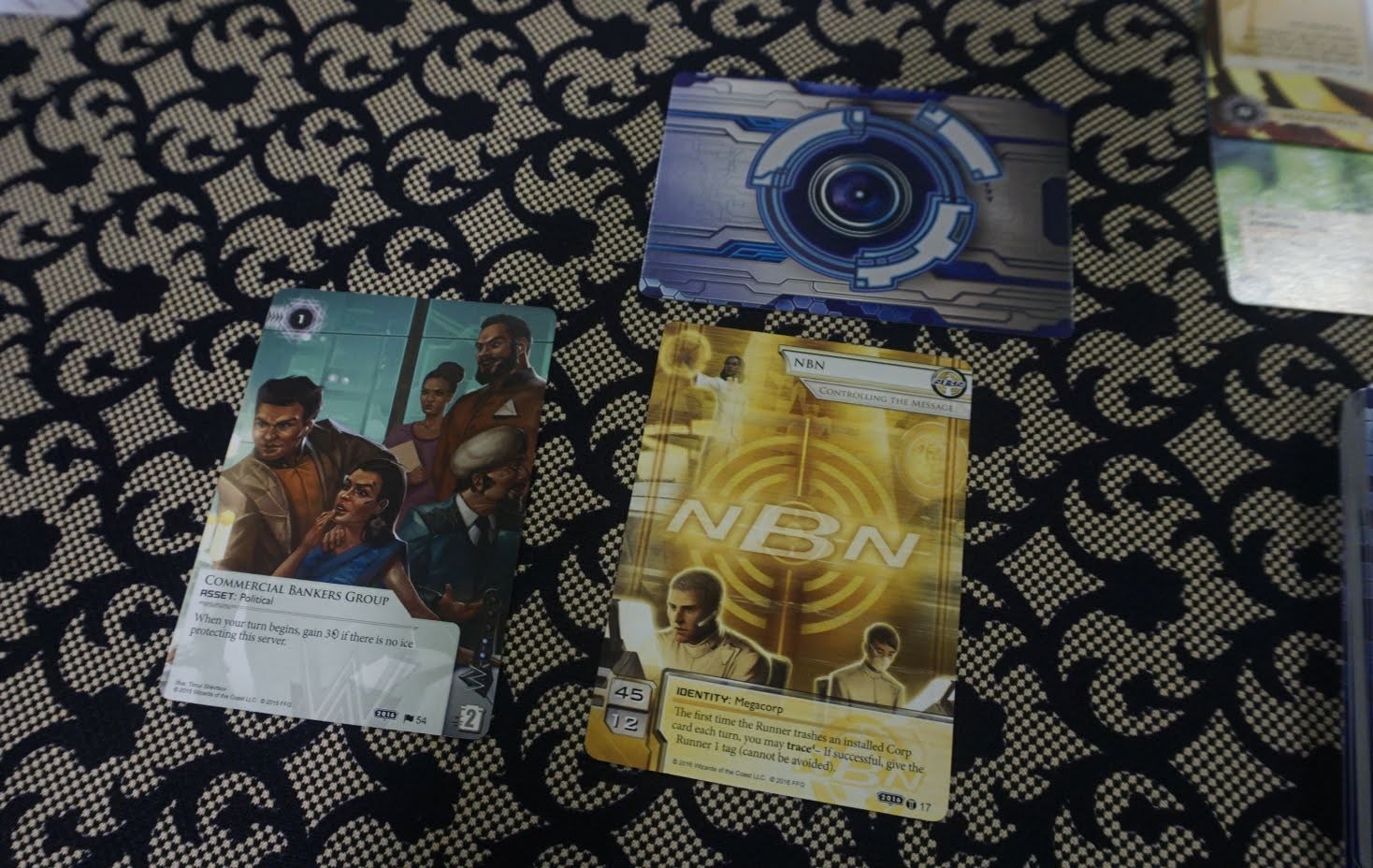
I notice the graphic design has changed. The card on the left is the newer version. The image is zoomed in and enlarged, but the font is smaller. I find the text too small. Both Allen and I struggled to read the text. This design is not senior citizen friendly. 

Saturday, 14 October 2023

teaser video for Ali Baba and the Forty Thieves


I must admit I'm not very good at making videos. Ali Baba and the Forty Thieves is my entry at the 2023 Malaysia Board Game Design Competition (MYBOGADECO). 

Teaser video: https://www.youtube.com/watch?v=h_sCbUa9jvI 

Game overview: https://www.youtube.com/watch?v=1fB42Wo14TQ 

Friday, 6 October 2023

Game art: Snow White and the Eleven Dwarfs

My next game will be Snow White and the Eleven Dwarfs. I plan to have it released before the end of the year. This will be the second physically published game from Cili Padi Games. Here I'd like to share the progress of the art work. 


This above is the second version of my prototype. The first prototype didn't even have any art. It was just a deck of standard poker cards. I used the Joker as Snow White, and the numbers as the dwarfs. At that stage I didn't have expansions like the Evil Queen and Prince Charming. 

The art for the second prototype was all from the internet. If you look closer you will find that the cards have different art styles. They are by different artists. My favourite art is that of the dwarfs. The same artist did a series of dwarfs, and they worked perfectly for my prototype. 

When I decided to make Snow White my second physically published game, I asked Edwin Chong, who did the art for Dancing Queen, to help me with this project. This was the first concept art: 


Similar to Dancing Queen, this concept was based on a Japanese manga (comic books) style. I didn't specifically requested for this, but I told Edwin if he thought it would work I was open to try it out. It might be good to use a consistent style for all Cili Padi Games publications. It becomes our identity. A brand promise. Something people remember us for. 

Edwin had a bold idea. He brought Snow White to modern day Japan. He re-imagined the dwarfs to be children at an orphanage, and Snow White and Prince Charming being teenagers or older kids taking care of the young children. The whole atmosphere is that of warm, sentimental anime movies. This was a bit beyond my expectations. I am more conservative, so I thought dwarfs should still be dwarfs, i.e. of the short old bearded men type. I thought the first Snow White was a bit too young. The reason I picked Snow White as a setting was it was something people are familiar with and can relate to. So I felt the art and concept should not veer too far from what most people have in mind. So the next iteration was adjusted as follows: 


My favourite was Grumpy the dwarf. I think he's absolutely adorable. I did not specifically want to follow the characters in the Disney version of Snow White, even though it is probably what most people are familiar with. I have 14 different dwarfs in my game, so the 7 from the Disney movie won't be enough. In my version of Snow White, only #1 will be named Happy. The rest won't have names. 


More dwarf designs were then added, but my favourite was still #4. I'm probably becoming a grumpy old man myself. That's why I like the grumpy one. 

With colours added. 

The first box front mock-up

What do you think? Any thoughts? Suggestions? This is still work-in-progress, and it will be really helpful to me to have feedback. 

Sunday, 1 October 2023

Dorfromantik


The Game

I kept thinking of Dorfromantik as Dorf Romantik (two words), and had trouble finding it on BoardGameGeek.com. It is the 2023 German Game of the Year (Spiel des Jahres) winner. It is originally a computer game, and I purchased the computer version when it first came out. Back then I felt it was very much like a boardgame. It is a solo game, and you do tile placement. I guess it is not surprising that it has now been turned into a real boardgame. The boardgame publisher sells this as a boardgame for 1 to 6 players. I see it is essentially a solo game. Technically it is called a cooperative game, but it is actually a solo game with turns divided among the players. 


When you play Dorfromantik, you draw hexagonal tiles from face-down stacks and use them to build a landscape. This is very much like Carcassonne. You play until you run out of tiles to place. There are rules to tile placement, and also ways of scoring points. You score points when the game ends. Everyone plays as a team, and there are no individual scores. There is only one team score. The terrain types on the tiles include villages, forests, wheatfields, rivers and train tracks. The only restrictions on placement are the rivers and the train tracks. Rivers must connect to rivers, and likewise the train tracks. A tile edge with a village can be immediately next to a tile edge with a forest. It just means the villagers are living right next to a forest.  

Mission tokens are placed on some tiles - those speech bubble tokens with a number. The number indicates how big a terrain needs to be (stretching over how many tiles) for the mission to be completed. For example in the photo above there is a train track mission with 6. The train track is currently length 2. You will need to grow it to length 6 in order to complete this mission. One important rule is when you add a mission token to a matching terrain, that existing terrain must not already meet the criteria. You can't add a value-6 mission to a track of length 9. If you do that, you are considered to have failed the mission. The mission token is discarded. 


There are two types of tiles with different backs. Those on the left are the mission tiles. When you draw one, you flip it over to see what kind of mission comes with it. You must then draw a mission token for the tile. The other tiles, on the right, are just regular tiles. On your turn you can choose to draw either type. There is a rule that there must always be at least three active missions in play if possible. The first three tile draws in a game must be mission tiles, in order to fulfil this condition. 


When setting up a game, the mission tokens are arranged face-down. There are five types, corresponding to the five terrain types in the game. 

The number on a mission token is the criteria to be met and also the score value. 


When the game ends, the longest river and the longer train track score points too. Some terrains feature flags. These terrains score points based on how big they are. There is generally a tendency for similar terrains to group together. 

If you compare this photo and the previous one, you can see how the landscape has grown. 


This village is size 7 at the moment (covering 7 tiles). It can still further expand, from the open edge at the top left. 


When a game ends, you use this score pad to do scoring. If it is your first time playing, you will only use the first two rows. The other scoring conditions can only be used after you have unlocked them. Dorfromantik is a legacy game. You play through a campaign - a series of games, and as you play, the game itself changes. Game components and rules are added, based on decisions you make and your achievements. There are five mystery boxes in the game which contain game components. As you play through the campaign you get to open them and add new elements to the game. The new elements give you more ways to score points, and more to think about. 

This is a legacy game with no destruction aspect. You don't tear up cards or mark anything permanently. When you feel you've played the game enough, you can reset everything. You return all the game components to the right boxes, and you can let a new group of players experience the game from scratch. 


This is the legacy campaign chart. The table on the left tells you how many ticks you can make depending on how high you score at the end of a game. You tick path sections in the central area to make progress along the paths. When you reach specific stations, you unlock new game elements. You can use them in your next game. 

So far younger daughter Chen Rui and I have played five games, and we have now opened all five boxes. However we have not yet unlocked all game components and scoring conditions. We still need to play more to unlock them and to be able to use them. 

The Play

Dorfromantik is a peaceful and relaxing game. For seasoned gamers the first few games will feel easy and simplistic. The strategy is straight-forward, and it is easy to complete all missions. However as the campaign progresses you will unlock more game components, scoring criteria and missions. The game will become more challenging. It will no longer be easy to balance your priorities between the many missions and ways of scoring. There will be more to think about. There will be trade-offs to consider. For non gamers and casual gamers, the early campaign is a gentle introduction to the game system. It is welcoming and pleasant. 

There is no clear definition of when a campaign ends. You can play as many games as you want. Eventually you will unlock all rules and components. You can consider that the end, but you can still keep playing the game in its complete form. I sound like I'm talking about a Super Saiyan. After you reach the final form, you probably won't want to reset to start over, because it would be dull. The only reason you want to reset the game is to let a new group of players experience it for themselves.  


The speech bubble icons are mission icons. All mission tiles have such an icon at the back. When you decide to draw a mission tile, you flip it over to see what type of mission it is. You then draw a mission token of the specified type to place onto the tile, before you add the tile to the landscape. Whenever you complete a mission, you move it off the landscape to an area for scoring. If you fail a mission, you also remove it, but you put it somewhere else. If a mission tile on the map no longer has a mission token (like in the photo above), it means the mission has been completed or it has failed. Only missions still in progress, i.e. still having a chance to be completed, remain on the map. 


You want to make one very long train track and one very long river, because only the longest ones will score points. 

If you compare this photo and the previous one, you can see how the map has developed. 


This is another game. Wheatfields, forests and villages which have flags will score points. You will try to make them as big as possible. However they will score only if by game end they are completed, i.e. have no open edges. In the lower section of this map you can see a wheatfield (yellow) of size 14. It is worth 14 points now. However it still has an open edge, at the bottom right. You can still expand from here to hopefully score more points. However you must remember to close this open edge off before you run out of tiles. Else this wheatfield will score nothing. 

The Thoughts

Dorfromantik is a good family game. And that's what the Spiel des Jahres is all about. They recognise great family games. It is cooperative, so it works well as something parents can play together with children. The game is refreshing and a little different, which is nice. It being originally a computer game may attract non boardgame players to dip their toes in our wonderful hobby. That's certainly a plus. 

Thursday, 28 September 2023

in the media: TV2 interview on boardgames and parenting


I was interviewed by TV2 (Malaysian national TV) journalist Choo Jia Yi, on boardgames, parenting and game design. The interview was aired on 28 Sep 2023. 


An ex-colleague Howie saw me on TV and excitedly took this photo to send to me. 

Link to interview: https://www.youtube.com/watch?v=XJ0ar_YR0t0 

Monday, 25 September 2023

Game design: Ali Baba and the Forty Thieves


This year I am participating in the Malaysia Board Game Design Competition (MYBOGADECO). My entry is Ali Baba and the Forty Thieves. This was not a game designed specifically for the competition. When I signed up for the competition, I happened to have this game in development which matched the theme of the competition. At the time the game was still called Catch 22

By taking part in the competition, I forced myself to make progress with my design. I didn't have a proper theme for the game prior to this. Now I had to think about a suitable theme. I needed to get the rulebook properly written up. I had to make a proper prototype. I needed to work on my sell sheet too. 

The first prototype I made used characters from Miyazaki Hayao movies. At the time I didn't have any theme so I just picked some random pretty art I found on the internet. I used the name Catch 22 because the game was about not exceeding the number 22. Also "catch 22" is an English expression. I later realised there is a well-liked book by that name. My game is not related to the book. 


After deciding on the Ali Baba theme, I looked for relevant drawings on the internet and made the next prototype: 


For the competition I could not use other people's art without permission. As opposed to looking up the artists for the many pieces of art I used and getting permission one by one, I decided to ask my younger daughter Chen Rui to help. She did original art for me, and I made the third prototype below: 


This is how a game is set up. Everyone starts with $20 (or whatever the currency is in the age of Ali Baba). Your goal is to get to $80. 


This is a mock-up of a game in progress. Every round each player is dealt three cards. After looking at your cards, you arrange them before you face-down, with the smallest card on the left and the largest on the right. During a round, players take turns revealing cards. You may reveal any card belonging to any player, and you may even reveal the top card from the draw deck. However you may not reveal your own card. When you reveal a card, as long as the total of all face-up cards has not exceeded 22, you claim a reward. The longer the round goes, the bigger the reward. When a player eventually causes the total to go beyond 22, the round ends. This player doesn't get a reward, and is penalised instead, losing $10. 

The rewards start at $1, and can eventually increase to $200. 

I bought the poker chips on Shopee. The quality is so-so, but they are cheap. 

I bought the box at Daiso. 

I have now submitted this copy of the game to the competition judges. My other copy is the older prototype. I will need to create another copy of this latest version. 

Saturday, 23 September 2023

In Front of the Elevators


The Game

In Front of the Elevators is a game from Japan, by Saachi, who has designed quite a few quirky and clever games. It is a light card game, about queuing up for elevators. Not the kind of setting you'd normally expect right?  Every player controls a family, and you want your family members to be able to get onto the elevators. If they do you score points. You have to queue when you approach an elevator. However the characters in the game have abilities which may let them cut queue. There are also other ways of manipulating the queues. You play this elevator waiting game for 3 rounds, and then the highest scorer wins. 


This above is a game in progress. You have three elevators on the left, and a queue next to each elevator. The elevator cards specify how many people they can fit, and how many points each person who manages to get in scores. Normally the first to go in scores the fewest points, and that last person to barely squeeze in scores the most. This is highly thematic. If you are the last to make your way in, naturally you feel luckiest. I find this funny and relatable. 

When you set up a round, every player randomly draws two cards belonging to his family (i.e. colour). The rest of the cards are shuffled and divided into three draw decks. The card backs in the game have different colours, representing the families. So when you draw a card, you know whether you are getting your own family member or someone else's. When you look at your opponents' hand cards, you know which families their cards are from. On your turn, you must play a card, i.e. send one of the characters in your hand to queue at one of the elevators, and then you draw a card from one of the draw decks. Everyone takes turns doing this, until the draw decks are exhausted and everyone has one card left unplayed. The then round ends. The characters at the head of the queues get to board the elevator, and they score points. 


A family has 7 members - Grandpa, Grandma, Dad, Mom, Son, Daughter, and a Lost Child. Whenever you play a card, you may be able to use its special power. For example when you send Daughter to queue, if in the same queue there is a Son (her brother), the Son (regardless of which family he is from) will let the Daughter cut queue in front of him. He takes good care of his sister. In the same way, Dad always lets Mom cut queue, Grandpa always spoils Grandma, Mom spoils Son, and so on. When the Lost Child comes to queue, one member in the same family will leave the queue and go to her, standing behind her, to accompany her. All the card powers are related to different ways they may manipulate the queue. When you draw cards, you can draw cards from your own family or from other families. That means you can play cards from other families. 

The three elevators specify how certain characters score double if they manage to board. For example for one of the elevators Mom and Grandma would score double. When sending family members to elevators, this is an important consideration. 


If three similar characters join the same queue, they get distracted. They meet old friends so they leave the queue to have a chat at the lobby. In game terms, this translates to the three cards going out of play. They score 1 point for the player who played the third character. When you play your own family member to an elevator where he or she can potentially score double, it can be risky because others may do the same, resulting in three similar characters being in the same queue. Everybody loses. Well, unless someone plays the fourth character, because by then the first three would have already left, and the fourth character would be the only character of the type in the queue now. 

The Play

Procedure-wise, this is a straight-forward game. The rules aren't complicated either. However it gives your brain a healthy jog. You may think that it should be good to queue early, so that you have a better chance to win a spot. However if you are there early, there is a higher risk of getting disrupted by a subsequent card play. E.g. the Lost Child might come looking for help, or the second and third card of the same character luring your card away. Now you think maybe you should go later. However if you are late to the party, you may be too far down the line to get onto the elevator. This is the kind of dilemma you will face. 

Even drawing a card is not exactly simple. There are three decks to choose from. Do you draw your own colour or an opponent's colour? If you draw your own, it means you have control over where to send your family member. You can hold on to your card and wait for the right moment. However if you draw an opponent's card, it means you can intentionally send it somewhere unproductive. In our game, we were more offensive than defensive, so we tended to grab other people's cards so that we could stick them somewhere useless. What nasty people we were. 

Your hand size is 2. Every turn you must play a card and then draw a card. What this effectively means is you can keep a card on hand and never play it, or you can save it until the best possible opportunity comes about. You may hold on to your own card to play it at the right moment. You may keep an opponent's card and play only when you are sure it won't score. 

It is easy to count cards. There are only seven characters in each colour. You can easily tell which characters are in play and which are still out there. In the early game, most characters are not out yet so there is much uncertainty. As the round progresses, the situation gets clearer. You gain more information, and this helps you make better decisions. In the early round your decisions are more luck-based, but as the round goes on, you will be making better informed decisions. This is quite an interesting experience. You feel you have more and more control, and you get to see whether your earlier bets pan out. 
 
Dad and Mom

The Lost Child. Card powers are shown at the top. 


There are two Daughters at the centre elevator. If anyone plays the third Daughter, all three Daughters will be removed from the queue, and the characters who will get on the elevator will be the two Grandpas and the Son. 

The Thoughts

In Front of the Elevators is very much a Japanese style game. Not many components, compact rules, and it brings to the table something unique and unusual. The fact that it is about queuing for elevators already make people go "what?"  I like that the game is able to create a refreshing experience by using just a handful of simple game mechanisms. It is a short game, but a fulfilling one. I enjoy the art style too.