Friday, 7 April 2023

Oh My Goods!


The Game

Oh My Goods! comes in a small box and it is a pure card game. It is designed by Alexander Pfister. I have played a few of his games and they are popular - Great Western Trail, Mombasa, Isle of Skye. However I found them just okay and I didn't like them as much as most gamers. I enjoyed Oh My Goods! more than his better known games. It made me want to play again immediately after my first game. 


Oh My Goods! is a game for 2 to 4 players. You build factories, and send your workers to work at them to produce goods. To produce goods you need raw materials. Goods produced at one factory (the output) can become the raw materials for another (the input). Goods are worth money and you spend them to recruit workers and build more factories. The game ends after a player builds his or her eighth factory. You score points for factories, workers and goods. 


One important mechanism in the game is how all players get some random raw materials every round which is used for production at factories. You reveal cards one by one from the deck until you have two cards with a sun icon. About half the cards in the game have suns. The cards revealed this way will be about half the raw materials available. You will do this again to generate more raw materials, but before that you have to decide where to send your workers to work, and also in which mode they are to work. Assigning your workers to factories means you are attempting to produce goods there. If all the raw materials needed are already available, that's great for you. If they aren't yet (which is often the case) you will have to decide how much risk you want to take. There is a chance that after the second revelation round you still won't have enough of the raw materials you want. The worker mode also comes into play. Normally your worker produces two goods, and you must provide all the required raw materials. However you can ask him to work sloppily and only produce one good. By doing this he needs one raw material fewer. So it's a balance between risk and reward. Going for full production can be risky. Doing things sloppily means you produce only half, but it is a safer option.

You have some hand cards. If your worker is short on raw materials, you can fill the shortage from your hand. That's one way of mitigating risk. 

Whenever a factory is able to initiate production, you can feed it a different kind of raw material to increase production. This is a very effective way to produce in bulk. These secondary raw materials can be from your hand or they can be ready goods from your other factories. 


These are assistants, i.e. additional workers, you can pay to recruit. Costs at the top left, victory point values at the top right. To recruit an assistant you must fulfil the condition stated. Here the conditions are all related to having built a specific number of a specific type of factory. Assistants only produce one good and have no sloppy work mode. 


There is another important use of your hand cards. They are the factories you get to build. Every round you will be able to draw new cards. You need to balance between using them as raw materials and saving them to be built as factories. What factories you have access to is determined by card draw. 

When your factory produces goods, you draw cards from the deck and place them face-down on top of your factory. These represent goods you have in storage. Goods of different factories have different values. When you need to use money, you sell (i.e. discard) goods for money. 

So in this game the cards are common raw materials (when face-up at the centre of the table), private raw materials (when in your hand), factories (when played face-up before you) and goods (when face-down on top of your factories). 

The Play

It turns out to be harder than I expected to create a fancy production chain. Ideally I want to build a series of factories where the output of the first feeds as input to the second, and so on, so that I keep doing value-add to my goods. That's much easier said than done. You don't always draw the cards you want. Also you are under constant time pressure. Playing to 8 cards is fast. You really cannot afford to take your sweet time to orchestrate your perfect assembly line of factories. Most of the time, quick and dirty will beat procrastinating and waiting for the stars to align. There is uncertainly most of the time due to not knowing which raw materials will be available. There is angst in choosing between high risk high reward and low risk low reward. The game presents difficult decisions. 


One tactic I tried was building factories with different raw materials needs. This way, no matter what raw materials were made available for a round, there was a factory which had a good chance of being activated. I could send my worker there. I'm not entirely sure this is a good tactic. If many of my factories are the low level ones needing just the basic raw materials, I may not be very profitable. 


Getting to the eighth factory felt like the blink of an eye. The game is tantalising in this sense. You feel you are almost there in completing your perfect combo of factories, but just one step away and the game end is triggered. This is the best kind of game balance and pacing. End when you are in that most exciting moment. That's what made me want to play again immediately after my first game. 

The Thoughts

Oh My Goods! is a small but crunchy game. It reminds me of tableau games, but it is not exactly that. Not all of your factories will jive with one another. Creating your perfect chain of factories is just the ideal you pursue, not necessarily something you will actually achieve. And that's what makes this game such an engaging puzzle. How do you do the best with what you are dealt. There is plenty of tough and delicious decisions. 

Tuesday, 4 April 2023

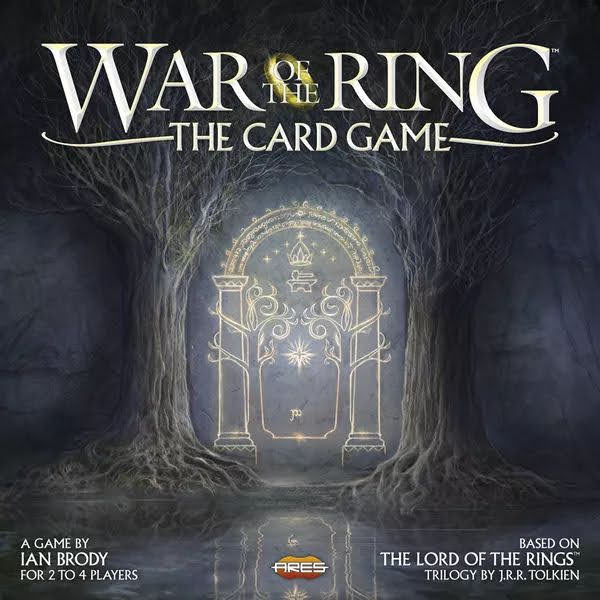
War of the Ring: The Card Game


The Game

War of the Ring: The Card Game is a complex card game for 2 to 4 players. It presents in game form the story of Lord of the Rings. Although also called War of the Ring, I would say the only similarity to the boardgame version is it is divided into two aspects - the story of the hobbits attempting to destroy the ring and the military campaigns in Middle-Earth. The card game is very different from the boardgame. 

You have two factions in the game, the Free People and the Shadow. Within each faction there are two groups. In a four player game, each player will play one group. Normally all four groups will be in play, even if there are fewer than 4 players, for the sake of completeness of the story. Some players will control two groups. The four groups operate fully independently, having their own draw decks, discard piles and hand cards. 

The game is played over 9 rounds. Every round represents one stage in the story of Lord of the Rings. The Free People and the Shadow compete and score points. By the end of the game, the faction with more points win. During the game, sudden death victory is possible if one faction outscores the other by a large enough margin. 


When setting up a round, normally you have one battleground card and one path card. The battleground is where war is waged. The path represents the story of Frodo and the fellowship of the ring. The Free People and the Shadow play cards next to the battleground card and the path card to achieve superiority. They take turns playing cards until they all pass or run out of cards. They can at most carry over two cards to the next round. When a round ends, the battleground card and the path card are scored by the faction with higher strength. 

This photo above is a little unusual because there are two battleground cards. This happened because of the special power of the first battleground card drawn, which required that an additional card be drawn. 


Aragorn is an important character. Some characters can only be sent to fight battles. Some can only be sent to advance the story in a favourable way. Some can do either. One important element in this game is when characters are sent to do their jobs, they usually die, even if they are successful. Cards are a precious resource. Your deck will gradually thin, and that's something you must manage carefully. 

Cards can be played face-up in a reserve area, ready to be deployed in a future round. Some cards give a bonus when in the reserve area, like Aragorn. You put them in reserve more for this bonus than because you intend to send them out to fight. However they are available in case the situation becomes desperate. Sometimes it's a tough choice whether to deploy such cards. 

Playing a card normally requires another card to be discarded as payment. This payment goes to the discard pile, which means it will be reshuffled and returned to the draw deck when the draw deck is exhausted. If you have a card which you can't utilise well yet, you can use it as payment for another card. Some cards are only fully effective under certain situations or at certain times or locations. Your job is to manage the luck of the draw to utilise your cards to their fullest potential. 

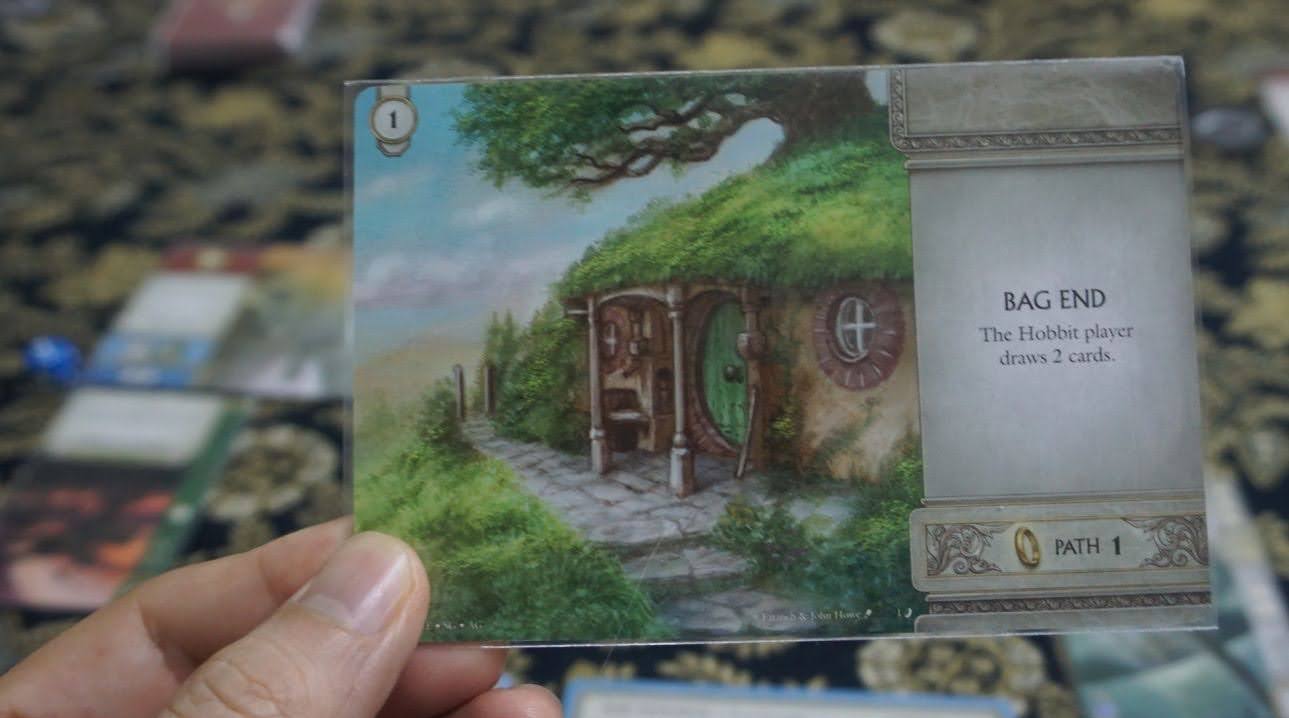
This is one of the path cards. Path cards are numbered at the bottom right. The number at the top left is the victory point value. Characters who can be assigned to path cards have a number range specified. For each number there are three path cards and you will only use one per game. This creates some variability. 

We used dice to keep track of our strengths. In each faction (Free People and Shadow) there are two groups. Each group is further divided into nations, e.g. Rohan, the Hobbits, the Wizards, Isengard, Mordor. Each nation has its own emblem. Battleground cards (left) specify which nations may participate in the battle. You can't just send anyone you want. 


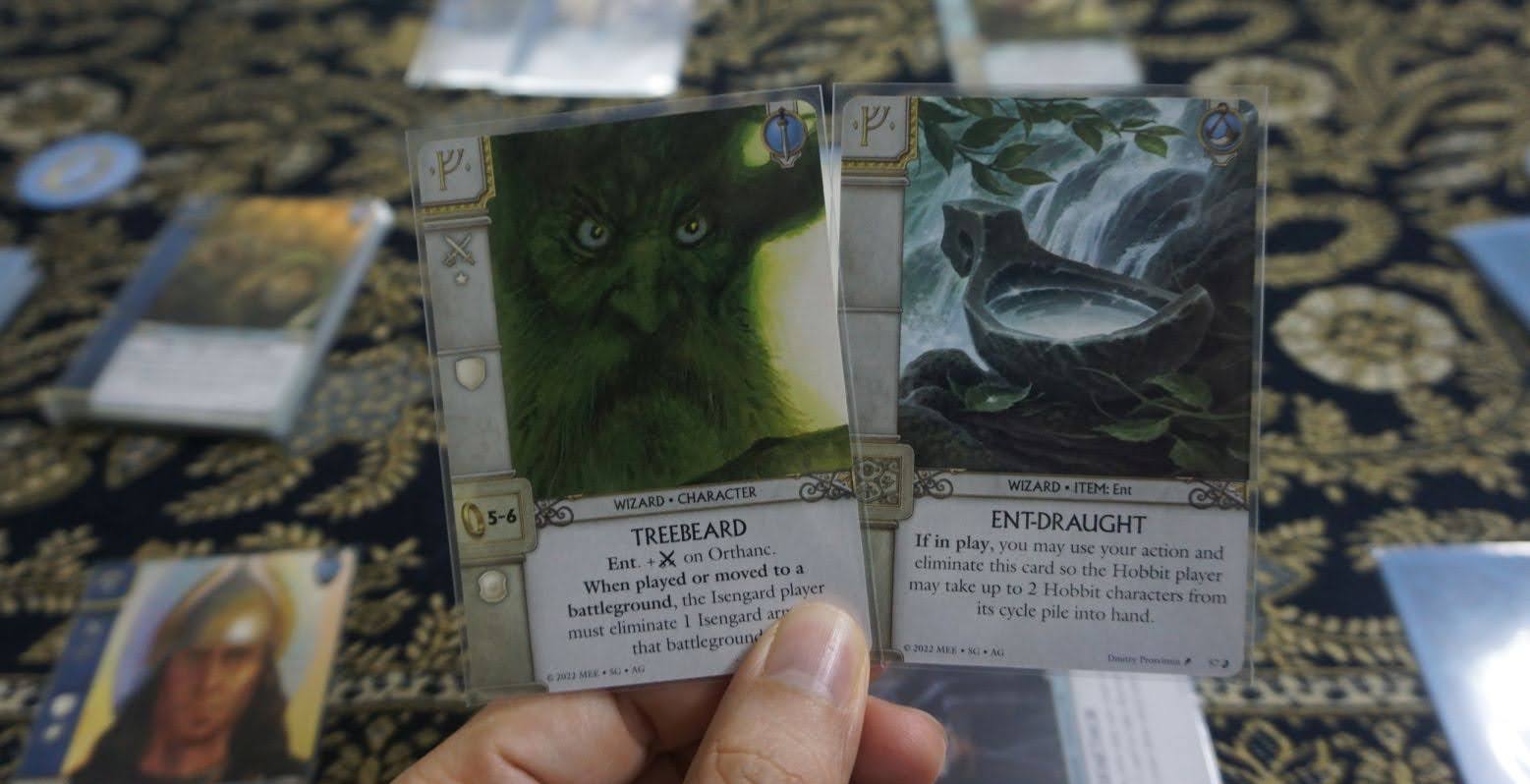
A character card on the left, and a matching item card on the right. Items can only be attached to specified wielders. From the storytelling perspective, this is nice and thematic. From the gameplay perspective, this is an additional challenge for the players. When you do manage to get a character to wield their item, whether it is by sheer luck or by good hand management, it is satisfying. 

The Play

War of the Ring: The Card Game is a highly thematic and story-rich experience. Every card covers some aspect of the Lord of the Rings lore. The core of the game is hand management. How do you make the most of your cards? How do you control the thinning of your deck? How do you decide which cards to use and which to sacrifice? You need to plan ahead and prepare your cards for upcoming battles and stories. You will draw cards at unsuitable times. Your task is to make the best out of the predicament you are put in. 

One key theme that keeps coming up in this game is sacrifice. You regularly sacrifice your cards, removing them permanently from the game. You lose cards in battle, even in the ones that you win. When you get desperate to play your one last card but you no longer have another card in hand to use as payment, you can choose to permanently remove the top card from your deck. It is risky, because it may turn out to be a powerful card. So how desperate are you? The game is full of difficult decisions. 

There is a sense of escalation for each battleground card and path card. Sometimes when both factions commit many cards to the same fight because both are adamant on winning it, it can become a very costly contest. This is also a game of deciding when to fight and when to concede. Resources are scarce. 

It is important to be familiar with your deck. One unique thing about the Hobbits is they don't die easily. Often when they are supposed to be removed from the game, they go to the discard pile instead. They will come back after the next reshuffle. That is nice, and that is something you want to make good use of. Knowing your decks will help you in strategic planning. 

The face-up cards in front of the players are the cards in reserve. I played the Free People and Han the Shadow. You can see I only had two cards in reserve (bottom of photo), while he had a ton (top of photo). We had a huge difference in power. I feel I didn't conserve my resources well. I didn't fully utilise my cards. In the early game I had some lucky wins because Han's card draws were atrocious. However he did better hand management and planning. Moreover, the natural tendency of the game is the Shadow faction becomes more powerful towards late game. In our game eventually I could not keep up and lost by sudden death. 

This was one of my groups. That huge face-up stack on the left are the cards permanently removed. The face-down card is actually my draw deck. The card at the top right the discard pile, and at the bottom right the only card left in reserve. I was running out of cards. I didn't have any more resources to continue fighting. 

The Thoughts

War of the Ring: The Card Game is without a doubt a gamer's game. There is a lot of text and many card powers to digest. The core game mechanism is not too complex, but there is a fair bit of rules to handle. It will take some time to get familiar with the decks. If you like Lord of the Rings, you will enjoy the details you find in the game. 

The game feels a little like a deck-building game, but you are removing cards from your deck, not adding to it. This reminds me of Lincoln from Martin Wallace, but in Lincoln the cards are more generic and have much less text and fewer special rules. The main impression I get from playing War of the Ring: The Card Game is the pain of making sacrifices. You are constantly forced to sacrifice some cards in order to play other cards. The life of every soldier fighting for you is precious. As a general, who are you going to send to their deaths, and for what strategic purpose? How do you make their sacrifices most worthwhile? 

Friday, 31 March 2023

Giant Pandemic


Due to my work, I created a giant version of Pandemic. I made this for a team-building event. I asked younger daughter Chen Rui to draw a giant map based on the standard map. Most of the details were the same, but I needed it to be 6 feet by 4 feet. Looking at this photo you can't really tell how big the map is. You'll need to look at the map when placed in my sitting room next to the furniture. 


I needed the map to be big because I planned to have this activity accommodate 20 to 40 participants. The map needed to be big enough so that most participants could easily see the various details on the map. I did not change the game rules. The changes I made were in how this activity was to be executed by four teams as opposed to this being a game played by four players. Within each team there would be members assigned to different tasks. There would be some communication challenges thrown in. Pandemic when used well is a great team-building and training activity. 


I bought most of the activity props. I needed to get a copy of Pandemic too, because I used the cards from the actual game. For the rest, I had to hunt everywhere to find equivalent large sized components. I arranged to playtest this giant version of Pandemic. Not for gameplay, since I didn't change that, but for making sure the components worked well. My dining table was not big enough for the map. I needed to add one more table and a white board (see bottom right) to create enough flat surface for the whole map. 


I used toy cars as player pawns. The white cube is a die for prototype-making. I used it as a research centre. I used square wooden blocks as diseases. I bought them at Daiso and spray painted them. One problem with the toy cars was players could not resist playing with them. This is the kind which you can pull back and then release to have it dart forward. Chen Rui kept playing with her car, knocking over game components on the map. 


I prepared four spare cars in the same four colours as those on the map, and placed them in front of the four players as reminders to tell which one on the map was their car. Here we have one flaw. In the original game, the player pawn colours match the player character colours. I couldn't find large player pawns to match all the character cards, so I went with toy cars. 


I put the character cards into identity card holders and attached lanyards. In each team there would be one member wearing this, and his or her job was to remind the whole team they needed to fully utilise the character ability. 


I changed this part of the game board. In the original there are only four circles. When you manage to cure a disease, you put a marker into the circle. If you manage to eradicate the disease, you flip the marker to the other side, which shows a different symbol. In the giant version, I wanted something which looked like a table, each row being a different status. The four little bottles are markers you can advance downwards. 

Game in progress


For the outbreak marker and the infection rate marker, I used this type of whiteboard magnet which can be found at stationery shops. 

I found large transparent plastic cans for the four diseases. 


These four small bottles are status markers for the four diseases. Originally I thought about half filling the bottles with liquid in the four disease colours. I later changed my mind because I was worried the liquid might leak and damage the other components. 


I feel bad for having moved Jakarta into the Indian Ocean. The city locations are not meant to be accurate. 


We played the giant version with just the four of us. The team-building would have 20+. It's a little too big for four players, but a trial run was good to help iron out any issues. 


We won rather easily. That was not surprising since my daughters and I had played Pandemic and its variants many times. Vanilla Pandemic was easy for us. We did have a newbie Joti, but he picked up quickly under our guidance. One thing I learned from this playtesting was when I conducted the team-building activity, I should refrain from giving too much guidance. I should only teach the rules and not give any tips. If I were to guide the participants on how to play, it would effectively be me playing and not them learning. 


The activity during the team-building workshop took about 2.5 hours. I told the attendees that had a very difficult mission, because they had to manage not just COVID-19, but also COVID-20, COVID-21 and COVID-22. 


Learning the rules was challenging for them. After all they were not regular gamers. However they were sporting and participative. There was plenty of discussion and debating. 


I created many player roles and assigned them to more than half the participants. I don't mean the roles in the game like medic, scientist and operations expert. I mean player roles I created when I turned the game into a team activity involving four teams. Naturally there was a team leader for each team. I had four disease controllers whose jobs were to handle the disease cubes. No one else was allowed to touch the disease cubes but them four. I had card holders who were responsible for drawing and handling player cards. No one else were allowed to touch the player cards. One player role which turned out to be quite fun (but also busy for the guy assigned) was the infection officer. His job was to draw and announce the two infection cards at the end of every turn. Basically he was the bringer of bad news. That stage of a game turn was called Breaking News. 


I did not manipulate the game setup or the two card decks to make it easier or harder for them to win. I just let randomness run its course. Pandemic is well balanced and a random setup normally won't create too extreme a situation. Also the point of the exercise was not to intentionally let them win so that they would feel good, or to make them lose so that they would learn from failure. It was an exercise to challenge their teamwork, communication, collaboration, strategic awareness and strategic planning. 


Adrian was the card holder for Team 3 (red team) and his job included drawing player cards. He happened to be the only person to ever draw Epidemic cards. Everyone blamed him for having unlucky hands. It really wasn't his fault. He just happened to be assigned the job. Look at his nervousness as it was time to draw player cards again. At this point he had already drawn two Epidemic cards. 


In the end, they only managed to cure two diseases before they were hit by the 8th outbreak and lost. They were close. They were only three turns away from curing the remaining two diseases. One team already had enough cards to treat the third disease. The next team had enough cards to pass to the following team, which would then have enough to cure the fourth disease. 

Tuesday, 28 March 2023

Dancing Queen on Malay Mail and 8TV


When Vivae Board Game Cafe (Ampang branch) did their official launch, there were reporters doing interviews, and the short video from Malay Mail is now on Youtube. My design Dancing Queen, released at the end of 2022, was featured in the video. They covered that Dancing Queen won the 2021 9-card game design contest on BoardGameGeek. It's great to get some limelight! 


Can you find Dancing Queen?

Lim Jia Xian organised a boardgame event in Bukit Mertajam and it was featured on the Astro 8TV TV channel. I didn't attend the event, but Dancing Queen made an appearance in the video alongside other local designs. Evan Cheah, the other guy being interviewed in the video, is from the local game designer circle and has played Dancing Queen before too. 

Get a copy of Dancing Queen here: https://www.cilipadigames.com/

Friday, 24 March 2023

boardgaming in photos: friends and celebrities


During Chinese New Year this year I brought Attika back to Sabah, but didn't manage to get it played. I decided to put my foot down and brought it to the table. I (green) was sloppy and let younger daughter Chen Rui (blue) score a sudden death victory. She used her buildings to connect the two temples. She had planned this patiently. She amassed cards. She played the new land tile at the bottom right. She then quickly constructed two more buildings to complete the connection. I should have been more alert and stockpiled some resources. Then I might have been able to stop her. Or perhaps I needed to place the tile myself and block her path. Attika is a wonderful game. 


We played a second game, since the first one ended so quickly. This time Chen Rui (blue) got stuck in a bad position. Her starting buildings were those two at the top left, and they were quickly surrounded by my (green) buildings. She lacked resources to help her build, and also space. 


I (green) dominated the centre, forcing Chen Rui (blue) into two groups of buildings. She had to start a new group to be able to expand. 


4 Mar 2023. I met up with Edwin, Ruby, Xiao Zhu and Benz. They are my Pandemic team. We completed Pandemic Legacy Seasons 1 and 2 together. We are ex-colleagues and used to all work at a mobile game company. Since it was a game company, we had the perfect excuse to play games at the office. It's aah... training.  

We met up at Starbucks in Technology Park Malaysia. It was a quite place and we could stay and play the whole afternoon without being chased away. There was only a handful of other customers. We played Ticket to Ride: Japan. We had wanted to play it for a long time, but never got around to arrange a time. I also taught them Carcassonne


When playing Ticket to Ride: Japan, I replaced some of the shinkansen (bullet train) pieces with these souvenirs I bought in Japan. The game came with 16 shinkansen pieces but I only had 6 mini train souvenirs, so for the other 10 pieces I still had to use the standard trains that came with the game. Using these pretty pimp-up pieces distorted our game somewhat. We all raced to build shinkansen tracks because we wanted to use those pretty pieces. Once the 6th piece was used, the motivation to do shinkansen tracks suddenly plummeted. 


10 Mar 2023. I did a gathering with my BNI friends Jessyca, Nicole, Preston and Susie. We played the original Ticket to Ride


I brought out Through the Desert, which I had not played for a very long time. This was one of the earliest games I bought, about 20 years ago, when I got into the boardgame hobby. 

This is an eye-catching game. 


Taluva isn't a huge hit, but by now it is on its third edition. For a hobbyist game that's very successful. I like the game and am happy it is doing well. I'm always a little torn when I teach this game to new players. It is an open information strategy game, where experienced players tend to have an advantage over new players. I feel bad about beating the newbies too soundly. It would be like bullying them. I feel lousy and they don't enjoy the experience either. This time, things went the opposite direction. I not only didn't win, I made a mistake which gave the eventual winner Jessyca the victory. Gosh I need to do some self-reflection on why I did so poorly. 


10 Mar 2023 was the official launch of the Vivae Board Game Cafe Ampang branch. I was invited to showcase my game Dancing Queen. I also brought other prototypes to be playtested. There were a few other local game designers at the event. 

I had a chat with one of the customers who tried Dancing Queen, and found out that he was a reader of my blog! He once bought a game and couldn't figure out how to do the setup. He Googled and my blog was the first entry to show up. He commented on my blog post to ask about the game setup. I have been blogging since 2007, but I don't often run into readers. When it happens I can't help feeling that little bit of narcissistic pride. Sorry, I'm but human. 


Dancing Queen is now released, but whenever I get a chance to demo it, I still carefully self-inspect to see how I can further improve the way I introduce and teach the game. How do I make it easier for the players to understand the game, to see the hook and to enjoy themselves? I find this is a very important skill for game designers to learn. I still keep fine-tuning how I teach the game. Sometimes I omit a rule when teaching, and only explain it when the relevant situation arises during play. 


The guest of honour that day was Tian Chua. I don't meet celebrities often so by the next day I was already showing off on social media. This photo was taken when I explained to him how Snow White and the Eleven Dwarfs worked. I look like a conspiracy theorist foisting his postulations on an innocent bystander. Tian Chua listened intently. When I later explained Dancing Queen to him, he asked intelligent questions. He wasn't just humouring me. That is something I respect. The way he asked for clarifications made him sound more like a gamer than a muggle. A closet gamer? 

Friday, 17 March 2023

Secret Moon


The Game

Secret Moon from Seiji Kanai is the sequel of Love Letter, one of my favourite games. It is also a card game and a microgame, but it is a very different game from its predecessor. The story is a continuation. In Love Letter players are trying to deliver letters to the princess. In Secret Moon, some of the letters from a wanderer has reached the princess, and they are going have a penpal meetup, in the garden under the moonlight. Very romantic. The minister thinks this is totally inappropriate and wants to stop the princess. He is bringing his guards to search the garden and bring the princess back to the palace. So this game has two competing factions. The princess faction wants to have the princess meet the wanderer, and the minister faction tries to prevent that. 


These are the characters in the game. The player count supported is unusual - 5 to 8 players. The recommended player counts are 6 and 7. In the princess faction you have the princess herself, the wanderer and the priestess. The priestess appears to be in the minister faction but she actually wants to help the princess. The minister faction includes the minister himself and four guards. Regardless of the number of players, all characters are to be in play, just that some of them will be randomly placed face-down at the centre of the table and these become non-player characters. 
 

The numbered cards are the player order cards. In each of the three rounds, they are shuffled and dealt out to every player. That means turn order is random every round. The player order cards list the actions you may perform, so they also serve as reference cards. 

The markers at the top right can be used to remind you who has seen which card, and who have been confirmed to be in which faction. When we played, we found them a little tedious, so we soon gave up on using them. 

The two factions win in different ways. The princess faction can win by capturing the minister, and the minister faction can win by capturing the princess. In addition, the princess faction also wins by simply lasting until the end of the game. That means the time pressure is on the minister faction. The minister faction can also win by revealing the character cards of both the princess and the wanderer. 

Every round, each player may only perform one action. One important rule in this game is you are not allowed to discuss or openly share information. This is very different from typical secret identity games. Normally such games encourage discussion and communication. You are encouraged to lie and misdirect. The designer Seiji Kanai considers himself a shy person, so he wanted to design a secret identity game that works for shy players. 

There are many types of actions available to you. The simplest one is to simply look at the character card of another player. You will know the character of that player, but you cannot tell anyone directly who it is. So this may not be as powerful an action as it seems. It is not exactly an efficient way to distribute information. Another action is to question another player - who are you? Depending on how that player responds, everyone else at the table will gain some information. If the princess or the wanderer gets questioned, they must remain silent. So you will know they are definitely in the princess faction. If the minister gets questioned, he must angrily reply "you idiot, it's me!" (because his identity is exposed now). If the priestess or a guard is questioned, they say "it's just me". It's not easy to find out who the priestess is. 

You can accuse another player by declaring his character. If you are right, he must reveal his character card. Otherwise, you must reveal yours. Another action you can take is to capture a character. You can only do this to revealed characters. So to capture the minister or the princess, you need at least two actions, accusing to reveal the card and then the actual capturing. 

Guards are vulnerable fodder. Once they are revealed, they are automatically captured, i.e. they are out of the game. So they are usually sacrificial pieces. However being out of the game doesn't mean you lose. As long as your faction wins, you are a winner too. 

There are two other actions. You can protect another player from attacks for the rest of the round. However you cannot protect in the third round. You can also sacrifice yourself to prevent one player from taking an action. 

This is a tiny game, but it does have a fair bit of rules. This is not exactly a simple game. 

The Play

I did a 5-player game, and there are some additional rules. During game setup, the priestess and the guards are shuffled and one is randomly removed from the game. You won't know who is missing from the game. 

The card on the left is a player order card, and you get dealt a new one every round. The card on the right is a character card. You are assigned a character at the start of the game. 

When I started playing, I was rather clueless what I was supposed to do. Three rounds went by quickly, because everyone only had one action per round. I soon realised that every action was precious. You really have to think carefully how to make every action count. There are 6 types of actions. When you are still new to the game, this is a little overwhelming. It takes a little while for things to click. 

There is challenge in identifying your teammates, due to the restrictions on communications. You have to think one or two steps deeper why a player has chosen a particular action, and why target this particular other player. These small pieces of information can mean something. There is a warm feeling when you cultivate mutual understanding despite the lack of direct conversation. Most secret identity games achieve understanding through a lot of talking. They are extrovert games. Secret Moon is an introvert game. You are not allowed to openly exchange information. When you succeed in working out the same ideas through subtle hinting and quiet actions, it's like falling in love - the kind where you can sense that the other person also quietly likes you, without neither loudly proclaiming their interest. When you play, you can chat about other things. The table doesn't have to be like a graveyard. It's just game information that you can't openly discuss. It can only be conveyed through the game mechanisms. 

The rulebook comes with strategy tips for every character! I avoided reading it because I wanted to discover the strategies myself. That's a big part of the fun. The fact that there is a strategy guide section in the rulebook means that this is not a simplistic game, despite being short and having very few components. You need to put some thought into it. If a player boldly asks "who are you?", does that mean he's definitely not a guard? Because guards would be afraid of accidentally exposing the minister. Would this player then be on the princess team? Or maybe he's the minister? But if he's the minister wouldn't such a bold move be too risky? It would hint at his identity. Behind every small decision in the game, there can be such deeper considerations. 

There certainly is some luck in the game. The turn order every round is random, and sometimes when you get to the third round, you know turn order will determine who wins. Turn order affects how players make decisions. If you are late in the round, you likely won't be using the protect action, since there are not many actions left to protect your teammate or yourself from. The luck element is acceptable, since this is a short game. Luck injects some unpredictability and excitement. 

The markers are pretty, but we ended up not using them. 

This round the minister is third in turn order. 

The impatient, the tickled, the thoughtful and the laughing. 

The Thoughts

Secret Moon is a game designed for shy players, the quite people, the introverts. It is not exactly a simple game. It's short, and you only have at most three actions the whole game, but underneath this microgame you see some tricky decision-making. It feels more like a medium-weight strategy game. It takes a little time to learn and appreciate. If you want to get casual games to enjoy it, you need to teach the game with care. If you play Secret Moon like a mindless and random game, you probably won't enjoy it. It is a thoughtful game. 

I like this kind of compact game. Short yet rich. It's a good filler for seasoned gamers.