Saturday, 15 March 2014

in photos: Metropolys, Elasund, Ra

7 Feb 2014. Metropolys, an older game which I have not played for quite a while. I brought it to Boardgamecafe.net. I think nowadays I'm usually the only dinosaur who brings these older games there to play. I don't buy many new games.

The unique feature of Metropolys is the bidding mechanism. The start player of a round bids for a building spot by placing one of his numbered buildings there. If another player overbids him, he places his own higher-numbered building not at the same spot, but on an adjacent vacant spot. That means the winning bid and eventual construction can end up being far far away from the original spot put up for bidding. There are many ways of scoring - specific spots have points, having tallest buildings in an area scores points (i.e. area majority), and also there are two secret objectives per player which score points too.

This is not a very complex game, but we played rather slowly. We were probably discussing and calculating and analysing more than we were playing. We had bystanders participating in the analysis and speculation too. Game nerds are nuts, especially these heavy Eurogame fans sometimes simply cannot not analyse a board situation to death.

It has been a while since I last played Bohnanza, the classic that made Uwe Rosenberg famous. I taught a group of new players, and we had a wonderful time. This is a good ice-breaker because of the constant trading and negotiations.

28 Feb 2014. Again, I brought an oldie to Boardgamecafe.net - Elasund, by Klaus Teuber of The Settlers of Catan fame. The Settlers of Catan is so famous in Germany that someone wrote a novel using it as a setting. In the novel, Elasund is the first major city on Catan. Elasund went full circle to become a boardgame.

Elasund has many familiar elements, yet feels very different. You do roll dice every round to see who gains money and influence. If you roll a 7, there is no production, and someone may get robbed. Your objective is to reach 10VP's, which is done mainly by constructing buildings, walls, and the church. There is a nasty streak in this game. Your buildings can get torn down when someone else builds another building. You need to stake permits onto the building site before you build, and sometimes your permits can be used by your opponents to build their own buildings.

I played with Chee Seng, Wai Yan and Ivan. I think it was the first time for all of them. We had too many 7's in our game. Yes I know 7 is expected to be the most common result when rolling two dice, but the frequency we were getting was simply indecent. And despite having so strategically placed my buildings on the 6 and 8 rows, I'm getting a paltry income because of the horrible die rolls. Aarrgghh! There is definitely luck is this game (and I'm not saying this because I lost miserably), but there is definitely strategy too. The granularity is similar to The Settlers of Catan. The complexity is slightly higher, and it's a little nastier too of course.

The cubes in the photo are used to mark building ownership. They are also used to keep track of victory points. Everyone has 10 cubes, and if all get placed onto the board, you win. That's a convenient way to track VP's.

Another classic - Ra. We did a 5P game. I had decided early on to focus on monuments. The final turn was the most tense. Chee Seng was the last player with any sun left, so he was the one drawing tiles from the bag. The rest of us were eagerly chanting Ra! Ra! Ra! hoping he would draw Ra tiles to end the epoch and thus the game. However every single tile that he drew was useful. He didn't draw any disaster or any Ra tile. Eventually he filled up all eight spots, and happily bagged the lot. I think he scored about 10VP from that single turn, which won him the game.

Ra has a special place in my heart. It was one of the heavily played games when I first got into the hobby, although it wasn't one of my favourites. At the time it was out of print and I home-made my own copy. Now I would shudder at the thought of cutting out so many tiles. I taught my colleagues in Taiwan the game, and they loved it. Around the time of my birthday we had a gathering to play boardgames, and when we played Ra, they insisted that I be the start player. When I drew the first tile out of the bag, I was stunned. The tile in my hand was coloured. My copy of the game was black-and-white because I printed it using a black-and-white printer. It turned out that my friends had bought a copy for me from the German eBay as my birthday present. That was unforgettable.

Friday, 7 March 2014

Okiya

Plays: 2Px2.

The Game

Okiya is a 2P abstract game. In a way it is a more sophisticated tic-tac-toe. You play on a 4x4 grid. You try to make a row of four discs or a square of four discs. A third way to win is to block your opponent from making the next move.

Player pieces are red and black.

The gameboard is randomly set up every game. Every tile has two features, e.g. in the bottom row, from left to right: Rain and flower, cactus and note, rain and cherry blossom tree, note and cherry blossom tree.

The key difference with tic-tac-toe is the placement restriction. The first player plays his piece on any border space. Each space in the grid is a picture with two features, e.g. rain and leaves, bird and flower, cactus and moon. Other than the first disc played, every disc must be played on a space which shares a same feature with the space where the previous disc was played. This is how you can restrict your opponent and control the game. It is also how you can run out of moves if you are not careful - i.e. there are no more available spaces sharing the same feature.

The Play

Wai Yan taught Chee Seng and I this game at Boardgamecafe.net. It's quick to learn and play, but it can be quite thinky. It's a perfect information game, so like chess you can spend a lot of time thinking of all the permutations - if I do this he may do this or this and then I would have to play here or here etc.

Chee Seng and I played twice. He won the first game by forcing me to become unable to play a disc. I won the second game by successfully making a square. I didn't really think too far ahead, just about two turns ahead.

The Thoughts

Okiya looks like a light filler, but it feels a little serious to me. It's not hard to think a few steps ahead so I think people will tend to do that, which may slow the game a bit. There is variety since the playing area is randomly set up from game to game. The way the restriction works is interesting because it is not only about limiting your opponent's next move, it can also be about how you force your opponent to give you good moves after his next move. And of course this is where you have to think far ahead of the many possibilities.

Thursday, 6 March 2014

Love Letter

Plays: 3Px2, facilitated a game of 4P.

Microgames are popular nowadays - games which are very short and have very few components. I never quite understood the appeal. Gamers tend to start with gateway games and then gradually shift towards more and more complex games. Some eventually settle at heavy Eurogames. Some land at complex Ameritrash games. Some land at detailed wargames. Falling in love with microgames is counter-intuitive. Aren't they just mini fillers which are even simpler than regular fillers?

I have seen an Adventure Time themed fan-made version of Love Letter on BGG some time ago. It recently occurred to me that I have a situation that needs a microgame. So I downloaded the files and self-made a copy, knowing that the kids will at least be amused by the pictures. My kids are very busy people - school, tuition classes and various extra-curricular activities. Sometimes I feel Malaysian (or Asian) parents are over-educating their children. I think children need some time to just play and be children. A microgame would fit my purpose perfectly, something that can be played just before bedtime to unwind, to have a laugh, and to have bonding time.

I think this fan-made Adventure Time themed version is very well done. I wouldn't have decided to self-make a copy if not because of it.

There are so few rules that they don't even fill up a card.

The Game

Love Letter has 16 cards, numbered 1 to 8, two cards per number. Everyone starts with one card. On your turn, you draw one card, and then play one of the two cards in your hand. Every card has a special ability, lower numbers usually having stronger abilities. To win, you either have to be the last player not kicked out of the round, or you have to hold the highest number when the draw deck runs out.

Some cards can force a player out of the round. E.g. one card lets you guess an opponent's card, and if you get it right, he is kicked out of the round. Another card lets you compare cards with another player. The player with the smaller number is kicked out. There is one card which protects you from other cards until your next turn. Higher numbered cards usually have weaker powers. In fact the 8 card comes with a disadvantage. You are kicked out of the round if you play it. So if another player forces you to play it, or you happen to have two 8's in your hand, you will lose the round.

A round plays out very quickly. The winner claims a token. The first player to claim a certain number of tokens wins the game.

The Play

The game was a blast! It's quick to set up and play. You can relax and not think too hard. The Adventure Time theme is certainly cute. The children enjoyed it. Shee Yun (8) quickly grasped some of the tactics (there really isn't much though). Chen Rui (7) just played without thinking or planning much, and did just as well. We only played to 3 tokens to win, which is lower than what the rules say, so that the game is shorter. It takes 15-20 minutes to play.

There is some simple deduction. Some cards become more powerful later in a round, e.g. the one where you guess an opponent's card. Late in a round, when many cards have been played, it becomes easier to guess. When two players compare cards and one loses, you get to see his card so you will know the winner's card is one of the larger numbers. There is just a little bit of thinking required so the game doesn't feel like a brainless luck fest.

Chen Rui cheekily deciding who to attempt to sabotage.

At Shee Yun's birthday party I taught her friends this game, and they liked it.

Qian Yu (left) enjoyed it so much that she didn't want to leave when her mum came to fetch her. She begged to play a few more rounds so that she could finish the game. When her mum stayed and chatted with my wife, the children finished the game, and then quietly played a few more rounds while the adults were not paying attention.

The Thoughts

Love Letter is just a cute filler. It is clever and quick. It is nothing very fancy, but can be particularly handy in certain situations. It can be hilarious too. I enjoyed spending those quality 15 minutes with my children just being goofy.

Afterword: Mon 10 Mar 2014 - I realised that I got the card distribution wrong! The #1 card should have five copies, the #2 - #5 cards should have two copies each, and the #6 - #8 cards should only have one copy. Oops... It didn't feel wrong when I played with this wrong distribution. I guess I have to play this again with the right distribution to see how different it is.

Thursday, 27 February 2014

Paths of Glory

Plays: 2Px1.

I bought Paths of Glory in February two years ago. At the time I was on a long break from work, and I had thought it would be easier to arrange a time to play this 8-hour game. That didn't work out. At the start of this year I decided I needed to do something about these games that I keep saying I should play but never quite get around to. I set specific dates to play them, and made appointments with my opponents. I hoped by putting a date into my calendar, it would help. It would also help to build the anticipation. So on 16 Feb 2014, Allen and I set aside one full day to play Paths of Glory at my place.

The Game

Paths of Glory is a Card Driven Game (CDG) about World War I. It is a long, complex, strategic 2-player wargame. One player plays the Central Powers (Germany, Austria-Hungary, Turkey etc), and the other plays the Allied Powers (France, Russia, Britain, USA, Italy, etc). The game starts in 1914 and has 20 rounds, each round being equivalent to about 3 months. A Victory Point (VP) counter starts at 10VP. The Central Powers aim to reach 20VP, where they would win an instant victory. The Allied Powers aim for 0VP. You increase (or decrease) the VP value by capturing VP cities. Some events also change the VP value. If no one reaches the instant victory condition by the end of 1918, victory is determined by where the VP counter is. It may end up being a draw.

This is a CDG, which means the cards drive many events in the game, e.g. the Russian Revolution, initially neutral countries entering the war, and introduction of new armies. Every round players take turns playing cards to take actions. In addition to triggering events, cards are used to move troops, to initiate attacks, to make strategic redeployments and to heal troops. Play on the board revolves around a few major frontlines. Both sides try to break through and capture VP cities, while at the same time maintaining a formidable front. Staying in supply is important, because precious armies which go out of supply are summarily permanently eliminated.

Battles are quick, usually only requiring both sides to roll one die each. Many factors come into play, e.g. strength, entrenchment, terrain, fortresses, flank attacks and card plays, but once all these are taken into account, the outcome of the battle can be found in a narrow range. You know the best and worst cases of damage inflicted by both sides. The die roll determines where within this range the final outcome lies. You can't rely on luck to win. You need to maximise all the combat factors. If you manoeuvre well, some battles cannot be lost.

The units on the board consist of armies and corps. Armies are your main fighting units. Corps are much weaker. There is a predetermined number of armies for each country. New armies are introduced only via event cards. When an army takes damage, it is flipped to the weaker side. If damaged again, it is reduced to a corp. A corp, when damaged, flips to a weaker side too, and if damaged again, is eliminated. An eliminated army can be rebuilt in the country capital and sent forth to fight again. However if an army is eliminated due to being out of supply, or due to being unable to retreat after losing a battle, it is permanently removed from the game. This is painful because it is a permanent reduction in a country's battle capability.

Cards in the game are divided into three stages. Each player has his own deck. Both start the game with only cards from the Mobilisation stage. You need to increase your war status to specific levels before you can shuffle cards from the next stage into your draw deck. War status is increased by playing specific cards as events. This is one important aspect of the game that you must manage.

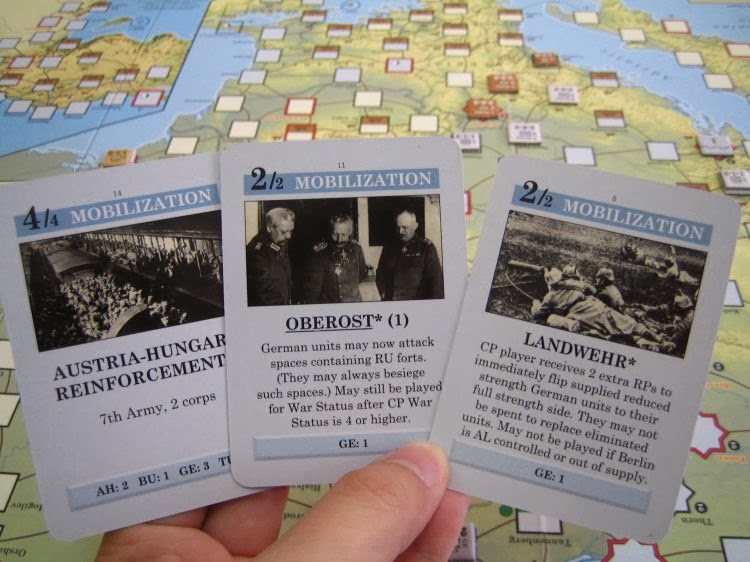
These are Central Powers cards from the Mobilisation (first) stage. If you want to move or attack, you use the first number at the top left as operations points. If you want to do strategic redeployment, you use the second number. If you want to play the card as an event, then of course you follow the main text. If you want to replenish troops or heal units, you use the text at the bottom. If there is a number in a bracket after the card name (in the middle), that's how much you increase your war status if you play the card as an event. The asterisk means the card is removed from the game if it is played as an event.

The game is rules-heavy, but the basic mechanisms are not all that complex. What is challenging is the many special cases and exceptions, and exceptions to exceptions. These are all based on historical facts, so there is a lot of historical flavour in the game. But these are also rules overhead that players will need to remember and also look up during a game.

This being a complex game, I won't go into further details. Let's look at pictures and do show-and-tell.

The Play

The rulebook says that in tournaments, the Allied Powers have a slight advantage, so I let Allen play the Allied Powers, while I played the Central Powers. I own the game and I read the rules, so I am at an advantage.

This is the start of the game. There are three fronts. The western front is at the French-German border, the main forces being French and German. I hadn't realised that Britain had so few battle-ready armies in 1914. The eastern front is at the Russian border, with mostly Austria-Hungarian forces plus some German forces facing the Russian forces. In the Balkans there is a smaller front, with Austria-Hungary vs Serbia. Countries not yet at war do not have their units on the board yet, e.g. no Turkish or Italian forces yet.

This is the western front. German units are grey. French units are blue. The British unit is biege. The larger units are armies, while the smaller ones are corps. There is only one French corp in this photo, the one at the bottom. The three numbers on the units are combat strength, health/endurance and mobility. When a unit is flipped over to the weaker side, usually only the combat strength is reduced. The weaker side of a unit has a horizontal bar. Cities with red borders are worth victory points.

This is the eastern front. Russian units are brown. Austria-Hungarian units are light grey. German units are grey. The 8-pointed stars are fortresses. They provide additional strength to defenders. Even when vacant of troops, a fortress forces enemy units to besiege it and thus ties them down. Once destroyed, a fortress cannot be rebuilt.

Allen's Russians took the initiative and made a joint attack on my Austria-Hungarian army.

I did rather poorly in the eastern front, and Allen's Russians kept forcing me back. Unlike the stronger German units, Austria-Hungarian units are equal to Russian units, so I had no unit quality advantage in this theatre.

The Russians are coming. Allen by now had one large army group right next to Budapest, one of the capitals of Austria-Hungary.

Allen made one grave mistake at this point. His Russian (brown) army group had been overly aggressive, and its supply line was cut by my weaker Austria-Hungarian armies. Being out of supply meant his army could not move or attack. It had to wait for rescue - for other friendly armies to reestablish a supply route. My two Austria-Hungarian armies (light grey) positioned themselves to block any attempt by Allen's other Russian and Serbian forces to rescue his isolated army. If I could hold off the rescuers, the stranded army would be permanently eliminated, a large blow to the Allied Powers.

My Germans (grey) came to help too, holding the positions staunchly to keep the Russian army in Budapest out of supply. Allen's rescuers could not break through, and he lost not only this sizeable force, but also more critically, the momentum in this theatre of war.

The tables turned, and my armies turned around to pursue the Russians and Serbians instead. The northern part of the eastern front had been mostly neglected prior to this. Now that I could afford to spare some attention there, I eagerly attacked. Allen's defenses were weak there, and I was able to break through easily and I destroyed quite a few fortresses.

About five hours into the game, we realised we had made one very big rule mistake. We completely forgot that we were not supposed to enter the borders of countries which were not yet at war. In our manoeuvring at the eastern front, we had trampled all over Bulgaria and Romania, when both of them were not yet at war. Oops... so sorry... please excuse us. No wonder the eastern front felt so spacious! We had been running around the neighbours' backyards without permission.

The western front was a very different story.

There were many fortresses along the western front, many armies were entrenched, and there was not much manoeuvring space. The positions along the front were easy to defend but hard to attack. It was a war of attrition. We kept needing to send fresh troops and to heal the units here. I had a small breakthrough in the early game, capturing Brussels. However I could not sustain a strong enough force and the army group which broke through eventually had to retreat back to the old frontline.

Two French (blue) armies attacking my German (grey) army. As the game wore on, our forces gradually depleted and it became harder and harder to hold the line.

The French broke through and my German army was forced to retreat. By this time the British (biege) had mustered a decent force too. I had been assigning some reinforcements to the eastern front, which meant I had fewer new armies for the western front.

Throughout the game, Allen had been much more aggressive than I was in increasing his war status. By the time he entered the third and final stage (Total War stage, at war status 11), I had barely entered the Limited War stage, with a war status of 5. I spent many cards on replenishment, hoping to gain a strong momentum to break through, and I didn't play many cards as events which could have increased my war status. I think my view was a bit too short-term, and my decisions came back to haunt me. I'm not sure whether progressing quickly to a higher war status is always a good thing, or whether under some situations holding back can be beneficial. My gut feel is generally it is good to progress. Some cards which allow new nations to enter the war are in the later stages. Also certain events that progress the Russian Revolution are in the later stages too. Surely these would have benefited me.

When Turkey (strictly speaking, it was still the Ottoman Empire at the time) entered the war, I didn't quite know what to do with it. Most of its units were placed in the Near East section of the map, and most of them were corps. The Near East map has many restrictions - limited movement, limited strategic redeployment, limited attacks etc. There were many exceptions, and because of that I was too lazy to deal with it. Also the units were mostly corps, which were much less glamorous than armies. So I mostly neglected this theatre of the war. I don't quite know what to do with it.

One interesting bit in Paths of Glory is it has Lawrence of Arabia! The Arab Northern Army in the game was lead by Faisal, a close friend of Lawrence.

This is the Near East map. Turkish units are orange. The Arab North Army (treated as a British / beige corp) starts in Arabia, and now has captured Jerusalem.

Italy was the next country to enter the war after Turkey. The starting army composition and army locations of all countries are all known. So both players can prepare for how to deal with them beforehand. In hindsight, I should have done that with Italy, and not scramble to respond only after the Italian troops popped up on the board. Thankfully Italians troops were initially weak and dispersed. I was able to quickly put together a formidable Austria-Hungarian army group, and I marched it south to deal with the pizza boys before they became a serious threat.

I was too cocky, and forgot to protect my supply line. Allen used one lowly semi-prepared Italian army to cut off my supply, and my new shiny stack of Austria-Hungarian armies was permanently eliminated. Ouch! Now my southern flank was completely exposed. I only had two lousy corps hanging around screaming four-letters words repeatedly.

The Italians (yellow) are coming.

Allen and I played till Turn 10, which is halfway through, i.e. around mid 1916. It took about 7 hours, excluding rules explanation. We could not continue due to other commitments, and stopped there. My Central Powers were ahead in victory points (VP=13, i.e. above 10), but in terms of overall board position, I was poised to lose a lot of ground. My western front defense was starting to crack. My southern front was effectively a void. My war status was far behind. Only on the eastern front I had something to show. In such a situation, possibly one thing I could do was offer peace. This is one of the actions available to players. If you are ahead in victory points (more than 10VP for Central Powers, less than 10VP for Allied Powers), you can offer peace as an action. If your opponent accepts, the game ends in a draw. If he refuses, you roll a die to see who gains one VP, with you having better odds than your opponent.

These are the permanently eliminated armies - 8 Russian armies (brown), 4 Austria-Hungarian armies (light grey), 1 Italian army (yellow), and 1 British army and 1 British corp (beige). The British units are a special case (see the black dot). This is the British Expeditionary Force, and it is never allowed to heal. So once it is eliminated, it is permanently removed from the game.

The board situation at game end.

In the western front, France (blue) has broken through, and Germany (grey) is trying to push it back. Britain (beige) has now assembled a formidable force.

The Balkans. The Serbians (Allied Power) have been wiped out. The Germans have reached the Black Sea. I captured so many cities that I ran out of markers to mark them as Central Powers controlled. However we made a big mistake in this section of the map. We should not have been fighting in Bulgaria or Romania. They were not at war yet!

This is the northern half of the eastern front. The yellow markers are destroyed Allied fortresses. My forces were unstoppable, simply because Allen didn't have many units to stop me in the first place.

The main table is the General Records Track, where various statuses like VP and war status are tracked. The Combined War Status is also the general war weariness. If it hits 40, the game ends, and players look at the VP indicator to determine who wins and whether the game ends in a draw. The two tracks at the top are for US entry and the Russian Revolution. Obviously we have not gamed these aspects much. I think the Russian Revolution track should have progressed to the second space, just that I had forgotten to move the marker.

Allen gave me this tray, and I find it very suitable for Paths of Glory.

The Thoughts

Playing Paths of Glory reminded me of the game of Here I Stand that I played with Han and Allen. That game took a full day too. Paths of Glory doesn't have as much width or variety, but it has more detail. It is only focused on warfare, but it is very rich and strategic. It is grand in scale. You need to take a very strategic view. It is more about how to allocate resources to the different theatres of the war than about how to fight individual battles. It is about how to use your cards - as events, movement, offense, strategic redeployment, or replenishment, and not just about manoeuvring armies. It is about gaming your card deck, anticipating and leveraging events, and defining long-term strategies.

Although die rolls and card draws introduce a luck element, I feel that players have much control in this game. It mostly comes down to the decisions you make. You have perfect information on the board. All combat factors can be calculated and you know the possible range of the battle outcome. So ultimately it's about how much resources you have allocated to that battle, and how well you have positioned your units. I feel that in this game every decision will come back to haunt you. There are implications further down the line that you will concretely feel. Sometimes you regret, sometimes you feel justified. Sending reinforcements to one front will help you do well there, but it means another front is getting less support and will probably suffer. When I play, I feel that successes are because I have made wise decisions, and failures can only be blamed on myself. Decisions are often about compromises. You gain something, you lose something. This is what makes them interesting. And tough!

This is a game that you need to play with an opponent of about the same skill level. I imagine I would get completely slaughtered by an experienced player, which would be no fun for both parties. Manoeuvring units and protecting supply lines is an intricate dance in which both players will play out various scenarios and sequences in their minds before making any move. It takes two equally skilled (or unskilled) players to make this mental sparring interesting.

Allen thinks playing the game well requires knowing the cards well. That is very true. You need to have a good idea of what type of cards are in which stage so that you can plan. You need to know not only cards in your deck, but also cards in your opponent's deck.

Paths of Glory is a wargame through and through. It has quite many rules and is nothing like Eurogames. It takes significant time and effort investment. The basic mechanisms are not that hard to digest. What is challenging is the many special cases, and exceptions, and exceptions to exceptions. Most of these are to handle historical events and situations. I think if you know the history of World War I well, they will all make perfect sense, and will be easier to remember too. I am glad I finally got to play this. It was a lot of work to prepare for this one game, but it was very satisfying. The preparation and anticipation were part of the fun.

Tuesday, 18 February 2014

in photos: Small World, Can't Stop, Hanabi

I bought Small Word on the iPad when it was on sale during the Christmas period, planning to play it with Han and Allen, only to later discover that it doesn't have async mode. If we were to play together, we would need to be online at the same time. So I ended up just playing against the AI's a few times.

Small World is a very Euro wargame (which is an oxymoron). You establish empires and expand them, and every turn you score points based on how many territories you control. As your empire runs out of momentum, you can retire it to start a new one. Your old empire still scores points, as long as it is not yet wiped out by your opponents. Battles are mostly deterministic. Only when you are short of armies for a final attack you roll a die to see if you get some free reinforcements. So the game is much about board positioning, deciding who to attack and who to leave be, and picking the empire (each has unique abilities) which best suits your ambitions.

Can't Stop was free around Christmas time, so I downloaded it. This is a simple push-your-luck game. I have played it before. Despite the simplicity, you are constantly forced to decide whether to be content with what you have gained so far on your current turn or to gamble your achievement on the possibility of gaining even more ground. You are constantly torn between greed and conservatism.

26 Jan 2014. The children asked to play Barbarossa. I, of course, am happy to do so. I didn't want to make my sculptures too hard, but I think I went too far the other way and made them too easy instead. My sculptures are white - needle, lemon and milk. Even before the game started the children were already giggling and pointing at the lemon. They already knew what it was. Is it that obvious? "Milk" was too simple too. In fact Shee Yun thought it was "carton". I underestimated her.

31 Jan 2014. I asked the children to teach my mum to play Hanabi.

It was a challenging exercise, because it was not exactly easy for Shee Yun (8) to organise the rules of the game in her mind, and then communicate them in a clear and structured way. Maybe this is one form of extra-curricular training I should give her - teaching games rules. Needless to say Ma was rather confused. I had to add some clarifications after Shee Yun was done.

We played using a mahjong table, which Ma usually uses for gin rummy or mahjong rummy.

This was the only game we played when we were back at my parents' home in Kota Kinabalu during the Chinese New Year period.

We scored 18pts, which is not spectacular, but not too bad either. Full marks is 25pts.

Chen Rui (7) said she wanted to sort the cards when we were packing up, so I let her do it.

Tuesday, 4 February 2014

Tokaido

Plays: 4Px1.

The Game

In Tokaido, players are Japanese travelers in the olden days, taking the famous Eastern Coastal Road from Kyoto to Edo (modern day Tokyo). They are not racing to reach Tokyo first, but instead compete to have the richest experience from their journeys. This is measured by, of course, scoring points.

The core mechanism in Tokaido is the player order mechanism in Thebes. There is no fixed player order. Instead the current turn is always the turn of the player whose pawn is furthest behind along the road. Once that player advances his pawn to any unoccupied space and takes the corresponding action, you check again who is now the furthest behind. It may even be the same player again.

Every location is represented by a dot along the road. Dots with a horizontal white line are used only in 4 or 5-player games. The bowl of noodles location is an inn, where everyone must stop before the next leg of the journey starts.

There are many different location types, which are basically different ways to score points. The first time you reach a seaside location, you score 1pt. The second time, you score 2pts, and so on. When you visit a souvenir shop, you get to look at a few souvenirs available and you may buy one. You score points for each souvenir, and you score more for more variety in souvenir type. You can make donations at temples, and at game end players score points based on who has donated more than others. The scoring methods encourage you to focus on just some of them, because the more you visit one type of location, the higher the reward. This creates competition among players who have decided to target the same location type. Even when you are not particularly interested in a certain location type, sometimes you want to visit them simply to deny your opponents.

Every player gets to pick a character at the start of the game, which gives special abilities. These usually encourage players to focus on one location type, so players will have slightly different priorities from the start of the game.

You often collect cards, so there is a bit of a set collection feel in this game. That large card at the bottom left is a character card.

The Play

The core mechanism is simple, so I had no problem teaching the game to my children (7 and 8). The many scoring methods took some time to explain, but none of them are complex. The children did not fully grasp how to prioritise the different scoring methods or how to play competitively, but they had no problems with the flow of the game. They played following their whims, and did not really think a lot about the scoring, as if they really were on a road trip and they could stop wherever they please. Maybe that's the ultimate form of playing Tokaido - that's really getting into the theme. :-)

Despite the relaxed atmosphere and the pleasant artwork style, there is competition. You do have to pay attention to what your opponents are focusing on, and you do need to assess when to jump ahead to grab a highly sought after location, and when to grab spots simply to deny your opponents. The inns, where everyone must stop before continuing, also create some tension. Whenever you reach an inn you can buy a good meal, which is worth 6pts (that's a lot). However the costs differ so if you are late, you may have to pay more. Also throughout the trip you must not eat the same meal twice. If you are unlucky, you won't be able to buy a meal even if you can afford it.

I absolutely love the artwork.

The scoring markers are tiny and can be easily lost. The score track advances in a zig-zag manner which is a little disorienting for me.

The Thoughts

Tokaido works with families and casual gamers. It's straight-forward, and the artwork is very attractive. It feels like 7 Wonders (by the same designer) in that there are many ways to score points and you need to pick a few to focus on. Actually that can be said about many other Eurogames out there nowadays. That dreaded "multiple ways to score points" phrase again. Overall it is a pleasant package, but not very memorable (other than the gorgeous artwork). I would describe it as the turn order mechanism in Thebes being expanded into a complete, independent game.

Thursday, 30 January 2014

Happy Lunar New Year

For those who celebrate the Lunar New Year, I wish you happiness and good health in the year ahead.


Gu Zheng 古筝

The early types of guzheng emerged during the Warring States period (475 to 221 BCE). It was largely influenced by the se (瑟), a plucked stringed instrument. It became prominent during the Qin period (221 to 206 BCE), and by the Tang Dynasty (618 CE to 907 CE), the guzheng was arguably the most commonly played instrument in China.

The modern zheng is very different from ones made centuries ago, mainly due to natural evolution influenced by local as well as historical environments but also because of the adoption of Western musical styles. Strings were once made from silk but now they are almost always metal-nylon which increases the instruments’ capabilities, volume and potentials.

There are many techniques used in the playing of the guzheng, including basic plucking actions (right or both hands) at the right portion and pressing actions at the left portion (by the left hand to produce pitch ornamentations and vibrato) as well as tremolo (right hand). These techniques of playing the guzheng can create sounds that can evoke the sense of a cascading waterfall, thunder, horses' hooves, and even the scenic countryside. Plucking is done mainly by the right hand with four plectra (picks) attached to the fingers. Advanced players may use picks attached to the fingers of both hands. In more traditional performances however, plectra are used solely on the right hand, reflecting its use for melodic purposes and its relative importance in comparison to the left hand which is used solely for purposes of ornamentation. Ancient picks were made of ivory and later also from tortoise shell. Ornamentation includes a tremolo involving the right thumb and index finger rapidly and repeatedly plucking the same note. Another commonly used ornamentation is a wide vibrato, achieved by repeatedly pressing with the left hand on the left side of the bridge. This technique is used liberally in Chinese music, as well as in Korean gayageum music.

Sunday, 26 January 2014

GiftTRAP

Plays: 4Px1.

The Game

Every round a number of gift cards are randomly drawn and displayed on the board, and every player secretly decides which gift to give to which other player. Once this is done, every player then ranks the gifts according to his (or her) own preference. He must pick the top three, plus one least preferred gift. All this is then revealed, and everyone scores points for how well chosen the gifts are. If a player has picked one of the top three preferred gifts for the recipient, they both score points. Otherwise, they both lose points. Each player has two score markers, one to keep track of points gained from giving gifts, and the other one for receiving gifts. To win, both these markers must reach the end goal.

Chen Rui (7) and Shee Yun (8). It was Chen Rui's birthday so this game was perfect for the occasion. The nine spaces at the centre of the board are for the gift cards. The number of gift cards to be used depends on the number of players. The nicely-wrapped-up-gift marker is the giver score marker. The open-box marker is the recipient score marker.

The Play

I played with the family when we visited Meeples Cafe. It's a simple game so it was easy to teach to the children. One of the selling points of the game is that it would trigger discussions and revelations about your friends. E.g. oh I didn't know you like this, or oh I didn't know you hate this, or gosh you have weird tastes. I didn't expect these to apply in our game, since we are a family living under the same roof. But they did. It is partly because of the variety of gifts in the game, which put us in situations which we have never encountered before. E.g. a gift yacht. How would I know if my daughter would like a yacht? The topic never came up over dinner!

The fun comes from not knowing your fellow players well enough. You make discoveries, you get to know each other better. The fun can also come from knowing your fellow players too well. One gift that came up in our game was advanced driving lessons. Now I've always teased my wife Michelle's that her driving is aggressive. She insists that she is just attentive and she knows what she is doing, and she always knows what she wants to do next, unlike many other drivers who are slow, clumsy and distracted on the road. My first thought when I saw advanced driving lessons was this was the perfect gift for her! But she would completely disagree. And because we both knew this topic so well, we had to guess what the other was going to do. We both wanted me to give her the right gift, so that we would both score, but should she make it her favourite gift because she knew I'd pick that for her? Or should she not pick it because she trusted that I knew she wouldn't like it? This additional history that we brought to the game added a twist for us.

Michelle and my scores were quite extreme. I had a high giver score, but a low recipient score, which means I often picked the best gifts for others, but I didn't often get what I truly liked. That's sad. My family doesn't understand me! Michelle on the other hand gave lousy gifts but received all the things that she liked. Life can be so unfair. In constrast, Shee Yun and Chen Rui's scores were well balanced, and they came first and second place.

My (green) giver score marker was in the lead...

... but my recipient score marker was way way way behind.

The Thoughts

This is a get-to-know-you game, very suitable for playing with new friends. It works for old friends too. It's quite simple to play, so it works as a family game, as a party game, and as a casual game with casual players, even non-players. The fun comes from both getting to know your friends better, as well as from shared past histories. The simple game mechanisms fade into the background, and the personal touches come to the front.