Friday, 4 May 2012

the excitement of 3-player games, and Tammany Hall

From late 2010 to early 2012, most of my boardgame sessions were 3-player games with Han and Allen. This period started after Allen's first child was born (he was more house-bound than usual so Han and I decided to play at his place to keep him sane), and lasted until Han's overseas work assignment (and I'm pretty sure we'll continue as before once he returns). During this period I easily settled down to this comfortable routine, and became lazier and lazier to organise bigger boardgame sessions. Jointly, we had many games suitable for 3 players, more than we could play. I think we developed a kind of play style together. We tend to be brisk in playing (and we often quote our 50-minute game of Merchants and Marauders); we sometimes take turns simultaneously and end up confusing ourselves whose turn it should be; we often do that "attack-him-he's-the-leader!" thing. I've found that 3-player games have a unique type of excitement, especially when the game being played has some, but is not purely, direct confrontation. Not being a fully confrontational game means you have a choice of taking an aggressive action or taking a peaceful or self-development action, and when you decide to take the aggressive action, it makes the offensive intent more pointed and much clearer.

3-player games have a delicate balance, because any apparent leader will quickly be targeted by the other two players, and he will have a tough time maintaining his lead going one against two. However, the temporary alliance between the other two players is often fragile, because once the alliance achieves the objective of bringing the leader back in line, it will be every man for himself again. So even during the period of alliance, each ally will be trying to better position himself to come out stronger after the dust settles. Distrust your enemy, distrust your ally even more. 3-player games often become a tricky balance of doing well but not appearing too strong, or finding the right opportunity to push for a quick victory before your opponents gang up on you. It's a bit like that scene in Reservoir Dogs - every player holding two guns, each pointed at one of the other two players.

I was reminded of all this when Han, Allen and I played two games of Tammany Hall at www.slothninja.com. We have played this game in its physical form before, quite some time ago, but never got around to play it again until recently. The game has been out-of-print, but is now on Kickstarter trying to achieve the funding goal. The games we played were turn-based and we didn't need to be online at the same time, so the pace was more like a PBEM (Play-by-E-Mail) game. It took us about 5 days to complete a game. I was amazed how exciting and tense the games were. Allen would agree that they were downright stressful. I want to write about these two games. I won't describe the rules (which I've covered before). I'll just jump straight to the session reports and what I was thinking and feeling during the games. You may want to Ctrl-click to open the screenshots in a separate window while you read the descriptions that accompany each screenshot.

Game 1: 23 - 27 Apr 2012

A game of Tammany Hall has 16 rounds, with every 4 rounds culminating in an election. That track at the top shows that we were at Round 4. This being a 3-player game, only Region I (the bottom bit) was in play initially. Regions II and III would open up in Q2 and Q3 respectively. I was red, Allen was yellow, Han was purple. The most defining moment of the Q1 election was the fight for Ward 7. In this screenshot, only Allen (yellow with 3 bosses) and I (red with 1 boss) were fighting for it, but before the election started Han placed one boss to enter the race. I gave up on it and didn't spend any favour chip. Allen and Han were both determined to win it and spent as much as they could. Unfortunately for them, they tied, so both of them lost, wasting many chips in the process. I became mayor.

Being mayor earns you 3VP, which is nice, but it has its drawbacks, because once you become mayor, you must assign special abilities to your opponents, which they can use against you afterwards, while you don't get any special ability. Also the mayor is first in turn order, which makes it hard to defend against others, especially slandering. The rulebook tells you not to complain though, because you are already given 3VP. After the Q1 electcion, I was the apparent leader with a big red target painted on me.

This was just before the Q2 election. Q2 was less eventful than I expected. I actually managed to hold on to the mayor post, although I wasn't really eager to do so. Allen had been using his Precinct Chairman power to shift immigrants around to strengthen his influence, often diminishing mine at the same time. Han had been using his Deputy Mayor power to collect favour chips. Although I won the most wards, many were sparsely populated, i.e. they didn't help much in becoming most influential in the four immigrant groups. Becoming mayor twice in a row meant my score was far ahead now.

Q3 elections had just started. I (red) made a deal with Han (purple) so that I'd let him win Ward 6 and he'd let me win Ward 4. This way we could both conserve some favour chips.

Near the end of the Q3 elections. Han (purple) later won Ward 10, which meant Allen won 6 wards, I won 5 and Han won 4. Allen became the new mayor. In Q3 he had majority influence over three immigrant groups - the Irish, the Germans and the English! That's 9 favour chips going to him. My score was still in the lead (18), but Allen was close behind (15), and Han was further behind at 10. Allen had a lot of favour chips, and would be powerful going into the final Q4 election. It looked like Han and I would need to gang up on him to prevent a runaway leader.

Q4 elections had just started. Ward 1 (bottom left) had just been resolved. Allen and I competed for it, both spending many chips, only to end up tied. This was painful for both of us. I was very badly positioned going into this election. In the final round before the elections, I slandered away Allen's bosses in Wards 3 and 5, so that I could win both wards uncontested. However, Han, whose turn was after mine, swooped in and did the same to me, claiming those two wards. I had expected Han to slander Allen's bosses in Wards 8 and 15, since Allen was the bigger threat. In hindsight, I should not have left myself so vulnerable. Throughout Q4 Han and I had been mostly focusing our attacks on Allen, and I built a false sense of security that Han wouldn't target me. I should have tried to compete with him in some wards, e.g. 6, 7 or 10, so that he would be forced to play more defensively and would not have such a free reign.

Near the end of the Q4 elections. I would eventually lose in Ward 17 too. I didn't have as many favour chips as Allen, so I lost to him in Wards 2, 4, 9, and 17. Han had a magnificent come-from-behind victory, winning 10 wards! That's 10VP. He also gained 6VP for most Irish, English and Italian favour chips left, and 3VP for mayorship.

Final score: Han (purple) 30VP, Allen (yellow) 22VP, Hiew (red) 19VP.

Game 2: 27 Apr - 3 May 2012

In our second game, we were assigned the same colours as before. Han was purple, Allen was yellow and I was red. This screenshot was taken during the Q2 election. Earlier, in Q1, I had become mayor uncontested. All three wards that I competed in were won uncontested. Han and Allen competed in two wards and each won one. That meant I, again, became the big fat target, not just because I was ahead in points, but also because I had conserved the most favour chips.

In this second game, I tried to be more aggressive in pressing my advantage. Instead of trying to go for the less populated (and thus less attractive) wards in order to appear weak, I wanted to fight for the more densely populated wards, so that I could gain majority influence with more immigrant groups. In this screenshot, Ward 1 had just been resolved. Han (purple) and I (red) competed for it. He spent all favour chips he could afford and won it. I hadn't expected that, so the favour chips that I had spent were wasted. It was a right decision for Han, because eventually he gained majority for three immigrant groups, greatly helped by the immigrants in Ward 1. He also won the most wards and became mayor.

This was during the Q3 elections. Noone bothered to contest for Wards 17, 11 and 13 on the right, because they had few immigrants, and I think also because noone was keen to be mayor going into the last election.

This was the start of Q4, i.e. it shows the outcome of the Q3 election. Han (purple) won Ward 1 (but his token was cut off from this screenshot), 8 and 9. Allen won three wards too, and I won four. Ward 4 was tied between Han and Allen. Ward 15 was tied between Han and I. I became the reluctant mayor going into Q4. I was leading in points, but Han and Allen were not far away. At this point Han had very few favour chips, much fewer than us, so he'd be at a disadvantage when he had to compete during elections. I gave him the Council President power which let him lock up wards. This would be useful to him because he could quickly lock up a ward with only his boss present to make sure he'd win it uncontested, without needing to spend favour chips. I wanted to keep him in the competition so that he could still be a threat, and Allen couldn't focus his attacks (and defenses) only on me.

Final round before the Q4 elections. I had many English (white) favour chips. However Allen used his Chief of Police power well and removed English immigrants from many wards where I wanted to fight for (3, 5, 7), rendering my English favour chips useless there. Han made good use of his Council President power and locked up Wards 1 and 4 for himself.

Q4 election had just started. Contested wards were 3, 7, 9 and 14. All of us had the chance to become mayor, and that 3VP bonus would be a big factor in determining the final winner. The 2VP for having the most leftover favour chips for each of the immigrant groups could also determine victory. It was going to be a very close game.

I knew I (red) would lose to Allen (yellow) in Ward 3, and Han (purple) would lose to him too in Ward 14, because neither of us had enough of the right coloured chips to fight with him. So it all came down to what would happen in Wards 7 and 9. Han already had 5 wards in the bag, and if he won a 6th ward, he would became mayor. That would be 9VP, for the wards and the mayorship. I too wanted mayorship, because with my current lead, that would likely seal my victory. However I would need to win both Wards 7 and 9, and also have more favour chips than Allen (because we would be tied at 5 wards each).

This was the favour chips situation. Han was purple, I was red. If I wanted to safely win Ward 7, I'd have to spend 4 chips. If Han conceded Ward 7 and didn't spend any, then the favour chips he had left would be enough to tie me in Ward 9, denying me Ward 9. If Han gambled that I would take a risk in Ward 7 and spend fewer than 4 chips, he might spend all he had to try to win Ward 7 and secure his mayorship. It all came down to one crucial decision. Would Han try to win Ward 7? I gambled that he would, and this was what followed...

Han didn't spend any favour chip in Ward 7. I won it having spent four, when I could have won it spending just one. We tied for Ward 9, so neither of us won mayorship. Han (purple) and Allen (yellow) both had 5 wards, but Allen had tons more favour chips, so Allen became mayor.

This was the favour chip situation at game end. After all the scoring was done, Allen (yellow) won the game with 26VP. I (red) had 23VP, Han (purple) had 19VP. I retraced our game, and found that if I wanted to win, I would have needed to spend either 1 or 2 favour chips to fight for Ward 7. Only then I could tie Allen with 5 wards, and also have more favour chips than his 12. That would have been a perfect storm, but I guess one should not expect such perfect alignments to happen easily.

Thoughts on Tammany Hall

These two games of Tammany Hall had been tremendously fun and tense. Allen said he needed a break from such stress. This reminded me of my two PBEM games of Axis and Allies Anniversary Edition against Han in 2009 (Game 1, Game 2). I reread these session reports and enjoyed myself reliving the wars.

Tammany Hall is a perfect information game. The types of actions you can take is low, but there are many possibilities and implications. In theory you can work out all the possible outcomes, but in practice it is quite daunting. In a PBEM-like format, you can take your time working out all the possibilities, but when playing face-to-face, that can become analysis paralysis. There is still some uncertainty. What new immigrants become available after the immigrant pool is exhaused is random, but you don't refresh immigrants very often. The blind bidding (committing favour chips) during elections is not random. You need to guess your opponents' intentions. The elections can be very tense. I am very impressed that with not many rules and with few action types, the game can create so many possibilities and opportunities for clever play, and also bring out the theme convincingly.

I hope the Kickstarter project works out well. This is a game that deserves more attention.


Noble Knight Games - Buy, sell and Trade! New and Out-of-Print RPG's, Board Games, Miniatures, Dungeons & Dragons

Thursday, 3 May 2012

Tournay

Plays: 2Px1.

The Game

Tournay is a successor of sorts to Troyes. Troyes is a cube-converting, VP-scoring Eurogame with interesting use of dice and a bit of worker placement. Tournay is the card game version. It has some similar elements, however overall I find it to be quite different. It is more a tableau game (like Race for the Galaxy, 51st State, San Juan), and of course the "interesting use of dice" aspect is gone, because it has no dice.

Every player starts with his own 6 workers (in the basic game), 2 of each type - soldier (red), cleric (white) and civilian (yellow). You use workers for drawing cards from similarly coloured decks, the more advanced decks requiring more workers. Cards are buildings and characters that you can play into your 3x3-grid play area by spending money. Once played, you can place your workers on buildings to use their powers. There are three event cards visible at any one time, some good, some bad, and whenever a Town Crier card is revealed from any deck, events take place. You can spend workers (and money) to combat events, which are worth points and can also protect you from future events.

The centre area. On the left (which should be the top), the event cards deck, and 3 events revealed. You know what's coming and you can prepare for them, but you won't know exactly when they'll happen. Next, available workers to be purchased. In the basic game, you can only purchase additional workers using specific buildings. Then there are 9 decks of cards, 3 colours x 3 levels. You need to use workers to draw cards, higher level cards requiring more workers.

The lower left section is my personal area - my plaza where unassigned workers assemble, one already used yellow worker (civilian), my $5 coin and my green scoring marker, which is only needed at the end of the game.

My play area during mid game. The Port (1st row 2nd column) lets me use another player's yellow building. The Architect (2nd row 1st column) earns me $1 whenever I construct a building in the same row or column. The Fort (2nd row 2nd column) lets me defeat an event card if the event has occurred before. The Priest (2nd row 3rd column) lets me use a building in the same row or column twice (on different turns, and still requiring a worker). The 3rd row 2nd column building (can't read and can't remember what it is) lets me draw two level 2 white cards. The Monastery lets me buy a new worker. At this point I had defeated at least two events and had used them as ramparts to protect me against events.

As you use up your workers, eventually you will need to spend a turn resetting all of them back to the unused state. Ideally you use all up before you reset, but since there are 3 types of workers, sometimes you are desperate enough to use a particular type (which are all exhausted) that you reset sooner. You can use workers of other players, paying them for such usage, but normally you can't use their buildings. Only some buildings allow you to do that.

The game ends after a player has filled up his 3x3 grid and has constructed at least two prestige buildings, i.e. Level 3 buildings which often score a lot of points for the owner and also some for other players. Other than the prestige buildings, some normal buildings also score points, as do events that have been defeated.

The Play

Allen bought Tournay 2nd-hand, and it was a good deal. He liked Troyes very much. The English version of Tournay is not yet widely available. His is the international version containing English rules. We did a 2-player game. I didn't remember much about Troyes, but I was quite sure the gameplay of Tournay felt quite different. Tournay was all about drawing cards and playing them into your own 3x3 grid, and trying to make the most of your cards. One thing that I felt a little uncomfortable about was you are more-or-less stuck with the cards you draw. You do have some choice when getting a card, either the face-up card (if one is available), or you draw two and pick one. However once you gain a card, you either build it, or you waste it when you exceed the hand limit. I guess you do have a choice of building it or wasting it, but the latter seems just... wasteful.

I have a nagging feeling that a significant part of your success is how lucky you are with the card draw. However, each deck only has 10 cards, and the card powers are mostly quite generic, i.e. they can be useful in many situations and combinations. Having few cards in each deck means players can quickly learn what cards are available and where to look for them. So, maybe I worry too much. The prestige buildings (level 3 buildings) can give a lot of points. It's probably best to hold on to them, try to fulfill the scoring conditions before your opponents guess what they are, and then build them just before the game ends.

I was quite lucky with my buildings. I had one building which let me combat events cheaply, and another one that let me use buildings twice. This combination let me combat many events. I guessed that there would be a military prestige building that awarded points based on number of events defeated, and I was right! I drew that exact same card I was hoping to get. This, plus another combination of a building that allowed me to buy more workers and a prestige building that scored for sets of workers, gave me a comfortable win.

My play area at game end. The top left and top right buildings are prestige buildings. They give you points based on specific criteria. They also give points to your opponents who fulfill the same criteria, although not as many points as are given to you. The red shield icon means victory points. Some buildings give no victory points, e.g. those in the bottom row.

The Thoughts

My biggest impression is how different Tournay feels from Troyes. Tournay is a pleasant construct-your-own-city game, where you try to make the most of clever combinations of buildings and characters, and then shoot for the most suitable prestige buildings. Player interaction seems lower compared to its predecessor. In my one game neither Allen nor I used each other's workers at all. It didn't feel very necessary, since many actions only needed one worker, and the numbers on the dice rolled aspect of Troyes no longer exists. Probably we have not discovered the nasty strategy of using up valuable workers of opponents before they can use them. Troyes has this nastiness in its dice mechanism. We should experiment with this the next time we play Tournay.


Noble Knight Games - Buy, sell and Trade! New and Out-of-Print RPG's, Board Games, Miniatures, Dungeons & Dragons

Tuesday, 24 April 2012

Power Grid: The Robots

Plays: 3P (2 humans 1 robot) x1.

The Game

I've always liked Power Grid, and own most of the expansions. Unfortunately most of the time it's just Michelle and I playing 2-player games. So I was immediately interested when I heard about the Robots expansion which introduces robot players. It allows players to add robot players when the number of humans is low, to make the game more interesting.

Each robot is made up of five parts, and each part specifies some rules governing the behaviour of the robot. The parts can be mixed and matched, resulting in many possible combinations and robot characteristics. There are also some base characteristics of the robots, which they will follow precisely unless overridden by their special characteristics. During gameplay, players need to manage the robots, and in some cases make decisions for them. The robots' actions will not always be optimal. They are there more to be exploited by the humans than to compete. Their actions are mostly predictable, so a clever player will try to use it to his advantage.

A robot is made up of five parts, and each part specifies rules the robot follows for a certain aspect of the game.

The Play

Adding a robot does feel like having an additional player, albeit not a very threatening one. 2-player Power Grid is not as good as 3+ players, so in my case it is nice to have some new dynamics. Phase 2 no longer means all cities are opened up, because the robot can now be used to occupy the second city spot to block your opponent until the start of Phase 3. Taking into account the robot's behaviour is important, and manipulating turn order is important. The cost of having an extra player (or more) is the overhead in calculating the robot's actions (most of which are deterministic) and in managing the actions themselves. Sometimes the robot can be a useful tool to hinder your opponent.

We used the Russia map. Michelle was red, the robot was yellow, I was green.

We played the red, yellow and purple regions. I (green) started near the centre of the purple region. Michelle (red) started near the border of the red and yellow regions. The robot (yellow) started in the most backwater city in the yellow region, but it quickly expanded outwards to interfere with one of us (under the guidance of the other human, of course). Look at how the robot's houses have occupied the 2nd slots of many cities, blocking the remaining player until the start of Phase 3.

Power Grid is still Power Grid though. The game doesn't feel very different. This expansion is not meant to significantly change the gameplay. In the game that I played with Michelle (and one robot), I actually came last, i.e. I lost to the robot! But I swear I was not beaten by it. I was just outmanoeuvred by Michelle. She had quickly connected 17 cities to end the game when I had not expected her to be able to afford it yet. I keep losing to her at Power Grid. Must be the accountant in her.

The Thoughts

I think Power Grid: Robots achieved what it set out to do - to allow robot players to be added when there are too few humans for the game to be interesting. If there are enough humans, say four, or even three, I'd say the robots are not necessary. There is some overhead in managing the robots, but it's worthwhile if it lets me play some interesting two-human-players games.


Noble Knight Games - Buy, sell and Trade! New and Out-of-Print RPG's, Board Games, Miniatures, Dungeons & Dragons

Tuesday, 17 April 2012

Flash Point

Plays: 4Px1.

The Game

Flash Point is a cooperative game about fire fighters trying to save people from a burning building. Working together, the players need to save at least 7 out of 10 victims to win.

The game starts with three victim markers on the board. Some parts of the building are already on fire and some walls damaged. Fire fighters start outside the building. On your turn, you get 4 action points to spend, and once done you do fire spreading before the next player's turn. You can spend action points to move, to open doors, to break walls, to carry victims and to fight fire. To save a victim, you need to carry him (or her, or it; yes you have to save pets too) outside the house, and call the ambulance to pick him up. Whenever a victim is saved, or is killed by fire or found to be a false alarm, a new victim marker is added to the board. So you plunge into the burning house again to answer the next distress call.

After actions are done, bad things happen. You roll dice (one 6-sided and one 8-sided) to determine where smoke will appear in the building, which is a 6x8 grid. If the new smoke appears on a clear space, the space becomes smoky. If the space is already smoky, it bursts into flame. Any smoke adjacent to fire immediately lights up too. If the space is already burning, an explosion occurs, spreading fire or damaging doors and walls in all four directions. An explosion also occurs if fire reaches hazardous materials, which are seeded on the board at the start of the game. There are also hot spots. If the smoke roll hits a hot spot, you must do an extra smoke roll and add a hot spot. If your second smoke roll hits another hot spot, you keep on rolling. Things can get out of hand quickly if you are unlucky. Damage to walls can be good or bad. A collapsed wall section lets you walk through, i.e. it's a shortcut. However, if the building takes too much damage, the whole thing comes down and the game ends.

Fire fighters can barge through burning spaces, but if caught by fire (smoke lighting up, or an explosion occurring in an adjacent space), they are knocked down and are transported to the ambulance. Victims caught by fire simply die.

Each player picks a specialist to play at the start of the game, and can switch roles during the game. Each specialist has a different special ability, e.g. the paramedic can give first aid to revive a victim, so that he can walk by himself and need not be carried. The different abilities can be useful under different situations.

The Play

I did a 4-player game. All of us were new to the game except for Allen who is partially new - he has played a computer implementation before, but the rules are slightly different. I struggled a little with explaining the rules, even though I have read it a few times before, because of the various terms they use. Once things got underway, gameplay was smooth. I guess I needed to physically see how things work before everything clicked.

We kept getting explosion after explosion. It was a race against time to save 7 victims. Like Pandemic, there is a tension between long-term and short-term goals, the long-term goal being to save people, and the short-term being to subdue the fire enough so that it doesn't get out of hand. It can sometimes be tough to decide which to prioritise.

When I explained the game rules earlier, I had explained that among the victim tokens were some false alarms which could be ignored and simply discarded. I asked my fellow players to imagine discovering a cat instead of an unconscious victim. When we actually played, we found that there was a cat token! It was only then I realised I had given a bad example. The cat needed to be rescued too and should be treated as a victim. Sorry, all cat owners.

The round blue markers are victim markers. When placed on the board, they are face down (i.e. showing the question mark). Only when a fire fighter reaches them they are turned face up. The one on the right has been confirmed to be a victim. Now the green fire fighter needs to carry her out of the building.

One funny thing that happened in our game was we kept discovering victims at one particular bed. After carrying one victim from that bed away to safety, we again heard calls for help from the same spot. Must have been some wild orgy. People kept crawling out from under the bed.

Due to the many explosions, many of the walls were damaged and the building started to get shaky. One of us had to switch role to the structural engineer to quickly fix some of the walls so that the building didn't collapse. We came very close to losing the game due to the house collapsing - just one bad dice roll away. Thankfully we eventually managed to save our 7th victim to win the game. At that point, one victim had died in the fire. We decided to try to save the last two. Unfortunately we couldn't, the building finally collapsed soon afterwards, ending the game.

We played the full game and not the introductory game, but we used the easiest level. At harder levels, there are more initial fires, hazardous materials and hot spots.

The dining room in the top left corner is burning very badly. An explosion had spread the fire outside the building. The toilet in the bottom left corner is in a bad condition too. Explosions have damaged the walls.

The fires at the dining room (top left) and toilet (bottom left) are under control now, but the kitchen in the centre is now burning very badly.

The Thoughts

Flash Point feels quite Euro, and at the same time most aspects of the game tie well with the setting. The setting feels real and is something most people can relate to. This can work well as a family game, but probably an adult will need to handle the smoke and fire spreading aspects initially. Actions are easy to understand, and the behaviours of the fire and explosions are intuitive once you see them in action. There are a few illogical aspects, but I think they are acceptable compromises to maintain balance and playability.

Flash Point reminds me of Pandemic, another cooperative game, and I can't resist comparing them. Pandemic is a little tighter, has fewer rules overhead and fewer moving parts, and has that delicious tension of the tendency of infected cities to get infected again. It is more abstract. Flash Point has a completely different setting that players can relate to more directly, as if they are present at the scene of the fire. Using memoryless dice instead of recycleable cards to determine where smoke appears means Flash Point probably has higher randomness, but I see this as a feature, not a strength or weakness. Despite the seemingly higher randomness, Flash Point feels quite balanced. Maybe the many dice rolls average out in the long run, so good and bad luck even out.


Noble Knight Games - Buy, sell and Trade! New and Out-of-Print RPG's, Board Games, Miniatures, Dungeons & Dragons

Friday, 6 April 2012

Ora et Labora

Plays: 2Px3.

The Game

Ora et Labora means praying and working. It is about developing and running a monastery in the middle ages. This Uwe Rosenberg design has many similarities to his two earlier designs, Agricola and Le Havre, especially the latter. You construct buildings which have various abilities, and you place your people on these buildings to utilise these abilities. Buildings come from a common pool, so once a player has constructed a building, no one else can construct it, but they can pay the owner to make use of it.

Each player starts with a plot of land which is partially developed, with basic buildings, limited available space for new buildings, and some forests and moors. Forests and moors can be cleared to obtain wood and peat respectively, and the cleared land can then be used for building construction. The play area can be expanded by buying more plots of land, which can give more forests and moors, and also different landscape types (coast, sea, mountain) which allow specific types of buildings to be constructed.

The monastery grounds at the start of the game. Two moors from which peat can be harvested, and three forests from which wood can be harvested. Three basic buildings, and two vacant spots available for construction.

There is a goods accumulation mechanism similar to both Agricola and Le Havre, where all types of goods will gradually accumulate until someone takes an action (e.g. using a building, clearing a forest) to claim the goods. The amount of goods drops to zero and starts accumulating again. In this game, this mechanism is implemented using the production wheel, which makes things easier to manage. This is not the core of the game though. This is just a solution to a minor problem. So, just a nice-to-have.

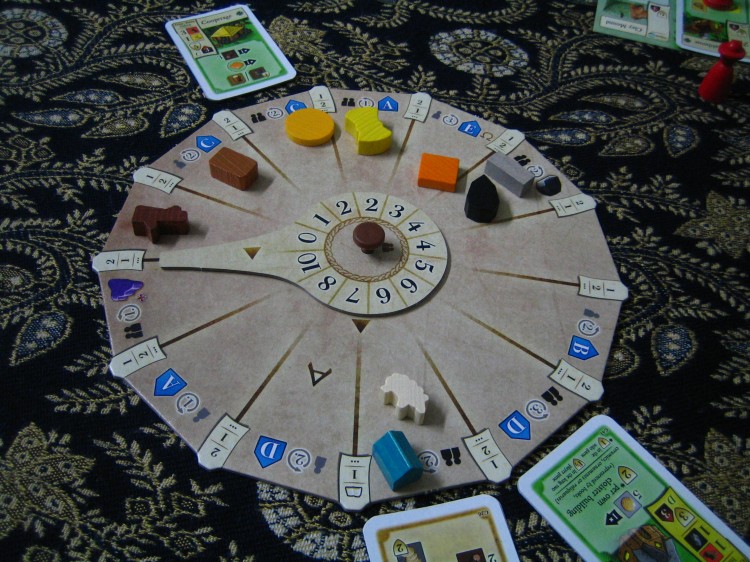
The production wheel. At the start of the game, the markers for all goods are piled here, at the zero space.

The production wheel during a game. At the start of every round, the hand is rotated one notch, which will increase the numbers next to some of the goods markers. This is how goods accumulate, without needing to physically add goods tiles to many piles of goods. Pretty nifty. When a certain goods type is claimed, the marker for that goods is moved to the zero space, and it will start accumulating again from zero. The little blue house is a reminder for when the next settlement phase will occur.

Some of the goods tiles in the game. These are double sided. Pot icon means food value, fire icon means energy value, shield icon means victory points worth.

The core of the game is still the buildings, and how you make use of them. There are many ways to earn victory points. There are many types of goods in the game, and some types are worth victory points. Buildings themselves are worth points too, and you need to spend resources to build them. Every building has a settlement value, and these are scored using a special building type - the settlements. Settlements can be built only at specific times during the game. If you have accumulated the required resources, you can build one. It is not mandatory, but it is usually desirable. At game end, each settlement scores its own settlement value, and the settlement values of the four buildings orthogonally adjacent to it. So you want to place settlements next to high settlement value buildings, and vice versa.

The buildings available at the start of the game. On the vertical banner on the top left of each card are: (a) terrain type the building can be constructed, (b) resources required, and (c) building score and settlement value. The little open bible icon means these are the starting buildings. The lower half of the cards are the building powers.

Unlike Uwe Rosenberg's two previous hits, Ora et Labora doesn't have a feeding phase where you must have sufficient food set aside or suffer a penalty. This is replaced by the settlement phase, where if you don't have the resources set aside to be able to build a settlement, it would be at worst a missed opportunity rather than a penalty. Depending on how you develop your monastery, sometimes you may not want to build many settlements.

The game comes with two ways to play - Ireland and France. The difference is in the buildings. Each building card is double sided so you decide up front which side you want to play. I have not studied the differences in detail. I just know that in France you drink wine and in Ireland you drink beer.

The Play

So far I have only played 2-player games. The structure and game end condition are a little different from 3P and 4P games. I am assuming the overall feel of the gameplay is similar. In the games that I have played, we seem to focus a lot on construction. Each building is worth points (both direct victory points and the potential in its settlement value), and sometimes I construct a building more for its points than because of the intention of using it. I wonder whether this is normal. That said, some buildings and building combinations are quite useful. I sometimes use my opponent's buildings, when they suit my purpose. The cost is not too high.

There is still the greed vs planning tension. When you see that a certain good has accumulated a lot, it's very tempting to grab the lot instead of sticking to what you have been planning to do. Do I grab it before my opponent does so? Should I delay constructing that building by one turn? There are often many juicy choices, which means tough decisions.

My monastery at the end of a particular game. I have 7 settlements (cards with a blue house icon on their top right corners) out of the maximum of 8. Normally there are only 4 settlement rounds in a game, but the Castle building lets you build extra settlements.

There is also that "maximising" feeling when you play this game. You want to make the most of every action. You try to build up an efficient scoring engine. You try to develop a high-scoring monastery. Many things are achieved by many small steps, so you are meticulously planning your moves and squeezing every bit out of your actions. One of your three pawns is a prior (whom I call "the boss"), and if he is idle when you construct a building, you can immediately place him on the new building as a free action to utilise the building. You want to make use of this as much as possible. There are a few such small tactical considerations throughout the game.

For 2-player games, the game does not end after a fixed number of rounds like in the 3P and 4P game. The game ends when there is only one building left in the common pool (i.e. not yet built). So there is some tension in timing the game end. If you are using some building combo to create many goods worth victory points, you may want to let the game drag longer. If your opponent is doing this, then you want to try to construct buildings quickly to expedite the game end, even if the buildings aren't high-scoring or useful to you.

Another monastery at game end. I didn't buy any mountain plots this game.

Michelle's monastery. Or maybe I should say nunnery? The buildings with the yellow banners are the monstery itself, and they must be built adjacent to one another, extending from the initial cloister office.

The Thoughts

Ora et Labora feels very familiar, because I have played Le Havre. It feels more open, and the constant pressure in having enough food is replaced by the less intimidating settlement phases. It has a spatial element in the landscapes types and the possible expansions. I can't say which is better. Perhaps it is unnecessary to do so. If you like development games this is a good choice. If you're looking for something very different from Le Havre, you'll be disappointed. Ora et Labora is a complex development game, and it has some differences from its predecessors. I see it as one more choice on my shelf when I feel like playing this type of game. There are many possibilities to pursue in this game, and I like the sense of achievement in developing my own monastery.

The level of player interaction is similar to Le Havre and Agricola, perhaps slightly less tense, not because of the type of interaction itself, but because the game system is more forgiving. In Agricola, claiming four food from the board just before harvest time can be a very nasty action to your opponent who is short on food.

From Agricola to Le Havre to Ora et Labora, the designs have shifted to be less restrictive and more open, giving more options for scoring. However I don't see the earlier designs as inferior, just different. So Ora et Labora does not replace any of its elder brothers, it adds to the family.


Noble Knight Games - Buy, sell and Trade! New and Out-of-Print RPG's, Board Games, Miniatures, Dungeons & Dragons

Tuesday, 27 March 2012

boardgaming in photos

9 Mar 2012. I taught Allen to play A Few Acres of Snow, randomly deciding that I'd play the French and him the British. I made a big big mistake in the early game, despite have played 5 times before. I didn't protect Quebec properly and it was raided successfully by Allen. Aaarrgghh! I kind of saw it coming, because I knew he befriended some Red Indians early. I should have been more proactive in defending against such a raid.

The raid on Quebec set me back severely. And then I made my second mistake, which was flatly stupid. I wanted to resettle Quebec, so that the Quebec card in my deck would become useful again. I didn't realise that in my deck only the Quebec card (which I couldn't use at the time) had a settler icon. I held on to a Trois Rivieres card and a boat card, and kept waiting for a card with the settler icon so that these three cards together would let me resettle Quebec. But such a card didn't exist! I realised my mistake after one full cycle through my deck, and only then hurriedly bought a settler card from the neutral pile.

Allen went with the settling approach, hoping to settle and develop villages to towns to end the game. I was far behind in settling, so I must go with the military approach. Allen bought a bit too many cards into his deck, which slowed him down. Eventually I was able to bring just enough military force upon Boston to conquer it, winning the game. This was one long game, where an experienced player's not-quite-forgiveable mistakes and a new player's tendency to bloat his deck both slowed the game.

Tigris and Euphrates on the iPhone continues to be fun. The AI's are good enough (or maybe I'm not very good yet) so the game is challenging.

Sometimes I get beaten by the AI's, but at least I rarely come last, usually being able to come at least second place. I do need to work hard to win.

10 Mar 2012. The kids (7 and 5) wanted to play Ingenious. They have a general idea that they should place icons next to long strings of matching ones, but I do sometimes needs to point out even better placements. They are getting the hang of how to do scoring, sometimes Shee Yun (7) even corrects my scoring mistakes.

What's funny is sometimes Chen Rui (5) tells me not to place my tile at a certain spot because she wants to put hers there. Sometimes I oblige.

Quoridor was free on the iPhone so I downloaded it. This is an abstract game where you try to move your pawn to the opposite side of the board to win. On your turn you either move your pawn one step or you place a wall. You only have 9 walls and once they're used up you can't place any more walls. The only rule in placing walls (other than physical constraints) is you can't complete cut off your opponent's path to your side of the board. You can at most force him to take a longer path.

The AI seems weak though. I won my first game, and quickly lost interest. The game should be more interesting against human players. But then I'm not really into abstract games. And... let's not go into whether Eurogames are actually just abstract games with pasted on settings.

12 Mar 2012. The children playing Twister during the school holidays. They asked me to play with them, and I managed to persuade them to just let me be the spinner guy.

Their limbs are not long enough or strong enough for them to do well...

... but they have fun.

13 Mar 2012. Shee Yun (7) now often asks me to play Monopoly with her after seeing me play it on the iPhone. I downloaded it when it was free and am now starting to regret it. Not that I'm bashing Monopoly. I just think it doesn't quite work as a 2-player game. But Shee Yun likes games where she gets to collect money.

She likes to read the Chance cards and Community Chest cards herself, and just forges ahead even if she comes across words she doesn't understand.

I had to mortgage almost all my properties. I think I was eventually able to buy the most expensive dark blue set (the Park Lane and Mayfair Ave equivalent), but by then Shee Yun had two completed sets both having buildings. We did no trading at all, because there was no incentive to do so. We completed our sets by ourselves without needing to trade. She had the lead and had no reason to trade with me, although she did ask me why we weren't trading (which she had seen the AI's on the iPhone version doing). I didn't want to trick her into making a trade that would benefit me more than her.

My bankruptcy was a relief. I landed on her hotel. Maybe when she grows up I should tell her that I loved her so much I played 2-player Monopoly with her. Now that's (gamer-) fatherly love!

Thursday, 22 March 2012

Mondo

Plays: 2Px1.

I played Mondo with Michelle during our recent visit to Meeples Cafe. This one we didn't play with the children, since I couldn't think of a good way to handicap ourselves to give them a sufficient advantage. So they played The Kids of Catan by themselves.

The Game

Mondo is a real-time game where everyone simultaneously tries to place tiles to fill up his player board. There is a timer, and when it runs out, the round ends, and players do scoring. A tile can have one to three different types of landscapes (water, desert, grassland or forest). It may have an animal, and it may have an active or a dormant volcano. When you place a tile, you should try to make sure the sides match with the board and with other already-placed tiles. It is not mandatory, just that you get penalised for every mismatch. You want as many animals as possible, because each scores 1 point. You want as few volcanoes as possible, because the player with the most volcanoes gets penalised based on the number of volcanoes he has. You only have 7 minutes to fill up your board. If you finish early, you can grab a bonus tile. Naturally the first to grab such a tile gets the one with the highest value. Once time runs out, you do scoring.

You gain points for animals and for every correctly enclosed landscape. You are penalised for empty spots, mismatched sides and volcanoes. In more advanced variants, there are additional scoring methods you need to think about, e.g. needing to fulfill certain criteria, or having the most of a certain animal.

This is the basic side of the player board, where the world is surrounded by water. Here I have 5 correctly-enclosed landscapes, the 3 forests, and the desert in the centre and the desert on the right.

This is the advanced side of the player board, where the world is surrounded by 4 different landscape types. I have 7 correctly-enclosed landscapes here, 2 forests, 2 grasslands and 3 deserts. Only the desert and the forest on the right contain mistakes.

You play 3 rounds, and the player with the highest score after 3 rounds wins. There is one mechanism which tries to disadvantage the current leader. Before the 2nd and 3rd rounds start, a volcano marker is given to the leader at the time, so that in the upcoming round, dormant volcanoes are treated as active volcanoes only for this player. The volcano mechanism is interesting, because you need not try to have no volcano at all, you just need to have fewer than one other player. So there is a game of chicken here in how far you dare to go in using tiles with volcanoes. Sometimes it may be worthwhile taking the penalty, because volcano tiles are often good tiles.

The Play

Michelle and I only played the basic game. I quickly discovered the angst of whether to take tiles with volcanoes. In order to complete more correctly-enclosed landscapes, I needed tiles with more landscape types, but such tiles usually come with volcanoes. At first both of us were wary about taking volcano tiles, but after the first round, in which I scored higher than Michelle, I decided to not worry too much about taking volcanoes, as long as I wasn't taking too many of them. This helped me a lot in completing correctly-enclosed landscapes. Michelle was a bit too conservative about taking volcano tiles, which hampered her. In the end I managed to outscore her despite the volcano penalties from all 3 rounds.

Unlike Galaxy Trucker where tiles are one-sided and start face-down, Mondo tiles are double-sided and are all available when a round starts. You can easily scan the piles of tiles on the table for the combination you want. However it can still be hard to look for specific tiles you want. The more specific your requirement, the harder it is, e.g. you need three different landscape types in a particular configuration, you prefer tiles with animals, you prefer tiles with no volcanoes.

The Thoughts

Mondo is quick and pleasant. It's hard to avoid comparison with Galaxy Trucker, but I wouldn't call it just a simplified version of Galaxy Trucker. Despite the real-time side-matching and tile-placing, it somehow feels different. I'm not sure why. Mondo is much quicker to set up. There is no surviving-a-space-flight phase after each round - you score immediately based on how you have constructed your world. There are a number of considerations when you build your world, but they are not as complex as those in Galaxy Trucker. What surprises me is despite the similarities, they feel different enough that I think it's OK to own both, unlike Power Grid and Power Grid: The First Sparks which I think you only need to own one (I prefer the more mathy original).

Mondo is straight-forward fun. A little solitairish because you can't meddle with others' worlds, but with the more advanced rules (which I have not yet tried) there will be more competition. The game is suitable for non-gamers and casual gamers, but you probably want to stick to the basic game. It's a good family game too. At the same time it's a game that hardcore gamers can enjoy and don't need to tolerate just to be able to play with children or non-gamers. There are multiple ways to handicap more experienced (or stronger) players, if required.

Michelle gave this her seal of approval. Should I buy it?

Tuesday, 20 March 2012

Mow, Black Sheep, Jungle Speed

I recently had a family outing at Meeples Cafe again, this time playing Mow, Jungle Speed, Zooloretto, Black Sheep and Mondo, all being new to me except for Zooloretto, which was requested by my daughter; and all having animals except Jungle Speed. We had a great time, spending almost 3 hours there. I was quite surprised when Shee Yun (who just turned 7) won at Zooloretto. I didn't teach the rules or scoring method in detail and just taught as we played. I'm still not sure what Michelle and I did wrong. I thought Michelle was doing well, but too many animal types at the barn gave her too many negative points. I'm not sure what Shee Yun did right either. During the game we did give her advice now and then, but she mostly made her own decisions, mainly enjoying collecting animals in her pens and not really strategising much.

Shee Yun's winning zoo in Zooloretto.

Mow is a light and quick card game. It is a little like 6 Nimmt / Take 6 / Category 5, but even simpler. On your turn you try to play a card into a row at the centre of the table. If you can't, or choose not to, you take all the cards in the row and put them into your (negative) score pile. Every card is numbered, and also has a number of flies depicted. When you add a card to the row, it must be added to either end, i.e. you can only play a number smaller than the smallest number in the row, or bigger than the biggest number in the row. The flies on the cards are the negative points you get if you take the cards. There are some special cards, e.g. some allowing you to insert a card in the middle of the row, some allowing you to change the direction of play. The game ends when the deck runs out.

All cards in Mow feature cows, and most depict flies too, which are negative points. Cards with dark green backgrounds are special cards. These two in my hand can be inserted between two cards, as opposed to being placed at either end of the card row.

There is some, but not much, strategy. Usually you try to get rid of the middle numbers, so that you can save the special cards and the extreme numbers for when things get dangerous. Sometimes you may try to intentionally play a very big or very small card to try to force the next player (or any other player) to take the row before your turn comes again. It's a light-hearted game, and it's fun to see people score tons of flies. Suitable for children. Suitable as a party game, and to play with non-gamers.

Shee Yun (7) looks rather pleased with her cards.

Chen Rui (5) knows where to play her cards.

Jungle Speed is a popular game that I have never tried before. Similar to Halli Galli, it's a speed / reflex game. Players take turns revealing cards from their personal decks, and when two cards with the same pattern (not necessarily colour) appear, the two corresponding players try to be first to grab the totem pole at the centre of the table. If you beat your opponent to it, you give all your revealed cards to him. You win by getting rid of all your cards.

There are some twists. When one particular pattern is revealed, everyone must try to grab the pole. Another pattern introduces a special round where everyone reveals a new card simultaneously, and if there are matching patterns, the corresponding players must again fight for the pole. The patterns used in the game are intentionally similar, so players can easily make mistakes. If you do make a mistake and grab the pole when you are not supposed to, you will be "rewarded" all revealed cards.

Jungle Speed is a party game. Very easy to teach. Suitable for children too. Just don't be too rough when you try to grab the pole, which is easier said than done.

Me, Michelle and Chen Rui and the Jungle Speed totem pole.

Black Sheep was a game that Shee Yun requested for on our previous visit, because the box cover looked interesting to her. I think she just likes animals. I hadn't read the rules before. In fact I hadn't read much about the game at all. I didn't even know it was a Reiner Knizia game. The staff helping us didn't know the game either, so we didn't play it that time. This time I was prepared, having read the rules beforehand.

There are three fields at the centre of the table, and each is randomly seeded with two animals for players to compete for. Every time the animals are won by one of the players, two more will be randomly drawn from the available pool to replace them. This continues until some animal types (there are six) start to run out, and the fields get closed down. At game end, players score based on numbers (1 - 3) written underneath each animal (which you can't see during the game), and also for each full set of animals. Black sheep score negative points, but they are needed to make complete sets, so sometimes they are worthwhile.

Players compete for animals by playing cards onto their sides of the fields. Each side can accomodate up to 3 cards. The cards depict one of the six animal types, and the 3 cards played together with the 2 animals on the field combine to make poker-like hands. 5 of a kind beats 4 of a kind beats full house (3A2B) beats 3A beats 2A2B beats 2A. When the ranks are the same, individual animals are compared - horse beats cow beats pig beats sheep beats chicken beats black sheep. You have no control and limited fore-knowledge in the animals that turn up in the fields. You only have a hand size of three, and on your turn, you must play one or two cards to one field. There is some luck in the card draw and in the random animals that turn up. Often you need to decide which field to fight for and which to concede.

One of the fields at the centre of the table. The yellow barn player currently has a full house (3 pigs and 2 black sheep). The purple barn player must play another black sheep card if he wants to win these two animals, i.e. to make four of a kind. The red barn player has already played all three cards, and they can't beat the yellow barn player, so the cards have been turned face-down.

The player board, or farm, where you keep animals that you've won. The animals are lovely.

My animal cards.

My farm at game end. I only have one complete set. If I had another sheep, I would have two sets.

Black Sheep is suitable for children too, but probably not for those younger than 7, since there is a need to understand, evaluate and plan for poker-like card sets. The strategies and tricky decision-making may be beyond young children. I see Black Sheep as a light strategy game most suitable for older children and casual gamers. It has the cute factor. It is too light for hardcore gamers though.

All in all, a fun family outing to Meeples Cafe.

The children liked the fishballs at Meeples Cafe.