Sunday, 3 October 2010

After the Flood online

Han, Allen and I started an online game of After the Flood at www.slothninja.com on 8 Aug 2010. After the Flood is a strictly 3 player game designed by Martin Wallace that the three of us have played before once. I took screenshots during our game, to make this session report. We finally finished our game on 3 Oct 2010. This was how our game went.

Han was green, Allen red, me purple. Unfortunately I couldn't choose my colour (green), and this colour assignment confused me on more than one occasion.

This was early in Turn 2 (of 5). This shot more or less shows the situation at the end of Turn 1. Allen (red) had passed very early in Turn 1, which led to his downfall. Although Han (green) and I (purple) had to pay more to take further actions, we placed more workers onto the board. Due to the relative number of workers in the Irrigation and Weaving boxes, in the Decline phase of Turn 2, Allen lost all his workers there. In Turn 1 I built 4 cities, Allen 3 and Han 2 (see squares). I built in Umma and Lagash too, despite the lack of special abilities, just to give myself more opportunities for city expansion later. In Turn 1 both Allen and Han expanded their cities (see squares with crosses). I overspent my resources and decided to forgo expanding any city.

All three of us had started our empires, Han in Amorites (north west), Allen in Isin (central-west), me in Larsa (central-west). I don't remember why Allen attacked me in Uruk. Han had destroyed Allen's city in Babylon, and built his own. A city in Babylon is very valuable because it gives you extra armies when you start an empire.

The worker boxes (on the right) are more populated now. Han had already placed a worker in Mittani (northern tip) in preparation for starting an empire there next turn. This was baaad news for Allen and I.

Start of Turn 3. At the end of Turn 2 I was the only one who had expanded a city, at Nippur (centre). My rhythm was a bit behind Han and Allen. They had done their city expansions in Turn 1, and were already in progress to their next expansion. Allen was still suffering from resource shortage, because he had fewer workers in the Irrigation and Weaving boxes.

Turn 3. All of us had started our Turn 3 empires, Han (green) in Mittani in the north, the most powerful empire, Allen (red) in Uruk (central Sumeria) and me (purple) in Egypt (west). Allen had paid resources to recruit more soldiers (his Sumerian empire had a base value of 3 soldiers, but he had 9 - 8 plus the one already on the board). He had also paid a wheat to equip his army (see yellow cube in army equipment box at the top centre) to make it more effective in battle.

Allen had invaded Ur, destroyed my unexpanded (grrrr...) city and built his own, and had now invaded Eridu too. Having a city in Ur is good because it gives an extra textile at the start of every turn. Han had done a lot of trading and had more than enough to do a full city expansion (which required 2 wood + 1 each of tool, gold, oil and lapis lazuli). I was still working towards that.

Han (green) had destroyed my city in Nippur and built his own. A city in Nippur gives an extra VP for every Sumerian (light coloured) territory held by your army. Han's Mittani empire had spread down all the way to Lagash in the south east. Allen had destroyed Han's city in Eridu (south eastern tip) and built his own.

Competition in the Irrigation and Weaving boxes had been fierce. Allen and I could not beat Han. Since Han was leading, I thought it was better that I kept my worker count the same as Allen, so that we both would get the same amount of resources. If I had forced him into 3rd place or vice versa, one of us would have even fewer resources the next turn, and it would be even harder for us to cooperate to try to beat Han.

Start of Turn 4. Both Allen and I were very screwed. We had no workers left in the Irrigation and Weaving boxes, because when there was a Decline (start of Turn 2 and 4), the player with the most workers removed all but 2 workers, and the rest must remove the same number of workers. Han had exactly two workers more than both of us. At the end of the previous turn all 3 of us had expanded cities, but for Allen it was just a small expansion, paying 2 wood for 4VP (vs Han and I who did the full expansion for 20VP).

Now Han (green) had started an empire in Kassites (north east), and Allen (red) in Hittites (north west). I (purple) mostly did worker placement.

I had now started my (purple) empire in Egypt (west) too, and had expanded my empire to Babylon. Allen had expanded his empire along the northern border to Kassites, which was Han's home region. He even reinforced his army (see the number 2 in his army icon) to make it harder for Han's empire to reemerge.

I had expanded my army too to kill off as many of Han's armies as I could. Han had no more army on the board now, but that actually didn't mean much, because he still had 9 armies waiting to be unleashed, while Allen and I were down to 1 and 2 respectively.

Turn 5. In the previous turn both Han and Allen had done city expansion (Nippur and Eridu respectively), but not me. Han had started his green empire in Assyria. Assyria was the strongest empire in Turn 5. Allen had started his red empire in Chaldea (south), and I had started my purple empire in Elam (east). I had expanded towards Nippur, to compete with Han. I had given up on doing any more city expansion, committing my resources to my armies. I had the best equipped army in turn 5, which meant better odds in battle.

Allen did an accelerated expansion (which meant paying armies to expand more than once for one action), reaching Kassites in the north, which was the only location that lapis lazuli could be traded for.

It may seem that not much had changed, but if you look at Han and my army counts, they have dropped a lot. We did a lot of fighting in Nippur. I wanted to reach Sippar in the north, the site of Han's last unexpanded city. If I could destroy that city, Han would not have any city to expand, and that would be 20VP missed. However, even if I did an accerelated expansion to reach Sippar to destroy the city, he would have enough armies left to retake it and rebuild a city. So I gambled on the slow tit-for-tat in Nippur, hoping that my better equipped army would last longer than his. In Uruk, Allen had reinforced his army to protect his last unexpanded city. I guess his didn't really trust me to leave him alone. Ha ha...

Eventually my empire was strong enough to drive Han's armies out of Sumeria, but not strong enough to destroy Han's last unexpanded city in Sippar. Allen had passed by this time. See red circle in the Passed box near the top right. Now that the fighting was over, what remained for Han and I was to place as many workers as we could for the game-end scoring. He (green) had placed workers (octagons) in Amorites and Kassites in the north, which were 4VP territories.

I used my last action to overtake Han in Amorites, and to draw equal to him in Kassites.

After end-of-game scoring, Han (green) won by a big margin, at 131pts. I had 103pts, Allen 90pts.

The Online Implementation

The design is meant for players to take their time taking turns, and not meant for all players to be online at the same time watching one another making their moves. You get an email notification when it is your turn. There are no animations. When you take your turn the screen refreshes automatically to show the results of your moves, but when it is another player's turn, you need to refresh the screen yourself to see what has changed. There is a turn log which is helpful in showing all the moves that have been made.

The user interface is clean and clear. Some text on the board is small, but you can click to zoom. There seems to be some minor bugs, but overall the program works fine. I highly recommend playing the game here. One wishlist item - let me choose my colour, because I want to play green.

Further Thoughts on the Game
  • The game is brutal. An early mistake can ruin you for the rest of the game. That was the case for Allen - passing too early and not fully utilising his workers in turn 1, and to a certain extent me too - wasting my resources in turn 1 and getting left behind. I was too conservative and spent more resources on strengthing my army than I really needed to.
  • Gaining victory points mostly boils down to two things - city expansion and empires. There is the end-game worker presence scoring, but during the game, these are the two areas you need to keep in mind of. They are the objectives that you must never lose sight of.
  • Resources is everything. You need them to place workers. You need them to recruit extra soldiers. You need them to equip your soldiers. You need them to expand cities. You sometimes even need to spend them when passing, to fight for first mover advantage in the next turn, which can be critical, especially when you are competing for the big empires. You need to plan and prioritise everything based on the resources you have.
  • Don't waste your workers. Leftover workers at the end of each turn are discarded, so you might as well make the most of them, even as payment for taking actions after someone has passed.

After the Flood is a well-balanced and tense 3-player game, where every decision is important. There is a lot to think about and you are constantly torn in different directions. Some games are described as knife-fights in a phone booth. Just imagine three people fighting in a phone booth. And each has two knives.

Thursday, 30 September 2010

boardgame collection Sep 2010

Once in a while I take photos of my game collection, capturing a snapshot of how my collection has grown. I enjoy comparing the snapshots of different periods. It is like watching history unfold.

Overview. This photo covers 95% of my collection.

These are some games not in the overview shot. They are here on a lower shelf of another bookshelf, so that my children (5 and 3) can reach them. Most of these are games they can play. Some are games they can play with, e.g. DVONN, hidden beneath Blokus.

Han keeps some games at my place, since he usually comes here to play anyway, and he'd be playing these games with me anyway, e.g. Dungeon Lords, Warriors of God.

The tall boxes and the long boxes.

Some of the Axis & Allies games.

9 Blue Moon expansion decks are in that red box.

The one at the top is (roughly) my hot shelf, i.e. games that I'm currently most keen to play. At the bottom is Axis & Allies Pacific 1940, a recent purchase that I'm very keen to bring to the table again. Please pretend you didn't see the toilet paper next to it.

There are quite a few expansion boxes that I have hidden away, because I usually try to put the content of expansions into the box of the base game, e.g. Carcassonne, Lord of the Rings, Galaxy Trucker. In the case of Keltis, I put the content of base game and expansion into the expansion box.

Wednesday, 29 September 2010

boardgaming in photos

9 Sep 2010. Old Town Kopitiam, Cheras. Han and I played Taluva while waiting for the other players to be ready to start playing. Taluva is a game that I like a lot, but unfortunately I can't find anyone with the same level of enthusiasm. Maybe it's too much an abstract game.

11 Sep 2010. Han and I visited Allen's home for the first time. Samurai was one of the games we played. This game looks good.

My tiles.

Nearing game end.

12 Sep 2010. My starting farm in Agricola with Farmers of the Moor expansion. I literally lived in the forest. My two room hovel was surrounded by forests.

Halfway through the game. I had used the Slash-and-burn action to convert two forest tiles at the bottom to fields. I had expanded my house quickly, because I had the Wet Nurse Occupation (pay 1 food for a child whenever you have a vacant room).

End of the game. I had a nice big stone house, but unfortunately I didn't plan for heating properly, and 3 of my people fell sick. That's bad. They earned 1VP as opposed to 3VPs, i.e. 6VPs lost. I had one unusual Minor Improvement (see extra card at the bottom right). It was basically two extra spaces to my farmyard. I lost the game to Michelle by a 7VPs, i.e. even if my people hadn't fallen sick, I would still have lost.

My Occupations, Minor Improvement and Major Improvements.

Tuesday, 28 September 2010

Stone Age

The Game

I have never had much urge to try Stone Age, despite it being one of the more popular games released in the past few years. It's a medium complexity worker placement game, and I have played quite many worker placement games. Another one of higher complexity may interest me, but not one of medium complexity. When I visited Hong Kong, my friend Ben had this game (which he had not played and had not read the rules for), so I decided this was a good game to introduce him to worker placement games.

In Stone Age, everyone starts with a tribe of 5 people and some food. In every round there are three phases - placing your people, executing their actions, and feeding them. In placing people, the players take turns to choose one location on the board to place his people. The number of people placed can vary. They do this until everyone runs out of idle people. Then the players execute the actions of their people according to where they have been placed, and finally the people need to be fed, 1 food per person.

On the board there are spaces to collect food and various resources. Depending on how many people you have placed, you roll a certain number of dice, and then divide the result by a certain factor. E.g. if you are trying to collect wood, divide by 3. If gold, divide by 6. You always round down. So it is much harder to collect gold than wood. Other than collecting stuff, you can also:

  • Have a baby - Place two workers at the love shack and gain a new worker from the next round onwards. You can have at most 10 workers.
  • Build a farm - Every farm that you own reduces the need for hunted food by one during the feeding phase. Max 10 farms.
  • Gain a tool - Tools help to boost the results of your die rolls, helping you to collect more resources (or food).
  • Claim a hut - Huts are how you score points during the game (as opposed to scoring at game end). Each hut specifies the combination of resources required to claim it, and also the victory points awarded. Some huts need specific resources, e.g. 1 wood, 1 brick, 1 stone. Some huts have looser requirements, e.g. 5 resources of any 2 types, or up to 7 resources of any type. The victory points rewarded correspond to the value of the resources, i.e. wood 3pts, brick 4pts, stone 5pts, gold 6pts. There are 4 stacks of huts and the top hut is available until claimed by a player.
  • Claim a card - You need to pay resources for cards. There are always four cards available every round, just like the huts. Cards have many variations. Generally they give a one-time bonus and also give bonus scores at game end. The one time bonuses can be food, resources, tools, farms etc. The end game bonus scores can be for the number of farms you have, number of workers, number of huts, number of different special civilisation icons.

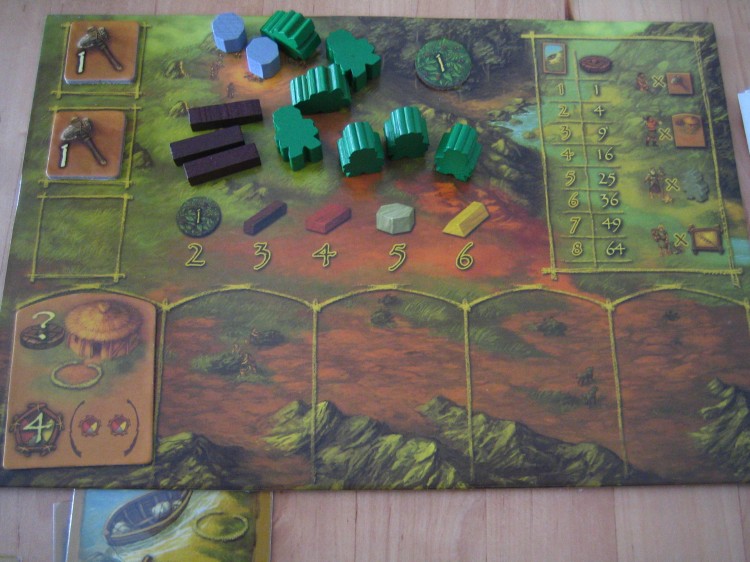
The gameboard, from the east angle. The top half of the board are the locations for resources - hunting ground for food (the round chips), forest for wood, clay pit for bricks, quarry for stone (they look blue but they are actually grey) and river for gold. At the centre and left of the board are the farming spot (occupied by a blue worker), the baby-making spot (occupied by 2 blue lovers), and the toolmaker spot (occupied by a red worker). At the bottom are the spots for huts and cards. On the left, just inside of the score track, is the farm level track. Green has progressed to Level 1, but the rest are still at zero.

So in summary, babies and tools help you gain more resources, farms help reduce the "maintenance cost" of your tribe, and huts and cards are how you score points. The cards reward you for being strong in specific aspects. E.g. cards with builders score points based on number of builders multiplied by the number of huts you have. So if you have many builders and many huts, you will score a lot. Cards with civilisation symbols score based on the number of different civilisation icons squared. So the more you have the better. You are rewarded for specialisation. During the game you can easily see what your opponents want, and you need to decide between helping yourself and denying them.

The player board. You keep your people and resources here. On the left are 3 spots for you to keep your tools. At the bottom are spots for your huts. They are not a hard limit. You can stack your huts if you get more than five. At the centre the value of the resources are listed. The table on the right is a reference for end-game scoring.

The game ends when either one of the stacks of huts runs out, or the card deck runs out. So the players have some control over it. If you want to game to end sooner, try to claim more cards or claim the last few huts from the smallest stack.

The Play

In the two games that I played with Chung, Ben and Moh Yen, the hottest spots were usually the farm spot, the baby spot (love shack) and the tool spot, roughly in that order. These are the things that improve your infrastructure. Sometimes the card spots were competed fiercely, when the right cards came up. The game could be played quite quickly, because many actions could be taken simultaneously by the players, without strictly following the procedure as described in the rules.

Red and blue in a gold rush.

In the first game that we played I won by a big margin, because it was the first time for everyone else in playing worker placement games. I had a lot of civilisation icons which gave me a lot of points. Also during the game there were a few times when I made use of the "up to 7 resources" huts to sell a lot of gold bars, and noone stopped me. In the second game the scores were closer. Chung focused on a hut + builder strategy and gained 72pts for that. He also had a high in-game score, i.e. he sold a lot of resources during the game. Ben did well in two end-game scoring categories, but his in-game scoring was poor. I took quite many cards and did moderately well in four end-game scoring categories. By quantity, as opposed to quality, I managed to overtake Chung to win the game.

The Thoughts

I liked Stone Age more than I had expected to. The game is smooth and easy to teach. It is a very good game to introduce non-gamers or casual gamers to worker placement games, or even the modern Eurogames or the boardgame hobby as a whole. There is strategy and competition, so this is by no means a too simple game for veteran gamers. The worker placement mechanism creates a lot of competition among the players. You need to watch what your opponents want. The dice can spoil your plan sometimes, but you roll dice so much that luck evens out somewhat. Also you do have the tools to help mitigate the risk of bad die rolls.

Monday, 27 September 2010

Dixit

The Game

Dixit. Spiel des Jahres winner of 2010 (Game of the Year award in Germany). It's something very different from past winners. It's a party game, a social game. When I made a rule summary for the game, there was so much space left on the half page space that I normally use for rule summaries, that I had to enlarge the font to make it look less empty. So the game is one with very simple rules, but the actual playing turns out to be not that straight-forward, and there is a lot of freedom for the players to use their creativity.

Here's how the game works. Everyone gets 6 cards. Every card in the game is a unique drawing, often with a few different elements. Every round one player takes the role of the Storyteller. He picks one card from his hand secretly and says a word, a phrase, a sentence, or even tells a whole story. Every other player then picks a card from their hands to give to the Storyteller. The Storytellers shuffles all cards and then reveal them. Now all other players try to guess the Storyteller's card.

If everyone guesses right, or everyone guesses wrong, the Storyteller gains no points and everyone else gains 2pts. If some guesses right and some not, then the Storyteller and the correct guessers gain 3pts. Non-Storyteller players whose cards are chosen gain 1pt. So the Storyteller wants to make his riddle not too easy and not too difficult. The other players want to guess the correct card, and also wants to pick a card from their hand that others will guess. This can sometimes make it quite a challenge to guess the right card, when all the card revealed seem to match the clue given by the Storyteller.

The box is nice and is used as a score track.

I love the artwork. The artist is a very pretty French lady.

The Play

I played a four-player game with Ben, Chung and Moh Yen. It was the first time for all of us. We didn't do any fancy stories, and mostly did single words, or phrases, or names. Chung was pretty good at making the right guesses, and took the lead throughout the game. I think he read us very well. Some interesting situations came up, e.g. when Chung picked the name of a colleague whom only Ben and Moh Yen knew. I had no idea who Greg was or what he was well known for. I could only randomly pick a card from my hand. When all cards were revealed, 3 out of 4 had musical notes or musical elements. Obviously Greg was a musician or composer. They could easily tell which was the card I contributed. But I almost made the right guess too. In another situation the clue was the name of the Hong Kong governor. They all live in Hong Kong and know about the local politics, but I had no idea about this guy. However in that round I actually made the right guess, whereas not all the rest did. I picked the card with an anchor icon, because that meant port, and Hong Kong being an important port, its governor probably was involved in some controversial policy related to the port. It turned out that this wasn't the reason, so although I had a solid reasoning, it was luck that won me the 3pts, not reasoning.

There were a few rounds in which one card matched the clue very very closely. It matched so well that it felt overly obvious. The Storyteller should not have made the clue so obvious. But then maybe that was intentional, sowing doubt in the other players, thus making some of them boldly make the right guess and some conservatively make the wrong guess. There was a bit of psychology in there.

Often when a round concluded it was fun to ask the Storyteller how the clue related to the card selected. It was also fun to ask the wrong guesser (or even the correct ones) why they picked those specific wrong (or right) cards.

The Thoughts

Dixit is a game that is easy to teach, and can be played with casual players. I think it is better with more players, at least 5. It gives a lot of freedom to the players to create their own fun. The clues can be silly, humourous or completely crazy. They can also draw from the group's past experiences or shared in-jokes. If you want to, there's nothing stopping you from making your clue a poem, a song, or even a scene acted out.

It is possible to make use of knowledge that only some players have as your strategy, but I feel it is not good because the players who do not share the knowledge will feel left out. I was a victim of this strategy in the game we played. I prefer the clues to be based on something that everyone has an equal chance of guessing. E.g. some abstract concept that everyone can try to associate with the particular drawing.

Calling Dixit a party game may be a little unfair, because sometimes people tend to think of party games as quite mindless and chaotic. Dixit requires a bit of thought in coming up with an interesting clue. If played mindlessly it would not be much fun. It would defeat the whole purpose.

Sunday, 26 September 2010

boardgame marathon in Hong Kong

I recently visited Hong Kong on holiday. The main agenda was Disneyland, for the children, but I also planned to catch up with some old friends. My old friends - Chung and Ben - are not regular gamers, but Ben had bought a bunch of games from China on a business trip, and never sat down to read the rules or play them. So while I was there, we had a gaming marathon, going through many of his games.

Over the course of four days, we had a total of 33 plays (mostly on the weekend) of 10 different games. We played: Carcassonne x1, Dixit x1, Stone Age x2, Cash-a-Catch x3, Pandemic x13, Battle Line x3, Pick Picknic x4, Lost Cities: the Boardgame x2 (but I taught them the Keltis rules), Agricola x1, Lost Cities x3.

Dixit box, which is also used as a score track. This version uses discs instead of wooden rabbits as scoring markers. I think I would prefer the rabbits. I kept forgetting which disc was mine.

Some of the cards from Dixit.

Since Chung and Ben (and Moh Yen who also joined us for some of the games) are not gamers, most of the games that we played were light to medium-complexity games. I normally like heavier Eurogames, but I found that I had a lot of fun anyway, because of the company. It amazed me a little. I had thought I was a more game-centric person than a company-centric person, i.e. the games being played were more important that the people I played with in determining how much I enjoyed myself. I had a fantastic time playing with my old friends. We made a lot of silly jokes, just like the old days. It was like going back in time to when we were still students. We had a lot of fun.

I realised that from all the games played, only 2 were completely new to me - Dixit and Stone Age. I had thought I would have played more new games. There were some games that Ben had thought about bringing but eventually did not, e.g. Pack & Stack (which I have not played before). I'm pretty sure Chung's favourite was Pandemic. He kept asking to try it again and again. We started at easy level and eventually made it to hard level, and winning too. However so far the hard level wins had been with 2 players (easier to win than with more players), and had been with the more powerful combination of roles - Medic + Dispatcher and Researcher + Scientist. Next time we need to try with 3 players, and with other combinations. Maybe even add the expansion On the Brink.

I realised why Stone Age is so popular. It's good for casual players. It is relatively easy to learn, compared to other worker placement games. It clicks quite quickly. We played it twice, and even in the first game they were starting to strategise and explore the various possibilities. So Stone Age is a good gateway game, in that it is not too difficult to learn, and at the same time it is interesting enough to make the new players want to explore it.

Stone Age.

Personal player board of Stone Age.

The gold mine was fully occupied.

Throwing three 1's in Stone Age is very very very bad. I thought it was Ben who had this, but he said it wasn't him. I don't think it was me. Must be Chung then.

We did Agricola too, which they both found a bit complex. Good thing I only taught them the family game with no Minor Improvements and no Occupations. While I was explaining the rules, I found that they were approaching the verge of giving up. So I suggested to just get started and play a few rounds, and see whether they liked it. If they didn't we could stop. If they wanted to restart we could do that too. Eventually the whole game went by with no objections or pauses. I think they were probably a little surprised that although I won, it wasn't by any big margin. They probably still felt the game was a little complex. I doubt they'll play this again by themselves, at least not without a few more times of guided plays.

Ghost Stories was a game that we gave up on. Ben was keen to play it because of the theme. However after I had explained 80% of the rules, they felt it was too much, and we decided to give up. The time being 1:30am didn't help either. We had expected to be playing until much later than that, maybe not throughout the night, but probably until 4am or so. However after teaching 80% of Ghost Stories, we all felt sleepy, and decided to call it a night. Ben and I had two short games of Battle Line before bedtime. I think it was a good thing that we didn't try to push ahead with Ghost Stories. I think we would not have enjoyed ourselves.

Battle Line. We didn't play with the special cards, because I didn't know the rules for those.

Cash-a-Catch was a lot of fun. We got so excited that many times someone bought a batch of fish that he (or she!) didn't need at all. Needless to say, laughter ensued. And somehow Ben managed to end up with less money than when he started the game! We all teased him that he sucked at selling fish. Better stick to your day job Ben. Pick Picknic was hilarious too. Lots of cheers when a fox caught many chickens, or a single chicken unexpectedly managed to claim a huge pile of corn. Chung (I think it was him) invented a Cantonese term for the fast fowl (value -2) which I thought was very appropriate: "走鸡". Literal translation is "the chicken than ran away", and in Cantonese this phrase usually means to miss an opportunity.

Ben, me, Chung and Moh Yen playing Cash-a-Catch.

We had to make a rule that all hands must be off the table when the auction started, so that noone had any unfair advantage in reaching for the bell.

Pick Picknic.

Another game we thought about playing but didn't was Race for the Galaxy. I was reluctant to teach this, as I thought they might find it overwhelming. However Ben was interested, so we took the game out. However when sorting out the cards, we found that there were some cards missing. We couldn't complete the recommended starting hands. Probably a defective deck. So we put the game away.

We had one game of Lost Cities between Chung and I when both of us scored negative points! Sometimes we get rather competitive. Our second game of Stone Age was pretty tense too. It was a 3 player game - Ben, Chung and I. By our second game we all had some idea what to do, so the competition was more intense. After that tense game we decided we needed to switch to a cooperative game (Pandemic).

Cards from Lost Cities: the Boardgame.

Lost Cities: the Boardgame. They liked this enough that we played twice. I prefer the Keltis artwork and rules.

Pandemic. Asia is in trouble. These are not high-rise buildings. These are diseases.

I had a wonderful time playing with my old friends. Some people may question: you flew all the way to Hong Kong and spent a weekend playing boardgames?! I say quality time spent with friends is not measured by what you do, but how much fun you had.