Sunday, 25 September 2011

the new old town

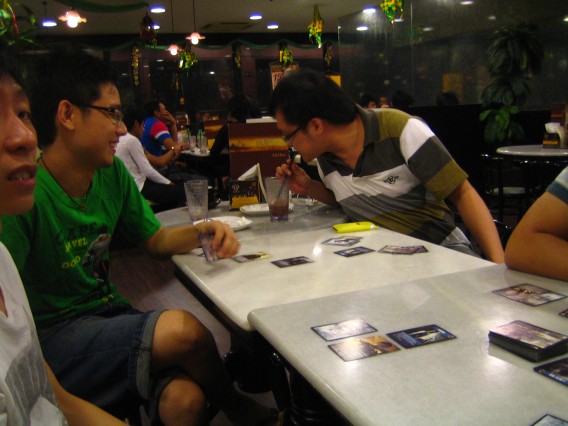
Jeff, who has been hosting open gaming sessions at Old Town Kopitiam, Cheras, (Kuala Lumpur, Malaysia) has been doing so since 2007. Old Town is just a regular food and beverage franchise, where some customers sit down with their laptops for hours over coffee while enjoying high-speed WiFi anyway, and they don't mind boardgamers playing games there. 2007 was the same year that I started blogging about boardgames. I read about Jeff's open gaming sessions on the net, but since I more or less regularly played at home, I didn't join them, although I live quite near Old Town. I still remember the first time I met Jeff in person was when I happened to be at Old Town on a Friday night with some (non boardgaming) friends, and the Old Town gamers were playing Le Havre. So that's probably early or mid 2009. Only in Sep 2009 I joined them for the first time, because I wanted to meet Afif, and also to play a 5-player game of Automobile (I had played the game before, but not with five). Since then, I visited them now and then. Not really regularly, since I still mostly played at home (or at Allen's home, which is nearby), but I kept in touch.

On this year's Malaysia Day (16 Sep 2011), Jeff launched his new location. Technically, I should say his own new location. It's called OTK Cheras, which is probably going to be confusing. We should now refer to the old place as Old Town, and the new place as OTK. OTK is very near Old Town. I couldn't attend their first open gaming session, but managed to make it to the second one. There were many more gamers than usual, maybe because of the 20% off first-visit discount, heh heh. There were five tables with games going. The new place can accommodate 9 tables comfortably. There are two shelves for Jeff's game collection, and one shelf for the games he sells. My www.boardgamegeek.com username is on one of the walls, woohoo!

If you live in Kuala Lumpur or visit Kuala Lumpur, pay them a visit. Details here. The Friday open gaming sessions are free. No food or drinks served though (at least for now).

23 Sep 2011. OTK Cheras. Photo taken from the back corner. Two regular tables in the foreground, two low tables right behind them, and one big table in the background. That shelf in the background is one of two shelves for Jeff's game collection.

Another photo taken from the other back corner. There is still some unutilised space in the foreground. Those guys standing in the background were playing Railroad Tycoon / Railways of the World, which has a huge gameboard. That's why they needed to stand up. Right at the centre you can see two display shelves. Through the display shelf on the left, you can see a game shelf far in the background. That's the other shelf containing Jeff's collection. Through the display shelf on the right, you can see the glass door of the entrance. On the right is the shelf for games for sale.

This is the shelf for the games for sale. It reminds me of National Geographic.

One section of the wall at the inner corner. These are some of the activities that Jeff and team are involved in.

Photo taken from one of the front corners. The low table on the right is normally used for children activities. This evening we had four veteran gamers playing an 18XX game. Definitely not for children. Before you read too much into this, 18XX games are complex games about railways in the 19th century. Just in case you didn't know.

This is the front section of OTK. On the right is the big table. On the left, one of the shelves holding Jeff's collection. At the risk of inciting burglary, I'm going to point out that he has a still-in-shrink-wrap copy of Axis & Allies Anniversary Edition, right at the top right corner.

Sunday, 18 September 2011

Havoc: The Hundred Years War

Plays: 5Px1.

The Game

Havoc is an out-of-print card game from a small publisher which should be considered for a Kickstarter project to get it back in print. It can be summarised as a Poker game fleshed out to have long-term strategic planning and to reward skillful play more. In a game, there are nine battles to be fought over, each rewarding different numbers of players different amounts of victory points (VP). Every player starts with a hand of cards. Prior to each battle, there are a few rounds of drawing cards done generally in the format of drawing two and returning one, until someone starts the battle. Every player can decide whether to participate in a battle, playing cards if they do. If you participate, you must commit at least two cards, and in each battle round you can gradually add cards until you have six, or you can hold and not play any more cards. Once noone wants to play any more cards, the strengths of the card sets played are compared, and the strongest set (or sets) gain points for that battle being fought.

The row of cards are the battles to be fought. Most battles have 2 or 3 victors. Agincourt only has one. The last battle has five. The biggest victor takes the card, while the 2nd and 3rd placed victors take the small tiles. The number of battle cards is a tiebreaker.

Since the maximum number of cards in a set is six, the way strength is determined is a little different from Poker, but is very similar. The cards come in six suits and are numbered 1 to 18. There are some special 0 value cards which can be a joker suit (i.e. can be part of a Flush) but cannot be part of any Straight. These 0 cards are Dogs of War and can be used to pick up used cards after each battle.

The 0 white card is a Dogs of War card. The text on the cards are just flavour text, with no impact to gameplay.

Throughout the game there will be many rounds of picking cards up, interspersed with battles, when cards will then be spent by participating players. When picking cards, there can be up to four face-up cards to pick from, and there's always the option to draw from the draw deck. If a card good for you is face-up, you can happily take it, but it also means your opponents know what you have taken and they may guess what kind of set you are trying to make.

Deciding whether to participate in a battle can be a very difficult decision. Battles are costly and you definitely cannot afford to participate in every battle. However you also don't want to let your opponents win easy victories. It's tricky to decide when to commit and when to conserve your cards.

The Play

I did a 5-player game at Old Town Kopitiam Cheras with Jeff, Wai Yan, Ang and Dennis, this being my first game. I was conservative and skipped the first few battles, hoping to collect more cards in order to be able to make stronger sets and plan better. Wai Yan participated in many battles and did so early. In the first battle that I participated in, I went head-to-head with Ang, who was also a first-timer and had also been hoarding cards. Unfortunately my card set was not as strong as his, so this battle was expensive for me. For him too, but at least he earned a big reward.

I accumulated so many cards that I had difficulty holding them.

There is a lot of bluffing in the game. Everyone's resources are limited, and generally there is a reluctance to participate in battles, especially those with too many contenders. You may spend many cards and gain nothing. Sometimes the first participant can intimidate others into declining to fight by playing some strong cards early. During a battle, when participants are adding one card after another, there are often many tough call to make. Often every card played is a painful decision, because you don't really get that many cards throughout the game. You are risking spending more cards, when the rewards are uncertain. Because of this mentality of trying to conserve your strength all the time, there are many opportunities to bluff, to encourage your opponents to "cut their losses".

Card counting is definitely going to help in this game. The more you remember, the easier it is for you to make decisions. This aspect may turn off some who don't like a memory element in games. It is not necessary to work very hard on remembering cards in order to enjoy the game. In fact it might feel like work if you try too hard. There is no need to be overly competitive. Having some general idea of cards that have appeared is sufficient to enjoy the game. E.g. if an opponent has picked up many 16's, he may be saving up for 5 of a kind or 6 of a kind for the final battle. You can tell a lot from what cards your opponents pick up.

The Thoughts

Strictly speaking, the game is abstract, but the theme of the Hundred Years War fits very well with the feelings that you experience when playing the game. There is a lot of tension. You need to pick your fights. You need to conserve your strength and spend your cards wisely. There is a constant conflict between short-term easy wins and long-term big wins. You are constantly forced to make difficult decisions. The final battle is almost a little anti-climatic, because by then you simply play the best set that you have. It is the culmination of the long-term planning that you have been doing throughout the game, and hopefully what you have saved up can beat the rest. Or maybe you have deliberately given up on the last battle and have spent your strength to win many earlier battles. That is certainly a viable strategy.

Havoc is a meaty Poker game. I wouldn't call it a glorified Poker game. It is much more than that. It gives a rich story arc and long-term planning to Poker. I am impressed.

Wednesday, 14 September 2011

The Message: Emissary Crisis

Plays: 8Px5?.

I received The Message: Emissary Crisis as a gift from Yoyo of Swan Panasia / Witch House (Taiwan), who is a distributor of the game. I have heard of this game before. It was originally published as a Chinese language game in China, and was based on a spy movie The Message (风声). The English version seems to differ a little, e.g. some characters available are different, but the core game is the same. I normally don't pay much attention to secret identity team games, since I rarely play in big groups, which is usually the best way to play such games. I brought the game to Old Town Kopitiam Cheras to try it out, since the open gaming sessions there organised by Jeff usually have more players. To my surprise, we had so much fun that I lost track of how many games we played, and I lost track of time. It was way beyond my curfew time when I left for home. Thankfully my wife didn't have durian husks waiting for me (to kneel on) by the time I reached home.

Box cover.

The Game

At the start of a game, everyone gets dealt a character card and an identity card. The character card tells you what special powers you have. The identity card is kept secret. It tells you whether you're in a team (red or blue) or you're a lone ranger. The teams win by having one of their team members collect three messages in the colour of their team. The loners win as individuals by completing the missions stated on their character cards (which can be secret or public, depending on the character being played). The core premise of the game is, of course, that you don't know who your enemies and your friends are. You need to work that out, because it will help you stop your opponents and it will likely be necessary to help you (or your team) win.

Some of the character cards. Those with an "S" in the top right corner are special characters, which are initially face-down, i.e. secret.

Identity cards. KDR is the red team, FRS the blue team, and MOF are the loners.

At the start of your turn, you draw two cards. Then you can play cards (and others can too). Before you end your turn, you must transmit one message. A card can be used in one of two ways. If used for its special effect, only the card text matters. If used as a message, only the colour and transmission method matter. When transmitting a message, you must follow the transmission method stated on the card. There are three methods. (1) Pass the message face-down and anti-clockwise, until someone accepts it and places it in front of him. If noone wants the message and it comes back to you, you must accept it and place it in front of you. (2) Ditto, except the message is transmitted face-up. (3) Pass the message face-down and directly to any other player. If he rejects it, it comes back to you and you must accept it.

So every turn there will be at least one new message introduced. It may let one of the teams get closer to victory if it is red or blue. It may make a player get closer to elimination, because once you get three black messages, you are eliminated. Both of these possibilities gradually build up the tension. Also, as the game progresses, players will gradually have better ideas of who is friend and who is foe. It becomes a race to reach the victory condition, sometimes relying on people you only half trust. Are you being deceived? Should you go with your gut feel?

The many cards in the game are different combinations of the 3 colours, the 3 transmission methods, and only 9 card effects. Many card effects are related to messages, e.g. Decode lets you see the message before you decide whether to accept it, Lock On lets you force another player to accept messages, Intercept lets you snatch an in-flight message, Transfer lets you redirect a message to another player. There's a Prove card that you can play on another player to force him to take certain actions depending on his identity. There's a Counteract card that can cancel any other card effect. All these cards are tools to help you achieve victory. Just be careful who you use them on.

Some of the game cards. The icons in the top right corner dictate the transmission method if they are used as messages.

The Play

We did quite a number of 8-player games - Jeff, Wai Yan, Dennis, Ang, Caleb, Ken, Joshua and I. Here are some specific moments I remember.

  • Somehow Dennis was wearing a big red target most of the time. For a number of games he was the first to get eliminated. In one of the games, his mission (which would apply only if he was MOF, i.e. a loner) was to have two other players die. He announced that, and everyone thought the safest way to stop him from winning (just in case he was MOF) was to kill him. I don't remember whether he was MOF.
  • Dennis transmitted a face-down message. Ang was the first player sitting on his right and thus received the message first. He used a Decode card to peek at the message. Ang was obviously shocked, and hurriedly declined the message and passed it on. The whole table started laughing, and of course noone wanted the message, which went full circle back to Dennis. Dennis must accept the message, which was of course a black message, i.e. strike one towards getting eliminated. Dennis declared that this game was not recommended for people with no poker face.

    Ang and Dennis.

  • In one game, Caleb had it all sorted out. He knew who was on his team, and confidently transmitted a blue message to his teammate who already had two blue messages. Noone could stop him, and the blue team won. Caleb cheered and flipped over his identity card. It was a red team card! What the.... ?!!! He had confused his identity with that in the previous game!

    Caleb and Jeff.

  • In another game, I more or less worked out that Wai Yan and Joshua were my enemies, and Ang was my teammate. I was on the blue team and already had two blue messages. On Ken's turn, he transmitted a face-down message directly to me, gave me a meaningful look, and said something to the effect of "you know what to do". My hunch was he was my teammate, and we were going to win! Suddenly Ang played Intercept to grab that message. He had thought it was a black message so he decided to "take a bullet" for me. It was a heroic act. When he flipped over the message and found it to be blue, that look on his face was priceless. He looked up at me. I was speechless. Ken was speechless. By then, everyone knew that the three of us were on the blue team. We struggled on for a few more turns, but eventually lost the game. I was eliminated. Joshua was MOF and he won, which was no easy feat.

    Half of Joshua, Ken, and Caleb.

We were quite a rowdy crowd, and if we were at some other venue we would probably be asked to leave or at least to tone down.

Only black cards in my hand. Should I try to get someone killed?

The Thoughts

The Message is a game where you play-the-players more than you play-the-game, if that makes sense. The rules are simple, once you get past the poor writing. This is one game that needs to be translated from English to English. Here's my translation. I'm not 100% sure it is accurate and complete, but it is playable and definitely much easier to understand. In this game, you need to pay attention and be fully involved, so that you don't miss any small gesture or any subtle hint. It works well in a big group despite having to wait a long time for your turn, because many cards can be played and many abilities can be used on others' turns, and you need to be paying attention to what others are doing all the time.

This is a game that is good for playing with new friends. You will get to know them better. The game has direct player interaction, not of the type where you kill your opponents' soldiers or where you rob them of their hard-earned money, but of the type where you have to make direct eye contact, you have to observe their every move, you have to read their minds, and you have to discuss, persuade and perhaps even lie. I like how simple the game is, which allows the play-the-players aspect to come to the forefront.

If teaching new players, I recommend playing the game at least 3 times. Games can go quite fast so new players may not grasp what's going on in the first game. Once the players become comfortable with the rules, and shift to the play-the-players mode, the game starts to shine.

I have not played Shadow Hunters, Bang, Coach Ride to Devil's Castle or The Resistance, which share many similarities with The Message and may have influenced its design, so I can't comment on them. I'm happy to have The Message in my collection. It's a good game to bring out when you have 6 to 9 players. Officially the game supports 3 to 9 players, but I think you need at least 6 for it to be good.

Sunday, 11 September 2011

Illuminati (Deluxe Edition)

Plays: 3Px1.

The Game

In Illuminati you play a secret organisation (or Illuminati) trying to take over the world by spreading your influence via various groups (which can be organisations, communities, political parties, etc). You start the game as a rich and powerful but lonely organisation. You gradually gain control of groups to add to your power structure, which will grow like a tree, spreading in all directions. You use the groups under your control to further spread your influence, further growing your power structure. Your groups have various characteristics and abilities which make them useful in different ways. You win the game by being the first player to control a certain number of groups, or by completing the special victory condition of the Illuminati group that you are playing.

Every turn a card is drawn from the deck. If it is a group it is added to the pool of groups that players can recruit. You can try to control these neutral groups. You can try to attack groups controlled by others. If you succeed, any puppet groups controlled by the targeted group come with it to join your power structure. So attacking another player can be very lucrative. If the circumstances are not so conducive for taking over an opponent's group, you can try to neutralise it (send it back to the uncontrolled pool), or even destroy it completely. The ways to calculate the odds for these three types of attacks (to control, neutralise or destroy) differ. E.g. it is easier to use a Liberal group to control another Liberal group because they have the same ideology; it is easier for a Peaceful group to destroy a Violent group because they are opposites.

Your groups earn money for you every round, and money is used to boost attack or defense. You need to decide whether to spend it on offense, or to keep some for defense on your opponents' turns. You need to move your money around, because each group can only use the money on its card, the exception being that money on the Illuminati card can always be used.

Players can trade and can support one another in attacks or in defense. So there can be some temporary alliances. It is even possible to negotiate joint victories, if the players involved can achieve victory at the same time.

Illuminati cards, i.e. the HQ, have black backgrounds (The Discordian Society, top right). To control another group, a card must use an outward pointing arrow. See how each pair of cards is linked by matching arrows. The characteristics and special abilities of each group are written on the cards.

A further expanded evil empire. Money is placed on the cards themselves. In preparation for the next round, I placed the income for the next round beside the cards. Cards have fixed income.

The Play

Han, Allen and I did a 3-player game, which is less than ideal. The recommended number of players is 4 to 6. My Illuminati's special victory condition was to control 5 Weird groups (like Trekkies). They were supposed to be rare, but somehow many appeared in our game, making my life much easier. Did I not shuffle the cards properly?

Groups closer to the core of the power structures (i.e. closer to the Illuminati) have stronger defense against attacks, but I find that the defense bonus isn't really that big. That means everyone still has to watch out for attacks against these groups, especially considering they likely have puppets attached to them. So during our game, we had to be on our toes all the time, watching out for attacks. I find that money is very important, in both attack and defense, which means earning money and moving money to where it is needed are very important.

In our game we mostly attacked to control, and did not attack to neutralise or attack to destroy much. The latter two can be easier to do, and they will result in pushing the victim back, while the attacker gains nothing. I wonder whether this will cause some games to drag on and on. Attacking to control is still more attractive to attackers, because the attackers will gain something if they succeed, so maybe this will prevent games from dragging.

Attacks are resolved by rolling two dice. Quite a number of factors need to be considered to calculate the odds, but they are all straight-forward. Rolling 11 or 12 are auto-failures, which means no attacks are 100% guaranteed, no matter how much extra money you spend. In our game there was one such unlucky attack was made by Han, targeting one of my groups. We had both spent a lot of money on this, but he was much richer and outspent me by a mile. I muttered "eleven" just as he rolled, and to my surprise (and his dismay), he rolled 11! Maybe I have some untapped superpower. Had the attack been successful, it would have set me back a lot, because I would have lost a sigfinicant sub-tree of my power structure. Soon after that, I quickly gained control of two uncontrolled Weird groups, and achieved my special victory condition. At that time all of us had about 7 or 8 groups, which is slightly over halfway to the target of 13 groups.

The Thoughts

It is interesting to plan and to grow your evil empire. The theme is quite fun, and I find many groups in the game quite humourous and relevant. Gameplay is aggressive, and players always need to watch out for attacks. The rise and fall of the evil empires are fluid. You can gain and lose many groups very quickly. There is much player interaction, as players fight each other for control over various groups. Players try to gang up on the perceived leader, trailing players try to help each other out to catch up.

The game is simple and light-hearted. I enjoy the unusual and rich theme. This is one good simple Ameritrash game to play when you need to take a break from Eurogames which sometimes just feel bland and too similar to one another. Illuminati was first published in 1983, close to 30 years ago, which is impressive. I don't think the game has aged much. It is still very relevant, and still a good game compared to recently published games.

Friday, 9 September 2011

Giro d'Italia

Plays: 3Px1.

The Game

Giro d'Italia is a card game about competitive cycling. Each player controls one or more cyclists. The game is played over a fixed number of rounds. Whoever's cyclist is furthest in front by game end wins.

The game is a little abstracted, but many aspects of a cycling race are represented. A peloton card represents the main group of cyclists who cycle close to each other to save energy. You need to spend extra energy to break away from the peloton, but once you're on your own, you'll be spending more energy. If you don't cycle fast enough, e.g. when lacking energy, the peloton may catch up and you'll be absorbed back into it, wasting your previous effort.

Every cyclist starts with the same amount of energy, so conserving energy and using it at the right times are important. The race course has uphill, downhill and flat sections. Some cyclists do better when going uphill, some when on flat land, and some are generalists who do moderately well on both terrain. Slopes are dangerous and if you cycle faster than a certain limit, you may fall, or get exhausted, or even get a puncture.

The row of pink backed cards in the centre are an abstract representation of the race track, it's main purpose being to mark the relative positions of the cyclists and the petolon, who race around this rectangle. There are now two cyclists that have broken off from the petolon. The four horizontally placed cards are also a representation of the race track, focusing on terrain. The race track starts with flat land (green), followed by a downhill slope (black) and another flat stretch, and finally ending with an uphill slope (red). The numbers on these cards represent distance, and also determine the number of rounds to be played, which is 10 here (3+3+2+2).

The Play

I have only played one game, and I'm not entirely sure I got all the rules right. I definitely made a mistake with the event cards, making accidents less likely than they should be.

In our 3-player game, Han, Allen and I each controlled two cyclists. We broke away from the peloton quite frequently and early, just because we wanted to see what would happen. It turned out to be not such a good idea, as cycling fans (obviously I'm not one) would already know. Our cyclists fell or were eventually caught up by the peloton. In the end it was one of my cyclists, a climber who had never broken away from the peloton and thus had conserved most energy, who broke away in the last round to win the race.

The Thoughts

My first game was definitely more an experiment than a game, trying to learn how the game system works. I find that the game is mostly open information, the uncertainty being only the speed of the peloton every round (but there are only 3 possible outcomes), and whether an accident happens when you speed uphill or downhill (but you know the odds are about half). So you actually have much control. You decide how much risk you want to take. Being a mostly open-information game, the game becames one of trying to outmanoeuvre your opponents, taking into account all the factors that affect your cyclists, e.g. which player is controlling the peloton, the current and upcoming terrain, how tired your opponents are, and the positions of every cyclist.

Slipstreaming is interesting. If your cyclist is exactly behind another, he gets an extra move next round. However being one step behind means it is more likely for the peloton to catch you. Tricky decision. This game has educated me on competitive cycling.

The rules are a little disorganised and I should look up www.boardgamegeek.com to clarify some points before I play again, to make sure I don't miss anything.

Monday, 5 September 2011

boardgaming in photos

26 Aug 2011. I have played Innovation with the Echoes of the Past expansion twice now. It adds a number of new concepts. Setup is a little troublesome, because depending on the number of players, a specific number of old and new cards are randomly picked to form the card decks. This also means some cards will not appear at all.

Novel is a new card, and it shows some of the new concepts. The brown circle is a bonus. As long as a bonus icon is showing, it adds to your score. If you have multiple bonus icons, only the highest valued icon counts as the face value, the rest count as 1pt each.

The empty square with the text "Draw a 3" is an Echo effect. When you Dogma this card, you execute all visible Echo effects in the stack. This means in future when your stack is Splayed and there are older Echo effects showing, this stack can be very powerful.

I absolutely love this new reference sheet. It lists all the criteria for the Special Achievements. There are 5 new Special Achievements in the expansion, and all Special Achievements old and new are in play every game. This reference sheet also lists the number of cards to be used when setting up the game, and the number of Achievements required to win, for different numbers of players.

Allen, Han and Alvin. Four of us played Innovation with Echoes of the Past at Old Town Kopitiam Cheras.

I'm not sure yet what I think of the expansion. More plays are needed. At the moment I still feel a little overwhelmed by it. At the moment I think I prefer the simplicity of the base game, but I'm not sure I won't enjoy the more possibilities in the expansion after I am able to digest it better.

27 Aug 2011. Race for the Galaxy with all 3 expansions. Michelle's Terraforming Guild (top row, 3rd card) gave her 22pts! She had ten windfall worlds (top left icon on card is a white circle with a coloured halo)! She scored 63pts for this tableau. I managed to beat her with a military tableau (78pts), but none of my cards had 22pts.

31 Aug 2011. 51st State. As I previously half-expected, I bought the game. From Han. Having played a few more games, the game is still quite solitairish, but it's still fun to work my tableau in the game. I guess I simply like such Race for the Galaxy-like games, and 51st State is different enough to feel fresh. I think there is more luck in 51st State than Race for the Galaxy, but the aspect of make-do-with-what-you-get is just as fun.

1 Sep 2011. Ice Flow. This is Allen's copy which he had not played before. I taught him and Han to play, since I have played the game before. This is a team race game where you need to get your three explorers to cross the Bering Strait. This was an award winner at a UK game show.

The game is very much about making sure you are able to pick up enough resources (rope and fish) to last you through the race. Rope is used to climb ridges and to fish. Eating fish lets you swim short distances and also you can also use fish to distract polar bears. The game is a little puzzle-like in that you always to try find the best move and try to set up good moves for your next turns. Han (yellow) won the game comfortably and neither Allen (red) nor I (grey) could stop him.

4 Sep 2011. Nightfall again. I have been playing many card games lately. On one particular turn I had this many minions in play (all except the action card in the lower right)! Most of them were the weaker starting minions, but still it was fun to see so many in play.

Han, Allen and I played 2 games back-to-back. In both games both of them were obsessed with Big Ghost, a very powerful attacker (attack value 5). It was very scary to see Big Ghost in play. However in one game my Ivan Radinsky more or less neutralised Big Ghost by putting it back into its owner's draw deck, and in the other game Han had a card that defeated it before it could attack. So in a way Big Ghost is bad, simply because it attracts too much attention. But of course if it manages to attack, it will likely be devastating.

That finger (of Han's) pointing at me looks like a scheming finger saying, "Attack him! He's strong!"

I have played four games now, and most of the time my strategy is to just buy cards that can chain. So far I am not yet seeing specific combinations of card abilities that create very interesting synergies like in Dominion. Mostly I'm seeing that good card colour combinations allow long powerful chains. I do see how some card abilities neutralise the abilities of other cards, which is interesting. Diplomacy, negotiations and deceit (pretending to be weak) remain important. Timing and pace are important, much like Dominion but not exactly in the same way. You need to watch when the Wounds will run out. You need to make the most of your attacking minions before that. No point building up a super deck which will start being effective only when the game is about to end. I think Han is planning to get the expansion. That'll help to fill up some of the remaining 70% of the game box, heh heh...

Sunday, 4 September 2011

Power Grid expansions marathon

I recently purchased three Power Grid expansions from Jeff (a.k.a. CK), and over the Hari Raya (Eid ul-Fitr) holidays, Michelle and I played through all six of the maps. We also played the Power Grid Promo Cards Set, which Allen gave to me. He acquired two sets when he bought stuff from www.boardgamegeek.com. In all games we used Variant 3 of the Power Grid Power Plant Deck 2 expansion. In this variant, six big plants are added to the deck, and the number of connected cities required to end the game is increased from 21 to 24 (for 2-player games). Since I usually only play Power Grid as a 2-player game against Michelle, I think in future we will always use this variant. Here's our journey to some exotic (to us) parts of the world. How many people can boast visiting 7 countries in one week?

Korea. What's unique is there are two resource markets, and every round you can choose to buy from only one of them. I lost this game due to resource dependency. I had a big nuclear plant, which meant I needed to buy from the South Korean market. However I also depended on coal and garbage. In the final round, no matter what I did, Michelle could starve me of either coal or garbage by buying up more than she needed, and I wouldn't be able to power all my plants. In hindsight, I could have connected to fewer cities in the previous round so that I had priority in buying resources in the final round; I could have stored resources (especially uranium) so that I wouldn't be so stuck. One thing I like about Power Grid is whenever I lose, I can usually look back and tell what I have done wrong and how I could have done better.

Yellow houses block off areas that are out of play.

We started close. Michelle was red and I was green. We established a frontline and marked our territories like tomcats from the early game.

We visited Seoul some years ago and were lucky to be there during the cherry blossom season (about one to two weeks in a year). I enjoyed visiting the folk village near Suwon too.

China. What's unique here is a planned economy, where for the first two thirds of the game the power plants appear in a strict ascending order. The number of plants available for purchase every round is much fewer than the standard game. I (green) blocked off Michelle (red) and kept her in the north east, but she eventually paid to jump to the south.

I recently watched a Chinese movie called Aftershock (唐山大地震) directed by Feng XiaoGang, about a family that survived the 1976 earthquake in Tangshan. I like the movie a lot.

Russia's power plant market is smaller, so players have fewer choices. Also when the start player does not pick a power plant to auction, the smallest power plant is immediately discarded, which means a better plant may become available for the other players to buy. The leading player has a difficult decision to make.

The map only covers the western half of Russia.

Japan. I have played this once at Old Town Kopitiam Cheras. Connections are mostly expensive. Players can start two networks, which is a unique feature.

Step 3 (i.e. the last third) of the Power Grid Japan game. The rightmost power plant with the green edge is from the power plant deck expansion. Normally you can only have three power plants, but you can have four in a 2-player game.

Two of the cards from the Power Grid Promo Card Set. The one on the left is just a warehouse for you to store up to 3 resources. It doesn't count as one of your power plants. The one on the right removes three resources which are cheapest from the resource market, thus increasing the price. When these cards turn up, they are immediately auctioned off to the players (or acted upon). We played with this promo card set when we played the Spain and Portugal map.

Another weird card. When you gain this fun fair you place one of your houses on it and it is treated as another city that you have connected to.

Spain and Portugal. No new uranium is added to the resource market in the first Step, but many will be added in the second Step. At the start of the second Step, three wind power plants will become available.

The rightmost power plant is a flux generator, which is from the promo card set. It is quite useful, because it can process any resource and it powers 6 cities.

Madrid the capital of Spain was unfortunately not in play in our game. We blocked it off with a yellow house.

Brazil. The garbage resource is treated as biofuel tanks here. All biofuel plants are always in play, regardless of the number of players.

I (green) started in the north east, where there were many cities close to one another with low connection costs. Michelle started near the centre and spread both north and south. The connections between my area and hers were expensive, and she blocked me off before the start of Step 2 (when cities would accommodate two players), grabbing those cities in the north west which were my only remaining affordable avenue for expansion.

Michelle and I played 4 maps in 2 days, and by the end of that we were both a little sick of Power Grid. We took 2 days off before completing our quest. I am a little amazed at how we managed to enjoy Power Grid as a 2-player game. I think the ideal player count is probably four. BGG says best with 4 or 5, and recommended with 3 to 6. 2 is not even a recommended player count.

I don't have any strong preference among these six maps. I think the China map is less interesting with 2 players, because there are only 2 power plants available every round. That's very restrictive. With more players, the number of plants will be one less than the number of players. Considering purely the maps (and not the special rules), the Japan map is interesting. It's long and narrow. There are small groups of cities here and there with cheap connections, but most connections are expensive. The possibility of starting two networks is also interesting. Do you start your second network early or later? It is a very useful ability that you don't want to squander.

Rules-wise, the two resource markets in Korea are interesting. Also the Russian map rule where the smallest power plant is discarded if the leading player doesn't put any up for auction makes for a very interesting and difficult decision for the leading player. Overall I'm happy that each map has some unique enough aspects, and none distort the game too much to make it unwieldy. Well, Power Grid can be considered a little unwieldly in the first place, heh heh.

I've never been a game expansion completist. I don't have much interest in weird small expansions, like the X-Deck of Agricola, and the small promo expansions of various games. I like expansions that have something solid to offer and not just minor novelty. So the Power Grid Promo Card Set doesn't do much for me. Just a nice-to-have. So it's more valuable to me as a momento than as a game play component.

Saturday, 3 September 2011

Evolution: The Origin of Species

Plays: 2Px2, 3Px1.

The Game

This is the other review copy that I received from Right Games, also a card game, but this one much less abstract. You create animal species and evolve them to gain new traits. You try to keep them alive until the end of the game, which is when the card deck runs out, and they'll score points for you.

Every round you get to play as many cards as you want. A card played face down is a new species. If you tuck a card under an existing specie, you are adding a trait. There are all sorts of traits, most helping your species to survive, some hurting others' species.

After everyone has played cards, food abundance is randomly determined, and then players take turns claiming food to feed their animals, until either all animals are fed or food runs out. Any animal not fully fed dies.

The most interesting part of the game are the traits. You can make an animal carnivorous so that it can eat another animal, even your own. You can give your animal camouflage ability, so that it cannot be eaten by a carnivore, unless the carnivore has the sharp vision trait. The fat tissue trait lets an animal store food for future rounds. The big size trait makes an animal vulnerable only to big carnivores, but it increases the food requirement by one. Some traits are played between two animals, e.g. the symbiosis relationship lets one animal protect another, but the symbiont must be fully fed before its dependent.

Box cover on the left. The game box is the slide open type.

You create a new animal specie by playing a card face down, i.e. using a card that you don't plan to play as a trait. After an animal is created, you tuck trait cards under it.

Some traits are shared by two species. If either one goes extinct, the trait is lost.

As the game progresses, some animals starve, some get eaten, some develop many traits. Those that survive till game end score points for you, for the animal itself, the traits, and any increased food requirements. So although increased food requirements make it harder for your animals to survive during the game, they give points at game end if your animals survive.

The Play

I've played two 2-player games against Michelle, and a 3-player game against Han and Allen. It was fun to breed super animals. We used the Parasite card a lot. This is a card that can be played on your opponent's animal to force it to require two additional food. It often results in the targeted animal dying of starvation.

In the first game I was the victim of a number of Parasite cards, and never caught up for the rest of the game. In both the 2-player games that I played, once a super specie was created, it became quite impossible to beat, and it does seem easier to create super species in 2-player games. The 3-player game seems to be more interesting, because the two trailing players can try to gang up on the leading player. There is less risk of a runaway leader. In the 3-player game, Han did quite well most of the game, while I struggled. Both Han and Allen liked being carnivores, so the game was quite vicious. In the early game, both Han and Allen experienced total elimination of their animals, which meant they could start anew by being dealt 6 cards. I struggled with 1 animal most of the time, which meant I could only draw 2 cards every round. We had a few droughts (i.e. low food availability), which killed off many animals. One happened in the second last round, and killed one of Han's strong animals. That was such a sudden and hilarious twist of fate. Because of this drought, I won the game with my single animal specie.

Michelle, sitting opposite, had three carnivores!

My super specie on the left. Traits cannot be repeated, except for Fat Tissue. My animal on the left was so fat that "Yo Momma's so fat" jokes definitely apply. Both my animals had the Hibernation trait, which let them not eat. However this trait could not be used in consecutive rounds, and also not in the final round. Else it would be over-powered.

The Thoughts

The many traits in the game seem daunting at first, but once you understand them, they are easy to remember and they make sense. It is fun to evolve your animals to try to survive. There's a constant race between hunter and prey in trying to outmanoeuvre each other. The uncertainty in food availability creates much tension. It's a brutal survival game.

Despite the many colourful traits, I think the strategy in the game is not really that deep. It seems the best strategy is to create one or two super species. This is harder to do with more than two players, and the game will become more fluid. Parasite cards are very powerful and can unbalance the game, but I think similarly with more players, the luck factor reduces because of the possible ganging up to bring the leader back in line.

I think Evolution is best played with casual gamers. It is a fun experience and is also very thematic. The luck element is a little high for it to be taken too seriously as a strategy game. It should be played as a light game. This game has a magical spark. It's just fun to watch the ecology created during the game and to see how animals mutate through evolution. It's also fun to laugh at how many precious animals get killed by one bad die roll. Both Han and Allen immediately liked the game after their first play.

If you are visiting the Essen game fair in October this year, Right Games will be at Hall No. 7, Booth 7-05.

Thursday, 1 September 2011

Kingdoms of Crusaders

Plays: 2Px2.

The Game

I received a review copy of this card game from Right Games, a Russian game publisher which has been publishing games in Russia for some years and is now venturing into publishing English versions of some of their games.

Kingdoms of Crusaders is an abstract game which reminds me of Battle Line. The base game is a two-player game, but you can play with up to four with two copies of the game. I'll just describe the two-player game here.

Players fight over 5 locations by playing cards on them. Hand size is five. On your turn you draw one card and then play one card. A location can have at most four cards per player. Once all locations are full, the game ends, are you determine who has won which locations.

Each card has up to five different icons. You try to make sets with these icons. Whoever has bigger sets wins a location, e.g. I win if I have a set of four similar icons and you have at best a set of three. If tied, compare number of sets, e.g. two sets of three beats one set of three. If tied again, compare icon type, e.g. a yellow (knights) set of four beats a brown (spearmen) set of four. If still tied, check the next biggest set type. This probably sounds more complex than it actually is. It's much easier to explain using cards to make examples. If you win more locations than your opponent, you win the game.

The Play

Despite the simple rules, there can be much agonising over how to play your cards. Whenever you play a card to a location, you are committing yourself. You can't undo. It's a constant struggle of waiting for your opponent to commit and then trying to play cards that would be just enough to beat his best possible combination. At the same time you try not to commit yourself too much and stay flexible, which is not easy to do.

In the first game that I played against Michelle, I took the lead in winning two locations, but she came from behind to win all three remaining locations. In the second game her card draws were rather poor, and I easily claimed three locations.

Game in progress. The game comes with a narrow strip to mark the 5 contested locations, but since I played a two-player game, it was quite unnecessary. In the fourth location, Michelle had played 4 cards, which meant her side of the contest was full. I could still play two cards. She now had two sets of three (green and brown). If I could make a set of four with my yellow, I would win. If I could make two sets of three (yellow and blue would be the only possibility given the current cards already played), I would win.

This is one game where it's better to hold your cards this way instead of fanned out.

I was in a dilemma over the location on the left. Having two sets of three (red and green) and the potential to make up to two sets of four was good, but Michelle had the potential to make three sets of four. Now I was trying to wait and see what card Michelle would play, before I played my fourth and last card.

Card back. I like the artwork of this game.

The Thoughts

Kingdoms of Crusaders is a simple and quick card game, yet it has many difficult decisions. It should be easy to teach non-gamers or those who mostly play traditional card games. Afterall the game is abstract. The five colours are basically five suits. There is some luck in the game, but skill is rewarded, just like many traditional card games. This game can be a good filler, since it's pretty quick.

If you are visiting the Essen game fair in October this year, Right Games will be at Hall No. 7, Booth 7-05.