Showing posts with label traditional games. Show all posts

Tuesday, 15 April 2025

Shogi


The Game

I have tried shogi once many years ago. At the time I read a Japanese manga called Gekka no Kishi (Shogi Players Beneath the Moonlight), and one of the books came with a free shogi set made from cardboard. I had to cut the pieces out myself to make the set. Last year when on holiday in Japan, I came across a travel shogi set, and decided to buy it as a souvenir. Only recently I managed to play it with younger daughter Chen Rui.   


Shogi is Japanese chess, and it is similar in nature to other chess games like international chess and Chinese chess. You checkmate your opponent to win. One thing you'll notice is you can't tell apart one player's pieces from the other. There is no black vs white like in chess. In Chinese chess the text is usually in two different colours, and the text themselves differ a little between the two sides. In shogi, only the text for the two kings vary slightly, by just one dot. The shogi pieces are in the shape of an arrow, and that's how you tell them apart during play. Your pieces point at your opponent's edge of the board. 


There are two unique aspects of shogi which set it apart from other chess games. Firstly, you have prisoners of war. When you capture an opponent piece, it goes out of play only temporarily. It becomes your piece and you can deploy it back onto the game board. On your turn, instead of moving a piece, you may deploy a prisoner to any vacant spot. If that piece is a pawn, you cannot use it to check your opponent king. If it is not a pawn you can use it to check or even checkmate your opponent king.


The other unique aspect is that many of the pieces can be upgraded. When your piece reaches the three rows near your opponent's edge of the board you have the option to flip it over to the upgraded side. The text on the upgraded side is red. The movement abilities change, generally becoming more powerful. Upgrading is optional. However if a normal piece gets to a position where it has no possible next move, it must be upgraded. For example a normal pawn can only move forward. If it hits the edge of the board, it must upgrade because in the upgraded form it can move backwards and sideways. 

Shogi is similar to other chess games in that different pieces have different movement abilities. There are pieces which are the equivalent of rooks, knights and bishops. No queen-equivalent though. 

The Play

The most powerful pieces in the game are the rook (飛車) and the bishop (角行). Unlike chess, there is only one piece of each per player. 


This is a perfect information game and an abstract game. It is the kind of game where you can think and plan many steps ahead. You can map out a huge decision tree of what if I do this then my opponent does that and then I do this and then he does that and so on and so on and so on. This is very much a chess type game. I am only a novice chess player, so I am nowhere near being able to appreciate the nuances and the differences between the different chess type games. I just feel they are somewhat similar and many of the same principles are applicable across them all. 

At first I felt the ability to deploy captured pieces would be super powerful. However after trying it, it did not seem as overpowered as I had imagined. Or perhaps I have not learnt to use it well.  


The pieces at the bottom left corner (香車) is something I don't find an equivalent of in chess or Chinese chess. This is a rook which can only move forward. Or a Chinese chess pawn which can advance any number of steps. 


At this point I had captured many more pieces, and I had a huge advantage. I had captured and deployed Chen Rui's rook, and both my rooks were upgraded (red). Imagine playing chess with two rooks when your opponent has none. 


I had just deployed the knight (桂馬) at row 5 column 8, brought in from my prisoner pool. It was checkmate now. Chen Rui's king (王將) (row 3 column 7) couldn't move forward or backward because in either case it would be captured by one of my (red) rooks. She had no way to block or capture my knight either. 

The Thoughts

I write a blog about modern hobby games. I am far from qualified to critique this traditional game. I am only able to share my experience as a boardgamer. I find the unique aspects of shogi refreshing and fun. If you have the opportunity to give it a go, I think you'll find it interesting. Now that I have played it, I feel so cultured ahem. 

Thursday, 6 February 2025

boardgaming in photos: Chinese New Year in Sabah


Chinese (Lunar) New Year has come and gone. It is now the Year of the Snake. One gift my wife Michelle received this year came in this pretty wooden box, which had a snakes and ladders game board on the cover. I guess that's appropriate because it's the Year of the Snake. 


I spend most Chinese New Year holidays at my hometown Kota Kinabalu in Sabah, East Malaysia. This trip I brought some of my prototypes back for playtesting. I asked my family to playtest Malaysian Holidays for me. We tried three different rulesets. I wanted to test the flow of the game to make sure it is suitable for casual gamers. 


I taught my niece and nephew Ali Baba and the Forty Thieves. I suddenly felt like Uncle Roger when I said niece and nephew. They were able to follow. Lauren (10) was a little confused about multiplication (there is one x2 card in the game), but she ended up winning. Oswald (12) won a game too. I was the only one who didn't win. Hmmph... beginner's luck.


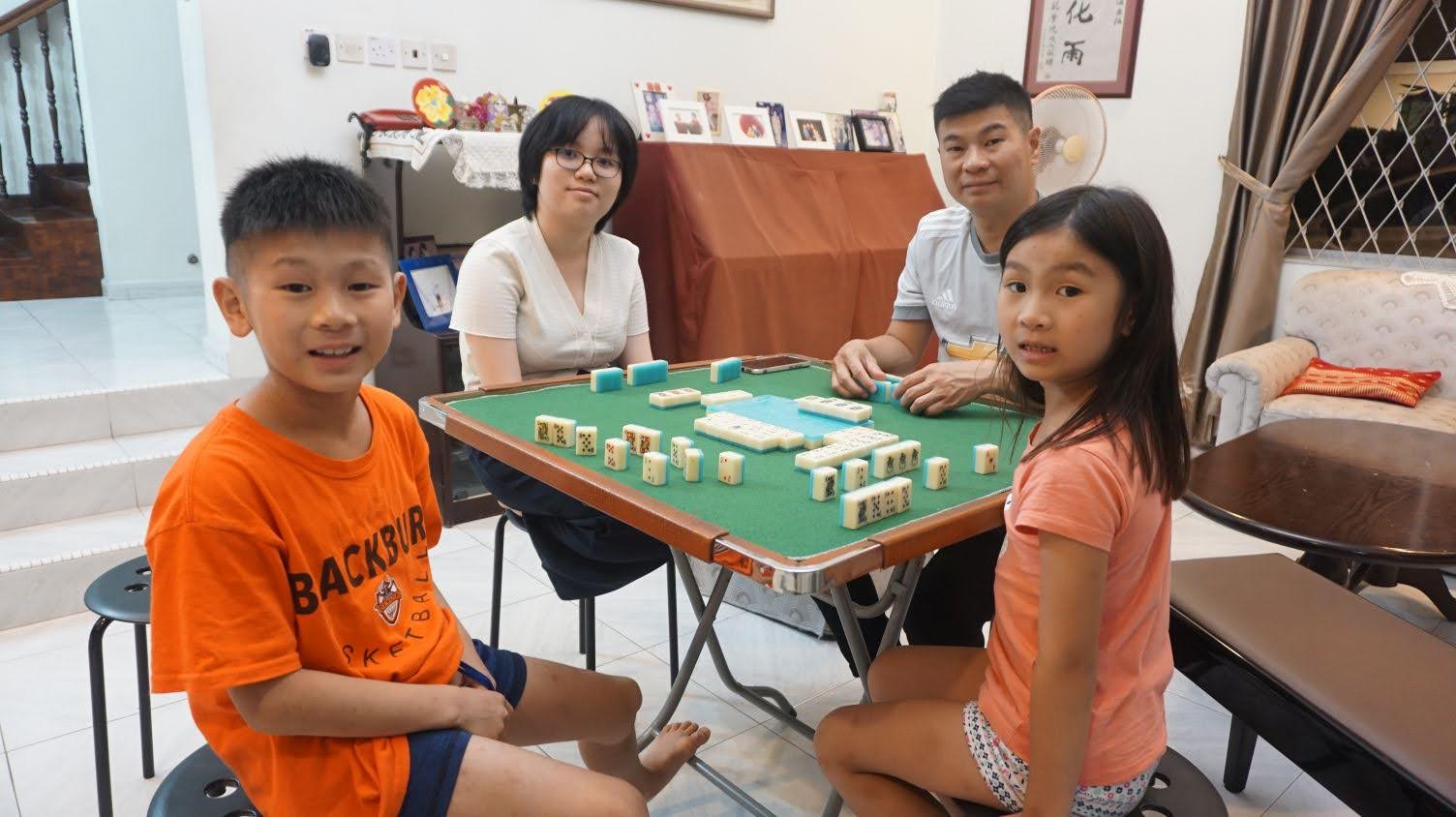
Mahjong Rummy is a Chinese New Year staple. Three generations at the same table. Not many boardgames can do this. 


Michelle had an annual gathering with her girl friends, and all the husbands and children went together. I asked the children to help me playtest Taking Sides. I brought Snow White and the Eleven Dwarfs too to let them play. Two years ago before I decided to publish it, I had shown them the game, also at this annual gathering. They were highly engaged in playing the game, and it was partly their response to the game which made me decide to go ahead with publishing Snow White. So this time bringing them the published version of the game was a meaningful occasion. They had contributed to this game getting published. 

They had mostly forgotten how to play, but they picked it up quickly. As dwarfs they gave very clever clues, clues which minimised helping Snow White. It was not those weak ones like my number is larger than yours, or our numbers are even numbers. Due to the higher complexity of the clues given, playing the game was more mentally taxing. These are smart kids. 

Saturday, 18 February 2023

boardgaming in photos: Chinese New Year edition


For the 2023 Chinese New Year (to be more inclusive I should call this the Lunar New Year, it's just that in Malaysia this is what it's commonly known as), I went back to my hometown Kota Kinabalu in Sabah. It had been three years since I was last back for CNY, i.e. before the pandemic hit Malaysia. Every time I do packing to go back to Sabah, my checklist includes a reminder to bring some games. This time I only brought two standard sized box games - Attika and Res Arcana. The rest were small box games, card games, and some prototypes of my own game designs. 

I asked younger daughter Chen Rui to play Res Arcana with me. I had played it a few times and I like it. It was the first time for Chen Rui. Originally I planned to bring Race for the Galaxy. Chen Rui had seen me play it on the iPad, and she was interested. Unfortunately I had forgotten that I had lent my copy to Julian. By the time I realised it it was too late. We were so busy preparing to travel that I didn't have time to arrange to get the game. So I brought Tom Lehmann's other game. 

Res Arcana is not similar to Race for the Galaxy, but it does have the element of creating combos. In Res Arcana you know exactly what cards you have in your deck. You only have 8 cards in it. Your challenge is to devise the most effective strategy to get yourself to 10 victory points given the limited strategy space. 


I complain all the time how contemporary Eurogames are just exercises in resource conversion. Yet Res Arcana is exactly a game which does resource collection and resource conversion. I struggle to come up with a justification for liking it but not other more popular resource conversion games. 


Perhaps I should call it a hand management game. You know exactly what cards you will have access to, just that you can't be certain when you will draw which card. Your task from the get go is to figure out how to make the most of the cards fate deals you. Yes, you do use your cards to produce and convert resources as efficiently as possible. It's just that you do that by cleverly managing your hand and creating good combos. I think I can convince myself. 

Chen Rui had fun with Res Arcana. At first she was flustered that her resource production sucked. The problem was more due to my character and starting cards being good at producing resources. Thus the contrast. Eventually I won, but she learned how the game worked and caught up, and was within range of the finish line. 


You see gambling games everywhere during Chinese New Year. My parents' home back in Sabah is no exception. We played mahjong rummy. The mahjong rummy entry on BoardGameGeek was submitted by me, many years ago. Till now the representative remains the same one. I photographed it in Sabah too.  


Normally on Day 1 of CNY my parents would plan CNY visits (拜年) to the homes of some friends and relatives, bringing all three generations - themselves, my generation and my children's generation. This year they didn't plan any visit, so we played mahjong rummy at home almost the whole day - my mum, my wife Michelle, Chen Rui and I. 


Mahjong rummy is a traditional gambling game. Most gamers probably frown upon it. With so many better games out there, why play this type of luck-heavy and dull game? I think playing games is more about the playing than the games. It is more important to be able to sit together around a table and have fun. What game it is on the table is secondary. 


If I were to nitpick the problems with mahjong rummy, my biggest gripe would be the jokers. You win or lose money simply based on the number of jokers you draw. Now I don't gamble big at home. It's only 20sen per joker. Let's say for a particular game I have 1 joker. The other players have 3, 1 and none respectively. When a game ends, I need to compare the number of jokers with each of my opponents. Between each pairing, whoever has fewer jokers must pay the other player. I will pay 40sen to the player with 3 jokers. I don't need to pay the player with one joker because we are tied. I will collect 20sen from the player with no joker. This is all luck! There is no skill in this at all. In boardgame hobbyist circles, if a game designer does this he or she will certainly be condemned. In fact, a game designer will probably make the players with more jokers pay those with fewer. That's called game balance. 

So this is what happens when you get a boardgame hobbyist to talk about traditional gambling games. 


Mahjong rummy is indeed a luck-heavy game. There are many tactics, which make you feel you have more control than you actually do. In my opinion, that's genius. I think it's one reason it has longevity. 


Over a few days of mahjong rummy, newbie Chen Rui was one of the net winners. Both Michelle and I lost money. My mum is a veteran. She plays regularly with friends. She made money. 


My wife Michelle share a tradition with a group of old friends from secondary school days. They meet up on Day 3 of CNY every year. Some of them do not live in Kota Kinabalu (e.g. us) but during the CNY period most will be back in KK. It's not easy for a group of friends to maintain such a tradition for so many years. They have been doing this since before their children were born, and by now the older children are going to university. 

Now for the husbands and the children, the gathering can be a little awkward. Most of us are not particularly close friends with one another. This year, I brought some of my game prototypes to be played in the husbands and children group, while the ladies have their extended catch-up session. This gave us something to do together, and I could playtest my games. Certainly a win for me. 

I brought Snow White and the Ten Dwarfs. Well it can be ten, seven, twelve, or some other number. It just depends on how many players we have. This is a one-vs-many game. You need to carefully think about how to publicly share information, and you have to piece together many small fragments of information to do deduction. The youngsters were very absorbed in the game. When a young man's mum came to ask what he was playing, he anxiously said, "Mum not now please I need to focus". It's gratifying to see others enjoy my game. 

Chen Rui participated. 


In Snow White every dwarf is a number. At the centre of the table there will be one face-down dwarf, and the rest of the dwarf players need to work out what number that dwarf is. A dwarf player knows his own number, and may look at the card of only one other dwarf. The dwarfs must share information to work out the missing dwarf. The tricky part is Snow White is always listening. Snow White wants to find out who the #1 dwarf is. It is a race between her and the dwarfs to see who works out the right answer first. This is a naturally absorbing game because you need to listen and think carefully to give the right clues and determine the correct answer. It is tense because it is a race. 

From my playtesting so far, this game needs at least 7 players. It can handle up to 12. I still want to test with more. I want to see at which point it stops working well. The more players there are, the more complicated the deduction will become. After a certain threshold, higher complexity will probably be less fun. 


Chen Rui and Adrian, my brother-in-law, played mahjong rummy with my nephew Oswald and my niece Lauren. I wouldn't call this cultivating the gambling habit since young. Let's call this upholding Chinese tradition. 

Friday, 15 November 2019

Chinese Chess

13 Nov 2019. Elder daughter Shee Yun told me that she has been playing (international) chess at school. The exams are over, the holidays are coming, the syllabus has been covered and there are no more classes. So the students have much freedom to do what they want. I asked her whether she knows how to play Chinese Chess, she said no. I have this Chinese Chess set at home which is my father's retirement gift. It is a beautiful set made of pewter. I took out this set to teach Shee Yun to play.

One problem with the board is the river is too wide. It should be only one square wide, not two. This is a little confusing. The manufacturer sacrificed usability for the sake of aesthetics.

The pieces are heavy, which is nice. However you can't use them like how you use regular Chinese Chess pieces. Typically the pieces are made of wood. When you capture an opponent piece, you first stack your attacking piece on the victim. You press your index finger on your piece, then draw the opponent piece out using your thumb and middle finger. When the opponent piece is pulled out, your own piece will snap onto the game board. The pewter pieces have a soft felt bottom and not a smooth one. So you can't do the customary thing with them.

The game board is made of wood, and it is quite heavy. The board can be folded in half to become a rectangular box. The whole thing is so heavy that you can probably kill someone with it.

I'm no good at Chinese Chess. I rarely play. I know the rules and some simple tactics, but I don't really know what the general strategies are or how to assess the board at a strategic level.

I attacked aggressively, forcing Shee Yun into a defensive mode. She applied the concepts she learned in Chess to Chinese Chess, and they mostly work.

I let her take back moves when she made mistakes, but I didn't go easy on her. Sometimes I helped her analyse the board situation, reminding her of threats and risks. One thing she found difficult to remember was how the knight / horse could be blocked by a piece immediately next to it. How the cannon works when attacking was also something new to her. In Chinese Chess, the cannon moves like the rook in Chess, but when attacking it must jump over one other piece.

Checkmate. My chariot (which is the rook-equivalent, top right) was poised to capture her king. I played aggressively since the early game, but Shee Yun grabbed the initiative and counter-attacked, checking my king a few times. I had to play carefully to avoid getting trapped. I did not actually plan ahead for this particular winning move. I only noticed it while analysing the board for my next move. When I saw it, I took it and ended the game.

Friday, 19 July 2019

photos of Zhong Shan

Strictly speaking these are photos taken in Shun De (顺德) and not Zhong Shan (中山). In June I visited Zhong Shan in China and the surrounding area. It was a trip to visit relatives in China. We did sightseeing. This was a trip planned by two of my aunts. My parents signed up quite early and asked whether I wanted to join. I said yes. I had not gone on holiday with my parents for more than 25 years. We were a group of 15. Most group members were my uncles and aunts. There were only two members from my generation - a younger cousin and I. I did not specifically pay attention to boardgame related matters when in China. After I got back, I noticed some of the photos I took were related to playing games. Playing is a universal thing and is not only limited to These Games Of Ours.

Mahjong is one of the best known traditional games in China. When we were in Shun De, we visited the ancestral home of Bruce Lee. This is not exactly a hot tourist destination. It is not even open on a regular schedule. We had to make a reservation so that someone would open up the place for us. There were no other tourists when we were there. The house was in a sleepy village. We stopped by the village temple. This was a temple for ancestral worship. It was effectively the community centre of the village. Old folks gather here to play mahjong and to chill. This photo was taken at the temple.

The temple.

The main entrance.

My uncle sat down and looked like he was itching for a game.

A local sleeping at a mahjong table.

Ancestral plaques.

There were a few groups of people playing mahjong. They probably thought we were weird, but they didn't seem to mind us.

Vegetable hawkers at Feng Jian water village (逢简水乡). I wonder whether they were playing Fight the Landlord (斗地主), since there were exactly three of them.

Sunday, 21 January 2018

Hanafuda (Japanese traditional game) - Koi Koi

Plays: 2Px6.

I bought my cheap set of Hanafuda cards more than two years ago, and only used it to play a game for the first time recently. One difficulty was not understanding the Japanese rulebook that came with the game. I searched the internet for rulebooks, and none among those I found are exactly the same. I wonder whether there simply are multiple ways to play, and people just mix and match a set of rules they like. Overall I think I got the core mechanisms right. I don't think I've done anything that unbalances the game.

The Game

Hanafuda refers to the set of cards, i.e. the game components, as opposed to an actual game and its rules. Hanafuda cards can be used to play many different games, and Koi Koi is one of the most commonly played. It is a two-player-only game, played over 6 or 12 rounds. Each round only one player scores. After the last round, you sum up your scores to determine who wins. Let's start with introducing the cards themselves in a Hanafuda set.

There are 48 cards in total, 4 for each of the 12 months. There is a plant associated to each month, and this is equivalent to the suit concept in poker cards. So Hanafuda has 12 suits. If you look at the photo above, you will notice that within each set of four there are repeated plants or flowers. In addition to the suit concept, there is also a concept of rarity. There are four rarities: commons, ribbons, animals and brights. Most months (suits) have two commons and two specials (ribbons / animals / brights). E.g. the card with just plum blossoms is a common card; the card with plum blossoms and a bird is a special card, an animal card.

This is the peony set. Peony is the flower for the 6th month. The first card is a ribbon card, in this case a blue one. The third card is an animal card, featuring butterflies. The others are common cards.

At the start of a round, each player is dealt 8 cards, and 8 cards are placed face-up in a common pool at the centre of the table. This uses half the cards. The remaining half becomes the draw deck. On your turn you perform two actions. First you play a card from your hand. If it matches the suit of any card in the common pool, you get to claim both cards and move them to your scoring pile. It there is no match, the card played becomes part of the pool. Your second action is to reveal a card from the draw deck. Similarly, if it matches the suit of any card in the pool, you get to claim both of them. Otherwise, it goes to the pool. After completing both actions, you check your scoring pile. If the cards you own form any scoring combination, you may decide to score and thus end the round. If you can score but decide not to, you declare "Koi Koi" (which roughly translates to "Bring It On!") and continue playing. Usually this means you want to go for a higher point value combination. There is a risk though. If your opponent scores after you declare "Koi Koi", he scores double.

There are many scoring combinations in Koi Koi. The simplest one is 10 common cards, which is worth 1pt. There are others like 5 brights, 3 brights, 5 ribbons, 3 blue ribbons, 3 poetry ribbons. Every round of play corresponds to a month, e.g. Round 1 is Month 1. All 4 cards of the current month is also a scoring combination, worth 4pt.

One unusual scoring combination is Boar-Deer-Butterfly. It requires three specific cards with these animals. In this photo I already have Boar and Deer in my scoring pile, and I have Butterfly in hand. Chances are good that I can make the combo. The Butterfly card is a peony card. I have another peony card in hand - the ribbon peony card. There is currently no peony card in the pool. I can play the ribbon peony card, and then on my next turn play the butterfly peony card to claim both peony cards and complete my Boar-Deer-Butterfly combo. However there is a risk that my opponent has a peony card too. After I play the ribbon peony card, he may quickly play his own peony card to prevent me from claiming peony cards. Even if he doesn't have a peony card, he may draw one from the deck, which will result in him claiming both peony cards too. There is always a risk. When I play the ribbon peony card, I myself may draw a peony card from the deck, forcing me to immediately take both peony cards. Then the butterfly peony card in my hand will be left with no match for the moment. If the last peony card is among the bottom 8 cards of the deck, it will never enter play and I will never be able to complete the Boar-Deer-Butterfly. All of the above are what go through your mind when playing Koi Koi.

There is one special situation when you play a card which matches another in the pool, and then when you draw from the deck, it is of the same suit too. Under this situation, you do not claim any card. All three remain in the pool. Whoever plays or draws the last card in this suit gets to claim all four cards. Not all the rulebooks I found contain this rule, but I have decided to use it when I play.

You play 6 or 12 rounds, and every round only one player scores. This creates a meta layer. If you are leading comfortably, and you are in the final few rounds, you will want to aim for easy combos that allow you to score quickly and thus minimise the chances of your opponent catching up. If you are far behind, you will need to gamble and aim big. Else you will never catch up.

The Play

Shee Yun and I learned to play Koi Koi together. There are so many different cards in a Hanafuda deck that in the beginning it was daunting. It wasn't easy to remember which were brights and which were animals. At first I thought brights would be cards with the sun or the moon, but of the five bright cards, only two actually have sun or moon. I had thought animal cards would be easy, but there is a card with a crane which is a bright card and not an animal card. There is a phoenix card which is also a bright and not an animal. And then there is a bridge card which is an animal. Wha...?! There is one storm card which is a common willow card, but it shows no willow, and it certainly looks anything but common. Shee Yun was much better than I was in remembering all these details. A fresh young mind is more absorbent. For now we still play with the rulebook nearby, for easy reference. We still need that.

In our first two games we made a big mistake which severely unbalanced the game. We had thought any complete set of the same month (suit) is a scoring combination (as opposed to only the current month). That made the game exciting but rather random. Scoring was almost always done via a month combo. It became a matter of who got lucky with collecting cards of the same month. It was hard to stop. I realised the mistake only after I tried a digital version of Koi Koi. After correcting this mistake, our games became much more interesting. Month combo scoring became rare, but it was still something to watch out for. Scoring anything more than 1pt was not easy. There was an interesting balance between going for quality and going for quantity. Focusing on special cards can bring great rewards, but if the game drags on and the high hopes bear no fruit, you will be at a disadvantage trying to scrape together common cards to make cheap combos. There is always a struggle between speed and high point values. Yet another consideration is that the dealer wins if a round ends with no scoring combo from either side. This doesn't often happen, but this rule puts the onus on the non-dealer to score before time runs out.

It is important to watch your opponent and try to guess what he is thinking. There are always clues - from the cards he collects, from the cards he plays into the pool. Sometimes you want to make preemptive strikes to break some combo he might be working towards.

When you look at your hand of cards, you will automatically categorise them in different ways. Some cards are risky to play, e.g. those which may help your opponent claim cards he wants. Some cards are quite safe to play. E.g. two cards of the same suit have already been claimed, and both the remaining two are in your hand. Some cards are labelled non-urgent. Usually they are no longer useful to anyone. You want to use them to bide time, waiting for a better opportunity to play other useful-to-you cards, or waiting for a less risky situation to play other useful-to-your-opponent cards. Some cards you may want to save for later, because they will help you, just that you need to wait for the right time. You need to be prepared for the possibility that all cards will need to be played. If the game drags on, those unsafe cards will eventually need to be played. Maybe you can tempt your opponent to score a lower valued combo before you play those unsafe cards. You never replenish your hand. Your 8 starting cards are all you will ever have in your hand. Hand management - planning how to play out your hand - is core to the game.

By the time the cards are dealt, and you can see the common pool, some situations may already be obvious. If many brights are already in the pool, you can bet your opponent will try to grab them as quickly as possible. By looking at your hand and the pool, you need to assess which combos you will have better chances with. You then plan your card play accordingly. Throughout the course of a round, cards being drawn from the draw deck will change the strategic landscape. You need to adapt to it.

All this sounds strategy-heavy, but ultimately Koi Koi is largely a game of chance. We are mostly talking about probabilities. Yes there are many tactics you can employ, but this is no deterministic strategy game. It is a gambling game. You do your best to improve your chances. The game always gives you hope that you can score big. However you always need a little luck. The 8 cards at the bottom of the deck will never see play. You never know what's in there and what scoring combinations are possible or impossible for the round. That uncertainty is part of the excitement.

I kind of conscripted Shee Yun to play with me, but after she had a taste, she found it interesting and afterwards asked me to play again with her. That's a good sign.

That row in front are the common pool. Currently there are cards from 6 different months, which is considered plenty. The cards at the top right are Shee Yun's scoring pile. This photo was taken when we played wrong. We grouped cards by month (suit) because we almost always scored by completed months. After correcting our mistake, we grouped cards in our scoring piles by rarity.

I did the Boar-Deer-Butterfly!

Shee Yun made this blue ribbon combo.

The Thoughts

Playing Koi Koi was more a cultural experience than trying another boardgame. It's a traditional gambling game, which means more luck and less strategy than the average hobbyist game. That doesn't mean it is low on skill or brainless. It's just a different balance from what we boardgamers usually play. Once you get familiar with the cards and the combos, it is a fast-paced game which you play like eating Pringles - sometimes you can't stop and you keep playing, always hoping that the next round you can score something bigger. What I enjoy about Koi Koi is being greedy, and then due to that greed, succeeding in making huge combos. That is exhilarating. I also like the psychology bit - reading your opponent and trying to guess what he's aiming for. You also need to disguise your own intentions as best you can, so that you don't put him on guard. There is decent player interaction in Koi Koi.

I don't mind the luck element. Some rounds you will be unstoppable because the stars are aligned in your favour. Luck is somewhat evened out because you do play multiple rounds. Tactics will help and are not pointless. Also, it is the luck which gives the game the gambling type of excitement. It feeds you hope that maybe you can finally make that big combo, that maybe you can do even better than the current combo you already have.

I feel the game needs to be played in the 12 month format, for it to feel complete. A single round only takes a few minutes, but playing 12 months will mean 30 - 45 minutes. So maybe if to play it as a filler, do 6 months, and to play it as a proper game, 12 months.