Showing posts with label gambling games. Show all posts

Saturday, 18 February 2023

boardgaming in photos: Chinese New Year edition


For the 2023 Chinese New Year (to be more inclusive I should call this the Lunar New Year, it's just that in Malaysia this is what it's commonly known as), I went back to my hometown Kota Kinabalu in Sabah. It had been three years since I was last back for CNY, i.e. before the pandemic hit Malaysia. Every time I do packing to go back to Sabah, my checklist includes a reminder to bring some games. This time I only brought two standard sized box games - Attika and Res Arcana. The rest were small box games, card games, and some prototypes of my own game designs. 

I asked younger daughter Chen Rui to play Res Arcana with me. I had played it a few times and I like it. It was the first time for Chen Rui. Originally I planned to bring Race for the Galaxy. Chen Rui had seen me play it on the iPad, and she was interested. Unfortunately I had forgotten that I had lent my copy to Julian. By the time I realised it it was too late. We were so busy preparing to travel that I didn't have time to arrange to get the game. So I brought Tom Lehmann's other game. 

Res Arcana is not similar to Race for the Galaxy, but it does have the element of creating combos. In Res Arcana you know exactly what cards you have in your deck. You only have 8 cards in it. Your challenge is to devise the most effective strategy to get yourself to 10 victory points given the limited strategy space. 


I complain all the time how contemporary Eurogames are just exercises in resource conversion. Yet Res Arcana is exactly a game which does resource collection and resource conversion. I struggle to come up with a justification for liking it but not other more popular resource conversion games. 


Perhaps I should call it a hand management game. You know exactly what cards you will have access to, just that you can't be certain when you will draw which card. Your task from the get go is to figure out how to make the most of the cards fate deals you. Yes, you do use your cards to produce and convert resources as efficiently as possible. It's just that you do that by cleverly managing your hand and creating good combos. I think I can convince myself. 

Chen Rui had fun with Res Arcana. At first she was flustered that her resource production sucked. The problem was more due to my character and starting cards being good at producing resources. Thus the contrast. Eventually I won, but she learned how the game worked and caught up, and was within range of the finish line. 


You see gambling games everywhere during Chinese New Year. My parents' home back in Sabah is no exception. We played mahjong rummy. The mahjong rummy entry on BoardGameGeek was submitted by me, many years ago. Till now the representative remains the same one. I photographed it in Sabah too.  


Normally on Day 1 of CNY my parents would plan CNY visits (拜年) to the homes of some friends and relatives, bringing all three generations - themselves, my generation and my children's generation. This year they didn't plan any visit, so we played mahjong rummy at home almost the whole day - my mum, my wife Michelle, Chen Rui and I. 


Mahjong rummy is a traditional gambling game. Most gamers probably frown upon it. With so many better games out there, why play this type of luck-heavy and dull game? I think playing games is more about the playing than the games. It is more important to be able to sit together around a table and have fun. What game it is on the table is secondary. 


If I were to nitpick the problems with mahjong rummy, my biggest gripe would be the jokers. You win or lose money simply based on the number of jokers you draw. Now I don't gamble big at home. It's only 20sen per joker. Let's say for a particular game I have 1 joker. The other players have 3, 1 and none respectively. When a game ends, I need to compare the number of jokers with each of my opponents. Between each pairing, whoever has fewer jokers must pay the other player. I will pay 40sen to the player with 3 jokers. I don't need to pay the player with one joker because we are tied. I will collect 20sen from the player with no joker. This is all luck! There is no skill in this at all. In boardgame hobbyist circles, if a game designer does this he or she will certainly be condemned. In fact, a game designer will probably make the players with more jokers pay those with fewer. That's called game balance. 

So this is what happens when you get a boardgame hobbyist to talk about traditional gambling games. 


Mahjong rummy is indeed a luck-heavy game. There are many tactics, which make you feel you have more control than you actually do. In my opinion, that's genius. I think it's one reason it has longevity. 


Over a few days of mahjong rummy, newbie Chen Rui was one of the net winners. Both Michelle and I lost money. My mum is a veteran. She plays regularly with friends. She made money. 


My wife Michelle share a tradition with a group of old friends from secondary school days. They meet up on Day 3 of CNY every year. Some of them do not live in Kota Kinabalu (e.g. us) but during the CNY period most will be back in KK. It's not easy for a group of friends to maintain such a tradition for so many years. They have been doing this since before their children were born, and by now the older children are going to university. 

Now for the husbands and the children, the gathering can be a little awkward. Most of us are not particularly close friends with one another. This year, I brought some of my game prototypes to be played in the husbands and children group, while the ladies have their extended catch-up session. This gave us something to do together, and I could playtest my games. Certainly a win for me. 

I brought Snow White and the Ten Dwarfs. Well it can be ten, seven, twelve, or some other number. It just depends on how many players we have. This is a one-vs-many game. You need to carefully think about how to publicly share information, and you have to piece together many small fragments of information to do deduction. The youngsters were very absorbed in the game. When a young man's mum came to ask what he was playing, he anxiously said, "Mum not now please I need to focus". It's gratifying to see others enjoy my game. 

Chen Rui participated. 


In Snow White every dwarf is a number. At the centre of the table there will be one face-down dwarf, and the rest of the dwarf players need to work out what number that dwarf is. A dwarf player knows his own number, and may look at the card of only one other dwarf. The dwarfs must share information to work out the missing dwarf. The tricky part is Snow White is always listening. Snow White wants to find out who the #1 dwarf is. It is a race between her and the dwarfs to see who works out the right answer first. This is a naturally absorbing game because you need to listen and think carefully to give the right clues and determine the correct answer. It is tense because it is a race. 

From my playtesting so far, this game needs at least 7 players. It can handle up to 12. I still want to test with more. I want to see at which point it stops working well. The more players there are, the more complicated the deduction will become. After a certain threshold, higher complexity will probably be less fun. 
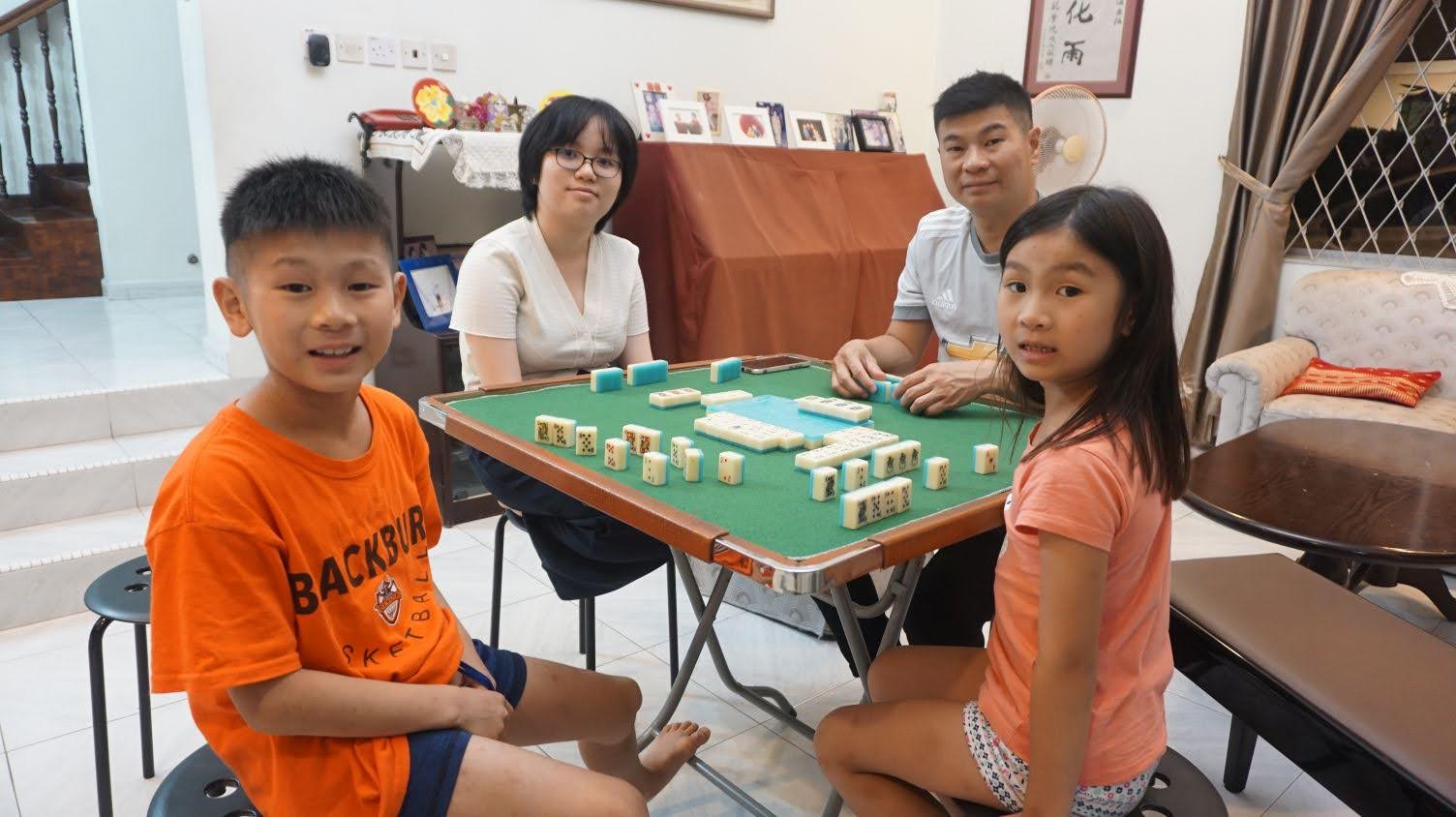

Chen Rui and Adrian, my brother-in-law, played mahjong rummy with my nephew Oswald and my niece Lauren. I wouldn't call this cultivating the gambling habit since young. Let's call this upholding Chinese tradition. 

Tuesday, 20 November 2018

Downforce

Plays: 6Px1.

The Game

Downforce is a light game with a car-racing setting, but it is more than just a race game. You will find that you need to make bets, you need to make predictions and evaluations based on limited information. There will be some cooperation. You are not just racing to be number 1. You are manipulating the whole outcome to be beneficial to you.

There will always be six race cars in play, regardless of the number of players. If there are fewer than 6 players, some players will control more than one car.

This scoring sheet lists all the ways you gain (and lose) points. Before the game starts, you bid for the car you want. The amount you spend for your car will be paid in victory points at the end of the game. Competition starts even before you rev up your engines. The car positions are randomly assigned, the deck of cards are dealt out to everyone. Cards are used for movement. Before bidding, you get to see your cards. You know which cars your cards will be good at moving. The starting positions of the cars, and your cards, are two of the three factors affecting your decision in bidding for cars. The third factor is the special ability card on the right. Whenever a car is randomly picked to be auctioned off, a random special ability card is drawn to be paired with it.

After the race starts, there are three points in time when any car passes specific milestones when all players will make bets on which cars will be in the top 3. Refer to the Betting Payouts section in the photo above. At each bet, you pick just one car. If at the end of the game the car is among the top 3, you get a payout. You don't necessarily have to bet on your own car.

After the race ends, you score points for your final position in the race. Refer to the Racing Payouts section at the bottom. If your car wins the race, you get 12VP.

Car movement is determined by these cards. Each card shows one or more colours, each with a number. When you play a card, you must move the cars in the specified colours as far as possible, in the specified sequence and taking the specified number of steps. Sometimes if a car is blocked, you will not be able to move it. White is the wild colour. You may treat it as any colour not already on the card. If you have two whites, they must be treated as two different colours. Cards are all single-use. If your car finishes the race while you have cards remaining, they are all discarded. You wait till everyone else finishes.

This was the map we played. It is a little unusual due to the two loops. The junctions at those two loops easily cause blocking. The blue car is now being blocked by the red and the green cars. The race only lasts one lap. This is a quick game.

The Play

We did a 6-player game, so everyone had exactly one car. During bidding, since I had many black numbers in my hand, I decided I would get the black car. I bid quite high for it. In hindsight I should not have done so. If I had many black numbers, it meant others would have few, and thus it was less likely they would compete with me for the black car.

The car in the pole position was the red one, and Ivan won the bid for it. Being in the pole position had its advantages. He quickly sprinted ahead of the rest of us and created a gap. Only the green car was able to keep up somewhat. There was much blocking among the cars left behind. It was quite tough being blocked. It could really bog one down. In our game, we had blocking mostly in the early game. From mid game onwards, there was much less of it. It seemed the cars, especially those in the leading positions, moved very swiftly and smoothly.

Red had a huge lead at this point. Those yellow lines were the milestones for betting. The leading car had passed the first yellow line and was approaching the second one.

We had one funny moment around this time. If you look at the photo above, red and green were coming out of the second loop. One player played a card which had a green number, so he had to move the green car. He made a mistake, and instead of moving the car across the yellow line, he sent the car around the loop again. All of us pointed at that and started laughing - what are you doing are you trying to pull a fast one?! We all said that was certainly an unexpected strategy, and would have been super effective had he not been caught red handed.

In the second half of the race, many people rooted for green, and it eventually overtook red to win the race. My black car managed to break out from the lagging group, and gradually caught up to take second place. The hot red car ended in third place. I had a dilemma. At both first and second bets, I betted on red. At the second bet, green was doing better than red, but I gambled that Ivan would be able to regain the top position. I betted against the general consensus. By the third bet, it was obvious that red would not be able to catch up, so I knew I had to bet on green. My dilemma was between supporting red or my own black. This made me feel uncomfortable. I had bet on red, so I had the incentive to help it earn a good position. However, if my own black gained a good position, I would earn more points too. Helping one meant sacrificing the other. There was no win-win. In hindsight, I should have supported red. It came down to whether red or black would earn 2nd place. If red were 2nd and black 3rd, I would earn 5VP more. If black were 2nd and red 3rd, I would earn 3VP more. There was a 2VP difference so I should help red. Unfortunately during the game I did not make this proper analysis. Out of instinct I supported my own black. So I did not score as much as I could have.

The final positions - green was 1st, black 2nd and red 3rd. This by no means reflected the actual positions of the players. The green player did win the game, but I (black car owner) did poorly.

My final score was 12, and that was below average. The 5VP I spent on bidding for the black car was expensive. In our game we had an unusual situation. One of the players won his car without having spent any VP. That meant even before the race started, I was already 5VP behind him.

The eventual winner was the green car owner, because his car came first, and also he had bet heavily on himself. This was an unstoppable combo.

The Thoughts

Something about Downforce makes me uncomfortable. It is not a pure race game. Three things affect your final score - (1) how much you pay for your car (or cars), (2) whether you bet correctly during the race, and (3) how well your car(s) does at game end. In the first aspect, you exercise your evaluation skills. You decide which car (or cars) you want to invest in, and you try to win it at the lowest price possible. In the second aspect, you try to predict the result by assessing the current situation on the board, and also by guessing your opponents' intentions. A car which many people are supporting will likely do well. There is some groupthink here. Only the third aspect is purely about racing and coming first. However it is only part of your score, and sometimes not even a big part.

What makes me uncomfortable is the situation I experienced. By mid game green was far ahead and it felt impossible to compete. Not only had he bet on himself heavily, he also had many supporters because they too had bet on him. So it was no longer a racing game where everyone was trying to come first. The trailing players were only competing among themselves. This might be a groupthink problem. Perhaps the players should have ganged up on the leader, instead of supporting him.

Downforce is about predicting a final result and then working towards making it come true. It is not just purely trying to be first. It is about creating an end condition where you maximise your score and minimise your opponents' scores. This is quite a different mindset from a more conventional race game where you are immersed in the racing tactics.

One possible problem is people may tend to bet on the same car. After all, the board situation is open information. If most people bet on the same car, then all these people will be supporting that car, and that car will do well. However, to stand out from the crowd, you can't be doing the same thing as everyone else. You need to do something different. Yet if you bet on a dark horse, that might not be a good idea because few or no other players would be helping you. Again, this may be a problem only in our game. In closer races, it is harder to determine which car is doing better, and players may be betting on more different cars.

I may be making the game sound more complicated than it is, with all that talk of evaluation, groupthink, reading others' intentions, I-help-you-you-help-me, and manipulating the board situation to your desired end condition. In the end, this is still a light game that you can easily teach to casual players and non-gamers. The game is engaging because even on other people's turns they may be moving your car. They may also be blocking your car. There is certainly plenty of interaction. You don't need to overthink it like I do.

Saturday, 12 November 2016

Catch2

I rarely mention my work at this blog. I currently work at a game company. We don't make boardgames though. We make mobile games. I do play mobile games, but the variety that I play for leisure is much less than the variety of boardgames I play. One of the mobile games I have been working on has just been released. It is a variant of Big 2 or Cho Dai Dee. The name of the game is Catch2, and it is now available only for Android devices. If you have an Android device, do try it out, and I'd greatly appreciate any feedback.

Sunday, 28 February 2016

Cheaty Mages

Plays: 4Px1.

The Game

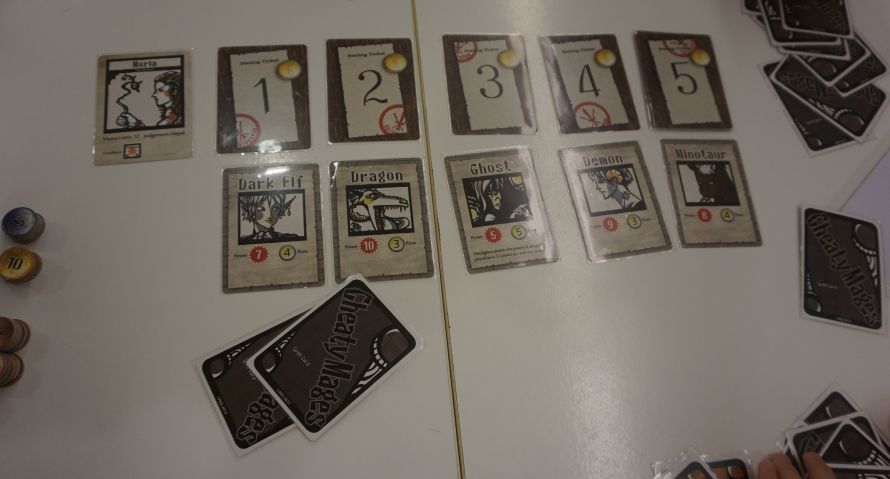
Cheaty Mages is an earlier work of Seiji Kanai of Love Letter fame, and it reminds me of Reiner Knizia's Colossal Arena. Players are mages who make bets in three tournaments. Each tournament has five contestants, and only one will win. If you bet on the right one, you'll make money. The key idea in the game is you get to cast spells on contestants to try to sway the results. Whoever makes the most money after three tournaments wins the game.

Before a tournament starts, the five contestants are announced and all players secretly make bets. You can bet on one, two or three contestants. If you bet on only one, and you win, your reward is doubled. If you play safe and bet on three, your reward (if you win) is halved. After everyone has placed his bets, the tournament starts. Casting a spell on a contestant is just playing a card on him. Players take turns playing cards until everyone passes. Cards have various effects, the most common ones being increasing or reducing the strength of the contestant. Some cards must be played face-up, and some face-down. The face-down ones keep you guessing what your opponents have played, and whether they are trying to help or hinder the contestant. Some cards have a mana cost. You don't spend mana when playing it, but the total mana value of spells played on a contestant is an important number. At the end of a tournament, if the total mana exceeds the limit that is allowed by the judge, the contestant may get all the spells dispelled, or he may even be disqualified, depending on the ruling of the judge. So even if you want to help a particular contestant, it can be risky to play too many cards on him.

The judge of a tournament is revealed at the start of the tournament, so players can plan ahead. In addition to the mana tolerance limit and the judge's decision when it is exceeded, some judges also enforce additional rules, e.g. some categories of spells are outright banned.

The contestants have different characteristics. They have different basic strength values and reward values. Naturally the stronger ones have a smaller reward value. Some of them have special rules, e.g. with one of the contestants, positive cards played on him reduce his strength instead, while negative cards increase it.

The guy at the top left corner is the judge. The contestants are lined up neatly under their respective numbers. This is to facilitate betting.

During a tournament, many cards are played below the contestants, some face-up and some face-down.

These are some of the spell cards. The icon at the top left corner is the spell category, which determines whether a spell is to be played face-up or face-down. The number at the top right corner is the mana cost. The first and third cards simply increase the contestant's strength. The one in the middle doubles the payout of a contestant, if he wins the tournament.

The Play

Guessing your opponents' bets is important, but what's more important is using this information to help yourself win more than your opponents. If you find that another opponent has bet on the same contestant as you, it is not necessarily a good thing. If he has only bet on one contestant but you have bet on three, then he would be earning much more than you if this contestant wins. So you actually want to stop this contestant, not work together with the other player to make him win.

There are some tricks you can use, e.g. pretending to support a particular contestant to mislead your opponents. Since some cards are played face-down, you can use them to confuse other players. It is actually quite easy to make a contestant exceed his mana limit. So sometimes you can "help" a contestant get disqualified.

Deciding whether to bet on one, two of three contestants is not straight-forward. I have only played one game so I have not given the betting aspect a lot of thought, but I think when deciding which and how many contestants to bet on, there are many factors to be considered. The judge, the relative strengths of the contestants, the number of hand cards of your opponents, how much money everyone has, and your own cards, are all part of the equation. You need to weigh the risks and the rewards.

During play, observing how your opponents play their cards helps you work out which contestants they are supporting. That's generally the case. Sometimes you do get surprised.

The Thoughts

Cheaty Mages is a lot about guessing your opponents' intentions. It is also about pushing your luck - how many spells do you dare to play on a contestant you are supporting? Sometimes you do get into win-win situations - both you and another player support the same contestant. These can be beneficial.

There is some luck. Sometimes you simply don't get the cards you need, or your bets happen to be completely misaligned with the rest of the players. You just have to make the most of what you are dealt. Sometimes that's the fun - making the best out of the worst.

Cheaty Mages should be a light game, but I think players new to the hobby can feel overwhelmed, because the spells, the judges and the contestants have some special abilities. The overall idea is simple though. It's just betting on a horse race, but you get to do some hanky panky. Yet you can't be too obvious because otherwise you'd get caught. This sums up the game.

The setting and the overall concept do not attract me. I feel a lack of control. It's not easy to make the game go your way. However this may be due to my inexperience. Possibly the game is actually more about making the right bets, rather than making bets and then trying to steer the game your way. There may be more than meets the eye in analysing the judge, the contestants and the players' positions.

Wednesday, 19 November 2008

Dou Di Zhu 斗地主

I recently visited Hong Kong, on a business trip. I extended my stay to meet up with old friends, and we played a lot of games. We played through the night. The last time I stayed up playing games the whole night was in 2003, and it was also in Hong Kong, and it was also with Ah Chung and Ben. That time, the game was The Settlers of Catan, and I hadn't become a boardgame hobbyist yet. It happened soon after that though.

One of the games that I liked the most was, surprisingly, not one that I taught my friends (who are not gamers), but one that Ben taught Ah Chung and I. This is a very popular card game in China, which uses a standard card deck, and is strictly for 3 players. It is called Dou Di Zhu / 斗地主, which means fighting the land lord or land owner. This is probably a phrase or term people use during the cultural revolution, when the communists went against the land owners. The game has a cooperative element, because two players play against one. It is very much a gambling game - it is designed to be very addictive and it really tempts you to raise the stakes. It plays with your greed, your recklessness, or maybe your timidity.

Here's how the game plays. It has some similarity to Big 2 / 锄大D. All cards are dealt out to all 3 players (including the 2 jokers), except for three. The winner of the previous hand has the opportunity to be the landlord. He looks at his cards, and decides whether he wants to be the landlord. If he does, he shows the 3 leftover cards to the other 2 players, and then takes them into his hand. If he doesn't, he passes the 3 leftover cards to the player on his right, who then has the opportunity to become landlord. If no one wants to be landlord, the cards are reshuffled, and for the next hand the stakes are automatically doubled.

Once the landlord is decided, the other 2 players will play against him. Let's say the default stake (注) is $1. In a normal hand, if the landlord wins, he earns $1 each from the other players. If he loses, he pays $1 each to the other players. So, obviously to be landlord means you win big, or lose big.

The basic structure of the game is like Big 2 / 锄大D, i.e. it's a climbing game. The start player plays a card or set of cards, the next player can play a stronger card/set of the same type, or pass, and this repeats until a player plays a card/set that cannot or will not be beaten. The winner of this trick then starts a new trick by playing a card/set. The objective is to get rid of all your cards.

The possible sets in Dou Di Zhu are different from Big 2. Suits have no meaning. 2's are also stronger than Aces, but the two jokers are the strongest, with the coloured joker being stronger than the other. Here are the possible sets:

  • Single cards.
  • Pairs. You can play multiple pairs as a set, as long as the numbers are in sequence, and you have at least 3 pairs, e.g. 44556677.
  • Triplets. You can attach an additional card to a triplet (e.g. KKK4). You can play multiple triplets (e.g. 444555, or 444555666). You can also attach extra cards to these (e.g. 44485553666J).
  • Fours. These are bombs (will be explained later). You can attach an extra card to these, but they will then become less effective bombs, and they do not double the stakes.
  • Straights. Minimum 5 cards, but they can be as long as you want them to be.
  • Double Jokers. I mention this separately from pairs because this is the royal bomb.

No flushes or straight flushes, since suits do not matter. We did not play full houses, but I'm not sure what the formal rules say (if there are any in the first place). Ben says usually full house is not played because it is too easy to make.

Now, bombs. Bombs can be played no matter what type of set is being played in the current trick - pairs, triplets, straights etc. It overrules the type. And very importantly, when a bomb is played, it doubles the stakes. If another bomb is played later in the same hand, the stakes are doubled again, and so on. Bombs are powerful, but you may not always want to play them. If you don't think you are going to win the hand, then it is better not to bomb, because it will only make you lose more. Bombs are not common. Not all games will have bombs, and even for those that do, they may not get used. From the games that we played, we had one game with 4 bombs, but that's extremely rare. It's probably because Chung and I are new. Ben says with veterans at most he has seen 3 bombs.

Dou Di Zhu is very interesting in that it's a 2 vs 1 game. The partnership play is interesting, because you need to guess your partner's intentions, and try to cooperate. Of course, you are not supposed to share information of your cards, or give directions to each other. You should only communicate through card play. You do not need to win yourself. If your partner wins, you win too. Well, there is a little difference. If you win, for the next hand you get first chance to be the landlord. This can be a consideration.

In Dou Di Zhu, the destination is more important that the journey. You win, or you lose. If you lose, it doesn't matter how many cards you have in your hand. You will not be penalised more, or less, depending on the number of unplayed cards. So there is a lot of planning ahead required. You need to plan how to get rid of all your cards. If it looks bleak, then you might as well give up and try to help your partner win (assuming you are not the landlord).

I like the big sets that you can make in Dou Di Zhu. When you have 8 cards remaining, most people don't expect you to be able to play all in one go. This is possible if you plan well. I like the excitement of the bombs. In fact I got so excited over them that I have been using them a bit too recklessly, hurting instead of benefiting myself and my partner, thus earning screams from Ben.

There is some card counting required if you want to play well. At least you should try to remember the big cards. Ben's guideline is to remember J, Q, K, A, 2, and the Jokers. There is, of course, luck in the game, but there is much strategy and room for innovative play and interaction depending on how your opponent(s) and partner play. So I am happy that Ben taught us this game. Very good for when you have exactly 3 players. Maybe this was why it was invented - Big 2 needs exactly 4 players.

Monday, 21 July 2008

Royal Turf

Royal Turf is a horse racing and gambling game. It consists of 3 races, and you try to win the most money by betting on horses. There are 7 horses in the game. You win money by betting on the first three that pass the finishing line, and you lose money if you have bet on the last horse. On your turn, you roll a die, and then move a horse. When you move a horse, you shift it's tile to indicate that it has moved. This horse cannot be moved again by anyone else until all other horses have also moved. Once all horses have moved, you reset the tiles, and all horses can move a second time.

Each horse has a movement tile with 4 icons and corresponding numbers. These 4 icons appear on the die. The horse head appears 3 times. The saddle, cap and horse shoe appear once each. After you roll the die, the icon on the die tells you which icon you must use for moving a horse. So the movement tile basically defines the characteristic of the horse. Some horses will likely move at a medium pace most of the time, e.g. head=4, saddle=5, cap=8, shoe=6. Some horses mostly moves slowly, but can have some unexpected and huge bursts, e.g. head=1, saddle=20, cap=3, shoe=1.

The game board. In this race the horses are quite spread apart. The tiles at the top define the characteristics of each horse. Horses which have moved have their tiles shifted slightly upwards. The table at the centre of the board is the payout table. Payout depends on the position of the horse (1st to 3rd only) and how many people have bet on it.

Close-up of race. These first 4 horses are very close to one another.

I played this with Han, Chong Sean and Simon at Carcasean. I don't remember which ruleset I used. There are 2 versions of this game, the other being called Winner's Circle, and the rules vary slightly, but the components are the same. I started very very badly, and never recovered from it. I actually managed to get in debt after the first race. In this game you get 4 betting tokens of values 0, 1, 1, 2 which you must place on different horses. In the first race, my 1 tokens were placed on horses that weren't in the top 3, and my 2 token was placed on the last horse. This is the worst possible outcome of a race. So I was $200 in the red. The biggest lesson I learned from that is try to avoid betting on a horse all by yourself. It will become the target of everyone else. There is some group psychology in this game, because of the hidden bets. Actually hidden bets is a variant, but Chong Sean told us it's much better to play this way.

Royal Turf is just an okay game for me (maybe because I lost very badly). There is definitely some group psychology in this. One interesting thing is the payout is less if there are many people betting on the same horse. Yet if you are the only person betting on a horse, it will be difficult for it to win in the first place. This is a light game suitable for new players, and I think it is good with larger groups.