Showing posts with label publisher - Splotter. Show all posts

Wednesday, 24 June 2026

Yuhang boardgame retreat June 2026

The retreat didn't actually have a name. I call it the Yuhang retreat simply because it was organised by Yuhang. This was a private event of a group of boardgamers in Kuala Lumpur coming together for 3 days of gaming, staying at an Airbnb at Taman OUG. I didn't know Yuhang well before this. It was Jon who asked me whether I wanted to join. It was only after I had signed up that I found out I know several of the others who were going, like Julian and Tim. 

We started Friday afternoon. Some already checked in by 3pm. I went in the evening. The original idea was all of us would stay at the Airbnb, so it would be three days of just boardgames, eat and sleep (and shower). However some of us (including me) decided to go home for the shower and the sleep. My home was only 20 minutes away. We went out for some meals, and ordered delivery for others. The latest I stayed up was about 2.30am. Some of them played till 5am. I don't have that kind of stamina anymore. In the mornings we started around 10am, and some started around noon. 


I realised I hadn't played High Society after so many years in the hobby. This is a well regarded game from Reiner Knizia. 


We brought out Splotter's Horseless Carriage. I own a copy but I have only played it once before. It was a three player game. I think this game is best with five. At the retreat we did a four player game, using Julian's copy. I had forgotten many of the rules, so he did the teaching. Look at all these folks looking so serious staring at their car factories. You know this is a tough game. 

My factory


Julian had some 3D printed accessories which were very helpful. The slots for the white bars help secure them, in case the players accidentally knock these boards. 

Game in progress


In this particular game we had much demand for sedans, and some for pickups. We had very little demand for sports cars. 


I made a mistake when expanding my factory. I had one mainline producing sedans. I wanted to set up another so that I could produce and sell more cars. I think this is the minimum if you want to be in contention to win. It is something you need to plan for far ahead. If you look at the expansion board at the lower left, you will notice that the entrance is facing right. I had wanted to place another mainline in the lower right area, so that it could be connected to both the group of darkest grey tiles and also the group of light grey tiles. This way, the new mainline would meet many of the requirements expected by consumers. However my poor expansion tile placement from earlier on stopped me from adding the next expansion tile here. The doorway facing right prevented me from attaching an expansion tile here. I gave up, and I placed a ton of planning tiles on the right, on the other expansion tile I didn't have any use for now. This gave me an advantage in choosing turn order. I couldn't do much else with that expansion on the right anyway, so I might as well utilise it. 


We had more demand than we could fulfil. I think that means we were not doing a good job. Most of the demand was either very cheap cars or very expensive cars. 

Julian has this nice 3D-printed tray which I find super convenient. 


Late in the game, I was on my way to come last when I realised I might be able to redeem myself a little bit. At the time Jon was still behind me, but he was catching up. I added a mainline to produce pickups at the top left. I fought for turn order so that at least for one round I had access to all the highest techs at the time, and I could make an up-to-par pickup. This didn't earn me much money (i.e. points) since it was quite late in the game, but at least it helped me hang on to third place. Barely. Sorry Jon. Lesson learnt - don't give up easily. 

If you look closely at the photo above, you will find another bad mistake. In Horseless Carriage, those tiny arrows are important and you want to leave space to place them next to car part producing tiles. One car part you produce can give you several features, if you have access to the tech. However for each feature you must be able to place the matching arrow. I had not planned for this well, and later in the game when I was able to access the higher techs, I could not place the arrows, so I missed the opportunity to improve my cars. 


Joon Lam (blue) and Julian (red) had a close fight, and so did Jon (green) and I (yellow). Jon and I were far behind the other two. 

Julian, Joon Lam, me, Jon


We had friends who came for only part of the retreat. In total we had maybe 18 attendees, and at any one time I think the highest player count we had was around 14, i.e. three tables. 


I did not play this. I just saw others playing it. I think Marc brought this. He and Joanne came all the way from Johor to join the retreat. 

So colourful. 

A jigsaw puzzle! 


Captain Sonar was a game I brought. I have wanted to play this again for some time but it has been hard to find the right occasion and to get enough players. I'm glad I got to experience the excitement again. 


Some of the whiteboard markers that came with the game had dried up. Thankfully I brought along some extras. I was the radio operator on my team, and I thought I did pretty well figuring out the position of the enemy submarine. However when they used silenced movement, it threw me off and I got confused. At one point I thought they were at the exact same position as us. I couldn't ask my captain to shoot, because the torpedo would damage us as well. The opponent sub managed to track us, and soon destroyed us. 


This is Jon's prototype - Foundations of Rome. I have seen this game go through several iterations. It is like watching your friend's child grow up. I keep telling him this game is better than Castle Combo. He started designing this game before Castle Combo was released. These two games look similar, because you are also playing cards into a 3x3 grid. I found Castle Combo so so. Nothing really grabs me. I like that in Foundation of Rome you need to plan carefully how to upgrade your buildings. If planned well, they give you great rewards. You will be placing people on the buildings. People are one of the ways you score points. 

Foundations of Rome (prototype)


I played a physical copy of Castle Combo for the first time. Prior to this I have played it several times on BoardGameArena.com. 


I went for the money bag strategy, collecting many such bags, and trying to amass a healthy amount of money. Castle Combo is hugely popular now. I don't think there's anything wrong with it. It's a simple and accessible tableau-building game. I am not keen about it because it doesn't offer me anything particularly new or interesting. Jon loves this game. I realise Jon and I disagree on so many games. Maybe we chat often so we discover many games we disagree on. We do agree on many games too. Or maybe I'm just a hard-to-please. 

Another one of Jon's prototypes I played was On Three. This is a two-player game which uses poker hands. I really like it. It's thinky and compact, and it uses just a normal deck of playing cards. I told Jon this is his Regicide


Samurai Spirit was another game I brought. I have fond memories of it. It is a challenging cooperative game. We did a six-player game. We made it to round 3, but unfortunately we lost because we were short of one doll icon. All the villager families were killed by the bandits. Tragic!


Joon Lam asked me whether I brought my prototype Pilgrim Poker. I did. I didn't intend to push for getting it played. I wanted it to be there on standby. If the opportunity arose and people wanted to take a break from heavy games to play a light one, I could bring it out. I hadn't expected that it would be specifically requested. 

We had great fun with it. In one particular round, I saw that Julian had a 13 (the highest card), and Joon Lam a 12. This would be difficult for me to win. The other cards were middling. Julian issued a Side Bet against Joon Lam. That made me go hmmmm.... Julian didn't know he had the 13. The only reason I could think of for him to go against such a strong card was I must be holding the special card (4 - Zhu Bajie) which made the lowest card win instead of the highest. Only then would the 12 be a weak card. This round we did several times of Side Bets and Raises. Eventually both Julian and Joon Lam folded. I had raised the bet amount to $10 (the max). I also had a Side Bet against Chan, at $10 as well. Now Chan had a special card too (10 - Sun Wukong). He did not fold. Win or lose, his bet would be doubled. I felt confident I could beat him, because I was pretty sure I had the 4. When it was time to reveal our cards, I was stunned. I did not have the 4! I had a 12. I panicked for a split second because this was out of my expectation. Then I felt relief. I still won because 12 beat 10, and I won a lot of money from Chan because of his special character. He had to pay me extra. That was a painful loss for him. 

We discussed after that round ended. Julian explained that he was just bluffing when he initiated a Side Bet against Joon Lam. At the time, both of them were leading, and both had a lot of money. So for Julian to issue a $10 Side Bet against Joon Lam wasn't a big deal. Julian wanted to intimidate and confuse Joon Lam. I'm happy that hardcore gamers enjoy Pilgrim Poker. I try to make my games accessible to the casual crowd, and sometimes this means sacrificing gamers. So I am glad my game is interesting enough for them too. 

Lifeboats is one of the most colourful games I played at the retreat. 


This is a noisy game with much politicking. I will write more about it in a separate post. 


Julian is a big fan of Obsession. He has a very nice insert set for it too. I am amazed by how well designed these 3D-printed custom inserts are. 


Sticheln (1993) is a trick-taking game that's more than 30 years old. I've always enjoyed it. I think the latest version is called Stick 'Em. There is also a version called Picante. It introduces some interesting twists, and they make the gameplay highly strategic. At the start of every round, everyone chooses a pain colour. During the game, every card you win gets you only one point. Every card in your pain colour that you win costs you points, based on its card value. This can be very painful. With four players, the card value goes up to 12. Winning one 12 in your pain colour will cause you to lose 12 points. You will need to win three tricks to recover from that. So you play this game very carefully, doing your best not to win cards in your pain colour. This can be difficult, because of another unusual rule. For every trick, any colour which is not the lead colour is a trump colour. That means if someone leads a trick with your pain colour, you'd better have a small card in your pain colour so that you can avoid winning this trick. Or you hope someone else who has a different pain colour wants to win it for himself and will play a card of a different colour. The tactics in Sticheln take a little while to get used to, and you will experience pain in the process (my friends can attest to it). The game looks simple, but the implications of these little twists are many. 


When they played the game, the first comment was this was obviously a pretty old copy. Some of the card edges had yellowing. Not exactly in bad shape, but the signs of age showed. 


Xiu Yi, Yuhang and Chan. Some of them declared this the best trick-taking game they have ever played. I'm glad I introduced the game to them. We played this on the very last day of the retreat, when we had a smaller group. We were too tired to play any more heavy games. 


One other game that was a pleasant surprise for me was Rajas of the Ganges. This is a pretty well known game, and I certainly have heard of it before. I did not have much interest to try it, because it sounded like just another worker placement game. Now that I have played it, yes, indeed it is a worker placement game, and it doesn't have any mechanism which is particularly innovative. However I found myself enjoying it a lot. I will need to think about why before I write more about this game. 

I played 13 new-to-me games throughout the retreat. I will later write about them all. Gosh this one retreat is giving me a lot of homework. 

This is the kind of retreat that makes you feel you are 30 years younger and still doing crazy stuff with your immature schoolmates. We were still in Kuala Lumpur and not some remote mountain, but the three days away from all other activities and worries, being able to spend time with friends who are equally mad about boardgames, playing and discussing and laughing, have been wonderful. 

Sunday, 31 May 2026

boardgaming in photos - Risk and Race for the Galaxy


In my work as a leadership trainer, I regularly collaborate with others in the industry - fellow trainers, coaches and training providers. Being in a business community called BNI, I regularly meet fellow members of the community and we help one another in our businesses. One of my friends Captain Fuaad has developed a training game based on Risk, and he asked several of us to help him playtest it. We did this at Bored boardgame cafe. It was a weekday afternoon so there was not much crowd. They let up take up a fair bit of space. The giant game board needed much space. I have my own giant boardgames which I use for training too. I am lucky to be able to integrate my passion of boardgames with my passion of helping others become effective leaders. 


I can't recall the last time I actually played Risk. It was probably Risk Legacy that I played, and that might be more than 10 years ago. 


It is an amazing feeling to see my games being promoted in a language I cannot read at all. Box & Brew Cafe of Thailand stocked some of my games. They bought from me in bulk when we met at the Asian Board Games Festival in the Philippines. 

If you are in Thailand, you can find my games at Box & Brew Cafe! 


We visited Xiaozhu's home and I took the opportunity to ask my friends to help playtest my Dream of the Red Chamber (红楼梦) game. One thing about this prototype that I did not deliberately plan for is the combination of 6 and 7. It's a thing that teenagers say now, which old timers find annoying. And also in Chinese (well, Cantonese) it can be misread as something... ahem... inappropriate. I have been thinking about changing the numbering system. Instead of 0 being the main character Jia Baoyu, maybe I should make him the 9. The reasoning is when I play sets containing him, I fan the cards in such a way that he will always be hidden from view, while the largest number of the set will be visible. Him being 0 means he is always the first card on the left, so he will always be hidden from view. How can the main character be always hidden from view? He should be the most visible. By making him the 9, whenever there is a set containing him, his whole card will always be visible. That is my rationale. Now that there is this coincidence of the 67 set, maybe I don't have to change it. Also if on the table I only see tons of Jia Baoyu, the game looks a little boring too. 


I also played this prototype with Pey Ling, a teacher who specialises in studying and analysing Dream of the Red Chamber - the true expert. One thing she shared with me was that Xue Baochai, one of the two main female characters, was probably a little plump. In one particular scene after some light exertion she was already panting hard. Hey you learn something new every day. 


Pey Ling's specialty is not just Dream of the Red Chamber. She studies and teaches all four of the major Chinese literary works. So we also played my Pilgrim Poker prototype, which has a Journey to the West theme. I showed her my Rebels of the Three Kingdoms prototype too. 


Sun 17 May 2026 I was at Kinokuniya bookstore at Pavilion Damansara Heights demoing my games. Currently they stock Ali Baba and the Forty Thieves and Snow White and the Eleven Dwarfs. They invited me to do a demo session because they were running a promotion. Pavilion Damansara Heights is not a very busy mall, even on Sundays. Maybe it is because the place is spacious, the mall felt rather sparse to me. Kinokuniya itself did have some foot traffic. There were always people around. Most people didn't stop to examine the games, whether mine or others at the same table. They just took curious glances. Some did stop to ask, and I gave them brief overviews of the games. Very few wanted to sit down to play. I mostly just showed the game components and explained briefly how the games worked. Some were happy to buy after listening to the overview. Ironically none of those who sat down to play bought the games. 

Boardgames is still very much a niche hobby in Malaysia. This afternoon at Kinokuniya reminds me of that. At boardgame events, yes, we attract people who are already interested, and we get the impression that hey there are so many fellow boardgamers in Malaysia. Half a day at a regular bookstore reminds me that we as the boardgame industry still have a lot of work ahead of us to promote the hobby and to create awareness. Although it was a little depressing to be idle for much time, especially compared to when I booth at boardgame events, I am still happy that I'm doing a little bit in introducing tabletop games to the public. Keep hustling! 


I did a five player game of Heat on BGA. This is such an enjoyable game, and I'm happy that it is doing well. It has many expansions. I don't own a copy, but if I were new to the hobby, I would have purchased one. 

I'm super happy to be assigned green, my favourite player colour.

I'm don't have a paid account on BGA so my colour assignment is random.


This part of the board is challenging - several consecutive corners with low speed limits. We played with some expansions - just a few extra rules here and there. In some ways Heat is a push-your-luck game. How far are you willing to push your car to get that extra bit of distance by paying the price of clogging your hand with heat cards? Movement is often deterministic, only occasionally you roll a die, and usually you are the one deciding when to take the risk. The decision of whether to discard cards and hope to draw better ones is not always easy to make. This game should be in some hall of fame. 


I did a two-player game of Molly House with Han. This time I was pretty determined to help the mollies (i.e. LGBTQ community) survive and gain acceptance. They have never survived in all the games I played. This time I approached the game like a cooperative game. I tried to keep track of the cards in the gossip pile. I worked hard to help the community score points. As the game progressed, Han outscored me by a lot. I was arrested for indecent behaviour and I had a major indictment which might lead to a death sentence. My resolve shattered, and I decided to betray my comrades. I became an informer. Eventually the community was infiltrated and shut down by the authorities. Han was hanged for sodomy. I won the game, but I felt so dirty. Aaarrgghh! 

Having played several games of Molly House, I now conclude that it doesn't quite work for me. It is a design I admire for how bold it is, and I like the premise. I don't like the memory element. Because the game mechanisms are unusual, I find the game hard to learn and to play. It feels like a lot of work. After having played several games, I still don't feel I know how to play it. 


I have been enjoy my ongoing plays of Race for the Galaxy with Jon and Yasmin. When I open up my browser tab of BGA games, this is usually the game I most look forward to to take the next turn. 


I completed a game of Signorie on BGA. I have played this before but I have forgotten most of the rules. I had to relearn. I continue to suffer the consequences of my own laziness when playing games on BGA. I do play the tutorials, and I download the rulebooks in case I need to refer to them. However since BGA handles most of the game mechanisms, I usually end up being too lazy to learn the game rules properly. I just click without fully understanding the consequences of my actions. It's not the fault of BGA. It's entirely mine. 


I read up my previous blog post about Signorie, and one thing I did differently this time was I tried to set up many bonus actions in the early game. Investing in this gave me extra actions throughout the game. I didn't do as badly as the first time I played the game. I didn't do particularly well either, since I didn't really understand some parts of the game. 

Signorie is a decent game and I should learn it properly. 

I might be losing the appetite for more complex games. Many of them feel convoluted and tiresome. 10 years ago I would not have imagined myself saying this. Heavy Eurogames is supposed to be the pinnacle of boardgaming for me. 

Splotter Games announced Bailiff of Boscoop. For many years I had this rule: when Splotter releases a game, buy it. Don't wait and see. Just buy it. I like almost all their games. But now I am discarding this rule. I am certainly interested to try the game, but I might not buy it. I bought Horseless Carriage. It is a good game, but I have only played it once. Till now I have not made time to play it again. 

Friday, 28 April 2023

Horseless Carriage


The Game

Horseless Carriage (2023) is the latest game from Splotter. I am a big fan of their games, and by now I have reached the stage I can confidently buy-before-try. They are the only game designer team I can say that for. Their previous title was Food Chain Magnate (2015), which was 8 years ago. These guys take their time. 

Horseless Carriage is about the early days of the automobile industry. Cars are a new product on the market. As car manufacturers, you need to work out what exactly your customers want, so that you can develop the right products. At the same time, you are also shaping what the market perceives to be important features. Car buyers are fickle, and tastes regularly change. You need to be able to handle the ever increasing customer expectations while at the same time competing with your opponents to sell cars. The richest player at the end of the game wins. 
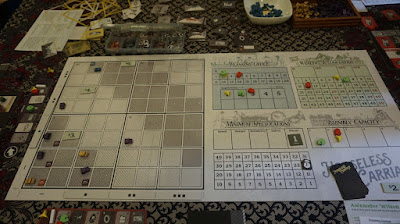

The most important part of the game board is the 8x8 grid on the left. This represents the car market in an abstract way. The X and Y axes represent two different types of requirements of car buyers, e.g. safety, speed and range. Buyers at the lower left corner have no expectations, while those at the top right corner expect many features to be available in your cars. Naturally those who have high expectations are also willing to pay more. 

The rest of the board are various tracks, including for turn order, scores and production capacities. 


You have your own player board, which is your car factory. This is the most important part of the game - how you place various tiles in your factory. I think of the player board as not just a factory. It is a representation of your car company. In addition to your production lines, you also place your dealerships, marketing departments, research departments and planning departments here. 


This is a countdown timer track. You play at most 7 rounds in a game. However some actions trigger this timer. If the timer hits zero before you complete 7 rounds, the game ends early. If the game ending early is beneficial to you, you can deliberately manipulate the timer. This also means sometimes you need to think twice before performing certain actions, because your action may cause the game to end earlier than you prefer. 
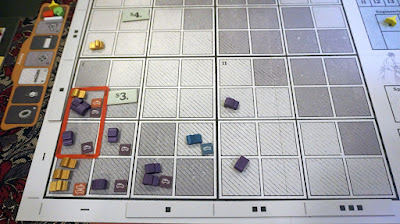

Cars placed on the board represent buyers, i.e. market demand. Purple cars are regular cars (sedans), the golden ones are trucks, and the blue sports cars. There are black squares along the X and Y axes. They represent how many features of a specific category that the buyer expects to see in your car. For example the Y axis is currently associated with safety features (light brown). Near the top left there is a truck in the row marked with two black squares. This means this particular buyer who is looking to buy a truck wants a truck with at least two safety features. 


These frames represent the reach of your dealerships. The more marketing departments you have attached to a dealership, the bigger the frame you can use. Bigger frames let you reach out to more customer segments. 


When selling cars, you place the frames on the board like this. Your dealership must fulfill the requirements of customers in all segments covered by the frame. When players' frames overlap, it means they will be competing for the same customers. Turn order for selling cars becomes crucial.  
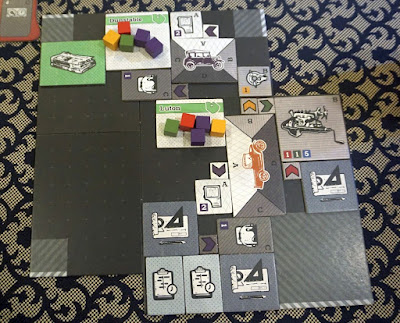

This is a factory, i.e. player board. The tiles with cars are the mainlines. They are the hubs for producing cars. They must be connected to dealerships - those white tiles with cubes. Cubes on dealerships represent how many features and in what types the cars sold here have. The four sides of a mainline are in white and three different shades of grey. These four sides allow the mainline to be connected to up to four separate assembly lines, which I'll call sublines. Let's take the orange truck mainline as an example. On the A (white) subline, there is a workstation producing doors. All tiles in the A subline must have the same white background and must be eventually connected back to the A side of the mainline. There is a purple arrow pointing at the door workstation. This indicates that the workstation is producing a purple, i.e. design, feature. This allows you to place a purple cube on the connected dealership. 

On the B subline (light grey) there are two workstations. The interesting one is on the right. It has two arrows pointing at it, green and red. This means it is producing two features, a green range feature and a red speed feature. These allow the green and red cubes to be placed on the dealership. Notice that this B subline is at the same time serving the other mainline making purple sedans. If you can get separate mainlines to share some sublines, you will save much space and heartache. 

My truck mainline has no D (dark grey) subline, because I have no space for it. I have no option to use any dark grey workstations. Tiles once placed on your factory floor can never be removed or shifted. This is very much a Splotter design philosophy. You have to plan carefully and know what you are doing. An early mistake can ruin your game. 

You will place more are more cubes on your dealerships, meaning your cars will support more and more features, in order to meet customer expectations. 


These are the tech tracks. There are five of them in total. Two will be placed next to the main board, to represent the two types of features buyers want most this round. The other three which are off board are still important and you need to pay attention to them. At the end of every round, one of the tech tracks at the main board will be replaced with one of these three off board. What buyers expect will change every round. The white bars on the three off board tech tracks represent the minimum requirements of the market. You must fulfil all minimum requirements to be able to sell your cars, and not just those two types on the main board. 

The player markers on the tech tracks represent your research level. Research level grants you access to specific workstations as shown on the tech tracks. One important rule is if your turn order is ahead of other players, you can use their techs as if you own them. This is called using their patents. It is difficult to develop all techs by yourself, so turn order is an important element to pay attention to. 

Players' research levels influence which types of features will be demanded by buyers. The more you research a tech, the more it will get prioritised to be moved to the main board next. If you want to manipulate which tech goes next and which doesn't, this is how. 


Every round you get to develop new market segments. By doing this you generate regular new demand on the main board. This particular card will create demand for four sedan cars from now until the end of the game. 


When you develop new demand, you place those tiny square tiles. Every round these square tiles generate new customers (i.e. car pieces). This is predictable and you can plan how you want to compete and which customers you want to serve. 

The Play

Horseless Carriage is a 3 to 5 player game. Han, Allen and I did a 3-player game. We were all new to the game. My gut feeling is it will be more interesting with more players, because competition will be more intense. 

Han and I had read the rules, and we both agreed that it was hard to imagine how the game worked. The rules were not that complicated. As veteran gamers, normally by reading the rulebook we can more or less figure out how a game works and what the general strategies will be. With Horseless Carriage, we felt lost and had little idea what we should be doing. It feels like having read a sentence, and despite knowing every word in it, I still don't understand what that sentence means. We had to sit down to play to start learning how the game actually works. 

The core of the game is laying tiles in your factory. It's all about planning. You start with a large factory floor. Every round after placing as many tiles as you want, you get to expand your factory floor in preparation for the next round. You will be doing this six times. By the seventh round when the expansion tiles run out, it is time for the game to end. All those tiles you get to place on your factory floor are free! The mainlines, the workstations, the dealerships, the planning departs. All free. If this game were designed by someone else, each department and function may have a different cost, and you have to make money and save up to buy them. In the end it becomes complexity for the sake of complexity. In Horseless Carriage, the designers had decided that these aspects were not the core of the game, and did away with them. I admire that. 

Every tile on your factory floor, once placed, can never be removed or shifted. This is very much in the spirit of other Splotter games. You'd better know what you're doing. This is not the kind of game that you can happily do random things and explore at your leisure and expect to be able to steadily work things out and catch up by game end. This is an unforgiving game. An early and bad mistake can doom you for the rest of the game. This is the kind of game that Splotter makes. They don't give you child guards. No catch-up mechanisms. No protection from doing stupid things. If you are going to play a Splotter game, you have to remind yourself you are an adult now and you will take responsibility of your own actions. 

By Round 2, Han, Allen and I were already stunned staring at our factory floors and repeating oh crap oh crap oh crap in our minds. Mistakes in the first round already started haunting us. It was like having dropped a pound of salt into the broth and now we had to think how to save the mess. It was disaster management. We needed to work out how to not further screw ourselves. It was funny to have three grown men brooding over a table muttering what am I doing. 

The ever increasing customer expectations are a constant source of pressure. We needed to plan ahead and predict what the market would want, and then design our factories accordingly. We had to allocate space for workstations which would help us fulfil customer expectations. There were five different types of requirements, and customer priorities changed every round. It was challenging to keep up. This is a game about long-term planning. While working towards meeting market expectations, we were also competing among ourselves. 

We didn't compete too directly in the factory building aspect. We couldn't mess with one another's factories. However the quantities of the workstations were limited. If one particular type ran out, it would be bad news for anyone who still needed that type. We still needed to watch closely how others were designing their factories, so that we could plan how to compete on the main board. You gotta know your enemies. 

More direct competition came from selling cars. If our car features were about the same, we would be competing for the same customers. Players have some control over generating market demand. If you know there are certain expectations which only you can meet and no one else, you'd want to create such customers. You would monopolise that segment. With three players, the game board felt rather spacious. However we often couldn't serve many of the customers. So maybe the game does need that big a board. Or maybe we were just horrible at playing. 


I was the only person making trucks (the golden pieces). I thought having a monopoly would mean big bucks coming in all the time, but that didn't exactly happen. Most of the time I didn't manage to produce trucks with many of the desired features, so I mostly sold to low-end customers who had little or no expectations. I only had myself to blame. Allen and Had did consider competing with me, but the truck mainline was a large piece, and they already had enough trouble managing their factory floors. They didn't want another major project to have migraine over. 

Being able to expand assembly lines from the mainline tiles is of utmost importance. This is how you keep up with customer expectations. Ideally you want to keep your options open for all four sublines A, B, C and D, but that's difficult to do. This is very much a spatial game. If you are producing two types of cars, it is best if they can share some sublines and workstations. That's going to save you a lot of pain. 


We only played 5 rounds. By then, the result was clear. Han produced sports cars, and he managed to create a group of high-end buyers which only he managed to sell to. His sports cars had many features and round after round he focused on selling expensive toys to these rich boys. Sports cars themselves were already more profitable than regular cars. Being able to serve the high requirement segment meant even more profit for Han. Allen's sports cars couldn't compete, and I didn't make sports cars at all. By Round 5 we knew it was impossible to catch up to Han. 

The Thoughts

Horseless Carriage did not disappoint. It is a heavy Euro strategy game, very much in the Splotter style. This is the kind of game hardcore gamers like. I like that the game doesn't rely on too many rules or too complicated rules to create a rich and interesting strategy space. It is not minimalistic. It uses just enough to make the game work. Some simple and seemingly innocent rules have much tactical consideration behind them. No doubt this is a heavy game, so it is not for players new to the hobby. 

Designing and expanding your factory is a spatial challenge. It is the bulk of the game. It reminds me of Uwe Rosenberg's polyomino games. That's essentially what you're doing right? But here the gameplay is much more complicated. It is not just about filling spaces and leaving as few holes as possible. There is much more you need to consider. Horseless Carriage also reminds me of Martin Wallace's Automobile. They share the same setting. The mechanisms are vastly different. Automobile is less complex, but not by any means a light game. I like them both. Horseless Carriage made me itch to play Automobile again. 

Some of the earlier Splotter games like Antiquity and Indonesia get complaints about being fiddly. Indeed they have some components which are tedious to manage during play. I am not too bothered, as the enjoyment is worth the trouble. The fiddly part of Horseless Carriage would be those flimsy plastic frames. When we played, if we could tell apart our dealership ranges easily, we didn't bother to place the frames. Only when we had overlaps, and thus direct competition, then we used those frames. They are still a useful visual tool, just a bit difficult to handle. 

I thought about whether Horseless Carriage has enough player interaction. You can't mess with your opponents' factories, so that part of the game, which is the most important part, feels a little like multiplayer solitaire. In our game, Han cornered the billionaires sports car market, and there was squat Allen and I could do. Eventually I concluded that there is plenty of player interaction. You do have to be acutely aware of what your opponents are doing, and you have to think about what they are planning to do. You have to decide where to compete and where to concede. In our game, there were parts I felt helpless about, but it wasn't due to a lack of player interaction. I had already missed the opportunities to do something well before I got to the helpless situation. Horseless Carriage can be a brutal game, and I love that. It has both a rich strategic layer and a complex execution layer. You can't neglect either one. I like how important the strategic layer is. If you fare poorly at that level, no amount of good execution will save you. 

This is the way.