Showing posts with label Collectible Card Games. Show all posts

Friday, 9 May 2025

Altered

The Game

Altered is a CCG (collectible card game) released in 2024. It is a two player head-to-head game. In typical CCG’s you fight to the death. Not so in Altered. Each player has two characters, a hero and a companion. They start at opposite ends of a track. Your goal is to help them advance until they meet. Your opponent is doing the same, and whoever makes hero and companion meet first wins. 


During a round of play, you take turns playing cards until both players pass. Playing cards usually requires spending mana. At the start of the game you must pick two of your hand cards to become mana generators. Such cards generate mana every round. At the start of every round you have the option of setting aside one more card to be a mana generator. You will be permanently increasing your mana pool. This is important because you want to be able to play more cards and also play more powerful cards.


Cards played give you strength in three different elements. The location of a character tells you which elements they need to be strong in to allow them to advance. For that element, they need to be stronger than the opponent’s equivalent character in order to advance. A location may have two or even three elements. You only need to be stronger in one of these elements to advance. Your character and your opponent’s might not be at the same location, so they might might need different elements to advance. When they are at the same location, if the location has two or more elements, they might both advance due to each being stronger in a different element. 

Since you have a hero and a companion, when you play a card, you have to decide who to play it for. At the end of a round, cards played leave the play area and go to a reserve area. Hero and companion strengths are reset. Cards in your reserve area are open information. You can play them again, but after that they will leave the game instead of going to the reserve. The cost to play a card from reserve can be different. You can see what cards are in your opponent’s reserve, and this is something you need to defend against. 

Your deck has a hero card, and it defines a special ability for the whole game. When you customise your deck you’d want to utilise well this special ability. 

The Play

This is a race game. If you play perfectly and both your characters advance every round, they will meet in Round 4. Although the premise is less gruesome than typical CCG’s, it doesn’t mean this is a “nicer” game. You are not only trying to advance, you should also be trying to stop your opponent from advancing. 

Strengths are reset every round. It is important to manage your resources for long term success. You need to manage your mana pool. In the early game you will likely be adding a card as mana every round, and then at some point you’ll feel it’s enough. However there are no hard and fast rules. Depending on the situation you might choose to do something out of normal. The cards you have is also a resource to manage. You need to know when and where to play them, and when to conserve them. 


I played against Han on BoardGameArena.com. This seems to be a popular thing to do now - make a game available for free on BoardGameArena to get it lots of exposure and to get people excited to buy it. Gameplay is smooth and straightforward. I did not really inspect my deck before I played, nor was I familiar with Han’s deck, so I have not actually explored the meta game, which should be the most interesting aspect of a CCG. I only tried the core mechanism. The game felt less directly confrontational, but it is still pretty competitive. You have two characters to advance. Resources feel limited and you have to make hard decisions. One dilemma you will sometimes have is whether to do something that helps your character advance, to do something to stop your opponent’s character from advancing. That’s choosing between rushing and stalling while building up strength. 

The Thoughts

I am not a CCG person so I am probably not doing this game justice. Altered introduces a few novel ideas. At the moment it feels more or less like other CCG’s. There is the growing mana pool which creates that feeling of escalation. I imagine a big part of the fun is in the deck building and the meta game. You will enjoy this more if you have a group of opponents to play with regularly. 

The good news is you can try the game for free on BoardGameArena.com and you can experience several starter decks. 

Thursday, 13 February 2025

Star Wars Unlimited

The Game

Star Wars Unlimited is a 2-player battle card game. It is a collectible card game and you can do deck-building with it. What is most attractive about it is, of course, the Star Wars universe. You get to see all those familiar characters, weapons, and spaceships come into play. Other than that, it seems to me to be pretty much standard fare. That said, I am not an expert in collectible card games, so I might be missing some of the nuances. 

To win the game, you need to reduce your opponent’s health points to zero. Every turn, you draw cards and play cards. You may always play one card face down before you as a resource. There is no limit to the number of resources in front of you. To play a card face up, you need to pay the resource cost, and you do this by turning your resource cards 90°. Your resources are reset at the end of your turn. This aspect reminds me of Hearthstone, the digital CCG. Every round you get more and more resources, which will allow you to play more cards and better cards. In Star Wars Unlimited, the dilemma you have is which card to sacrifice as a resource. This is not always easy.

Other than the resource cost, every card also has an attack value and a defense value. Face up cards can only be used once per turn to attack. You can choose to attack the opponent base to reduce their health points, or you can attack one of their units. There is one restriction regarding unit type. Ground units can only attack ground units, and space units can only attack space units. Both unit types can attack the opponent base. When a unit takes damage, the damage is accumulated as long as it hasn’t reached the defense value. The unit is killed once the defense value is reached. 

Players control a general, and this is the player’s character. The general has a unique ability. It can also be deployed as a unit by paying the cost. When the general dies as a unit, it doesn’t actually die but just returns to being your general. However the general can only be deployed once as a unit. 

My base and my general

Some weapons are tucked under characters to modify their abilities. 

We used dice to keep track of modified attack and defense values.

Units have various icons, and this is something you need to consider when building your deck. Usually cards with the same icon combo well with one another. There are abilities which depend on icons. 

Icons are at the top left, below the card cost. 

The Play

The game starts slow and there is a gradual escalation because of the resource system. In the early game you probably want to play a card face down as a resource every round. Later when you feel you have enough, it might be better to keep and use those cards. The card abilities mostly match the Star Wars theme so that is fun. One interesting dilemma is whether to attack your opponent base or his units. You know the base is your ultimate objective, but if he is building a nice combo which can cause you a lot of pain, you may want to break it up first. 

Cards have interesting abilities. Some characters from the movies combo well, e.g. R2D2 and C3PO, and that’s fun to do. 

The Thoughts

Star Wars Unlimited feels like a pretty standard collectible card game and head to head battle card game to me. It’s on the simpler end of the spectrum so it is easier to pick up for a wider range of players. This will be a game you can use to attract casual gamers because of the Star Wars theme and the relative ease of play. 

Friday, 19 July 2024

Siege Storm


The Game

Siege Storm is a 2-player head-to-head battle card game with a fantasy setting. You each have your own deck of 34 cards. Every card is a fighter. Cards are also your basic currency - gems, which you need to spend to play cards. Your deck is your life points. Your goal is to make your opponent exhaust their deck before you do yours. It's a fight to the death. 


The game box has two compartments for the two decks that come with the game - a good guy deck and a bad guy deck. Seraphia and Styxia. The game has expansion decks so you can play with other factions. 

The factions have different card backs. 


There is only one card type in the game. They are all fighters. The number at the top left corner is the cost to play a card. You pay in gems. Your cards are gems. That means to play a card, you will have to discard other cards from your hand. The number at the bottom left is the attack strength, and at the bottom right corner the defense strength. There are two powers in the centre. The action is what you can perform immediately by playing the card as an action. If you play the card as a fighter, the action can also be triggered after three rounds. The passive ability takes effect as long as the card is in play and face-up. 

This game lets you to do deck-building. A playable deck requires 34 cards. You get more than that number of cards for both the factions. Some cards are marked and they are the recommended deck for beginners. Once you get familiar with the game you can customise your deck. Duplicate cards are allowed. 


A game is set up like this. The three cards at the centre represent the front line. You can send fighters here to hold ground. The purpose of holding ground is simply to allow a fighter's passive ability to remain in effect. The three stacks on the right are your draw deck, just that it is split into three. This is for the sake of providing a visual cue for how many life points you still have. You always draw cards from the top deck. When one deck runs out, you move on to the next one. 

The space between the front line column and your health bar column is the marching column. This is where you deploy fighters and where they advance. You always deploy a fighter at the bottom position. Every turn, your fighters move forward one position. When they advance from the top position, you must decide what to ask them to do. You have three options. You can get your fighter to storm the opponent. The action of the card is triggered. Your fighter also attacks your opponent or one of their fighters. Or you can position your fighter to hold ground, i.e. to camp at a front line position. Or you can convert your fighter to play a support role. From that point onwards, it gives you a discount when you play cards. 

These are the core mechanisms of the game. Not very complicated. The cards have various abilities, and that's where things get more interesting. The various card abilities define the characteristics of the factions. 

The Play

When playing a game of this nature, I can't avoid comparing it against Magic: The Gathering. I'm a newbie in Magic. I have only tried it a few times. Siege Storm has a different core system, but I consider it a similar kind of game. Every turn you will draw cards and thus deplete your life points. You can look at this as a benchmark. You need to play your cards well to deplete your opponent's life points efficiently. Much more efficiently than 2 cards per turn. 

One difficult decision you have to make in the game is which cards to play and which cards to sacrifice as payment for the card you play. This is similar to Race for the Galaxy. This is sometimes quite painful. Another decision which can sometimes be tricky is whether to play a card as a fighter or as an action. The action would be immediate and impactful, but if you play the card as a fighter and wait three turns, you will have more options. You can storm, i.e. launch an attack. You can have the fighter hold ground, i.e. extend its passive power. You can create a supporter, i.e. long term discount. If you play a fighter, your card is exposed and you are giving your opponent time to prepare to respond. If you see a powerful attack coming, you probably want to deploy a high defense fighter as a shield. 

You won't be able to play all cards. Some will be spent as payment. 


Now my opponent has two fighters on his marching path and one of them is about to strike. I only have one fighter on my marching path, newly deployed. This is in preparation for the impending attack. 


The face-down card at the bottom left is a support minion. This was a fighter which had completed its march and I had chosen to turn it into support. Horizontal placement means I have used its discount power this turn. I will reset it to vertical orientation at the start of my next turn. 


To play well you need to be familiar with your deck, and your opponent's as well. It will help you plan and strategise. The luck of the draw will affect how you play. You need to be flexible. You do know what cards you have in your deck, so you can anticipate what will eventually come. It seems to me in the early game you should send fighters to hold ground (so that you enjoy the long term passive abilities) and also to play support (so that you get discounts for the rest of the game). These seem to be simply sound preparation and build up. There are some cards which let you launch early and effective attacks, which is contrary to this general strategy. Probably there will be more different tactics with other decks. I am only scratching the surface now. 

The Thoughts

If one-on-one battle card games is your thing, Siege Storm is worth checking out. It's short and sweet. It's pretty. I'm not really into this genre, so at the moment I have only taken a quick taste. There is certainly more of it I have not seen or appreciated. I think you'll need many more plays and also you need to fiddle with the deck-building aspect to fully enjoy the game. The two factions in this base game are quite different and have their unique styles of play. The good guys can heal themselves by moving cards from the discard pile back to the draw deck. They also have some expensive but powerful angels. If you get rich enough, deploying an angel can deal a killer blow to your opponent. The bad guys have some disposable but quick and strong units which can be sent on early suicide missions, messing with the opponent's tempo. I checked BGG and there are four other faction decks which have been released. 

Friday, 20 October 2023

revisiting Android: Netrunner

Android: Netrunner is a 2012 game, originally designed by Richard Garfield, who created Magic: The Gathering. The original Netrunner was published in 1996. That version had only two decks, corporation and runner, and no expansions. The 2012 Android: Runner was designed to be a living card game with many expansions. It is similar to but not exactly the same as a trading card game. Expansions are fixed packs instead of random packs. You don't need to spend a lot of money buying many blind packs hoping to get the specific cards you want. Android: Runner used to rank very high on BoardGameGeek.com. In 2018, Fantasy Flight Games decided to terminate the game series. I was quite surprised at the time. I thought the game system was still very popular. Although there are no more official expansions and no official support, some players have organised themselves to develop and publish new expansion packs. There are still people actively playing the game. 

I've always had some hesitation going into a game with such depth as Android: Netrunner. These are what people call lifestyle games. Like Chess, Go, Magic: The Gathering, you can be a player who plays just one game. Just one game is enough to keep you busy and happy. In fact, you need to devote enough time to such a game to truly enjoy it and appreciate it. The analogy is friends with deep and meaningful relationships. In boardgame terms, I tend to be the extroverted socialite and I prefer discovering and playing many different games. 

I have played Android: Netrunner before. I own the base game and quite a number of expansions. So far I have only used some basic decks and decks designed by other players. I have not yet ventured into building my own decks. That means I have only skimmed the surface. It had been quite a while since I last played. I remembered the game fondly, but by now I had forgotten most of the rules and had to read the rulebook all over again. I decided to try to get back into the game because I bought more expansions this year. I have been buying expansions when I come across them on discount. I can't resist. I keep telling myself I'll get back into the game some day. I asked Allen to join me in learning the game system. He lives nearby so it's easy to arrange to play. We have both been playing games less in recent years, busy with work and life. If we set a goal, it may help us to get back into more regular gaming. Middle aged uncles need to be reminded to allocate some me time, or we time. Making a living should not make us forget to live a life. 


I asked Allen to play the runner (hacker). I think it's more fun playing runner. Android: Netrunner is a 2-player-only game, about hacker vs corporation. The corporation has some agenda to complete, and the runner is hacking into the corporation's servers to try to find and steal them, before they are completed. The photo above shows the play area of the corporation player. The row of cards near the bottom represents the various servers. The horizontal cards above the servers are shields protecting them. In game terms they are called ICE - Intrusion Countermeasure Electronics. Servers can be cards played by the corporation player. Hand cards, draw deck and discard pile are also servers which the runner can attack. 

The game is not just runner attacking and corporation defending. Some ice are traps and can cause damage to the runner. Although the initiative lies with the runner, the corporation certainly has many ways to trick, trip and hurt the runner. 


Allen looks troubled. This is a game with quite a lot of text to read and digest. When you get more familiar, it will be much quicker. The runner's play area is much simpler. You have your draw deck and discard pile, and three rows of various equipment (in this photo he only had two types of equipment, thus just two rows). 


As the corporation player, having agenda cards in hand is anxiety inducing. The runner can decide to attack your hand cards, and if he is successful, he randomly draws a card. If it is an agenda, it is claimed and scored by the runner. The runner needs to score 7 agenda points to win the game. In this photo I had two agenda cards, the first and third cards, and they are worth 3 and 2 agenda points respectively (number on left edge). 


This wasn't my first attempt at relearning Android: Netrunner. I think not even the second time. It had been a while, so I couldn't even remember for sure which attempt this was. This time round it felt easier to get into. It didn't feel as complicated as I remembered it to be. Both runner and corporation need to find ways to earn a steady income, because many actions require money. The corporation is generally defensive, always needing to protect the agendas and needing to put on a poker face. Sometimes the corporation plays aggressively, setting up traps to catch the runner unprepared. There is greed and risk-taking on the runner's part, and the corporation tries to make use of that. The corporation sets up ice (shields). The runner installs programs to overcome them. The corporation advances agendas to score them, before they get stolen by the runner. 

An agenda card

A piece of ice


Playing ice is free, unless you have more than one ice at the server. You only pay when you activate it to stop or hurt the runner. The more powerful the ice, the higher the cost. 


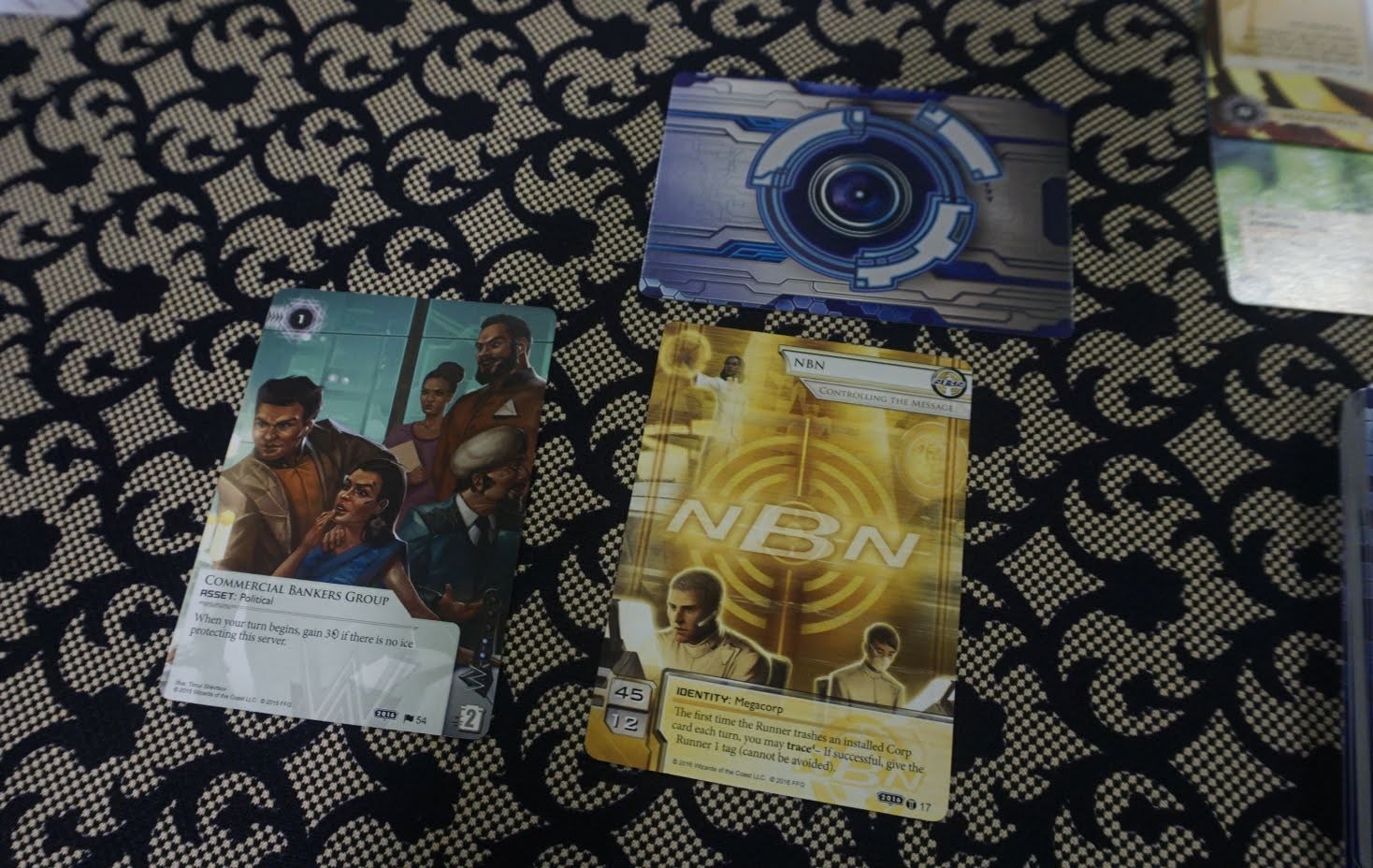
I bought two preset decks which were the winning decks in the 2016 Netrunner championships. I am lazy to build my own decks, so using the best player's deck is great, even though it'll take time for me to learn to utilise it well. This above is the winning corporation deck. 

I notice the graphic design has changed. The card on the left is the newer version. The image is zoomed in and enlarged, but the font is smaller. I find the text too small. Both Allen and I struggled to read the text. This design is not senior citizen friendly. 

Friday, 25 January 2019

Keyforge

Plays: 2Px1.

Keyforge is arguably the most important event in the boardgame / card game industry in 2018. The designer is Richard Garfield, who created Magic: The Gathering. Keyforge is declared a unique card game - each deck that you buy is different from every other deck in the world. This is a very new concept. Keyforge is not the only game which features this, but at least for now it is certainly the one with the highest profile. It is introducing a new business model to the hobby.

Keyforge is a 2-player head-to-head card game. Each player has his own deck of cards. There are 7 houses (factions) in the game, and every faction has its own cards. A deck that you buy has 12 cards each from three different houses, making a total of 36 cards. There are 7 factions, and each has many cards, so there are plenty of permutations to make a deck of 36 cards. Duplicates are allowed - one of the decks I bought has two copies of the same card. That makes even more permutations. Every deck has a unique name and card back, so you can't take a card from one deck and mix it with cards from another deck. Well, technically you can if you use card sleeves with opaque backs, but it's against the spirit of the game and also the official rules. So the business model is different from collectible card games and trading card games. In CCG's you buy packs of cards to collect individual cards, and use the individual cards to build your own deck (which can be the same as someone else's). Rare cards are not easy to collect. You may need to buy many packs to accumulate, say, a set of four. It may be cheaper to buy them from specialty shops selling single cards. In Keyforge you are buying a specific deck of cards, generated by an algorithm to make sure it is playable, and to make sure it is unique. You can't customise your deck. You see what you get and try to make it work for you.

Keyforge has a starter box, which is the recommended way to get into the game system. It contains basic components (markers, mostly) you need to play the game, and four decks of cards. Two of the decks are preset learning decks. It is the exact same two decks in every starter box. They are designed to ease you into the game system gently. The other two decks are regular decks - they are unique. The starter box sold out soon after game release. I had planned to try Keyforge, but had not preordered it. By the time I wanted to buy, it was too late. I would have to wait for the reprint. However, many people feel the starter box is unnecessary. Those two learner decks are not really valuable. You can probably borrow it, or even get them free, from people who have bought the starter box and are now done with them. They are a tutorial basically. As for the markers and such, you can use other generic markers. Not as pretty, but it's workable. Then what's left are the two unique decks. For the price of the starter box, you can get four unique decks, thus the argument that the starter box is unnecessary. I was planning to buy the starter box, for the components. It would be nicer to play with the official components. Unfortunately I did not have the option to buy it, since it was temporarily out of print. I didn't want to wait, so I bought two individual decks instead.

These two are the decks I bought - Tobias "Neurosis" Lilafiddler on the left, and Rector J. Litblade on the right. When you buy a deck you don't know which houses it contains. I am glad that my two decks cover 5 of the 7 houses. I want to try as many different houses as possible. The only overlap I have is Sanctum.

When you open the box of an individual deck, you will find the deck of cards wrapped in transparent plastic. The top card lists all the cards in the deck, so without taking off the plastic wrap, you can see the content of your deck. I saw some players selling unplayed decks at half price on Facebook. These unplayed decks still had the plastic wrap, so I am guessing they looked at the card lists, didn't like them, and decided to sell straightaway.

The Game

Only now I am getting to the actual gameplay. Keyforge is a 2-player only game, in which you race to forge three keys. You need to collect 6 ambers to forge one key. You use the abilities of your cards to collect amber, and you try to do it more efficiently than your opponent. Each player has his own deck of cards. If you use up your deck, you reshuffle your discard pile and continue. Normally your hand size is 6. There is no limit to the number of cards you may play on your turn. At the end of your turn you always draw up to your hand limit.

On your turn you must pick a house to be your active house, and on that turn you may only play and use cards of that house. This is a key concept in the game. The are four types of cards in the game. Creature cards you have deployed can help you mine amber and fight your opponent's creatures. Artifact cards are placed behind your creatures. They give you long-term benefits and normally don't get involved in fights. Action cards have effects that are resolved immediately, and they are then discarded. Upgrade cards are attached to your creatures, giving them additional abilities. They live and die together with the creatures they are attached to. There is no concept of attacking your opponent in this game. You are not trying to kill your opponent. You are racing to forge your third key. When your creatures attack your opponent's creatures, your main objective is to slow him down. Creatures can help to gather amber.

Creatures and artifacts enter play in a horizontal position, which means they are exhausted and cannot be used yet. Exhausted cards are reset at the end of your turn. Whenever you use a card, you turn it horizontal so that you remember you won't be able to use it again this turn.

Forging keys is simple. Whenever you have 6 or more amber at the start of your turn, you must forge one key. Even if you have enough to forge two or more keys, you still only forge one. The next key has to wait for your next turn.

There's an archive concept in the game. Some cards let you deposit cards into your personal archive. At the start of your turn, you may take all cards out from your archive. The archive is useful for saving up for a big play. You can save many cards of the same house into your archive, and then take them all into your hand on the same turn, to be able to play many cards of that house within one turn.

The first row is my creatures. I use the green chip to indicate that creature is Stunned, i.e. unable to act until the Stunned status is removed. The second row is my artifact. This particular artifact has the Omni keyword, which means it is active regardless of my active house. The stack on the left is my discard pile. I use the dice on the right for tracking my Chains, since I don't have the official game components for doing this. The Chain concept is for temporarily handicapping a player, reducing his hand limit. When you have 6 or fewer Chains, your hand limit is reduced by 1. If you have 12 or fewer, it is reduced by 2, and so on. Dice work nicely for tracking this, because every dice you need equals one card fewer. Every turn your Chain reduces by one, so eventually you will be back to your normal hand size.

The pink chips at the top right are for tracking injury. The blue chips for increased Power. At the far left, the purple chips are amber. The leftmost card is my character card. It is for storing amber and keys. Next to it is the draw deck, and then the discard pile. On the right, the first row is the creatures, the second row the artifacts, and at the bottom the archive.

The above are the basic mechanisms. There are a few other concepts I want to mention. There is a Capture concept where your creatures Capture your opponent's amber and keep it until they get killed, after which the amber is returned to your opponent. You can't use such Captured amber yourself, but this slows down your opponent, and that's valuable. There is a Steal concept where you actually take your opponent's amber and make it your own. This of course is much more powerful. It slows down your opponent and speeds you up at the same time. There are many concepts and keywords which are applicable specifically to creatures and how they fight. Some creatures are Elusive, and do not get injured the first time they are attacked. Only when they are attacked a second time within the same turn that they would be injured. Poisonous creatures kill their targets as long as they are able to deal damage, even if the damage dealt is less the health value of the target. Creatures which can Skirmish take no damage when attacking. Many of these concepts will be familiar to CCG players.

There really is not a lot to the basic game mechanisms. By themselves they don't define what the game is. To truly get a feel of the game, you need to look at how the 7 houses are designed, what kind of powers the cards have, and what kind of interactions and strategies emerge form all of these.

The Play

I asked Allen to try Keyforge with me. Neither of us are CCG players. We have played some 1v1 card games, but not many. We dove in without much preparation or study.

The game flow feels quicker, compared to CCG's that I have tried. Not that I have played many, or played much of them. One reason for the brisk pace is there is no currency concept. You don't need to spend mana or money to play a card. You can play a card as long as it belongs to your active house of the current turn. You don't worry about generating enough mana, or generating enough mana of a specific type.

Selecting your active house is not as straightforward as it sounds. Although playing cards is free and you can play many on the same turn, most of the time they enter play in the exhausted state, so you don't get to use their powers immediately. To be able to use their powers, you need to select the same house again the next turn. By then, you may not have that many cards of that same house to play. Sometimes you are torn between wanting to play cards and wanting to use cards.

The is a race game, and collecting amber is what helps you win. Creatures mine amber for you, so you probably should not think of them as fighters who can do some mining on the side. They are actually miners who can do some fighting on the side. I'm making the game sound like one of tin-mining gangsters (Yap Ah Loy retheme anyone?). The game is first and foremost about forging keys, not fighting. Fighting is just a means of slowing down your opponent. When he has fewer miners than you, you will mine amber more efficiently.

Each of the seven houses has its characteristics. You want to play to their styles. Your deck will have cards from three houses, and you will try to make them complement one another. Things change quickly. Sometimes many cards enter play at the same time. Sometimes many creatures get killed by a single clever play, wiping the battlefield clean. This is exciting and fun. Each side tries to squeeze out some advantage over the other, and also try to negate any advantage the other side is having. When you get more familiar with the houses, you can anticipate better your opponent's plays and thus plan better how to play against him.

These are some cards from House Mars. Zyzzix the Many (bottom left) and Incubation Chamber (bottom right) let me put cards into my archive. Orbital Bombardment (bottom centre) lets me deal damage to opponent creatures depending on how many Mars cards I have in hand. If I use the first two cards to stockpile many Mars cards in my archive, then draw them all on one turn, then play Orbital Bombardment, I would be able to deal a massive amount of damage.

These are House Sanctum cards. The Sanctum faction is a faction of noble knights. They protect (increase armour) and they heal. The cards in the bottom row all have an orange gem at the top left corner. This orange gem is amber. When playing such cards, you gain amber.

The Thoughts

If I am to talk about the game mechanism, I can say this is a fast-paced game where the board situation changes quickly. It is fun trying to make effective combos. The houses do feel different, and feel like they have consistent stories. The same can be said of many similar card games though. Keyforge doesn't seem significantly better or different. In terms of craftsmanship and design quality, I think it is top-notch and it does not lose out to other top games. The only more obvious difference I see is it is more streamlined and fast-paced.

What's more interesting to talk about is the whole game system and how it compares to other games as a hobby. When comparing Keyforge to games like Magic: The Gathering and Android: Netrunner, the analogy that comes to mind is mobile games vs PC games. Normally "mobile games" is derogatory, but I don't mean it that way here. Mobile games fill a different need. You play them in your fragmented time. You don't need to sit down and commit one or two hours to enjoy them properly. They are easy to get into and they appeal to a wider audience. They are not limited to hardcore players. It is not surprising that some hardcore PC gamers consider mobile games not proper games. Keyforge has no deckbuilding. The deck is already built for you. You just play. You don't worry about collecting cards to build a dream deck. You don't need to spend a lot to get into it. You just need to buy one deck, then find other players in your community. I bought the Android: Netrunner base game and many expansion packs, but I never really got into it because I couldn't set aside the time to learn it properly and to do deckbuilding. I couldn't commit to playing regularly with other enthusiasts. Netrunner takes more effort, but it is also rewarding when you learn to play well and when you play against other good players. Keyforge requires much less commitment. You can play casually. It feels less intimidating because I don't need to spend time on deckbuilding and studying how to make good decks. I just make the best of whatever deck I play.

Another analogy is dating vs marriage. Marriage is a big decision and needs commitment. A date is much more relaxed. Not that you are not serious about it, just that you are not expected to make any promises. Let's just play and see where it goes. Keyforge feels like a much more welcoming game, and more suitable for casual play.

Quite a few boardgame cafes and groups in Kuala Lumpur are doing Keyforge events. I have not joined any, nor am I part of any local Keyforge community, so I'm not really sure how things work. Magic and Netrunner are games that need communities. You want to regularly play with various people with different decks and play styles. Everyone regularly tweaks his decks. This is what keeps the games interesting. You can play the game again and again because if this variety. You fellow players are creating new content for you to enjoy, as you are for them. You learn from one another and grow together. I think CCG's are inseparable from their communities. If the community is lacking, the game as a hobby feels incomplete. I think Keyforge needs a community too, even if the level of commitment required is less. I think a big part of the fun is getting to play with and to play against many different decks. Every deck in the world is different!

I imagine players in a Keyforge community can regularly trade decks. Once you've played enough of a deck, trade it with a fellow player, and both of you will get to try something new. It's win-win. If it's a deck you like and want to keep, you can still lend it to your friends.

I am curious how Keyforge will be like as a consumption model. I have seen people buy decks, open them to see the card list, and then immediately deciding to sell them without even opening the plastic wrap. A deck is not expensive, so for a player to be regularly buying and trying out new decks is a reasonable consumption model. This may be cleverer than CCG's. In Keyforge I may be buying the same card many many times, but because it appears in different decks, the card backs are different, so these many copies of the same card are not really the same. I wonder whether an average Keyforge player will be spending more than an average Magic player in the long run. Netrunner players probably spend less than Magic players, since they buy a finite set of expansions.

I wonder whether there will be new cards introduced to Keyforge. Or maybe the question is when, not whether. Magic has a regular release schedule, introducing new cards and expiring old cards (expiring as in disallowing them in standard tournaments). The game stays fresh. Players get new toys to play with. The game company continues to make money. It's good for all. I wonder whether Keyforge will have something similar. I don't think the business model, the consumption model, or how Keyforge works as a hobby is stable yet. The game designer and publisher may have their intentions for the game system. I wonder whether the game system is shaping up to be what they had imagined. I am curious to see how this goes.

Wednesday, 11 June 2014

random thoughts on Hearthstone

I've won 144 games on Hearthstone. Assuming my win rate is about 50% (which is quite optimistic of me) I should have played around 300 games now. I still enjoy the game very much. So far I have only completed one season (end of May 2014), and the highest rank I managed to reach was 15 (lowest is Rank 25, highest is Rank 1, and above Rank 1 there is a Legendary Rank). I hovered around Ranks 16 to 18 at end of May, but recently I have been doing rather poorly, being stuck at Rank 20. At Ranks 20 to 25 you can't drop ranks. Else I probably would have fallen further. I'm not sure what I am doing wrong. Or is it that there are more and more good players? Or the system is matching me with more experienced players, who are mostly better players than me? Despite the many losses, I still like playing in Ranked mode, because I get to play against strong opponents. I like the challenge and the tension.

There are some characters that I prefer over others, e.g. I like playing Warlock and Shaman, I don't quite like playing Druid, but generally I play all characters and don't have any strong preference for any one character. I pick characters based on the quests available. I have constructed one deck per character. I don't fiddle with my decks much. Sometimes when I keep losing with a particular deck, I'll review it and fine-tune it. But generally, I just play.

I get annoyed when I run into players who use many legendary cards. Legendary cards are powerful cards. You can only have one copy of each in your deck, unlike regular cards which you can have two copies of. Since Legendary cards are usually quite powerful, I often have no counter for them. I don't have many Legendary cards myself, so when I see an opponent playing one Legendary card after another, I feel helpless. I also feel frustrated because I feel I'm losing because of the cards he has access to, and not necessarily because he has built his deck better or he has played more skillfully.

I admire players who make very clever use of common cards, and players who hold back cards to be used at the right time. Not players who rely on many powerful cards.

I see some common combos. There is one where a Priest player plays a spell card to double a minion's health, and then another spell card to increase its attack value to be the same as its health value. That minion can become so strong that it can killed off the opponent Hero that same turn. The first time I saw this, I thought it was a very clever combo. However after I encountered this a few more times, I found it to be formulaic, unimaginative and annoying. I prefer opponents who have variety in their decks and who are flexible. Repeatedly used formulas and standard killer moves bore me.

Sometimes it's not just specific combos of a few cards, it's also generally how a deck is constructed. For example a deck with many murlocs is easy to build - just search for keyword "murloc" - and it can be very powerful because murlocs often boost one another's abilities. There is not much skill in building a murloc deck, and there is not much skill required to play a murloc deck effectively. I think it's quite one-dimensional. Thankfully I don't run into murloc decks all that often. If I do, then the fun is in seeing whether I can defeat it, despite knowing how powerful it can be. I am not so keen about using a murloc deck regularly myself.

I am more and more familiar with the characters and their cards now, so when I play I start to anticipate what cards my opponent may have, and I try to avoid getting myself into situations where he can deal a devastating blow. It is very satisfying to be able to reach this next level of play. There is more to think about. There is more skill involved. I think this is what makes CCG's so captivating. The fact that I'm ranting about some of the annoyances I have with Hearthstone means I'm really getting into this game, so it's a good thing. It is rewarding.

I usually just play two or three games per day, which is not all that much. Some days I play a bit more. Some days I don't play. It is very convenient to pick up the iPad and just play. The game is quick and smooth, yet is still challenging and has some depth.

I have been hoping to get to this level of play with Android: Netrunner - to go beyond the initial floundering and to start appreciating and utilising the intricacies of the game. I've installed the software to play Android: Netrunner online, but I still have not actually tried using it. It's a PC-based software, so it's not as convenient or user-friendly as Hearthstone on the iPad. Also the player pool is much smaller. I am still hesitant because it's a little intimidating, but I hope I can bite the bullet and delve further into Android: Netrunner. It is a more complex game than Hearthstone and I think it will be even more satisfying if I commit the effort to learn to play it well.

Sunday, 4 May 2014

Hearthstone thoughts

I think I have played about 60 games of Hearthstone by now, and I'm really enjoying it. This is the first time I got this far with a Collectible Card Game (CCG). I have never played this much of any other CCG's before, or LCG's (Living Card Games). Basically I have never gone in depth into any CCG or LCG. With Hearthstone I'm now tinkering with a bit of deck-building. I don't consider myself anywhere near being an expert, but I am enjoying the game immensely. I don't feel any pressure or urge to spend real money to buy cards. The game already comes with many free cards, and by simply playing as the 9 different characters you can earn more free cards, at least until they advance to Level 10. The daily quests (usually along the lines of winning a certain number of games using a particular character) award gold, which can then be used to buy card packs. I usually just play to complete these quests, and the gold I earn allows me to buy a new pack every few days, which I'm quite happy with. Here are my random thoughts about the game.

Having many cards in hand is important, and so is drawing more cards than the standard one-card-per-turn. More cards in hand means more flexibility to react to threats. Holding many cards in itself is also a threat, and makes your opponent think twice before making any move, because he will worry about whether anything he does will invite a deadly counter-attack. I have learned that it is not always a good idea to try to play as many cards as you can, fully utilising the mana gained during your turn. Sometimes it is better to just hold on to a card, and only play it when the effect is greatest. Some cards should be saved for more desperate situations. It is still important to keep playing minions and attacking your opponent, to maintain a pressure on your opponent. It is just that you must try to have a reserve so that you have some flexibility. I always get nervous, even if I'm winning, when I'm out of cards and can only rely on that one card draw per turn.

It is important to know your opponent's character - the general style of play as well as the specific cards for the character that he may have in his deck. Knowing these means you know what to watch out for, so that when you play you avoid making risky moves. For example, one of the characters has a spell which can turn any minion into a frog. So if you have enough mana to play two medium-strength minions or one-high strength minion, you may want to go with the two medium-strength ones. I'm just getting into this level of play, and I find it very enjoyable. When you get decimated by the same card a few times, you start to remember it.

If you want to have a coherent strategy, or a specialised strategy, you probably want to do deck-building. The game allows you to play with a random deck or with your own pre-built deck. I'm not sure how the system builds your random deck. It probably just follows some generic formula, like how many minions and spells of a certain cost, and how many character-specific cards plus how many neutral cards. The system-built random decks seem to work at a basic level, but if you want a bit more control and if you want to experiment with certain strategies, then you have to spend the effort to deck-build.

One opponent showed me a very impressive move. He didn't have many fancy minions, and during our game I felt I had a slight lead. Then suddenly within one single turn he killed me using his lone mediocre minion. He played a spell to increase the minion's health, then played another spell to double its health, then played yet another spell to increase the minion's attack value to be the same as its health. Suddenly, I was facing a 22-attack, 22-health monster grinning down at me. Game over.

Sometimes when I lose I whine that the other guy won because he had better cards. In the back of my mind, I don't think it's always true. I feel most if not all powerful cards have some way to counter them. Usually if you know your opponent may have a certain powerful card, you can adjust your play to mitigate the impact of getting hit by it. Of course there is still some luck, this being a card game. Even if you have the right cards to counter a certain powerful card, it doesn't mean you will draw them at the right time. I don't play very competitively. The game offers casual play as well as ranked play. At the moment I'm comfortable not spending real money to buy cards to boost my strength. Maybe later on, if I get very competitive, but at the moment I don't see it. I'm thankful that Blizzard offered this game free. I'm sure there will be players who decide to buy cards, and I don't see it as a bad thing. Blizzard has produced a great product and they deserve to make money from it. In fact I feel I should spend some real money. Maybe I'll buy some packs just to support them.

I get annoyed when an opponent can already kill me off but still wastes time summoning minions and casting spells instead of just getting it over and done with. When I know I'll lose, I don't just concede and exit. I give my opponent the pleasure of making that final kill. But if I see the guy still going around in circles trying to set up some elaborate and unnecessary master stroke, I get annoyed and feel like just leaving the room. When I win I'd just stab you straight in the chest and get it over and done with. Thank you and good game.

If my attempt to get into Android: Netrunner can be like Hearthstone I'd be very happy. I have been wanting to go in-depth with Netrunner, but am still not there yet. Allen has agreed to join me. I have passed to him all my runner cards for deck-building, while I fiddle with the corporate decks. However we have yet to start our regular plays. The idea is to play it as a quick filler each time we meet, before we move on to the main course.

Friday, 18 April 2014

Hearthstone

Hearthstone is currently free on the iPad. It's a Collectible Card Game with a World of Warcraft setting. I've tried it and from my initial exploration it's seems to be a decent CCG. Relatively simple, but I enjoy the variety in the characters you can play. Like Magic: The Gathering, it's about trying to kill the enemy character by reducing his health points to zero. You also get to play creatures onto the board, and the creatures fight each other. At the moment it appears to be much less complex than Magic, but it may be because I'm still new so I have not seen many fancy card powers yet. Also I have not explore the deck-building aspect yet at all.

Wednesday, 24 December 2008

Magic the Gathering

I finally got to try Magic the Gathering. Magic, as it is often called, is a revolutionary game, which created the CCG (Collectible Card Game) genre, and got many many people into this hobby, and made them spend a lot of money. When you get into a CCG, you start with buying a starter set of cards, the minimum required to start playing. After that you buy booster packs. These have 10 cards each, and the cards are random. You need more cards to customise and improve your deck. So people buy and buy and buy to collect the cards and hope to get the rare cards. I have never gotten into CCG's, and do not intend to. But I am curious about Magic the Gathering, because of how it single-handedly created this craze.

It was by chance that I got myself a starter pack. I visited Hong Kong in Nov 2008, and bought Ticket to Ride Nordic Countries at the Wargames Club at 8/F, 678, Nathan Road (I can never forget this address, even if I try to). They had a promotion, and I could select up to HKD100 worth of products from a special section and get them for free. Most were CCG booster packs, and these were probably the slow-moving stock. I don't play CCG's, so there was no point in getting booster packs. So I asked the shopkeeper which ones are complete playable games. And this starter set was one of them.

This is a special version of Magic the Gathering. It is a Chinese version, with a Romance of the Three Kingdoms (三国志) theme. It comes with two pre-constructed decks of 30 cards each. After reading the rules, I find that the basic gameplay is actually quite simple. It is like Blue Moon, where the basic structure is quite simple, but the strategies and variation will come from special powers of the cards and values of the cards. In fact, I think Magic's basic game rules are even simpler than Blue Moon. You have 3 types of cards. Land cards (I'm not sure of the standard English terminology, since the version I have is Chinese) are used to summon creatures or to cast magic spells. Creature cards are soldiers or animals which you can use for attacking your opponent or for protecting yourself from attacks. Magic cards are one-time-use cards that have effects benefiting yourself or hurting your opponent (or both). Both you and your opponent have 20 life points at the start of the game. You lose life points when you are attacked and you cannot or will not defend yourself. You lose the game if you run out of life points. You also lose the game if you need to draw a card, but you have no more cards to draw. There are some more rules about attacking and defending, e.g. if you have used a creature for attack, then it cannot be used for defending when you are counter-attacked (which reminds me of Lightning Midway, another card game), but these are the basics. Pretty simple.

The box front of the starter set.

It is probably old stock. The box is not exactly in good condition. It looks like it has been squashed before. Look at the white creases.

Some of the components of the game. It comes with two player mats printed on colourful but thin paper. You can place your draw deck and discard pile on the player mat. I used a white Go piece to mark my life points, at 12. The cards on top are the creature cards, which are mostly different types of soldiers here. The cards are the bottom are the land cards.

A close-up of two of the cards. The one on the left is a magic card, or one-time-use special power card. This one says "Return to the battlefield" (top left corner). The skull on the top right is the cost to play this card, i.e. you need to tilt a skull/swamp land card. The text on the middle left is the card type, i.e. "magic". The icon/text on the middle right is an indicator that this card belongs to the Romance of the Three Kingdoms version. The bold text in the big box is the special effects / abilities. The italic text is flavour text. On the bottom left is the artist name. The card on the right is one of the most powerful cards in this starter set, attack value of four and defense value of five, in the lower right corner.

I convinced Michelle to try it with me. After she played it (and won), she flatly said she didn't like it. This is the same fate as Blue Moon. She just doesn't like this kind of game, and I think it is because it is too directly confrontational. You need to hurt your opponent in order to win, be it fighting over dragons or taking life points away. She enjoys Race for the Galaxy and also finds Dominion likeable, because these are victory points gathering games, and are thus not so confrontational. Strangely she didn't seem to dislike Lightning Midway as much as Magic or Blue Moon. Maybe she won a bit too many of that (and I didn't try to let her win).

I am lukewarm about this Romance of the Three Kingdom starter set, but I see now how Magic can be very interesting. There are five elements in the game corresponding to the five land types, and creatures and magics corresponding to these five elements have different characteristics. There is so much freedom for the game designers to create interesting cards, and there can be many interesting combinations of cards. For this starter set, I think I can still play it for a few more times to learn the strategies, but unfortunately I don't think Michelle will want to play this again.

I still don't think I will get into Magic or any CCG. I don't like the blind collecting aspect. I have pre-ordered the A Game of Thrones LCG (living card game), which is a new format from its previous CCG format. This will be more like Blue Moon, where you can decide exactly what expansion to buy (there will still be many, I predict) and you'll know exactly what's in each expansion pack. No lucky draw and no chasing for rare cards. Now I need to find an alternative way to introduce A Game of Thrones to Michelle so that she doesn't dislike it from the start. Can I sell it as "just a little variation of Race for the Galaxy"?

Thursday, 13 December 2007

Nightmare Before Christmas TCG, Neuroshima Hex

Two other games which I played for the first time on 30 Nov 2007, in addition to Hannibal: Rome vs Carthage, are Nightmare Before Christmas TCG (trading card game) and Neuroshima Hex.

Nightmare Before Christmas TCG is a Nightmare Before Christmas-themed card game. I do not know the movie well, so I can't relate to it much. The game is played over 12 rounds, and at the end of the game your score based on the character cards and treasure cards (I think) that you have played. There are generally 3 types of cards - location cards, character cards and treasure cards. The currency in the game is interesting - pumpkins. But you are not given toy pumpkins. You are given a card with pumpkins on them and you hide / reveal the pumpkins with another card to indicate how many you have. Han and I just used poker chips instead.

So, you have locations, which are revealed one per turn for the first six turns, and can be added to your Halloweentown (i.e. your row of location cards) in any way you like (either to the left or to the right). Locations have special powers which you can use, if you have enough characters with enough values (I mean the numbers on the character cards and not family values or anything like that) at the location you want to use. You can use the power of only one location at the start of your turn. Then you have characters. You play character cards to locations by paying pumpkins. Characters usually have special powers too. Lastly, you also have treasure cards, which you play to score points and also to make use of their special powers. With so many special powers for the various types of cards, there is quite a lot of text to read through, especially when you are still learning the game and are not familiar with the cards yet.

The row of cards in the middle are the locations. Those below are the characters, and those above are the treasures.

The basic things that you can do are: draw cards, gain pumpkins (which you must use within your current turn, or they are thrown away), move your characters, and play cards (introducing characters or treasures). You pay pumpkins to play cards. The powers of the locations are mostly related to these actions, e.g. letting you collect a certain number of pumpkins, or make a certain number of moves. Since you score based on the values of the character and treasure cards that you play, this game is a lot about making the most out of your resources. You try to make use of the special powers of your locations, character cards and treasures, to let you "make more with less". E.g. with the deck that I am playing, there are three characters called Lock, Shock and Barrel. If I can get all three of them played at the same location, when I move Shock, the other two can move with her for free. This saves me some move actions. There are also treasures which you can play at a discount, if you fulfill another condition. So, this game is a lot about knowing your deck well and making good use of the characteristics of your deck.

Oh, and there are different decks of cards. Each deck contains different locations, characters and treasures. So each deck has different characteristics.

One thing that I find is the game feels a little solitaire. The player interaction is limited and it feels like you are mostly trying to optimise your own moves. At the start of every turn, the start player can choose a common action that everyone can take - drawing cards, moving characters or collecting pumpkins, at the cost of one card. The player who fulfills a certain criteria can take the action for free, e.g. a player who has the most character cards in play, or the least number of cards. So, naturally if you are the start player, you will prefer to choose the action which you can do for free, or if not, at least an action that your opponent cannot do for free. But it seems this is the main way of player interaction.

In our game, Han went through his deck of cards very quickly, taking the opportunity to draw cards as much as possible. He developed his Halloweentown more efficiently. I struggled with reading the text and formulating a strategy. By the time I kind of had a feel for it, I was quite behind in terms of going through my deck, and at the second half of the game, I was getting repeat cards, i.e. cards I had already played, which I could not play again. I did not manage to make use of many of the card powers which are dependent on other cards, and lost the game decisively. But I was happy that I got Lock, Shock and Barrel out together, so that when I moved Shock, I could conveniently move Lock and Barrel with her. That was a mini achievement for me. It was handly to move them to another location, so that I could use the power of that location in the next round.

The three good friends (I assume), Lock, Shock and Barrel.

Neuroshima Hex is a science fiction themed game set in an apocalyptic future (I think). However, it is actually quite an abstract game at the same time. It can be played by 2 to 4 players. Han and I played two two-player games, using different factions in the game.

You get a board with a play area in the middle made up of 19 hexes. You get a set of tiles representing the faction you are playing. You have an HQ, you have your soldiers, your modules (which enhance the abilities of your soldiers), and you also have some special action tiles in the mix. The objective of the game is to destroy, or damage as much as possible, your opponent's HQ. At the start of the game, you and your opponent place your HQ on the board. Every turn, you draw 3 tiles randomly, and must play two of them. You can play soldiers and modules onto the board, or you can play special action tiles, e.g. some allow you to move a tile, some allow you to trigger a battle, some allow you to throw a grenade to kill a soldier/module and all those next to him/it. Soldiers have different abilities, e.g. shoot (from long range), hand-to-hand fighting, block bullets, neutralise an enemy etc. They also have a number to indicate the order of battle resolution. Soldiers with number 3 (symbolising speed, I guess) attack first, before soldiers with number 2 (and eventually 1) can do so. So, for most of the game, you are playing tiles and setting up for the next battle. Battles occur when a battle tile is played, or when the board fills up. When this happens, you resolve the attacks step by step, with the number 3 characters first, then 2, 1 and finally 0 (the HQ's are 0 and they attack enemies in adjacent spaces).

The green and red factions. Sorry I don't remember their names. The tile at the top is the red HQ, and the one near the bottom right is my green HQ. On the soldier tiles, the longish triangles mean ranged attack, and the short triangles are melee attack. Some attack in multiple directions, some cause double damage (double triangles), some attack twice (e.g. with both speed 2 & 1). Some have double health (the plus sign), i.e. need to be hit twice before being killed. The red tile with a circle just below the red HQ is a module. This module is giving the three adjacent soldiers an additional ranged attack.

Yellow and blue factions. The two HQ's are next to each other!

The game has a lot of calculations, not as in mathematics, but as in "if I place this soldier here, then when a battle occurs he will kill that soldier, but will in turn be killed by this other soldier, and then this space will be vacant and that enemy soldier in that far corner will be able to shoot at my HQ". So there is quite a bit to study, like a logic puzzle. However, at the same time, your choices are limited by the 3 tiles that you draw. So you just try to do the best that you can with whichever two of the tiles that you (must) choose to play. To some extent, you are dependent on luck in drawing the right tiles in a timely manner. If you are always unlucky with your tile draws and keep drawing the wrong tiles at the wrong times, then it will be hard for you. However, everyone has a finite set of tiles (like in Samurai), which will usually be used up or almost used up. So, weak tiles now mean stronger tiles later. This mitigates the luck factor somewhat.

The factions are colourful (not literally). Each faction has its own strengths and weaknesses, and its own characteristics, which matches the back story well. Each faction will need to be played differently to be effective. In this, the design is done well to match with the theme.

I lost both games. In both games neither HQ were destroyed (reduced from 20 health points to zero), but mine was damaged more severely. In the second game I had a good start, drawing many good soldiers early on. However the balancing factor came into play, as in the second half of the game I did not have many good soldiers to draw anymore, and the tide turned. So Han came back from behind to win the second game. This is one game where I should not always insist on playing green, because green is but one of the four factions, and since each faction is unique, one should try them all.