Showing posts with label push your luck. Show all posts

Tuesday, 5 August 2025

Coco Boom

The Game

Coco Boom is a game I am excited to write about, because I had so much fun with it. I played it at the Asian Board Games Festival in Penang. I only bought two games that whole long weekend and this was one of them. It is a party game, and I am not even a party game person. I normally blog about games in the sequence that I play them. I am supposed to write about seven other games before I get to Coco Boom. However, I am going to let it cut queue because hey, life is not fair.

Coco Boom is a push-your-luck party game from Taiwan. it is a card game and there are only four types of cards in the game. There are three types of coconut cards valued at 300, 500 and 1000. There is a bomb card valued at -500. At the start of the game, everyone gets a hand of cards. Every round, everyone adds one card face-down to a central deck. You know what you have added but you don’t know what the others have added. The start player adds two cards instead, so he has a little bit more information. The shared deck is shuffled, and the round starts.

On your turn, you try to guess what the top card is. If you are right, you can choose to claim that card or you can take a risk and guess the next card. If you are right again, you will be able to claim all the cards you have guessed correctly so far. However, if you are wrong, you leave empty handed. If you keep guessing correctly, you can continue guessing, further pushing your luck. Pushing your luck is tempting because if you can win a second or third card, the values of your cards increase.

You play until the deck runs out. Then you start a new round with everyone contributing cards again to form a new deck. 


Let's talk about the bomb. When you take a guess, you can't guess the bomb. When you reveal the top card from the deck, if it is a bomb, everyone slams his hand on the card, and whoever is slowest is forced to take the bomb. So this is partly a reflex / speed game as well. The copy I bought came with a Christmas promo. A new type of bomb card is added which looks very much like the normal bomb. The only difference is a little Santa Claus hat. If a Christmas bomb card shows up, you are not supposed to touch it. Whoever does so first is forced to take the card. 

The game is played until someone scores 3000, or until there are not enough cards left to start a new round. Richest player wins. 

The Play

At the Asian Board Games Festival, Tom's table playing this game was one of the loudest in the hall. The other loudest tables were BGN (Board Game Night) and Wisebox, both from Thailand. When I sat down to play Coco Boom, and this was with a group of people I didn't know, I understood why. 

This is a gambling game. You are guessing what the next card is, but there is some basis for you to guess. There are more 300's than there are 1000's. When more and more cards have been claimed, you can count what are left. The card or cards you have added to the shared deck is also information you use to make a guess. When other people fail to guess the second or further cards, what they have revealed go back to the deck. This is the most useful information because now you know for sure what are in the deck. There is always tension between greed and playing it safe. I love guessing 1000 and getting them. The 300's are a safer guess because there are more of them, but when you guess 300 and draw a 1000, you start questioning your life choices. Why should I not be great?! Why not me?! Why should I not put on the Ring?!

There is plenty of drama in the game. Here's one situation I experienced. There were only three cards left in the deck. One player guessed a 500 and a 300 correctly, and there was only one card left. If he guessed that one correctly too, all three of his cards would be worth 200 extra per card. He guessed 300, but it turned out to be a 500! So he had to surrender the 500 and 300 back to the deck. By now the next player knew all the cards in the deck - two 500's and one 300. But which one was he going to guess first? 500 seemed to be the better bet, with a 66% chance of being correct. If you do get it right, are you going to take the next guess? Or are you going to settle with 500? It's a simple game, but you encounter these juicy decisions all the time. 

The Thoughts

Coco Boom is a simple and happy game. It works better with more players. It's a game you can teach easily and it's great for non-gamers. There is a fair bit of luck, so this is not the kind of game your distrusting aunt will complain about you being the expert gamer always winning. It is a simple game so the playing field is pretty level. For gamers, this is a fun filler. You don't schedule game night around it. I bought a copy despite not generally being a fan of party games because I see there are lots of situations I can bring this out. This is a party game which is not about trivia, not about judging one another, not about doing any performance, and not about persuading people. If these are the things which make you stay away from party games, check out Coco Boom

Friday, 1 August 2025

Flip 7


The Game

Flip 7 is currently H, O, T, hot! I remember coming across it before it was this hot. I thought the game mechanism was clever indeed but I didn’t sit down to play or buy a copy. By now it has been nominated for and won several awards. 

Flip 7 is a push-your-luck game and a party game. Every round everyone has a chance to score points. If you want to score more you need to take bigger risks. There is a risk of leaving empty handed. Cards in the game are numbered 0 to 12. There are twelve cards numbered 12, eleven cards numbered 11, and so on, down to a single 1 and also a single 0. Every round you start with one card. On your turn you choose to either draw a card or exit the round and score. If you exit, you score the sum of the values of your cards. Drawing means you are potentially increasing that sum, but if you draw a number you already have, you go bust and you are out of the round, scoring nothing. 

If you manage to flip over 7 cards without going bust, you score a huge bonus. There are some special cards in the game. You can force another player out of a round. You can get an extra life, i.e. in case you draw a repeat number, you can discard it without going bust. You can also make one player draw several cards in a row (including yourself). That can force them to go bust, or possibly suddenly give them many points. 

The game ends when anyone reaches 200 points. That’s all there is to the game. 

The Play

I did a three player game with Allen and Han on BoardGameArena.com. The first thing I’ll say is this is a game that is best played in person. The excitement of seeing what card is revealed is mostly lost when the game is played in asynchronous mode. Han made it to seven cards once, but we weren’t there to cheer for him. It must have been a very exciting moment when you are on your sixth card and you need to decide whether to attempt the seventh. 

There is certainly some luck in the game. If you are unlucky, you’ll go bust even on your second card. However you always have a sense of control because after all you are the one deciding whether to draw another card. Some cards seem to be very powerful take-that cards. At first I wondered whether this would lead to a poor play experience because players may feel they are arbitrarily attacked. Now that I have played the game, I realise these are a good way to balance the game, allowing players to slow down any unusually lucky leader who has sprinted far ahead. 

Although you can only control your own fate, whether to draw a card is not a solo game type decision. If your opponents are far ahead, you’d need to take risks to catch up. If you are leading comfortably you probably want to go slow and steady, and get to 200 safely. So this is a game with good player interaction. 

The Thoughts

Flip 7 is a game about gambling and greed. When you are behind, you will have that mindset of I just need to go big and I'll turn the tables in one round. You really see human psychology in play in this game. Yet this is a simple game. There is nothing particularly new about it, but it works very well and provides an enjoyable experience. Non-gamers will pick up the rules in no time. Experienced gamers will have fun with it too. The concept is so simple that it makes me wonder why this game wasn't already designed twenty years ago. Sometimes genius is in the simplicity. 

Friday, 15 December 2023

Zombie Cats Daring Contest


The Game

Okay I know the name sounds weird. I'm fully responsible for that. I came up with this English name in order to upload this game to the BGG database. Zombie Cats Daring Contest is a family game from Taiwan. It is a push-your-luck game. You are constantly risking your earnings so far to gain even more. If you fail, you lose what you have just earned. 

The metal box is pretty

This is a card game. On your turn you flip over cards from the deck. You must keep flipping until the card values add up to at least 7. As long as the total is between 7 and 10, you can earn victory points. If it exceeds 10, you go bust and leave empty-handed. This is very much like Black Jack. When you do reach 7, this is when things get interesting. You can decide to play it safe and end your turn there and then, claiming the cards you have flipped over so far as victory points. However you can keep drawing and hoping to earn more points, at the risk of going bust. 

Once you get to 7, it's time to make decisions

If you manage to reach 10 exactly, in addition to claiming cards worth 10 victory points, you also get to claim a trophy worth 10VP. That's a total of 20VP. There are only three such trophies in the game. If all have been claimed and you need to get one, you steal it from another player. You are not only gaining 10VP, you are also forcing an opponent to lose 10VP. 


When you get to 7, there is another option. You may discard your cards to roll a die. There is a one third chance that something bad will happen (you lose cards). There is a two thirds chance that you'll gain something. You may win a trophy, or you may steal cards from an opponent. 

The game ends when the deck runs out. You add up your points on your cards and trophies, and the highest scorer wins. 

The Play

This is a very simple game with a large dose of luck. If you draw cards until you get to 6, and then next draw a 5 to go bust, there is nothing you can do. It's just bad luck. To get to exactly 10 points certainly needs some good luck. Still, throughout the game you will come to decision points. You regularly need to decide whether to gamble and test your luck. You may not have much basis on which to make your decision, but it is an exciting experience. 

Since there is a huge luck element, there is not much to overthink. You can play in a relaxed manner. There is some targeted aggression. You can decide who to steal cards and trophies from. If there is an obvious leader, they may get ganged up on. The draw deck is your countdown. If you want to target the leader, better do it before time runs out. 


There are five mystery box tiles in the game, numbered 1, 3, 5, 7, 9. By default they are face-down. When you draw a mystery box card, you must flip over one of these tiles. The number is then added to your total. Your turn works in the same way, but if you claim the card, it is not worth anything. 

The mystery box card is worth 0 VP

Five cards revealed, and we're not even at 7 yet!

The zombie cats are cute

The Thoughts

Zombie Cats Daring Contest is a simple push-your-luck game. It is a party game which does not require much brain usage. It is easy to learn and will work for casual games who do not want to learn complicated games. 

Tuesday, 12 December 2023

Deep Dive


The Game

Deep Dive is a game about penguins hunting for food. You play a clan of penguins, and your family members dive deep into the ocean to look for food. The deeper you go, the higher valued the prey you will find. However you need to remember you are prey too. There are larger predators out there - killer whales and sea lions. If you run into them, you won't be able to hunt. You need to run (well, swim) for your life. 

Every player gets three penguins. 


The tiles in the game are divided into five colours, representing five different ocean depths. On your turn you send one of your penguins diving to hunt for food. You always start at Level 1 - the shallowest level. You flip over a face-down tile. If it is food, you may decide to keep it and end your turn, or you may decide to dive deeper. If it is a predator, your turn ends, your penguin is temporarily locked on that predator tile, and you return empty-handed. If you decide the food you find is not good enough and you want to dive deeper hoping to find something better, you simply reveal a tile from the next level. If you are lucky, you can keep going until you find a highly valuable food tile at Level 5, the deepest level. 


Penguins which run into predators become temporarily stuck like this. Sometimes you run into air bubbles. If this happens you must continue to dive. You might also run into rocks. You can decide to pick up a rock and end your turn. On a future turn, you can spend the rock to directly dive to any depth. You don't need to start at Level 1. 


When you collect food tiles, you must arrange them in a grid before you. There are three different colours. A row can have up to three tiles and they must be in different colours. Tiles in the same column must have the same colour. If you have a complete row, you score points based on the sum of the tile values. An incomplete row scores half that. So you will try to collect colours evenly. The tiles in the photo above are currently worth 17 points. 

When penguins hunt, they can claim food tiles previously passed over by other penguins. You can collect colours you need this way, and sometimes the point values are decent too. This is a risk-free endeavor, since the tile is already face-up. You know what you are getting. 

The game ends when all tiles at one level have been flipped over. Usually it will be the first level. Players collectively have some control over how soon the game ends. You can roughly calculate how soon it will end, so you know how much time you have left to complete your rows.  

The Play

This is a push-your-luck game. You want to dive deep and find high valued food tiles. However taking risks too often may not be good, because when you run into a predator you essentially waste a turn. Luck is certainly a factor, but sometimes you can mitigate that. Sometimes you can decide how big a risk you want to take. There are situations when you have safe choices, even though they may not be attractive. 

When we played, everyone disregarded the rocks for most of the game. In the late game I was first to start picking up rocks and using them to directly dive deep. When others realised how lucrative this could be, everyone started clamouring for rocks. Using a rock takes two turns, one to claim the rock and the other to actually deep dive, but since you can bypass several levels, you are reducing your risk and going straight for the higher point value tiles. 

Players need to collect food tiles in different colours, so not every tile has the same worth to every player. At different times, people may be prioritising different colours. You have to watch this, and try not to leave behind colours others want. 


Many penguins were locked by predators. Running into a predator is unfortunate, but the game gives you some compensation. The next time your other penguin visits a level which has your own locked penguin, you may choose to skip that level and go straight to the next one. This reduces your risk exposure. Also when all three of your penguins are locked, you get to claim a face-up tile from one of the levels they are at, before they all return to your hand. 


We used an expansion. That third tile in the second row is a wild card and has all three colours. 


Near game end, we started grabbing these low valued prawns from Level 1 which had been ignored most of the game. We were now desperate enough to use them to complete some rows. If we didn't manage to complete rows with high valued tiles, their total values would be halved. At this point we still had prawns in all three colours. 

The Thoughts

Deep Dive is a simple entry-level game, good for casual players and families. The push-your-luck aspect is exciting. There is a fair bit of luck. This works well as a children's game too. 

Sunday, 17 March 2019

The Quacks of Quedlinburg

Plays: 4Px1.

The Game

The Quacks of Quedlinburg is the 2018 Kennerspiel des Jahres winner (expert category winner of the Game of the Year award in Germany). The name is quirky and doesn't sound very serious. If I were browsing games at a game shop, and if it didn't have any award-winner logo, I would likely have passed on it without hesitation. Thankfully I'm not picky when I play with my regular group, otherwise I would have missed out on this fun game.

The Quacks of Quedlinburg is arguably a deck-building game, just that it doesn't use cards. It uses chips in a bag. It is also a push-your-luck game, like Blackjack.

Every player has a pot like this. You are dodgy witch doctors trying to make magic potions, and you are not quite sure how everything works. You are literally randomly chucking ingredients in to see whether things work out. Every round, all players work on their own potions at the same time. You try to make the best potion possible. The potion you make may earn you points and may also earn you some money, which can then be spent on new ingredients for your future potions. Your potions will get better and better, as your collection of ingredients improve. At the end of the 9th round, whoever scores the highest wins the game.

That droplet marker is where you start brewing your potion. Brewing a good potion simply means increasing its numerical value. It is possible to move your droplet marker. If you manage to do this, in future rounds you start your brewing from a more advantageous location, and it becomes easier to make a high valued potion. The list at the bottom left tells you the starting ingredients in your bag. Everyone starts with the same combination. Most of the starting ingredients are bad (the white ingredients). You only have one orange and one green ingredient. The flask at the bottom right is not an image drawn on the player board. It is a separate, double-sided game component. The unused side (with liquid) is showing now. Once you use it, it is flipped to the used (empty) side. I'll explain this later.

These are the game components at the centre of the table. The main game board is small. You use it to keep score, to keep track of the round number, and to remind yourselves the actions to be performed at the end of a round. Those books show the special powers of each ingredient type. The game comes with several special powers for each ingredient type, and you can choose to mix and match in any way you like.

The hanging lamps in the upper half represent the 9 rounds in the game. Special icons on the lamps are reminders that special rules apply. E.g. some ingredient types can only be purchased from rounds 2 and 3 onwards. E.g. in the last round money doesn't buy ingredients anymore, and instead is converted to points at $5 per 1VP. The icons on the banners in the lower half are reminders for things you need to do at the end of a round.

Every round you will keep drawing ingredients from this bag, one at a time. You place a drawn ingredient in your pot before you draw the next one.

Let's talk about the core mechanism, starting with the droplet marker. The droplet marker is your starting point. You want to place ingredients progressively further and further along the outward spiral, going as far as possible. Each position in the spiral specifies rewards. The further you go, the better the rewards are. If you are a trailing player, you may get to use the rat marker, placing it somewhere ahead of your droplet marker. The rat marker marks a temporary and better starting point for the current round.

Once the brewing starts, everyone performs actions simultaneously. You generally won't be interfering with one another so you can do this concurrently. Brewing simply means drawing ingredients out of the bag one by one, until you are happy with what you achieve, or you overdo it and the potion explodes. Each time you draw a new ingredient, you look at the number on it, and you place it that number of spaces ahead of the previously placed ingredient. In the photo above, the first ingredient drawn was a white 2, so it was placed 2 spaces ahead of the rat marker. The next ingredient drawn was the orange 1, so it was placed immediately ahead of the white 2. The rest all work the same way. Once you decide to stop brewing, your rewards will be indicated by the space immediately after your last placed ingredient. In the photo above, the rewards are $15 (number in green bubble) which can be spent on buying new ingredients, 3 victory points (number in box), and one ruby. Rubies can be spent to permanently improve your droplet marker position and to reset the flask.

Your potion brewing may come to an abrupt end if an explosion occurs. An explosion happens when the total value of white ingredients in your pot exceeds 7. After an explosion, you may no longer draw ingredients from your bag for the current round. Your reward is still based on that space next to your last placed ingredient (even though it has caused the explosion), but now you have to choose between money or victory points. You can't have both. You still get the ruby if the space gives you one. Having to choose isn't too bad a penalty in the early game, but towards game end, it becomes a big deal and exploding or not can mean the difference between winning and losing.

In the photo above, the white ingredients now total 6. There are white ingredients with values 1, 2 and 3. If the next ingredient drawn is a white 1, that's still fine. You hit 7 but you have not exceeded it yet. The next white ingredient can't be a 2, because there are only two 2's in the bag and both have been drawn now. If the white 3 is drawn, then kaboom!

Every round, everybody does this brewing thing, until either everyone chooses to stop or goes kaboom. You want to go as high as possible, but as you approach 7, you need to start thinking hard whether to stop or to draw one more time.

The most important thing you do after you are done with brewing and before a round ends is to to buy new ingredients. You may buy up to two per round, and if you buy two, they must be in different colours. New ingredients go into your bag. So do all ingredients drawn in the current round. You'll start the next round with a new distribution of ingredients.

The most important aspect of the game is the special powers of the ingredients. They need to be explained to paint a clearer picture of what the game is like. Let's start from the top left. The orange ingredient doesn't do much. That's why it's cheap. It mainly gives you a non-white ingredient, thus diluting the percentage of white ingredients. The blue ingredient lets you draw a certain number of ingredients from the bag, then decide whether to add one of them directly to your pot. Ingredients drawn this way and not added to the pot are returned to the bag. When you draw a red ingredient, if you already have some orange ingredients in the pot, the value of the red ingredient is boosted. The black ingredient lets you improve the position of your droplet marker. It may earn you rubies too. There is a condition though - you need to have more black ingredients in your pot than your immediate neighbours, both of them if you want the ruby too. If the last or second last ingredient in your pot is a green one, you gain a ruby. A yellow ingredient lets you return your previous ingredient to the bag, if it is a white one. This temporarily reduces your risk of exploding.

If you look closely at the score track, you will see many rats. Rats are a catch-up mechanism. Some spaces on the score track have a rat tail between them. When you trail far enough behind the leading player, you get to use the rat marker to augment your start position for brewing potion. In this photo above, the red player is only two points behind the leading yellow player, and there are no rat tails between their score markers. So the red player does not gain any benefit. The green and blue players are further behind, and there is one rat tail between them and the yellow player. So for the current round, both of them get to use their rat markers. The rat markers are to be placed in the space immediately in front of the droplet markers, because the rat value is 1.

In this photo you can see a rat marker in front of the droplet marker. That means this player board belongs to a currently trailing player. You will also notice that this particular pot has exploded. The white ingredients add up to 8. Busted! It was that last white 1 which spoiled the potion. The space next to the last ingredient shows $18 and and 5VP. The player only gets to choose one of them now. Let's say he didn't draw that last white 1. In such a case, he would also gain the benefit of that green 1. The green 1 would be the second last ingredient, and thus it would give one ruby.

At the start of every round, one such fortune teller card is drawn. These are event cards which usually affect everyone. Sometimes good, sometimes bad. This particular card doubles the rat values, so this is good for the trailing players and bad for the leading player. Fortune teller cards inject some randomness and excitement.

One notable thing in this photo is the droplet marker, which has now moved 9 steps away from the centre. This is no easy feat. It takes conscious effort to make use of rubies and ingredient powers to push the droplet this far. The second notable point is the rat marker being this far away from the droplet marker - 4 spaces! If I remember correctly, this was due to the effect of a fortune teller card doubling the rat values. The third notable point is that the yellow 4 ingredient is five spaces away from the previous ingredient - the blue 1. This looks wrong at first glance, but it is not a mistake. There was previously a white 1 ingredient between the yellow 4 and the blue 1. It was the power of the yellow 4 which allowed that white 1 to be returned to be bag, thus creating this situation above.

Now let's talk about the flask at the bottom right. It is empty now, i.e. it has been used and flipped to this exhausted side. The flask can be used at any time to return your most recently drawn ingredient to the bag, provided that it is white, and the potion hasn't yet exploded. Once the ability of the flask is used, you need two rubies to reset it. In this photo, the white ingredients total 5 points, so the pot is now in danger of exploding. The most recently drawn ingredient is a white 2, so if the flask were not exhausted, it would be reasonable to consider using it.

The Play

I did a 4-player game, the highest player count, and I think that's the best way to play. The quantities in each ingredient type are limited, so more players mean they run out more easily. There is more competition. Every round there is a comparison to see who has brewed his potion the best relative to his start position (i.e. relative to the droplet marker or rat marker). More players means more competition here too. There will likely be a wider range of victory points during the game, and thus rat tails will come into play more. Adding players doesn't affect play time much, because brewing is done concurrently. That's a plus.

The biggest excitement in The Quacks of Quedlinburg is that of playing Blackjack. In the early stages of brewing, there is no risk of exploding, but you will still be anxious about whether you'll draw a white or a non-white ingredient. That lucky draw feeling keeps you engaged. It's like buying lottery and checking the results. You feel happy when you draw a non-white ingredient, usually. Sometimes you are less happy when you draw a green or a red ingredient too early, because you won't get to utilise its power. In the later stages of brewing, the tension builds because you start risking an explosion when you draw that one more ingredient. It is not hard to memorise the ingredient composition of your bag. You can calculate your probabilities pretty accurately if you want to. However, probabilities are just that - probabilities. A 10% probability of exploding does not mean you should just go ahead and draw again. You just might draw that cursed white 3 ingredient. Yet if you back down from a 90% chance of success, you may regret it. To draw or not to draw - that's the angst you keep getting all the time.

Max was first to focus on black ingredients. Black ingredients help you move your droplet marker, so they are a good early investment. To enjoy the benefit, you need to have more black ingredients in your pot than your neighbour. Jeff and I were Max's neighbours. As we watched him reap benefits from the black ingredients, the neighbour envy kicked in and we both went for black too. Wakanda Forever! Allen sat opposite Max, so whether he took any black had no impact on Max. He didn't bother with black. After Jeff and I invested in black, we were able to deny Max because we caught up to him. In fact Jeff later overtook him. At the same time since Allen never bothered with black, Jeff and I enjoyed the black benefits as long as we had at least one black ingredient.

I was first to invest in blue. The blue combo could be terrifyingly effective. Some rounds when I used a blue ingredient, it helped me draw another blue ingredient, so I could trigger the blue power again. When I had many blue ingredients, such a chaining effect helped me reduce risk and also pushed my potion value up. Soon the others started copying my blue strategy, and not long afterwards the general supply ran out of blue 4 ingredients.

In our game the fortune teller cards triggered double rats at least twice, which was great news for the trailing players in those rounds.

These were the ingredients in my bag by game end. I had 6 blue ingredients. In the last round you don't buy any more ingredients. So this means in 6 out of 8 rounds I bought blue ingredients.

This was my potion in the final round. I was very close to maxing out my potion value - only 3 spaces away. At this point my white ingredients already totaled 7 points, so it was risky to continue to draw. I still had 2 blues, 2 greens and 3 whites in the bag, so I had more than half a chance of not exploding if I drew the next ingredient. However, too much was at stake to risk this. In fact, even the previous draw was already risky. Had I drawn a white 3 instead of the white 2, my potion would have exploded. I was already at 5 points then.

The Thoughts

The Quacks of Quedlinburg gives you that it's-my-lucky-day anticipation, and that push-your-luck anxiety. It also gives you that sense of progress and accomplishment of deck-building games. Your choices in ingredient purchase will yield results. There is some luck, and things don't always work out well, but eventually you will see the results of your decisions. Every round you get to buy up to two ingredients. Every round your bag is reset. This is akin to reshuffling your deck every round. It is like a sped up version of a deck-building game. I find the game fun and exciting. I think the KdJ win is well deserved. However I don't see the game as an "expert game" or gamer's game. I think non-gamers and casual gamers can handle it.

Each ingredient has a variety of powers. There are four recommended sets of powers which have been playtested and balanced. Once you are done with these, you can mix and match the ingredient powers as you like. We played the basic set meant for new players. The powers are straight-forward. I expect in the other more advanced sets there will be more interesting powers and more complex interactions among the powers.

Tuesday, 9 February 2016

Celestia (new version of Cloud 9)

Plays: 5Px1.

The Game

Celestia is a remake of Cloud 9 using a similar theme. Players ride an airship, taking turns to be the captain. The airship travels from one cloud city to the next. At each city, each player may individually decide to alight to score points, or to stay on board, hoping to travel to the next city to score even more points. There are perils along the way. Each time the airship attempts to travel to the next higher city, dice are rolled to see what cards the current captain needs to play in order to arrive safely. If the captain fails to play such cards, the airship is forced to land, and everyone still on board scores no points. So this is a push-your-luck game. After a trip ends, whether due to a failed flight or due to all players having decided to alight, a new trip starts back at the first city. This goes on until one player accumulates more than 50 points from the scoring cards he draws. There is a deck of scoring cards for each cloud city, and the scores vary even within the same deck. However generally the higher cities have higher valued cards.

The captain must always steer the airship to the next city if he has the right cards. He may not run the airship aground to deny other players points, albeit at the cost of not scoring any points himself. The only exception is when he has jokers in hand. Using jokers is optional. If steering the airship successfully requires playing jokers, then the captain has the choice of whether to steer the airship to the next city.

The game comes with some special ability cards. E.g. one allows you to force an opponent to alight. Another one allows you to alight safely when you otherwise can't.

The game components in Celestia are much prettier than those in Cloud 9.

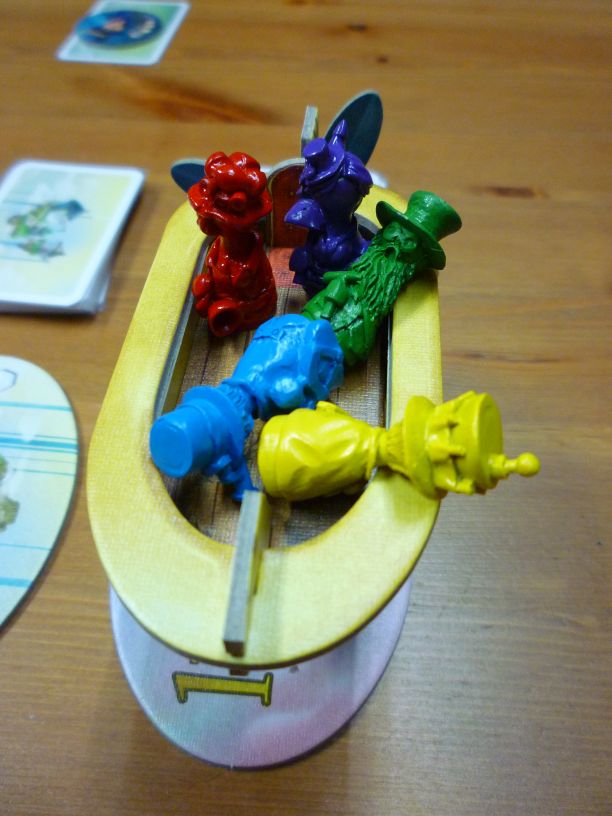
The player pawns are different not only in colour. They are of different sculptures. We were a little clumsy so our pawns look like they are drunk.

Celestia doesn't have a game board. These oval shaped tiles represent the cloud cities the players are attempting to reach. The cards on the right side of each cloud city are the scoring cards.

The basic cards in the game, which are used to steer the airship to the next destination.

The Play

Celestia is a risk-taking game. You constantly face the dilemma of whether to score points now, or wait and hope to be able to score more, at the risk of scoring nothing. The passengers can see the captain's die roll before deciding whether to alight, so you know roughly how much risk you are taking. You should try to remember what cards your opponents are lacking from previous failed trips, however you won't know what recent cards they have drawn. These more recently drawn cards may just be in that colour they were missing earlier. You can look at how many cards they have in hand. More cards mean better chances of them succeeding, but again, you cannot be exactly sure whether their hands are very lopsided - many cards in one or two colours and none in others.

There is one consideration which I think most new players will take some time to grasp. You need think a few turns ahead, to see when you yourself will become captain. The captain normally doesn't have the option to alight. If you are going to be captain next, and you are down on cards, you'd better alight now, even if you are sure the current captain can make it to the next city. If you don't, you will likely end up scoring nothing due to being stuck as captain next turn and not having the choice to alight.

The special ability cards can be very powerful if used at the right time, e.g. forcing an opponent to alight when you expect he will be making a killing in the next turn. They can also help you score big if you set up such an opportunity.

Scores are secret, since you draw scoring cards and keep them in hand. So when we played we couldn't tell exactly who were about to win, or when. The number of cards and types of cards drawn only served as a rough estimation. Dith won the game handily. He drew quite a few high valued cards.

The Thoughts

Overall Celestia is very similar to Cloud 9. It is only in execution details that they differ. Ideally what you want to do is alight just before the voyage is forced to end, but doing this consistently is a challenge. Sometimes you play safe and end up scoring much less than you could have achieved. Sometimes you get too greedy and end up scoring nothing. This game is easy to teach, and it's suitable for families and casual players.
I prefer the Cloud 9 version. It is simpler and cleaner. There are no special ability cards, which I feel is unnecessary and doesn't justify the additional complexity. I also prefer how the jokers in Cloud 9 work. You just need one joker card to navigate successfully. A single joker card covers all card requirements for the next leg of the trip. In Celestia, the joker is weaker and counts as just one wild card. So in Cloud 9 there is a bigger uncertainty due to how powerful the joker is. I like this. It's more exciting. There are more surprises. Cloud 9 is a better family game. Celestia seems to have added more stuff to please the gamer crowd. I can see the advantage of the scoring card mechanism. You won't know your opponent's exact score, and you can't precisely predict how much you yourself will score. This reduces tedious calculations at end game, since you can't calculate accurately anyway. Also, drawing cards is always fun because of the anticipation and the surprise element.

This comparison I'm doing is futile though. Cloud 9 is out of print, so if you like the game, just go get Celestia.

Saturday, 3 October 2015

Infiltration

Plays: 5Px1.

The Game

Infiltration is designed by Donald X Vaccarino of Dominion fame. Players are hackers who have successfully hacked into the computer system of a mega corp. They compete to steal as much information as possible. Their entry into the system does not immediately trigger an alarm. However they do leave traces, and the security system picks these up and analyses them. Sooner or later the system will realise it has been infiltrated, the alarm will sound, the gateway will be sealed, and any hacker who has not jacked out by then will be locked on by the tracking program and captured. Only those who have escaped in time can win the game, and the winner is, of course, the one who has stolen the most secrets.

The mega corp's data storage is divided into many layers, arranged in a V shape here. You enter the system at the first room in the top right corner. Each room contains some information. Each room also has different features, e.g. triggering events, making tools available, even bringing in non-player characters. Room cards are randomly drawn so they are different from game to game. Their order will also be different. This introduces variety. There is one secret room on the right, by itself. This is a special vault, and only under special circumstances a player can enter it. There is no guarantee for any particular game that it will be accessed.

That game component at the centre is the proximity counter. It shows the alert level of the security system. It is at 00 now. When it hits 99, the game ends. Hackers who have not yet escaped the complex automatically lose, regardless of how much data they have managed to steal. The proximity counter is basically a countdown mechanism.

These are your cards. The four on the right (without pictures) are the action cards. Everyone has the same set. Those on the left are the item cards. You start with some specific items based on your character, and some randomly drawn items. At the start of a round, everyone secretly picks a card to play. Once everyone has committed, the players take turns revealing their cards and executing them. The four action cards are Advance, Retreat, Extract and Interface. Advance and Retreat are simply moving deeper into the complex or backing out. Extract means downloading data. Every room contains some data files, and players need to race to download them. This is done in cut-and-paste mode and not copy-and-paste, so once a file is downloaded by one hacker, it is no longer available to others. Interface means making use of the unique ability of a room. It is usually a one-time thing, so it is also first-come-first-served. As you can see, hacking is a race. However being first to enter a room entails some risk too. Most rooms trigger an event upon first entry, and the event can be bad for your health.

In lieu of an action card, you can play an item card. These are usually more powerful, but they are single-use. Some are quite situational so you need to pick the right time. Some items let you advance quickly through the system, some items let you download more data than usual, some items let you manipulate the proximity counter, some items let you steal data from others.

This is one of the characters. Characters don't have unique abilities. The only gameplay difference they make is the two specific item cards each character starts with. All that text on the character card is flavour text. A character can get injured during play - you flip the character card to the other side. When injured, you can only move (Advance or Retreat) in alternate rounds, i.e. you are moving at half speed. Some rooms and some items allow you to heal yourself.

How much the proximity counter increases every round depends on a die roll. So you are never exactly sure how quickly this countdown timer will tick. There is a modifier though, so that you have a rough idea. The die roll modifier is negative at the start of the game, which means the proximity level usually increases slowly in the beginning. However the modifier tends to increase during the game, so the countdown speed will accelerate, building up to a climax.

The Play

We did a 5-player game. Most of us were new to the game. I had one item which propelled me to the front. It gave me an advantage over the others. I also had quite a few good items, and the right conditions for using them came up. I managed to make very good use of them, and I amassed quite many data files.

That black guy in front (left) is my character. When you are alone in a room with many data files, it's a windfall. You will be able to download many files at one go. When multiple hackers do downloading at the same time, they each get fewer files. Sometimes when too many hackers download at the same time, some will leave empty-handed. Who gets files and who doesn't depends on turn order of the current round.

Seeing that I had a good lead, I decided I should play safe and retreat early. I paid close attention to the proximity counter. I knew it would accelerate, so I knew I should start retreating around the time it reached halfway. Some of my fellow hackers were injured early in the game. This is painful and can really mess your tempo up. Sometimes when you can't move, and you don't have anything else to do at your current location, you will be wasting an entire turn.

I became a runaway leader. In Infiltration there aren't many cards that let you directly attack another player, so the other hackers could not gang up to rob me of my data files. The situation was awkward for them. They could sense the danger of staying too long, but they didn't have many files, so they had to bite the bullet and go deeper to hunt for more. The decision was much easier for me. It was time to run, Forrest, run.

Ivan had now advanced to the second floor (the other half of the V formation). Rooms on the second floor have better goodies. The room Ivan is in has 6 data files. The first floor rooms in our game mostly had two data files only. Only one had four.

Ivan had one item which was a shortcut. If he was caught still in the system when the alarm sounded, he could sacrifice some data files to take a shortcut to exit the system. This meant he had a get-out-of-jail-free card, and he could gamble and dive deeper. Still, I was quite confident I would win, because I had quite a large pile of data files, and I had played conservatively, allowing enough time to exit. What I hadn't thought of though, was the group psychology. I was a clear leader by mid game, which meant I was also a big red target. For the trailing players who had little hope of leaving safely, the mentality was "I'm gonna die anyway so let's drag everyone else down with me". Just as I was about to step out of the (virtual) gate, it slammed shut on me - someone had played an item card that jacked up the proximity counter. My estimation of how much time I needed to escape was quite accurate, but I hadn't anticipated this. Ivan became the only one who was not tracked down by the police, and he was the automatic winner. My wealth of data amounted to naught. I should have tried to convince my fellow hackers that once I made it out there I would make good use of the stolen data and expose all the corruption and wrongdoings we discovered. It was a noble cause and their sacrifices in helping me would be all worthwhile, right?! Guys?!! Y U do dis?!!!

The Thoughts

When Ivan taught us the game, he described it as Incan Gold on steroids, which I think is a very concise summary. You need to steal the most data to win, but if you fail to escape with the data, it all amounts to nothing. So it's about how far you push your luck. The main differences are (1) Infiltration is richer in mechanisms and setting (it's a Fantasy Flight Games game afterall), and (2) you only get one run in Infiltration compared to five expeditions in Incan Gold. The game mechanisms in Infiltration fits the setting well, so it is immersive. Player interaction is the race type and not the direct type. There is a sense of adventure because you never know what will come up in the next room. This game can be rethemed to fantasy adventurers exploring a dungeon hunting for treasure (don't get eaten by the dragon!), but that's not my type. Cyberpunk is more attractive to me.

The countdown timer (i.e. proximity counter) creates excitement and a building sense of urgency. You need to be on your toes. You need to judge the right time to start running. The variety in data rooms and items creates surprises and variability from game to game. These make the game colourful. The game concept is straight-forward and the premise is interesting. It may look a little complicated, but I think this can be a good introductory game.

Saturday, 21 September 2013

Cloud 9

Plays: 4Px1.

I think I first read about Cloud 9 at Gamer Chris' blog. I know it's a simple push-your-luck game, so when I visited Meeples Cafe with the family recently, I decided to give it a go. It turned out to be a pleasant surprise.

The Game

Players participate in hot air balloon rides, and try to score as many points as they can on each trip. Every round a different player becomes the pilot. The other players - the passengers - get to decide individually whether to score points and leave the balloon, or to stay on board hoping the balloon will ascend to new heights (which would bring even more points). The pilot rolls some dice (the number depends on the current altitude), which determine what cards are required for the balloon to continue ascending. The passengers make their decisions after seeing the die roll results, basically guessing whether the pilot will be able to play the required cards. Once everyone has made up his mind, the pilot must play cards if he has the required ones. The only exception is wild cards. A single wild card fulfills all dice requirements, but the pilot can decide whether to play it. If the pilot can't or won't play the required cards, the trip ends, and everyone still on the balloon scores no points. So the trick is trying to leave the balloon to score points as late as possible, and not get stuck there when the trip abruptly ends. It's like chasing a stock market bubble. You want to get out and make a killing right before the bubble bursts.

All four players still in the hot air balloon. The dice icons on the clouds indicate the number of dice to be rolled to see what cards are required for the balloon to fly higher. The point values of the altitudes are: 1, 2, 4, 6, 9, 12, 15, 20, 25. So the higher you go, the more tempting the next level becomes. The highest possible score of 25 is half of what you need to end the game. However it's not easy getting there.

The cards. You only need one wild card to satisfy all requirements depicted on the dice.

If only one player remains on the balloon, the rules change a little. This sole remaining pilot decides whether to leave or to stay before he rolls the dice.

After every trip, everyone draws one card, the balloon returns to the starting point, and a new trip starts. The game ends after a player reaches 50pts, and the highest scorer wins.

The Play

The rules are very simple, and my children (8 and 6) understood immediately. However they easily gave away their hand because when they looked at the die rolls and then at their cards, we could easily tell from their reactions and facial expressions whether they would be able to play the required cards. That made the lives of the passengers too easy. So we asked them to not look at their cards at all when they were pilot, until after all passengers have made their decisions.

Chen Rui (6) scored big in one of the early rounds, and maintained a comfortable lead. In contrast, Michelle and I floundered far behind. We were too greedy in the early game and stayed on the balloon longer than we should have. We were too desperate in the late game because we were behind, and again took bigger risks than we should have. We never managed to catch up, not even close! Chen Rui at one point told us she could easily cruise to victory by scoring just one or two points every trip. And she was right! She was already near 50, and we were nowhere in the vicinity. Shee Yun (8) put up a good effort catching up, and ended up just 1pt behind Chen Rui, who ended the game by reaching 51pts.

Game end situation. Chen Rui (yellow) had just reached 51pts. Shee Yun (orange) was only one step behind. Michelle and I (red and green) were far far behind.

As in most push-your-luck games, in the late game, if you are ahead, there is little incentive to take risks. You can afford to take smaller risks and you will likely cruise to victory anyway. If you are behind, then you must take risks and hope for greater rewards. You are behind anyway, so you might as well gamble and hope for a lucky break. Because of this nature, push-your-luck games can become less interesting in the late game. How big a problem this is depends on personal tolerance. Cloud 9 was brisk and fun for me, so although I had this familiar feeling again, it didn't bother me too much.

One interesting twist about this game is how the pilot has no option to score and leave. That means sometimes before it is your turn to become pilot, you already need to think about bailing out. The points you are going to get may not be very attractive, but then you have to balance that against whether you think you will last two consecutive rounds. This can be a tricky decision.

You can determine what colours your opponents are likely short of whenever a trip ends. If a player can't play 2 green cards, then he either has no green cards, or has only one, or has a wild card but is not willing to use it. The next time he is pilot again and needs to play green cards again, it is probably a good idea to bail out. However it may turn out that he has just drawn a green card after the previous trip. So you never know!

The Thoughts

Cloud 9 is a simple game of brinkmanship that works as a family game, a party game, a children's game and also a filler. It's a game that really tickles human greed. You are constantly engaged because every round you need to decide whether to take your winnings, or to raise the stakes. You are constantly gambling and hoping your luck will hold. I truly enjoyed playing this with my family. I probably won't suggest it when I plan a game session with seasoned gamers, since we tend to plan around heavier and more complex games. But it's a blast to play with the right target audience and on the right occasion.

Saturday, 24 August 2013

Nanuk

Plays: 7Px1.

The Game

Nanuk is a party game, a card game, a bluffing game, a gambling game, and a group psychology game. That's quite a mouthful, but it is actually a simple game. Players are Eskimo hunters planning hunting excursions to the Arctic tundra. They bluff about how many days they can last on the punishing tundra and how many animals (of a specific type) they can bring back. They outdo one another, until eventually someone will say that's impossible. Then this naysayer and the "highest bidder" split the group into two. Other hunters must decide to join one of these groups - whether to join the hunting trip or to stay home. The participants contribute food to prepare for the excursion. If it is successful, all participants gain food (and glory). If it fails, then the doubters gain food instead. OK, that last bit of the story doesn't quite make sense, but it is necessary for the game to work. Here's how the story translates to game mechanisms:

At the start of a round, every player holds 3 cards. Cards come in four suits - fish, bird, seal and deer, and each such animal card has one or two animals of the same type. The start player initiates the bluffing by indicating on the game board how many days he thinks the hunting party can last on the tundra, and how many animals of a specific type can be bagged. The next player must then decide whether to doubt him or to further raise the stakes. If this next player thinks he can do better, he updates the board by increasing the number of days he thinks he can last. The animal type and count can be changed, but it is not mandatory. Increasing the days in itself already increases risk, because every additional day spent hunting increases the chances of drawing a card with a polar bear icon. Polar bears cause hunts to fail, unless there is a lucky charm card to distract them.

When a player eventually decides to be the naysayer, the rest of the group must decide which side to take. The hunt leader and the naysayer both may try to convince others to take their sides. The decision to go or to stay put is made secretly and simultaneously. Once decisions are revealed, the participants may contribute cards for the hunt. These cards may not necessarily be of the specific animal type being hunted. Contributors can give whatever they like. These cards are shuffled and then revealed, and the hunted animal type is counted. After that, the hunt leader draws cards from the draw deck one by one, until the hunt fails because of a polar bear encounter, or until he reaches the number of days he said he was going to last. If the hunt is not failed by a polar bear, the leader checks whether he has reached the target number of animals. If the target is reached, the hunt is successful, and all participants split the loot, which is cards contributed by participants plus cards drawn from the deck. If the hunt fails, the loot goes to those who stayed home instead.

In the background, the markers on the game board indicate that the active player thinks he can do a one-day hunt and catch six (5+1) fish. In my hand are a fish card, a bird card and a seal card.

I'm not exactly sure of the loot splitting process, because in our game we decided to randomly distributed the cards as equally as possible, so that we could play more quickly. In the official rules the players get to see the cards and pick what they want.

The game ends when the draw deck runs out. Players then score points using all the accumulated loot cards (not hand cards). Every complete set of four animals is worth 3VP, and every pair of similar animals is worth 1VP. Highest scorer wins.

The Play

We did a 7-player game, and in the case of Nanuk, I think it is definitely the more the merrier. More players means it is possible to have high ambitions. There is more uncertainty, and thus more excitement. Sometimes you feel positive that many will join the hunt, and you go for a high target because you have that together-we-can-do-this feeling. Sometimes your gut feeling betrays you and you find that even your loudest supporter was just kidding. We certainly had a lot of table talk - claiming we had so many animals of a certain type, urging others on to make ever bolder claims. Most of us were new to the game and we were mostly optimistic, especially early in the game. That lead to very ambitious targets. Ian, who had played before, said we were crazy bold. And then our early excursions were mostly successful too, which fueled the optimism even further. Whenever we had a decent number of participants, the hunt was usually successful. Only towards mid-game people started to consider staying home more often. That was when decisions became trickier. You don't want to end up on the wrong side of the divide. It is usually better to end up in the bigger group. Hunting party or opposition party, there is a higher likelihood that the bigger group will end up being right. However if you happen to be in a minority group that is right, it can be very profitable. Imagine a big group of losers going hunting and putting together a huge pile of cards, and then you being the only guy staying home, but being right. That would be a major windfall. And you get to put on a smug I-told-you-so look too.

We were quite a rowdy bunch. At one point someone started asking do you have birds, and another guy (was it me?) started saying you should have at least one. Sorry to Wai Yan, the only lady at the table. We were a bunch of 30+ year old adolescent boys. Eventually it was Wai Yan who won, because she made the correct judgments frequently, and thus collected many cards.

In the last round of the game, we realised how unbelievably lucky we had been throughout the game, and why. Most expeditions, as long as they were being supported by enough hunters, were successful. It probably made us more optimistic and careless than we should have been. In that final round when we flipped over the cards for the final hunt, we found that many of the polar bear cards were at the bottom of the deck. No wonder we didn't see that many polar bears earlier. Needless to say, that final hunt failed miserably.

My accumulated loot at game end. Two complete sets of animals = 3VP x 2 = 6VP. Two birds make 1VP. That's a total of 7VP. I have one extra bird. Wait, that doesn't sound right.

The Thoughts

Nanuk feels like Liar's Dice. It's a simple party game suitable for big groups. There's group psychology, push-your-luck, and bluffing. There's an exciting gambling feeling too. It is best played as a light game, and I think the variant of randomly distributing the loot is a good one. If you want more control, you can use the official rules which allow participants to pick cards.

Thursday, 5 August 2010

Viva Topo! and Didi Dotter

Both Viva Topo! and Didi Dotter are children's games that I tried at Carcasean. Both are quite simple, so I'll write about both in the same post.

In Viva Topo! each player has a family of mice and uses them to collect as much cheese as they can. The game board is a circular track, with multiple stops. Each stop has four pieces of cheese, with the earlier stops having smaller pieces, and the last stop (i.e. finish line) having the biggest pieces. The mice race to collect cheese. They move by die roll. The pip distribution is 1, 1, 2, 3, 4, 5. Then 1 sides also show a cat, and the cat is the exciting part of the game. The cat starts rough halfway around the track opposite from the starting point for the mice. On your turn, you roll the die and move only one of your mice. If you roll a 1, you must also move cat. You need to move your mice quickly to avoid getting caught by the cat. Sometimes you need to settle for the smaller cheese pieces. If the cat is approaching, you may want to get your mouse to escape to an earlier stop. You get a smaller piece of cheese, but at least you mouse is safe now (once a mouse reaches a stop, it cannot move anymore).

The cat movement doubles in the later part of the game, cranking up the tension. The game ends when all mice have reached stops or have been caught.

The game board all set up and ready to go, for 3 players. The cat icons on the race track show the cat movement. The cat initially moves 1 step every time the cat icon is rolled on the die, but will later move 2 steps instead. The four corners are intermediate stops where mice can hide and claim smaller pieces of cheese. Each has two entry points. To claim the biggest cheese pieces a mouse needs to complete the full circle and get to the cheese castle at the centre.

The cat in Viva Topo! looks hungry.

At most four mice are allowed on any one space.

The starting box is a cosy mouse home. At this point one of Chong Sean's mice (blue) had reached the cheese castle and had claimed one of the biggest cheese pieces, but two of his mice were still at home. If the cat reaches the front door, they would be out of the game immediately.

The die. Two sides feature 1 and cat-face. The other four sides are 2 to 5.

Racing down the track. The cat is slowly approaching.

This little red mouse dived to safety and claimed a 2-segment cheese piece before the cat could catch it.

This is a simple and fun game. It's "only" a roll-and-move game, but there is actually some strategy in deciding which mouse to move. Should you focus on moving one or two mice to get them to reach the big pieces of cheese? Should you get a mouse to safety now or gamble on it being about to reach the next stop and get a bigger piece of cheese?

It's nothing deep, but there are some interesting decisions. It's quite exciting. And the mice (and cheese) are cute. I'm going to get a copy and I think my children (5 and 3) will like it.

Didi Dotter has cute components too - 12 rubber eggs. Each egg is made up of two halves, which can be attached together because the flat surfaces have magnets. The flat surfaces also have matching drawings. When the game starts, all half-eggs are placed face-down on the table and shuffled. Then each player picks one half-egg and put it in his egg cup. The game is a real-time game. Once the game starts, players try to find a half-egg in the middle of the table that matches his own half-egg, or any of his opponents' half-eggs. Once you find a match, stick the two halves together and claim that egg by putting it in your egg holder. When your egg cup is empty, you can choose (a) whether and (b) when to refill it with a half-egg from the centre of the table.

Setting up the game.

A round ends when all matching half-eggs have been found. Sometimes two players may be holding the two matching halves of an egg. It that case noone gets it. When a round ends you check the matches that you've made. There are 11 types of birds in the game, and you need to have matched all 11 types to win the game. 11 round discs are used to track this. One of the eggs has drawings of a fox. That's a joker and you can treat it as any bird type.

The 11 types of fowl.

The game is fast and furious. You need speed. Good memory helps, and a bit of luck doesn't hurt either. Things get pretty crazy once the game starts. And it's over very quickly. Don't even think about stopping to ask a rule question. That's what happened to Michelle. Chong Sean and I were so absorbed in the action that we couldn't stop to think or to answer her. Needless to say, she came in last. Now that wasn't very gentlemanly of us was it? Well, we were just being kids. Our game ended after the 3rd round.