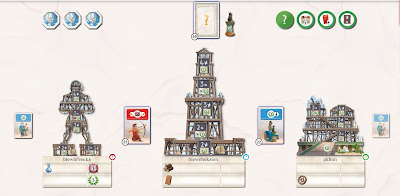
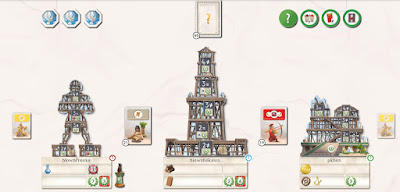
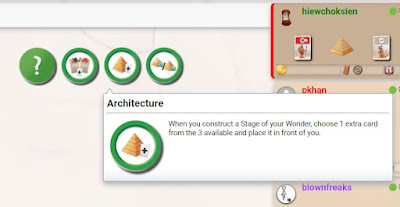
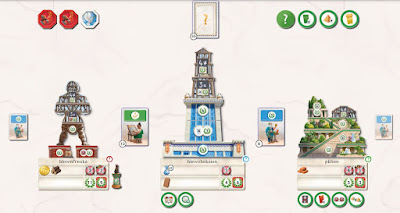
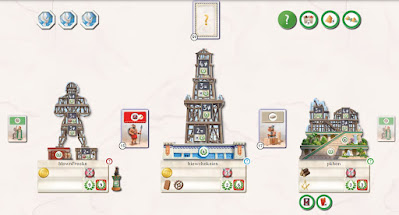
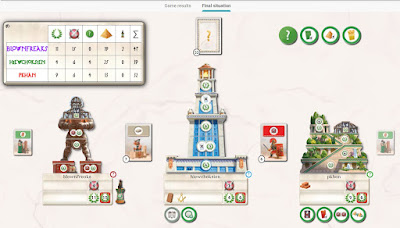
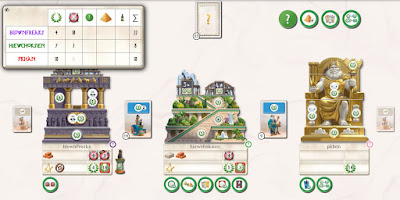
Pantheon adds some gameplay elements and offers more options. When you summon a god, you don’t take a card from the card structure. This can be important when you want to avoid letting your opponent take a certain card. The god powers are potent. They can give you a critical advantage. If you play the base game a lot, this is a nice expansion to give you some new content. It is not just more of the same. It brings in new elements.
Saturday, 2 May 2026
7 Wonders Duel: Pantheon
Saturday, 14 February 2026
7 Wonders Dice
Friday, 25 February 2022
7 Wonders: Architects
Friday, 4 January 2019
7 Wonders: Armada
Plays: 7Px1.
The Game
7 Wonders is a successful game, having spawned many expansions, big and small. I have played some of the expansions but not all. Armada is one of the bigger expansions. It adds a naval aspect to the game, and increases player interaction in a few ways.
Everyone gets a dockyard board like this. You have four ships in four colours. Every time you construct a building or a stage of your wonder, you may also move a ship of the corresponding colour by paying extra resources. E.g. when you construct a red military building, you may move the red ship. The cost of moving the ship is printed on the dockyard board. Most of the time when you move a ship, you gain some benefit, as printed on the dockyard board too. E.g. the green ship lets you draw some island cards (see photo above) and claim one. Island cards come with various benefits.
The red ship increases your naval strength, which is a new game element. You now have not only army (military) strength but also naval strength. Unlike army strength, naval strength is compared among all players at the end of every era. The few who are strongest score points, and the weakest loses points. You are not just comparing with left and right neighbours.
The yellow ship increases your commerce level and also triggers taxation. Whenever taxation occurs, players with lower commerce levels than the player triggering taxation loses money. So this is a form of high commerce level players bullying low commerce level players. There is another side of the coin - piracy. Some cards trigger piracy, and piracy hurts players with high commerce levels.
The blue ship gives you points, just like the blue prestige buildings in the base game.
The Armada expansion comes with some new cards. You'll be playing 7 instead of 6 turns every round. Many of the new cards are related to the new naval element. Some cards let you interact with players other than your immediate left and right neighbours. You can buy resources cheaply from players who are sitting further away. You get to compare army strength with them too. Naturally you want to do the latter only when you are stronger or expect to be stronger than them.
One small change is the purple guild cards now score at most 10 points. I am guessing after introducing the new game elements some guilds can be overpowered, thus the need to set a limit.
The Play
I did a full 7-player game. If you have an 8th wonder from other expansions, you can play an 8-player game. The rulebook also comes with a team variant, where you can play in teams of two players sitting together. I have not tried this yet.
In the early game, I emphasised buildings which produced resources. I wanted to make sure I could build all three stages of my wonder. Investing in resource buildings early makes construction easier later. I noticed that no one spent much effort in constructing science buildings, so I decided I was going to be the science guy. See all those green science buildings I already had at this point. In this game the decision-making was fast and almost brainless for me. Most of the time, the moment I received the hand of cards from my neighbour, I already knew which card was best. Usually it was the science card. I didn't want to be distracted by blue prestige buildings or red military buildings. There was much thumb-twiddling for me waiting for others to decide.
I had two big problems. Firstly, I wasted many opportunities to sail my ships. Very often I was short of resources or money. This meant I missed out on many of the benefits on the dockyard board, or I got them later than I would have liked. The other problem was commerce level. I was behind most of the others, which meant I suffered much from taxation. I contributed much to the government and the pirates. I completely neglected military - both my army and my navy. I did have to lose points because of that, but it was not too painful.
My green science ship helped me discover this foggy island. Once I had this island, I was no longer affected by taxation or piracy. I just wished I had it earlier. I would have saved much money, which in turn probably meant I could afford to buy resources to sail my ships more often.
I fared poorly in sailing. My red and blue ships never moved. Green and yellow had only moved two steps each at this point. At the bottom of the yellow column you can see the pyramid icon. This means whenever I build one stage of my wonder, I get an opportunity to pay to sail my yellow ship. On different dockyard boards the pyramid icon appears in different columns.
This was my nation at the end of the game. My green ship had reached the end of the track, which was expected, since I was the science guy. Science gave me many points. The two purple guilds too. However my total score was mediocre compared to others. The penalties due to weak military was just one factor. I think the bigger problem was how I missed out on many opportunities to sail, and it had a cascading effect. I had played two yellow cards, and built all three stages of my wonder. If I had not missed any sailing opportunity for the yellow ship, it would be at at least the fifth step.
If you look at the top three green science cards, they have a new icon not seen in the base game. This new icon means it becomes the science icon which you already have the most of. It is not exactly a joker and you don't get to choose what science icon it becomes.
The Thoughts
The Armada expansion adds player interaction. You now need to compete in naval strength. You may interact with players sitting further away from you. Taxation and piracy affect everyone. In the base game, most of the player interaction is with your immediate neighbours. That was a basic design principle when the base game was designed - to make a 7 player game move briskly, don't overwhelm a player by requiring him to study closely what all the other six players are doing. Armada changes direction somewhat. The impact on player interaction is more obvious when you play with a high player count. If you only play with 3 or 4, these changes don't come into play or don't matter much. So I see Armada as mostly meant for playing with 5 to 7 players.
Armada adds complexity. It's not suitable for players new to the game. I think there will be too much to digest. I think 7 Wonders is a perfectly complete game and it plays fine without any expansion. Expansions do spice it up a bit and create same variability, but are not essential. You want expansions only if you play the base game heavily and want to get more life out of it.
Friday, 14 October 2016
7 Wonders: Duel
Plays: 2Px2.
7 Wonders: Duel was my birthday present this year. When it was first released, the reviews were generally positive. I had a rough idea how the game worked, but did not proactively seek it out to play. I would happily give it a try if I the opportunity arose. I don't often play 2-player-only games nowadays. My wife doesn't play boardgames much now, and when I go for boardgaming sessions, we usually play 3- to 5- player games. However as the award nominations and award wins started coming in for 7 Wonders: Duel, I became very curious and decided to buy a copy.
The Game
Game setup is done like this photo above. The photo was taken when this particular game was at the start of Age 2. A game consists of three Ages. Each Age has its own deck of cards. At the start of every Age, the cards are laid out in a specific pattern (see left side of photo). There is a mix of face-up and face-down cards, and most cards are partially covered by other cards. Cards which are not covered by others are available to be claimed by the players. When a card is claimed, others may become available. When a face-down card is freed up this way, it is turned face-up.
The small game board on the right serves two purposes. The green science tokens are placed here. During the game, whenever you manage to collect a pair of identical science symbols, you get to claim one of these science tokens. This means discovering a new technology. It gives you some benefit. The other purpose of the board is to track the relative military strengths of the players. Whenever you increase your military strength, you push the military marker towards your opponent's side of the board. If you manage to push the marker all the way to the end, you immediately win a military victory.
On the right side, each player has four large cards. These are wonders of the world they can build. Each of them requires certain resources to build, and when built, they give some benefits.
A closer look at some of the wonders of the world - required resources on the left, benefits on the right.
The premise of the game is you are building your own civilisation while competing with your opponent. A turn is very simple. You take a card from the card structure in the middle of the table. Each card is a building. You can choose to construct the card you take, adding it to the play area before you, as long as your nation produces the required resources, or you can afford to buy what you're short of. If you are unable to or choose not to construct the building, you have two other options. You can discard the card to make money. How much you make depends on how many commercial buildings you have in your civilisation. You can also discard the card to complete a wonder of the world. A wonder usually requires more resources to construct than regular buildings, but it also gives more benefits. One big difference with 7 Wonders is wonders only take one turn to complete, not three. However you get to build up to four wonders, not just one.
There are three possible ways for the game to end. The normal end condition is getting to the end of Age 3. You determine victory by scoring points, from your buildings, wonders, military strength and also for money left in hand. The two other game end conditions are both sudden death conditions. I've covered the military victory above. The other instant win condition is the science victory. If you collect 6 different science symbols, you win immediately. This is interesting because it is in conflict with scientific discovery. To make scientific discoveries you want to collect pairs of matching symbols; but for the science victory you are going for different symbols. This pulls you in opposite directions.
Cards from Age 3 are arranged this way. Each Age has a different layout. Face-up cards allow players to plan ahead, while face-down cards maintain some suspense and randomness. At the start of every game, some cards are removed from all three Age decks, so every game will be slightly different. You won't know which cards are missing initially because of the face-down cards.
It is best to arrange your buildings this way. Brown and grey buildings produce resources. Yellow buildings are commercial buildings. Some produce resources. Some provide benefits like buying certain resources at a fixed low price, as opposed to the price being determined by the production level of your opponent. Blue buildings are prestige buildings which give victory points. One building type which I don't have yet is the green ones, the science buildings. Some buildings allow you to build another for free. This is the same type of chaining as in 7 Wonders.
The Play
7 Wonders: Duel plays very briskly. Every turn is simple, and before you realise it the game is coming to an end. Yet you still have the satisfaction of building up your civilisation one step at a time. You try to collect buildings that complement and combine well with one another. This is very much a tableau game like Race for the Galaxy. There are many broad stroke strategies you can pursue, and you can pursue multiple strategies concurrently, with different levels of emphasis, and adjusting your emphasis depending on how the game situation changes. You can work on victory points. You can go military. You can threaten a science victory. You can go for scientific discoveries, which is a different thing from the science victory. You can be an industrious resource producer. You can be a great trader. There is no lack of goals to work towards. However you need to remember to pay attention to what your opponent is doing. This being a two-player-only game means it's a zero sum game.
Sometimes you do need to slow down and think a few turns ahead, especially when there is a card which you want badly. You want to work out a specific sequence of claiming cards to ensure that card is freed up on your turn. Some wonders give you an extra turn, and this can be crucial for securing a card you desperately want. The card drafting mechanism in 7 Wonders has been replaced with this card selection mechanism, and I must say it works well. It is simple and effective.
I have played two games against my wife Michelle. In both game she went for the science victory, while I focused on VP buildings. In the first game she misunderstood the resource and cost requirements for constructing buildings. She thought she couldn't afford to build, when she actually could. Needless to say, her tempo was severely impacted, and I cruised to a comfortable win by VP. In our second game, her science victory proved unstoppable. In hindsight, I should have competed with her from much earlier on. By the time I realised the danger, it was already too late. In that game one of the technologies available was a 7th science symbol. Even if I managed to stop her from collecting the 6th science symbol from buildings, I would not be able to stop her from collecting a pair of matching science symbols and then take the 7th special science symbol to win. I realised that seeing this 7th science symbol in play is already a warning sign - watch out for the science victory! It's also a cue to seriously consider going for a science victory yourself.
Michelle found the game quite enjoyable.
Among the three face-down cards in the second row, the colour of the card in the middle is slightly different. This is not a misprint. That card is a guild card, a special type of card which gives victory points depending on a specific criteria. In earlier versions of 7 Wonders, there was a problem with some Age 3 card backs, which are purple in colour. In the printing industry, purple is a difficult colour to get right.
The Thoughts
My one word review of 7 Wonders: Duel is: pleasant. It's not particularly amazing or groundbreaking, but playing it is soothing, like having a warm drink on a chilly day. It plays smoothly. You are taking baby steps to build something big. You don't have too much to think about on your turn, since there aren't all that many immediate choices. However you still keep in mind the general directions you are heading towards. That said, it is a head-to-head game. Your loss is my win. I am not surprised to read many comments that this game is more confrontational than its predecessor. It is not destructive though. You don't go about burning your opponent's buildings. I think only one or two wonders allow such a thing. Military actions allow you to rob your opponent, but you get to do this at most twice in the whole game. So generally this is still a game of building up, not of tearing down.
One player compiled some statistics, and found that about 50% of games are won by victory points, 25% by science, and 25% by military. That surprises me a little. I had expected both the instant victories to be rarer. I thought these two victory conditions would be mainly tools to distract and to force your opponent's hand, something like the temple connection victory condition in Attika. I am pleased that they are more than that.
Saturday, 19 November 2011
7 Wonders 2-player game
Plays (2-player variant): 2.
One reason that I bought 7 Wonders was I read that it was good even as a 2-player game. The 2-player game is a variant, and the rulebook says that this should only be attempted by experienced players. There are additional rules. There is a dummy 3rd player that both players take turns to manage. It is a little different from the standard game, which I have written about here.
The 2-player game is set up like a 3-player game. The dummy player's cards form a draw deck. The human players take turns to play for the dummy player. If it is your turn to do so, you draw a card from the dummy player's draw deck (so that your hand size will be one more than normal), and you pick one card each for both yourself and the dummy player. Once a turn is completed, the human players swap their hands.
Controlling the dummy player is very handy. You can use it to build / discard / bury cards that your opponent wants. You can make it buy stuff from you and pay you lots of money. You can make it militarily stronger than your opponent to penalise him. Naturally, your opponent will try to do the same to you. With this variant, there is more to think about and to consider, and the game slows down a little because of it. The game becomes more complex. There are more things you can manipulate.
I personally prefer to play with more players, because I enjoy playing 7 Wonders at a quicker pace, and I find that having to manage the dummy player's civilisations is a little distracting. So 7 Wonders probably won't be a game I'll pick when I play with my wife. The 2-player game adds another layer of strategy and the game does work. So it's worth a try if you like the game, but it will be easier if you have already played a 3+ player game. Michelle didn't want to bother with a 3+ player learning game and jumped straight in. She actually beat me in our first game. So the game is not hard, just not as brisk as the normal game.
Buy from Noble Knight Games. Status: in stock (at time of this post).
Sunday, 8 May 2011
7 Wonders
Plays: 6Px1.
7 Wonders is one of the big hits of 2010, selling out its first printing quickly and rising to the top 20 at www.boardgamegeek.com like a rocket. The game is so popular that there isn't much about it that hasn't already been written somewhere else. So, I shall try to be brief.
The Game
7 Wonders is a card game with a civilisation theme. It is divided into 3 ages, and in each age everyone draws 7 cards, picks 1, and passes the rest to a neighbour. You pick 1 card from what you receive from your neighbour, and repeat the process until you have claimed 6 cards this age.
Cards can be buildings that you build, or they can be used to build 1 of the 3 stages of your wonder, or they can be discarded to earn money. Buildings give various benefits, e.g. producing resources, giving military strength, contributing to science, allowing you to build other buildings for free (some buildings require resources to be built). The many different buildings help you build your civilisation. They are your civilisation. Ultimately, they help you score points, some directly, some not.
In essence it's a game of choosing cards. You manage the direction of your civilisation as you make these choices. You manage money and resources.
One design objective of the game is to allow 7 people to play within a short time. This is achieved by having everyone pick cards simultaneously. Also you only directly interact with your neighbours, e.g. comparing military superiority, trading.
The Play
I played a 6-player game with mostly newbies at Old Town Kopitiam Cheras. It took 45 minutes including rules explanation. The game indeed moved very fast. Pick a card and pass the rest. How long can that take?
Military is a funny aspect. It's a game of neighbour-envy. Once someone starts developing military, his neighbours will feel the pressure to do the same. Once they too do that, their next neighbours will feel the pressure too. Domino effect. Jimmy sat between Jeff and I, and once Jeff started developing military, an arms race began.
Watching what others are doing is important. You should deny your opponents good cards, not just the immediate neighbours but also opponents further away.
Henry made an indecent amount of money, partly helped by Allen who bought a lot of stuff from him. Henry depleted the gold ($3) coins from the supply, and his stack of coins was as impressive as the Tower of Babel. He eventually won the game. I was happy to come second. I produced many resources which let me build some high-scoring buildings. Military also scored me some points.
I need to thank Kareem for bringing and teaching the game. I have been wanting to try 7 Wonders for a long time.
The Thoughts
I like it enough to pre-order it. I don't often have big groups, but the game is supposed to be best with 3 or 4 (and I often have 3-player sessions) and also I'm hoping the 2-player variant will work well with my wife and I.
7 Wonders has a constant flow of decisions. There is luck in how the cards come up, e.g. bad luck if two cards you want badly are in the same group because you can only pick one. However you have interesting decisions to make most of the time. You need to decide between picking a card good for yourself or picking a card for the sake of denying an opponent. You need to decide which strategy to pursue when two (or more!) are presented to you.
Despite the simplicity, I feel the game has strong theme - managing resources, the military arms race, the unique wonders, the tech tree aspect of some cards making other cards free. There are many different aspects to growing a civilisation, and many of them are represented in this game, despite some being in a fairly abstract way.
This is an adjustable-depth game. You can decide to play it with minimal thinking, just focusing on what cards you want to collect. You can do in-depth analysis, trying to guess each player's intentions, checking everyone's cards to count what are still in circulation. Also, this game satisfies the card combo itch. You try to collect cards that work well with your wonder and with your chosen strategy, or you switch strategy to make your cards work. It's all about collecting a set of coherent cards.