Showing posts with label specials. Show all posts

Wednesday, 31 December 2025

my 2025

The biggest change at my boardgame blog in 2025 was the quantity. Since starting this blog in 2007, I have never written this many blog posts. The number of posts is more than double of the next highest year. This is mainly because of the many new-to-me games I played on BoardGameArena.com. Together with my long-time gaming buddies Han and Allen, we started playing asynchronous games on a regular basis. I discovered many new games this way.  

This year I have played 260 different games, and of these, 187 are new-to-me. For comparison, in 2024 I played 72 different games. In 2025, I had 777 plays, of which 280 are my usual suspects top three - Star Realms, Race for the Galaxy (played vs AI) and Ascension. My other dimes are Innovation, Daybreak, Regicide and Ali Baba and the Forty Thieves. I played 46 games of Innovation, almost as many as Ascension. I shouldn't count Ali Baba, because my records of games I design are not accurate. I demo them a lot and don't always record these. Also I treat demoing games as work and not play. I get all these numbers from the https://geekgroup.app website. This is such a nifty tool. It's easier to use and has more features than what BoardGameGeek.com currently does, and its data is synced from BGG. 

Surprisingly when I list my favourite new-to-me games played this year, the top two are heavy Eurogames, a genre which I proclaim to no longer like. Stupor Mundi offers very different ways to improve your capabilities. You need to compete in several different aspects. It presents difficult decisions. The many aspects in the game are linked in different ways so you have to take care of all of them. There are so many different ways to build your castle. 

Darwin's Journey was a challenge to learn. Part of why I like it is the challenge. I did so poorly in the first game it motivated me to want to do better. It was a puzzle to solve. There was so much I was supposed to do, and I was appalled by how little I had achieved by the end of the game. This is a rewarding game to learn to play at least half competently. 

My most memorable game session was Blood on the Clocktower. This is a social deduction game, and ironically social deduction games are generally not my thing. Blood on the Clocktower is an improved and more complex version of Werewolf. In the game I played, I was the demon, i.e. the main bad guy. That made me rather nervous. In this game, every single villager (here called townsfolk) has a unique ability, which makes playing the demon challenging. Thankfully there are balancing factors. Even though the townsfolk do know some pieces of information, this information might be wrong. The moderator might give them wrong information because they have been poisoned, or their powers have weaknesses in certain situations. I won as the demon, and learned that I can be a pretty convincing liar. 

I played many good games this year. Others new to me which are memorable include Santa Maria, Tiger & Dragon, Maracaibo, Lord of the Rings: Fate of the Fellowship, Duel for Cardia, and Drones vs Seagulls.


Tiger & Dragon


Santa Maria

On the game designing and publishing side of my boardgame hobby, this year I published the fourth game under Cili Padi Games - Pinocchio. This was also the year the Matagot edition of Dancing Queen was released. My first game published under an established international publisher. This is an important milestone for me. I have now exported my games to USA (Portland Games Collective) and Denmark (Games Kobenhavn). I have a second game which has found a publisher. Malaysian Holidays has been licensed to Specky Studio, and it will be released early 2026, in conjunction with Visit Malaysia Year. I thought I wouldn't be participating in many boardgame and boardgame related events in 2025, because they are tiring and sales aren't always great, but I still went to quite a few - Sarong Music Run, Dice & Dine, Keretapi Sarong, Asian Board Games Festival in Penang, and Thailand Board Game Show. There was a boardgame event at my hometown of Kota Kinabalu, Sabah, but unfortunately I couldn't make it. My friends who were there said they did great sales. Looks like Sabahans are hungry for boardgames! I hope there will be a similar event in 2026, and I will do my best to be there. It's my hometown! 


Keretapi Sarong event


Asian Board Games Festival in Penang


Thailand Board Game Show 2025

I have been participating less in game design competitions. This year I've only participated in the one organised by STTOS, designing a game for Sabah tourism. However this year I became one of the judges of the Design & Play (DNP) game design competition organised under Malaysian Boardgame Design (MBD). There were six judges, all Malaysian game designers who have published games. It was an interesting experience, seeing a game design competition from the other perspective. We hope Malaysian boardgame design continues to grow and we see more and more good games from local designers. 


Haireey, Buddhima, Chee Kong, Logan, Jon and I 

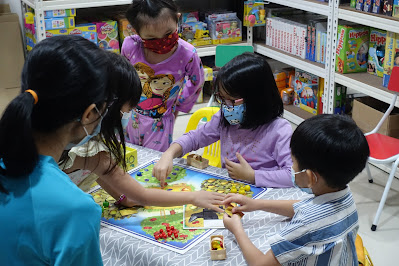
This year I did a seminar at Connaught Chinese Primary School on boardgames and parenting. I'm doing a little part in creating awareness of boardgames. When I visited Hong Kong on a personal trip, I met up with and interviewed Charles Yan, a Hong Kong publisher. It was fun to learn about the boardgame industry in Hong Kong, and to some extent China and Taiwan too. 


At SJK(C) Taman Connaught with my friends who helped run games with the attendees.


Charles and I in Hong Kong

I am running out of space at home for boardgames, and did a small purge this year, giving away some games to friends, and selling some. Now that I have some space on my game shelves, I hope I don't use it up too quickly. 

This year I participated in the annual BGC (BoardGameCafe.net) Boardgame Retreat for the first time. I've known Jeff and Wai Yan for years and they have been my main game supplier (drug dealer) for a long time. Now I'm selling my own games through them. I had a blast at the retreat. It was great to have a few days of being away from everything else and simply enjoying my hobby. 


Here's wishing everyone a wonderful 2026 ahead, and many more happy gaming moments! 

Friday, 5 December 2025

interview: Hong Kong and Boardgames - Charles Yan

I made a short trip to Hong Kong in November 2025.  I looked up my records. The last time I was in Hong Kong was 13 years ago, in 2012. That time I brought my in-laws and also my daughters, who were 6 and 7 then. This time it was just the two of us, my wife Michelle and I. The main reason we planned this trip was that Michelle had promised to visit her old friend. I also took the opportunity to visit my old friend. Before the trip, I contacted Charles Yan of Hong Kong game publisher Time2Play and asked whether I could do an interview with him. He follows my blog, and we are connected on Facebook. However we have not been interacting much. I thought this would be a great opportunity for me to get to know him and the boardgame industry in Hong Kong. 

We met at Maritime Square (青衣城) in Tsing Yi 

The best known game from Time2Play is 9Upper, a party game of obscure topics and terms in which you have to pretend to know what they mean and convince the judge so. By now they have sold about 40,000 copies in Hong Kong. Time2Play has published about 10 local-designed games. They do localisation of international titles too. Charles is also the founder of Boardgame Academy. This is a different Board Game Academy from that in Thailand. Boardgame Academy (HK) is a social enterprise which sets out to support and improve the education system using boardgames. It aims to make learning more fun, and to help students learn better and enjoy learning. 

Hong Kong and Boardgames

Before I arrived in Hong Kong, I searched Google Maps for boardgame stores. I noticed that many boardgame cafes and clubs seem to be concentrated in Kwun Tong (观塘). After chatting with Charles and another boardgamer friend Jetta, I realised that in Hong Kong there is this phenomenon called private rooms. For serious boardgamers who regularly go out to play, the money they spend on boardgame cafes is quite a sum. So some of them group together to rent a small place to be their private gaming room. They can use it to store their game collections too. This ends up to be cheaper, and they can have their own place which they can use any time. Some of these private rooms are converted to boardgame clubs or boardgame cafes, allowing other boardgamers to use them for a fee. The owners of these clubs don't run these as full time businesses. They have other full time jobs. These clubs are just side businesses which help offset their hobby expenses. So these club owners do not aggressively grow and develop their businesses. 

When I was in Hong Kong, I visited a bookstore on Nathan Road, and found their boardgame section. The first thing I noticed was most of the titles were under Broadway Games. Many were international titles localised. I took the opportunity to ask Charles about Broadway Games. Their parent company is a toy manufacturer with factories in China. This parent company is a huge manufacturer, among the top ten in the world. It has been the manufacturing partner for international boardgame publishers for some time. One of their clients is Amigo. Broadway Games was established mainly to localise international games. Many of their titles are being manufactured by their parent company in the first place, so doing localisation into Chinese is a natural next step. By now Broadway has published close to 600 game titles, releasing about 40 games every year. They now publish original titles too. Another major player in Hong Kong is Capstone. They are the distributor for Asmodee and Swan Panasia of Taiwan. They have a large boardgame store in Causeway Bay on Hong Kong island. I almost wanted to pay a visit, but timing was bad and I couldn't make time for it. 

There are three major bookstore chains in Hong Kong, and they collaborate in backend operations. They handle large volumes, and because of that, they prefer to deal with only large vendors. It will be very difficult for indie game publishers like those in Malaysia to break in to chain stores like these. Our number of products and how much we can sell is too low for these big players. So this is similar to the situation in Malaysia. 

In shopping malls in Hong Kong, cash registers are typically directly managed by the mall as opposed to being managed by the shops. Shops can request for cash registers, but these cash registers are centrally controlled by the malls. The business model at shopping malls is shops pay a basic rent to mall, and they also pay a commission based on sales. That is why the malls need to have control of the cash registers. The malls want to attract more shoppers, because the more the shoppers spend at the shops, the more commission the malls will earn. Having centralised control of cash registers means the malls have the data to help them decide how to charge rent, and also whether to renew the rental agreements with the shops. 

Now some of the shops apply a similar business model renting shelves in their shops to product suppliers. You can rent a shelf to place your products. You have to pay basic rental, and then depending on your sales every month, you also pay a commission. Charles has rented such a shelf before at a large bookstore. It wasn't cheap, but it was a viable business arrangement. He made enough sales for such an arrangement to be profitable. He calculated and found that the basic shelf rental charged by the shop was enough to cover the shop rental which the shop needs to pay to the mall. This means even if the product supplier sells nothing for the whole month, the shop has nothing to lose. Any sales is a net profit to the shop. 

Boardgame Design and Publishing

Charles takes custom game design jobs. Sometimes corporates and NGO's approach him to create boardgames based on specific topics or objectives. These boardgames may not be sold to the public. Some are merchandise for a company. Some are gifts. He has designed games for anti-drug campaigns, anti-gambling campaigns, water preservation awareness and disability awareness. Little Fighter is a 25-year-old computer game which is re-releasing on Steam. In conjunction with the re-release, the makers are publishing a novel. The deluxe edition of this novel comes with a card game, and this card game is designed by Charles. 

Charles does localisation of international games too, and he says this is challenging to do. In Hong Kong, gamers are generally fine with English versions of boardgames. If there is a hot new game released internationally and they are interested, the game being in English is not a hindrance. If the Chinese version of a hot game is released later than the English version, by the time it is released, many of the Hong Kong gamers will have already bought the English version. Hong Kong uses Traditional Chinese, like Taiwan. China, Malaysia and Singapore use Simplified Chinese. If the Traditional Chinese version of a boardgame is not printed at the same time as the English international version, the volume would be small, and that drives up the cost. The volume for Traditional Chinese is not that big anyhow, so unit cost is always a challenge. Since Taiwan uses Traditional Chinese too, publishing collaborations between Hong Kong and Taiwan publishers make perfect sense. Charles knows many people from the Taiwan boardgame industry and he does collaborate with them. In Taiwan and China there is a bigger need for Chinese versions of boardgames, because compared to Hong Kong, the English proficiency is not as high. Malaysia and Hong Kong have the same challenge. We were both English colonies. With high English proficiency, there is little need for localisation. 

I asked Charles his thoughts about targeting the China market. He said that indeed China is a huge market. His full time work is with an office furniture company, and he has worked in Guangzhou before. The many cities and regions in China are all very different. They are different markets. We cannot think of China as a single big market. It may be even more complex than targeting South East Asia, with multiple countries, different cultures and different languages. Charles' China strategy is to find a reliable local partner and let them develop it. 

Some Hong Kong game designers pitch their games to Taiwanese publishers. Taiwan is a bigger market than Hong Kong. 

Charles has been to the Asian Board Games Festival in Singapore. He has come to Malaysia too, for BoxCon. He went to Essen in 2019. He doesn't think it's the right time yet for him to be exhibiting at Essen. It is better to focus on Asia first. Perhaps this is something Malaysian designers and publishers should think about too. Several Malaysian designer friends and I have been planning to apply for a government grant to exhibit at Essen. We should think hard about what we want to achieve and what preparations we need to make to ensure the trip is fruitful. 

One funny story Charles shared with me was about the box for 9Upper. For one of the print runs, the box was manufactured by a factory which also made boxes for the iPhone. That time Charles would show his game to friends and proudly declare "This is iPhone standard!" Charles has conducted a 9Upper competition at a large public event. The people who signed up did not know that the competition would be a little different form the standard rules. The core idea was still the same. Every round one highly specialised term was announced, and most contestants had to pretend to know what it was and explain it as convincingly as possible. However in this competition the participants did not play on separate tables. They had to go on stage and try to convince the whole audience. The audience voted for who they believed by applauding them. The host used a sound meter to measure the applause, and whoever had the least support was disqualified. 

I asked how 9Upper became so successful. Charles said that 9Upper was marketed primarily through channels outside of boardgame circles. Youtubers and influencers needed content, and 9Upper was a tool which let them generate interesting content for their viewers. These influencers were able to reach out to people who do not usually play boardgames. Charles had a clear target audience for 9Upper. He chose the right methods to create exposure for the game to its intended audience. This is something I need to learn to do better. 

Another effective way to promote boardgames is to collaborate with IP's outside of the boardgame industry. He did one collaboration with a Hong Kong beer brand, creating a drinking game version of 9Upper. If we want to let more people know about boardgames, we should not be thinking only about the boardgamer circle. 

Boardgames and Education

Charles' work on Boardgame Academy is relatively recent. They became more actively only since 2024. There are several active NGO's in Hong Kong, and Boardgame Academy received a grant from one. Charles and his two partners in this venture are all parents, so they care about education. Their children are going through the education system now. They see the problems with the current system, and want to be able to do something to address these problems. In the current system, children often find learning uninteresting. Learning is a chore. It is hard to relate what they learn to real life. Learning should be real and it should be fun. Boardgames is something that can arouse curiosity. When there is curiosity, learning becomes fun and satisfying. Children will view learning differently. Learning becomes something they are keen about. Such a change in mindset can transform lives. 

Boardgame Academy is now actively working with the Hong Kong Institute of Vocational Education (IVE). That day, after my interview session with Charles, he had an appointment at the Shatin campus to do a seminar. The Shatin campus focuses on two areas, social services and IT. Boardgames can support both of these. Charles has designed several boardgames which convey messages related to social issues. In digital game development, boardgames are a good way for students to learn about game design. 

One interesting case is how a game about Poland is used to teach and discuss history. The game is Warsaw: City of Ruins. In the game, Warsaw, the capital of Poland, is destroyed several times due to war, including World War I and World War II. When students played the game, they raised this question - is there going to be a World War III? This was an opportunity for the teacher to discuss World War III, international geopolitics, and also the Ukrainian War. Boardgames can draw people in and trigger thoughtful discussion. There is an annual book fair in Hong Kong in July. During the week-long fair, exhibitors can request for seminar slots for their guest speakers. Which slot you get depends somewhat on your speaker. Saturday and Sunday slots are the most sought after slots, usually reserved for high calibre speakers. Because of Warsaw: City of Ruins, Charles got connected to the Polish embassy in Hong Kong, and managed to invite the Polish ambassador to be his speaker. At that fair he managed to get a valuable weekend slot. 


Charles has collaborated with Rachel Chen of Taiwan and Xeo Lye of Singapore. Xeo's publishing house Capital Gains Studio has released several finance and business related educational games and they are now being used in Hong Kong. Charles was the translator for Reiner Knizia when he was in Beijing for DICE CON. That would be like a dream come true for me, being able to work with Reiner Knizia. 

As a publisher in Time2Play, Charles publishes and sells games, but Boardgame Academy does not aim to sell games. It is not pitching its own games as educational tools with the ultimate goal of selling more games. Its main goal is to address educational challenges. Whose game is being used does not matter, as long as it is the right game which solves the learning problem. 

In Hong Kong, just like in Malaysia, many people view computer games negatively. They are perceived as something youngsters get addicted to and forget everything else. Children become glued to their devices and don't develop social skills. People who want to promote boardgames say that boardgames will help to reduce screen time. I must admit I myself do this. Screentime is a pain point that many parents have. In Hong Kong, some people perceive boardgames as just a lesser evil compared to computer games. For drug addicts, one method to wean them off drugs is to allow them to take weaker drugs. It's called substitution therapy or medication-assisted therapy. Boardgames are perceived as such a substitute. Well, among gamers I would joke that boardgames are the worst drug, but on a serious note, I'm a little shocked that boardgames are perceived as a compromise and a lesser evil. A light drug. I have never thought of boardgames that way. In Malaysia, most people think of boardgames as kids' toys. People should not think of digital games as evil. I play mobile games myself. Games are entertainment. In moderation they are perfectly fine, digital or analog. 

There is a global NGO called Junior Achievement. Their Hong Kong chapter runs an annual competition called the International Trade Challenge. Students work in pairs to develop a product to be marketed internationally. They are not restricted to specific product types. In the competition last year, out of the top three, two were boardgames. This year, many entries were boardgames. It's nice to see such enthusiasm and awareness of boardgames. 

Charles is preparing to run a boardgame design competition in 2026. There will be two divisions - secondary and tertiary. For the secondary school division, teams which are shortlisted will be assigned mentors to guide them and support them in further developing and completing their boardgames. The mentors are local game designers from Hong Kong. This will be like the reality TV show The Voice of China (中国好声音). This will be helpful to the secondary school students. It's great to see game designers work together to teach and guide others. 

Another major event Charles is planning is a boardgame fair which will be on 27 Jun 2026. The main organiser will be the Hong Kong Institute of Vocational Education Shatin campus, while Boardgame Academy will be the co-organiser. This will be the first time a boardgame-specific fair of this size is held in Hong Kong. 

It's always interesting for me to learn about the boardgame hobby and industry in different countries. It was a fruitful trip to Hong Kong, and it was inspiring to have a chat with Charles. 

Friday, 31 October 2025

My Top 50 Games - 2025

The last time I did a Top 50 list for myself was 2019. I thought it would be fun to do this exercise again. This list is not at all scientific, nor is it authoritative. It is just a reflection of what games I like and what games are important in my journey as a boardgamer. Even for me, this is not strictly a "best games" list. Some games are here because they are a big part of my journey. I hope this is interesting to you and you discover something unexpected. 

  1. Innovation - This was #7 back in 2019 and it has moved up to the top spot partly because I have been having much fun playing it with younger daughter Chen Rui. I now own the latest edition, Innovation Ultimate. Innovation is full of possibilities and unexpected twists of fate. There are many clever things you can do with the cards you get. One valid complaint I have heard of is that the winning player has fun, but the losing players feel helpless. Now that I have thought more about this, I don't think it is a problem. Indeed by the time you are near game end, there isn't much you can do to turn things around, but before you get to that stage, there are still all sorts of fancy stuff you can tinker with. With Innovation, you do have to accept that there is some luck. Don't take it too seriously. Sometimes you lose simply because of bad luck. I always enjoy the excitement of drawing a card to see whether it will be my next killer move or whether it will be my saviour. At any point in time, you don't really know whether your luck is going to turn. 


  2. Race for the Galaxy - This was my previous #1 game. I now mainly play it against bots on the iPad. The bots are decent. Well, either that or I'm still not a very good player after 2000+ plays. Playing on the iPad is very fast. Yet still enjoyable. 


  3. Through the Ages: A Story of Civilization - Vlaada Chvatil's magnum opus. I don't play this often now, but I have many fond memories playing this with my wife Michelle. We used to play this a lot. I still find this the best implementation of a civilisation game. 

  4. Carcassonne - I have many expansions, big and small. I have Carcassonne Maps too. I cheat a little by using one entry to represent the whole series. I'm doing the same for several other game families. Carcassonne was one of my gateway games when I entered the hobby, and till now I still find it lovely. 


  5. Sekigahara: The Unification of Japan - A genius piece of game design. This is a game which gives me goosebumps. You don't use dice for battle resolution. You have some luck in the card draws. Before a battle, whether you can win is already decided by the cards you have in hand and the pieces you have on the board. The tricky part is you don't know what your opponent has. So are you going to attack or not? Sometimes it is about bluffing. 


  6. Attika - I think this is an underrated gem. You win by constructing all your buildings, or by connecting two temples. Often this is an efficiency game about optimising resource usage. It is hard to win by connecting temples, but it is a threat you can use to force your opponent's hand. This is a game in which you don't score victory points. 


  7. The Lord of the Rings - This cooperative game is challenging to learn. Not that it is complex, just that it is a little unusual. However once you grasp the rules, it is highly satisfying to play.  


  8. Love Letter - I will always be grateful to the gamer who created a fan-made Adventure Times version of the game. It was because of the cute art that I hand-made a copy of the game to try out. I instantly fell in love with it. So minimalistic yet clever. It was my inspiration and model for Dancing Queen


  9. Indonesia - Splotter Games has a special place in my heart. So many of their games amaze me. They are complex, strategic, and unforgiving. They keep making hit after hit. The only complaint I have about Indonesia is one particular part of the map. My home state of Sabah looks completely wrong. 

  10. Automobile - This is a complex game of few actions, but every action is important and you must choose carefully. I have the very first edition of the game and I much prefer the art in this edition to the later ones. 

  11. Ra - This game is here for both the nostalgia and also for how wonderful it is as a game. My first copy was a fully self-made copy, because at the time it was out of print. My second copy was a gift from my friends who found a used copy on e-Bay Germany. This happened in an era without Google Translate, so it wasn't easy for them to get something from Germany. So this was a very meaningful gift. Since then, Ra has been reprinted, and it was reprinted several times. Now I own Priests of Ra as well. This was one of my earliest games when I got into the hobby. I spent many hours playing it with my friends in Taiwan. 


  12. Agricola - This is another game I have played a lot with my wife Michelle. I actually like Le Havre more than Agricola. Agricola ranks higher because I've played so much of it. Yes, I make the rules. No, I don't apply them consistently. 
  13. Brass: Lancashire - I have the original Brass, and I like the Peter Dennis art. 
  14. A Few Acres of Snow - Hey, yet another Martin Wallace game. Also with art from Peter Dennis. I love how the deckbuilding mechanism is used to simulate the challenges of managing a war in the colonies back when emails and telegrams were not yet invented. 
  15. Machi Koro - I have fond memories playing this with my daughters, who love the fishing boats. I always choose to play with the second edition rules with a random market. I don't like the original version in which all buildings are always available. 
  16. Hansa Teutonica - This is a highly interactive Eurogame. You are always trying to pressure your opponents into helping you. 


  17. Here I Stand - I'm not sure whether I still have the appetite for a 9-hour game. In the grand scheme of things, spending 9 hours to simulate an entire era in European history is pretty short. Even when you add the hours reading the rules beforehand. 
  18. Lord of the Rings: The Confrontation - A very smart two-player game. Just don't expect many of the Fellowship of the Ring to survive. 
  19. Regicide - This is a game I both admire and enjoy playing. You can play this with just a deck of regular playing cards. I love how difficult it is to win this cooperative game. It is what makes every victory a celebration. 
  20. Axis & Allies - I cheat a little and this represents the whole series. I don't like every single game in the series. My favourites are the latest standard game and Guadalcanal. I don't enjoy the larger versions as much. The anniversary edition is okay. I've started to lose interest in the series though. I didn't get North Africa because I couldn't even finish reading the rules. It just felt tedious. Stalingrad is coming soon, and I can't muster much enthusiasm. So this is mostly a nostalgia entry. I did have much fun with the series, beginning with the 1984 edition. 
  21. Pandemic Legacy: Season 1 - This represents the Pandemic series. There are many in the series which I like. Rising Tides (Netherlands) is good. Pandemic Legacy Season 0 was fantastic. If only the basic Pandemic existed, it might not make this list. However I had a lot of fun with many of the spin-offs. 
  22. Mystery Rummy: Jack the Ripper - I have almost forgotten about this game, which was my spouse game for quite some time. I have many other rummy games from Mike Fitzgerald, but this is still the one I like best. Whenever we played a victim card, we would declare in poor English pronunciation "weeg-teem". 

  23. Civilization - Francis Tresham is a legend. This game from 1980 was waaaay ahead of its time. You see nations rise and fall. You experience disaster after disaster. It may seem to be much simpler than many other later civ games which are more similar to the computer game, but I find that it does the few things it sets out to do very well. There is constant pressure to advance in science. You have to pick what you learn carefully. Sciences you pick meaningfully affect your board play. 
  24. Food Chain Magnate - The company organisation chart becomes a game, and the game works splendidly. 
  25. In the Year of the Dragon - This game teaches you that life is suffering. But you can still survive well enough. Maybe. The Year of the Dragon is not a good year I tell you. You will have fun complaining about how tough life is. You get to laugh at others' misfortune. Or you entertain your friends with your own misfortune. 
  26. Age of Steam - Martin Wallace's classic can be unforgiving. I have the older ugly version. The latest version is much prettier. 
  27. Hammer of the Scots - This is Braveheart the boardgame. I loved the movie. I learned more about the history of Scotland after buying and playing this game. I learned that the movie was a highly dramatised version of history. The game itself is excellent. 
  28. Maracaibo - This is a new entry. I enjoy how much you get to grow your abilities in this game. 
  29. Antiquity - This is an older Splotter title, with lots and lots of pollution. It is complex and brutal. Things go downhill by default and you need to find a way to turn things around. This is not a game for the faint of heart.
  30. The Princes of Florence - This Wolfgang Kramer design is one of the games from my early days in the hobby. 
  31. Ticket to Ride Map Collection 7: Japan & Italy - This is the representative of the Ticket To Ride series. This is one of the spin-offs I enjoy more. 
  32. China - Michael Schacht is a prolific designer and this is my favourite among his games. China was a reimplementation of Web of Power, and after China there were other reimplementations. I'm grateful that I happened to have bought China when it was in print. The publisher Uberplay is no longer in business, and I like this particular iteration of the game. 
  33. Power Grid - This doesn't represent the spin-offs in the family, just the base game and the expansions. I don't like the spin-offs so much, but I do like the expansions. I have quite many different maps for Power Grid
  34. Le Havre - This was the game that came after Agricola. I like how it tells the story of a growing port city, how businesses and industries sprout and then fade. 
  35. Taluva - This is a game with a strong spatial element. This is an underappreciated gem. 


  36. Faiyum - I like how the players' actions collectively shape how a game shakes out. How the map develops can be very different from game to game. 
  37. Santa Maria - This is a bunch of unassuming mechanisms coming together to make an excellent game. The game uses dice in a clever way. It is a development game. The core idea is now implemented in a new game - Saltfjord
  38. The Lord of the Rings: Fate of the Fellowship - I don't categorise this as one of the Pandemic games, despite the core engine being from that series. There are many elements in the game which make it more a Lord of the Rings game than a Pandemic game.  
  39. Quartermaster General - A World War 2 game which is almost a microgame. Minimalistic, but still has much character. The different nations all have unique abilities. 
  40. Roads & Boats - A complex game about logistics. People can steal "your" goods, because goods don't belong to anyone. That's communism, my dear comrade! You need wagons and rafts to store goods because what you can carry is yours, at least as long as you are still carrying them. 
  41. Merchants & Marauders - I love the freedom of sailing the seas going wherever I want and choosing my own adventure. 
  42. 7 Wonders - I suspect if this were released today instead of in 2010, I would find it just okay. It's just multiple ways of doing set collection. But maybe that's not important. I did have much fun with it. It does work well. 
  43. Seven! - This is a simple, silly game, and I find it hilarious. It may sound like a dumb game, but I think it is cleverer than it looks. The art is ugly. Not artsy. Just ugly. But that's okay. It's part of why it's funny. 


  44. Endeavor - I have not tried the latest reimplementation, but I'm happy even with the first version of the game to be on this list. It's a clean design with simple actions, but everything hangs together well. 
  45. Stupor Mundi - This is new to me in 2025. I had much fun with it. It is highly strategic and offers you many attractive options. You really have to think hard to maximise your actions. 
  46. Darwin's Journey - This too is new to me this year. It is overwhelming in that there are many things you want to do, but you have limited resources and actions. This takes some effort to play even half decently. 
  47. Azul - Beautifully straight-forward and accessible. This game fully deserves to be so popular. 
  48. Heat: Pedal to the Metal - Race games are really not my thing, but this is just so much fun. 


  49. Glory to Rome - I am starting to forget how this plays. I just remember it making me happy, and some combinations of buildings being very powerful. 
  50. 300: Earth & Water - So much history and angst in such a small package. 

Two notable absences are Star Realms and Ascension: Deckbuilding Game. I have been playing them for more than 10 years, and I have logged more than 1500 plays for each of them. I am still playing them on my phone. I do like them enough, but I want to make space for mentioning other games. 

The highest ranked game from 2019 which has now dropped from the list is Die Macher. I still think it is a great game though. In 2019 it was ranked #27.  Any games here which you totally agree with? Or totally disagree with? Or have never heard of? 

Tuesday, 31 December 2024

my 2024

2024 has been a memorable year for me. Having been a boardgame hobbyist for 20 years, this was the first time I visited the Essen game fair in Germany. For boardgamers, Essen is a pilgrimage. I went purely as a gamer. I was not an exhibitor. I did not go as a publisher or as a business. I was a consumer going there to fully enjoy myself. And what an experience it was. It was earth-shattering to me, a first timer. So many games, and so many are interesting. So much to see and to be amazed by. By gamer standards, I didn't buy that many games from the fair. Mostly small box card games, and only a few standard sized boardgames. Several months in, and there are still many I have not yet played. I have much homework ahead. 


Of the games I played for the first time in 2024, my favourite isn't even a recent game. It is Seven! (with exclamation mark). This is a simple and silly card game. The core mechanism is straightforward. It is something casual players can easily pick up and enjoy. Despite the simplicity, I like how it creates tension and surprises for the players. There certainly is some luck, but it's exhilarating when you feel you've read your opponents correctly. I am working hard on creating games like this - simple yet enjoyable, and not rehashes, and not dumb. 

Heat: Pedal to the Metal is a race game, and normally race games are not my thing. However I enjoyed it greatly, despite having only played it online. Days of Wonder (the publisher) is working their magic. Excellent game choice and amazing production. 

Riftforce is a 2-player card game which gave me a pleasant surprise. Even after reading the rules I wasn't confident I would like it. Only after playing it I was able to appreciate the intricacies of the design. 

An Infamous Traffic was a memorable experience. This is a game about China and the opium wars. This story is not often told in boardgames. 

I have played many trick-taking games, and by now I tend to be wary of them. OnStage / SangDen from Vietnam turned out to be delightful. It has several neat ideas, and they come together splendidly. 

Other new-to-me games I like are Hegemony, Ticket To Ride Legacy (Legends of the West), Sky Team and 300: Earth & Water

The number of plays I had in 2024 is less than in 2023. In 2023 I had 813 plays, of which 678 were Race for the Galaxy, Star Realms and Ascension. After deducting these three which greatly distorted my total, the total becomes 135. In 2024, I had 534 plays, of which 440 were the same three games plus Dominion. Deducting the big four, the total becomes 94. The big numbers come from games with digital versions. That is why I manage play a lot. Some are played with Han, and some against AI's. In 2024 I played 72 different games, slightly more than 2023 when I played 61 different games. I knew I was playing less in 2024, because I was busy with work, and also my boardgame time was spent not only on purely playing games, but also on designing, playtesting, publishing and selling games. 


I published two games in 2024, Snow White and the Eleven Dwarfs and Ali Baba and the Forty Thieves. Snow White was originally slated for end of 2023, but it was delayed and released only in early 2024. Ali Baba was scheduled for December 2024, but I managed to get it out by early November. I guess that's an improvement. I have started work on my 2025 game. I have decided the next one will be Pinocchio. I have been thinking about which game to choose for some time. I pick Pinocchio because I want my next game to be something simple and has wide appeal. That means it needs to be something casual gamers and non-gamers can easily learn and enjoy. The price point needs to be low. Non-gamers find it hard to accept the typical price points of games that gamers are used to. 

My first published game Dancing Queen has sold out. I have no more stock available. There may still be stock at some of the retailers which have bought copies from me. Dancing Queen will have an international release by a large publisher likely within the first half of 2025. Since an established and experienced publisher is publishing and marketing it, normally I would not need to work on the publishing part of the game any more. They have many more resources than I do and can do it much better than I can. However there is something about the older art and theme that I still feel attached to. So I decided to still do my own small print run, with the agreement of the main publisher of course. So there will be a second Malaysian edition of Dancing Queen, in addition to the international edition. This edition will have Chinese added, because I want to enter the Chinese language market, not just in Malaysia but also hopefully in Taiwan, Hong Kong and China. The international edition will be in English and French, and will likely be focused on the US and Europe markets. So I'm hoping to do something for Dancing Queen to prepare for expansion to Asian markets. 

The second Malaysian edition of Dancing Queen will be different from the first. This time I am getting Magicraft to do the printing. I won't be using the custom-made Ricola-style box. It will have normal paper based cards and not PVC cards. It won't come pre-sleeved. So the 2022 first edition of Dancing Queen will become a rare edition. If someone offers to buy your copy at a high price, please don't sell it. Either that or take the opportunity to charge an arm and a leg. The second edition will have a lower price point, because those changes above will help me lower my production cost. 


2024 has been a busy year for me in the game design and publishing part of my boardgame hobby, especially in the marketing area. I counted that I have participated in 7 events as an exhibitor. Game On Lah in Putrajaya in February, HELP University Open Day in May, BOXCON (KLIA2) in June, Asian Board Game Festival in Penang (Malaysia) in July, MTG Family Day in August, C2AGE (comics, cosplay, anime & games) in September, Thailand Board Game Show in November. I don't always break even with my sales at events, but events are more about exposure and marketing than profitability and sales. Breaking even is nice, but it is not always something to be expected. Or maybe I need to learn to do my sales better. 

The Malaysian boardgame market is small. We the people in the industry still need to work hard to grow the market. We need to invest much effort in creating awareness, in spreading the love of boardgames. We are far behind many other Asian countries. 

Having spent much time, effort and money on many different events, I have learned much and I strive to be more selective in 2025, and to manage my booth better. I need to be clear about the objective I'm trying to achieve for each event, be it building my brand, connecting with other people in the industry, selling my games, getting my games playtested by strangers or learning from others. Certainly my trip to Bangkok to exhibit at the Thailand Board Game Fair has been eye-opening. 

Other than exhibiting, I have also attended other types of events. I went to some Tzu Chi activities. I visited the boardgame club at Monash University. Some of these help to introduce more people to this wonderful hobby of ours, and that's something I'm happy to do. 

I took part in the Pegasus pitching day, in the Young Buddhist Association of Malaysia (YBAM) game design competition, and in the Hippodice game design competition. All were good learning experiences. 

With so much time spent on all these activities, it is no wonder that I have been spending less time playing commercially published games. 

Boardgames is no longer purely a pastime. It is something bigger to me now. Not only a business I am trying to grow, but also a mission to bring happiness to people, and to help people create memorable moments. Got to work hard in 2025 too! 

Friday, 31 December 2021

my 2021

The most important milestone for me in 2021 is Dancing Queen winning the Best Overall Game at the BoardGameGeek.com 9-card Nanogame Design Contest. This was a great encouragement for me to continue working on game design. I became a boardgame hobbyist in 2003. Throughout the years I have mostly been a consumer and not a creator. I did dabble a little in game design a few times, but I never took it seriously until recent years. The first game I spent a lot of time and energy on was F My Life, a game about questionable life decisions which has some dark humour. I made a prototype and played it quite a few times with different people. However I was not able to get it to a stage I was satisfied with. Eventually I set it aside. I still like the premise. Hopefully I can think of some other way to make it work. Then I'll return to it. 

The whole idea behind Dancing Queen was inspired by the contest. The rules required that contestants use at most 9 cards to design a game. I found this an interesting challenge because I've always admired Love Letter. It only has 18 cards but it is a clever and compact design. I wanted to do something like that - create a fun game with minimal components. Dancing Queen went through many cycles of designing, playtesting and fine-tuning. It was a rewarding experience with many happy discoveries. 

In November I participated in the Game On Lah event. This was the first time I showcased my game design at a public event. It was a valuable experience. 

I have quite a few work-in-progress game designs. Some of them are portable 2-player games just like Dancing Queen. I toyed with the idea of making a 10-card game and an 11-card game as follow ups to Dancing Queen. These games are easier to work on because younger daughter Chen Rui is usually willing to playtest with me. She was my #1 playtester for Dancing Queen and even developed a strategy I hadn't seen myself. However I later shifted to work on games for bigger groups. 2-player games may be too niche. If I am aiming at the global market, the 2P target audience is big enough. However if I'm going to start with Malaysia, then a safer and easier bet is probably casual games for 4 to 6 players which can be played at boardgame cafes and at non-gaming-specific gatherings. Now I have some prototypes which are for this player range. Some game ideas started with using just a standard deck of cards. This makes creating prototypes easier, because I don't need to create a prototype. 

Jeff, Kareem and I are working on establishing a games studio to design, develop, publish and market Malaysian games. We are all busy with our other primary jobs so this is moving slowly, but we hope to make steady progress.

Work-wise, this year I joined a partnership with three other friends to work on an education business targeting young children aged 4 to 7 - Play with Purpose. We are now one of the distributors of HABA, the 80-year-old German company specialising in children's games, toys and other products. We will be bringing the HABA Learning Program to children in Malaysia. It's a blessing to work on something you are passionate about. As the saying goes - when you find a job you love, you never have to work another day in your life. You are doing what you enjoy, so it doesn't feel like "work" anymore. In 2015 when I joined a mobile game company, it was a most exciting time in my work life.  


The pandemic situation in Malaysia was much worse in 2021 compared to 2020. I attended even fewer boardgame meet-ups than last year. This year I have slightly more than 30 new-to-me games. One which stands out is MicroMacro: Crime City. It is certainly something very different from the typical boardgame. It is essentially a solo detective game. It's the kind of game you can only solve once, just like reading a detective story. 

MicroMacro: Crime City

This year I played quite a few new-to-me games on BoardGameArena.com. They were all played with Han and Allen. We play with a Zoom conference call on at the same time, so that we can chat. The experience feels much closer to playing face-to-face. The three of us used to game regularly some years ago. We all like to play fast, often starting our turns when the previous player is still wrapping up his moves. Our tastes in games overlap well enough. We clicked well as a small gaming group. Now Han lives in Johor Bahru, about 4 hours drive away, so we don't get to meet up often. Due to the pandemic we actually met up and played, albeit virtually, more than in recent years. Among the games played online this year, I liked Carnegie the most. I can't really justify why I like it better than other similar games. It's a strategic Eurogame. It is a development game in which you improve your abilities and get more and more powerful. You get a sense of achievement as you see your efforts pay off. You get to set long-term goals, and when you are able to achieve them, you get much satisfaction. Yet many heavy Eurogames have these too. 

Carnegie

I bought a used copy of Baseball Highlights 2045. I rarely play sports-themed games and generally don't find them interesting. I am not familiar with baseball. However I quite enjoyed this game. It's a tactical 2-player game with some deck-building. You gradually trade mediocre players for better and better ones, augmenting your team. You will leverage the abilities of your players. At the same time you watch what kind of players your opponent is buying, so that you know how to play against them, maybe even recruit new players who are good at defending against or even neutralising your opponent's strengths. 

Baseball Highlights 2045

I bought a copy of Imperial Struggle, designed by the makers of Twilight Struggle. It looks more intimidating than Twilight Struggle, but once you get into it, it is not that scary. I enjoyed this sweep of history game. 

Imperial Struggle

Traders of Osaka has the Japanese game signature - small box, few components, simple rules, but everything is intricately crafted and comes together as a clever and tightly-woven game. Often when I read the rules of these Japanese games, I cannot fathom what makes them fun. Only upon experiencing them first hand I am able to appreciate their brilliance. 

Traders of Osaka

In 2021 I have bought only six games. If declaring oneself a boardgamer requires a license, mine would have been revoked. I bought MicroMacro: Crime City, Imperial Struggle, A Kindly World and Pandemic Legacy: Season 0 because they promised a certain experience I was keen about. I have owned Pandemic Legacy: Season 0 for almost a year now, and still have not started playing the campaign, because of the actual pandemic happening around us. Hopefully next year I will at least get the campaign kicked off with the same team who accompanied me through seasons 1 and 2. 

I bought Priests of Ra because I was curious to see how it worked. Ra is a game full of happy memories for me. Priests of Ra is not new. In fact it is probably out of print in most places. I bought it mostly because of nostalgia for its predecessor. Strictly speaking it was my wife Michelle who bought JOME. For now I count all game purchases in the household as mine. Michelle bought JOME to support a local game designer. 

My most played games in 2021 were all played on digital platforms - Race for the Galaxy (played against AI's), Star Realms and Ascension. I played more than 400 games of Race for the Galaxy, and more than 100 games of both Star Realms and Ascension. Other games played more than 5 times include MicroMacro: Crime City (I solved all the crimes in the base game), Betrayal Legacy (my family and I continued the campaign late last year and completed it early this year), and Sky Towers. I have certainly played many games of Dancing Queen too, just that I didn't record them when I was still in the designing and playtesting stage. Because of that I didn't develop the habit of recording plays for it even after the game was done (as in submitted for the contest). Maybe I feel the game is never quite done because it is my own design. I can always decide to change it and improve it further. 

Race for the Galaxy

I was interviewed by Sinchew Daily again. The last time was 2017 and it was a different reporter then. This time round a few others in local boardgame circles were also interviewed. The reporter wrote a series of articles and they took up quite a lot of space. This was good exposure for boardgames. 

Here are my hopes for next year. I hope the pandemic situation gets better, and I can have more face-to-face gaming sessions. I hope to make more progress in game design and game publishing. I hope to introduce the boardgame education programme (HABA Learning Program) to more children, parents and educators. Here's wishing a happy new year to everyone!