Showing posts with label Power Grid series. Show all posts

Friday, 1 September 2017

Power Grid: The Card Game

Plays: 6Px1.

The Game

I like Power Grid and have collected quite a few expansions. In 2011 there was a version released called Power Grid: The First Sparks, using the stone age as its setting. It was a simplified version of Power Grid. I didn't like it because I didn't feel Power Grid needed simplifying. And then last year (2016) we had Power Grid: The Card Game. This version took a different approach. Instead of streamlining all mechanisms and the overall gameplay, the map (i.e. spatial) element was entirely carved out.

This is how the game is set up. At the top you see two rows of four cards each. These are the power plants you can buy through auctions. In the middle there are four columns of cards. This is the resource market. The columns are numbered 1 to 4, referring to the price when you buy a resource card from the corresponding column. The $1 column starts empty. Resource cards are added here only under specific situations. Normal resource cards cost at least $2. After the resource buying phase each round, there will be holes in the $2 to $4 columns. Leftover resources are shifted left, i.e. they become cheaper. The columns are then filled up using cards drawn from the resource deck.

The overall structure of a round is simple - you may buy a power plant, you may buy resources, and finally you may expend resources to generate electricity and make money. There are many types of power plants. Some require a specific resource type (e.g. uranium, coal), some can use multiple resource types (e.g. oil or gas), some don't require resources at all (e.g. hydro plants and wind farms). You spend money on plants and resources to make more money, and then spend that money on buying bigger and better plants to make even more money. You prepare for a final round after the power plant deck runs out for the first time. In this final round, the money your plants earn is directly converted to points. If you have money left over from earlier rounds, it is converted to points at a 10:1 ratio. Whoever has the most points at game end wins.

Like the original Power Grid, turn order is very important. It is something you need to be aware of at all times, and you need to manipulate it to your advantage. Turn order is determined by how much you have earned in the previous round, and ties are broken by how big your best power plant is. When auctioning off new power plants, you go in turn order. This is slightly disadvantageous to players who are leading. They must decide first which plants to bid for. They cannot wait and see. When buying resources, you go in reverse turn order. Again the leading players are at a disadvantage. They will likely lose out on the cheaper resources.

The value in the top corners is the minimum price of a power plant. If you want to buy a plant, that's the minimum bid. At the bottom left corner you see the resources required to power up the plant. At the bottom right you see how much you earn when the plant generates electricity.

Normally you only get to bid for plants in the top row. The bottom row is just a preview of what may soon become available. These two rows of cards are always arranged in ascending order. When a plant is bought, a new one is drawn to take its place. The two rows may need to be rearranged depending on the minimum price of the newly drawn plant.

I now have two power plants. The limit is three. The resources are placed below the corresponding plants. The storage capacity of a plant is double the resource amount required to power up the plant. That means you may at most buy an amount of resources needed to power the plant for the current round and the next. The numbers along the edges of the resource cards indicate the quantity. Each time you consume a resource, you turn the card 90 degrees clockwise. When you reach 0, discard the card.

The Play

The game has plenty of tactical bouts. You fight at the plant auctions and at the resource market. You fight to maintain a healthy growth. You need to keep making money and upgrading your plants, and you don't want to fall behind. You are constantly manipulating the turn order. The long-term strategy is always to get to a strong set of power plants by the last round, and to be able to power them all. The journey is full of pitfalls and unexpected twists. The order of power plants appearing is random, and this is a tricky uncertainty to manage. It affects the scarcity and the prices of resources, and your decisions on which power plant types to compete in. The order of resource cards appearing is also random.

Jostling for position at the turn order track is crucial. It is disadvantageous to be in the lead, but it doesn't make sense to stay behind all the time just to avoid this disadvantage. You do need to progress, and you can't afford to stunt your growth.

The most important player interaction is in the power plant bidding. It affects who you will compete with for resources. If affects your income and turn order too. It is important to consider your power plant upgrade path. This is the crux of the game, and it is not something you can really plan beforehand. You need to be nimble and be keenly aware of the situation. Ideally you want to save money and not change power plants too many times, but sometimes you need to get a middling plant as a stepping stone to help you earn enough money for the better plant that will come later.

I have 3 power plants now. The next time I buy a new one, I will have to decommission one of them.

We did a 6-player game, and we barely had enough space at the table.

The Thoughts

I didn't have high hopes for Power Grid: The Card Game, but it proved me wrong. I didn't like Power Grid: The First Sparks because I felt it was an unnecessarily diluted version. In Power Grid: The Card Game, a huge chunk was cut out, but surprisingly it retained much of what makes Power Grid interesting. There is still enough depth. There are still interesting interactions in fighting for power plants, in buying resources, and in managing turn order. Jaime Lannister with one hand less is still a very interesting character.

What purpose does this card version serve? It is a shorter game if you don't mind skipping the map element. It doesn't feel incomplete or dumbed down. If you specifically like the spatial element in Power Grid though, then the card game is probably not for you.

Sunday, 31 July 2016

Power Grid: Australia

Plays: 6Px1.

I own many expansion maps of Power Grid, but in recent years I have stopped buying because I don't play Power Grid often. I don't own the Australia / India expansion, but I had a chance to try it when Ivan brought it to Boardgamecafe.net. The cities on the Australian map look like this.

One cheeky thing about this map is the cities are drawn upside down, because Australia is "Down Under". The map has a few variant rules. One of them is that when you expand your network, you can spend $20 to establish presence in any city on the board. This is why those two isolated networks in the red area can exist.

Another rule change is related to nuclear plants. Nuclear plants are not allowed in Australia. However uranium is mined in Australia and exported. When you play this map, the nuclear plants represent uranium mines instead. During the bureaucracy stage, instead of powering cities for you, they earn you cash directly based on the uranium price at the time. Every time a player sells uranium, the price drops. At the end of every round, the price recovers, based on the resource replenishment table - that row in pink.

The third main rule change is in Stage 3 of the game. Resource prices jump up due to a new tax. In this photo you can see the resource market being split into two sections, the shorter section currently being empty. This section is only used in Stage 3 when resources become more expensive.

This photo was taken in the early game. We had six players, and five were crowded in eastern and south eastern Australia. I (green) started in Brisbane and Gold Coast. The two main cities Sydney and Melbourne each have two halves, each half being treated as an individual city, with no connection cost between them. This is attractive to players.

Sinbad was blue. He started in Perth. There were only 5 cities in this area, so once a player started here, nobody else wanted to come because it would be suicide to crowd into such a small area in the early game.

Ivan (I think) was yellow and started in Sydney, and got surrounded by Allen (red). He had to spend the $20 to jump to South Australia. I (green) expanded peacefully in Queensland.

Jeff (black) wouldn't leave me alone and jumped to Queensland to mess with my expansion. He needed to escape the south eastern corner anyhow because it was crowded. It was just a question of where to jump to. Purple had jumped to the Northern Territory. Sinbad (blue) had filled up Western Australia, and had now jumped to Tasmania.

Despite the few rule changes, Power Grid is still Power Grid. The basic principles and strategies still apply. This is a game won and lost on dollars and cents. Every Elektro (the currency in the game) counts. I was a little sloppy and by late game could not catch up with the rest. I was a little wasteful. I probably spent more than I should have when bidding for power plants. I wasn't meticulous enough in my planning. One thing I like about Power Grid is how every time I lose, I can look back and see exactly why I lost. This shows how strategic the game is, and how much my decisions matter. Players who like Power Grid will like this map. When we played, we used the expansion power plants (they have green borders). Ivan and Jeff said this power plant deck is better balanced. I'm not yet at the skill level to be able to appreciate this balance myself.

This photo was taken when we entered the 3rd Stage. The moment Stage 3 began, we had to move the 6 cheapest resources of each type to the $9 and $10 spots, i.e. the smaller section of the resource market. From that point on, resources would cost at least $3. The $1 and $2 spots were no longer in use. Our eventual winner was Ivan. He powered the exact number of cities required to win. No others could reach that in the same round as him, so there was no need for a tiebreaker. In Power Grid, players often tie in the number of cities powered, so money often comes into play as the tiebreaker. Uranium mines (nuclear plants) play an important role in Australia because in the last round, they still generate income, and that additional money can often mean win or lose.

Tuesday, 24 April 2012

Power Grid: The Robots

Plays: 3P (2 humans 1 robot) x1.

The Game

I've always liked Power Grid, and own most of the expansions. Unfortunately most of the time it's just Michelle and I playing 2-player games. So I was immediately interested when I heard about the Robots expansion which introduces robot players. It allows players to add robot players when the number of humans is low, to make the game more interesting.

Each robot is made up of five parts, and each part specifies some rules governing the behaviour of the robot. The parts can be mixed and matched, resulting in many possible combinations and robot characteristics. There are also some base characteristics of the robots, which they will follow precisely unless overridden by their special characteristics. During gameplay, players need to manage the robots, and in some cases make decisions for them. The robots' actions will not always be optimal. They are there more to be exploited by the humans than to compete. Their actions are mostly predictable, so a clever player will try to use it to his advantage.

A robot is made up of five parts, and each part specifies rules the robot follows for a certain aspect of the game.

The Play

Adding a robot does feel like having an additional player, albeit not a very threatening one. 2-player Power Grid is not as good as 3+ players, so in my case it is nice to have some new dynamics. Phase 2 no longer means all cities are opened up, because the robot can now be used to occupy the second city spot to block your opponent until the start of Phase 3. Taking into account the robot's behaviour is important, and manipulating turn order is important. The cost of having an extra player (or more) is the overhead in calculating the robot's actions (most of which are deterministic) and in managing the actions themselves. Sometimes the robot can be a useful tool to hinder your opponent.

We used the Russia map. Michelle was red, the robot was yellow, I was green.

We played the red, yellow and purple regions. I (green) started near the centre of the purple region. Michelle (red) started near the border of the red and yellow regions. The robot (yellow) started in the most backwater city in the yellow region, but it quickly expanded outwards to interfere with one of us (under the guidance of the other human, of course). Look at how the robot's houses have occupied the 2nd slots of many cities, blocking the remaining player until the start of Phase 3.

Power Grid is still Power Grid though. The game doesn't feel very different. This expansion is not meant to significantly change the gameplay. In the game that I played with Michelle (and one robot), I actually came last, i.e. I lost to the robot! But I swear I was not beaten by it. I was just outmanoeuvred by Michelle. She had quickly connected 17 cities to end the game when I had not expected her to be able to afford it yet. I keep losing to her at Power Grid. Must be the accountant in her.

The Thoughts

I think Power Grid: Robots achieved what it set out to do - to allow robot players to be added when there are too few humans for the game to be interesting. If there are enough humans, say four, or even three, I'd say the robots are not necessary. There is some overhead in managing the robots, but it's worthwhile if it lets me play some interesting two-human-players games.


Noble Knight Games - Buy, sell and Trade! New and Out-of-Print RPG's, Board Games, Miniatures, Dungeons & Dragons

Friday, 25 November 2011

Power Grid: The First Sparks

Plays: 2Px1.

Meeples Cafe in Subang Jaya offered me a free game session to play some of the latest Essen 2010 boardgame releases. They visited Essen and brought back quite many new games, and they offered some free gaming sessions (drinks not included) to their members on specific days in November. I rarely visit boardgame cafes nowadays, because in my regular gaming group there are already more than enough games for us to play. However I couldn't pass up this opportunity to try some of the games that I was interested in, so I booked a Wednesday evening to visit them.

Meeples Cafe reminded me a lot of the Settlers Cafe in Singapore (although the last time I was there was a number of years ago). Many helpful staff. Gaming hours and drinks prices are good. Most importantly, game selection is very good. Log (the boss) told me they are nowadays usually full on Fridays and Saturdays, but when I was there on a Wednesday, it was full too. Good thing I made a reservation.

Just like what I used to do in Taiwan when visiting Witch House boardgame cafe, I read rules beforehand and made rules summaries, so that I could jump straight into the games, the first one being Power Grid: The First Sparks.

The Game

If you have played Power Grid, then I'll describe First Sparks as a streamlined and quicker version, simplifying the calculations required, and yet still preserving all the key elements of Power Grid.

Players are clans of hunters and gatherers in pre-historic times. They hunt for food and learn to farm, and with the food gathered they feed and grow their clan, spreading clan members across the board. Food is the currency in the game, and is also used to "buy" better tools and to gain knowledge, which will in turn help the clans hunt and farm more efficiently. The game ends when one clan reaches the size of 13 clan members, and whoever has the biggest clan wins.

There are four types of food that the players can hunt (or fish, or gather) on the board - mammoths, boars, fish and berries. All of them require the right tools, and are worth different amounts of food units. The abundance of these natural resources fluctuates during the game, depending on how heavily each is being hunted. If everyone hunts boars, then of course the number of boars will drop. So there is some competition for the same types of food sources, and it is usually good to go for food sources that others are ignoring.

The storage board for storing the available natural resources. The cardboard pieces with numbers on them are a handy reminder for how many resource pieces to replenish at the end of a round.

Players can also learn to farm, and this does not depend on positioning on the board or the abundance of wild animals / vegetation. You secure a regular supply of food.

Like Power Grid, turn order plays an important role in the game. The leading player (whoever has the biggest clan) is usually penalised. He is first to pick a tool or knowledge card to buy, and everyone else, starting from the last player, has the right to buy it before he does. He only gets to buy it if noone else wants the card. This is a different form of auction. The first player is also last to harvest food from the common pool, so by the time it is his turn, there is less to harvest from. He is last to expand his clan, so he may find that others have occupied spaces that he had intended to expand to, and thus will need to spend more food to expand.

The cards in the game are either tools (for hunting or farming) or knowledge. You can have at most 3 tools at any one time, but knowledge cards are not limited. Knowledge cards have special abilities, e.g. your food doesn't rot, or you pay less when expanding to spaces already settled by other clans.

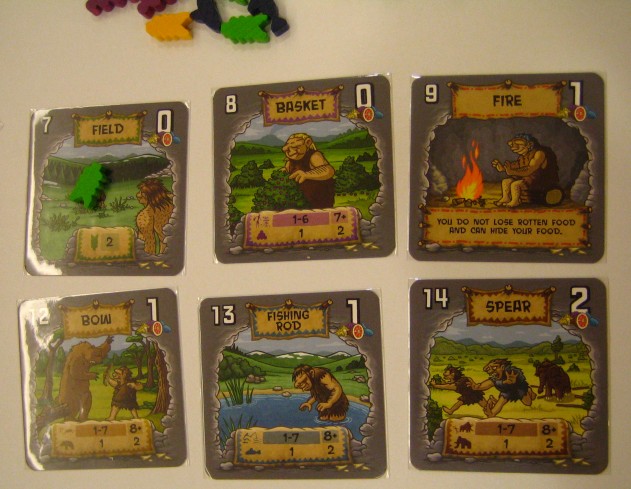
The starting cards in the card market for a 2-player game. Tool cards have an icon showing the type of food they can be used to harvest. E.g. the bottom right card is a Spear tool card and it is for hunting mammoths. For this particular tool, if there are between 1 and 7 mammoths in the common resource pool, you can harvest one mammoth. If there are 8 or more, you harvest two. Technology cards have text describing their abilities. The Fire card on the top right is a technology card.

The number on the top left of a card is the "size" of the card, for comparison of which card is "better" and thus their ordering in the card market. The number on the top right is the (fixed) cost in food units.

The Play

I did a 2-player game with Han. The 2-player game requires a dummy third player. The game pace was very brisk. In fact it was so quick that we played more than half a game before realising that we had completely forgotten about playing the dummy third player. So we restarted the game. Food seemed to be sufficient all the time, as long as we were careful not to over-extend ourselves. Maybe we were too conservative in expanding. We didn't really need to compete much in the same types of food. There was only two of us, but four types of hunted (or gathered) food, plus farming was also an option. The game didn't seem very interesting with 2 players.

Our incorrectly played 2-player game. We got this far without realising that we had completely forgotten about the dummy 3rd player.

Game in progress. Each tile is made of two hexes, and each hex has 3 spaces. There is no limit in the number of clan members in a space, as long as they are from different clans. However it is more expensive to settle in a space that already has other players' clan members. Also it is more expensive to expand through mountains (the rocks).

The knowledge of Fire seemed to be a big factor. The player who has Fire doesn't lose one third of his food every round. In a two player game, there is only one Fire card, and whoever doesn't get it seems to be at a significant disadvantage throughout the game. We have yet to figure out how to overcome that advantage. The tool and knowledge card costs are fixed, so there is no bidding up the prices. Unlike Power Grid, you can't force an opponent to pay more for a good card. In the first halfway-abandoned game, I had Fire and did well all along while Han struggled a little. In the second properly-played game Han had Fire. I thought I managed my food and expansion well, but I didn't notice that he had been stockpiling a lot of food. When he reached the clan size of about 8, he suddenly grew his clan straight to 13 members to end the game, using his huge stockpile of food. I didn't see that coming, and I was nowhere near 13.

The Thoughts

I quite like Power Grid and don't mind its fiddly aspects. So I didn't find streamlining it (which is what First Sparks does) necessary. First Sparks is attractive and quick, and does retain all the key elements of Power Grid. For me personally, it feels a little unsatisfying, since I'm quite comfortable with Power Grid. First Sparks seems to be more suitable for people who don't like Power Grid (e.g. the maths involved, the fiddly rules). I'm already a fan of Power Grid. Comparing First Sparks against Power Grid:

  • No bidding up the power plant (tools / knowledge) prices in the auctions.
  • No need to decide whether to buy resources (or how much to buy) to run your power plants. In First Sparks you will always want to harvest food with all your tools.
  • In First Sparks your network won't be walled off as badly as in Power Grid. The cost increase to settle in crowded spaces is not as brutal.

I suspect First Sparks is better with 4 or more players. My 2-player game experience was not as interesting as Power Grid 2-player games that I have played.

Sunday, 4 September 2011

Power Grid expansions marathon

I recently purchased three Power Grid expansions from Jeff (a.k.a. CK), and over the Hari Raya (Eid ul-Fitr) holidays, Michelle and I played through all six of the maps. We also played the Power Grid Promo Cards Set, which Allen gave to me. He acquired two sets when he bought stuff from www.boardgamegeek.com. In all games we used Variant 3 of the Power Grid Power Plant Deck 2 expansion. In this variant, six big plants are added to the deck, and the number of connected cities required to end the game is increased from 21 to 24 (for 2-player games). Since I usually only play Power Grid as a 2-player game against Michelle, I think in future we will always use this variant. Here's our journey to some exotic (to us) parts of the world. How many people can boast visiting 7 countries in one week?

Korea. What's unique is there are two resource markets, and every round you can choose to buy from only one of them. I lost this game due to resource dependency. I had a big nuclear plant, which meant I needed to buy from the South Korean market. However I also depended on coal and garbage. In the final round, no matter what I did, Michelle could starve me of either coal or garbage by buying up more than she needed, and I wouldn't be able to power all my plants. In hindsight, I could have connected to fewer cities in the previous round so that I had priority in buying resources in the final round; I could have stored resources (especially uranium) so that I wouldn't be so stuck. One thing I like about Power Grid is whenever I lose, I can usually look back and tell what I have done wrong and how I could have done better.

Yellow houses block off areas that are out of play.

We started close. Michelle was red and I was green. We established a frontline and marked our territories like tomcats from the early game.

We visited Seoul some years ago and were lucky to be there during the cherry blossom season (about one to two weeks in a year). I enjoyed visiting the folk village near Suwon too.

China. What's unique here is a planned economy, where for the first two thirds of the game the power plants appear in a strict ascending order. The number of plants available for purchase every round is much fewer than the standard game. I (green) blocked off Michelle (red) and kept her in the north east, but she eventually paid to jump to the south.

I recently watched a Chinese movie called Aftershock (唐山大地震) directed by Feng XiaoGang, about a family that survived the 1976 earthquake in Tangshan. I like the movie a lot.

Russia's power plant market is smaller, so players have fewer choices. Also when the start player does not pick a power plant to auction, the smallest power plant is immediately discarded, which means a better plant may become available for the other players to buy. The leading player has a difficult decision to make.

The map only covers the western half of Russia.

Japan. I have played this once at Old Town Kopitiam Cheras. Connections are mostly expensive. Players can start two networks, which is a unique feature.

Step 3 (i.e. the last third) of the Power Grid Japan game. The rightmost power plant with the green edge is from the power plant deck expansion. Normally you can only have three power plants, but you can have four in a 2-player game.

Two of the cards from the Power Grid Promo Card Set. The one on the left is just a warehouse for you to store up to 3 resources. It doesn't count as one of your power plants. The one on the right removes three resources which are cheapest from the resource market, thus increasing the price. When these cards turn up, they are immediately auctioned off to the players (or acted upon). We played with this promo card set when we played the Spain and Portugal map.

Another weird card. When you gain this fun fair you place one of your houses on it and it is treated as another city that you have connected to.

Spain and Portugal. No new uranium is added to the resource market in the first Step, but many will be added in the second Step. At the start of the second Step, three wind power plants will become available.

The rightmost power plant is a flux generator, which is from the promo card set. It is quite useful, because it can process any resource and it powers 6 cities.

Madrid the capital of Spain was unfortunately not in play in our game. We blocked it off with a yellow house.

Brazil. The garbage resource is treated as biofuel tanks here. All biofuel plants are always in play, regardless of the number of players.

I (green) started in the north east, where there were many cities close to one another with low connection costs. Michelle started near the centre and spread both north and south. The connections between my area and hers were expensive, and she blocked me off before the start of Step 2 (when cities would accommodate two players), grabbing those cities in the north west which were my only remaining affordable avenue for expansion.

Michelle and I played 4 maps in 2 days, and by the end of that we were both a little sick of Power Grid. We took 2 days off before completing our quest. I am a little amazed at how we managed to enjoy Power Grid as a 2-player game. I think the ideal player count is probably four. BGG says best with 4 or 5, and recommended with 3 to 6. 2 is not even a recommended player count.

I don't have any strong preference among these six maps. I think the China map is less interesting with 2 players, because there are only 2 power plants available every round. That's very restrictive. With more players, the number of plants will be one less than the number of players. Considering purely the maps (and not the special rules), the Japan map is interesting. It's long and narrow. There are small groups of cities here and there with cheap connections, but most connections are expensive. The possibility of starting two networks is also interesting. Do you start your second network early or later? It is a very useful ability that you don't want to squander.

Rules-wise, the two resource markets in Korea are interesting. Also the Russian map rule where the smallest power plant is discarded if the leading player doesn't put any up for auction makes for a very interesting and difficult decision for the leading player. Overall I'm happy that each map has some unique enough aspects, and none distort the game too much to make it unwieldy. Well, Power Grid can be considered a little unwieldly in the first place, heh heh.

I've never been a game expansion completist. I don't have much interest in weird small expansions, like the X-Deck of Agricola, and the small promo expansions of various games. I like expansions that have something solid to offer and not just minor novelty. So the Power Grid Promo Card Set doesn't do much for me. Just a nice-to-have. So it's more valuable to me as a momento than as a game play component.

Thursday, 12 May 2011

boardgaming in photos

29 Apr 2011. I played a 5-player game of Power Grid on the Japan map (part of the Russia/Japan expansion) at Old Town Kopitiam Cheras. Power Grid is a game I like a lot but I seldom get to play it. So it was good to play again. Sendai is one of the cities badly affected by the recent earthquake and tsunami in Japan.

The northern island of Hokkaido and the northern tip of Honshu are moved to an inset. This was the early game. One unique part of the Japan map is a player may start two networks instead of one. However networks must to started in six specific cities, like Tokyo, Sapporo.

Some smaller cities do not have the Phase 1 slot, i.e. you cannot connect to it in Phase 1. This makes things more difficult. Saitama on the right is one such example. It doesn't have the $10 green slot.

Mid game. Power Grid is a game where every dollar counts. Sometimes your plans can be completed ruined because you miscalculated by just $1. That was exactly what happened to me in this game. I should not have played by gut feel during the power plant auctions. Recipe for disaster.

Near game end. In our game everyone was careful in ensuring his power plants had enough capacity to power enough cities. There wasn't much threat of resources getting depleted or oven prices being pushed very high. Money was tight for most of us. Kareem's (red) power plant capacity improvement was a little behind the rest. However he had saved some money, and on one very crucial turn when he managed to catch up, he quickly expanded his network to 15 cities and ended the game, winning decisively.

Game end. Kareem 15, Jeff and Henry 14, me 13, Jimmy 12. I still like Power Grid. I have stopped buying expansions for quite some time, because I simply don't play it often enough. If I play it frequently I would buy all the expansions. Now I only have USA, Germany (base game), France, Italy, Central Europe and Benelux. No China, Korea, Brazil, Spain+Portugal, Japan or Russia.

1 May 2011 (Labour Day). Carcassonne: Hunters & Gatherers. Michelle's red hut is sitting on a very lucrative network of rivers. So much fish!

Part of the map created after the game ended. The meeples (followers) have been removed.

Box cover. I have the German edition. Bought in Taiwan.

My favourite part of the box cover - a hunter taking a break.

1 May 2011. I played the East expansion to Hansa Teutonica for the first time. It has some different rules. It is supposed to be more balanced and more fine-tuned, but Allen, Han and I are not good enough at this game to be able to appreciate that. Maybe I will write about this in more detail after I play it more. At the moment, I have a lot to learn even from the base game map.

The blue bonus tokens directly printed on the map (on the right) are one of the new features of this expansion. When you establish a trade route at one of these routes, you get to immediately use the special power of these tokens. Note that some cities don't have slots for offices (see the green or yellow/green banners). Only certain bonus tokens allow you establish offices at such cities.

2 May 2011. Castle Ravenloft. Han, Allen and I played the next adventure, scenario 3.

We found the lab, which was our objective, quite early. Later we realised that we had made a blunder when setting up the deck of tiles.

Fighting (and eventually killing) the boss. Afterwards we realised we made yet another blunder, but a minor one - this was not the correct figure to use. Well, at least we did use the correct character card. Castle Ravenloft is simple and fun, and gives enough variety through the encounter card drawing, the monster card drawing, and the dungeon building via tile draws. The only part I don't quite like is you know roughly when you will find your destination. So it feels like the game is throwing monsters at you while you wait for a timer to run out. It doesn't feel like I'm really exploring a dungeon when I roughly know the next tile will likely be or will likely not be my destination.

Money, a Reiner Knizia game, implemented on the iPhone. It was free for a short time so I downloaded it. I've only played a few games, so I don't feel like writing about it in detail. In this game you try to collect as much money as possible, preferably in the same currencies. At game end, you score for currencies where you have exceeded $100, you score bonus points for collecting all three of the $20 notes or $30 notes for any currency, and you also score points for the $10 Chinese coins. In my first game above, I came in dead last playing against 3 AI's.

Every round there are two sets of 4 cards for the players to secretly bid for. When bids are revealed, whoever has the highest bid picks first, and his bid is then placed at the centre, i.e. other players may take this spent set of cards. After everyone has taken cards, whatever is left at the centre is topped up to 4 cards per set from the draw deck in preparation for the next round. So basically when you bid for cards, you need them for two purposes - for bidding in future rounds and for saving some to be your money collection for game end scoring. Sometimes you may need to give up collecting a particular currency halfway through because you need to spend the money, or if there are too many others competing for it.

This iPhone implementation is done very well, artwork and interface are excellent. I'm not so sure about how strong the AI's are. I lost my first game but won the next three. Still, 4 games is a small number to draw any conclusion. Playing on the iPhone is very fast, so I have not really been thinking much about strategies, or trying to track what the AI's are collecting. I guess that's the disadvantage of playing a boardgame / cardgame implemented in electronic form - things move too fast and you don't slow down to smell the roses.