Friday, 12 August 2022

PARKS


The Game

PARKS is a recent and popular game. I saw it available at the Board Games Together public gaming event at Chinatown (Petaling Street), and asked the organiser to teach me to play. 
 

The theme is the many national parks in the USA. The core mechanism is based on this track at the top built from multiple tiles. When a round starts, every player has two hikers at one end of the track. On your turn, you must advance one of your hikers to a new tile. You can walk as far as you want, and normally you will land on a vacant tile. The tile you land on gives you some benefit, usually in the form of resources. Some allow you to take specific actions. When both hikers of all players reach the end of the track, the round ends. You play four rounds. Every new round a tile is added and all tiles are shuffled to make a new track. This keeps things varied and you will have to adjust your tactics accordingly. 


The icons on the tiles indicate what you gain when landing on them. In most cases you collect resources. You can exchange specific combinations of resources for park cards, and park cards are worth points. This is your main source of victory points. Cashing in resources for park cards is an action which some tiles allow you to perform. You can't do this any time you want. You need to land on a specific tile to do this. The final tile always allows you to do this, so every round you have at least two opportunities because you have two hikers. 


The campfire allows your hiker to land on a tile which has other hikers. You only get to use your campfire once per round, use it wisely. Once it is used, you douse it, i.e. flip it to the other side. You reset it at the start of the next round. 
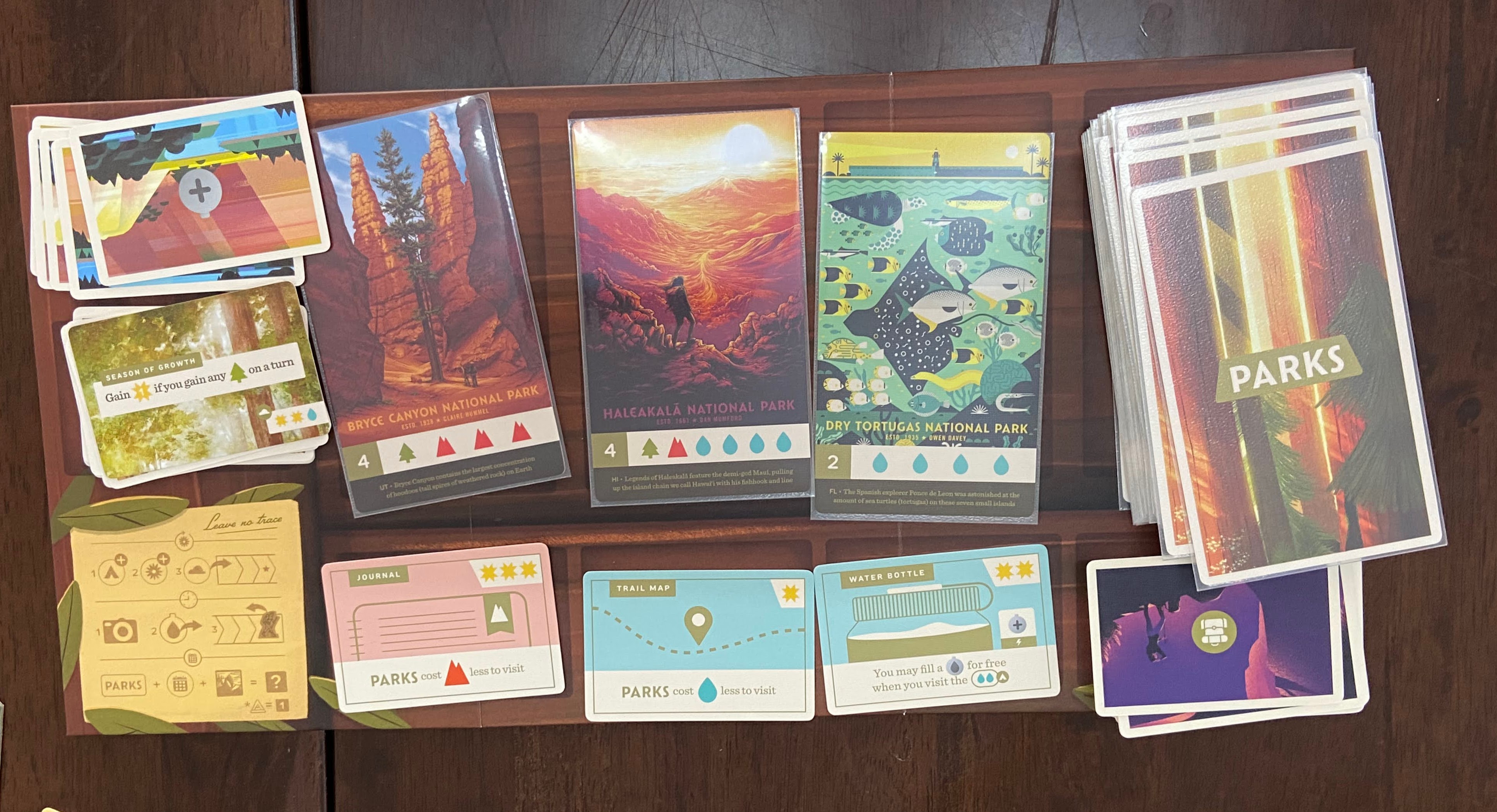

The largest cards in the middle are the parks. You can see what resources they require and how many points they give. Whenever a park is claimed, a new one is drawn to replace it. All the other cards you see here have different functions. The canteen (bottle) is an equipment which allows you to convert water to another resource type. There are powers you can buy which give you permanent abilities. There are also cards which introduce special rules for each round, e.g. giving extra resources when you collect a particular resource type. 


When setting up a round, every tile on the track gets seeded with one resource. Whoever is first to land on the tile claims the resource on it. The end tile offers three different actions. Whoever uses these actions early gets a discount. Both of these encourage players to go fast. However, in general there is incentive to go slow. Going slow means your hikers are stopping at more tiles to claim more benefits. These add up. Hikers who are quick to reach the end do nothing and just wait. The only exception is the last hiker still moving. This hiker is no longer allowed to move step by step and must immediately go to the end tile. When there are two hikers remaining, they can collaborate and both take their sweet time moving one step at a time, collecting tons of resources as they go. 
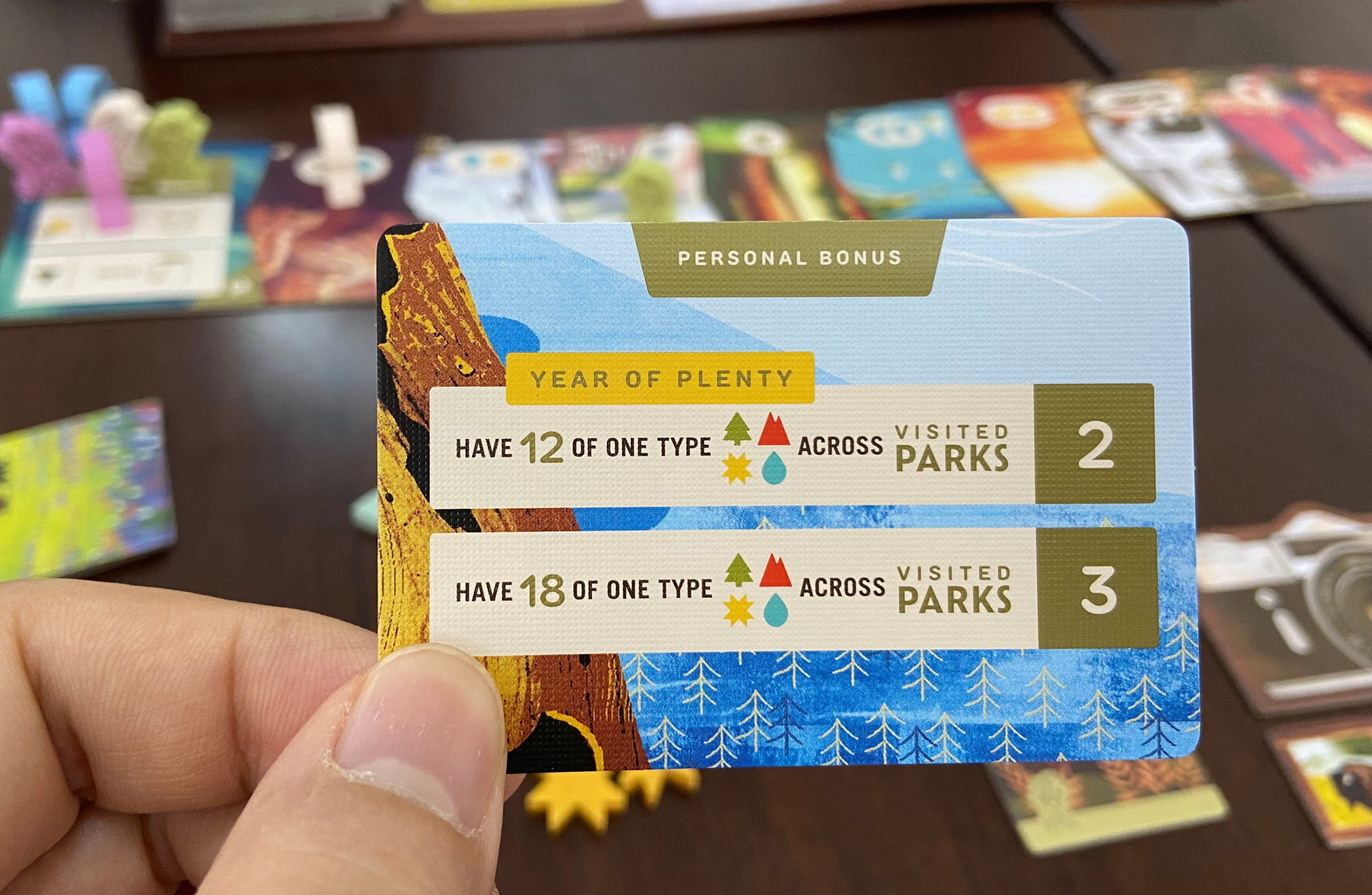

This is a secret objective you draw at the start of the game. If you can achieve it, you earn a bonus. This particular one I drew gave me points if I managed to collect enough parks to have 12 or 18 of the same icon. I chose to go for parks needing water. I managed to get myself a permanent power of discount by 2 water whenever I claimed a park. This helped tremendously. 


These were some of the parks I claimed. They all needed water. At the top right there's a camera. This is another way of scoring points. Players need to fight over this camera because there's only one in the game. When you perform the photo action, you first claim the camera if it doesn't belong to you yet. You may then pay two resources for a photo, which is worth 1pt. If you already own the camera when performing the photo action, you take a photo for just one resource. 1pt doesn't sound like much, but if you do this regularly it is lucrative. 

The game is colourful and eye-catching.

The Play

PARKS reminds me of Tokaido. It has that vibe of taking your time to enjoy the scenery. That "it's the journey not the destination" feeling. The central mechanisms are different. In PARKS the turn order is fixed compared to Tokaido where it is always the player who is behind who takes the next turn. However in both games there is that same incentive to go slow. Slow is more. You are pressured to go fast only when there is a specific spot you want desperately. 

There is significant player interaction, almost like a worker placement game, because you usually can't enter a tile occupied by someone else. You pay attention to what your opponents are collecting, because if they are going for the same parks, you need to race them. You try to deny your opponents the use of their special abilities. If an opponent has many canteens, you know he will want to visit tiles that provide water. You would want to occupy those tiles to foil his plans. 

There is no direct attacking between players. The competition here is of the Chinese dinner type. The food is all at the centre of the table. It's all about being faster to grab that chicken drumstick which most people want. This is an open information game, so there can be analysis paralysis if you play with friends with a bit of such tendency. The only secret information is the objective card drawn at the beginning. This doesn't seem to have a big impact though. 

The Thoughts

PARKS is a resource collection and conversion game. For me personally, it is a rather typical Eurogame, i.e. been there, done that. There's nothing particularly wrong with it, just that there's nothing truly new and exciting for me. But this is my problem. I think this game will bring joy to many other people, despite being just okay for me. It's a mid-weight strategy game. There's decent player interaction. The art is lovely. The components are excellent. It's a well-crafted play experience. I will use pop songs as an analogy. For me, of course pop songs from 20 years ago are superior to those today.  Pffttt. Those are songs from my time. The youth of this day and age will like the current pop songs. The songs from my era would be called classics, or simply old songs. Outdated songs. If I try to objectively compare PARKS with mid-weight Eurogames from 20 years ago, I might reluctantly admit that PARKS is better, because today the boardgame industry has higher standards for artwork and game components.  

Saturday, 6 August 2022

Dancing Queen progress

The work on publishing Dancing Queen is moving along. I should start doing a bit more marketing like releasing information and sharing updates of the project. I still plan to have the game released in November 2022. There's still a lot of work to be done. 


Previously I had decided to go with the Japanese manga (comic) style art. It was the most popular choice by far in a survey I did. Some commenters suggested to have more dancing in the art work. This was supposed to be a game about dancing, but the two main characters didn't even seem to be dancing. That made sense. 


This is the current version, with some adjustments made. There is a bit more feeling of motion. Also I have picked the light background. 


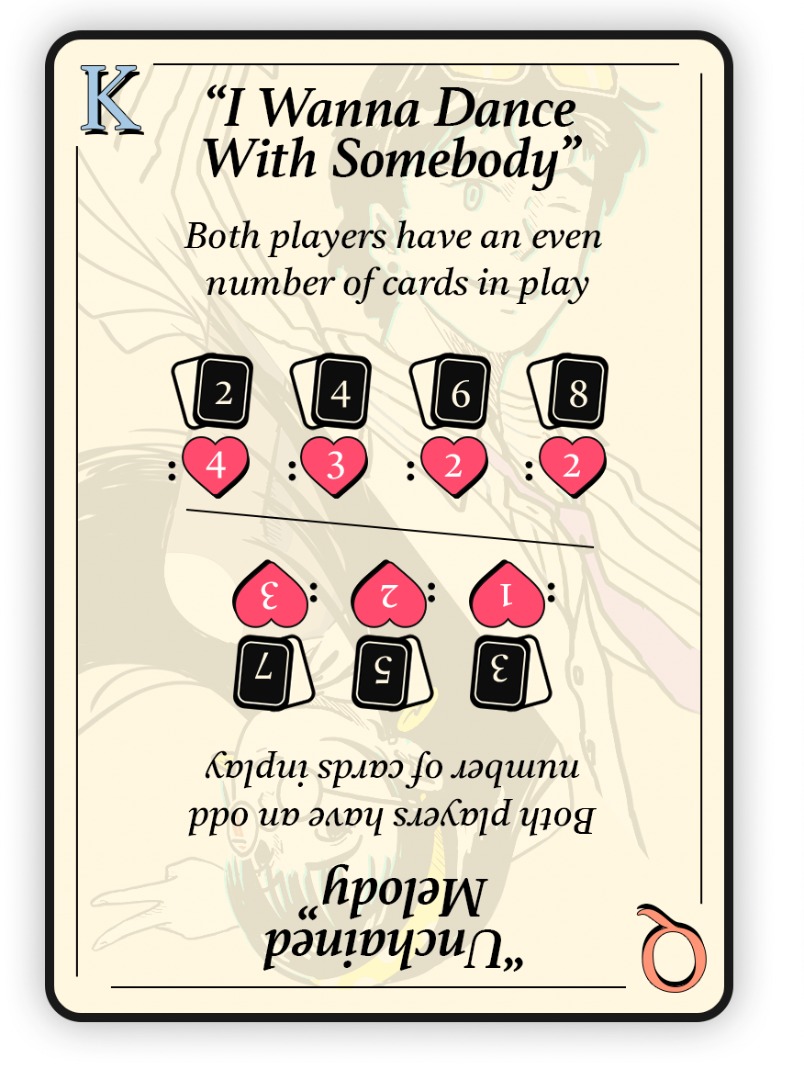
It took some effort to design the card fronts. It was challenging to come up with a way to communicate the 18 different powers on the cards. Previously I mostly tried to communicate using symbols. My artist now suggests having the text explain the power clearly, and then use symbols just to list the point values. This image above is our current card power notation. The image below is the previous version of the same card. 


I am changing all the card names to song names. I am standardising this. Previously my card names were a mess of different things. I am not used to the new names yet. When I think of a card power, the old name is still what comes to mind first. It'll take me some time to relearn this. 


The artwork is not all done yet, and what we have so far isn't finalised, but I couldn't wait to create a new playtest copy of the game. I wanted to get a feel of how the game will be using this new art style and notation. I wanted to start testing this. I had goosebumps seeing this art concept transform into something physical. I felt like a pregnant mum when the baby's kicking. 


One important reason I made this playtest copy was I wanted to try how the game feels after being converted into a pure card game. The previous version of the game has two reference sheets, each the size of half an A4 sheet. I can't squeeze all that information into a single card, so I'm splitting it up into four cards. Not ideal, but it's a compromise I have to make for the sake of portability. I want the whole game to fit inside one small deck. 

The 7 trophies and the microphone used to be yellow and black cubes respectively. I'm converting them all to cards as well. Dancing Queen, the 9 card game, will become a deck of 25 cards. 


Four cards will make a complete reference table, like this. This was created by me, not by my artist. It will look better when done by a professional artist. I just wanted to test this format out early and get some feedback early. 


We don't have the art for the trophies and the microphone yet, so I downloaded some clipart from the internet to be used as placeholders. We earlier decided to change the microphone to a spotlight. Now we will likely change the spotlight to a disco ball. That should fit the theme even better. Julian said the spotlight would end up like floorlights, depending on where you sit. 


I have started asking friends to test this version for me. It was exciting for me to see this being played at the table. Once Dith and Julian started playing, they found a few issues. Thankfully these were just text and notation errors, and not game mechanism problems. The core game mechanisms have not changed from the previous version which won the contest. Only art, names and how the rules are explained have been modified. One potential problem is the text might be too small and hard to read. I wonder whether this will be a major issue, or this is just an old people problem for me and friends of my age. We needed reading glasses when playing the game. 


We are still adjusting the card front. This is another version with a bit more colour. Do you like this one better? 

Friday, 29 July 2022

Yes! Ginseng


The Game

Yes! Ginseng from Taiwan is a light game about the many delicacies found at a typical Taiwanese night market. The game comes with a pair of chopsticks! They are not used as a game component. They just add to the theme. It looks like you are buying a pack of takeaway food. 


During play, three order cards are made available at the centre of the table. These are what you compete to fulfil. Each order specifies the ingredients needed to complete it. On your turn, when you have the right ingredients, you may turn them in to claim the order card. Whenever an order is claimed, draw a new one to replace it. When the order draw deck is exhausted, the game ends. Whoever has completed the most orders wins the game. 

You earn money when you complete an order. You can spend $2 to buy a special card. These cards have a wide variety of powers, some offensive, some defensive and some supportive. 


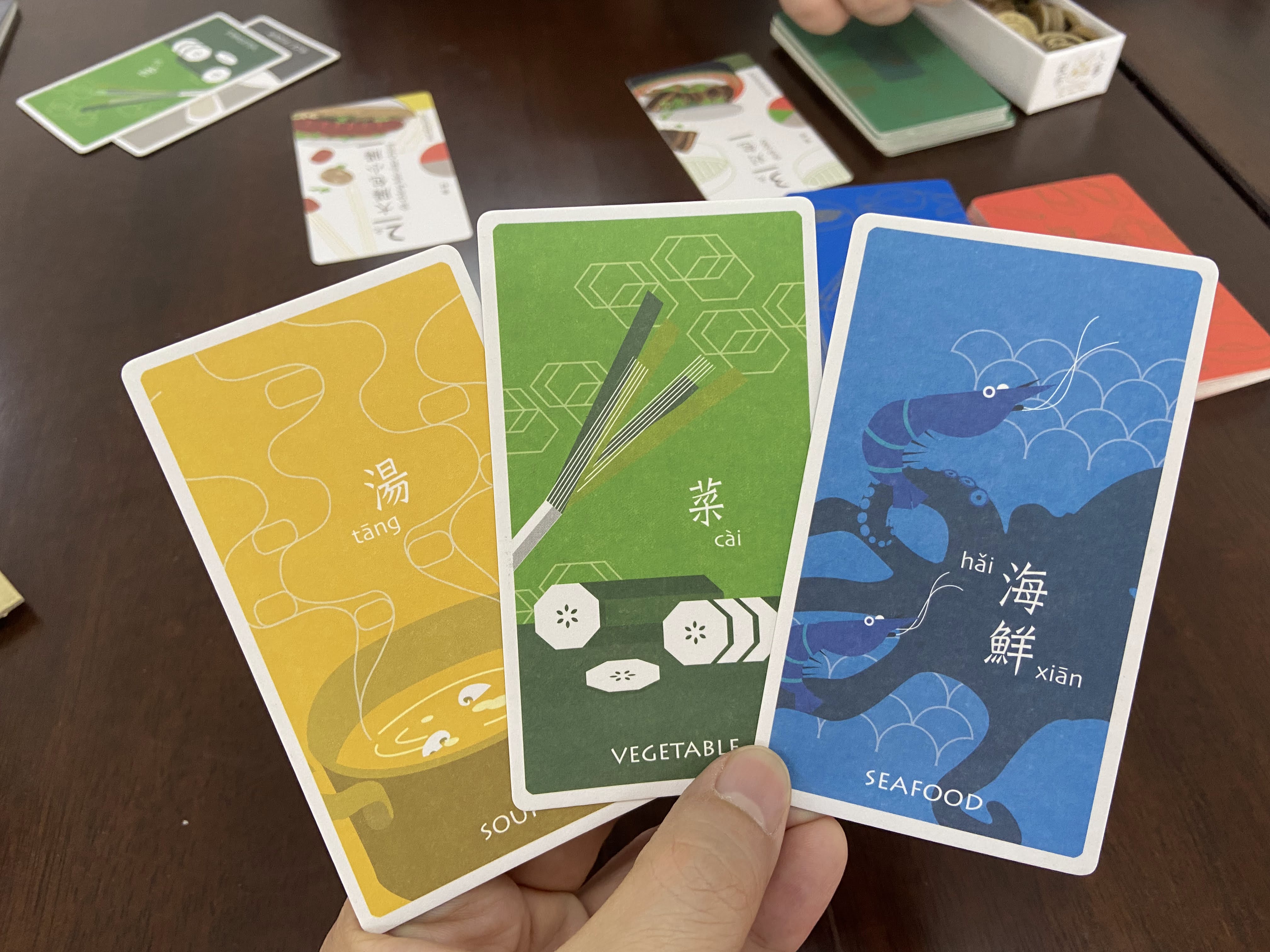
The cards are large and pretty. Those with coloured backgrounds are the ingredients. Those with white backgrounds are special cards. The hand limit is 8 cards. You have to discard at the end of your turn if you exceed that. 

The five types of ingredients are grain, meat, seafood, vegetables and soup. 


The special cards drawn in red are the offense cards. The Cockroach prevents an opponent from fulfilling orders for one turn. 


Among the ingredient cards are some which have spoilt. They are useless cards. You can't discard them until you have more than 8 cards. The card backs are the same. If an opponent tries to steal ingredients from you and he picks a spoilt ingredient, you can laugh at him. So I guess they serve a purpose. 
 

The order cards are pretty. The semi circle on the left tells you what ingredients are needed. The more ingredients an order requires, the more cash you'll earn. 


I like the name of this card. This is a support card. On the turn you play this card, you may substitute meat and seafood with vegetables and grains. 

The Play

Yes! Ginseng is a simple game. On your turn you draw 3 ingredients, and then try to fulfil as many orders as you can. If you have money, normally you just spend them to buy as many special cards as possible. When a good opportunity arises to play a special card, you do it. It's a light game and there is not a lot to think about. Sometimes you think about who to attack. 

Victory is determined by the number of order cards. So normally you will prioritise completing the orders requiring fewer ingredients. That's a more efficient way of using ingredients. The harder to complete orders do give you more money, and you can spend money on special cards. If you like attacking others, you can decide to go for money. Yes, in this game the rich bullies the poor. Capitalist pigs! 

There certainly is luck. If you are unlucky you keep drawing spoilt ingredients. Player interaction is one way the game naturally creates balance and neutralises luck. Any player who gets lucky and stands out will be ganged up on by the rest. Your completed orders is open information. Everyone knows who is in the lead. 

3-player game in progress

The ginseng card is equivalent to two jokers

I managed to complete 8 orders

The game comes with a booklet which introduces the various local foods in Taiwan

The Thoughts

We should have a category of games called travel souvenir games. In Malaysia, Kaki Lima would be such a game. Yes! Ginseng is this kind of game. It contains cultural elements of Taiwan. A gamer visiting Taiwan would be happy to bring a copy home. This is applicable for non-gamers as well. 

From the game mechanism perspective, the game is simplistic. There is not a lot of depth. There is not a lot of strategy to think about. You play almost on auto-pilot. You'll always try to complete as many orders as possible, and buy as many special cards as possible. Money doesn't have any other use, except for being the tiebreaker at game end. You may decide to keep some money when you are near game end, if you think there's going to be a tie. Normally you just spend it all. There's a special card which robs you if you have $2 or more. Old timers like me are not the target audience of Yes! Ginseng, unless I'm visiting Taiwan. However the game mechanism being so simple means this is a game that can be easily learned by non-gamers. 

If I assess the game as a product and not just based on the game mechanisms, this is a solid product. It is pretty, accessible and well-produced. It's the kind of product you like at first sight. 

Friday, 22 July 2022

ROVE


The Game

ROVE is a game with only 18 cards. It is a solo game. Rove is an exploration robot which has just crash landed on an unknown planet. Your job is to help it get to safety to await rescue.   


This is how a game is set up. The 6 cards in the centre represent the 6 modules of our robot. You have 5 action cards in hand. Your mission is at the top left. Action cards and mission cards come from the same deck, at the bottom left. One side of the cards is the action card side, and the other side is the mission card side. 

To complete a mission, you need to rearrange the 6 modules into the formation as specified by the mission card. The position of one particular module will be specified, and the other 5 modules must be arranged in a certain pattern around it. To win the game, you must complete 7 missions before running out of actions. Every module has its own movement capabilities. They can move in specific directions, some orthogonally, some diagonally, some both. One module must jump over another when moving. One module pushes other modules when moving. 

Whenever you complete a mission, you get a new one from the draw deck. If you have fewer than 5 cards, you draw a card before continuing. 


The number at the top left of the action card tells you how many actions you get when playing the card. You spend actions activating modules to move. The pattern at the centre is a bonus criteria. If the modules specified by the criteria are arranged in the configuration shown, you get more actions when you play the card - that number at the bottom right. Thus you are not only trying to arrange the modules according to the mission cards, you are also constantly evaluating whether you should make these patterns on the action cards. 


Every module has a single-use power, which is quite strong, e.g. swapping two modules. Once you use a power, you flip the card over. 

The configuration shown at the top right of the mission card is what you need to achieve.

The Play

This is a challenging game. Your cards are your resources, and your job is to complete 7 missions before you run out of resources. You are under pressure to conserve resources and use them wisely. This is a logic puzzle. Information is mostly open. You need to work out a most efficient way of using your cards. The only unknown is future missions. The next mission is known and you can plan for it, but if there are more after the next, they are still in the draw deck and you don't know yet what they will be. There are many factors to consider and it's tricky to find an optimal move. Since there is some uncertainly you can't work out the perfect sequence of actions. You want to make use of the higher action values, but it is not always feasible. Sometimes you need to sacrifice the opportunity. 

There is no time limit, so you can think for as long as you like. There is no opponent impatiently telling you to hurry up. When I played I didn't try to be exhaustive. I played in a relaxed manner. I did take my time to find a good move, but I did not calculate every possible path. I barely managed to complete the 7th mission. I suspect I might have made some mistakes which gave me an advantage. I might have drawn more cards than I was supposed to. Oops.

Game in progress. I place used cards on the right. 

Once the single-use power of a module is used, the card is flipped over and the power is now in red. 

When you line up all the completed missions, they form a nice story. 

The Thoughts

ROVE is a lovely little puzzle. It is small and convenient, and thus a good travel game. Also good for  when you are waiting for your date. 

Sunday, 17 July 2022

in the media: Bernama


I went to a boardgame event at Storyeum, Petaling Street on Thu 14 Jul 2022, and was interviewed by a reporter from Bernama. I only appeared for a short while in the news clip they released, starting at 3:41. Here's the link to the video clip. It's in Mandarin Chinese though. The boardgame business mentioned is referring to playwithpurpose.com.my, where my partners and I are collaborating with HABA from Germany to introduce a children's learning programme in Malaysia. 

Monday, 11 July 2022

boardgaming in photos: Dancing Queen concept art


18 Jun 2022. I participated in MyStartr's quarterly retreat, when the whole company stayed at a holiday house for 3D2N and had almost three full days of activities. In the evening during free-and-easy time I brought out my prototype Snow White and the Seven Dwarfs. It isn't easy finding opportunities to playtest this with a group of 10+. I grabbed the chance to do it. The game was quite challenging with this many people. Some of the players took out notebooks and phones to take notes. This is a deduction game. The more players there are, the more information there will be to be digested and cross-referred. Everyone contributes a little bit of information, and everyone tries to link up all the clues. 


This is my current prototype. All the artwork is found on the internet. I didn't do any of them. Snow White, Prince Charming, the dwarfs and the queen are all by different artists. I really like the dwarfs. If the game ever gets to the publishing stage, I should seriously look up the artist and commission his or her work. 

Prior to this I had only playtested the vanilla game with just Snow White and the dwarfs. Now that I had more players, I could test the Prince Charming variant. There are two Prince Charming variants. The first one is simple. Prince Charming is just one more player on Snow White's team. The whole reason I came up with Prince Charming was I felt Snow White was too lonely. This is a one-vs-many game, and for one player to go against a whole team of brains seems a little cruel. So in the basic Prince Charming variant, the prince is just a teammate to help Snow White. We didn't play this. I skipped directly to the advanced Prince Charming variant. 

In the advanced variant, Prince Charming starts undercover. He pretends to be one of the dwarfs and he'll get to see another dwarf's card. That means the Snow White team gets a little more information. If any dwarf chooses to look at Prince Charming's card, the prince's identity is exposed and he loses the ability to peek at a dwarf's card. There's about a 50% chance that Prince Charming will get to use his ability before being discovered. 

One thing that surprised me was this variant created a new objective for the dwarfs. Finding the prince felt like an achievement, a mission being completed. It might not actually matter a lot to winning or losing, but the experience and emotions created were real. The existence of a Prince Charming also became a source of jokes and teasing. I was reminded that the game experience is not limited to just game mechanisms or winning and losing. The art, the setting, even the names used all contribute to the play experience. 

I came up with the Evil Queen variant later on. I still have not yet playtested it. This variant turns the 2-faction game into a 3-faction game. It requires a bigger group too. I wonder whether this will make things a little too complicated. I am eager to try it out. 


I taught everyone to play Category 5 / Take 6. This might be the first time I saw this played by 10 players, which is the maximum number of players. This was quite exciting, because almost every turn someone would get burnt. This is a classic card game from Wolfgang Kramer. It is more than 20 years old now and has been published in many different incarnations. I am focusing on designing card games, so I should learn from these successful card games. 


Catch Me is a children's game from HABA I taught recently. This is a speed / dexterity game. Every player controls a mouse. The mice are placed at the centre of the table, with their tails extending outwards. The players hold on to the beads at the end of the tails. One player plays the cat and holds on to the wooden bowl. The cat player rolls the die, and depending on the colour rolled, he must try to catch the mouse of that colour using the bowl. The mouse tries to escape. The mouse player tries to pull his mouse away before it gets caught under the bowl. If the mouse gets caught, the mouse player becomes the cat player next round, and the cat player gets to become a mouse player. If the mouse escapes successfully, the cat player continues to be it next round. One important rule is if a mouse player makes any mistake, the penalty is becoming the cat player next round. E.g. red is rolled but the yellow mouse gets too excited and runs away. The yellow mouse player will become the cat next round. 

My work on Dancing Queen continues. My artist has come up with three pieces of concept art. I went to different groups of people to ask for input. I have my own preference, but what is more important is the preference of my target audience. I gather data to help me decide. 

This is the minimalistic style

This is the 80's-90's Japanese comic (manga) style

This is the modern animation style

The people I surveyed can be divided into three main categories. The first category is my friends and family, i.e. mostly Malaysians. They are a mix of boardgamers and normal people (ahem). The second category is a community of Malaysian game designers, so they are all boardgamers. The third category is a community of international game designers. The three groups have slightly different preferences. Overall the Japanese manga style won hands down. So this is the direction I'm heading in. One interesting thing I find is the international group has a strong preference for the minimalistic style. I had thought the modern animation style would win more votes. It did have many supporters, but at the final tally, it did about the same as the minimalistic style. 

I am very excited to see my game take shape bit by bit.  Hopefully all go according to plan and I can get the game released in Nov 2022. 

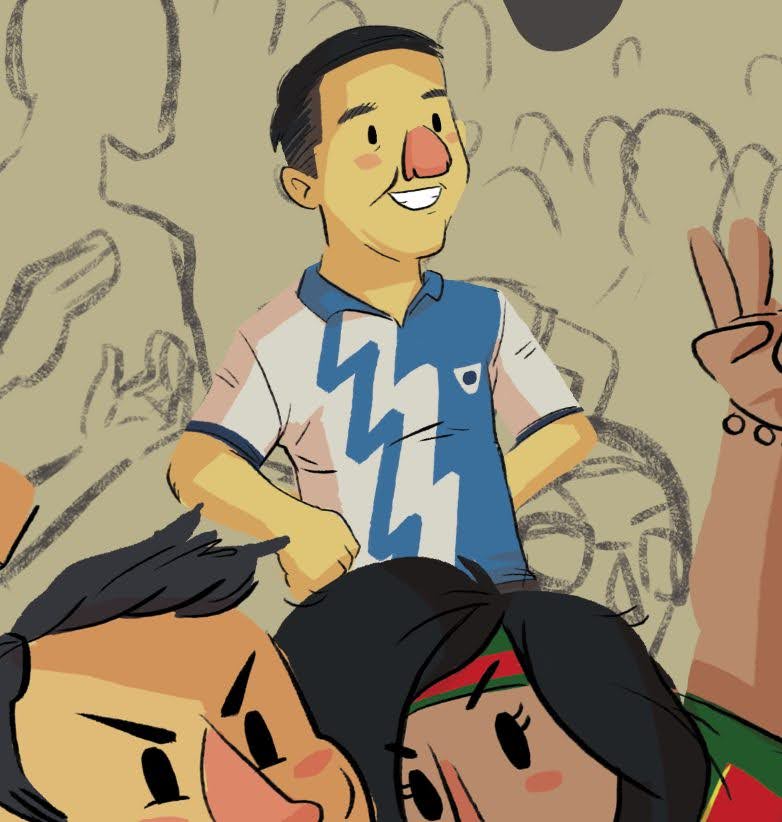
Gila Bola is what Haireey is designing and developing now. It is a game about the Malaysian football league, and this is his work-in-progress box art. He asked whether anyone wanted to be a cameo, and I jumped at the opportunity. For my jersey, naturally I picked the Sabah team, because I'm Sabahan. Getting myself onto the cover of a boardgame is more exciting than appearing in a newspaper! 

This is me - cartoon version

This is the live-action version

Sunday, 3 July 2022

Seasons of Rice


The Game

Seasons of Rice from Button Shy Games is a game with only 18 cards. It is a 2-player-only game. You build your own territory using cards, and score points based on the features in your territory. 


One side of a card is a character, and the other side is land. During setup, you draw two cards and pick one as your character. The other card becomes your starting land. Your character gives you a unique ability, usually related to scoring. Basic scoring (which both players enjoy) is based on fields you complete, i.e. areas enclosed by paths. The bigger the field, the more points you score. If a field contains a house, it is considered one level larger. Farmers and water buffalos in completed fields also score points. Buffalos score a flat 2pt each, but if you have buffalos outside of completed fields, you lose points. Farmers don't score many points if you only have a few, but if you have more, they are worth more than buffalos. 

Land cards can be placed vertically or horizontally. The key is not to leave any holes when you form your territory. Enclosed fields with holes in them are considered incomplete. 


The game is played over two halves, called seasons. When the first season starts, all 14 cards in the deck are dealt to both players. You pick one card to add to your territory, and set one aside for the second season. You then pass your hand of cards to your opponent. Repeat this two more times, then play the last card in your hand, and the first season ends. You will have 5 cards in your territory. There will be 6 cards set aside for the second season. The trailing player starts the second season, picking a card to play. You take turns playing a card until all are used. That ends the game. 


There are 5 completed fields in this photo. Can you count them? The small single square fields are completed fields too, just that they don't score much. Naturally you want your fields to be as big as possible, but there's a risk in being greedy. You might not complete the field by game end. If so, you get nothing for it. 

The Play

This little game has plenty of player interaction. You are constantly struggling between what you want and what your opponent wants. You must be keenly aware of your opponent's character power, so that you avoid helping him as far as possible. You are often torn between picking a card you want and picking one your opponent wants, for the sake of denying him. Sometimes it is not easy achieving the scoring criteria of your character. Completing a field can be challenging, especially when you are going big. This is very much a spatial game, so it feels more like a boardgame than a card game. 

You need to supply your own coins to keep score. Allen and I used components from another game.

The Thoughts

Seasons of Rice is swift and simple, but it gives your brain a good workout. There is a fair bit of luck, but it makes you feel you have much control, because there are many factors you can consider. You do have much information on which you base your decisions. This is a good thing. When you win, you feel clever and that you deserve it. When you lose, it's just luck. Seasons of Rice is a pleasant and relaxing little gem.