Tuesday, 22 March 2022

Season 0: our story

Warning: Previously when I wrote about Pandemic Legacy: Season 0, in order to avoid spoilers I omitted many details about the game. This here will be more-or-less a session report, and it will be full of spoilers. If you have not completed the game and intend to play, stop here. It's not safe to go any further. If you have completed the game or you are sure you won't be playing it, let's chat. 

I played the Pandemic Legacy series in order of publication, i.e. Season 1, Season 2 then Season 0. I did the first two seasons with Benz, Ruby, Edwin and Xiaozhu. At the time we worked at the same company, and usually played on Friday afternoons just before the end of the work day. Now some of us have moved on to different careers, and it is harder to arrange for all of us to get together again, especially in the past two years when the pandemic in real-life has put many things on hold. So we changed plans. I played Season 0 with my family - my wife and two daughters. They had not played the first two seasons. My wife Michelle had played a few different versions of Pandemic. My daughters had not. We had played other legacy games together - Betrayal Legacy and Machi Koro Legacy. We completed Season 0 within one month, playing 1 prologue game and 16 campaign games. Here are our experiences. 


At the prologue we already had to pick characters. I let the children pick for us. When we started the campaign proper, we continued to use the same characters as in the prologue. The most outstanding character was younger daughter Chen Rui's. Her ability was to move other players on her turn. When she did that she could move our pawns up to three steps away. This was very handy. She was our taxi driver. Whenever we needed to go somewhere far, we asked her to send us there. When we had to end our turns at a city with Soviet surveillance, we asked her to move us out of harm before the start of our next turns. Sometimes she spent almost her whole turn just moving the rest of us all over the place. That sounds a little sad for her, needing to play chauffeur at the beck and call of the rest of us, but hers was an important role. She was the MVP in our campaign. 


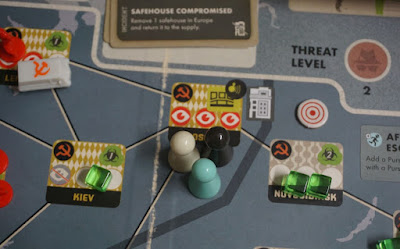
Chen Rui used the black pawn. We built a permanent safehouse in Moscow early. Being the capital of the Soviet Union, it was a high security place with three Soviet surveillance (red eyes), the highest level. However with a safehouse in place, we no longer feared surveillance. We were protected. One new ability Chen Rui picked allowed her to give cards to anyone when she was located in a particular city. She picked Moscow. She also got herself a visa to Moscow, which allowed her to fly to Moscow directly as an action. Most of the time her standard itinerary would be to fly to Moscow, and then she would send us speeding all over the board and give us the cards we needed. She just sat in Moscow and played backend support. 

Michelle's ability allowed her to give any card to any player in the same city. Normally you can only pass the card of that particular city. Other players may also take any card from her if in the same city, regardless of which card. Initially we thought we would be using Michelle's ability frequently. However Chen Rui's new ability was even more powerful. She could give cards to anyone anywhere on the board. We didn't use Michelle's ability as much as we expected. My ability allowed me to assemble teams with one card fewer, i.e. four cards. Elder daughter Shee Yun's ability allowed her to build a safehouse without playing a card. Normally you need to play the card of the specific city you are in. We declared that she could lay bricks anywhere (okay, we said she could s*** bricks anywhere). 

All these were our early abilities. Later when we obtained our second and third identities, we developed some other powerful abilities. However we still used our first identities the most, especially Chen Rui's. 

In the late campaign, Shee Yun used her Soviet identity more. By then we had a few permanent safehouses around the world so we didn't need her to be building new ones. She put together a powerful combination for her Soviet identity. She could walk into any Soviet city and instantly kill all Soviet agents. When she treated diseases, she could treat all at one go instead of one cube at a time. She was an effective sweeper, clearing off both spies and diseases. 


We built a permanent safehouse in Lagos. I always remember Lagos because of my experience in Season 1. One important character Kawasaki died in Lagos, and we were devastated. By now I have forgotten many details of my Season 1 campaign, but I still remember Kawasaki died in Lagos. This is how memorable a legacy game can be. In terms of timeline, the events in Season 0 happened before those in Season 1, so Kawasaki was not born yet in Season 0. I imagined this safehouse built in 1962 happened to be near Kawasaki's final resting place many years later. There's a poignancy to that. 


One new mission type introduced after the campaign started was disrupting virus trials. Trials were done in multiple cities, and we only had one chance to disrupt them. If we wanted to disrupt trials in multiple cities, we needed teams in place at all those cities at the same time when we carried out the operation. Cities in which we disrupted the trials were protected from future troubles. Cities which could not be saved suffered virus infections from the next game onwards. The infections worked in the same way as those in standard Pandemic and in Season 1. This was a nice touch. We saw how Season 0 transitioned to Season 1. 

When we encountered the earliest missions requiring disrupting trials, we were 100% successful. It seemed hard but somehow we managed it, stopping the trials in all cities. That saved us a lot of headache because it meant we didn't need to worry about infections for quite a few games. Yes there were those green cubes (diseases) introduced, but we didn't need to touch them at all. Only by the third time we had a disrupt trial mission that we failed. We failed that one completely, not managing to save any of the four cities. However we also failed in a super lucky way. All four of the impacted cities were adjacent to Warsaw. There was one asset we bought which allowed us to recruit a medic in a particular city. The player employing the medic could treat diseases in any city adjacent to the medic for one action. Michelle recruited the medic, and from then on easily treated diseases in all four cities whenever she felt like it. The diseases in our campaign never troubled us much because we were very lucky with those early missions. By the end of the campaign, we only had one contaminated city.


We never had to worry about the diseases popping up around Warsaw. Michelle could treat them at any time without needing to fly over.  


Beijing (i.e. Peking) was the only city that was contaminated, i.e. we had outbreaks there. We were lucky. Few contaminated cities meant much less trouble moving about the board. Outbreak tokens were the same as the incident tokens. We added outbreak stickers to the other end of the incident tokens. A token would be used whether we had an incident or an outbreak. The eighth incident or outbreak would end a game. We had two outbreaks in Beijing, thus two tokens there. 


We loved using this Diversion event card. It allowed us to move three incident tokens to any city. When a game ended, we had to add a surveillance sticker (red eye) to every city with one or more incident tokens. We were reluctant to end our turns in cities with surveillance because at the start of our next turns we would get exposed. If we could move multiple incident tokens to just one city, it meant we reduced the number of cities we needed to add surveillance stickers to. Also we could decide where we'd rather have the surveillance sticker. 

Santiago in South America was a backwater city, far away and hard to reach. We decided to make it our dumping ground for incident tokens, i.e. to have it take one for the team. Later on, we realised this was completely unnecessary. We should have just used Diversion on Moscow. Moscow already had Level 3 surveillance so we wouldn't need to add any more surveillance stickers. We had to issue a formal apology to the citizens of Santiago. We were stupid. 


It didn't matter if Moscow had many incident tokens. It already had Level 3 surveillance. We built a permanent safehouse there so we weren't afraid of the surveillance. When we played Diversion, the KGB agents must have been extremely frustrated that their investigations led them to their own HQ. They knew they had been fooled again by false leads.


We were always active in Moscow. Chen Rui always camped there. Later when we had multiple missions requiring infiltrating the site in Novosibirsk (right next to Moscow), Moscow became our transit point. 


Chen Rui became friends with a gangster in Shanghai. She could ask him to kill Soviet agents in Shanghai or any city next to it. That's what friends are for! We named the gangster Hui Man Keong (許文强 - the character played by Chow Yuen Fatt in the classic Hong Kong TV series Shanghai Bund). He helped tremendously in keeping East Asia clean. 

I got myself a visa to Manila so that I could fly there at any time. If anything urgent came up in South East Asia, I could get there quickly and try to defuse the situation. Also we had a permanent safehouse in Manila, and Manila was a neutral city, so I could quickly assemble a neutral team there whenever I had enough cards to do so. 


The blue fugitive tokens and the brown roadblock tokens are for yet another type of mission - hunting missions. A fugitive would start in a specific city during game setup and try to reach a Soviet city. Fugitive tokens spread to all neighbouring cities whenever an escalation card is drawn. If any fugitive token ever reaches a Soviet city, the fugitive successfully escapes us and our mission fails. Roadblocks prevent the spread of fugitive tokens. To eliminate the fugitive tokens themselves we need teams of affiliations matching the cities. To complete a mission we need to eliminate all fugitive tokens, i.e. we have to catch the guy, not just stop him from reaching a Soviet city. 

We usually tried to complete the hunting missions as early as possible, because if we let the fugitive tokens spread out, it would be a real pain in the neck to try to contain them. Also we needed teams matching the city affiliations to be able to remove the fugitive tokens. If we had fugitive tokens in both neutral and allied cities, we would need at least two teams to do this clean-up. 


This particular hunting mission had the fugitive starting in Los Angeles. We stopped him very early and he didn't even manage to leave LA. Within the first round, Chen Rui sent Michelle (pink) and I (green) to LA using her power. We then played an event card which let every player set up two roadblocks. That was enough to completely seal off LA. After that, it was only a matter of time to assemble an allied team to catch the poor guy. 


These two stickers in Bombay (modern day Mumbai) are a satellite control centre and a bug (listening device). Some missions required that we acquire a target in a particular region, and when we completed it, we were instructed to add these two stickers to the city where the mission was completed. At first I thought this was strange. Why have two separate stickers when we always had to add one then the other? Might as well have just one sticker with both icons. Only later we realised that if we were unsuccessful, we would only add the control centre but not the bug. We did well in our satellite control centre missions, and for the first five such missions, we were always able to bug the centres. We only failed to bug the centre in the Asia Pacific region. 


Later on these Satellite Launch cards turned up. Whenever we drew such a card from the player deck, the Soviets would launch a satellite in a specific region. All cities in that region would then be considered to have one more surveillance level. If any of us were in the region and not protected by a safehouse, we would be at risk of exposure by our next turns. This was scary. It felt like there was no place to hide. The bugs from the earlier missions allowed us to disable the satellites of specific regions. We still had to visit the control centre to be able to disable the satellite, but sometimes this was worth the effort. 


These round tokens remind you that big brother is watching you from the satellites. That is unless you are hiding in a safehouse. 


The European satellite control centre happened to be in Moscow, which was perfect for us. Chen Rui always camped there anyway so disabling the satellite was easier than walking down the street to buy newspaper from the corner shop. 

When it rains it pours. I once drew both an escalation card and a satellite launch card. 


This was yet another type of mission - infiltration missions. We had to visit a specific city, then get inside a specific building, go to a specific room and do something in that room. In between the rooms there were doors with codes. To open those doors we needed to have player cards which had the required numbers. This was a new use of the player cards. Those numbers at the bottom left mattered. It was not just about the affiliation or the city. The door codes were initially face-down. When we first entered a room we could flip over the codes to see what was needed. If we happened to have the right cards and we still had actions, we could continue to move through the building. If we didn't have the right cards, we would need to come back another time with the right equipment. 


As the infiltration missions became more complex, we had different paths to pick. The rooms had different effects, some good some bad. In the photo above, the office at the bottom left gives an action token. Action tokens are important. When you infiltrate a site, at the end of your turn you always exit the building and return to the city. If you want to infiltrate again you start at the front door next turn. You can't stay overnight inside the building. Sometimes without extra action tokens you simply can't reach deep enough inside a building to complete your mission. 


This was the mega complex that appeared in the late campaign which we had to infiltrate. This was in Novosibirsk. In the Season 0 story, one important character was Agent Sabik. He was a CIA operative sent to the USSR. The CIA lost contact with him and feared he had been captured by the Soviet. He managed to escape, but the CIA was not sure whether they could trust him. He might have become a counterspy. During our campaign there were a few times we got in contact with him, and we had to decide whether to trust him. When he was deep in the USSR, he had asked to be extracted but his handler Cooper refused and asked him to stay on to gather more intelligence. He was eventually captured by the KGB in Novosibirsk, and this mega complex was where he was detained. He was tortured and experimented on. He was patient 0 of the virus developed by the Soviets, that very virus which went out of control later in Season 1. This was an oooh moment for me because I have played Season 1. 


Finding the Novosibirsk building blueprint was one of the highlights of Season 0. It was hidden in a secret chamber at the bottom of the game box. This was fun. Gimmicky, but I like it. 


The mega complex in Novosibirsk was called the Pearl Compound, and to enter we must use our Soviet identities. 


Initially we had no information about any of the rooms in the Pearl Compound. We could only remove the seal of a room when we stepped inside. It was a huge complex with many possible paths. We had to guess where the room we needed to reach was. The various infiltration missions across different games all required different actions to be taken at different rooms of the Pearl Compound. Each time we had to go deeper to find the next room we needed. 


Some of the paths we took brought us to dead ends. Getting into dead ends meant wasting a turn. We could only try another route next turn. With the Pearl Complex so huge, we needed to stockpile action tokens before going in. Else we wouldn't have enough actions to go where we needed to be. 

Some of the rooms had useful abilities, like switching door codes and disabling satellites. However these were nice-to-have things we could do if we happened to be on the way. We didn't have the luxury to go in for the sake of visiting the rooms. We had to conserve our resources for completing the infiltration missions themselves. 


Later on we were able to create paths using air vents. Two originally unconnected rooms could be linked up. The sticker in the photo above is a newly created path between two air vents. 


After completing our campaign, we removed the seals of rooms which were still intact. We realised how lucky we were. We had managed to avoid the rooms with multiple surveillance icons (red eyes). 


This rightmost card is a symptom card. If you enter a city with disease cubes, you catch the disease and take a symptom card. Symptom cards take up space in your hand and reduces your hand size. Assembling a team requires five cards, and your hand size is 7. If you get very sick and have 3 symptom cards, you won't be able to assemble a team. Thankfully as the campaign progressed we were able to get ourselves treated. If we were at a safehouse, we could spend actions to discard symptom cards. 


There are many different symptom cards. The flavour text differs, e.g. coughs, fever, numbness in hands, nausea, but the in-game impact is the same. They just clog your hand. Whenever I took a symptom card I coughed loudly, getting into the spirit of the game. It is probably not a good idea if you are playing in a public place though. 


One of our missions required two allied teams on site. My Lee Kum Kee identity allowed me to bring along teams whenever I moved. In one particular move, I took a flight to the city where the mission was to be completed. Based on how I interpreted the rules, I could bring both teams along. Picturing this was crazy though. I was taking an Air Asia flight and checking in two vans as luggage, and the lady at the counter smile sweetly at me and wished me a great flight. Best baggage allowance ever! 


I brought two allied teams to San Francisco. I left them there to do their thing and moved to Toronto to disable the Soviet satellite flying over North America. The control centre was in Toronto and we had bugged it. 


Lucy Wong, the bodybuilding housewife, was my first identity and also the one I used the most. I was a frequent flyer to Manila. I befriended a shop owner there which let me swap two cards with any card from the discard pile. This of course was to help me with assembling teams, which I could do with one card fewer. 


These were our passports by the end of the campaign. Our MVP was definitely Chen Rui's first identity (top left). She was exposed many times, and we were quite worried whether she'd eventually burn that identity. Thankfully that didn't happen. She had two liabilities (dark brown stickers), both due to being exposed. 

Shee Yun (top right) had a friend Dr Robert who lived in Moscow. When Dr Robert first appeared, Chen Rui wanted him as an asset. When a player starts a turn in the same city as Dr Robert, she gains two action tokens. This was perfect for Chen Rui, because she always camped in Moscow and rarely left. Also she could use those extra actions to move us about efficiently. Unfortunately by that time she had already filled up all her asset spaces. She said she was willing to tear off an existing asset for Dr Robert. I insisted no. She was disappointed. We gave Dr Robert to Shee Yun later. It was helpful to her too later on when she became the designated player to do infiltration. Infiltration missions often needed extra actions. 

In addition to the medic, one other important asset Michelle had was the gunbrella. When she killed Soviet agents, she could kill two with one action. She was our "cleaner". 


This was the Moscow Incident, the most memorable one in our campaign. Our safehouse in Moscow was destroyed by an incident, and at the time three of us were in Moscow! Moscow had three surveillance icons and if we weren't able to move out of harm's way before our turns came, we would be exposed three times! At the time Shee Yun (white) was not using her identity which allowed her to immediately build a safehouse. To switch to that identity she would need to find a safehouse first to change. We had taken our safehouse in Moscow for granted. In hindsight, we should have built a second safehouse in Europe as backup. Moscow was the lion's den and we should not have taken that lightly. 
 

This was our map at the end of the campaign. Generally we did well. We suppressed many of the Soviet surveillance icons around the world. There was no more in Asia. We had another permanent safehouse in Novosibirsk. Although Novosibirsk was right next to Moscow and another safehouse so near the one in Moscow seemed like overkill, it did save us some trouble and helped us somewhat. The control centre in Tokyo was the only one we failed to bug. We had a permanent safehouse in Paris. Michelle had a visa to Paris and she was ready to fly there whenever anything bad happened in West Europe. 


These are player aids, front side on the left and back side on the right. The back side was initially blank. We added stickers during the campaign whenever new actions became available to us. By the end of the campaign the back side was full. 


The legacy deck asked us to fill in questionnaires like this. They were psychological tests asking behavioural questions. How we answered later led to different types of restrictions imposed on us. This was basically random. We couldn't determine from the questions what kind of restrictions would be imposed. We had no basis when deciding how to fill the questionnaires. I see this as just a story and role-playing element. 


We generally got the tougher restrictions. Yes, we looked up the debrief book and the operations deck to see what we would have received had we answered the questions differently. Chen Rui was adamant we did so. We had some infighting and I-told-you-so moments. One of the annoying restrictions was when we passed a card to another player we were required to discard an additional card. Cards were precious so this was a high price to pay. 


These are all the event cards in the game. At the start of every game we could pick which ones we wanted to use. The most we could have in a game was 10. I assigned Shee Yun to be responsible for picking event cards. We looked at the missions of the upcoming game before deciding which events to use. 


Some of the components added after the campaign started were the green disease cubes and the outbreak tokens. The out break tokens were not really new components. They were just the incident tokens with outbreak stickers added to the other end. 


This page in the rulebook initially only had that small section at the top. The rest of the page was blank. By the end of our campaign this page was filled up by stickers. These were all the player actions which were added during the campaign. 

Late in the campaign there came a point when we had to decide whether to help Sabik. CIA considered him a traitor and wanted to hunt him down. He told us he was just trying to save the world. This new disease developed by the Soviets had no cure. Even the Soviets could not control it. We decided to trust him and to assist him. When we did this, the rest of our legacy deck was discarded and we were given a new deck to replace what was discarded. This was the only major fork in the storyline. 

The December month was only played once, regardless of how successful we were with the missions. Two of the missions involved stopping the disease from spreading, which meant saving the world from disaster. The third mission was more of a personal vendetta thing. Sabik wanted to meet Cooper, his previous handler who left him in Siberia. We prioritised saving the world, and we managed to complete both of those missions. We then turned to the last mission. This was a climactic moment. When Sabik met Cooper (i.e. we were successful), he was overwhelmed with emotions. He looked like he was going to kill Cooper on the spot. We never found out whether he would have done so, because we shot him dead. It was a pitiful sight, watching him die. He looked like a biology class human anatomy model. His skin had turned transparent due to the side effect of the disease. He was restless and violent, very unlike a trained agent. Chen Rui was rather sad that we had to kill him. I said it was the right thing to do. Was it? 

We read the final passages of the story, and found that the four of us went on to become a powerful hidden force within the CIA, the same one which was behind the events in Pandemic Legacy: Season 1. We were the founding members of that evil secret organisation - Zodiac! 

Friday, 18 March 2022

Pandemic Legacy: Season 0


Note: There are minimal spoilers in this article. You can safely enter and read on. 

The Game

Season 0 is the third and likely last game in the Pandemic Legacy series. I have played Season 1 and Season 2 and enjoyed them immensely. There was no doubt I was going to buy Season 0 when it was released. This is a prequel, and we are now back in the 1960's. We are in the middle of the Cold War between USA and USSR. You play newly trained CIA agents. The CIA has found out that the Soviets are developing a bioweapon, so it urgently needs some medically-trained agents to help address this threat. 


These are some of the game pieces. Now that the theme is espionage, we no longer have research labs. We get safehouses instead (back row). There are no longer disease cubes in four colours. We get Soviet agents (red figurines). We get a new game mechanism - those vans on the left. They are teams we get to assemble to help us complete missions. 

The map has retro art. Look at the mug on the right, and the match sticks at the bottom. The world is divided into 6 regions, and this division is an important part of the game. Similar to previous seasons, Season 0 is played over 12 in-game months. Each month can be played once or twice. If you do well on the first try, you proceed to the next month. If you fare poorly, you get to play the same month a second time. The missions differ every month. You are considered successful if you fail just one mission and complete the rest. There are a few types of missions. The basic type requires assembling a team and sending it to a specific city. Another type is similar but you don't know which city it is. You need to find out as you play. 


This is a legacy game, which means the game rules and game components change as you play through the campaign. The map changes. New game components are added. New player abilities are added. Changes are permanent and carry over to all future games. Some of the changes are decided by the players. Some are caused by events during play. There are eight boxes in the game storing new rules and components. The game evolves. There is a stack of legacy cards which tells the story and introduces new mechanisms as you progress through your campaign. Every month there is something new to look forward to. 


To win a game you have to complete missions. To lose a game there are many ways. If the player card deck runs out, it means time has run out, so you lose. This is similar to basic Pandemic. If all the Soviet agents are on the board, it means the CIA has failed to contain the KGB, so you lose too. This is similar to how you run out of disease cubes of a particular colour in basic Pandemic. The third way to lose is when the 8th incident occurs. Incidents occur when you need to place a 4th Soviet agent in a city. The equivalent in basic Pandemic is outbreaks, but here it is handled differently. Soviet agents don't spread out to adjacent cities. Instead, you draw a card from the bottom of the threat deck (Infection deck in basic Pandemic), and resolve the incident stated on it. These incidents are all bad. 

Let's talk about the teams. You need teams to complete missions. Cities on the map are divided into three types, Allied, Neutral and Soviet. Player cards and teams come in these three types too. To assemble a team of a particular type, you have to spend five cards of that type at a city of that same type which has a safehouse. The equivalent in Pandemic is discovering cures. However assembling a team does not equate completing your mission. You still need to send the team to the city specified by the mission. 

Teams have one more important function. They kill enemy spies at the end of every player turn. However they only function in matching cities. In the photo above, the Soviet team can automatically kill all the spies in Pyongyang, which is a Soviet city. However it won't be able to do the same in Tokyo, a Neutral city.  


On your turn you perform 4 actions. Then you draw player cards into your hand, and finally you draw threat cards to be resolved. This will be familiar to those who have played Pandemic. Your strategic goal is to complete the missions. However you are constantly forced to handle tactical issues, i.e. the ever increasing Soviet agents. Threat cards determine where they pop up. You have to go about killing  (or deporting, if you prefer a less violent interpretation) them, but you must remember your long-term objective of completing the missions. You have to collect cards and assemble teams. There are escalation cards shuffled into the player deck. Whenever you draw one, the threat card discard pile is reshuffled and placed onto the top of the threat card deck. This means those cities which had Soviet agents deployed recently will get Soviet agents again. This is how the game creates urgency. While you are fighting fire you have to keep reminding yourself not to neglect the missions. 


The icon at the top left corner of a city indicates whether it is Allied (blue), Neutral (grey, a.k.a. Wi-Fi in my household) or Soviet (red). The background colour and pattern of a city indicates which region it belongs to. E.g. Africa is green. The red eyes represent Soviet surveillance. If you start a turn in a city with surveillance, you will get exposed. You need to scratch off a seal on your identity card (i.e. passport) and see what happens. Sometimes nothing happens. Sometimes you gain a disability. Sometimes your identity is burnt. That means you may never use this identity again in future games. 


In Europe at the top left, some cities are marked with a cross. This is to help remind you that these are not the target cities of the mission with an unknown city. Whenever you draw a European city card, you will know that's not the city beneath the mission card. Process of elimination. Sometimes you can't eliminate the possibilities down to one. You can still attempt to complete the mission by sending teams to as many possible cities as you can. When the unknown city is revealed, as long as you have an active team there, you complete the mission successfully. 


It's dangerous to have many cities having three Soviet agents. When you need to place a fourth, an incident occurs. 


Your characters are represented by passports. The game supports four players so there are four passports. Each passport has three identities. The game comes with many photo stickers and disguise stickers, so you can create your identities. This above was Michelle's first identity. The grey round seals at the bottom are what you need to scratch off if you get exposed. If there's an icon beneath the seal, something bad will happen. There is a problem with these seals. We couldn't scratch them off! We searched the net and found that many others had the same problem. This is disappointing. This isn't the first time such a mechanism is used in the Pandemic Legacy series. The solution is when you need to look under a seal, use the torchlight function of your phone and put the light behind the seal. You'll be able to see if there's an icon. Mark the seal with a pen to indicate it should have been scratched off. 

This was my first identity, a housewife who looked like a thug - Lucy Wong. 


For my second identity I decided to go for a James Bond look. Since my character was Asian, I named him Lee Kum Kee (famous oyster sauce brand in Malaysia). 


My third identity was a Russian one. It wasn't exactly convincing - Asian guy with a golden moustache. How you look does not impact gameplay at all. It's all just for fun, but that's part of the experience.  

This was one of the disguise stickers. Can you imagine that on a passport?!


That cylinder with an exclamation mark is an incident token. You place one at the impacted city when an incident occurs. The game ends when the 8th incident occurs. 


When an incident occurs, you draw a card from the bottom of the threat deck and resolve the incident stated in the grey box. Sometimes you are asked to add Soviet agents to cities. If those cities already have three agents, you trigger a chain reaction of incidents. Some incidents force teams to return to CIA HQ in Washington. Some incidents even destroy safehouses. An incident normally specifies a particular region and a condition. Something bad happens only if the condition is met. E.g. an incident may say add Soviet agents to cities in Asia with incident tokens. If there are none such cities, nothing happens and everyone is happy. However if there are some such cities, and they already have three Soviet agents, you immediately trigger another incident. Incidents can be very scary. In one of our games, we thought we were doing swimmingly well, only to be crushed by chain reaction incidents within a few turns. 


During setup you will pick some event cards to be available for the game you are going to play. These are single-use cards that can be played at any time, on anyone's turn, and it does not consume the active player's action. How many event cards you get to pick depends on how successful you have been in previous games. If you always complete all missions with ease, you'll get fewer. Else you'll get more, up to a maximum of ten. 


That strange block in the centre is a safehouse. Once you have a safehouse in a city, it protects you from Soviet surveillance. Also you can only assemble teams at safehouses. So they are important. 

The Play

I played Season 0 with my family. My wife Michelle has played other games in the Pandemic series. My daughters have not played many. None of them have played Season 1 or 2. However they do have experience playing legacy games - Machi Koro Legacy and Betrayal Legacy. We played a total of 17 games of Season 0 - 1 prologue and 16 campaign games. We did all 17 within one month. We played many during the Chinese New Year break. It was when the Omicron wave started in Malaysia, and we stayed home most of the time. We didn't do any New Year visits. Being a gamer, I'm certainly happy to stay home to play games. Okay, happy is an understatement. 

Season 0 is somewhat different from standard Pandemic, but it still feels familiar. The balance between being different yet feeling familiar is good. This is a tricky thing. If it were too similar, its existence would be pointless. If it were too different, fans would complain it was no longer Pandemic. I'm glad the designers found a nice balance. Assembling teams replaces finding cures, but teams still need to be sent to specific cities to complete missions. Also teams help in killing Soviet spies. One of my biggest takeaway from playing Season 0 is it is important to assemble teams. 

As the story develops, more and more mechanisms are introduced. There will be new types of missions. You get to perform new types of actions. There is a sense of escalation. The missions become harder and harder. The stakes become higher. However your abilities also become stronger. When you succeed in completing the tough missions, you feel smart. It is satisfying. It is fun to develop your character, finding good combinations of new abilities. Your identities will become specialists, and everyone will focus on certain aspects of the game. This is how you play effectively. It is necessary to do so, in order to keep up with the challenges the campaign throws at you. 

There is a sense of urgency when you play. Often the missions feel overwhelming and you feel stumped about where you should even begin. Sometimes you struggle to prioritise, not only among the missions but also between the missions and the ever growing Soviet agents on the board. You can't ignore the Soviet agents for too long. Sometimes we played with a heavy silence hanging in the air. Some missions felt close to impossible. When we were able to make good use of our abilities and some good luck that came our way to swiftly complete some missions, the feeling of elation was fantastic. Even when we knew we got lucky, we couldn't help feeling pleased with ourselves. 

The story is mostly linear. Not really that many forks. The game sometimes asks you to make decisions, and these later lead to some permanent effects. I find these arbitrary. You can't really plan ahead since you don't really know the implications of your decisions. It's fun as a storytelling thing, as in your decision led to this so don't blame anyone else. It's more a flavour thing than something you can be strategic about. The linear story is fine by me. It's an experience to go through, and it's engrossing enough to keep me entertained. There will be changes to the game board caused by random events and also by player decisions. Few changes are predetermined. That's a good thing. Different groups playing the game will likely end up with very different boards. This is closer to Season 1. In Season 2, how the board changes is mostly predetermined. I didn't like that. So I'm happy Season 0 has returned to the same approach as Season 1. 

The incidents mechanism makes the game unpredictable and tense. The outcome of an incident can be nothing, and it can also be the end of the world. In basic Pandemic, you can calculate just how bad an outbreak will be if it happens in a particular city. You pray you don't draw certain cities. In Season 0, details of incidents vary greatly. I'd say two thirds of the time incidents have no effects, other than increasing your incident count. However when a bad incident occurs, it can completely ruin your game. It is nerve-racking. 

Comparison against Seasons 1 & 2

Season 1 is closest to standard Pandemic. For me personally it was my favourite Pandemic Legacy experience, mainly because it was my first time. Till now my friends and I who played Season 1 still mourn over Kawasaki (one of our main characters) dying in Lagos. Season 2 is the most different version in terms of game mechanisms. The only thing I don't like is how it feels scripted. Not the story, but the board. Different groups will end up with more or less similar game boards by the end of the campaign. I prefer Season 0 to Season 2. The experience playing Season 0 was not as powerful as when I did Season 1, but Season 0 gave me many tense and exciting moments. The missions felt impossible, but we were given nifty tools to make the impossible possible. 

All four of us played the same characters throughout the campaign. This is the best way to play. You get attached to your characters, and this makes the experience even more immersive. Every time one of your identities get exposed, you suffer a minor heart attack, fearing whether you'd lose the identity forever. Once three of us were caught in Moscow without a safehouse. Moscow is a city with three surveillance icons (the max). We had a safehouse there which protected us from surveillance, but it was destroyed by an incident. Being in Moscow meant we would be exposed three times! I felt a chill run down my spine when that safehouse was destroyed. 

If you have played Seasons 1 and 2, I would strongly recommend Season 0. If you have played Season 2, you must have like Season 1. Then I'm sure you'll like Season 0. If you have not played any game in the series, I would recommend playing in order of publication, i.e. Season 1, 2 then 0. I think this is better than playing in order of timeline. In theory all three games are independent. However the stories are related, and I think playing in order of publication is the best way to experience how the story unfolds. 

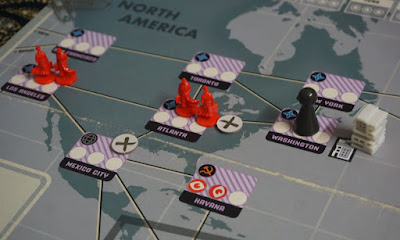
You'll get Soviet spies in the USA too. 

In our game the KGB even managed to put up surveillance (red eye) in some American cities. 

The Thoughts

Pandemic Legacy Season 0 is a medium-weight cooperative game. It is a legacy game, and an experience game. It comes with a story and a long campaign, which makes a memorable and unique experience. You get attached. The spy story is a nice-to-have thing for me. What I like the most is how the mechanisms create tension and excitement. These are more powerful than words you read. As the campaign progresses, more rules are added and the game does get more complex. We had some rule misinterpretations. I found that some rules were not made absolutely clear. We usually just decided based on what made the most sense story-wise. The minor rule mistakes didn't diminish our enjoyment of the game. 

It is best to play this with the same group of friends, and to play regularly until you complete the campaign. Don't drag it too long, or you'd forget rules and story elements in between games. Just imagine watching a TV series. You wouldn't wait too long between episodes. 

I wonder who this blog post is actually for. If you like Seasons 1 and 2, you'd probably have already bought and played Season 0. If you are not into the whole Pandemic Legacy thing, you probably won't be reading this. What's left are those who don't know a lot about the series. If this sounds fun, I'd suggest you start with Season 1. Can you play just Season 0? Yes, that does work. If you have played Pandemic and want a different experience, then Season 0 and Season 2 are both more different compared to Season 1. 

To minimise spoilers, I have omitted many details about my experience with Season 0. My next post will be a show-all post. If you are done with Season 0, let's compare notes. If you have no intention of playing the game, come look at the rest of the it. Just don't regret it. 

Friday, 11 March 2022

boardgaming in photos: Ubongo, Through the Ages, San Juan, Splendor, Tokaido


Ubongo is the kind of game which works well for boardgame cafes. Few rules, easy to learn, exciting and engaging. I place my copy in the living room at a visible location. My family noticed it one day and suggested to play. So dear fellow boardgamers, do position your games strategically at home. It works! Okay in my case it took rather long to work, but we are patient right? 


The game comes with many different player boards (right). Each player board specifies 6 different combinations of pieces. You will use one particular combination of pieces and then try to fit them all perfectly into the space on the player board. 


The end result you try to achieve is something like this. All the 6 combinations shown on the player board can fill the space perfectly. It's for you to figure out how to do so. 

Each combination is represented by an icon. You roll a die to determine which combination to use. 

The combination being used here is the rightmost (shield icon).


If you manage to fill the space within the time limit (set by an hourglass), you get to collect gems. There are 6 columns of gems on the main board. You have a pawn on the main board positioned at the bottom of one of these columns. The earlier you complete your puzzle, the further you get to move your pawn before collecting 2 gems from the column it is under. This means you have more flexibility in selecting gems if you can beat your opponents in solving your puzzle. Your final score is the number of gems of the colour in which you have the most gems. 


I have been digging up boardgames and card games I have bought on the iPad. Unfortunately some of them have been removed and I can no longer play them, e.g. Agricola. I guess this is due to license expiry or contract expiry. It feels unfair to buyers. Why should I lose something I've bought? 

I play these games on the iPad against AI's and not other humans. I just want a relaxing pastime and not serious competition. It's quick, and I can put it down any time. 

This above is Through the Ages. I'm not very good at it despite having played many games. I struggle to win against the AI's. I need to learn from them. Unfortunately my iPad is rather old and the game is not stable. Sometimes the app crashes and I can't continue playing. Restarting the app doesn't help. However sometimes if I boot up the app again after a few days the game loads successfully and I can resume. I still have not completed a recent game I started. Maybe I'll try again in a few days. 

I recently had an opportunity to buy a physical copy of the latest version of Through the Ages and its expansion. I own an older version which uses starting cards and not player boards. I rarely play this game face-to-face now, so I don't proactively look for a copy to buy. It was only when I saw a second hand copy for sale that I considered getting it together with the expansion. I have not played the expansion. Even if I didn't get to play it soon, it would be nice to own the latest version of this game I like and hopefully get to play it some time in the future. The seller later took down the game because his expansion was the version with printing issues (colours not matching the base game exactly). While I was hesitating whether to pull the trigger, the decision was made for me. 


I often play 7 or 8 games of Race for the Galaxy against AI's in one sitting. I am able to handle these AI's. I win some and I lose some. I have landslide victories and I am sometimes left in the dust. The AI's give me a challenge. In this particular game I managed to score more than 100, which is rare. 


I had not played San Juan for quite a while. I find that now I can't seem to beat the AI's. This is supposed to be an easier game than Race for the Galaxy. They were both inspired by Puerto Rico. In my recent plays of San Juan I kept losing to the AI's. There must be something I'm still missing. I need to work hard to learn to beat the AI's. Perhaps the San Juan AI's are stronger because it is a simpler game compared to Race for the Galaxy. Being more complex, it might be harder to programme a strong AI for Race for the Galaxy. 


San Juan is supposed to be a more relaxing game than Race for the Galaxy but I am more stressed playing it because I keep losing to the AI's. It is frustrating and enticing at the same time. 


Splendor is beautifully done. Good user interface and fitting background music. The AI's are not very strong though. After losing to the San Juan AI's I play Splendor to console myself. 
 

Tokaido is pretty. The only thing that annoys me is how I have to watch the animation of the characters walking along the path. It was probably nice initially, but soon I became impatient to get on with the game. At the moment I find the 5 player game dull. It seems the AI's almost always pick the nearest location when they move their pieces. This happens so often that it gives me the impression that there is no decision to be made. It is always best to visit the nearest location regardless of what type it is. I later tried doing 4-player games, and the AI's decisions seemed to vary more. Picking the nearest location might not be the wrong decision. The AI might indeed have considered all factors and found that the wisest choice. It's just that this makes a poor play experience. 

Friday, 4 March 2022

boardgaming in photos: The Castles of Burgundy, Innovation, A la Carte


This was my second time playing The Castles of Burgundy. The last time I played it was 2013. After 9 years, I had forgotten almost all of the rules. The only thing I remembered was I needed to position myself such that no matter what numbers I rolled with my dice, there would be something useful I could do. I found this principle still very useful. If I only play this game for the third time 9 years from now, I'll probably still remember this rule of thumb. 

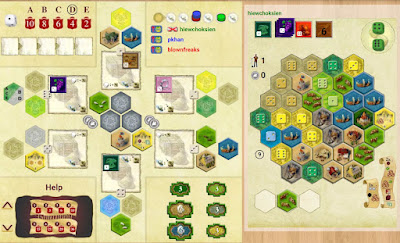
I played with Han and Allen on boardgamearena.com. We used the advanced side of the player boards, so the starting estate was not at the centre. In the screenshot above, the left half is the shared central board, and the right half is my player board. There were four dark green spots for me to pick where to place my starting estate. I picked the one on the right because there were more possibilities for expansion. 


Every turn you roll two dice and use them to perform actions. The two most common actions are picking a tile from the main board to put in your storage area, and placing a tile from your storage area onto your player board. The die values restrict where from the main board you can claim tiles, and also which locations on your player board you can place tiles. When placing a tile on your player board, the colour must match too. One currency in the game is workers. They allow you to change your die value,  one step per worker. You can spend a die to take 2 workers. 

Throughout the game you are essentially doing your best to fill up your player board, and you try to score as many points as possible as you do so. Whenever you complete a group of same-coloured tiles, you score points based on how early in the game it is and how big the group is. The different types of tiles have various powers, and they either give you special abilities or help you score more points. 


We were at the end of Stage 4 out of 5 stages, so it was near game end now. I had filled all the grey spaces on my player board and claimed a bonus for being first to do so.


These two were Allen's and Han's player boards respectively. Allen had filled all dark green and yellow spaces. Han had filled light green. 


Whenever you fill a blue space, you get to claim goods from the main board. One more action type you get to perform is to sell such goods to earn points. There are six types of goods, each associated with a different die value. You need to roll a specific number to sell a specific type of goods. 


Nine years later, I looked at my first review of the game, and found that my opinion was mostly the same. The Castles of Burgundy is a very popular game, and I can understand why. I probably won't turn down a game but it's not one I seek out to play. I like In the Year of the Dragon and Notre Dame better. 


I played another game of Twilight Struggle against the AI, this time playing USA. In Europe I managed to gain control of East Germany, which was satisfying. It was nice to control Finland, an immediate neighbour of USSR. It meant I scored an additional 1VP every time the Europe region was scored. 


Younger daughter Chen Rui said she wanted to play A la Carte. I consider this a children's game and she's not exactly a kid anymore. I must say this is an eye-catching game - the pan, the stove and those spice bottles. 


The core mechanism is pouring just the right amount of spice from the bottle, no more and no less, and without pouring out any of the translucent salt pieces. This is novel. This is a light and simple game. For me the novelty wears off quickly. I am not the target audience.  


I taught Chen Rui Innovation, one of my favourite games. She said it gave her a headache. That is understandable. It is a quirky game with some unusual mechanisms. Every card in the game is unique, which means there is a lot of read when you are new to the game. It's not an easy game to digest. 


She foiled my plans. I had planned to use my blue Translation card to claim the World achievement. To do that I needed to have coin icons on the top cards of all my stacks. I managed to orchestrate that, and by my next turn I would be able to claim the achievement. Unfortunately for me Chen Rui used a dogma to give me a red card, covering my top red card which had a coin. The card she gave me had no coin. I didn't have any other red card with coins in hand. I never managed to claim this achievement. 

Our game ended in the 6th epoch, which is normal. I won by 6 achievements to 3, but Chen Rui did well in that she managed to score 45 points by then. We were still in Epoch 6. If we entered Epochs 7, 8 and 9, she would have been able to claim the respective epoch-specific achievements immediately.