Friday, 4 March 2022

boardgaming in photos: The Castles of Burgundy, Innovation, A la Carte


This was my second time playing The Castles of Burgundy. The last time I played it was 2013. After 9 years, I had forgotten almost all of the rules. The only thing I remembered was I needed to position myself such that no matter what numbers I rolled with my dice, there would be something useful I could do. I found this principle still very useful. If I only play this game for the third time 9 years from now, I'll probably still remember this rule of thumb. 

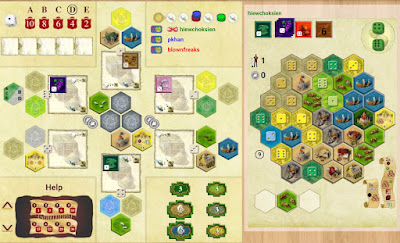
I played with Han and Allen on boardgamearena.com. We used the advanced side of the player boards, so the starting estate was not at the centre. In the screenshot above, the left half is the shared central board, and the right half is my player board. There were four dark green spots for me to pick where to place my starting estate. I picked the one on the right because there were more possibilities for expansion. 


Every turn you roll two dice and use them to perform actions. The two most common actions are picking a tile from the main board to put in your storage area, and placing a tile from your storage area onto your player board. The die values restrict where from the main board you can claim tiles, and also which locations on your player board you can place tiles. When placing a tile on your player board, the colour must match too. One currency in the game is workers. They allow you to change your die value,  one step per worker. You can spend a die to take 2 workers. 

Throughout the game you are essentially doing your best to fill up your player board, and you try to score as many points as possible as you do so. Whenever you complete a group of same-coloured tiles, you score points based on how early in the game it is and how big the group is. The different types of tiles have various powers, and they either give you special abilities or help you score more points. 


We were at the end of Stage 4 out of 5 stages, so it was near game end now. I had filled all the grey spaces on my player board and claimed a bonus for being first to do so.


These two were Allen's and Han's player boards respectively. Allen had filled all dark green and yellow spaces. Han had filled light green. 


Whenever you fill a blue space, you get to claim goods from the main board. One more action type you get to perform is to sell such goods to earn points. There are six types of goods, each associated with a different die value. You need to roll a specific number to sell a specific type of goods. 


Nine years later, I looked at my first review of the game, and found that my opinion was mostly the same. The Castles of Burgundy is a very popular game, and I can understand why. I probably won't turn down a game but it's not one I seek out to play. I like In the Year of the Dragon and Notre Dame better. 


I played another game of Twilight Struggle against the AI, this time playing USA. In Europe I managed to gain control of East Germany, which was satisfying. It was nice to control Finland, an immediate neighbour of USSR. It meant I scored an additional 1VP every time the Europe region was scored. 


Younger daughter Chen Rui said she wanted to play A la Carte. I consider this a children's game and she's not exactly a kid anymore. I must say this is an eye-catching game - the pan, the stove and those spice bottles. 


The core mechanism is pouring just the right amount of spice from the bottle, no more and no less, and without pouring out any of the translucent salt pieces. This is novel. This is a light and simple game. For me the novelty wears off quickly. I am not the target audience.  


I taught Chen Rui Innovation, one of my favourite games. She said it gave her a headache. That is understandable. It is a quirky game with some unusual mechanisms. Every card in the game is unique, which means there is a lot of read when you are new to the game. It's not an easy game to digest. 


She foiled my plans. I had planned to use my blue Translation card to claim the World achievement. To do that I needed to have coin icons on the top cards of all my stacks. I managed to orchestrate that, and by my next turn I would be able to claim the achievement. Unfortunately for me Chen Rui used a dogma to give me a red card, covering my top red card which had a coin. The card she gave me had no coin. I didn't have any other red card with coins in hand. I never managed to claim this achievement. 

Our game ended in the 6th epoch, which is normal. I won by 6 achievements to 3, but Chen Rui did well in that she managed to score 45 points by then. We were still in Epoch 6. If we entered Epochs 7, 8 and 9, she would have been able to claim the respective epoch-specific achievements immediately. 

Friday, 25 February 2022

7 Wonders: Architects


The Game

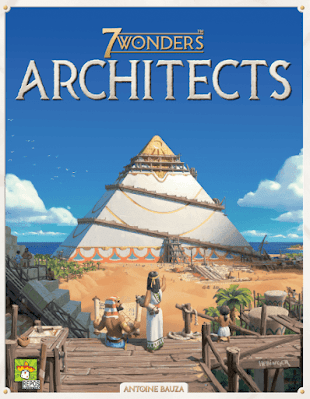
7 Wonders is hugely successful. It has spawned multiple expansions and spin-offs, and has now grown into a large game series. I recently learned that one of the latest spin-offs, 7 Wonders: Architect was made available on boardgamearena.com, so I asked Allen and Han to try it out with me. When I read the rules, I found many familiar elements. It was almost like a simpler version of 7 Wonders. It also has a bit of 7 Wonders: Duel. 


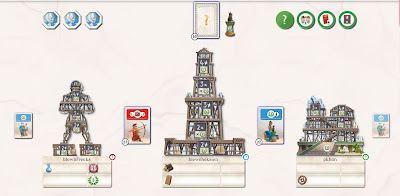
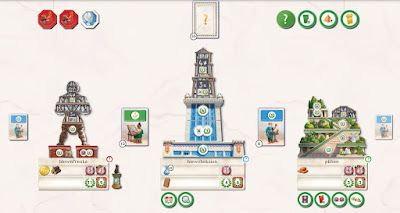
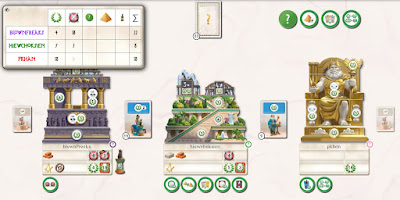
At game setup, every player is assigned one wonder of the world to build. Each wonder is built in 5 stages. Once any player completes his wonder, the game ends. The players are meant to sit in a circle around a table. There is a stack of face-up cards between every pair of players, and a stack of face-down cards at the centre of the table. On boardgamearena.com this is presented as seen in the screenshot above. 

On your turn you do just one thing - pick a card. You pick from one of the face-up stacks next to you, or from the face-down stack at the centre of the table. There are five different types of cards in the game, and they do different things. The grey and yellow cards are resources which you use for building your wonder. Whenever you have enough resources to build one stage of your wonder, you must do so. Whenever you build a stage, you get points and sometimes some bonus. Blue cards let you immediately score points. Green cards come with science icons, which you collect to exchange for techs. Some techs give you special abilities, some score points. 


Some blue cards come with a cat icon. If you claim such a card, you take the cat statue as well. With control of the cat you get to peek at the top card of the central deck. You are no longer blind drawing from the deck. This is handy. 


There are many techs. Each time one is claimed, the pool is replenished. If you don't like any of the three turned face-up, you can blind draw from the face-down stack. 


Red cards are military cards. You claim them to increase your military prowess. Some red cards come with battle horn icons. Horns cause the war status markers at the top left to flip from white to red side.  When all status markers are red, war breaks out. You compare your military strength with both your neighbours, and score a battle victory marker for each neighbour your are stronger than. These victory markers are worth 3VP each. If you are stronger than both neighbours, that's 6VP, which is pretty attractive. 

What I find interesting in the military aspect is after every war all military cards with horns are discarded. This means warmongering players who trigger fighting will lose strength after the fight they start. This is clever. 

The Play

7 Wonders: Architects is a smooth and quick game. On your turn you just pick one card. Players are competing over cards. When there's a card which both players want, it's first come first served. It may seem that the player earlier in turn order has an advantage, but after this player claims a card that his neighbour also wants, the next card may be an even more attractive one. 

Generally there are two types of tricky situations. The first one is when you like both the cards next to you and don't know how to choose. When you pick one, the other may no longer be around by your next turn. If you know one of them is not attractive to your neighbour on that side, then maybe you can risk taking the other card. Hopefully the card you want will still be around next turn. The other tricky situation is when both the cards are lousy. Not that they are inherently bad cards. It's just that some cards don't fit your current needs. When both are bad, you probably want to blind draw from the central deck, trying your luck. However it is not good to be forever stuck with two cards you don't want. If neither neighbour takes those cards, you may have to suck it up and take one, and hope that the next cards in the stack are useful to you. 

When you draw from the central deck, sometimes you get pleasant surprises, which is nice. However you have to remember you are putting your fate in the hands of luck when you blind draw. It may not be a wise thing to do. The cat feels powerful. When you have complete information, you make better decisions. I suspect the cat feels more powerful than it actually is. I'm a little OCD so uncertainty when making decisions irks me. That is why the cat feels so important to me. 

You have to pay attention to what cards your neighbours want and do not want. By doing so you can assess the risk of them taking what you want. Sometimes you have to take cards which are not important to you but are crucial to them. Yes, you have to be a jerk and hurt them even when it doesn't bring you much benefit. 

In the game there are four aspects you are weighing - collecting resources to build your wonder, directly earning points, obtaining techs for the special abilities (and victory points), and warfare. Direct scoring is a little boring, but points are points. They are not bad, just not interesting. Building one stage of your wonder takes patience and preparation, but the benefit whenever you complete a stage is rewarding. I feel it is better to take techs early, especially those which give you bonus abilities. By taking them early you get to use them more. If you get a victory point tech early, it is also useful because you have more time to adjust your play to fulfil the scoring criterion better. The warfare aspect is of higher uncertainty and it is exciting. If war breaks out often, the regular winner can get a huge lead. If there aren't many wars, investing in your military seems wasteful. Whether there are many wars somewhat depends on whether players aggressively take military cards. It also depends on how the military cards are positioned in the decks. If many military cards are near the top of the decks, you can't really avoid multiple wars. 

This is an open information game. You can see what everyone is doing and you can guess what they intend to do. You can think deep if you want to. You generally only need to consider your two neighbours. Players sitting further away don't affect you a lot. You won't affect them much either. This is very much like the original 7 Wonders. It simplifies a 7-player game by allowing you to worry mostly about just your immediate neighbours. However 7 Wonders: Architects is a turn-by-turn game and not a simultaneous turn game like its predecessor. 


The wonders of the world have different characteristics and these affect how you play. On the left, Allen had built the left foot of the Colossus of Rhodes, which gave him a military strength of 2. This immediately gave him a huge advantage and encouraged him to pursue war. 


I was first to complete my wonder - the Lighthouse of Alexandria (centre), but completing your wonder does not guarantee winning the game. I only managed second place. Han's Hanging Gardens on the right gave him techs, so he focused on collecting techs. 


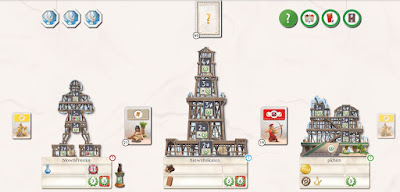
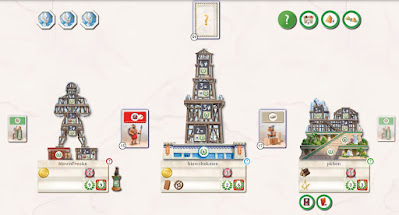
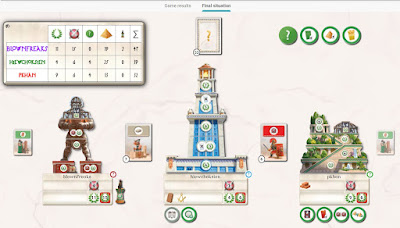
Since the game was quick, we immediately played another game. This time Han was first to complete his wonder - the Statue of Zeus. 

The Thoughts

When I first heard of 7 Wonders: Architects I wondered whether it was a totally unrelated game with the theme pasted on to help sell it. After all the 7 Wonders series is well known. Now that I have played it, I can confirm it is quite different from the original, but it fits the setting splendidly. It is simpler, but it is not a streamlined version of the original. It is its own game, with a different core. 

7 Wonders: Architects is a light game suitable for families and casual players. It is easy to learn but still has some strategy. It looks simple but it presents some interesting decisions. There is a fair bit of luck. You don't know what cards will turn up. For a short game like this luck is not a big issue. In fact I think it works well here because it creates excitement and surprises. 

Friday, 18 February 2022

boardgaming in photos: 7 Wonders Duel, Blokus Duo, Twilight Struggle, Baseball Highlights 2045


I taught younger daughter Chen Rui Baseball Highlights 2045. She is not familiar with baseball, but neither am I. The game works even if you know little about the sport. I said to Chen Rui that this photo looks like a scene from a Japanese manga, when the main character is about to make a super combo move. Imagine a threatening sparkle next to her glasses. 


We played the standard mode and not the beginner mode as recommended by the rulebook. In the standard mode you start with doing three rounds of buying players. In the beginner mode you have to play three matches in order to buy players three times. These three matches won't be interesting because there aren't many strong players yet. I don't have patience to watch kindergarten baseball. 


In our game Chen Rui had one particular player who specialised in neutralising human players. My good players often got smacked down by this particular player. Eventually I had to adjust my buying strategy to get myself more robot players and cyborg players. Only then things got a little better for me. Each match we used 6 out of our deck of 15 cards. Considering that we could place one more card in the On Deck position, we had access to almost half our cards. When I had a good human player, chances are Chen Rui had her anti-human player ready to counter my human player, unless she had just used this player in the previous match and she hadn't reshuffled. 

She was fond of one particular player called Boomer. She found the name funny. I wonder whether this is related to the "OK boomer" internet meme. 

We don't use the marker provided for score keeping. We directly used the pawns which managed to get back to home base (horizontal row along the top in the photo above). 


Chen Rui beat me by a huge margin in 7 Wonders Duel, the 2-player-only version of 7 Wonders. She scored 69 points! She utilised well her wonders which had the "one more turn" ability. When I taught her the game I told her this was an important ability. 


One of my biggest problem was I didn't have enough resource production cards - the brown and grey cards. I spent many turns discarding cards for cash, because I needed cash to pay for resources. 


This particular dark purple guild card was very attractive. It would give us $9 and at least 9 points. Both of us had taken many red military cards throughout the game. 


I tried to achieve a scientific victory by collecting green cards. I managed five different icons and was just short of one. My unbuilt wonder on the right would allow me to claim any discarded card, and I could get my 6th icon this way. Unfortunately for me Chen Rui quickly built the 6th and 7th wonders of the world, and that prevented me from building this wonder. I was so close! Had I not built my third wonder and instead saved the slot for this wonder, I would have won a scientific victory and Chen Rui would not have been able to stop me. 

Since I invested much effort into the scientific victory, it was not surprising that I fell behind in other areas. The scientific victory was a gamble. 


Chen Rui and I are still playing Attika. Now that we are getting very familiar with it, we can play quickly and we enjoy it even more. Sometimes when Chen Rui doesn't feel like learning new rules I'll suggest Attika. 


In this particular game I (green) managed to win by connecting two temples. I placed the land tile at the bottom right and that allowed me to connect my buildings. It is always satisfying to pull off a connection victory, which is usually hard to do.


Chen Rui begged me not to do it but I said no. So she did a mini flip-the-table move, flipping over one of the land tiles. She was just throwing a mock tantrum. We immediately proceeded to a rematch. 


Surprisingly our second game ended in a temple connection victory too. This time she (blue) made it. I was sloppy and didn't notice the threat. In this photo above you can see if she could construct three buildings at one go, she would connect the two temples. 


Had I been more vigilant I would have been able to stop her. I was too smug from my previous victory, so I deserved this lesson in humility. 


We played a third game. This time it had a more typical ending - all buildings being constructed. This was an aggressive match. Due to fighting for terrain, both of us had divided our buildings into two groups. 


I (green) could go for a connection victory by linking up my two groups through the space on the right. However it was a long way so it wasn't hard for Chen Rui to stop me. Still, it was useful for me to be able to create a threat and force her to respond. She had to block me and in doing so her building construction was suboptimal. She had to create a third group of buildings, thus spending two more resource cards. 


Eventually I won by constructing all my buildings. In this photo it looked like I (green) could still link up my buildings and win by connecting the two temples, but it was actually impossible because I didn't have enough buildings now. 


In this particular game my wife Michelle joined us. Chen Rui (yellow) had a poor start at the bottom right. Michelle (red) had quickly expanded and walled her off. At this point Chen Rui had only one building on the board when Michelle and I had four or more. 


Michelle (red) played aggressively, expanding quickly and grabbing land mercilessly. Because of this I spent many resource cards constructing buildings to stop her advances. I had to make suboptimal moves for the sake of defense, spending more cards than I wanted and forgoing the free construction bonuses.


I (green) placed a new tile in my backyard, and Chen Rui (yellow) swooped in to claim it for herself, blocking the way for my capital Korinth to grow. Bad girl! 


I later took revenge by doing the same to a tile she placed in her backyard. Muahahaha revenge is always sweet. Well, I originally intended to build these three roads in my own backyard. Now that she had taken "my" land, I had to find some place else to build them. 

The eventual winner was Chen Rui. She and Michelle were very close. Michelle could have won. When I saw her place her last land tile, I suggested a different location, because by doing so she could create a space for her to place her final building for free, next to another building it was dependent on. By doing this she could win in one turn instead of two. Her original plan was to spend one turn collecting resources, and then another to finish all buildings. My suggestion would let her win more quickly. However what we didn't expect was Chen Rui being able to block off that space which Michelle had just created for her own building. The tile placement helped Chen Rui instead, allowing her to build everything just before Michelle could. Michelle still needed two turns. Originally Chen Rui needed three, but due to that newly placed tile, she could do it in two, narrowly beating Michelle to win the game. Oops... my suggestion had cost Michelle the game. I swear I wasn't conspiring with Chen Rui. It was an impressive feat by Chen Rui, catching up and winning the game from a weak start. 


I have been playing a lot of Race for the Galaxy on the iPad against AI's. In this particular game I had a very nice combo. I started with Rebel Cantina which allowed me to treat military worlds as civil worlds. I had Pan-Galactic Mediator which gave me a prestige (a more valuable victory point) whenever I used this ability to settle a military world. I later had Contact Specialist, which also gave me a treat-military-as-civil ability but an additional bonus is the settle cost is discounted by 1. Subsequently the Rebel Pact, Terraforming Engineers and Universal Peace Institute all gave me further discounts by a total of 5. I settled the 9-strength Rebel military world at a cost of only 3 cards! 


Michelle felt like playing some games over the Chinese New Year holidays, and suggested Blokus. We played the 2-player version called Blokus Duo using my copy which is a standard 4-player version. To play the 2-player version we restricted play to a smaller area. Also our first pieces had to be played on two specific starting squares instead of corner squares in the standard 4-player game. 


Blokus is a game with straightforward rules. You aim to play as many of your pieces as possible. To play a piece, its corner must touch the corner of one of your other pieces, and its edges must not touch the edges of any of your other pieces. The game ends when no one is able to play any more pieces. Whoever has the fewest squares in their leftover pieces wins. That's all there is. Yet this is a game that let me experience a few stages of learning. At first I thought it was all about blocking others. Even the name said so - block us. Later I realised that being collaborative might actually work better. It was more important to ensure you could spread out and reach more areas, utilising spaces which your opponent couldn't use anyway. As I played more, I came back to realise that in the end you still need to block others cleverly, while most of the time going with the flow of your opponents and playing many complementing pieces. This is the kind of game in which you can philosophise, but you can also play it in a relaxed manner without thinking too much. 


I have been playing Pandemic Legacy: Season 0 with my family,  and since it is set during the Cold War, it made me boot up Twilight Struggle on the iPad to play against the AI. I played USSR. In this particular game our competition over Pakistan was intense, with influence level going beyond 10! 

I noticed that the AI seemed to be breaking a rule. When it did coups, the DEFCON level didn't worsen. I always watched the DEFCON level closely to make sure I didn't trigger a thermonuclear war and lose. The AI seemed to enjoy starting coups all over the place, not worrying about the DEFCON. I later realised that I had misunderstood the coup rules. Coups only affect DEFCON if they were done at battleground countries. I had thought they always affected DEFCON. So no, the AI wasn't cheating. 


The AI in Twilight Struggle isn't very strong. It is sufficient for you to learn the game but once you know the game well enough it doesn't pose much challenge. However I still chose to play against it because I was only looking to play a relaxed game. 


I was rusty. I only managed to win when the game ended after Turn 10. I remember I used to win by sudden death when I reached 20VP. Not that this is something to be proud of, since the AI is weak. The overall app is done very well. Very practical and easy to use for such a complex game. 

Friday, 11 February 2022

Fantasy Realms


The Game

Fantasy Realms was a nominee for the 2021 Kennerspiel des Jahres. It is a short card game with a simple core mechanism. Despite the minimalistic ruleset, I consider this a medium weight game. Every card in the 53-card deck is unique. They have different base values and powers. All cards affect some other cards, so there are many card interactions to manage in your head. 


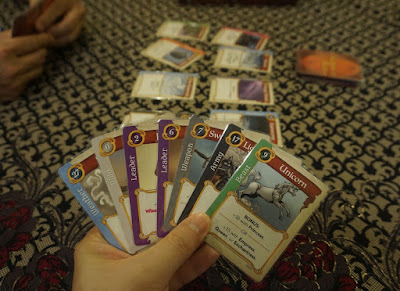
At the start of a game every player is dealt 7 cards. There are 11 suits in the deck, 10 of them have 5 cards, and the 11th has 3 cards. The number in the top left corner is the base value. Every card has a unique ability. The "ability" is sometimes a penalty. Ultimately these abilities affect the values of the cards themselves or the values of other cards. Some cards boost the values of other cards. Some cards decrease and even nullify the values of other cards. Some cards cancel the abilities of other cards. When you get your 7 cards, you can already work out what your total score is. However this score will change, hopefully for the better, as you play. 

A turn is very simple - you take a card then discard a card, just like Lost Cities. You will always maintain a hand of 7 cards. You may take a card from the draw deck, or claim a face-up card from the centre of the table. When you discard a card, you always discard it face-up to the centre of the table. That means someone else might later take this card you discard. By modifying your hand of cards, you hope to increase its value and outscore everyone else when the game ends. The game ends when there are 12 face-up cards on the table. This is what players at www.boardgamegeek.com recommend. The official rules say play to 10 discards. 

At this point 6 cards have been discarded. 


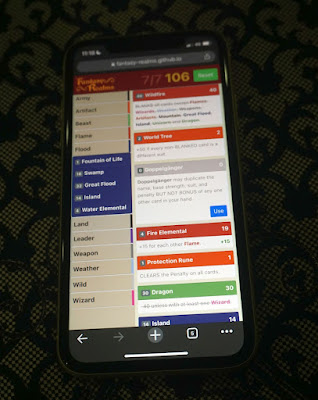
It is tedious calculating your current score. Every time you take a new card and discard an existing card, you more or less have to do the calculation all over again. Both the card you discard and the card you take may affect the rest of the cards in hand. Thankfully someone wrote a program to do the calculation for you. You just need to enter your hand cards and the program takes care of the calculation. Whenever your hand changes, just remove the card you discarded and add your new card. You still need to understand the card powers because you need to evaluate which cards to discard and which to take. You just leave the tedious scorekeeping to the program. 

The program is on this webpage: https://fantasy-realms.github.io

The Play

You are basically trying to fine-tune your hand of cards within a tight time limit, aiming to increase your score as far as possible. Every time anyone draws a card from the deck, there will be another face-up card added to the table. You don't really have much time. If you are lucky, your starting hand may already be pretty decent and you don't really need to swap cards much. If this happens you should just draw cards from the draw deck and try to end the game before the rest catch up to you. 

By watching what your opponents discard you can get some clues on which cards they may want and which they may not want. If you see them taking certain cards, it would be a big hint for what they are building towards. When you discard cards, you do want to avoid discarding something useful to your opponents. However it's not always easy to guess what they want. 

You don't know your opponents' current scores. I use 150pts as a rough guide. If I can hit 150pts I know that's a respectable score. If I'm much lower than that I know I probably need to work harder. 


In this particular game I was dealt Protection Rune, which removed penalties from all other cards. I had many high valued cards which had penalties. The Protection Rune got rid of all these penalties and all my high-value cards were able to score their full values. This was very lucky for me. 


In the second game I managed to reach 150pts and I was quite confident. When the final scores were revealed, I was surprised to place last! Han scored 230pts! Allen also outscored me by about 10pts. A score which won in one game can end up being the lowest in another. There is a huge range in winning scores. In this second game Han had one particularly high scoring card which received a boost by having two other specific cards. He didn't have them initially, but picked them up from what Allen and I discarded. It was Christmas time for him. 

The Thoughts

Fantasy Realms is a game about making combos, and it does so in an incredibly succinct way. Every single card is unique. There is much interaction among cards. All of the interactions do keep to a consistent fantasy medieval theme. If the King is together with the Queen, they both become stronger. The magic wand is only truly powerful when wielded by a wizard. If you ask the dwarf army to fight alongside any other race, they grumble and fight less effectively. If you look past the fantasy setting, all the card abilities are just about increasing or decreasing card values. However the card names and artwork do help a lot in immersing yourself in the story. You don't feel like you're playing Excel. 

There is some luck to the game, but I don't think it's a problem. The game is short. Sometimes you do get amazing combos right from the get go. That's luck. But it is still entertaining trying to save an atrocious hand. I find the game concise and condensed. Quick yet satisfying. It's a good filler for gamers, and a decent main course for casual players.