Friday, 4 February 2022

Imperium: Classics


The Game

Imperium: Classics is a civilisation game which uses deck-building as its core mechanism. It contains eight different factions. Its sister game Imperium: Legends has eight other factions, and they are more advanced. Both games are complete standalone games. 


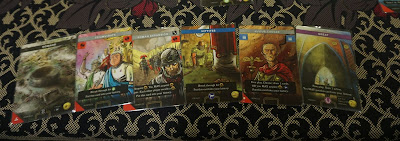
At the start of the game everyone picks a faction to play. Every faction has its own set of cards, and you set up your faction more or less like this photo above. That first red card indicates that you are still at the barbarian stage. You need to spend effort advancing your nation to become a civilised empire. This is a big part of the game. At the third position there is a stack of nation cards. They are your countdown mechanism for becoming a proper empire. Each time your draw deck is exhausted and you need to reshuffle your discard pile to form a new draw deck, you draw one nation card to shuffle into your new draw deck. This is how your nation advances. Once the nation card deck is exhausted, you graduate to become an empire. You can start using empire cards (with blue icons), which are generally better. However barbarian cards (red icons) become obsolete. Some cards have neither icons so you can always use them. 

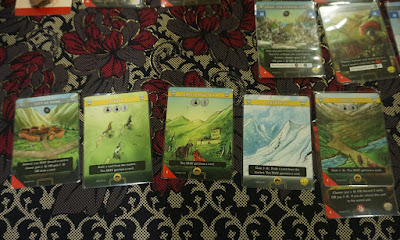
Those cards on the right are development cards. You can only buy them after you become an empire. You get to buy one each time your deck is exhausted and you need to reshuffle. So even after you become an empire, you still want to cycle through your deck quickly in order to buy more of these development cards. They are powerful and they score points too. 

You have a hand limit of five. You get three actions on your turn, and usually an action is simply playing a card and using its power. Cards not played need not be discarded. You can hold on to them for your next turn, just that you will draw fewer cards to refill your hand. You need to stick to the hand limit. Holding cards allows you to play them at the most opportune moment, but it also means you are cycling through your deck more slowly. You are slowing down your advancement. 


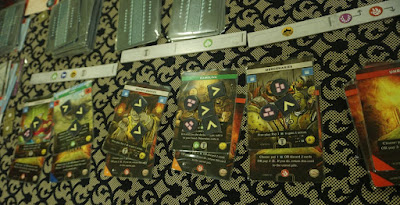
You set up the central playing area like this. There are several types of common cards which are accessible to all players. Buying cards work differently from typical deck-building games. You can't just buy anything any time by spending money. You need to have specific cards which let you buy specific types of cards by paying a specific currency (resources or citizens). There are two ways you buy cards. The cheaper way gets you an unrest card. If you pay more you don't need to take the unrest card. Unrest is bad. An unrest card has no function. It clogs up your deck, slows you down, and costs you 2VP at game end. You have to pay to return an unrest card to the centre of the table. When buying cards they go directly into your hand and not to your discard pile. You can use the new card immediately. 


Cards with swords (right) are attack cards. You rob your opponents or force them to take unrest. Most cards have some power. Unlike typical deck-building games, Imperium: Classics does not have basic currency cards. It doesn't have $1, $2 and $3 cards like Dominion, or attack value 1 and 2 cards like Ascension. There is more text to read in Imperium: Classics. It is not easy to earn the currencies in the game - resources and citizens. Only specific cards give these. 


Some cards once played are kept in front of you. Their powers can be single-use or ongoing. All region are kept on the table. Some other card types also stay in front of you. One common ability of region cards allows you to place a garrison. What this means is you can attach a card to it (see rightmost card above). Normally you do this to remove weak or useless cards from your deck. E.g. after you become an empire, you should stick your now-defunct barbarian cards underneath your region cards. 


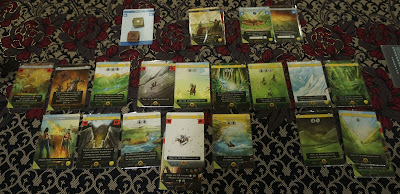
At the end of your turn you place a 1VP marker (those arrow chips) on one of the common cards. This makes the card more attractive. You can place it on a card you intend to buy, but you can't guarantee the card is still available by your next turn. In the photo above you can see many VP markers have accumulated on the cards. That means in our game the rate of buying cards was low. 


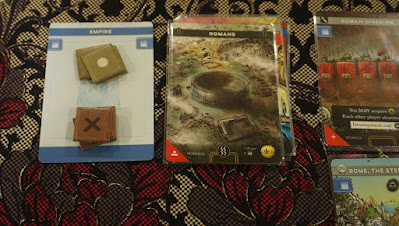
The status card on the left flipped to the blue side meant I was now an empire. The card at the centre was my Roman faction card. It showed my special ability, which was to score a point for every two citizens at game end. Some cards were buried under this faction card. Some of them were single-use cards which had to be removed from my deck. Some of them scored points at game end, and thus needed to be kept here. 


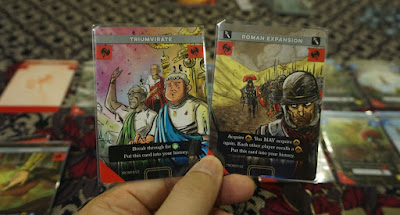
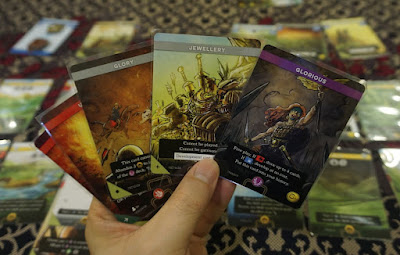
This is a Glory card. Every faction has one. When you play it, you discard three region cards in play in exchange for a Fame card. Fame cards are important because they let you score points at game end. Most of them have useful abilities too. One way the game ends is when Fame cards run out. 

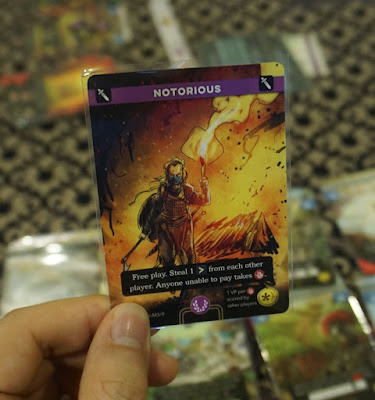
This is one of the Fame cards (purple bar). This one happens to be an attack card too (sword icon). It robs victory point markers from your opponents. 


This is the card at the bottom of the Fame deck. It cannot be claimed. You can only use its ability. Once any player uses it, the game ends after the following round. 

There are a few other ways the game ends. If any player develops all his development cards, the game ends. If the common deck runs out, the game ends too. In all these cases, victory is determined by victory points scored. Another way the game can end is when the stack of unrest cards runs out. This represents human civilisation collapsing and we all descend into chaos. The player with the fewest unrest cards wins. 

In Imperium: Classics every faction has its own character. In general you keep advancing your faction, improving your abilities and gaining more and more new ways to score points. The factions have different strengths and weaknesses. Depending on the combination of factions in play, you will have a different play experience. You have to balance between defending against your opponents' strengths and utilising of your own strengths. 

The Play

I played with Han and Allen. Han had played before and taught us the game. 

It took some getting used to at first, because it is quite different from typical deck-building games. There are a few new concepts to digest. Almost every card has a unique ability, and the abilities vary widely. There is a lot of text to read. The game is very much about understanding the strengths of your faction and making good use if them. There is not a lot of player interaction. When I planned how to grow my nation, I didn't need to watch the others closely. The most I spent attention on about my opponents was their attack cards. I needed to either develop the ability to block them, or prepare what they were going to rob from me. Now this sounds dumb. Why would I meekly produce resources and prepare them for the robbers? The thing is if I were to run out of resources, I would instead have to take an unrest card, which is usually a worse fate. I'd rather just pay tribute. Just take the money and go. There isn't much I can do to stop others from progressing, other than the occasional attack card. 

Progress is what you will be constantly obsessed with. You know once you become an empire, you'll get access to better cards and more scoring opportunities. There is always the incentive to keep your deck thin, so that you can cycle quickly. Fame cards are important because they give you points. They will also affect your play because often the points you receive from them depends on how well you fulfil certain criteria. 

We played two games back to back, trying out different factions. I played the Romans in the first game, a faction suitable for beginners because it is straight-forward. The Romans scored points for having high population, so I focused on that. Han was the Vikings, and he kept raiding us, stealing resources. One unique aspect about the Vikings is they would never advance to become an empire. If they get to that situation, the game ends instead. Allen was Carthage, and he was good at accumulating resources. 

In the second game I was the Scythians, Han the Greek and Allen the Celts. The rulebook advised that the Scythians should expand and get many region cards, and I obediently heeded that. My ability allowed me to score points for resources accumulated. I had two cards which produced resources based on the trade icons on my region cards. When I had enough such icons, I regularly produced resources and stockpiled them. Later in the game I found that one of the nation cards added to my deck allowed me to score points for region cards. No wonder the rulebook game me such advice.

I had many nation cards, which meant there was much work to be done to go through them to become an empire. Thankfully although I bought many region cards, they could be played onto the table and didn't clog my deck. My deck remained thin. 

Allen's situation was the opposite. The Celts were good at buying leaf (uncivilised) cards, and he used that ability frequently, growing his deck. That slowed his progress. Whenever he bought a leaf card, he forced Han and I to take unrest cards. That was a pain in the neck for us.  

One disadvantage of my Scythians was they would only get their Glory card after becoming an empire. I had no way to claim Fame cards when I was still in the barbarian state. Progressing towards the empire state was crucial to me. Han's Greek faction had a thin nation deck, which meant he could become an empire quite early. When he had to place the 1VP markers onto common cards, he usually placed them on empire cards (blue icons), because he knew Allen and I were not able to use them yet and would not likely want to buy them yet. 

This is what a 3-player game looks like. 

One of the Roman cards - Bread & Circus - is very handy. It can return two unrest cards per turn! 

These were the cards buried beneath my faction card by the end of the game. Those with a golden circle at the bottom right corner are cards which scored points. 

The card on the right is the Scythian faction card. You identify factions by the colour at the bottom left corner. 

The Scythians tend to have many region cards (yellow bar). 

I love the art style in the game. 

This was the Scythian card which scored points based on the number of region cards, 1VP for every two region cards. 

By game end I had 14 region cards. One had just been returned to my hand because I had just used it for defense. 

This was Allen's Celts faction card, which gave Han and I much headache. 

The Thoughts

Imperium: Classics is a game with character. It is different from typical deck-building games. When I played it I felt this was a game with heart. It felt slightly clunky at times, but there is uniqueness. This is your quirky and friendly neighbourhood bartender, not the clean-shaven and slick superstar salesman. Right out of the box you already have eight factions to play with. That's good value for money. 

There is not a lot of player interaction. Depending on your preference this can be good or bad. Unlike Through the Ages, you are not regularly comparing military strength, science level etc. Player interaction is mostly in the form of the occasional attack actions. In theory you do compete for the common cards. However in practice I find that since we don't buy cards all that frequently, this aspect doesn't feel very competitive. Most of the time I am just focusing on my hand of cards and developing my own nation. 

I like how the factions are constantly progressing, getting more and more abilities. I see this game as a race game as well. You do want to maintain good progress so that you get access to stronger cards and more scoring opportunities. How to fine-tune your deck and whether to keep cards for your next turn are questions that will keep you engaged. 

You do have to play to your faction's strengths. That somewhat constrains you. However you do have some freedom for creativity through augmenting your deck with common cards. That creates some variability even when you play the same faction. The faction card has two sides, one more challenging than the other. This too helps. 

Tuesday, 1 February 2022

Launching the HABA Learning Program

One project I started working on in 2021 is launching the HABA Learning Program in Malaysia together with a few partners. HABA is the German company well known for children games, toys and other products. If you see a children's game with a bright yellow box, it's probably a HABA game. This learning programme uses boardgames as a learning tool, and is designed for children ages 4 to 7. We had intended to work on this much earlier on, but COVID-19 disrupted our plans. 

I have been playing boardgames actively for almost 20 years. My two daughters grew up in a home where boardgames are regularly played. I witnessed myself the educational value of boardgames and how much they help in family bonding. So I am enthusiastic about this project. Through experiencing many different games, and expertly designed games, children learn many things not found in typical school curriculums. Encouraging parents to spend time playing games with their children is something meaningful to me. 


Our trial classes concluded successfully and we have now progressed to regular classes. In 2022, we will be training more teachers so that we can bring this programme to more children and parents. If you are in Malaysia and you are interested in the programme, whether you are a parent, a child, a teacher or a learning centre, visit us at https://playwithpurpose.com.my/. 


This is Lucky Pirates. You race to claim 5 gold coins. You roll a die and move your pirate along the islands. If you land at an island with a treasure chest, you get to claim a gold coin. If you land at your ship, you lose a gold coin. I assume you have to surrender it to your captain. If you happen to meet another pirate, you will have a duel, and whoever wins claims a gold coin. This is a 100% luck game, which will not be interesting for adults, but it is a fun experience for children. 


This is Hamster Clan, a cooperative game. As members of the hamster family, you need to work together to harvest all your food before winter arrives. At the top right corner, the lush tree is your countdown timer. Every round a leaf falls, and once the last one drops, autumn ends and so does the game. There are many rooms in your underground home, and specific storage rooms are dedicated to specific food types - clovers, carrots and grain. There are a few modes of transportation for you to move about. Some vehicles only fit one hamster. If multiple hamsters try to use the same vehicle, they will have to queue, resulting in a traffic jam. You should spread the work around to avoid such traffic jams. 

When the children I taught played this game, they didn't think or plan much and just went for whichever food type they fancied. Now these are 5- and 6-year-olds, so don't expect the kind of analysing and strategising like we seasoned gamers do. They only realised the traffic jam problem as they played. Eventually they could not harvest and store everything in time for winter, and lost the game. 

One of the parents Dith commented that the children should get a second chance, so that they could apply what they had learned in the first game and hopefully do better. This way they can learn better and see progress. The lesson plan only allowed playing the game once within the 1 hour session. However when I looked up the full programme plan, this game will actually be played three times, at different lessons. 

The game board is richly illustrated. Some elements are not relevant to gameplay, but they do add to the experience, invoking creativity in the children and helping them associate the game with real life. In this photo you can see one of the children have placed her pink hamster on the bed to rest. There is one particular room which is completely dark. When we played, the children were reluctant to stop there, being afraid of the dark. It was an opportunity to explore this topic and to explain why there is no need to be afraid of the dark. I am amazed how much heart goes into creating these games for children. 

Saturday, 29 January 2022

Happy Lunar New Year


Wishing everyone success and happiness in the Year of the Tiger! 

Friday, 28 January 2022

Oltree


The Game

Oltree is a cooperative game set in a medieval fantasy world. You are knights (called rangers) assigned to a damaged fort to repair it and to help the villages in the surrounding area. The game comes with six chronicles, and when you play you always pick one chronicle. A story unfolds as you work through the chronicle. You also pick one assignment card. Assignment cards and chronicles are independent and you can mix and match them. Technically you goal is not to complete your assignments, but you probably need to complete at least some of them because they help greatly towards your chronicle having a successful ending. 


This is one of the chronicles. A chronicle is a set of cards, organised like a book. You will flip through the cards like reading a book. 


This is an assignment card. There are three assignments you can complete. The assignment cards come with different difficulty levels. They determine the type of incident cards you will use in your game. There are five types of incident cards and every game you will only use two types. 


This is the main game board. The derelict fort is at the centre. There are eight villages surrounding the fort. You will move between the fort and the villages and perform various actions related to these locations. 


This is the progress chart with four stages which correspond to advancing the story, adding an incident to a village, adding a problem to a village and drawing an event card. At the start of your turn you always roll a die to determine how the progress marker moves. Most of the time it moves one step. Sometimes it moves two steps, and sometimes it doesn't move at all. 


On your turn you perform two actions, and they must be different. When you are at the fort, you may construct a building or repair a tower. Most buildings give all rangers additional skills, which increases the number of dice you roll when you apply the skills. Towers protect the two villages closest to them. A village becomes secured if it is protected by a tower and all its incident cards have been solved. All assignments require securing villages. 

Along one fort wall is a track for defenses and along another is a track for prestige. These are two aspects you have to maintain and improve. If either falls to zero, you immediately lose. If you exceed the max, you gain some benefit. Some incidents in the game check these tracks and the outcome depends on how high you are on them. 


Every village helps you in some way. When you spend an action to interact with the villagers, they give you some resource (willingly, mind you), they heal your wounds, they improve the fort defenses, and so on. However if a problem occurs at a village, you lose access to the village ability. You'll need to solve the problem to regain the ability. Solving problems is another action you get to perform in the game. 

Another thing you get to do at the villages is to encounter incidents. You get another player to draw and read aloud the topmost incident card at the village. Sometimes you need to make a decision and your fellow player will tell you the result of your choice. Sometimes you need to roll dice to determine what happens. The result can be good, bad, or nothing at all. Regardless of the result, that incident card is discarded, which is a good thing. You need to remove all incident cards from a village in order to be able to secure it permanently. If a village has four incident cards, it becomes perilous (see photo above), which means it can cause you to lose prestige. You can't allow too many perilous villages. 


This is an incident card. This particular one asks you to roll dice based on the knowledge skill. You count how many such skill icons you have on your character card and at the fort, then roll that many dice. The incident card tells you what happens when you succeed or fail. 


This is a problem card. Problem cards are different from incident cards. They are face-up and open information. They tell you exactly what you need to do to solve the problem. This one needs you to pay a treasure. Some problems require you to roll dice. 


Every player gets one character card. A character has a skill icon (top left) and a unique ability. Your character doesn't die when the health level drops to zero. You only lose the option of using one of the die faces. One die face is a conditional success, i.e. you may spend a health point to get a success. When you are out of health points, naturally you won't have this option. On the health bar there is a fatigue icon which looks like a no-entry sign. When your health level is at or below that, you can't use your special ability. 

The loaf of bread at the top left is a provision token. You may spend one provision to reroll dice. You may spend two to take an extra action. These can be extremely important at crunch time. 

Every ranger character gets their own unique player piece. What generous production!


Three of the die faces are blank, meaning failure. Two of them show a tree icon, meaning success. The last face is a success icon with a heart, which means you have the option of spending one health point in exchange for success. 

Your objective in the game is to be successful when you reach the climactic moment in the story. When the time comes, you will be required to roll dice based on a specific skill. You need to roll a specific number of successes in order to win. Depending on the game situation then, e.g. the number of assignments you have completed, you may automatically earn some successes. It will all come down to this final die roll, and you need to make sure you have prepared well for it. Throughout the game you will mostly be concerned about completing assignments, because you know it will certainly help you to win during the finale. In fact it is a necessity. The chronicle is more a countdown mechanism. The assignments are what you'll be busy with. 

The Play

So far all my plays are 2-player games with younger daughter Chen Rui. With 2 players, you get to pick two free buildings at game setup. When I first examined the game components, I thought the game felt a little complex. After reading the rules, I was surprised it was pretty straight-forward. I almost classified this as a light game. The things you get to do in the game are simple, and you only get two actions on your turn. Gameplay is smooth and intuitive. 

You will be doing a lot of reading. On the incident cards, the chronicle cards, the problem cards and the event cards. It's novel when you first play the game, since you haven't read any of them yet. If you play more you will eventually come to read the same cards, and you'll start thinking oh that one again. The novelty will wear off. I find that sometimes I just skip the story and flavour text and read what I need to do - which skill to roll dice for, what resource to pay, etc. I just want to know what's relevant to gameplay. This may be more a problem with the player than the game. Reading stories is supposed to be part of the fun, so if I choose to skip that, it's my problem. The incident cards, problem cards and event cards are all independent and unrelated. They are random and don't form any narrative. Only the chronicle cards tell a coherent story. 

The game is easy to learn but not necessarily easy to win. So far we have been winning, but barely. We got into many hairy situations. 


That at the bottom left is a portal. This is a game component specific for one of the chronicles. Most chronicles have custom game components. Those at the centre of the fort are some of the resources in the game. They are pretty. 

The tower at the bottom left is now repaired.


The tower at the bottom left protects the two villages right next to it. Neither of these have incidents cards now, which means they are now secured. Thus the green shield markers. 


This is an assignment card, with two assignments now completed. This will help a lot when we reach the climax of the story. Sometimes chronicle cards ask you to add ticks or crosses to the track on the left. These can affect what happens later in the story and even the finale. 


In this particular game we constructed many buildings at the fort. There is space for only 12 buildings at the fort. We had built nine by now. 

There's a dragon in one of the chronicles. 

Every chronicle card has a unique card back with a beautiful drawing. 


This was a game with many problem cards - the smaller face-up cards at the villages. We had a tough time solving the problems because we didn't have the right skills, or we didn't have access to the villages which produced the resources we needed. Those villages themselves had their own problems. 

The Thoughts

Oltree is a family game. It is a light to medium weight game. The production values are excellent - great components and beautiful artwork. This game will work well with non-gamers and casual gamers. It's easy to pick up, and yet also gives a decent challenge. If you like stories in games, this will probably be your thing. I'm not really a fantasy or medieval guy, nor am I a big story guy, so the setting and the story element don't do much for me. They are just novel initially. 

A game is essentially about completing as many assignments as you can as the timer counts down. The chronicle cards tell you a story along the way. The incident cards, problem cards and event cards sprinkle typical medieval fantasy world tit bits here and there. I have not yet completed all the chronicles. So far I don't think it is easy to guess what skill the chronicle finale requires as the story develops. Certainly if you guess right and construct many buildings that give you the right skill, your odds of winning will be higher. However there's no way to guess reliably so you should focus on the assignments. 

The assignments are the long term strategy you must pursue. The game system throws tactical challenges to distract you and force you to prioritise. Do you do what's urgent or do you do what's important? When there are too many incident cards creating perilous regions, you are forced to react. Sometimes the chronicles themselves throw crises at you. The problem cards may not always be big problems though (ironic!). If they block villages you urgently need to use then it's a pain in the neck. Sometimes you can safely ignore a problem as long as you don't need help from the affected villagers. Okay that's not very knightly of you. I'm just making a technical statement. 

In theory the game has high replayability. The six chronicles can be mixed and matched with the dozen or so assignments of different difficulty levels. However the assignments don't vary that much. All of them require securing villages. They usually involve constructing certain buildings or solving a certain number of problems. Although you can replay a chronicle, the second time around there will no longer be an element of surprise and discovery. You'll know what skill you need for the boss fight. The game becomes easier. I don't intend to replay any chronicle. That said, if I get six plays out of a game, that's well above the number of times I play most games. For casual players, knowing the story may not be a big problem. I think it's just a jaded gamer problem. 

Tuesday, 25 January 2022

boardgaming in photos: Blue Moon, Ingenious, Attika

29 Dec 2021. I taught younger daughter Chen Rui Blue Moon, the 2-player-only card game by Reiner Knizia first published in 2004. Each player uses a preset deck of 30 unique cards. Each deck belongs to a race in the Blue Moon world, and there are eight basic races. The later expansions added a few minor races. When setting the game up, you place three dragons at the centre of the board. During play, you compete to attract dragons to your side by displaying your power. You win by convincing all dragons to work with you. 

All the eight races in Blue Moon are very different. They have different strengths and abilities. With eight races there are already many different possible match-ups to play. You can also do some deck-building with the game, replacing some cards in your deck with those from other decks. There is a lot of replayability. Reiner Knizia said this was one of the most difficult games to design. With so many different cards and abilities, it must have been a lot of work to balance the whole system while giving every race unique characteristics. 

The base game comes with just two races, the Hoax and the Vulca. The other six basic races come in the form of small expansions. After these there are three more small expansions introducing new mechanisms and races. I am thankful I bought all of the expansions when they were still available. This edition of the game is now out of print. In 2014 there was a rerelease. All the 8 races and the 3 advanced expansions were put into one box and sold as Blue Moon Legends. This is a good deal. For the price of one boardgame you get the whole game system. However this newer version uses standard size cards. The first edition uses large cards, and I like that format better. The artwork used are the same, but there is some difference in the graphic design, probably to cater for the smaller card size. I prefer the older graphic design. The only thing I don't like about the original edition is the game title artwork. The "Blue Moon" looks rather amateurish. 

To truly enjoy Blue Moon you need to get to know the decks and the cards well. You need to understand the characteristics of each deck and how it is played and should be played against. If you play by simply making decisions based on the cards you draw, you are missing out on the strategic part of the game. When you get familiar with the decks, you start anticipating what cards you may draw, and you watch out for what your opponent may have up his sleeve. You play at a deeper level. 

Chen Rui and I played three games back-to-back. She tried three different races, starting with the Vulca who are strong in fire. They are a more straight-forward race and often win by being powerful. Chen Rui thought they were just meh after losing to my Hoax deck. The Hoax are a trickster race, not as powerful but they have many clever weapons. Chen Rui then tried the Pillar, who deploy giant caterpillars which force their opponent to discard cards. She wasn't impressed either. I played the Vulca against her Pillar, hoping to convince her that the Vulca was a decent race. For our third game Chen Rui played the Khind, a race which can fight in gangs, as opposed to other races which fight one-on-one. The Khind is a fun race to play. She had good card draws which allowed her to utilise well the Khind's specialty. She defeated my Vulca deck soundly. 

Dragons in the game.

The cards are large and visually lush. Reiner Knizia later released another game called Blue Moon City which is based on the same Blue Moon world, but it is a very different game. I own that too and quite enjoy it. It is a 2 to 4 player game about rebuilding a city, as opposed to being a confrontational game. In fact it is a game which encourages collaboration. 

When I compare playing Blue Moon and Attika, I find that I enjoy the experience of playing Attika more. Despite admiring how clever and well-balanced Blue Moon is and how much character each of its races have, on the emotional level I feel more happy when I play Attika. Playing and experiencing games is still primarily about the emotions and not logic or technicality. 

I have tried all eight basic races in Blue Moon, but up till now I still have not tried any of the three advanced expansions. I still feel I have not played the basics enough to qualify to play the advanced game. Perhaps I should think of them as variants rather than an advanced version. 

31 Dec 2021. This time when we played Attika my wife Michelle wanted to join us. I was surprised she still remembered the rules and didn't need any refresher. However she did make one rule mistake which put her at a disadvantage. She thought that she needed two cards of the same resource to make a joker. You can actually use any two cards as a joker, regardless of resource type. She only discovered this error near game end. I remember we did play this rule wrong in the past, when we started playing the game many years ago. Her memory is too good and she remembered this wrong version we have played before. 


With three players, we set up three temples. The map at setup is larger too. We started our game with each of us staking out one temple. This was a conservative approach. 

As we expanded we raced toward the centre, and soon established the front lines. 


This was one tidy game. After splitting the initial land three ways, we always expanded in our respective backyards. This was a safe and peaceful game, which meant efficiency was important. The initial land grab as we rushed the centre was exciting, but after that there was little aggression. We didn't allow our opponents lucrative opportunities to jump to our backyards. 

This temple was almost completely surrounded by my buildings.


1 Jan 2022. Michelle said we should play a game as a family on New Year's Day, and she suggested Ingenious. So this time elder daughter Shee Yun joined us. I later realised I had forgotten a rule. In the very first round, every player must place her tile next to a different starting shape printed on the board. In our games, once the first player placed her tile, everyone else would place theirs next to this tile, because that would earn more points. This was unfair for the starting player.  


Ingenious may look like a dry abstract game, but when playing it there is actually much drama and emotions. You score points in six different colours, and your final score is based on your lowest scoring colour. That means you must score your six colours evenly and not allow any to fall behind. If any of your colours hit the maximum score of 18, you get to shout "Ingenious!" to congratulate yourself and then play one more tile. This is a wonderful feeling. You feel clever, and being able to play another tile is certainly helpful too. It is always tempting to go for this high, even though you have to keep reminding yourself to grow your points evenly. 


I tended to be conservative and didn't push for the max points much, but everyone else loved going for the max. It was certainly fun. 


That very long row of blue stars gave us tons of blue points. We did not emphasise much on stopping the next player from scoring a lot of points, which was probably not the best way to play. We just enjoyed scoring lots of points ourselves. 


We had so much fun that once we finished our first game, we decided to go again. Ingenious runs smooth and is constantly engaging. Even when it is not your turn you will be watching the board and hoping your opponents won't take that perfect spot you are eyeing. The children won both games. Shee Yun won the first one and Chen Rui the second. Kids 2, Mum & Dad 0.