Wednesday, 24 February 2016

Coconuts

Plays: 4Px2, 3Px1.

The Game

Only when I started to write about Coconuts did I realise it is currently ranked number 1 in the children's game category on BGG.

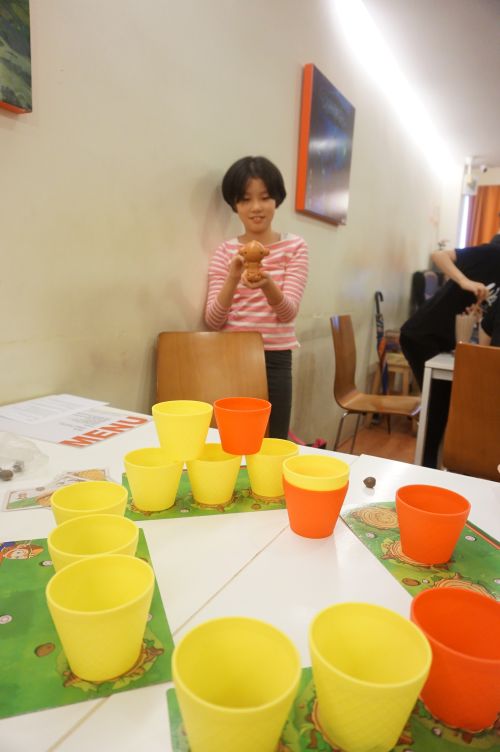
The core of the game is just this - you use a toy catapult (in the shape of a monkey) to project coconut-shaped rubber balls into plastic cups. With four players, you set up the game as above. Nine stack of cups in the middle, some consisting of only one cup, and some two. Each player has his own player board. On your turn, you launch a coconut, and if it lands in a cup, you claim that cup and place it on your player board.

There is a difference between red and yellow cups. If you score a red cup, you get an extra turn.

At the start of the game, everyone draws two cards. During the game you can play these cards to help yourself or to interfere with an opponent. The first card in this photo forces an opponent to launch his coconut with eyes closed. The second card lets you blow at a coconut launched by an opponent to try to deflect it.

Cups you win need to be stacked in a 3-2-1 pyramid formation. The moment you complete the pyramid, you win. However opponents can try to launch coconuts into your pyramid-in-progress. If they succeed, they take your cup from you, setting you back.

One important rule is once a coconut lands in a cup, it is not taken out. If all coconuts are used up (i.e. they are all in cups), the game ends. This is an alternative ending. Whoever has the most coconuts at that point wins. So coconuts are victory points. In this photo, cups with two or more coconuts mean more than one player has scored them, i.e. they have changed hands due to competition between players.

Chen Rui (right) is aiming at my cups.

The Play

This is such a simple game, yet it is also such pure joy. The catapult is not very precise. Sometimes the launched coconut veers to one side. Controlling the distance, i.e. how far to pull back before launching, is not easy either. Even if you get the coconut into a cup, it may bounce out, because it's rubber. And then sometimes after it bounces out it lands in another cup. The catapult makes you feel there is skill involved and yet sometimes the outcome seems random. You just do your best and hope for the best. It gives all players the perfect excuse - when you score a cup you congratulate yourself on your skill; when you fail, you console yourself saying it's just a little bad luck.

The game can be quite competitive and confrontational, since you can take aim at others' cups. A leading player easily becomes public enemy number 1. However targeting others' cups is often harder than targeting neutral cups, because they are usually further away, and sometimes they are stacked higher.

The fact that some cups may contain more than one coconut creates incentives for players to target these cups. The red cups are also more attractive. Not all cups are equal.

Scoring a cup is exhilarating, because it's not easy to do. This is more scoring a goal in football (soccer) than scoring in basketball. You want to stand up to do a fist pump. When I played with my wife and kids, we played three games straight.

In one of our games, a coconut fell into Chen Rui's milkshake. My first response was to ask her to finish it quickly so that I could retrieve the coconut. Chen Rui, without thinking, quickly obeyed. My wife Michelle gave me a what-the-hell look and said y u do dis. The coconut has passed through the hands of many customers and has probably rolled on the floor and under the sofa many times too. Who knows where else it has been. This is why mothers don't trust their husbands with their children.

Quite a few times one of our coconuts bounced off the table and flew towards the next table, and we had to trouble our neighbours to help us get the wayward coconut.

I had collected four cups, and now Chen Rui was targeting me.

You win when you claim your sixth cup to complete the pyramid.
One of the cards forces an opponent to make a long-distance shot.

This is one very lively game.

Scoring is a great feeling.

The Thoughts

I enjoyed Coconuts tremendously, and so did my children. It was better than I had expected. I can't really explain why a game based on launching balls into cups can be so engaging. I know there is competition between players. I know it is a race. I know there are game elements that make some cups more valuable than others. Yet all of these on their own don't explain why the game is so much fun. The game is more than the sum of its parts. The whole thing comes alive when everything clicks together.

Coconuts is not only a children's game. It is also a party game, and a family game. It reminds me of Loopin' Louie, which is also very simple. It's a good change of pace for hardcore gamers. Sometimes one needs to take a break from heavy strategy games and just have some silly fun and relax.

Saturday, 20 February 2016

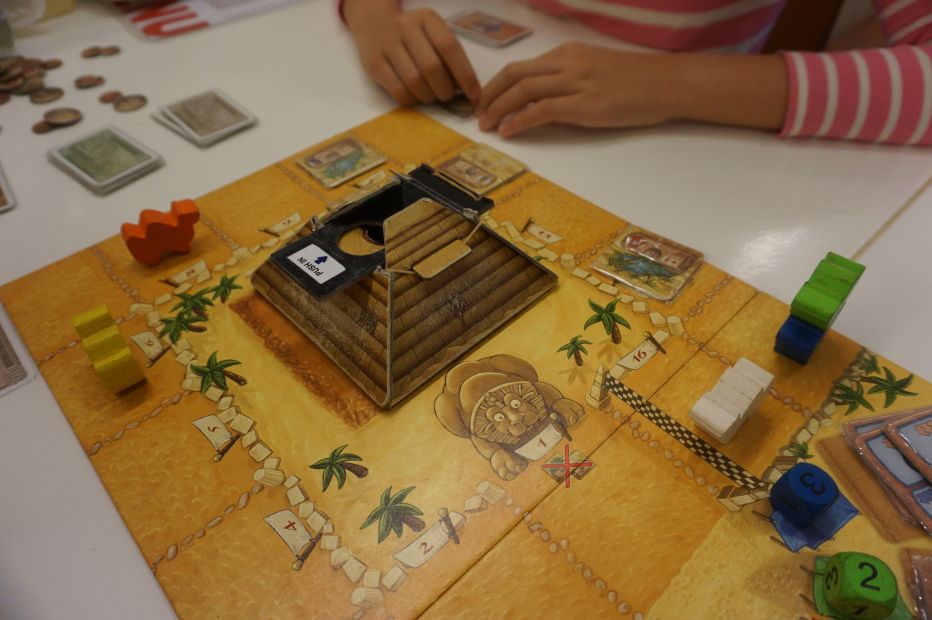
Camel Up

Plays: 4Px1.

The Game

Camel Up won the 2014 Spiel des Jahres. I don't really follow the SdJ closely now, since I am not their target audience, but being a boardgame hobbyist means I can't avoid knowing it, since this is such an important award. If I get a chance to try an SdJ game, I am usually willing to play, out of curiosity to see what the fuss is all about. So I tried Camel Up when I visited Meeples Cafe earlier this year.

You are punters at a camel race. Your objective is to win the most money from betting on camels. The game lasts one race, i.e. the camels completing one circuit around the pyramid. The race is broken down into legs, each leg being every camel having moved once. You can bet on the outcome of each leg - which camel will be leading at the end of the leg, and you can bet on the overall result too - which camel will win and which will come last. You make money by betting on the right camels, but you can also lose money for betting wrong.

In addition to making bets, another action you can do on your turn is to place or move an oasis. Everyone gets a double-sided oasis tile at the start of the game. When placed on the race track, these can affect the movements of the camels. A camel which enters an oasis space moves an extra step. However if instead of placing the oasis with the normal side up, you decide to place it with the mirage side up, then a camel which lands on the mirage must move backwards one step.

The last type of action you can take is to move a camel. You don't get to decide which one to move. You shake the pyramid and release a die from it. The colour and the value of the die (range is 1 to 3) decides which camel moves, and how far it moves. The die is then set aside, and only returns to the pyramid at the end of the current leg.

What is special about the camel movement is that they can ride atop one another. When a camel lands on the same space as another, it climbs atop the waiting camel. If a camel carrying other camels moves, it carries all these other camels with it, i.e. giving them a free move. Moreover, when camels are stacked, the one on top is considered being furthest ahead. Due to this mechanism, the outcome of the race and of each leg can be quite unpredictable.

To bet on the leading camel for a particular leg, you need to claim a betting tile like this one. The tiles are limited so you need to grab them before others claim them all. This tile in the photo means you are betting that the green camel will be the leading camel at the end of the leg. If you are right, you win $5. If the green camel comes second, you still win $1. Otherwise, you lose $1.

The dice belonging to the camels which have moved in the current leg are placed here to remind you that these camels will no longer move in the current leg. At a glance you can tell that the remaining dice in the pyramid are blue and white.

The Play

Playing Camel Up is all about knowing the right time to place your bets. You need to be constantly evaluating which camel will be leading at the end of the current leg, which will likely win the overall race, and which will likely come last. Whenever you feel confident enough, you'll want to place your bet immediately, because the earlier you bet (and bet right), the higher the reward. You need to balance between waiting for enough information to help you gauge your chances, and deciding early enough to be able to win the biggest prizes. There is a penalty when you bet wrong, but usually you have to take some risk. Often you can't afford to wait till you are 100% sure. In fact sometimes you cannot be 100% sure. Due to how the movement works, sometimes the sequence of the dice appearing and their numbers can combine to yield very unexpected results.

Taking the "move camel" action is probably the poorest choice, so much so that there is a $1 compensation for anyone who takes it. When you move a camel, you are giving more information to the next player. Everyone else will have a chance to act on this additional information before your turn comes around again.

The children tended to choose the camel movement action more than Michelle and I. They didn't realise the danger of doing that. They were less alert about the opportunities to place bets, and often we had to remind them. Maybe they just enjoyed shaking the pyramid and dropping a die. Also they might have been seeing the game more as a race game than a gambling game. This game is a gambling game, just that it is gambling on a race. It's all about assessing risk and reward.

Orange and Yellow were too far behind and had no chance of winning. White, Green and Blue all stood a chance to win. I don't remember whether at this point the white die had been drawn. Let's assume it had, which means all three leading camels had to wait for the next leg before they could move again. In the next leg, if the first die to be drawn was the white one, White would win because it would cross the finish line. If the blue die was drawn first, and the value was a 2 or a 3, then Green would win, because Blue would be carrying Green when it crossed the finish line, and Green being on top meant it was considered to be ahead of Blue. If Green moved one step first, getting off Blue's back and climbing atop White instead, and then Blue moved 2 or 3 steps, then Blue would be the champion.

The Thoughts

Camel Up works very well as a family game. It is not complex. The components are very attractive. There's some strategy, but also a healthy dose of luck. Parents won't feel bored when playing it with their children, because there is some strategy in the betting and in placing oases. Yet they won't always win because sometimes the dice surprise you. Camel Up works well as a party game too.

Saturday, 13 February 2016

Poo: The Card Game

Plays: 4Px2.

The Game

When the name of the game is Poo, you know you can't take it too seriously.

Poo is a card game in which players are monkeys flinging poo at one another. It's a free-for-all melee. Everyone can attack anyone else. Whoever receives 15 points of poo is knocked out. The last remaining monkey is the winner. Simple.

Everyone has a hand of five cards. On your turn you normally get to play one card. Some cards specifically allow you to play more than one card. The most common cards are the poo cards, which let you fling a certain amount of poo at anyone you want. There are defense cards which let you block poo when you are the one being attacked. There are clean cards which let you clean off some poo on yourself. There are mishap cards which you can play on an opponent's turn just before he flings poo, interrupting his action. There are also event cards which have many different effects. How the cards work are all written on them.

The Play

I played this game when I brought my family to Meeples Cafe. We used pen and paper to record our poo amounts, i.e. how much damage we had taken during the game.

When I played with my children, I automatically became public enemy number one. I was hit with poo left, right and centre, and was soon eliminated. We don't often play the kind of game which allows ganging up on a specific player. I normally don't go easy on them when we play games. So they happily grabbed this opportunity to team up to kill the boss.

All the cards have some text, some more than others. For first time players, you need a bit of time to read the cards. The card powers are all straight-forward though, so once you are familiar with them, gameplay is quick and smooth. There is not a lot to think about or plan ahead for.

The rightmost card is a mishap card, which you can play just before an opponent flings poo. This particular card forces to active player to fling his poo at himself.

Since I was knocked out so quickly, I could take a photo of my family.

This "The Big One" is rather disgusting if you have a vivid imagination. It hits an opponent with 7 points of poo.

The Thoughts

Poo is a casual game, a party game. It's silly fun. It's rowdy. It doesn't require much brain power. You can just relax and play. Some cards are quite powerful if you use them at the right time, and it is satisfying when you use them well. There are opportunities for clever play, but don't expect much depth from the game. This is a game where you target specific players. It should not be taken seriously, else it may result in hurt feelings. Being able to target specific players can make the game fun. You taunt, you cajole, you threaten, you reason, you persuade, you negotiate, you take sides, you make promises, you betray your friends, you try to divert attention, you beg for mercy. There can be plenty of player interaction in this game. How much fun you have with it depends a lot on the crowd and the atmosphere. There is not much strategy or game mechanisms to discuss. Poo is just a simple tool for friends to be doing something together. I think it works better with old friends. It might not work so well as an ice-breaker with new friends. Having to fling poo at someone you've just met feels awkward.

Friday, 12 February 2016

Roll Through the Ages: The Iron Age

Plays: 4Px1.

The Game

Roll Through the Ages has a few expansions and variants, and Iron Age is one of the variants. It's more a variant than an expansion because it takes out some parts of the original and replaces them with new elements. It's not just adding minor rules or small modules.

The player board is different. You don't have 5 types of goods. You just have goods (fourth row, grey). Grain (5th row, green) remains the same. If you expand your empire by settling more provinces, you will need more grain to feed your population every turn. The first row is gold. You can convert goods to gold to be used on a future turn. This is akin to investing and earning interest, because gold is worth more than the original goods it is converted from. You spend both gold and goods to discover new technologies. The 2nd row is ships. Once you discover the ship-building tech, you can build ships. They are worth points, and can also be used for war. The 3rd row is armies. You spend food and population to build armies, which are of course used for war.

Warfare is a new concept. Some die rolls let you decide to initiate a war of conquest, which lets you score points depending on how large your army is. Some die rolls force you to enter a war. You win or lose points depending on how well you fare. You don't directly attack a fellow player, but your military strength difference does come into play because of the other new mechanism - the tribute. One of the die rolls let you demand tribute, which is basically scoring points depending on how much stronger you are compared to every other player. The others don't lose points, but they can deny you points by paying you one good.

This is the player sheet used in Iron Age. In the base game, the more cities you build, the more dice you roll. There are no cities in Iron Age. Instead, you get ports and provinces. Both allow you to increase your dice. Ports increase your rate of collecting goods too, and do not consume food. Provinces increase your military strength and award tribute points. The turn sequence is very similar to the base game. You get to roll up to three times, just that dice showing skulls (disasters) are locked and cannot be rerolled. After rolling dice, you collect goods, workers and food, and then spend them to build ports, settle provinces, build ships, build armies and construct monuments. You need food to feed your people. You may spend goods, gold and innovation points to discover a new technology. The possible new phases are warfare and tribute. They do not occur every turn.

The game can end in three different ways - when a player discovers a specific number of techs, when a player scores a specific number of tribute points, or when all monuments are completed.

This yellow fate die is new in the Iron Age. It can affect your harvest. It may allow you to initiate a conquest or demand tribute. In this photo, the smoking bones icon means a good omen - you can set this die to any face you want. On the left side of the die, the helmet icon means you have the option to initiate a conquest. On the right side, the sun means a drought, and the food production on every die is reduced by one. Other than the fate die, the basic dice in the game have also changed.

The Play

I did a four-player game. Roll Through the Ages is a filler, and can be completed in about half an hour to 45 minutes. It is quite straight-forward, but it has some strategic depth. How it uses a dice mechanism to tell the story of a growing civilisation is interesting. In the Iron Age, a slightly different story is being told. You deal less with specific goods, and you have to manage the arms race more. Iron Age felt more like a full-fledged boardgame than a filler-type dice game. You have more decisions to make than the original game. Our game ran longer than an hour. I'm not sure whether it was more because we were unfamiliar with it, or the game is indeed more complex than the original and takes longer to play.

The Thoughts

If you like Roll Through the Ages, you should give Iron Age a try. The basics are familiar, but the overall feel is a little different. If you are new to the series, I would recommend starting with the original game, which is more straight-forward and plays more smoothly, but still has decent strategic depth. Iron Age is more for players who already know the original, who already like it, and want to inject some new elements.

Thursday, 11 February 2016

Broom Service

Plays: 4Px1.

The Game

Broom Service won the 2015 Kennerspiel des Jahres (the German Game of the Year, Connoisseur category). It is a remake of Witch's Brew, which was a card game. There are some changes, the most obvious one being the gameboard.

The core gameplay centres around these role cards. Every player has ten such cards, and at the start of every round, you secretly and simultaneously select four to use for the round. Once everybody has selected his cards, the start player begins the round by playing one of his role cards. When you play a card, you need to decide to be brave or cowardly. Choosing to be cowardly means you are guaranteed to be able to execute an action, albeit a weak one. Choosing to be brave means you want to take a strong action and you are willing to risk being forced to take no action. After the start player plays his card, one by one, all other players check if they have that same role card in their hands. If a player has it, he must play it, and then declare whether he wants to be brave or cowardly. If the previous player has declared to be brave, and the current player decides he wants to be brave too, then the previous brave player is dethroned, and loses his action. It's nice to dethrone someone else, but watch out for players coming after you, who may have that same role card and may in turn dethrone you. Naturally, if you are the last player and you have the role card, you can safely decide to be brave because no one comes after you.

Once everyone has had the opportunity to play a particular role card, the next card play starts with whoever was the brave one in the previous role. Being start player is the riskiest position because you can easily get dethroned.

The actions you get to execute are mostly related to collecting different potions, moving your pawns (witches) on the board, and delivering potions to wizard towers to score points. Depending on the terrain your witches are on, you need different role cards to activate them. So taking note of the locations of your opponents' witches will help you in guessing what role cards they will pick.

There are two types of wizard towers. The round ones only accept one delivery, so once a delivery is made, they are closed (marked using the flask pieces). The square ones are wholesalers and welcome all deliveries, but they give fewer points than the round ones.

Dark clouds on the board block movement, and need to be dispelled by playing the fairy role card. You gain some benefit when dispelling dark clouds, in addition to opening passage.

The brown octagon is a teleportation portal. It's a shortcut to another location on the board. The blue octagon is a special reward tile.

This area at the bottom left is a dead end. You can get to space D via a teleportation portal, but it's a one way street, and there is no way to leave this little strip of land. You are blocked by the river. Usually you only come to such dead ends near end game, to do a final burst of scoring.

The Play

I played with Jason, Ivan and Allen. Jason and Ivan had played Broom Service before. I had played Witch's Brew, but had forgotten most of the rules. I played poorly. I was too greedy and chose to be brave too many times when I should have chosen otherwise. That costed me many actions.

The addition of the gameboard gives the players much more context when trying to guess their opponents' intentions. Not only do the locations of the witches provide clues to which role cards your opponents may pick, the locations and demands of the towers also help. All game information is open (other than the role cards), so you can calculate what you opponents will be able to do in the coming round. You can look two steps ahead if you want to, e.g. an opponent may use one role card to move his witch from a mountain to a forest, and then another role card to deliver potions to a tower bordering the forest. If you think that's what he wants to do, you will be betting on him picking these two specific role cards. You can count three or even four steps ahead, but I think that's a bit too much. I just look at the more immediate possibilities.

There is much thinking put into the design of the gameboard. It is not random at all. As I played, I realised how different elements of the board drive competition and force players to make choices. There are a few directions you can go in. You only have two witches so you can't do everything and be everywhere. The board has character. The board setup is different from game to game due to the dark clouds, the teleportation portals and the reward tiles. There is variability from game to game.

The Thoughts

The core mechanism in Broom Service is predicting your opponent's moves, so this is a game with high interaction. You need to watch your opponents' resources and the locations of their witches. Moving witches, collecting potions and delivering potions are a logistics game, and it is built from the actions you earn from the role selection aspect of the game. I find Broom Service more a gamer's game than a family game. It can work with families, but it would be families who are already familiar with boardgames. I think it will be overwhelming to players new to the hobby. It is not very complex, but it's not Ticket To Ride. The addition of the gameboard (compared to Witch's Brew) is welcome, because it gives more context to the core role selection mechanism, and it also creates more competition and player interaction. The game becomes richer because of it.

Wednesday, 10 February 2016

Qwinto

Plays: 5Px1.

The Game

Some games amaze me. Qwinto is a filler game that uses three dice, scoring sheets, and pencils.

Everyone starts with a blank sheet. During the course of the game you take turns rolling dice to generate numbers which you fill into the blanks on your respective sheets. Everyone gets a chance to fill a number every turn, no matter whose turn it is. You can choose to forfeit this, but usually you want to fill in a new number every turn. When you are the active player, i.e. the one to roll the dice, you get to choose how many and which dice to roll. However if you do not or are unable to fill in a number, you get a 5pt penalty. There is no penalty if you don't fill a number on other players turns. If you roll more than one die, you don't have to use all of them to generate your number. You can use a subset. This means the more dice you roll, the more options you have, but also the more options your opponents have.

Refer to this scoresheet when I describe the restrictions and the scoring below.

The numbers in the three rows must be in ascending order. The colours of the dice (or die) you add up to make a number determines which rows (or row) you can put that number. There are only five columns which have three spaces. The numbers within such a column must not repeat. These restrictions sound simple enough, but when you play, you will realise how challenging they can be. Scoring works this way. If you complete a row, you score the rightmost (i.e. largest) number. In the photo above I have completed the yellow and blue rows. For incomplete rows, you score based on how many blanks are filled. Thus the 4pts for my orange row. As for the five columns, if you complete a column, you get to score the number in the pentagon. In the photo I have only completed three columns, so I only score these three.

The game ends when one player fills two rows, or one player is penalised the fourth time.

The Play

The simple rules and components belies the challenging nature of the game. There is more than meets the eye. You need to plan carefully and consider your options carefully. You need to consider the consequences of your actions. As you fill in more and more numbers, you will find that your options dwindle, and you become more and more at risk of being unable to roll a number you can fill. If you are not careful, you may create dead spaces - spaces where it is impossible to fill any number. You want to keep your options open, yet you also want to score as much as possible. You are constantly weighing your options, and how they will affect your future prospects. For such a little game, it is amazing how often you need to make tough calls. Sometimes you have to seriously consider forfeiting the chance to fill a number, because that number may throttle your subsequent plays. Yet you are always under pressure to fill a number every turn. Miss a few turns, and you may be outpaced by your opponents. Your opponents may force the game end before you line up your scoring. So speed is yet another layer to consider.

The Thoughts

Qwinto is still a filler, but what a challenging and fulfilling one it is. It is a short burst of intense mental workout. Player interaction is low, but not non-existent. When you decide how many and which dice to roll, it affects the other players. Ideally you want to deny them the use of your die roll. This is a game of constantly evaluating risks and probabilities. No matter how to fill your sheet, you need to be prepared for the consequences. This being a dice game means there is luck. However there is a decent amount of strategy, enough to make the game a satisfying one.

Tuesday, 9 February 2016

Celestia (new version of Cloud 9)

Plays: 5Px1.

The Game

Celestia is a remake of Cloud 9 using a similar theme. Players ride an airship, taking turns to be the captain. The airship travels from one cloud city to the next. At each city, each player may individually decide to alight to score points, or to stay on board, hoping to travel to the next city to score even more points. There are perils along the way. Each time the airship attempts to travel to the next higher city, dice are rolled to see what cards the current captain needs to play in order to arrive safely. If the captain fails to play such cards, the airship is forced to land, and everyone still on board scores no points. So this is a push-your-luck game. After a trip ends, whether due to a failed flight or due to all players having decided to alight, a new trip starts back at the first city. This goes on until one player accumulates more than 50 points from the scoring cards he draws. There is a deck of scoring cards for each cloud city, and the scores vary even within the same deck. However generally the higher cities have higher valued cards.

The captain must always steer the airship to the next city if he has the right cards. He may not run the airship aground to deny other players points, albeit at the cost of not scoring any points himself. The only exception is when he has jokers in hand. Using jokers is optional. If steering the airship successfully requires playing jokers, then the captain has the choice of whether to steer the airship to the next city.

The game comes with some special ability cards. E.g. one allows you to force an opponent to alight. Another one allows you to alight safely when you otherwise can't.

The game components in Celestia are much prettier than those in Cloud 9.

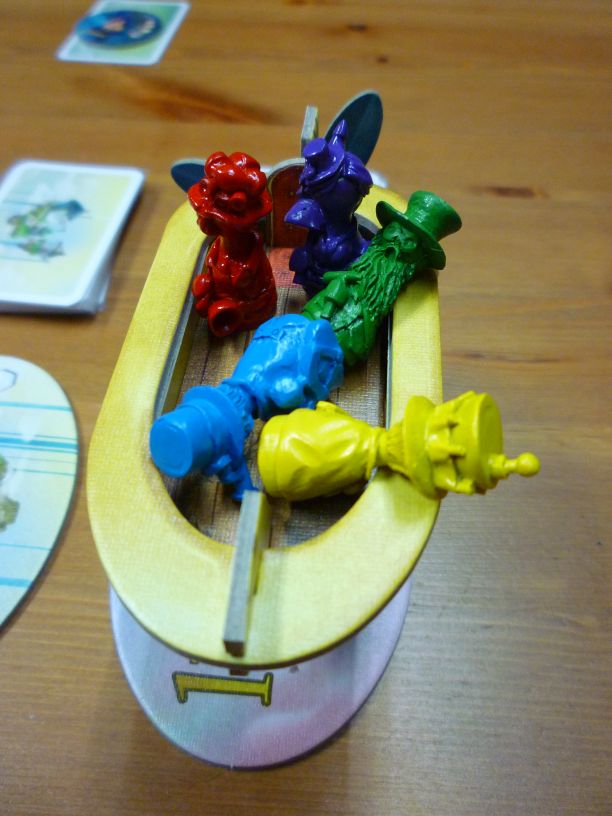
The player pawns are different not only in colour. They are of different sculptures. We were a little clumsy so our pawns look like they are drunk.

Celestia doesn't have a game board. These oval shaped tiles represent the cloud cities the players are attempting to reach. The cards on the right side of each cloud city are the scoring cards.

The basic cards in the game, which are used to steer the airship to the next destination.

The Play

Celestia is a risk-taking game. You constantly face the dilemma of whether to score points now, or wait and hope to be able to score more, at the risk of scoring nothing. The passengers can see the captain's die roll before deciding whether to alight, so you know roughly how much risk you are taking. You should try to remember what cards your opponents are lacking from previous failed trips, however you won't know what recent cards they have drawn. These more recently drawn cards may just be in that colour they were missing earlier. You can look at how many cards they have in hand. More cards mean better chances of them succeeding, but again, you cannot be exactly sure whether their hands are very lopsided - many cards in one or two colours and none in others.

There is one consideration which I think most new players will take some time to grasp. You need think a few turns ahead, to see when you yourself will become captain. The captain normally doesn't have the option to alight. If you are going to be captain next, and you are down on cards, you'd better alight now, even if you are sure the current captain can make it to the next city. If you don't, you will likely end up scoring nothing due to being stuck as captain next turn and not having the choice to alight.

The special ability cards can be very powerful if used at the right time, e.g. forcing an opponent to alight when you expect he will be making a killing in the next turn. They can also help you score big if you set up such an opportunity.

Scores are secret, since you draw scoring cards and keep them in hand. So when we played we couldn't tell exactly who were about to win, or when. The number of cards and types of cards drawn only served as a rough estimation. Dith won the game handily. He drew quite a few high valued cards.

The Thoughts

Overall Celestia is very similar to Cloud 9. It is only in execution details that they differ. Ideally what you want to do is alight just before the voyage is forced to end, but doing this consistently is a challenge. Sometimes you play safe and end up scoring much less than you could have achieved. Sometimes you get too greedy and end up scoring nothing. This game is easy to teach, and it's suitable for families and casual players.

I prefer the Cloud 9 version. It is simpler and cleaner. There are no special ability cards, which I feel is unnecessary and doesn't justify the additional complexity. I also prefer how the jokers in Cloud 9 work. You just need one joker card to navigate successfully. A single joker card covers all card requirements for the next leg of the trip. In Celestia, the joker is weaker and counts as just one wild card. So in Cloud 9 there is a bigger uncertainty due to how powerful the joker is. I like this. It's more exciting. There are more surprises. Cloud 9 is a better family game. Celestia seems to have added more stuff to please the gamer crowd. I can see the advantage of the scoring card mechanism. You won't know your opponent's exact score, and you can't precisely predict how much you yourself will score. This reduces tedious calculations at end game, since you can't calculate accurately anyway. Also, drawing cards is always fun because of the anticipation and the surprise element.

This comparison I'm doing is futile though. Cloud 9 is out of print, so if you like the game, just go get Celestia.

Tuesday, 2 February 2016

Monday, 1 February 2016

Codenames

Plays: 4Px1, 5Px1.

The Game

Codenames by Vlaada Chvatil is one of the hit games of 2015. There was a period when almost every game from Chvatil was a hit with me - Through the Ages, Galaxy Trucker, Space Alert, Dungeon Petz. There was always an innovation, a twist or a special hook. There is still innovation in his games, just that there are fewer heavy games of the type l like in recent years. I have not been following his newer games much. I have played Pictomania, a party game, which I found quite good. Codenames is a party game too.

Players are divided into two teams, red and blue. One representative from each team is to be the spymaster. His job is to give clues to his teammates to help them identify all spies on their side. Whichever team identifies all its spies first wins.

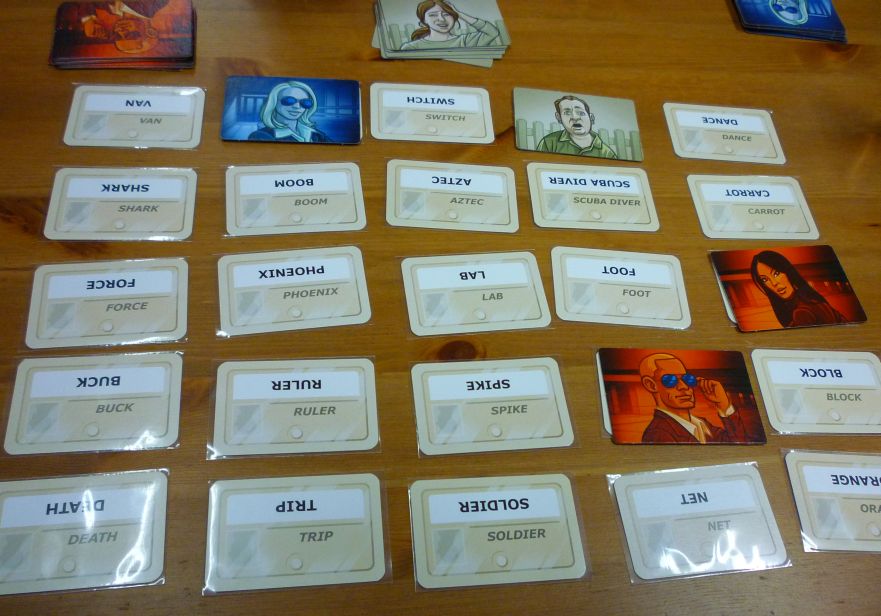
When a game starts, 25 cards are drawn from the deck and laid out this way. The words are codenames for 25 people. Some of them are spies of the red team, some are spies of the blue team. Some are innocent bystanders, and there is one assassin. The words are all common words, and many of them have more than one meaning. The two spymasters sit on one side of the table. Their teams sit on the other side.

This is one of the solution cards. It tells you which names belong to the red spies, the blue spies, bystanders, and the assassin. The blue lights along the edges mean blue team starts. The team which goes first needs to identify 9 spies, while the other team only needs to identify 8. On a spymaster's turn, he can only say one word and one number. The word is meant to hint to his teammates the codenames of their spies. Ideally he wants to guide them to more than one spy per turn, so the challenge is trying to think of a word which can be associated with two or more codenames on the table. That's not all. In order to not mislead his teammates to guess spies of the other team or, heaven forbid, the assassin, he needs to make sure the word given won't be linked to other codenames. If his teammates pick a spy belonging to the other team, it is treated as a correct guess done by the other team, which means the other team is earning one point at his expense. If his teammates pick the assassin, his team loses immediately. Thus you see the importance of not just scoring, but also preventing costly mistakes.

The number which the spymaster says determines how many guesses his teammates can make. Usually he uses this number to indicate how many codenames the current clue is linked to. However sometimes he can say a higher number simply to give his team more guesses, e.g. there may have been failed guesses in previous turns, and the team needs to catch up.

The team gets multiple guesses only if every guess is correct. The moment you make a mistake, your turn ends.

This is what an early game looks like. Two red spies identified, and one blue spy. There is one bystander incorrectly identified. There is no penalty in catching a bystander, other than having to end your turn immediately.

Blue is leading 7:6. In Codenames both teams are under constant pressure to identify more than one spy per turn.

The Play

I have played Codenames twice. It is very simple to teach and easy to understand. The key strategy is identifying two or more spies every turn. The challenge is in trying to think of a word which can be associated with two or more codenames, and at the same time will not be associated with codenames from the other team or the assassin. The spymaster has a tough job. During our games, he would often be mulling over the cards and cracking his head searching for the right word. This doesn't mean the team members have an easy time. Often they will be debating over what exactly the spymaster's cryptic clue means. There was a lot of taunting in our games. When the opponent spymaster was cooking up a word, we helpfully suggested "Easy! Rabbit, One!" (when there was a "Carrot"), or "Bomb, One!" (when there was a "Boom"). When the opponent team was trying to make guesses, we kept teasing, "It's so obvious!", or "Don't overthink it! Just do it!".

The spymaster always has to face the dilemma of how to give the clue. Should you pick a vague clue which can be associated with three codenames, or should you give a more straightforward one to help your team safely identify two codenames? When the team fails in guessing, the clue given is not wasted. They still need to remember it and take it into account on future turns. The spymaster can sometimes state a higher number, hoping his team will understand it is to allow for additional guesses based on clues from previous turns. However this can be tricky because the team members may not have the same interpretation. Sometimes you simply have to make wild guesses. If you are falling behind and your opponents are poised to win next turn, you might as well gamble. Paying attention to your opponents' clues is important too. They tell you what to avoid.

The Thoughts

Codenames is simple yet clever. It can be easily taught to casual gamers. It works very well as a party game and a family game. It can be played as a filler on game nights, a change of pace for hardcore gamers. What is interesting about it is the fun and satisfaction come from both common understandings among players, as well as cultural differences. When you as a spymaster make some obscure reference which your team members totally get and they make all the right guesses, it is exhilarating. Yet when you give a simple straightforward clue but your team members completely bungle their guess, that is hilarious too. Many a game ends with the teams doing internal post mortems on why such a stupid clue was given or why such an ingenious clue was misunderstood. Even observers of a game will be having fun, sometimes from simply seeing how tough a time the spymasters have, and sometimes from trying to think of clues which would have helped the teams more than the spymaster's clues. Codenames is a game that sparks creativity, not just in the spymasters in trying to come up with good clues, but also in the team members who are trying to make sense of the clues given.

I'm not a party game person. Codenames is not my type. However I do think it is quite clever and innovative. There are many cards in the game, both the codename cards and the solution cards. I think it will take a long while before it starts to feel repetitive because there are many combinations of cards drawn, positions placed and solution card. You don't normally worry about single words. It is the combination of words that matter.

Saturday, 30 January 2016

Ships

Plays: 4Px1.

The Game

Ships is the third game in Martin Wallace's transportation series, the first two being Automobile (which I love) and Aeroplanes: Aviation Ascendant (which I still have not played). This was the only game from Essen 2015 which I pre-ordered. So I had expectations of it.

The game board is divided into the ship technology track along the edges, and the map in the centre. When the players build ships or upgrade ships along the tech track, they get to place political control markers (disks) or merchants (cubes) in the cities in the map area. There are two types of ships. The merchant ships are, of course, for placing merchants, and the warships for placing control markers.

This is a player board. The first two rows are the warehouse and the bank, which determine how much space you have for goods and gold. As the disks get placed onto the gameboard, you will expand the capacities of your warehouse and your bank. The third row is your available pool of action cubes. The cubes in your colour also double as merchants. The fourth row lists the actions available to you. You spend cubes and gold to take actions. When you take an action, the cubes spent are placed in the corresponding action space. They are stuck here until you take the retrieve action to bring them back to the available pool. The fifth row is just a reminder for how many action cubes you get every turn, depending on which era you are in.

The cities on the map are divided into 6 regions, each region having its own colour. When you place a merchant (cube) or a control marker (disk), you gain an immediate benefit, e.g. goods, gold, victory points. When a region scores, you also earn victory points for each of your merchants and control markers.

The tech track is divided into 11 ages, and every age has two types of ships - merchant ships and warships. To be first to build a new ship, i.e. to place a ship marker in the next new age, you need to pay navigation points, which is one of the currencies in the game. Each time a new age is reached, the player who placed the first ship of that age gains points, and obsolete ships cause their owners to lose points. Players are constantly under pressure to upgrade their ships, or to dismantle the old ones before they cause too much harm.

As the cities in a region are gradually filled up, it becomes cheaper and cheaper to open up the next region. You also need to spend navigation points to open up a new region, but the cost, similar to how the tech track works, is discounted depending on how full the cities in the current region are. When a new region opens, i.e. when a player places the first merchant or control marker in it, the old region immediately closes and is scored. In this photo, the active region is the brown region. The greenish blue region is an old region and has been scored. At the moment you can see most of our merchants kept to the cities where we had control markers. This is because the control marker scores bonus points if there are merchants of the same player in the same city. However often players will end up mixing and matching because of the different benefits that can be gained from the different spots in cities.

The 11 ages on the tech track are grouped into three eras. These sail ships are from the second era.

At the start of each era, 12 cards are drawn and displayed this way. One of the actions the players can take is to claim one such card. Each of the three era decks have more than 12 cards, so the cards in play will differ from game to game.

Three different ship types representing the three eras - galleys, sail ships and steamships.

As the game progresses, spaces in the first two rows will be freed up due to the disks being placed onto the main gameboard.

The goods you collect can be sold for gold. Each of them has a special use too if you don't sell them. This adds a nice flavour to the game.

When there are five or more ships in the 11th and final age, the game will end. Players have some control over how soon the game ends. You need to analyse the board situation to determine whether it is beneficial to you for the game to drag on. In this photo there are no Age 11 ships yet. There is only one Age 10 ship, the red merchant ship on the left.

The Play

I played with Jeff, Heng and Ivan. We were all new to the game. In Ships the main thing you keep doing over and over is building and upgrading ships. Whenever you do this, you also place a merchant or a control marker on the map, which in turn means gaining resources or other benefits. Most of your actions are quite short-term tactical in nature. There is a cyclical nature in placing and upgrading ships, and also in populating cities and progressing to the next regions. There is a tempo in ships moving to the next age, and players starting to claim spots. You can score points for being first to build ships of a new age, but you need to have enough navigation points to do this. You also need to watch out for old ships which may cost you points. Every round you need to watch the tempo and try to position yourself to do the lucrative actions. You want to avoid setting up good moves for your opponents. You need to think ahead a few steps. You need to calculate and estimate the positions for the next few turns. The game flow is fluid because the actions are straight-forward. In fact they even feel simplistic and repetitive. However there is an underlying beat to all this that you must grasp and use to your advantage. You need to gauge when the next region will likely open up. You need to guess which spots your opponents will likely go for. You need to decide whether to block them or to do your own thing.

As you approach the 6th and last region, you will find that it is a boss fight. The victory points here are very lucrative, and there is no restriction on how many times you can score. You realise that 80% of the game is positioning yourself for this final showdown. If you are not prepared for this, you might be left standing in the dust.

I played rather instinctively and casually, and didn't really plan far or evaluate my options very carefully. In short, I was a little sloppy. My game was off-tempo and I soon found myself trailing the others. I missed quite many opportunities, or to be more accurate, I think I failed to set up good opportunities for myself. Instead I was hit by the old ship penalty quite a few times. This was the price I paid for not managing my pacing well. As we approached the final region, I noticed that Heng's warehouse was packed to the brim with grain. I realised then he had been stocking up for that final push. I was already behind and I knew my prospects were poor. I had to end the game as early as possible to prevent others from pulling even further away from me. That was the best thing I could do to keep my final score as close as possible to the rest. My desperation to end the game quickly benefited Ivan, who eventually won the game. He too wanted to end the game early because Heng was a major threat. Unfortunately for Heng, the two of us pushing hard to expedite the game end meant he couldn't fully unleash his fleet of warships.

Look at all that grain in Heng's warehouse! You know he's up to no good!

I (green) did rather poorly. Everyone had steamships and I was still sailing. Well, at least it was more romantic.

The Thoughts

I consider Ships a heavy Eurogame. It is a strategy game, the type gamers like. It is rather different from Automobile, which is a good thing. The four rounds in Automobile are very structured, procedural and clearly defined. In contrast, the rounds in Ships feel like endless overlapping waves, with no clear-cut termination points. Yet there is a cyclical nature and a tempo. You need to feel the pulse, and ride the wave, and manoeuvre it to your advantage. In both games you need to watch your opponents, and you need to carefully calculate and plan.

When playing Ships you need to constantly remind yourself to prepare for the final region and for the end game. Failing to do that will likely mean defeat. I've read one review which proposes that if every player is competent enough to be well-prepared for the final region, then their scores from that region will be quite close. In that case what determines victory will be how well they have been doing in the previous 80% of the game, i.e. the clever tactical moves and the little additional efficiencies achieved. That sounds logical, but I have only played one game so far, so I am not qualified to say whether it's true. So far I can only say that the end game is indeed crucial and it is something you need to position yourself for. It's not unlike the farmer scoring in Carcassonne.

I like the game, so the short summary is: no regrets in pre-ordering the game!