Showing posts with label Carcasean. Show all posts

Saturday, 30 March 2013

Asara

Plays: 4Px1.

The Game

Asara is designed by the famous designer team Wolfgang Kramer and Michael Kiesling (Tikal, Torres, Java, Cavum). It's a medium-weight Eurogame about building towers. The game is played over four stages. At the start of each stage players receive money and cards, and they use these to buy construction parts to build mighty towers. The board has many districts, most of which have tower parts available for sale. Some offer other things like more money, more cards, and the start player privilege. To use a district, you need to play a card onto a vacant spot in it. The first player to use a district can play a card of any colour, and subsequently anyone wishing to use that district must play a card of that colour, or play two cards (two cards played together is treated as a wild card, but it is costly to need to spend two cards for one action). Towers come in five different colours, ranging from brown (cheapest) to white (most expensive). Tower parts of the same colour cost the same.

The board has many districts, and they have between one to seven slot for cards. Most have three or four.

The most important district is the one for building towers. When you buy tower parts, they go behind your personal screen. You need to use the construction district to actually build towers. A tower must have at least one base part and one turret part. It can have any number of body parts. Hmm... that doesn't sound right. Let me check... ah, it's called trunk parts. When taking the construction action, you can extend existing towers by adding trunk parts to it. You can also upgrade towers by replacing plain trunk parts with fancy trunk parts with golden ornaments.

The central district is the construction district, the most important one of all. When two cards are played face-down, they are treated as a wild card played.

At the end of each of the four stages, you score points for each tower and each golden ornament on your towers. At game end, there is a contest for each of the five tower colours. The highest and second highest in each category score points. There is also a contest for the overall highest (and second highest) tower, and a contest for players with the most towers. The game end scoring is significant, and players must work towards that throughout the game. If I remember correctly, in our game more than half of the final scores came from the game end scoring.

My towers. At the end of a stage, these would earn 8pts. 4pts for the four towers, and 4pts for the four golden ornaments, two each on the white and red towers.

The player screen. You keep your purchased-but-unbuilt tower parts, money and cards behind the screen. The insides of the screen contain reference information. The left panel tells you that at the end of every phase, you earn 1pt for the start player marker, every tower, and every golden ornament. The centre panel tells you how you score the end game. The highest and second highest towers in each colour score points. The overall highest and second highest towers score points too. The player with the most towers also score points. The right panel shows the tower part cost for each colour.

The only piece of information that a card is used to represent is the colour.

The Play

We did a 4-player game. That's the max number of players, and probably also the ideal number. Although some have commented that Asara is a worker placement game, I find that it feels more like an area majority game. The game does have a worker placement mechanism, but most districts have about four slots, so even if someone else plays a card in a district before you do, you are not completely blocked out until all slots are filled. The area majority feel comes from deciding which of the five tower colours you want to compete in. You can see the colours of the tower parts that your opponents are buying so you know where they have chosen to fight. You need to decide where and how hard to fight. Do you go for breadth or depth? Quantity or quality? Brown tower parts may be cheap, but brown towers don't give many points at game end, and your opponents can enter the fray easily if they decide to do so. White towers are expensive, but they can score many points at game end. Others will hesitate to compete because not getting first or second place would likely mean a poor return on investment.

The board is too big to fit on the table.

There is also a game of chicken. Being first to play a card into a district is powerful. You decide the card colour that must be used here for the rest of the current stage. This can be particularly important for the construction district. If an opponent plays a card there before you, and you don't have a card of that colour, it becomes much costlier for you to do construction. So there is pressure to be first to play a card in this district. However playing early may mean you are poorly prepared. Ideally you want to buy many tower parts and then build all at one go, conserving cards. There is a nice tension in seeing who will blink first and play that first card.

You can carry over money to the next round, and sometimes it is better to do so than to spend them on areas which may end up not being worthwhile. Asara is an area majority game, and it is all about picking and prioritising where to fight.

Smile, boss! Only the (Carcasean) shop owner Chong Sean is looking at the camera.

The final scores range between 41 and 56.

The Thoughts

Asara is a clean design. It is a medium-weight Eurogame. The theme is thin - I find it hard to imagine inserting trunk parts to an already completed tower, like playing with Lego. The gameplay is quite interactive, because you need to pay attention to what your opponents are building in order to do well. I find it very much an area majority game. You need to decide where to fight and where to concede. You need to balance between quality and quantity when you build your towers. You need to think of how to best utilise your resources to achieve the biggest possible impact. Throughout the game you need to keep in mind the game end scoring.

Sunday, 24 March 2013

The Castles of Burgundy

Plays: 3Px1.

The Game

The basic idea in The Castles of Burgundy is players race to grab tiles from a central board, and then use these tiles to fill up their personal board to score points. Tiles come in different colours representing different terrain types. On your turn you roll two dice, and then use them to execute two actions. The numbers on the dice determine where from the central board you can pick tiles, and also where on your player board you can place tiles. There are various features on the tiles, e.g. farm animals, ships, buildings and mines, and they give different benefits, e.g. making money, performing extra actions and scoring points. When you fill up a region of connected hexes of the same colour, you score points based on how early it is in the game and how big the region is. If you are the first or second to fill up every hex of a particular colour on your personal board, you also score points.

That's the basic, central mechanism. There is much more to the game. Knowledge tiles give special abilities to players who claim and play them, including extra scoring opportunities. Placing ships lets you claim goods, which can be sold for money and victory points (VP's). Ships also let you compete for turn order, which is important because going earlier usually means more choices.

Actions being dependent on die rolls may make the game sound very luck-dependent. However you can mitigate that by using workers. Each worker spent alters a die by one pip. Changing a 6 to a 1 (and vice versa) is considered a one-pip change, i.e. it wraps around. It's usually a good idea to keep some workers around.

The game runs for 5 phases, with each phase lasting 5 rounds. Highest score at game end wins.

The central board. The group of tiles at the centre is call the black depot. You need to pay $2 (which is a lot in this game) to claim a tile from here. Around this black depot are the six normal depots, where you use dice to claim tiles. Each of the normal depots has a goods space (big square) where goods are stored. When a player adds a ship to his estate, he gets to claim all goods from any one goods space, up to the max his player board can hold (the limit being three goods types). The five squares on the top left, labelled A to E, are used for keeping goods tiles for each of the five phases in the game. Spaces A to D being empty means the game is in Phase 4 now. The column of five squares on the left are used for keeping the goods tiles for each round within a phase. The first three spaces being empty means it is the third round of Phase 4 now.
In a three-player game, not all spaces on the board are in use. We used spaceship tokens from another game to mark the spaces which were not in play.

The player board. Player boards are double-sided. This is the simpler side, and it is the same for everyone. The advanced side differs for each player. You start expanding your estate from the castle at the centre. You can only place tiles next to existing tiles. The three spaces at the lower left are for temporarily storing tiles that you claim from the central game board, i.e. you can hold at most three. The four squares at the top left are for the goods tiles - three for the three types of unsold goods, and the fourth one for sold goods, which are turned face-down.

Every player has two dice. The white die is rolled once per round to determine where the new goods tile goes on the central game board.

The Play

I did a three-player game with Chong Sean and Francis. I was the only one new to the game. My biggest realisation was how much you can mitigate the randomness in the game. I think one of the keys to winning the game is planning and manipulating your board and the overall game situation such that no matter what die rolls you get, you can always find something useful to do. That's easier said than done, and that is the charm of the game. You want to expand your holdings such that the numbers on the available land plots cover as many die roll results as possible. Trying to stay flexible has its costs and risks though. The game does reward focusing on specific scoring criteria, and if you try to do too many things at once, you'll end up being a weak jack of all trades.

Deciding whether to emphasise your own strength or to hinder your opponents is another constant consideration. It can be dangerous to let your opponents have too free a hand in growing their dominions. Yet another consideration is when you find yourself competing with another opponent (or more!) in the same field, do you continue to compete, which may result in a lose-lose situation, or do you switch to focus on other fields with less competition? This reminds me of Navegador.

The many scoring options and special abilities of the various tile types were quite overwhelming at first. Thankfully I had Chee Wee to be my Zhuge Liang. He pointed out a number of good options which I otherwise would have overlooked. In the end I beat both my opponents despite being the only newbie to the game. They protested that this didn't count - using dual-core processors is cheating.

My player board at game end. The northern half of my estate was completely filled up. I was among the earliest to fill up all light green (grassland) and river (blue) spaces on my estate, so I earned bonus chips (above my player board to the right).

The score track goes crazy between 83 and 99.

The Thoughts

I found The Castles of Burgundy just okay - not bad, nothing in particular that I dislike, but nothing particularly outstanding either. But then there's something about me and Stefan Feld designs (from among his many hits I only really like In the Year of the Dragon and Notre Dame), so I may not be the best judge of his designs. The game feels very Euro. It is a mechanism-first game. The mechanisms and the many scoring options seem sound. However I get a feeling that the many paths to victory exist for the sake of having many paths to victory. That in itself is not really a problem. It is what it is. Some players won't mind it but others will find it a turnoff. There really isn't much theme or story or setting.

I like the long-term planning and prioritisation in the game, and also the manoeuvring to make every die roll useful as much as possible. Despite these long-term strategic aspects, the randomness in the game manages to create many tactical opportunities and short-term gains to consider. The new tiles being revealed at the start of every phase and the placement of the goods tiles at the start of every round can make you rethink your plans. Sometimes a juicy opportunity surfaces which tempts you to go in a very different direction. Sometimes a golden opportunity appears for an opponent and you will have to consider whether to grab it just to deny him, even if there is little to gain for yourself. Sometimes you have to take one for the team.

It is satisfying to see your estate develop and to see your plans come to fruition. The game is rich in choices.

Saturday, 23 March 2013

Animal Upon Animal: Balancing Bridge

Plays: 2Px1.

The Game

Animal Upon Animal: Balancing Bridge is a standalone game based on Animal Upon Animal. It is a children's dexterity game where you stack up wooden animal pieces. In this version, as opposed to simply racing to get rid of your animal pieces, you don't hold any animals. You hold some animal combination cards instead, and try to get rid of them by having animals stacked in specific configurations. On your turn, you roll a die which determines from which of the four sides of the box you must pick an animal to be stacked with the other animals already on the bridge. To achieve a combo, you need to have the specific animal combination linked together in the stack. If the stack crashes down, your penalty is drawing another card, which means it becomes harder to get rid of all your cards. The first player to get rid of all cards wins.

The game box is also the game board, although strictly speaking only that bridge is the game board. Every game starts with a crocodile already on the bridge. Other animals are randomly scattered along the four edges of the board. Each side is associated with an icon, which appears on the dice.

Some of the animal combo cards. The die is in the background. Question mark means you can pick an animal from any of the four sides of the box. Pay attention to the rightmost card - two giraffes and a panther.

With this configuration of the animal stack, I achieved that two-giraffes-and-a-panther card.

The artwork is gorgeous. Hey you tourists! Beware the crocodiles!

One of the four sides of the box. This is the desert side, the icon being a sun.

The Play

I did a two-player game with Chong Sean, while waiting for others to arrive. It didn't work very well with two players. Chong Sean made the stack topple once, and that was enough to doom him. The game was over in probably less than ten minutes. It felt rather uneventful. I think the game would be much more fun with more players. Also it was probably not a good idea to play a children's game with all adults in the first place. With more players, it will be harder to make the combos you want, because there will be more other players to unintentionally (or intentionally) spoil your plans. There will also be more crashes, which is fun.

The Thoughts

I prefer the simplicity of the original Animal Upon Animal. If you have played the original many times and still enjoy it, then Balancing Bridge can be an interesting variant. There is some luck in the card draw, and also in how you can be accidentally hindered or even helped by your opponents. As I write this I realise there is no such luck element in the original game. But then this is a children's game, so some luck doesn't really matter. Children's games are not supposed to be serious and fully-skill-based.

Thursday, 21 March 2013

Kingdom Builder

Plays: 4Px1.

Qwirkle, which I previously wrote about, was the 2011 Spiel des Jahres winner. Kingdom Builder was the winner in 2012. Prior to the SdJ win, gamer interest in Kingdom Builder was probably mostly because of the designer - Donald X Vaccarino, the designer of Dominion.

The Game

Kingdom Builder, in one sentence, is a game of placing huts onto a hex-grid game board to score points. But that would be a rather unfair and overly simplistic statement. Every game is set up randomly, the game board being assembled from four pieces (the game comes with eight such pieces), and three scoring criteria picked (out of ten). So there is much variability, very much like Dominion. On your turn, you place three huts depending on the terrain card you are holding, creating a new domain or expanding your existing domain, and then draw a new terrain card for your next turn. There are seven terrain types on the board, and five can be built on, so the terrain card you draw will be one of these five. You are restricted to build on hexes of this specific terrain type. If you can expand an existing domain (a group of one or more connected huts), you must do so. Else you must start a new domain. You are restricted by the terrain card you draw, but how much that restricts you also depends on how you have been positioning your domains.

There are castles and special locations on the board. Having settlements next to castles at game end gives you points. Building next to locations lets you claim special abilities tokens. There tokens are randomised from game to game. Some are single-use, some can be used once per turn. They do fancy things like allowing you to move huts (normally once placed they stay put till game end), or letting you build extra huts under certain conditions.

The game board is modular, assembled from four pieces. Rivers and mountains are usually off limits for your huts. So are the special locations and castles.

The scoring criteria is the most important aspect determining the nature of a particular game, and how players compete to build their domains. E.g. one scoring criteria is you score 1pt for every row on the game board where you have huts. This encourages you to spread your huts out to many different rows. Another criteria is you score 1pt for every two huts in your largest domain. This encourages you to build one very big domain. Yet another criteria is you gain 4pt for every location or castle connected by your huts. This puts you in a connection game mode. Age of Steam! Some of these criteria pull you in different directions, so you have to decide which ones to pursue.

The game ends when one player exhausts his supply of huts.

The three scoring criteria cards.

The Play

The pace is quite brisk, since your turn is just placing three huts and then drawing a card for your next turn. Since the terrain card restricts where you can build, on your turn you can automatically eliminate all those hexes where you know you can't build on. From the short-term tactics perspective, the game is simple. The tricky part is the long-term planning aspect. When you have the freedom to start a new domain, where do you start it? These decisions are crucial, because they set you up for many future turns. I think the game is about how to position yourself such that in future turns, you will have good moves regardless of what terrain card your draw. You need to keep an eye on the scoring criteria, and also how others are playing. Some criteria require comparing against how well others are doing, so if players get into an arms race, it becomes expensive to everyone, while if no one wants to compete, it becomes a low-hanging fruit. Even for simpler criterias that only measure how well you do, others can block you from building your domains the way you want. You should do the same to them. E.g. blocking their expansion.

The early game is about quickly grabbing the special ability tokens, especially those that help towards achieving the objectives in the scoring criteria cards. In some games the special ability tokens work well with the scoring criteria, but in others they don't. You need to assess the situation and make the most of it.

Chong Sean is probably the most experienced in this game, and won handily, scoring more than double of what I scored. I was either the only new player, or one of two new players, and I came last. I still struggled a bit with how to optimize my moves, and to make my special abilities work towards the scoring criteria. Before I could get a good grasp, the game had ended. It was quick! Or at least it felt quick.

The scoreboard is only used at game end. Every board tile has a scoring track on its back, so you just use one of the unused board tile to do scoring.

The Thoughts

Kingdom Builder has high variability, moves briskly, and presents an interesting challenge of fully utilising the available special abilities and working towards the scoring criteria, while competing with your opponents. There is good player interaction, because of the castles and locations, and also simply because it's a spatial game. The theme is quite thin though. Like Dominion, this game is more about game mechanism than telling a story. "Placing huts on the board to score points" is not inaccurate. I'm still interested to play again, to experience the many possibilities, to learn to better utilise special abilities, and to learn to prioritise the scoring criteria better.

Despite being an SdJ winner, I think Kingdom Builder is slightly beyond the average family. What you do on your turn is simple. The rules are probably manageable, if slightly on the complex side for families. What I think will be challenging in a family setting is the strategies. I don't think the strategies are simple. To hardcore gamers they are not deep. Probably just mid weight. But I'm not sure the average family or casual gamer will fully appreciate the game. I guess it can work for more experienced gaming families or experienced gamers who prefer light- to mid-weight games. However it's definitely not a gateway game. Not something for people who just want to relax, socialise and not think much.

Kingdom Builder is a clever design that is satisfying to play well.

Friday, 15 March 2013

Qwirkle

Plays: 2Px1.

The Game

Qwirkle can be described as Scrabble using shapes and colours instead of letters. You create "words" in the playing area, where the tiles in a word must have the same shape of different colours, or the same colour of different shapes. You score for each word you make on your turn, 1pt per tile in each word. If you make a Qwirkle - a word with 6 tiles, which is the longest word possible - you score double, i.e. 12pts. There are six shapes and six colours in the game, making 36 combinations; and each specific combination appears on three tiles. So 6 x 6 x 3 = 108 tiles in the game. You play until the tiles run out, and one player runs out of tiles to play. On your turn instead of playing tile(s) to make a new word, you can forfeit your turn and exchange any number of tiles with the bag.

There are four Qwirkles in this photo. Horizontal blue word with all six shapes, horizontal orange word with all six shapes, vertical circles word with all six colours, and vertical stars word with all six colours.

The Play

Qwirkle won the prestigious Spiel des Jahres. It isn't the type of game that I actively seek out to play, but since I had the opportunity to try it at Carcasean (Kota Kinabalu, Sabah, Malaysia), I gave it a go. The rules are immediately familiar, because of the Scrabble-like mechanism. I expected a rather simple game. However as I played I found myself counting tiles, estimating probabilities and seriously strategising. The game may be a bit more strategic with 2-players, because it is easier to calculate. There's a 50% chance that a specific tile will be drawn by you.

I found that I often had to make tough decisions. It is always good to make a Qwirkle, and it is usually not easy to do so. You need to keep some tiles and wait for some more specific ones that allow you to make the Qwirkle. This takes up space in your hand of only six tiles. It is not easy to keep two or more options open, and often you need to play some tiles that you could have used to make a Qwirkle. You may even have to risk helping your opponent make a Qwirkle. There is brinkmanship in making long words. The longer a word is, the easier it is to extend it enough to make a Qwirkle. Do you want to set up an opportunity for yourself at the risk of letting your opponent grab it before you can?

Since all tiles will be drawn from the bag, as the game nears completion, it can slow down because the players have more and more information to calculate probabilities and to plan moves. I didn't find this a problem. I found it tense that time was running out and I needed to draw those few specific tiles to let me do a few more big scorings.

The Thoughts

Qwirkle is better than I expected. Easy to teach, and quick to play, but there are some interesting decisions and there is a bit more strategy than meets the eye. You can play to deny the long words by making some positions unplayable. Or you can gamble and create many opportunities for making Qwirkles. Whether to forfeit a turn to draw new tiles can be a tough choice too. You are forgoing a scoring opportunity, and you may not get useful tiles.

I'm not sure whether I would call this a light game, despite the simplicity of the rules. I guess you can play it without thinking much or calculating much, but I think this brainless approach would be a waste. There is some strategy in the game. Nothing overly complex, but it's there, and it's fun. I think it deserves the SdJ win - a good family game that everyone can play.

Sunday, 17 July 2011

Animal Upon Animal

Plays: 4Px1.

The Game

This is a dexterity game. Everyone starts the game with the same set of animals. To win the game you need to get rid of all your animals. On your turn, you roll a die and then try to add one or two of your animals to the stack of animals at the centre of the table (which starts with a crocodile). If you cause the stack to topple, you pick two of the fallen animals to add to your pool, setting you back. The die roll determines how the animal is added, whether to add one or two, whether somebody else picks the animal for you, whether you get to force another player to add the animal for you (if the stack crashes he gets penalised), etc.

The Play

Aaron, Chee Wee, Chong Sean and I played. This is yet another quick game that we pulled off the shelf at Carcasean, Kota Kinabalu. We had few crashes. Once a crash happened, especially a big one, the tension was suddenly diffused, because it became much easier to add pieces to the stack, now that the stack was smaller. So it became easier for the leading player to cruise to a win. I think the main tension is in the first build-up towards the first crash.

Everyone played the sheep first, the biggest piece.

Other animals.

One of the die roll results allow you to place an animal on the table next to the crocodile, as opposed to being stacked upwards. See those two small penguins.

The Thoughts

I wouldn't call this a children's game, because Jenga is not considered a children's game. It's a very simple game, not something hardcore gamers can play repeatedly, but it is something non-gamers (and children) can easily pick up. I guess there can be some strategy in how you place your animal, so that the next player will have fewer options. Overall it's a light game.

Saturday, 16 July 2011

Dancing Eggs

Plays: 4Px1.

The Game

The game comes with 10 toy eggs. On your turn, you roll two dice, and everyone competes to win one egg. One die determines how the egg is to be won, e.g. first to make a rooster sound, first to make a hen sound, first to walk around the table, bounce an egg and be the first to catch it. There is one special icon which will make you lose an egg if you make any sound because you mistake it for the hen or the rooster. The other die determines how the egg winner must hold the egg, e.g. below the chin, between the knees, under the armpit, between face and shoulder. The more eggs you have, the harder it is to hold on to them. The game ends when one player drops an egg. That player loses, and the remaining player with the most eggs wins.

The game box for Dancing Eggs is an actual egg holder, but this is not it. This is an egg holder for real eggs. Chong Sean's game box is so worn out that he needed to replace it.

The red die says bounce one egg on the table and see who catches it first. The plain die says whoever wins this egg must hold it between his knees.

The Play

Chong Sean, Aaron, Chee Wee and I played this around a small square table. It was a fast and furious and also very funny game. It was particularly hilarious to see others struggling in convoluted postures. Since we were racing against one another when fighting over eggs, everyone must focus and is thus fully involved. Aaron was the one with the most eggs, and also the one who struggled the most to hold them. Eventually he dropped one, and Chong Sean who had the second most eggs won.

The Thoughts

Dancing Eggs is an unusual and funny dexterity game. Good for parties, for children, for an energising break between complex sit-down-and-brood games, and definitely good for slightly tipsy people.

Sunday, 3 July 2011

Dragon Diego Dart

Plays: 4Px1.

The Game

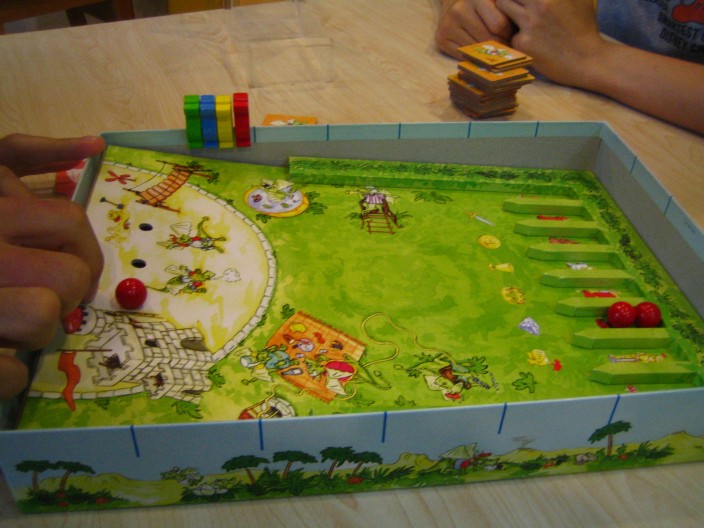
The game board is a slope, with a number of slots at the bottom of the slope, each marked with an icon. Three small red balls are positioned at the top of the slope. On your turn, you draw a tile and secretly look at the icon on that tile. You then roll the three balls one by one down the slope. Each ball that goes into the slot which matches the tile you have drawn scores you one point. After that every other player secretly and simultaneously guesses which icon your target is. They score one point for each correct guess.

Each slot at the bottom of the hill has an icon just above its opening, except for the two slots at the two extremes.

The premise of the game is that it is difficult to hit your target. If you hit some and miss some, it becomes a challenge for the others to guess. If you hit every time, it's easy to guess, because your opponents will just choose the slot where all the red balls are. You do have incentive to aim properly, and not intentionally mislead others, because getting all hits means 3 points for you.

The Play

When Chong Sean, Aaron, Chee Wee and I played, we tried to mislead one another by pretending to cheer when we missed and pretending to be disappointed when we hit. We also tried looking at some other icon when we aimed, which was tricky. The observers all watched the eyes of the active player closely. Overall we still tried our best to hit our target. Aaron did best at aiming, and won. We did have a number of occurrences of the guessers not guessing consistently, which means either the active player was a good actor, or the guessers were lousy.

Master marksman taking a shot.

These wooden dragon markers are score markers, using the edge of the game board (which is also the game box) as a score track.

Aaron (red) beat us soundly.

The Thoughts

This is a children's game, the important premise being that players cannot be too good at shooting. If they are, the game becomes a much less interesting game of simply trying to shoot well. The guessing part becomes meaningless. So if you get too good at shooting, I suggest handicapping yourself by shooting with your other hand, or with only your thumb (or any single finger), or even by blowing on the ball. Shooting with your foot maybe?

Friday, 1 July 2011

Piece o' Cake

Plays: 4Px1.

The Game

A cake is made up of 11 slices. The active player cuts up the cake into as many groups as there are players. Every player picks a group, and the active player picks last. Do this 5 rounds, and then the game ends and you do scoring. This is a very succinct and clever game. The crux is in how to divide the cake and how to pick a group for yourself. These determine the scoring at game end.

Cake pieces are drawn from a face-down stack and placed side-by-side in the order that they are drawn to form a full cake, which then is cut up into a number of groups by the active player.

When you collect a group of cake slices, you need to decide what to do with each slice. If you eat it, you gain points equal to the number of whipped cream spots on it. If you keep it, you score points at game end but only if you have the most slices of that type (including if you are tied). You have to think carefully whether to gain points immediately or to take a risk and go for the game-end scoring. You can forfeit taking a group to eat all slices of one type.

Dividing the cake requires much thinking and evaluating. You want to make sure none of the groups are too lucrative, and you also want to make sure the last group left for you has some value to you. It is important to look at what others have, and to remember what they have eaten ("eaten" slices are turned face-down). You need to be able to see the perspectives of all other players, and try to plan for what they will likely collect.

One clever part of the game is the game-end majority score printed on the slices is also the number of slices of that type in the game. No need for any reference chart. This is elegant design.

The Play

Four player game with Chong Sean, Aaron and Chee Wee. At first I thought the points from competing in majorities would be much higher than the risk-free way of eating the cake slices straight-away. It turned out that it was not necessarily so. It feels like there is more incentive to just eat the slices straight-away. However if everyone decides to eat most of the time, it becomes easier to collect slices to compete for majority at game end. This is very clever of the game design.

Most of the time we were openly discussing the best way of dividing the cake, trying to work out who would likely choose which group, and also persuading one another which group to pick. This being an open information game allowed this kind of open discussion. It was a little like working together to solve a puzzle, and also like pirates trying to split loot.

I randomly decided to spend most of my effort on collecting slices. After a few rounds, things looked rather bleak. It seemed that the way others were eating slices immediately was much more lucrative. I was surprised when I didn't come last. I was tied for 2nd place. Chong Sean came last (by 2pts), mostly because in one of the rounds I had made a move that he hadn't expected. I had chosen a group which he didn't expect me to choose. It was not a bad move for me. He had expected me to take another group which he thought was a better move, but I picked this group because this would also mess up his plans. Heh heh... I'm evil.

My collection at game end. I scored for the value 9 and value 11 cake pieces, but not the other two (values 8 and 10).

The Thoughts

The game is heavy on analysis, despite the very simple rules, simple game concept and clean design. It is quite tricky to try to evaluate the worth of different combinations of slices to every opponent as well as to yourself. It is challenging to create incentives for opponents to pick groups that you don't want, leaving alone a group that you do want.

The game didn't quite click with me. I appreciate how clever it is, but the gameplay isn't very interesting to me, probably because it is very minimalistic. The most important action in the game is splitting the cake, and it is something that one player does by himself while the rest watches.

Saturday, 25 June 2011

The Magic Labyrinth

Plays: 4Px1.

The Game

The Magic Labyrinth is a children's game with a memory element. It is played on an open grid with invisible walls. At any one time, one specific space on the grid, marked by a specific icon, is the goal that everyone tries to race to. Movement is determined by a die roll. The tricky part is the invisible walls. If you bump into one, you must go back to your starting corner. Whenever a player reaches a goal space, he collects a token, and after that a new goal space is determined. First to collect 5 tokens wins.

The way the invisible wall mechanism is implemented is quite clever. There are real walls set up under the game board. The player pawns have magnets beneath them, and a metal balls under the game board are attached to these pawns. When you move your pawn, you slide it along the floor. If you cross an "invisible wall", the real wall underneath the game board will block your metal ball, and it will fall off. Then you'll know you've hit a wall and need to go back to your starting corner.

The Play

Chong Sean, Chee Wee, Aaron and I played a four-player game. The early game was mostly trial-and-error trying to figure out and also remember where the walls were. The luck element is present, but good memory does help. I think we were either not very patient in trying to remember where the walls were, or we were simply bad at remembering. We still bumped into walls late in the game.

Chong Sean took an early lead, but others were able to catch up. In the end it was still him to first collect 5 tokens to win the game.

The Thoughts

It's a simple and well-produced children's game. Memory helps, but there is some luck in the die rolls which determine how fast you can move, and in the randomly determined goal which determines how far you are from it. I'm not a fan of memory games, so this is not really my thing, but I think this is a decent children's memory game. At least there is some skill involved.

Sunday, 19 June 2011

Vikings

Plays: 2Px1.

The Game

Vikings is a game about discovering new islands and populating them with your people. No looting or burning. In fact you may be the victim of such nasty deeds by other less peaceful Viking tribes, if you don't have enough warriors to protect your people. There are many ways of scoring points, some done every two rounds (the game has 6 in total) and some done at game end.

At the start of every round, 12 tile-and-Viking pairs are made available. They are randomly drawn, but are arranged around a rotating price wheel following specific rules. During the round players take turns buying these tile-and-Viking pairs and adding them to their personal play areas. As tiles are bought, prices may drop, and sometimes tiles can even be free. Here players try to manipulate prices and also often need to evaluate whether it's worthwhile to spend a lot of money on tile-Viking pairs that they really want.

The price wheel on the central game board. The $0 cost spot always moves to point to the first available set, but you can't buy this set unless there is only one Viking of that colour remaining (i.e. yellow here). So at least the $1, $2 and $3 sets with yellow Vikings will need to be bought before the $0 set can be bought. Once this $0 set is bought, the wheel needs to be turned so that the $0 spot points to the green Viking.

That little diagram on the right indicates that Vikings are to be placed according to the colours blue, yellow, green, red, black and grey from cheapest to most expensive spots, while island tiles are placed in the cheapest available spot and pirate tiles are placed in the most expensive available spot.

Tiles can be the start of an island, the mid part of an island, the end of an island, or a pirate. When gaining an island tile, you must place it. This is discovery of new lands. The new tile must be placed next to an existing tile or next to your homeland coast. You can immediately place the Viking on the tile if the tile is in the appropriate row for the Viking type (black is warriors, red is nobles etc).

If you buy a pirate tile, it is placed in the top row of your play area, and depending on its colour it will attack and neutralise certain tiles in that column, unless you have a warrior protecting that column.

There are 6 types of Vikings. Warriors protect specific columns in your play area, and in fact counter attack those pirates and give you money or victory points. Nobles and scouts give points. Goldsmiths give money. Fishermen give food at game end, and you gain or lose points depending on whether you have surplus or are short. Boatsmen are important. It is not easy to always place your new Viking together with your new tile, so often you have to temporarily set aside your new Viking. You use boatsmen to ship these set-aside Vikings to vacant tiles, making them useful.

In summary, players compete to buy tiles and Vikings from a central board, and then place them as optimally as possible in their respective play areas, building up a grid made up of islands which will hopefully score lots of points.

The top row in the player area is for pirate ships (I don't have any yet). The other five rows are for islands, and each row allows Vikings of a specific colour to be placed. That scoring reference card on the left is very useful.

The Play

I played a 2-player game against Chong Sean, who taught me the game. In our game we were never short of money. I wonder whether that's normal or we have been unusually thrifty. Every $5 is 1VP at game end, so you shouldn't waste money anyway.

I collected many warriors to protect my settlements. I also built my islands to be quite compact, leaving few blanks. Chong Sean's islands were more dispersed. He had fewer warriors than pirates, so his approach was to leave vacant tiles that he could not protect.

My pirate ships are very colourful. The rightmost green pirate ship only threatens the first three spots in the row, i.e. down to the green row. So the yellow goldsmith I have in that colomn is under no threat.

Player interaction was mostly limited to the tile-Viking pair buying. We did watch each other's islands, to decide which end-game scoring criteria to compete in, and to gauge which tiles or Vikings each other needed more desperately.

Chong Sean collected and preserved his boatsmen from quite early, aiming for the game-end bonus for most leftover boatsmen. I used mine freely during the game to get my Vikings onto the islands to earn points and money during the intermediate scorings. There is a game-end bonus for longest island. I had one long island from early on. Since Chong Sean didn't have any that were even close to mine in length, I was complacent and completed that island. That decision came back to bite me because later on he made one even longer island.

At game end, when the dust settled, we tied! I won by tiebreaker - money left. Well, he said if he had just placed one Viking differently at game end he would win by one point. But of course that doesn't count. Nyah nyah.

Game end. I have 6 (black) warriors protecting my realm from all pirates.

The Thoughts

Vikings turned out to be better than I expected. It's a little solitairish, in how you are mostly planning and building your own play area, and direct interaction being only in buying Viking-tile pairs. However you do have to pay attention to how your opponents are building up their areas, so that you can decide which game-end scoring categories to compete in. I enjoyed the puzzle-like aspect of how to fit everything together, fully utilising your tiles and Vikings, and always keeping an eye on the game end scoring criteria. Who would have thought Vikings can be so industrious. Just be prepared that the theme is a little thin.

Sunday, 23 January 2011

Genoa

I played this with Wan, who has written about it at this blog post. Since he has done the hard work of describing the game, I can save a lot of work and just make my description brief. :-)

The Game

Genoa, formerly called Traders of Genoa, is at its core a negotiation game. Your aim is to earn the most money, and there are many ways to do so in the game. On your turn, you can create up to five possible actions, however usually you can only make use of one of them. The others you try to sell to other players, thus making more money for yourself, while likely also helping the other players. At game end, the richest player wins.

The game board is made up of building spaces and street spaces. Every building provides a benefit, e.g. collecting goods, cards, control markers or special action tiles. On your turn, you roll two dice to determine a start building. You place a stack of five action discs on it. After that you may move the stack to an adjacent building or street, leaving behind one disc. You may do so until you exhaust the stack. During the stack movement, since you can only use one of the action discs, you will try to sell your surplus action discs to others. This is where the negotiation comes in. You try to strike a mutually beneficial deal. Sometimes you may choose not to use up the stack of action discs, to deny your opponents actions, but of course that also means you lose out on making money.

Top view of the game board. Round track on the left. The outermost rows of buildings on left and right are just storage spaces and are not part of the play area. The buildings in the play area each has a name and an icon indicating the benefit it gives.

The stack of action disks. It had started at the villa on the right, and had now moved one step to the Spices building. It could now move to the Restaurant, or to one of the street spaces.

Everyone starts with four cards, each representing one of the four key card-based ways of earning money in the game, and $130.

There are various ways of making money in the game. Large orders require you to deliver 3 different goods to specific buildings. Small orders require you to deliver single goods to specific buildings. Privilege cards are worth money at game end. They each represent a building on the board, and if you have privilege cards of adjacent buildings, the values increase. Messages require action discs on the same player's turn (not necessarily your own) to connect two specific buildings. All these four are represented by cards. A fifth way is controlling buildings. To do this you need to have collected control markers, and then use an action disc on a street space to place the control markers on adjacent buildings. Whenever anyone else performs an action at your building, you earn $10 from the bank. At game end, you also earn $10 per controlled building.

And of course, you also earn money from selling off actions during your turn.

The game lasts a specific number of rounds depending on the number of players. However sometimes depending on the die rolls one or more rounds may be skipped. This creates some uncertainty.

The Play

We had a 5-player game - Chong Sean, Wan, Shan, Chee Wee and I - and I think this is the best configuration. At first we were rather slow in striking deals, because we weren't very familiar with the system and with how to value the various actions available. Thankfully the negotiations speeded up considerably afterwards, else the game would really have dragged. Some of us focused more on certain strategies. Chong Sean did many big orders, Chee Wee did many messages, I collected many privilege cards. I also tried to gain control of more buildings. Shan also worked on controlling buildings, and Chong Sean too.

My cards in the early game. A privilege card (brown) shows which building it represents, and lists the total value of a set of cards depending on how many adjacent buildings the set has. A message card (green) shows two buildings that need to be linked by action disks for the message to be delivered. A large order card (pink) shows 3 goods and the delivery destination. A small order card (blue) shows 1 good and the delivery destination.

Chong Sean and I, being the ones who have played more games than the others, are always perceived as doing better, so we were at a disadvantage in this game. We were always perceived as bigger threats, so often when one of us made an offer, another player could offer the same, and the tendency would be make the deal with that player, even though the offer was exactly the same. Chong Sean after having completed a few big orders, and me having started collecting more privilege cards, were quickly thought to be in the lead by far. Not good. Chong Sean pleaded that he had been paying a lot to buy those goods required to complete his big orders, so his net income was not a lot at all. It was true, but at the time I don't think anyone really believed him, or cared. Chee Wee kept a low profile, but he had actually earned a lot of money from delivering messages. It was also hard for me to convince others that I wasn't really doing that well, because the number of privilege cards were open for all to see, unlike the money that Chong Sean had earned from big orders (money is always secret). I kept telling them I didn't have a lot of cash and I had so few orders done. Of course Chong Sean kept telling them that the privilege cards were worth a lot.

I had started collecting more and more privilege cards.

One thing that we missed out during rules explanation was the control of buildings. Chong Sean had explained that building owners earned $10 when the buildings were used by others, but forgot to tell us until halfway through the game that ownership was also worth $10 at game end. He had been distracted by a question during rules explanation. I guess I had gained a slightly unfair advantage due to this, because I was the one who had spent the most effort in controlling buildings. I did earn quite a fair bit of money when my buildings were used. I kept trying to convince everyone that it was just spare change. I don't think anyone believed me though.

Towards game end, I had collected 9 of the 14 privilege cards. Wan had 4, and Chee Wee 1. In the final round, I decided to attempt a big deal with Wan. I asked for his 4 privilege cards for $240. By giving me his 4 cards I would earn a lot of extra money, and I was prepared to split the profit with him, giving him a bigger cut. My gut feel was I needed to do this mutually beneficial deal to give me a surer win over the other players, but at the same time I had to make sure I don't give Wan a cut so big that I'd let him overtake me. So it was a bit of a gamble on what the right cut was. We negotiated, and eventually settled on $240. He gained $140 nett, I gained $70 nett. We did quite a fair bit of maths to work this out.

By now I had nine privilege cards.

Later in the game. I (green) controlled five buildings, Shan (red) two, Chong Sean (yellow) two.

The space at the centre is the marketplace. If the die roll determines that the action disk stack will start at the marketplace, the round marker will advance by one, shortening the game by one round.

Then the game ended, and we counted our money. Wan and I were both the richest, at $850! Tiebreaker was leftover resources, and I won by 1 more resource than him. That was very very close. We checked. I actually would have won without making that trade with him, so I had actually taken an unnecessary risk. I almost offered him $250, which would have cost me the game. Effectively that deal brought Wan from 3rd to 2nd place. Chee Wee who had been quietly making a lot of money was in 3rd place.

This was what I had at game end.

After the game, we realised a mistake that we had made. The goods buildings gave two goods and not one. I guess that would have made completing big and small orders more lucrative.

As I wrote this blog post, a few weeks after our game, I spotted an error in the scoring. Wan was the actual winner, and I was in second place. I wasn't the leading player at all. The final scores were: Wan 850, me 750, Chee Wee 735, Shan 620, Chong Sean 575. If Wan and I had not made that big trade, the final scores would have been: Chee Wee 735, Wan 710, me 680, Shan 620, Chong Sean 575. So, it was correct for me to have closed the deal. It brought me from 3rd to 2nd place. It was good for Wan too, because it won him the game!

The Thoughts

Close-up of the game board.

I enjoyed Genoa. Being a negotiation game, whether the game is fun depends on the people you play with. If not played briskly enough I think the game can be a pain. And of course the game can suffer from perceived notions of the players. The game is most fun with creative and flamboyant people. From turn to turn, the game system presents different opportunities, and it is up to you to make the most of what you get, picking one action for yourself, and trying to earn more money by selling off other actions, while minimizing the help they give to your opponents. On your opponents' turns, you are very much involved too because you'd be trying to sway their decisions and trying to make use of their actions too. It's a very involved game with little downtime. You are always engaged in negotiations.