Friday, 23 June 2023

boardgaming in photos: Regicide, Dancing Queen, Santiago


I recently bought Regicide (2nd edition). This was one of my favourite games from last year. In this edition, the box is made of plastic, and the design is similar to that of my Dancing Queen. I like it! Great minds think alike! Regicide is a game you can play with just a regular deck of poker cards, so it is not absolutely necessary to buy a copy in order to play. However I greatly admire the game design, so when BoardGameCafe.net stocked them, I quickly ordered a copy. 


The art is fantastic. In this edition the artwork of the diamonds has been updated. They are now bards instead of wizards. My wife and I gave Regicide a go. Her first time, my third. We managed to get to the final boss. We were defeated because we didn't have enough cards. This was the furthest I have ever managed to get. Previously when I played with Allen and Han we didn't get this far. I need to work harder to finally beat this game. 


Dancing Queen found yet another overseas buyer, this time from Vietnam. He bought two card games from Malaysia, Dancing Queen and Politiko. Politiko is a game which pokes fun at Malaysian politics. 


My BNI business community organised a major event on 6 Jun 2023. On the day itself we needed to reach the venue by 5:30am, so a few of us stayed at a hotel nearby the night before. I brought some games, and we played in the evening. This felt like a school graduation trip. I taught Alex and Rocky Dancing Queen. We played a number of my prototypes too. 


My old friend Kooi Khew visited from Singapore, and brought along his three kids. We played Halli Galli, a game that works for all ages. His children are 14, 12 and 6, and it's not easy to find games which suit all these ages (plus the two of us ahem mature age boys). The youngest at 6 was certainly at a disadvantage. 


We later played Santiago. I hadn't played for a while and had forgotten many of the procedures. Teaching the game was a struggle as I stumbled through the rulebook and my own reference sheet. Thankfully the game itself wasn't too complex. Once we completed a round, the process became much clearer and everything ran smoothly from there on. 

My copy of Santiago is an older edition. This is out of print now. There is a newer edition, and I only realised it when I recorded my play on BoardGameGeek.com. I don't quite like the artwork of the new edition. I like the simpler artwork in the old edition. Nostalgia factor? 


Jing Shen is only six, so he was certainly at a disadvantage when playing against adults. But he was a good sport and enjoyed himself. Kooi Khew and I gave him tips and alerted him of risky moves. In the end our scores were close, within a range of about 10. 

Friday, 16 June 2023

Snow White and playtesting

My first physically published game (self-published), Dancing Queen, was released at the end of 2022. Publishing my own game was kind of a bucket list thing. My motivation for creating games is to bring joy to people. I want to bring something fresh and different to players. I want to create happy moments and novel experiences. Self-publishing a game in itself is not exactly an achievement. Anyone with some spare cash can do it. Anyone can be a game designer. If by publishing my game I am only giving myself self-satisfaction, and not many people actually buy or play my game, and I end up with many unwanted copies at home, then I'm just wasting time, money and resources. For the sake of stroking my ego. I don't want to be doing this, so when I contemplated getting into game design and publishing, I thought hard and deep about how should I be doing all this. 

For many years I have been just a consumer in the boardgame hobby. I was a user. I was not in the industry. I knew if I wanted to get into the industry, it wouldn't be simple. Making game design or game publishing a livelihood is not easy. They say making a small fortune from boardgames is easy - when you start with a big fortune. It is perfectly fine to enjoy the hobby as a consumer. Why go into designing and publishing? Why am I trying to turn a not-too-costly hobby into an expensive one? Game designing and publishing is a business. It should not be an expensive hobby. I told myself if I wanted to go into this, it cannot be just burning money. Bringing joy to people is noble, but if I'm burning money to do this, I'm doing it wrong. 

Now my plan is for five years I want to be releasing one game per year. I don't expect to make much money, but I want to make sure I'm not throwing money into a bottomless pit. I want to see some results, so that I can prove to myself that I am capable of doing this. If I'm not as good as I think, I should go back to just being a consumer. That's not a problem. 

Now I have set up Cili Padi Games and published Dancing Queen. It is getting good praise. It achieved targets I set for myself (admittedly not very high targets). So now I am allowing myself to move on to the next game project. I want to do a game a year because I need to improve by doing. My next project will be Snow White and the Eleven Dwarfs. 


The artwork I use for my prototype is all from the internet. I don't have any of the copyrights. I will need to look for a professional artist to do my own art. I quite like the style of these dwarfs. I'm asking Edwin (who did Dancing Queen) to help me with my next project. 

Dancing Queen is a rather niche game. It is a filler for gamers, which is already an oxymoron. Economically, publishing and marketing the game is challenging. If I want to sell more copies of my game, I probably should make something which appeals to a wider audience. Dancing Queen is not easy for casual players to learn by themselves. Seasoned gamers will appreciate the nuances, but a clever filler is not something they plan gaming sessions around. 

Snow White is a very different beast from Dancing Queen. It is not a strictly 2-player game. Instead, its minimum player count is 7. It works well for casual players, but it is still a niche game, because of this unusual player count. Most game publishers don't want to publish this kind of game. They prefer games which support 2 to 5 players. Minimum 7 makes a game harder to bring to the table. Sometimes I wonder why I am punishing myself like this. My game publishing choices are making life difficult for myself. 


I have playtested Snow White many times, and I am surprised at how well received it is. Recently I-van Yee did an event at Invictus Forge, inviting his students to experience locally designed games. I brought some of my prototypes. It was a good opportunity for playtesting. 

I had a few variants which I had not been able to test, because it was difficult to arrange such a large group of players. Finally I was now able to test the Evil Queen variant. In the basic game, there are two factions, Snow White being one, and the dwarfs the other. When the Queen is introduced, she becomes the new third faction. In the basic game, Snow White wins by guessing the #1 dwarf correctly. If she guesses wrong, the dwarfs win. The dwarfs win by guessing the number of the dwarf who overslept. If they guess wrong, Snow White wins. There is always only one chance for anyone to make a guess, because the outcome of the guess determines who wins, and the game ends. 

When the Queen is introduced, she stays hidden among the dwarfs to sow confusion. She wins when Snow White or the dwarfs make a wrong guess. Snow White and the dwarfs can only win by making correct guesses. If the other party makes a wrong guess, it is the Queen who wins instead. 

I was worried whether the Queen mechanism would make the game too difficult for Snow White and the dwarfs. Without lies and a secret saboteur, the game is already challenging. There is a lot of information to process. Add on some pieces of data which might be false, all the deductions and calculations can be totally thrown off. As I watched the students play, I had a nagging feeling I was right to worry. Surprisingly, the dwarfs made a correct guess and won. One dwarf loudly declared that this missing dwarf must be a 5 or a 7. Another said it couldn't be a 5. Yet another said she was positive it was a 2. She was adamant so the rest decided to let her take the guess. I had thought she would be wrong because she was the only one thinking it was a 2. She turned out to be right. They all cheered happily. It was a wonderful feeling seeing people enjoy my game. 

Many players used their phones to take notes when playing Snow White.


This is another design of mine - Romeo & Juliet. This is a secret identity team game. Team Romance wants to bring Romeo and Juliet together. Team Duty wants to break them up and force Juliet to marry Count Paris. After the game one of the young gentlemen came up to me to say he really liked the game. That was a touching moment. 

Thank you boys and girls for playing my games. 


27 May 2023, Jon organised a TTGDMY playtesting session in Kajang. I finally managed to playtest Chee Kong's game In a Blissful World. He has spent a lot of time and energy on this design. The vision he has in mind is a deck of cards with which you can play many different games. In a Blissful World is just one of the games. The card deck itself is called Zodiac Go. When working on the game, Chee Kong had asked me for feedback on the art, so I had seen the game before. Although this was my first time playing the game, it already felt somewhat familiar. 

The cards have three characteristics. Firstly, they are numbered 1 to 12, each represented by one of the Chinese Zodiac signs. There are also in one of five elements - metal, wood, water, fire, earth. Finally they come in two polarities, yin and yang. I have seen the art before on my phone. Now that I get to see the physical cards, I find they look better in person. 

There is no cat in the Chinese Zodiac. In this game the cats are jokers. 

You don't directly draw cards from the decks. You pick from the 16 cards in the market. 


The game is like rummy. You play melds. There are three types of melds, the straights, the same kinds and the yin-yang pairs. This meld on the left is a yin-yang pair - metal (yellow) mouse but one yin (black background) and one yang (white background). 


This is Haireey's latest game, Waris Nenek (Grandma's heir). Grandma is dying and all the relatives are assembled at the old house hoping to get some inheritance. Most of these family members are possessed by demons. Most players play these demons, and one player plays the bomoh (witch doctor), who tries to protect the true heir. The demons need to find the true heir within 10 rounds. The first demon to do so wins. However if you guess wrong, you are out of the game. The bomoh needs to keep the true heir safe until the end of Round 10 to win.  


These are the 12 characters in the game. The demons may question the bomoh about characteristics of the heir. The bomoh may lie. The demons individually need to work out which answers are lies and which are truths. They rely on these answers to work out who the heir is. 


Demons have some character cards in hand. They help eliminate the possibilities. The character card of the heir is in the hands of the bomoh. 


This is Jon's game, Inspector's Choice. Every player has a score card, money, and two tokens - jail and release.  


When the game starts you draw a secret mission telling you the kind of feature you are supporting. In my case I drew glasses. Every time a suspect wearing glasses is freed, I earn one point. However if a suspect wearing glasses is jailed I lose a point. 

On the left there is one very specific person shown. If this specific person is freed, I earn 5 points. 


Every turn one person will play the inspector, and the others will try to bribe him. Five suspects are put in a line-up. The inspector will announce who he intends to jail (red token) and who to free (green). This is just the initial intention and it is not the final decision. All other players may now openly bribe the inspector, trying to influence his decision to jail or to free someone else. After all the bribes are offered, the inspector makes the final decisions. 

This is a game in which you need to guess your opponents' secret mission, in order to be able to effectively minimise helping them score points and also to force them to lose points. I found this quite interesting. 


This is Yi Jian's micro RPG, My Dishonourable Brother, inspired by the Lee Kwan Yew family saga in Singapore. In this game, the elderly father has just passed away, and the siblings find out that many of the properties left behind have not be managed well. They start accusing one another of mishandling. This is a game where you can be creative and exercise your eloquence. 

All the best to Malaysian game designers! 

Friday, 9 June 2023

Zoorena


The Game

Zoorena is a Malaysian local game, designed by Mike Ooi, who focuses on making games with broad appeal.  Zoorena is a card game which comes in a small package. There are 10 types of fighting beasts in the game. You challenge one another to battles. If you win, you score points by claiming your opponent's beast card. The stronger the defeated beast, the more points it is worth. The game ends when the deck runs out or when one player reaches 5 trophies. The highest scorer wins. 


Zoorena is a game for 3 to 8 players. You start the game by having everyone draw a card. You will always maintain having one card in hand. That's your beast. On your turn you only perform one action. The most basic thing you can do is to challenge another player to a battle. You compare your beasts privately, and the higher numbered beast defeats the other one. The winner claims the loser's card as a trophy and places it before him face-up. The loser then draws a card to replenish his hand, because you must always have one card in hand. Simple. 

Instead of a one-on-one battle, you may gather two or more people to gang up on one opponent. The attackers add up their strengths, so it is often hard for the defender to win. However even if the defender is defeated, only one of the attackers will benefit, because the defender has only one card to surrender. The weakest attacker gets to claim the card as his trophy. The rest get nothing, other than the satisfaction of having won an unfair fight. 

If you don't feel like attacking, you have other options too. You can discard your beast and use its special ability. Only some beasts can be used this way. You can also discard your beast in order to draw a new one. Finally, you can choose to do nothing. Sometimes that's the wise thing to do. 


The basic rules are simple. The key to the game is the special abilities of the ten types of beasts. They are numbered 1 to 10, which seems like a big gap. The strongest beast is ten times better than the weakest. However once the special abilities are taken into account, the comparison is not so straight-forward anymore. Also since you can decide to gang up on a player, the 10's are not as invincible as you think. 

The 1's cannot attack, but they defeat anyone attacking them. They are the best defenders. They can also create confusion. Let's say a 6 attacks a 1, and loses. The 6 is revealed, and you may then think the winner is a 7 or above. If you confidently attack using your 10, believing you will win even if the defender is a 10 (attackers win ties), you will lose your precious 10 to the lowly 1. 

This 4 above is Hang Tuah, named after the Malaysian folk hero. His special ability is if he participates in a joint attack and wins, he has the opportunity to switch to a different beast. 


10 may be the strongest, but Hannibal cannot win trophies. The loser's beast is discarded instead. So it's actually rather useless. There's a card which forces the loser to discard a trophy. That one is a scarier card. 

The Play

I played Zoorena for the first time at the local game designers showcase event at Vivae Board Game Cafe. The designer himself taught the game. We did a 4-player game. The game moves at a brisk pace. Being the first game, it takes a bit more time to read the card text and to understand the implications. You do need to appreciate the card powers and understand how they interact to fully enjoy the game. 


This is a 4-player game in progress. The face-up cards on the tables are the beasts we have defeated and claimed as trophies. They are open information so everyone knows who is closest to five trophies and who has most points. The leading player has a big fat target painted on him. 

This is a game in which you target specific people to attack. You also gather multiple people to attack one person. If you are not very comfortable with these, the game may not work for you. Still, victory is individual. Alliances are temporary and they are just for convenience. You don't have true allies. Collaboration only works when you think you'll get something out of it. This is a game with some politicking, since there are negotiations, alliances and persuasion. You have to appear weak and divert attention to your opponents. 

The Thoughts

Zoorena is a light game. It's the type that's suitable for boardgame cafes - casual, easy to learn, plenty of player interaction. It is almost a party game. I imagine it can get pretty rowdy. Part of it is inspired by Love Letter. Guessing your opponents' cards is an element I like. There's also the politicking and player manipulation aspect which encourages player interaction. 

It's a small package that fits in your hand. Only 50 game cards and 4 rules and reference cards. 

Tuesday, 30 May 2023

Gratitude: Dancing Queen

My journey with Dancing Queen started in January 2021, more than 2 years ago. At the time I had started exploring game design a little more seriously. I came across a game design contest on BoardGameGeek.com, and the premise intrigued me - contestants could only use 9 cards to design a game. I am a big fan of Love Letter, and this 9-card challenge was a good opportunity to test myself. Dancing Queen went on to win the Best Overall Game in June. It was a huge encouragement for me. 

After winning the competition, I approached a few publishers which do card games and microgames. Unfortunately I didn't get any interest. I had been considering game publishing, even before Dancing Queen. I hadn't intended to make Dancing Queen my first published game, because it is in an unusual niche. It is a microgame, but a thinky one. Not really something for casual gamers or non-gamers. In Malaysia, light and casual games will probably do better. It was the first placing in the contest that changed my mind. I knew I would be looking at a niche market, but I wanted to make a game that I am confident about. 

So in early 2022 I started working on self-publishing Dancing Queen. Now I was new in game design (in fact, I still am), but I was even newer in game publishing. There was much more I needed to learn. I ran into many difficulties, despite the game being just 25 cards in a tiny box. Yet the journey was a joyous and fulfilling one. Dancing Queen was released at the end of 2022. 

Now I sell the game at my own website - Cili Padi Games. I sell it through local Malaysian retailers too. Wai Yan from BoardGameCafe.biz regularly helps me promote Dancing Queen, and I am immensely grateful for that. She often takes photos with the customers who buy my game. It is a wonderful feeling seeing complete strangers holding a copy of my game in their hands. As a creator, what is most rewarding is bringing smiles to people. Thank you for your support! 


Friday, 26 May 2023

Beethoven vs Newton in 5th place


I submitted my design Beethoven vs Newton to the BoardGameGeek 2023 2-player print-and-play game design contest. The results came out recently and it placed fifth under the Overall Best Game category. This is a design I have spent a fair bit of time on, going through many iterations and playtests. I'm glad it is being appreciated. It won placements under a number of other categories too, ranging from 7th to 20th, e.g. for Best Rulebook, Best Mechanism, Best Date Night Game, Best Gateway Game. It did not do as well in the specialised categories, but I'm pleased it did best in the Best Overall Game category. It means a lot to me because that means as an overall package it is well liked. 

Results in full: link 

Game details, downloadable rules and print-and-play components: link

Monday, 22 May 2023

Oriental Daily Interview


The Malaysian Oriental Daily published an interview (in Chinese) of me on Sun 21 May 2023. The journalist contacted me a few weeks ago and wanted to interview me about game design. I showed her quite a number of my prototypes. I didn't know they were going to publish a video too, and I spoke my very local Mandarin. Had I known, I would have switched to a more proper Mandarin. Well, I guess I can say I am being authentic.  

Friday, 19 May 2023

boardgaming in photos: Race for the Galaxy, Machi Koro, Star Realms


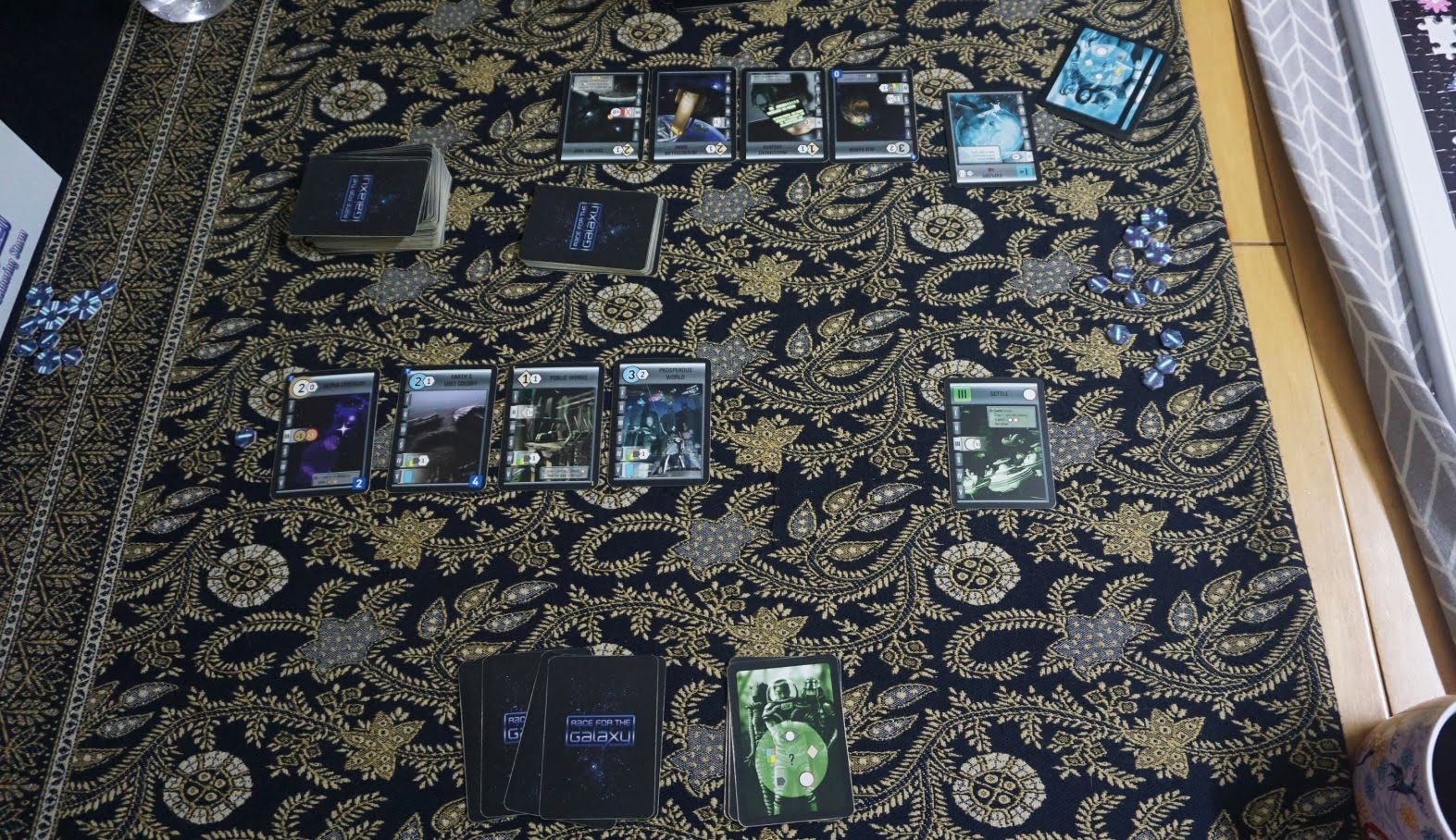
Younger daughter Chen Rui once saw me play Race for the Galaxy on my iPad and expressed interest. Since then I kept reminding myself to find an opportunity to teach her the game. By now she probably isn't all that keen. She was just curious then. I was just looking for an excuse to get her to play games with me. 


My copy of Race for the Galaxy includes three expansions, so the card deck is huge. In order to teach Chen Rui to play, I removed all cards from the expansions. The base game already has many cards, many more than the average card game. It is complicated enough. Better not overwhelm her. I had not played the physical game for a long time. I used to play this regularly with my wife Michelle when the children were young. That was before they went to primary school, ages ago. Now that I played the physical game again, it was full of nostalgia. Nowadays I play Race for the Galaxy only on the iPad, against AI's. 


I let Chen Rui use the light blue player cards. In Race for the Galaxy every player gets a set of player cards. I use green. Michelle used to play red. 


Playing the physical copy feels different from playing the digital version. On the iPad, the tempo is fast, and I am often lazy to think too much. I don't spend much effort to analyse and to think. I must admit I'm a little sloppy. The tempo in the physical game is slower, and I get to smell the roses a bit more. I am a bit more relaxed and take more time to consider my options. It is a nice change of pace. 

Race for the Galaxy has a second and a third expansion arc. Expansions from different arcs cannot be mixed. I bought expansions in the second arc, but not the third. By the time I got to the second arc, Michelle and I no longer played the game regularly. We did play the second arc, and based on those games we played, I liked the first arc better. When the third arc came out, I read about it but never bought it. If it ever gets released in the digital version I would buy it and give it a go. 


The digital version is pretty good. When I play, I normally play two AI opponents. My iPad is old and if I add a third AI, it can't handle the additional computing and often crashes. When I boot up the game on the iPad, I can play 7 or 8 games in one breath, and it takes maybe 45 minutes or so. I learned a few tricks from the AI's. 


Chen Rui suggested Machi Koro. When my daughters were younger, the three of us often played Machi Koro. We all liked it. It had been a while since we played. Chen Rui and I tried playing just the base game, but using the market mechanism introduced in the expansions. I prefer having the market mechanism, but had not tried it with the base game. I wasn't sure whether it would work well. After trying it out, we concluded that it worked just fine. 

In the base game we only needed to build four landmarks. That felt rather short. I was too used to needing to build six landmarks. 


In the base game, normally all the buildings are sorted and laid out, and made available to everyone at all times. This is just like Dominion. If you have in mind a particular strategy, you can keep at it and buy as many of the buildings needed as you want. The only thing stopping you is other players buying what you want. So in the base game it is easier to execute planned strategies. 

With the market mechanism, there will only be 10 types of buildings available at any time. Buildings are drawn from a facedown deck. During set up you draw them and add them to the market until you have 10 types. If you draw a building which already exists, you group the similar cards. Whenever anyone buys the last one of any particular building, you draw a new building from the deck, until you reach 10 types. When using this market mechanism, there may be only one copy of a particular building you want. It becomes much harder to execute any perfect strategy. You need to adapt to the situation in the market. At the same time you need to react to your opponents' strategies. 


I bought many convenience stores (green #4 building). If I rolled a 4 I would make $12. I would stick to rolling one die for a while. Chen Rui was starting to roll two dice, so my mines (blue #9) could help me. Blue buildings activate on all players' rolls. 

Later Chen Rui and I asked elder daughter Shee Yun whether she wanted to join us. We played with the first expansion, which has boats. I asked them to pose for a photo, to reenact one taken seven years ago.  

April 2023

June 2016

We hear this all the time - "kids grow up so quickly!"  Now both my children have completed secondary school. The three of us don't game together as much as we used to, but it is still great fun when we have our sessions. 


This particular game of Star Realms was rather extreme. My life points (actually it's called Authority) went all the way to 109. Normally players start with 50, and your goal is to reduce your opponent's life points to 0. I more than doubled my life points because I had many blue cards in my deck. 


I am still regularly playing Star Realms and Ascension on my phone, more or less daily. I have almost all the expansions. I have played Ascension for more than 10 years, and Star Realms more than 8 years. 1500+ plays of Ascension, and 1100+ for Star Realms. I should promote them a bit since they've given me so much joy. Go buy them! 

Friday, 12 May 2023

SCOUT

The Game

SCOUT is a game from Japan, designed by Kei Kajino. The first edition was released in 2019. In 2022 it was nominated for the Spiel des Jahres, the German Game of the Year. It is a card game. Most people would categorise it as a climbing game. However it is quite different from the typical climbing game. I find it highly innovative and it would be a shame to imagine it as just another climbing game. 

The game has a couple of unusual twists. I have read about it before, but at the time wasn't particularly interested in giving it a go. One twist is cards have two ends and they are different (hey, just like Dancing Queen!) You can choose which end you want to use. A second twist is you cannot rearrange your hand, just like in Bohnanza. Most people who review the game mention these two quirks, but by only explaining these two, it is far from sufficient to give an idea of what the game is like. 


A game is played over several rounds. Each round you will score or lose points. After a certain number of rounds, the final scores are tallied and the highest scorer wins. A round ends in two ways. Either one player plays all her cards, or she plays a combo which no one else is able to top. The former is just like most climbing games, but the latter is something very different. Typically in a climbing game if no one can top you, you just become the start player for the next run. You get to decide which kind of combo to play, and everyone must play that kind. It is an important advantage to become start player. SCOUT takes this further. If no one beats your combo, you immediately win the round. The stakes and the sense of urgency are much higher here. 

When a round starts, all cards are dealt out. When you examine your hand of cards, you already cannot rearrange them. The only choice you have at this point is whether to turn your hand of cards upside down. You don't get to make that decision for individual cards. It's all or nothing. In a sense you are getting two different starting hands and you must pick one. 

The combos in the game are simple. You have only singles, straights and same kinds. There is no concept of suit. The colours on the cards don't mean suits. When you play combos, you are not restricted to the combo type or the number of cards. As long as you can play something stronger, you're good. If the start player plays pairs, you are not restricted to play only pairs. 

Here's how the combos compare in terms of strength. Firstly, the more cards there are, the stronger the combo. Secondly, same kinds are stronger than straights. Lastly, larger numbers are stronger than smaller numbers. So 1-2-3-4 is stronger than 9-9-9. 4-4-4-4 is stronger than 1-2-3-4. 5-5-5 is stronger than 2-2-2. This feel familiar, but the fact that you can play a combo with more cards than the previous one defies tradition. 


To play cards from your hand, you can take them from anywhere, but they must be adjacent, and you cannot rearrange them. A 9-7-8-6 is not a straight, because the numbers are not in the right order. Using this photo above as an example, I can't play 5-5-5 because one of the 5's is separate from the other two. I will need to play the 7 and the 9 before these three 5's would "meet", and then I would be able to play 5-5-5. 

Playing a combo means you are beating the previous player's combo. In this case you claim all cards in her combo and put them in front of you. You will score 1 point each for these cards. If you are unable to play a combo, or decide not to, you must take one card from the previous player's combo and put it into your hand. After you select the card, you may turn it upside down before putting it into your hand. Also you may choose any position to insert it. Now this can be a very powerful move, helping you create good combos. If anyone takes a card from your combo, you will score 1 point. This is another way points are scored. 

At the start of a round everyone gets a car. This represents a single-use power. When you activate the car, you perform two actions on your turn. You first take a card from the previous player's combo, and you then play your own combo. Normally you only get to perform one action per turn. The car can be a life-saver. Whenever a player is unable to play a combo and is forced to take a card from the previous player's combo, she is effectively also weaking the combo still in play. Fewer cards = weaker. Normally when you take a card, that's already the end of your turn, so you can't immediately play a combo to beat the current combo. The car lets you do this. 

Usually when I introduce games, I don't like going into rules details. I would be regurgitating the rulebook. In the case of SCOUT, I find it necessary to explain this many aspects of the game because it really takes this much understanding of the details to be able to appreciate what it's like. Or so I hope. You might still be clueless what playing the game feels like. I encourage you to experience it yourself. 

And I'm not even done yet with explaining the game mechanisms. Just one more okay. When a round ends, everyone who is still holding cards loses 1 point per card. This is except for the winner of the round, if she wins by playing a combo no one can top. She may still have cards in hand. They cause no penalty.  

The Play

SCOUT is a combination of several unusual rules, and it is difficult to imagine what it's like without actually playing. One key difference from typical climbing games is your hand of cards can grow and can be improved. In games like Big 2 and Fight the Landlord, you have to live with what you are dealt. You plan around that from the beginning. You try to use the strong combos you can make to help you get rid of the weak cards and combos. In SCOUT you can't reorganise your hands, but you can take other players' cards and add them to your hand. 

We did a 3-player game, and the game is tense! Your power combo only needs to survive two opponent turns for you to win a round. Let's say I play 1-2-3-4-5-6. If my first opponent can't top that, he'd take one card, let's say the 6, and turn my combo to 1-2-3-4-5. That's still pretty strong, and my second opponent might not be able to top that. If the second opponent uses his car and further weakens my combo to 1-2-3-4 (taking the 5), a straight with four cards is still decent and might not be easily beaten. In SCOUT it is desirable to build strong combos and hope for winning by being undefeated. However if everyone is thinking the same, you might get into a situation of one seemingly strong combo being surprise-beaten by another even stronger combo. Sometimes you get that anxiety of how strong is strong enough. It is highly satisfying to create powerful combos. 

The need to keep beating opponents' combos is an ongoing threat. If everyone at the table collectively fails to stop one player, that ambitious combo you are building in your hand just becomes many points you have to lose. It is important to watch the number of cards your opponents have remaining. Like typical climbing games, if they have fewer cards than a combo you are about to play, you know they can't beat you. 


If I play the three 1's, and then that 6 on the left, I will end up with the straight 9-8-7-6. 


The tokens in the first row are: start player marker, car marker (once-a-round special power) and point token for other players taking cards from your combo. The numbered counters are for keeping score. 


This photo and the next are from the same game round. You can compare them. 


I played the 9-8 on the right, and then took and inserted a 4, so that I now had a combo of 3-4-5-6. If I played 7-8-9 later, I would be able to link up the 2, making a combo of 2-3-4-5-6. 

The Thoughts

There aren't many highly innovative games. I'm glad that SCOUT was nominated for the SdJ. I think innovation in game design should be encouraged. The last time I played a game which gave me a pleasant surprise like this was Regicide. That's a card game too. SCOUT is the kind of game you can play all night over snacks and drinks while chatting. It comes in a small box so it's great for trips with friends. Highly recommended! 

Monday, 1 May 2023

Dancing Queen on The Opinionated Gamers

The Opinionated Gamers (OG) is a blog I have been following for many years, since their inception in 2011. The team at OG was already writing for BoardGameGeek.com well before the OG blog started. They are old timers and long-time contributors to the hobby. 

A few months ago I contacted the founder and chief editor Dale Yu, and asked whether he was interested to give Dancing Queen a go. I sent a review copy to him in the US. This is what he thought of the game: link. He calls it a "super neat 2P card game". I must say I am thrilled. It is surreal to see my own game featured at a website I have been a reader of for so many years.