Friday, 24 December 2021

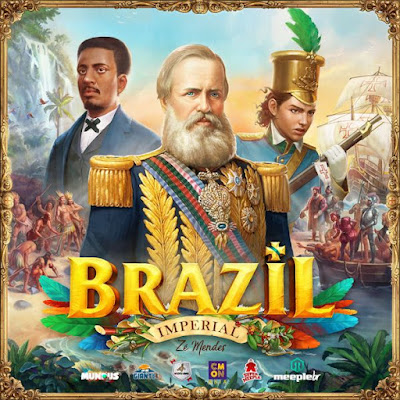
Brazil Imperial


The Game

Brazil Imperial is a game of colonisation and nation building set in the age of exploration. It is a 4X game and a civilisation game in which you start with a humble capital and grow into an empire, competing with other players for territory and resources. You construct buildings and cities. You produce resources and use them to expand your empire. You discover unknown secrets of the land. You raise troops and conduct battle to seize opponent cities, buildings and resources. The game is played over three eras. Every player gets one mission card per era. An era progresses to the next the first time anyone completes a mission of that era. Once anyone completes a mission of the third era, the game ends. Many things you do in the game give you points. The highest scorer at the end of the game wins. 
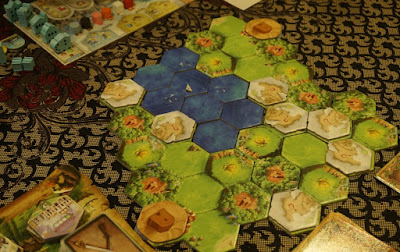

The game comes with many different setups. This above is one of the 2-player setups. The starting locations of the two capitals are fixed. The fog tiles are secrets you get to explore. They are usually good and the benefits are claimed on a first come first served basis. The map has different terrain types - plains, forests, gold deposits and lakes. Different terrain types allow different buildings. 
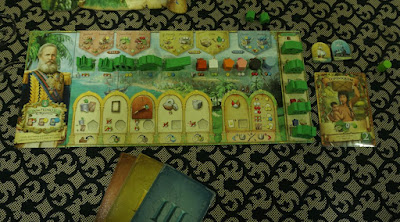

Everyone gets a player board like this. The large tile on the left is a monarch tile. You have a few options and every monarch gives a different bonus. The player board is mostly identical between players. The only differences are the army composition and costs. Each different coloured player board comes with a set of monarchs. 


The green player has two archers, a monarch, a cavalry and a cannon. The icons below the units are the costs to raise these troops. The units have different combat strengths and are also worth victory points the moment you create them. They never die. If they lose a battle, they just go to a waiting area. The next time you perform the deploy action, you may deploy them to your city or capital for free. 

The monarch unit is the only unit type which can establish a new city. The cavalry unit brings along any number of other units when it moves, which is very handy. The cannon can initiate a battle from an adjacent space. Normally you need to enter a space occupied by an opponent to initiate battle. 
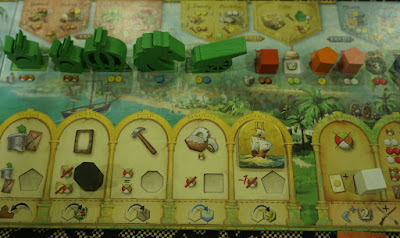

A player turn is short and simple. You pick one action, and you march once or twice. You can always march a unit once. Whether you get a second march depends on the action you pick and what kind of extra march it gives. E.g. the buy painting action gives an extra march if a unit is going to march into an adjacent forest. So it's situational. 

The 7 action options are shown in arches on the player board (see above). You can deploy troops, buy paintings, construct buildings and cities, collect resources and convert resources. Paintings give you special abilities and are worth points. They augment your abilities and are good investments. There's one action called manufacturing. You spend resources to move a cube, a pentagon or an octagon (see above) to one of the action arches. This enhances the action designated by the arch, e.g. waiving the payment for producing goods. This is also good investment especially when you enhance an action you plan to perform many times. 
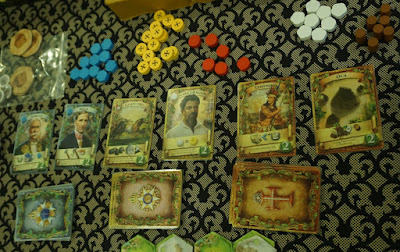

There are three types of paintings and two of each type will be made available at all times. The rightmost two are free, the others require payment. The leftmost two are the most expensive because you need to pay science. The blue resources are science, the most precious resource in the game. 
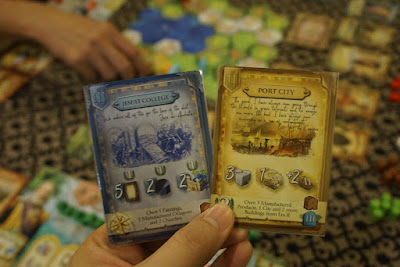

These are mission cards. They are what drive the core progression of the game. Think of them as a countdown mechanism. Whenever a mission of a particular era is completed and announced, everyone progresses to the next era. You must work on your missions so that you don't miss out on the point value and also the reward of building a palace. There are 6 types of palaces in the game. The first one is free and is used to mark your capital. The rest can be built only when you complete missions. They give various bonuses, and often these come in the form of extra victory points based on specific criteria being met at game end. Your choice of palace determines how you play. 
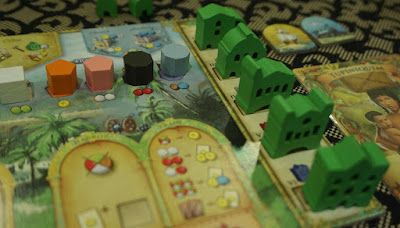
These are the palaces you get to build during play.
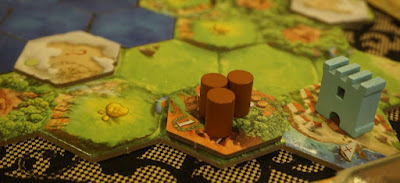

When you construct a building, it immediately produces resources. You place the resources on the building itself and you can use them any time. Once you exhaust them, you can make the building produce again by picking the renovate action. It's called renovate and not produce because before you produce, you may flip the building to the other side, transforming it into another building type which produces a different resource type. 
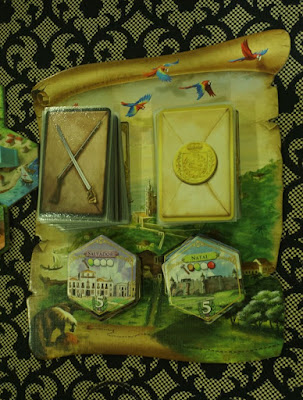

This little side board is for organising some of the components. At the top left you have the combat cards. You draw a combat card when you deploy a unit. Combat cards give you extra combat strength. During combat, the strength of units, buildings and cities are open information. The strength of combat cards is hidden information. Both combatants commit combat cards face-down. They are revealed when combat resolution is done. 

At the top right you have the gold cards. They have various abilities. Some may score you points at game end based on certain conditions being met. Some give one-time powers. If a gold card is not useful to you, you can simply spend it as a gold coin. 

The two stacks at the bottom are city tiles. When you build a city, you must pick from the top of one of these stacks. Cities are worth 5VP each, which is a lot. They are also expensive to build. 

Brazil Imperial is a game where you race to grow your nation, producing more resources which you then spend to construct more buildings and cities. Almost every other thing you do in the game scores you points - buildings, cities, military units, paintings and so on. Whoever does the best overall job of building his empire will be the ultimate winner. 

The Play

I did a 2-player game with Allen, so our map was small. We were both new to the game. 
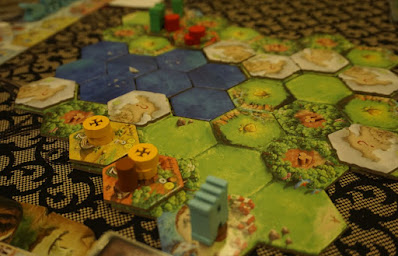

Allen (light blue) picked the capital location at the bottom right, so I took the other one at the top left. One thing unique about the light blue empire is most military units are built with gold coins, so Allen focused on constructing buildings which produced gold coins. A new building can only be constructed next to a capital, a city or another building. Only new cities can be constructed without being adjacent to your territory. 

The mission of the first era was not very difficult and I completed it quickly. I had a strict focus and minimised the number of steps needed to complete the mission. The speed surprised Allen a little. However for both Eras 2 and 3 he beat me to the missions. 
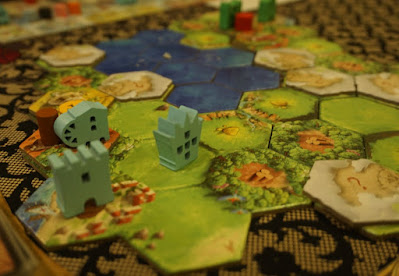
 

This piece in the middle is Allen's monarch. The monarch is a military unit and has combat strength. Its most important function is to build new cities. 
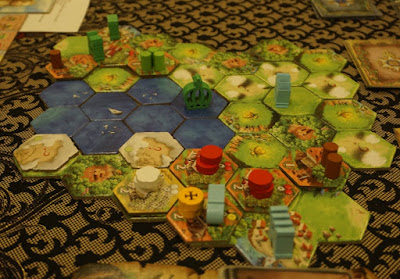

My (green) monarch was now deployed too and sailed towards the group of unexplored territories (fog tiles). Allen and I competed to uncover the secrets of these unexplored territories. He was faster than me in building construction. By now he had five buildings while I had only three. 
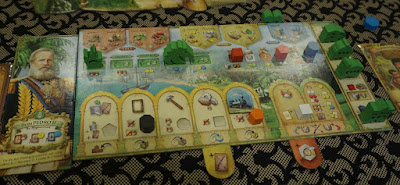

When you perform an action, you place your action marker inside the corresponding arch. This reminds you not to perform the same action next turn. You use a different action marker every era. When an era ends, you flip over the expired action marker and place it below one of your action arches. This boosts the action from then on. In the photo above you can tell this is the third era, because two action arches now have been boosted, with old action markers placed below them. 

My monarch tile (on the left of the player board) gave me resources when I purchased paintings. I picked this particular monarch because one of my missions required collecting many paintings. I wanted to create synergy.
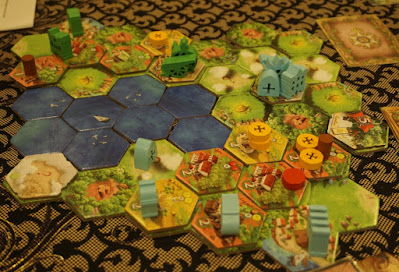

At the top right Allen and I were now in a stalemate situation. We had both built cities, and now we both had armies stationed in our cities. No one dared to attack, because whoever attacked would be at a disadvantage. The defender could rely on the combat strength of his city. Fighting never broke out between these two cities until the end of the game. 
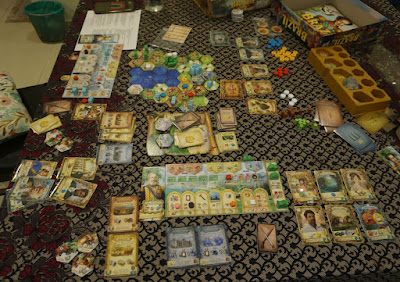
The map doesn't take up much space, but the rest of the game does. 
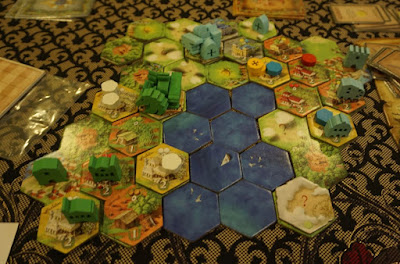

One of my (green) palaces scored points based on the number of cotton farms I had, so I build as many cotton farms as I could, and also renovated foundries to become cotton farms. The white resources on the map are cotton. 


When we did the final scoring, Allen and I both scored 76! I fell behind Allen in expanding my empire so I was not optimistic. I was the one who read the rules and I was more familiar with some of the intricacies. That gave me some advantage in some detailed execution aspects. The tiebreaker was science (blue resource) on the map. Allen had two and I had none, so he was the victor. I wasn't able to start constructing Era 3 buildings, and he already had two. 

The Thoughts

A turn in Brazil Imperial is very simple, and it makes the game feel accessible. You only perform one action and you may march up to twice. Down time between player turns is minimal. You always feel engaged. Actions are simple, and you usually have to plan a few steps ahead to complete a certain objective, e.g. renovate a certain building to produce resources, then spend those resources on manufacturing a product to enhance the deploy action, and then perform the deploy action to be able to deploy two units at once. 

You are always in a cycle of producing resources then spending them to expand your empire, be it in enhancing your abilities or building more and more stuff - buildings, military units and cities. You are always hungry and growing. That said, being big does not guarantee victory. You may have more space to construct cities and buildings, but smaller empires which are efficient in utilising their buildings can still do well in scoring points. 

There is a delicious tension between upgrading your abilities and racing to complete missions. On one hand it seems a no-brainer to upgrade your abilities in the early game, so that you get to enjoy the advantages for the rest of the game. But how far should you go? There is time pressure in completing the missions. If you spend too much time on upgrading many different abilities, you may not be utilising all of them enough. You may fall behind your opponents. Yet if you only focus on the race without developing a competitive edge, you will likely be outpaced by your opponents. There is pressure to grab land and to explore the unknown territories too. Finders keepers (usually)! 

Brazil Imperial is the type of game with many different ways to score points. Sometimes when playing such games I feel my strategic planning doesn't matter much. No matter what you do, you will score points. It's just a matter of being efficient and being clever with tactical execution. As long as you are efficient, you will end up scoring more points than your opponents. You try to be lazy. You want maximum gains with minimum effort. It comes down to an efficiency game. This is something that nags at me when I play. 

I like that the game makes me feel that there are many things I want to do, and I have a tough time deciding which I should do first, and which I may have to give up. You can't take your sweet time and do everything you like. There's a race going on. You need to pick a few areas and make sure your actions synergise well. Brazil Imperial is a development game. It is fulfilling to see your empire grow. You progress to construct better and better buildings. You accumulate wealth. You push your borders outwards. There is some combat but it won't be your primary focus. Raising troops gets you victory points, but killing opponents' soldiers doesn't. It takes much effort to capture your opponents' cities and buildings. It may not be worthwhile. The military aspect is an arms race. You can't afford to fall behind too far because your opponents are still threatening to steal your resources and points. You may not want to spend too much effort on planning an offensive because you may not get much out of it. It's not too hard to play defense and to match an aggressive neighbour in strength. 

The production of the game is top-notch, from the art to the game components. Allen said he decided to buy it because of how pretty it was, and that was before he even read the rules. 

I like how Brazil Imperial maintains a sense of urgency. You don't know your opponents' missions and how close they are to completing them. The clock is ticking and you always worry about falling behind and being unable to complete your own missions. Era 3 missions are broad and thus not easy to fulfil. You are often torn between focusing only on the main missions and going off on lucrative side quests. You want to do everything, and you are constantly worried you won't have enough time. 

Tuesday, 21 December 2021

Merry Christmas

Merry Christmas and Happy New Year! 

The theme for 2021 is mecha deities and this character is Dionysus from Greek mythology. 

Friday, 17 December 2021

A Kindly World


I rarely support games on Kickstarter and other crowdfunding platforms. Over the years that crowdfunding boardgames has been popular, I've supported fewer than ten games. This year I supported A Kindly World from Japan partly because I like the art style. I like that it is a little quirky and has something a little different to offer. I have never played other games by the designer. I read the rules before deciding to pledge. 


I was a little worried whether my package was lost in transit. Some supporters in USA had received their copies when I was still waiting for mine. It was a relief when the game arrived. I rarely receive mail from Japan so I couldn't help feeling a little excited about it. The box was slightly larger than A4, more or less the size of a a standard board game. 


The actual game is quite small, as you can see above. It was well protected by the mailing box. The mailing box was big enough for the game rules and the clear holder. 


The rules were not stapled into a booklet form. They are in loose sheets. The rules don't fit into the game box. I later created my own rules summary and made it small enough to fit inside the game box. 

The rules came in three sheets of paper. 

The last page is the card manifest. 


The English version is actually just the Japanese version with an English obi, i.e. the black paper belt above with English text, and rules in English. There is only one version of the actual game and it is in Japanese. The cards do have Japanese text, but the game is very much playable even if you don't know Japanese. 

The back of the box (and obi).

The game is pretty small, and the cards too. 

The rules summary I made can fit inside the game box.

The Game

A Kindly World is a push-your-luck set collection game. You collect cards during the game, and you win by collecting 7 different types of item cards. Every player gets a role card. You can also win by completing the mission on your role card. 


The first row are the roles, the second row the items. The items have patterns along the edges, and this is how you differentiate them by type. In addition to the patterns, you can also tell them apart by the number at the top left corner. The number specifies how many cards there are of that particular type. The number of cards of the various types range from 5 to 9. Two types have 8 cards. In this case one type has the 8 written in a solid font, and the other has 8 written in an outline font. So you can still tell them apart using the number. 

On your turn, you must create a row of cards, and you try to claim these cards before any clash happens. Once there is any clash, you must end your turn and without claiming any card. All cards in the row are discarded. 


A player's turn starts like this. The top card of the draw deck is face-up. The rest still remain face-down. When I first read the rulebook I didn't understand why this was necessary. Only upon playing the game I appreciated why this was practical. The active player must move the top card of the deck to the right at least once. Cards on the right of the deck form a row, and these are what you try to claim before your turn ends. 


The card which was on top of the deck has been moved to the right, and the top card of the deck is now turned face-up. If you compare the patterns on the edges of the cards, they are different, which means there is no clash yet. They are cards of different types. At this point you may decide to claim the card on the right and end your turn. Or you may decide to be greedy and move the top card of the deck to the right again. 


Now the new top card of the deck is again a new type and does not clash with any of the cards on the right. Now you may take both the cards on the right, or you may gamble again and move the top card to the right. What all this means is if you want the top card of the deck, you will need to gamble and hope the next card doesn't cause any clash. This is tantalising. The exact card you want may be dangling right in front of you, tempting you. If the top card of the deck is not what you want, and the cards on the right include some which you do want, it may be a good time to stop and claim them while you can. 


If you continue to move cards to the right, you may end up with a situation like this. Now the top card of the deck clashes with the card immediately next to it. That means you have failed and will leave empty handed. All three cards on the right must be discarded. 

This is how you collect cards. Once you have all 7 item types, you win. 


The other way to win is to complete the mission on your role card. Everyone is dealt one role card at the start of the game. This is initially kept secret. The missions are related to collecting cards too, but the requirements vary. The child wants to collect three cards with toy cars. Mr Pumpkin needs 2 cards in one type, 2 in another type, and 3 in yet another type. You have two goals to work towards. 


These are the trees of light. There are 4 such cards in the game. The rightmost card is the final tree of light, and it is shuffled into the bottom 10 cards of the deck. The rest are shuffled into the rest of the deck. When the first tree of light appears, role cards which are unused are revealed. This helps you narrow down the possibilities of your opponents' roles. You know which roles are in play, but you may not know yet who's having which role. When the second tree of light appears, everyone reveals his role. Now everyone knows for certain what everyone else is trying to do. The trees of light are relevant to some of the roles, e.g. the city person needs to collect two trees of light.  


These above are all the cards with a solid 8. They all share the same border pattern. The drawings are all different. I like this and think it is lovely, even though it is not exactly practical. Three of the cards of this type have the toy car icon at the bottom right. In the whole game there are 8 cards with toy cars. 

These are the cards in the outline 7 series, and they are all related to music. 

If no one has won by the time the last tree of light appears, you follow a tiebreaker procedure to see who wins. You check for fewest trees of light, then the most toy cars, and finally the most cards. 

The Play

My first game of A Kindly World was a 2-player game with Chen Rui. The 2-player game is a variant and is a little more complicated. The game is primarily designed for 3 or 4, and having played both 2- and 3-player games, I would recommend first timers to start with 3- or 4-player games. In the 2-player game, the role cards are shuffled into the main deck instead of every player being dealt one before the game starts. You collect role cards in the same way you collect item cards. You can win be fulfilling the mission of any one of the role cards you have collected. The 2-player game may be slightly more strategic than the standard 3- and 4-player game, but I think A Kindly World is meant to be a light game. I prefer to play with the simpler standard rules. 

2-player game in progress.

The game plays briskly. This feels like a five-minute game. Both times I played, once with two players and the other with three, we played three games back-to-back. Otherwise it doesn't feel like we've sit down long enough to have played a game. Many games take longer to set up than this game takes to play!

Despite being a simple game, there are some clever bits to discover. It is useful to try to guess your opponents' roles. If you know what the next player is trying to collect, you will avoid leaving cards that will help him. Whether to move another card to the right seems like a brainless decision, but there are actually a few factors to consider. It is not just a linear decision of few cards meaning low risk and many cards meaning high risk. Sometimes you keep revealing cards and risk failing because you don't want to leave a good card for the next player. Sometimes you are happy to collect just one card. Sometimes you bet against the odds even when the odds are horrible. 

That pile at the top is the discard pile. Now three cards have been moved to the right and there is still no clash among all four visible cards. This is rare. 

My character was Mr Pumpkin. I was still far from completing my mission. 

In a 2-player game, role cards (rightmost in this photo) are shuffled into the draw deck. When you see such a card, you don't turn it face-up (unless the second tree of light has appeared). 

This many cards revealed and still no clash! This is a minor miracle. 

The role card is still kept secret since the second tree of light has not appeared. 

The village elder can substitute one tree of light as the 7th card type. I have 6 types now, but unfortunately no tree of light yet. I need a tree or the 7th card type to win.

Chen Rui was curious whether all the different drawings within one type of card can be linked together to form a story. She grouped the cards by type and tried to sequence them into stories. Kickstarter supporters will be getting a digital comic book. It is expected to be released in Feb 2022. 

This is a 3-player game. Everyone gets one role. 

The Thoughts

A Kindly World is novel. Despite being simple and light, it has some endearing quirks. Sometimes I feel I get more fresh ideas and experiences from playing these clever little games than those typical 2-hour point salad Eurogames. There is a market for such heavy Eurogames, so many companies continue to make samey stuff and they continue to sell well. 

One reason I like A Kindly World is this is the kind of game I am learning to create. Something that works for non-gamers and casual gamers. Something that works at boardgame cafes and non-boardgame gatherings. But it must also have something new and interesting to offer. There has to be a certain catch. A Kindly World feels super simple, but it is not as innocent as it looks. It is no deep strategic game, but it does have a little spark of genius. 

Friday, 10 December 2021

JOME


The Game

JOME (official website) is a Malaysian design. It is a card game for 2 to 6 players. When I participated in the recent Game On Lah game event, they were in the shop right next to mine where I demoed Dancing Queen. I did not go out to try other games by other Malaysian designers. I stayed at my shop throughout the day. However my wife and children did manage to check JOME out when they came to visit, and they bought a copy to support the designer. 

This is a pure card game. 

The box is small and easy to carry around. 

Rules are short and simple. 


There are two types of cards in the game. The first row is trophy cards, and the second row battle cards. Trophy cards are worth points and you compete to gain as many points as possible. Battle cards are your ammunition to win trophy cards. 


During game setup, you create as many groups of trophy cards as there are players. You draw trophy cards one by one until you have four groups of distinct icons. If you draw a card with the same icon as an existing group, you add it to the group instead of creating a new group. Every player starts with a hand of six battle cards. 


On your turn you play a battle card and then refill you hand. The trophy cards specify which types of battle cards can be used. At the bottom left you can see that a yellow circle battle card and a red diamond battle card have been played. Both these shapes appear on the trophy card. You play your card next to the trophy card based on your seat position. E.g. the player sitting at the top left would play his card at the top left corner of the trophy card. 

The yellow circle card has a value of x2. The trophy card value is 8. The battle strength of the player sitting at the top left is thus 2x 8 = 16. The red diamond card has a value of +2. The battle strength of the player who played this is 2+ 8 = 10. At the moment it is the player at the top left leading. 

When you play card, you must either be first to compete for a trophy card, or you must become the leading player at a trophy group which is already being fought over. Once a trophy card has 3 or more battle cards played next to it, the reckoning is done and the trophy will be won by whoever has the highest strength. He claims the trophy card. A new trophy card is then drawn to replace it. 

Black battle cards are wild cards. All of them have special powers. In the photo above, the Half card halves the strength value of all your opponents. 


The Duos card lets you play an additional card. In this situation above, the player at the bottom right plays two cards on the same turn and wins the trophy. Once there are three cards played next to a trophy card, it is evaluated and claimed by the leading player. 

The dice values on the cards have meaning. In the case of ties in strength, you follow a specific tiebreaking procedure to determine who is stronger. You compare the number of cards, then the card colour and shape, and finally the die value. 

The game ends when the last trophy card is won. Whoever has the highest total trophy value wins the game. If you want a shorter game, you can agree to play to a certain point total. Whoever reaches the goal first wins. 

The Play

JOME is easy to teach and you can start playing quickly. On the get go you can tell which trophies you are eligible to compete for. It depends on whether you have the right battle cards. Trophy cards have different values, and naturally the higher valued ones will be more sought after. It is often good to be first to play a battle card on a trophy card. You claim one of the three slots available. If you have a second card which can be played on the same trophy, chances are even if another player decides to compete with you, you can reclaim the lead with your second card and win the trophy. There is a risk in going first too. If an opponent or multiple opponents have much stronger cards and will beat you to it, you would have just wasted one valuable turn. Your turns and your cards are your resources. You want to be efficient in spending the least resources for the most gains. 

One tedious part of the game is checking for valid battle cards. Battle cards come in 5 colours and 4 different shapes. There is a total of 12 different combinations. This means effectively you have a deck with 12 suits. I don't quite understand why this is necessary. I think it complicates the game needlessly. 


The game is highly tactical in nature. You can't really plan strategically. Every turn you analyse the situation at hand and decide on the best play based on your hand cards. You don't know what cards your opponents have and can only guess based on their actions which trophies they might go for. 

The Thoughts

Essentially JOME is a game of spending your resources (your battle cards) wisely. You want to be efficient, winning as many points as possible with what you are dealt. The rules are simple. This game can target the mass market. Non-gamers and casual gamers can pick it up easily. For gamers, this game does not introduce anything groundbreaking. It will be the kind of game used for spending time with non-gamers. It is also the kind of portable game you can bring on trips. 


These are the wild cards. The rightmost Pow card lets you immediately win a trophy card. I'm not sure whether I have understood the ability correctly. If it works the way I interpret it, then the +10 and the 6-value die are not necessary. One more thing I think can be simplified is how strength ties are broken. The official rules require players to compare number of cards, colour, shape and die value. I would prefer to simply require the player playing a card to exceed the strength value of the current leading player. This way ties will not happen and all the tiebreaker rules can be removed. 

Saturday, 4 December 2021

Dancing Queen public demo


The Game On Lah event organised by Locco ran for two days, 27 - 28 Nov 2021. This event promoted boardgames designed by local Malaysian designers. I was able to participate only on Saturday the 27th, since I had another commitment the following day. My goal in participating was to see how the general public (i.e. non-gamers) responded to Dancing Queen. Throughout designing, playtesting, tweaking and submitting the game for the contest, most people I had managed to playtest the game with were gamers. I didn't manage to get many non-gamers to try it out. So this event was a good opportunity for me to test a different segment. 

The event ran from 11am to 6pm. I arrived around 9:30am. I had much more time than I needed. All the preparation was done in about half an hour. I brought a portable speaker, and throughout the day I played songs from ABBA, Queen, Boy Zone, Spice Girls and Cranberries. These are groups which appear in the game. 


The venue was GMBB Mall, a relatively new shopping mall in the Kuala Lumpur city area, opposite Tung Shin Hospital. This mall specialises in artsy stuff and cultural events. There was not much crowd on Saturday. In the morning and around noon, most people who came to play were other designers who also showcased their games or gamers who knew of the event. There were slightly more people in the afternoon. I had only two tables at the shop assigned to me. I estimate about 80% of the time at least one of them was occupied. In the late afternoon most of the time both were in use. 

By observing how people played Dancing Queen, I learned a few things about how I could teach the game better. Some players still forgot to pass the microphone before drawing a card. This is something I still struggle with. I have considered removing this rule, since it's often hard to remember. However this rule has strategic importance. Whether to draw a card is an important tactical decision, and whether the microphone is being passed is an important consideration. Maybe I just need to find a better way to help people remember to pass the microphone. 


I invited friends to be my helpers - Eva (centre) and Ai Shiang. If I were alone the whole day at the shop, I would have difficulties taking toilet breaks and eating lunch. I would need to ask designers from next door to guard the fort for a while. Having a helper also meant players at both tables could be attended to at all times. 


My wife Michelle and daughters Shee Yun and Chen Rui came to visit in the late afternoon. Once the event wrapped up for the day, we went for dinner nearby to celebrate. 


The shop unit was a little small. It was a deep but narrow unit. I could only fit two tables comfortably. Adding a third would make the place cramped. 


This was the first time I showcased my game design at a public venue. I learned something from this experience so it was worth the effort put into preparing for it. I had actually brought two game prototypes, Police and Saikoyu, but unfortunately did not have the chance to teach them to my visitors. These are simpler games and are probably more suitable for casual players compared to Dancing Queen. 

Dancing Queen is not the kind of game casual players can quickly grasp and enjoy. I don't think it can be a mass market game. Gamers can quickly pick up the rules and appreciate the intricacies. As they play more, they will discover further depth and new tactics. Non-gamers will need some effort to digest the game. I think a successful mass market game needs rules that can be taught very quickly. It should not have many rules, and most of its rules should feel familiar to the target audience. Dancing Queen has a number of unusual rules, e.g. how cards are played face-down and how the orientation of a card determines whether it is a boy or a girl. The passing or end-the-round mechanism also takes some explaining. It's not exactly a hard game to learn. Both my helpers are non-gamers, and they managed. It's just that it is not the kind of game non-gamers can pick up within a few minutes and have their eyes light up.