Friday, 17 December 2021

A Kindly World


I rarely support games on Kickstarter and other crowdfunding platforms. Over the years that crowdfunding boardgames has been popular, I've supported fewer than ten games. This year I supported A Kindly World from Japan partly because I like the art style. I like that it is a little quirky and has something a little different to offer. I have never played other games by the designer. I read the rules before deciding to pledge. 


I was a little worried whether my package was lost in transit. Some supporters in USA had received their copies when I was still waiting for mine. It was a relief when the game arrived. I rarely receive mail from Japan so I couldn't help feeling a little excited about it. The box was slightly larger than A4, more or less the size of a a standard board game. 


The actual game is quite small, as you can see above. It was well protected by the mailing box. The mailing box was big enough for the game rules and the clear holder. 


The rules were not stapled into a booklet form. They are in loose sheets. The rules don't fit into the game box. I later created my own rules summary and made it small enough to fit inside the game box. 

The rules came in three sheets of paper. 

The last page is the card manifest. 


The English version is actually just the Japanese version with an English obi, i.e. the black paper belt above with English text, and rules in English. There is only one version of the actual game and it is in Japanese. The cards do have Japanese text, but the game is very much playable even if you don't know Japanese. 

The back of the box (and obi).

The game is pretty small, and the cards too. 

The rules summary I made can fit inside the game box.

The Game

A Kindly World is a push-your-luck set collection game. You collect cards during the game, and you win by collecting 7 different types of item cards. Every player gets a role card. You can also win by completing the mission on your role card. 


The first row are the roles, the second row the items. The items have patterns along the edges, and this is how you differentiate them by type. In addition to the patterns, you can also tell them apart by the number at the top left corner. The number specifies how many cards there are of that particular type. The number of cards of the various types range from 5 to 9. Two types have 8 cards. In this case one type has the 8 written in a solid font, and the other has 8 written in an outline font. So you can still tell them apart using the number. 

On your turn, you must create a row of cards, and you try to claim these cards before any clash happens. Once there is any clash, you must end your turn and without claiming any card. All cards in the row are discarded. 


A player's turn starts like this. The top card of the draw deck is face-up. The rest still remain face-down. When I first read the rulebook I didn't understand why this was necessary. Only upon playing the game I appreciated why this was practical. The active player must move the top card of the deck to the right at least once. Cards on the right of the deck form a row, and these are what you try to claim before your turn ends. 


The card which was on top of the deck has been moved to the right, and the top card of the deck is now turned face-up. If you compare the patterns on the edges of the cards, they are different, which means there is no clash yet. They are cards of different types. At this point you may decide to claim the card on the right and end your turn. Or you may decide to be greedy and move the top card of the deck to the right again. 


Now the new top card of the deck is again a new type and does not clash with any of the cards on the right. Now you may take both the cards on the right, or you may gamble again and move the top card to the right. What all this means is if you want the top card of the deck, you will need to gamble and hope the next card doesn't cause any clash. This is tantalising. The exact card you want may be dangling right in front of you, tempting you. If the top card of the deck is not what you want, and the cards on the right include some which you do want, it may be a good time to stop and claim them while you can. 


If you continue to move cards to the right, you may end up with a situation like this. Now the top card of the deck clashes with the card immediately next to it. That means you have failed and will leave empty handed. All three cards on the right must be discarded. 

This is how you collect cards. Once you have all 7 item types, you win. 


The other way to win is to complete the mission on your role card. Everyone is dealt one role card at the start of the game. This is initially kept secret. The missions are related to collecting cards too, but the requirements vary. The child wants to collect three cards with toy cars. Mr Pumpkin needs 2 cards in one type, 2 in another type, and 3 in yet another type. You have two goals to work towards. 


These are the trees of light. There are 4 such cards in the game. The rightmost card is the final tree of light, and it is shuffled into the bottom 10 cards of the deck. The rest are shuffled into the rest of the deck. When the first tree of light appears, role cards which are unused are revealed. This helps you narrow down the possibilities of your opponents' roles. You know which roles are in play, but you may not know yet who's having which role. When the second tree of light appears, everyone reveals his role. Now everyone knows for certain what everyone else is trying to do. The trees of light are relevant to some of the roles, e.g. the city person needs to collect two trees of light.  


These above are all the cards with a solid 8. They all share the same border pattern. The drawings are all different. I like this and think it is lovely, even though it is not exactly practical. Three of the cards of this type have the toy car icon at the bottom right. In the whole game there are 8 cards with toy cars. 

These are the cards in the outline 7 series, and they are all related to music. 

If no one has won by the time the last tree of light appears, you follow a tiebreaker procedure to see who wins. You check for fewest trees of light, then the most toy cars, and finally the most cards. 

The Play

My first game of A Kindly World was a 2-player game with Chen Rui. The 2-player game is a variant and is a little more complicated. The game is primarily designed for 3 or 4, and having played both 2- and 3-player games, I would recommend first timers to start with 3- or 4-player games. In the 2-player game, the role cards are shuffled into the main deck instead of every player being dealt one before the game starts. You collect role cards in the same way you collect item cards. You can win be fulfilling the mission of any one of the role cards you have collected. The 2-player game may be slightly more strategic than the standard 3- and 4-player game, but I think A Kindly World is meant to be a light game. I prefer to play with the simpler standard rules. 

2-player game in progress.

The game plays briskly. This feels like a five-minute game. Both times I played, once with two players and the other with three, we played three games back-to-back. Otherwise it doesn't feel like we've sit down long enough to have played a game. Many games take longer to set up than this game takes to play!

Despite being a simple game, there are some clever bits to discover. It is useful to try to guess your opponents' roles. If you know what the next player is trying to collect, you will avoid leaving cards that will help him. Whether to move another card to the right seems like a brainless decision, but there are actually a few factors to consider. It is not just a linear decision of few cards meaning low risk and many cards meaning high risk. Sometimes you keep revealing cards and risk failing because you don't want to leave a good card for the next player. Sometimes you are happy to collect just one card. Sometimes you bet against the odds even when the odds are horrible. 

That pile at the top is the discard pile. Now three cards have been moved to the right and there is still no clash among all four visible cards. This is rare. 

My character was Mr Pumpkin. I was still far from completing my mission. 

In a 2-player game, role cards (rightmost in this photo) are shuffled into the draw deck. When you see such a card, you don't turn it face-up (unless the second tree of light has appeared). 

This many cards revealed and still no clash! This is a minor miracle. 

The role card is still kept secret since the second tree of light has not appeared. 

The village elder can substitute one tree of light as the 7th card type. I have 6 types now, but unfortunately no tree of light yet. I need a tree or the 7th card type to win.

Chen Rui was curious whether all the different drawings within one type of card can be linked together to form a story. She grouped the cards by type and tried to sequence them into stories. Kickstarter supporters will be getting a digital comic book. It is expected to be released in Feb 2022. 

This is a 3-player game. Everyone gets one role. 

The Thoughts

A Kindly World is novel. Despite being simple and light, it has some endearing quirks. Sometimes I feel I get more fresh ideas and experiences from playing these clever little games than those typical 2-hour point salad Eurogames. There is a market for such heavy Eurogames, so many companies continue to make samey stuff and they continue to sell well. 

One reason I like A Kindly World is this is the kind of game I am learning to create. Something that works for non-gamers and casual gamers. Something that works at boardgame cafes and non-boardgame gatherings. But it must also have something new and interesting to offer. There has to be a certain catch. A Kindly World feels super simple, but it is not as innocent as it looks. It is no deep strategic game, but it does have a little spark of genius. 

Friday, 10 December 2021

JOME


The Game

JOME (official website) is a Malaysian design. It is a card game for 2 to 6 players. When I participated in the recent Game On Lah game event, they were in the shop right next to mine where I demoed Dancing Queen. I did not go out to try other games by other Malaysian designers. I stayed at my shop throughout the day. However my wife and children did manage to check JOME out when they came to visit, and they bought a copy to support the designer. 

This is a pure card game. 

The box is small and easy to carry around. 

Rules are short and simple. 


There are two types of cards in the game. The first row is trophy cards, and the second row battle cards. Trophy cards are worth points and you compete to gain as many points as possible. Battle cards are your ammunition to win trophy cards. 


During game setup, you create as many groups of trophy cards as there are players. You draw trophy cards one by one until you have four groups of distinct icons. If you draw a card with the same icon as an existing group, you add it to the group instead of creating a new group. Every player starts with a hand of six battle cards. 


On your turn you play a battle card and then refill you hand. The trophy cards specify which types of battle cards can be used. At the bottom left you can see that a yellow circle battle card and a red diamond battle card have been played. Both these shapes appear on the trophy card. You play your card next to the trophy card based on your seat position. E.g. the player sitting at the top left would play his card at the top left corner of the trophy card. 

The yellow circle card has a value of x2. The trophy card value is 8. The battle strength of the player sitting at the top left is thus 2x 8 = 16. The red diamond card has a value of +2. The battle strength of the player who played this is 2+ 8 = 10. At the moment it is the player at the top left leading. 

When you play card, you must either be first to compete for a trophy card, or you must become the leading player at a trophy group which is already being fought over. Once a trophy card has 3 or more battle cards played next to it, the reckoning is done and the trophy will be won by whoever has the highest strength. He claims the trophy card. A new trophy card is then drawn to replace it. 

Black battle cards are wild cards. All of them have special powers. In the photo above, the Half card halves the strength value of all your opponents. 


The Duos card lets you play an additional card. In this situation above, the player at the bottom right plays two cards on the same turn and wins the trophy. Once there are three cards played next to a trophy card, it is evaluated and claimed by the leading player. 

The dice values on the cards have meaning. In the case of ties in strength, you follow a specific tiebreaking procedure to determine who is stronger. You compare the number of cards, then the card colour and shape, and finally the die value. 

The game ends when the last trophy card is won. Whoever has the highest total trophy value wins the game. If you want a shorter game, you can agree to play to a certain point total. Whoever reaches the goal first wins. 

The Play

JOME is easy to teach and you can start playing quickly. On the get go you can tell which trophies you are eligible to compete for. It depends on whether you have the right battle cards. Trophy cards have different values, and naturally the higher valued ones will be more sought after. It is often good to be first to play a battle card on a trophy card. You claim one of the three slots available. If you have a second card which can be played on the same trophy, chances are even if another player decides to compete with you, you can reclaim the lead with your second card and win the trophy. There is a risk in going first too. If an opponent or multiple opponents have much stronger cards and will beat you to it, you would have just wasted one valuable turn. Your turns and your cards are your resources. You want to be efficient in spending the least resources for the most gains. 

One tedious part of the game is checking for valid battle cards. Battle cards come in 5 colours and 4 different shapes. There is a total of 12 different combinations. This means effectively you have a deck with 12 suits. I don't quite understand why this is necessary. I think it complicates the game needlessly. 


The game is highly tactical in nature. You can't really plan strategically. Every turn you analyse the situation at hand and decide on the best play based on your hand cards. You don't know what cards your opponents have and can only guess based on their actions which trophies they might go for. 

The Thoughts

Essentially JOME is a game of spending your resources (your battle cards) wisely. You want to be efficient, winning as many points as possible with what you are dealt. The rules are simple. This game can target the mass market. Non-gamers and casual gamers can pick it up easily. For gamers, this game does not introduce anything groundbreaking. It will be the kind of game used for spending time with non-gamers. It is also the kind of portable game you can bring on trips. 


These are the wild cards. The rightmost Pow card lets you immediately win a trophy card. I'm not sure whether I have understood the ability correctly. If it works the way I interpret it, then the +10 and the 6-value die are not necessary. One more thing I think can be simplified is how strength ties are broken. The official rules require players to compare number of cards, colour, shape and die value. I would prefer to simply require the player playing a card to exceed the strength value of the current leading player. This way ties will not happen and all the tiebreaker rules can be removed. 

Saturday, 4 December 2021

Dancing Queen public demo


The Game On Lah event organised by Locco ran for two days, 27 - 28 Nov 2021. This event promoted boardgames designed by local Malaysian designers. I was able to participate only on Saturday the 27th, since I had another commitment the following day. My goal in participating was to see how the general public (i.e. non-gamers) responded to Dancing Queen. Throughout designing, playtesting, tweaking and submitting the game for the contest, most people I had managed to playtest the game with were gamers. I didn't manage to get many non-gamers to try it out. So this event was a good opportunity for me to test a different segment. 

The event ran from 11am to 6pm. I arrived around 9:30am. I had much more time than I needed. All the preparation was done in about half an hour. I brought a portable speaker, and throughout the day I played songs from ABBA, Queen, Boy Zone, Spice Girls and Cranberries. These are groups which appear in the game. 


The venue was GMBB Mall, a relatively new shopping mall in the Kuala Lumpur city area, opposite Tung Shin Hospital. This mall specialises in artsy stuff and cultural events. There was not much crowd on Saturday. In the morning and around noon, most people who came to play were other designers who also showcased their games or gamers who knew of the event. There were slightly more people in the afternoon. I had only two tables at the shop assigned to me. I estimate about 80% of the time at least one of them was occupied. In the late afternoon most of the time both were in use. 

By observing how people played Dancing Queen, I learned a few things about how I could teach the game better. Some players still forgot to pass the microphone before drawing a card. This is something I still struggle with. I have considered removing this rule, since it's often hard to remember. However this rule has strategic importance. Whether to draw a card is an important tactical decision, and whether the microphone is being passed is an important consideration. Maybe I just need to find a better way to help people remember to pass the microphone. 


I invited friends to be my helpers - Eva (centre) and Ai Shiang. If I were alone the whole day at the shop, I would have difficulties taking toilet breaks and eating lunch. I would need to ask designers from next door to guard the fort for a while. Having a helper also meant players at both tables could be attended to at all times. 


My wife Michelle and daughters Shee Yun and Chen Rui came to visit in the late afternoon. Once the event wrapped up for the day, we went for dinner nearby to celebrate. 


The shop unit was a little small. It was a deep but narrow unit. I could only fit two tables comfortably. Adding a third would make the place cramped. 


This was the first time I showcased my game design at a public venue. I learned something from this experience so it was worth the effort put into preparing for it. I had actually brought two game prototypes, Police and Saikoyu, but unfortunately did not have the chance to teach them to my visitors. These are simpler games and are probably more suitable for casual players compared to Dancing Queen. 

Dancing Queen is not the kind of game casual players can quickly grasp and enjoy. I don't think it can be a mass market game. Gamers can quickly pick up the rules and appreciate the intricacies. As they play more, they will discover further depth and new tactics. Non-gamers will need some effort to digest the game. I think a successful mass market game needs rules that can be taught very quickly. It should not have many rules, and most of its rules should feel familiar to the target audience. Dancing Queen has a number of unusual rules, e.g. how cards are played face-down and how the orientation of a card determines whether it is a boy or a girl. The passing or end-the-round mechanism also takes some explaining. It's not exactly a hard game to learn. Both my helpers are non-gamers, and they managed. It's just that it is not the kind of game non-gamers can pick up within a few minutes and have their eyes light up. 

Saturday, 20 November 2021

Dancing Queen at Game On Lah event - 27 Nov 2021


Location on Google Map

I will be showcasing Dancing Queen at the Game On Lah event. The event itself is for two days, but I will attend only on Saturday. This is the first time I am doing a public demo for the game. For some other designers, they are bringing games to sell. However I have not yet printed Dancing Queen. So it will be just a public showcase and no selling. If you are interested to play a physical prototype of the game, come visit! 

Thursday, 18 November 2021

Signorie


The Game

In Signorie you play noble families in 15th century Italy. It is an age of political turmoil and great clans rise to power in the Italian cities, controlling politics, the economy and the military balance. You are the leader of your family. You arrange for the sons in the family to get educated in various fields - politics, religion and military. You get the daughters married off to other major clans to build and cement alliances. Doing these and a few other things in the game give you victory points. At the end of 7 rounds, the highest scorer wins. 


This is the main game board. The game supports 2 to 4 players. At the start of a round, dice in 5 colours are rolled. On your turn, you claim one die to perform an action. Every round you may claim at most 4 dice, and they must be in different colours. 


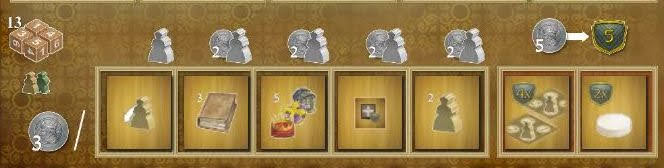
This is one of the player boards. They are almost exactly the same, the only exception being the rightmost column. The emblems each player is allowed to collect are different. The five columns in the middle represent five sets of actions you get to perform. Whenever you claim a die from the main board, you place it in a column matching the die colour, then pick one action in the column to perform. The space for the die in each column has a number, which is the base cost of performing an action. Green actions are most expensive, at $5. The number on the die is the discount you get. If you pick a high number, you can perform the action cheaply or even for free. However at the end of the round your die values are summed up. If you do not exceed 13, you gain a bonus. So there is a conflict between getting discounts and getting the round-end bonuses. Sometimes you may even take fewer dice for the sake of the round-end bonus. That means performing fewer than 4 actions. 

Once you pick a die, you have four action options from which to pick one. Let's take a yellow die as an example. In the yellow column on the player board, you can see an envelope with a yellow seal. This refers to two actions on the main board. There are 10 action tiles on the main board which are randomised every round. There will be 2 actions associated with each type of envelope. One will require expending sons, and the other daughters. 

On the player board, there are two other icons in the yellow box. The coin icon means you may take some cash. The white disc above a green circle means you may spend money to recruit a helper. You place the helper at a job in the green column. From then on, whenever you claim a green die, this helper gets to perform an action for free. 

The leftmost column on the player board shows five people - you the clan leader and four other elders. Initially you are the only one who is married, thus that while pawn representing your wife. At the end of each of the first five rounds, if your die total doesn't exceed 13, you get to marry your elders. The purpose of being married is to produce children. There is a specific action you need to perform to produce children (this sounds inappropriate but I'm talking about game rules here okay). You roll dice to determine whether the offspring is a son or a daughter. Children are essentially just another resource type. Some tasks must be performed by sons, some by daughters. Both sons and daughters are used as currency for some actions. 

The rightmost column indicates emblems you may collect when sending sons out to ally with other clans or marrying daughters to other clans. Emblems are worth points if you collect at least three in the same row. 


This is part of the main board, showing the 10 actions available to players which are shuffled every round. Actions which end up in the top row may be performed by expending daughters. Those in the second row require expending sons. 


The game is played over 7 rounds. These are the benefits you get at the end of a round if your die total doesn't exceed 13. Those benefits on the square tiles are randomly set up before the start of a game. The benefits for Rounds 6 and 7 are related to scoring victory points. You may spend $5 to score 5 victory points. The Round 6 tile allows you to score 4 victory points per city where you have a daughter married off to. The Round 7 tile allows you to score 2 victory points per helper employed. You get to see the scoring conditions before the game starts so you can plan ahead. 


The three columns on the right are the three fields your sons can get into - politics, religion and military. I think of them as sending your boys to be educated. As the placement spots on the main board get taken up, the minimum qualifications for sending sons become higher. Initially any basic diploma would do, but later you'd need a bachelor's degree, a master's degree and eventually a doctorate. When your son is highly educated, he scores more points for you when he establishes an alliance. Studying more is a good thing. 


At game setup, two emblems are randomly placed at each city. Those on the left can be claimed when you marry off a daughter at the city. Those on the right are to be claimed by sons forming alliances. At the start of every round, if any emblem has been claimed in the previous round, a new one is drawn to fill the vacant slot. Each city has 8 occupant spots. Once all filled, you may no longer send any son or daughter. 

The overall flow of the game is training your sons and daughters and sending them out to create alliances. Sons need to be educated first, so there is more effort required. For daughters, you need to save enough money for the dowries. Both sons and daughters are resources you need to produce and manage. You have to remember to find wives for your elders and to perform the family growth action. 

The Play

Han suggested Signorie. The two of us plus Allen played on BoardGameArena.com. I started off with the rush strategy, going for quantity and not quality. I sent my sons and daughters out as quickly as I could, grabbing as many emblems as possible. As long as the boys met the minimum requirement, I pulled them out of school to go to work. I didn't ask them to study more in order to score more points. The advantage of doing this was I could grab more of the right emblems. In the late game, one problem that came up for Han and Allen was a lack of the right emblems. This was bad because if no one could claim any of the emblems, no replacements would be drawn. We would be stuck. However emblems was just one of many ways to score points, and it wasn't a major one. 


I was the earliest to go out grabbing emblems (those on the right side of my player board). However I did not employ many helpers (white discs). At this point I only had two helpers - first column third position, and third column first position. Allen and Han spent much more effort in the early game recruiting helpers. This was the right thing to do. Helpers basically give you free actions, so it is best to get many of them early, and fully utilise them throughout the game. Allen started scoring points rather late, because he spent much time setting up his household of helpers. I had a gut feeling I should be recruiting more helpers, but I was impetuous and impatient to get going. By mid game I got into a tough situation. It was hard to decide whether to still recruit helpers. In the late game helpers are usually not worth it because you won't get to use them many times. The mid game is neither here nor there. You would use them a few times, but it's hard to gauge whether the return on investment makes sense. Eventually I didn't have many helpers. I focused my helpers on doing just one thing - collecting books. Books collected every round determine the turn order in the subsequent round. They are reset every round. If you collect enough books, you also score points. I worked on books for both the turn order advantage and the points. 

Both Allen and Han had many more helpers than I did, which meant they performed more actions than I did. Eventually Allen won with a comfortable margin. I had expected to come in second place, but right at the end Han overtook me by 1 point! Conclusion: Being impatient is bad. 

Han's sons studied hard. By the end of the game, he still had kids at school which he was not able to send out to form alliances. However these boys still scored half the points they would have scored had they found jobs. That turned out to be a decent chunk of points. My kids studied only for the sake of passing exams and getting minimum wage jobs. Once I had enough emblems, I didn't even bother to send more of them to school. I kept them home to plough, sow and feed chicken. By game end I had no sons scoring points for me. 

At the bottom left, two of the round end bonus tiles had been removed, which meant this was Round 3 now. 

I was purple, Han blue and Allen yellow. Allen was last to start collecting emblems. However at this point both of them had 5 to 6 helpers, while I only had two. 


When deciding which die to pick, you have to consider what your opponents have taken. If all your opponents have taken dice of a certain colour, you know the last one is safe and there is no urgency to take it. If an opponent has many helpers of a certain colour, you know he will want to take a die in that colour. If an opponent is low on cash, you know he can't afford some of the dice, so they are temporarily safe. Picking dice is not just about how desperately you want them. You have to think from your opponents' perspectives. 


By game end all the slots at every city were filled. We could no longer send any more sons or daughters. In a 3-player game, one of the cities is not in play. 


When our game ended, I (purple) had only two rows with emblems, while both Han and Allen had three rows. They took some generic emblems which were worth only 1 point each. Think of these as minor clans. Each row of emblems scores points only when you have at least three. So if you have difficulties getting a third emblem, you may have to take a generic one, so that you don't waste the points on the first two. 

The Thoughts

Signorie is essentially a resource conversion game. You need to produce money, sons and daughters, and these resources will eventually be converted to victory points. Sons go to school and then are expended to set up alliances with the major clans. When you set aside enough money to marry off your daughters, they are expended to build ties with the major clans too. Many actions require money. The most unique aspect of the game is the dice selection mechanism. This is the core of the game. It creates interesting and challenging decisions. The rest of the game is built around this core mechanism. Initially the number of different actions feels overwhelming, but once you grasp the few key processes - about what sons do and what daughters do, the actions are not hard to understand and remember.

Player interaction does not feel direct. However I can see that other players' actions can impact yours significantly. It just doesn't feel so. Because of this the game does not feel confrontational. I can see plenty of competition, including for the emblems, for the high valued dice, and sometimes even for the low valued dice. The limited number of spaces can be a source of contention too, but this will probably happen only near game end when space is running out. In the early game it doesn't seem hard to fulfil the criteria to claim a space. Eurogame designers are skilled in creating this kind of player interaction. They don't feel confrontational, but if you look slightly deeper they do hurt your opponents. 

I find Signorie quite a succinct game. Not that it is simple. Certainly the many action types take a little while to digest. Once I got past these, I find that it doesn't have much extra fat. Some games make me feel the designer added more stuff for the sake of having more stuff. In Signorie, almost everything you do relates to cultivating sons and daughters to serve the family. The fun to complexity ratio is high. It has just enough rules to bring out the fun. 

Sunday, 31 October 2021

revisiting Carcassonne

3 Oct 2021. I brought out Carcassonne again. The previous play was Sep 2019. I had thought it was much longer ago than that. Carcassonne by now has reached classic status. Published in 2000, it won both the 2001 Spiel des Jahres and Deutscher Spiele Preis. It is not as popular now compared to its heyday. In the 00's, it was almost like a mandatory game for new gamers. Now it is no longer surprising for newer gamers to have not tried it. Carcassonne has a special place in my heart because it was among a handful of games I played a lot of when I got into the hobby. My copy is the first edition. The current edition has different artwork for both the box cover and the tiles. 


My copy is a German version bought at Witch House in Taipei. I still remember when I first learnt the game, it just felt weird to me. I wasn't wowed into buying a copy immediately. In fact, I didn't think that highly of it. Being unfamiliar with Eurogames, I thought the best games should be like Axis & Allies and Samurai Swords. Thankfully I eventually did buy a copy. When I taught my wife and my friends the game, they all loved it. I too grew to be quite fond of it. 

One phrase we used to say when playing Carcassonne was farmers work lying down. When we placed a meeple as a farmer, we had it lie down to remind us that this meeple could no longer be retrieved until the end of the game. One important element which makes Carcassonne so much fun is how everyone can persuade, bribe and even threaten the active player when they are contemplating how to place their tile. We try to coax fellow players into collaborations. We remind them not to inadvertently help other players. 

This is the current box art, with a bit more depth of field. 

Originally I only intended to play with my wife Michelle. At the time younger daughter Chen Rui was at the table, so I asked whether she wanted to join us. She said yes, and picked black, because she always wears black. My customary colour was green, and Michelle's red. Michelle and I have been playing Carcassonne since before we had kids, and now Chen Rui is already 15. 

My Carcassonne is quite the Frankenstein, containing many expansions. I have the first expansion, which is almost essential. I call this the fat boy expansion because it comes with the big meeple. The official name is Inns & Cathedrals. I also have Abbey & Mayor. In this particular game, I used the tiles but not the various meeples that come with Abbey & Mayor. I have quite a few mini expansions, most of which came with the Spielbox magazine. I don't even remember their names. Since we have many more tiles than the base game, our games go a little longer. 


That huge castle at the centre started since the beginning of the game. If you look closely you can spot the starting tile - the half moon and horizonal straight road tile, just below the cathedral. This castle was not only big, it also had a cathedral, so it scored us about 75 points. Cathedrals are a high risk high reward proposition. If you manage to complete the castle, you score triple instead of double. If you fail, you get nothing. 

Sunday, 17 October 2021

Beyond the Sun - Level 4 tech


On 25 Sep 2021 Allen, Han and I played Beyond the Sun again, online. We had played this before, but had never managed to develop a Level 4 tech, so we were keen to attempt that. This time we succeeded. It was Han who developed the Level 4 tech. I wanted to do it too, and if I had insisted, I would have been able to achieve it. At one crucial junction, I picked a colonisation action over a research action. I knew that to forgo research meant I would not likely be able to reach the Level 4 tech before the game ended. I decided to colonise because by doing so I would be first to have four colonies. That would give me achievement points. You can't have everything. That's life. Once anyone claims the first achievement, you know the end is nigh. 

One of the techs Allen developed this game allowed players to jump (move their spaceships) then earn ore if they manage to wrest control from other players. This was a powerful tech that encouraged expansion and aggression. When you wrest control of star systems from others, you are also removing their farm or mine tokens, and adding your own. This is highly lucrative, killing three birds with one stone! Even peaceniks like me couldn't resist the temptation to go on the offensive when the time was right. No I'm not joking, I am a peacenik!

At the top left you see two star system cards instead of one. This was due to a special event giving us an extra star system, which was considered one jump away from the normal star system next to it. This extra star system works the same way as regular star systems. You can control it, place your farm or mine on it, and colonise it. However once colonised, you don't draw another star system card as a replacement. You will return to just having four star systems on the map. 

This was the Level 4 tech which Han eventually developed - Parallel Universe Generator. It is not easy to get to Level 4. In this game if you want to develop a Level 2 tech, you need to have first developed a tech to open a worker placement spot to do that. Same thing for a Level 3 tech and a Level 4 tech. Quite a few stars (figuratively) have to be deliberately aligned. Also, in order to aim for a Level 4 tech in a specific position of the tech tree, you need to make sure you research all the prerequisite techs. Often not all of them align with your strategy, so you will be picking suboptimal research options for the sake of building your research pyramid to reach that Level 4 tech. It takes focus and discipline to get to Level 4. If you research too broadly, you won't be able to build up the pyramid in time before the game ends. 

Level 4 techs give a big boost to your score. The one that was picked in our particular game gave a one-time special ability, which helped greatly in scoring. Having learned this tech also gave an additional scoring criteria at the end of the game. This basically meant two new ways of scoring from a single tech. Being able to research a Level 4 tech in itself is an achievement, and achievements are worth points too. Going for a Level 4 tech is a "do or do not, there is no try" thing. If you want to do it, you have to be committed and not stray from the path. Otherwise you might waste much effort only to fail due to the lack of focus.