Thursday, 23 September 2010

Wizard

The Game

Wizard is one of the games that I helped with English-to-Malay rules translation, but I had never played the game when I did the translation. I didn't even own the game. Only recently I receive a copy. So I decided I needed to get it played at least once, simply because my name is in there, right at the end of the Malay rulebook.

Wizard is a trick-taking card game, like Bridge. The term "trick" means each player plays one card, and one of them will win and claim this set of cards. This set of cards is called a "trick". There are four suits in Wizard, each numbered 1 to 13. There are also 4 wizard cards and 4 jester cards. The game is played over a number of rounds, depending on the number of players. In the first round, only 1 card is dealt to each player. On the second round, 2 cards, etc. The twist to the game is after looking at their cards and before starting the round, each player must predict how many tricks he will win in the current round. A player scores points if his prediction is correct, and loses points if it's wrong, regardless of whether he has overestimated or underestimated the number of tricks won.

Similar to Bridge, there is a "trump" concept. Every round one of the suits will be randomly assigned to be the trump suit. Cards in the trump suit will always beat cards in other suits. When two cards are both in the trump suit, then the higher numbered card wins. The wizard and jester cards spice things up a little. Wizard cards beat all cards. If two players play wizard cards in the same round, the player who plays it earlier wins the trick. Jester cards are the opposite of wizard cards. They are weaker than all other cards.

Some of the cards in the game. The blue suit is humans, yellow giants, green elves. The 4th suit is dwarves. The icons are supposed to be the weapons they use I think, swords for the humans, clubs for the giants, bows for the elves, and axes for the dwarves.

That's basically the game. You try to be accurate in your prediction. But there is incentive to predict higher, because when your prediction is correct, aside from a fixed 20pts, you also earn 10pts per trick won. The penalty for an incorrect prediction is -10pts per trick less than or more than the prediction. When you play, other than trying to make your own prediction come true, you also try to deny your opponents correct predictions, e.g. forcing them to win one trick too many.

The Play

Despite being the rules translator, I taught the game quite poorly and kept getting teased by Han and Allen. The rules are actually quite straight-forward, but there are a few special cases that I forgot about. We played the first few rounds wrong. Thankfully the stakes were much lower in those early rounds, so I think it didn't hurt our game too much.

We had 4 players, which meant 15 rounds. The game probably took us 45 minutes. The game becomes more and more strategic towards the later rounds, because more and more cards will be in play, and there is less uncertainty about whether certains cards are in the game or not. I realise a lot of fun in the game is in trying to make others predict wrong. If you can be the only player to predict right in a round, it is a big boost because you are the only one advancing and all the rest will be penalised.

By looking at the predictions made by other players, you can roughly guess how they will play and what kind of cards they have. Also as a round progresses, and your opponents start winning tricks, you can also guess how they will play based on how close they are to their predicted number of tricks.

In our game, Han did quite well and stayed in front most of the game, while Allen and I were mostly slightly behind, Allen close to him than I most of the time. Yee Ling was not so fortunate with her predictions and struggled quite far behind. I was score keeper and kept announcing the scores after each round. At one point Yee Ling even asked not to have her score announced. At game end, Han won at 45pts. I had 40pts and Allen 36pts. And we all cheered for Yee Ling because she made it to two digits. I shall not say the exact score, but it's the minimum requirement for meeting the two digits criteria.

The Thoughts

Wizard is a clever card game. It is quite a traditional style card game. Nothing very fancy. Forget about theme. Having some artwork is nice, but don't expect the game to tell any story. The game can feel a little long if you play by the exact rules. I wonder whether it will be better to start in round 4 or 5 (i.e. each player gets 4 or 5 cards), especially when you have fewer players.

One variant of the game is that the predictions made by the players must not add up to the current round number. E.g. in Round 8, the players cannot be predicting to win 2, 1, 3, 2 tricks. If the first three players have already predicted 2, 1 and 3, the last player must predict a number other than 2. This ensures that it is impossible for every player to achieve his goal. Someone will get screwed. I think next time I should play with this variant.

The excitement in the game is it can be a very big swing when your prediction is off by only one. E.g. you predict 6 tricks won. If you get it right, you gain 20pts + (10pts x 6) = 80pts. But if you "accidentally" win a 7th trick, your score becomes (-10pt x 1) = -10pts. That's a 90pt difference!

I like Wizard well enough, but there is one other similar card game I'll always choose to play over it - Sticheln, simply because the penalty in Sticheln can be much worse than in Wizard. I find the penalty system hilarious, even when I'm the victim.

Wednesday, 22 September 2010

Grimoire

The Game

Grimoire is a Japanese card game that Han bought on his recent business trip to Taiwan. Components are bi-lingual. We played it for the first time when we visited Allen. This was the first time we did a game session at Allen's place. It's very near my home, so it's convenient.

Grimoire means spellbook in French. Everyone starts the game with a spellbook and a bookmark. Every round you use the bookmark to select a spell you want to cast that round. At the start of every round a number of cards are dealt to the centre of the table, all but one face-up. Players will take turns picking up a card. Turn order is determined by the spells cast. Smaller numbered spells are usually weaker, but they let you go earlier. However if two or more players pick the same numbered spell, they will all go after all other players who have picked unique spells.

The spells let you do various things, e.g. collect victory point (VP) chips, rob another player's VP chips, rob another player's character card, protect yourself from attacks, buy an item card, meddle with turn order. The cards collected every round consist of two types - characters and treasures. Characters are played face-up in your area and provide various benefits, some related to scoring, e.g. collecting 1VP if you are last in turn order. Most are also worth VPs themselves. If anyone collects 10 characters, the game ends. Treasure cards are basically copper (1VP), silver (2VP) or gold (3VP) coins. They are kept face-down in a stack in front of you. Similarly the game ends when one player has 10 treasure cards. Most item cards provide some benefit, but there are some junk item cards. However the player with the most junk item cards at game end scores 5VP, so they can turn out to be valuable.

My spellbook and bookmark. The spellbook is bilingual. The left page is Japanese and the right page English. This is the number 1 spell.

The Spy card allows you to peek at the face-down card at the centre of the table. Every round there will be a number of cards placed at the centre of table to be claimed by the players. One of them is always face-down. Spy gives 1 victory point (number on lower left).

So there are three main ways of gaining VPs - treasures, characters and their powers, and VP chips. The tools you have at your disposal are your spells, your characters, and your items. Which kinds of tools to use, and how you want to score, will determine and restrict your strategy. E.g. I had a high valued character card, but it penalises me for having VP chips. So I wanted to avoid collecting VP chips. One of the character cards rewards having sets of copper + silver + gold, so if you have it, it'll affect your decision when selecting cards.

There is a bit of a story arc to the game. At game start, less than half of the spells in the spellbook are available to be chosen. With each subsequent round, one more (usually more powerful) spell becomes available.

The Play

We did a four player game - Allen, Yee Ling, Han and I. Up front I decided to go for a character-heavy approach. I had the Prince character which rewarded having many characters. I also had the Rogue card, a 6VP card, which penalised me for every VP chip earned, so I tried to not get any. However, I somehow got myself the Mercenary card, which gave me one VP chip every time I selected the same spell as another player; and I kept earning VP chips because of him! Since I had many characters, I was quite worried about attacks against my characters, so I kept choosing defensive spells.

Allen went for items most frequently. Han mostly went for VP chips. Yee Ling mostly went for treasure cards. At game end, I managed to achieve my goal of reaching 10 characters. The VP chips I earned caused my two Rogues (there are 3 copies of each character card) to be worth 0VP. Thankfully I had the King character card, which awarded 5VP per 5VP worth of VP chips. I had 10VP of VP chips, which meant a bonus of 10VPs! Unfortunately that was not enough to beat Han's score. He had 41VP, I had 40VP. Allen and Yee Ling both had 37VP.

My play area at mid game. I have collected 6 characters. Characters are always displayed face-up in front of you. Treasure cards are stacked face-down so that other players cannot see what they are or count how many there are. I have turned one of the Gold treasure cards (3VP) face-up for this photo. The white round discs are victory point chips. So here are the 3 main forms of victory points - characters, treasures and VP chips.

Thief and King. King is very powerful if you are going with a VP chip strategy. He gives 5 bonus VPs for every 5 VPs you have in VP chips. The artwork of the game is quite good and very Japanese manga style. However the box cover is surprisingly bad. I wonder what they were thinking.

The Thoughts

It's a double-think game. You are trying to guess what spells other players will choose, and hoping they don't foil your plans. You try to build a consistent set of characters and items that will help you score well. By reading other players' play areas you can try to guess their strategy and the likely spells they will pick. Do you want to play offensively or defensively? Will someone be trying to attack you this round?

The game feels polished. The various aspects are well integrated. I feel that every decision made impacts how I do later in the game. You interact with other players via the offensive and defensive spells, and also in the manipulation of turn order. It is important to watch what your opponents are doing.

My only problem with the game is it doesn't have a hook for me. Nothing really grabs me. I don't see anything wrong with the game. There is strategy. There is interaction. There are meaningful decisions. There are card combos. The spellbook is a novel idea, and it does work well. Much better than having to manage a hand of action cards. Maybe I am turned off by the offensive spells. I may be too conservative. During the game, when I found myself in a vulnerable position, I tended to play solely the defensive spells to avoid getting attacked. This approach took away a lot of the fun in the spell selection part of the game. So, maybe I'm the problem, not the game.

Sunday, 12 September 2010

Nuns on the Run

The Game

Nuns on the Run is another game played with the Old Town Kopitiam gamers. This is a game for 2 to 8 players. Most players will play novice nuns, and one or two players will play the abbess and the prioress. Let's just call them novices and nuns. It is evening at the abbey. The novices are supposed to be in their rooms. But each of them has a secret wish. To fulfill her secret wish, a novice needs to first locate a key, then proceed to a secret location, and finally make it back to her room safely, all without getting caught by the nuns. Whoever manages to do that first wins. If time runs out before any of the novices can complete her mission, the nuns win. If the nuns manage to catch the novices a certain number of times, they win instantly.

There are only 15 rounds in the game. Every round the novices move first by selecting one of four movement cards. They can run, or walk, or sneak, or even stay still. Once done moving, a novice rolls a die to determine how much noise she makes, and checks whether it is heard by the nuns. The only way to reduce your noise is by moving slower. However even if you stay still, it is still possible for you to make some noise and draw attention to you (no farting jokes please). This is a hidden movement game. Each novice uses a movement sheet to note down her location. The two nuns are always on the board, so the novices will always know where they are. If the noise made by a novice when moving can be heard by a nun, the novice must indicate the direction of the noise on the board. A level 6 noise can be heard up to 6 steps away, a level 5 noise can be heard up to 5 steps away, etc.

The novice I played, Margaret, and the four possible movement cards I could choose from.

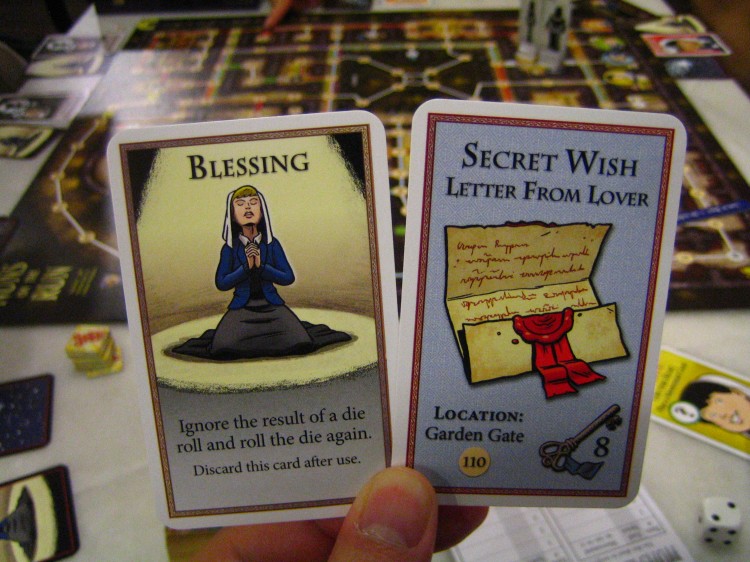
My blessing card and secret wish card, both randomly drawn at game start. The blessing card was a one-time-use special ability card. The secret wish card was basically my secret mission. It specified two locations I need to visit in order to fulfill my mission.

The prioress and the abbess. The abbess looks like a man. Like a weight-lifter. Look at those huge hands.

When the novices move, they also need to check whether they can be seen by the nuns. If they enter the line-of-sight (ooh... wargame term in a Eurogame...) of one of the nuns, they must indicate so on the board. When they disappear from the nun's line-of-sight, they must indicate the direction they have moved towards.

The nuns normally have to move along some pre-determined routes on the board. However if they hear or see anything suspiscious, they can leave their normal routes to pursue the novices. The nuns can move faster than the novices (max 6 steps compared to max 5 steps). After a nun moves, she rolls a die to try to listen for any nearby novices. This works the same way as the novices making noises. E.g. rolling a 6 means the nun can hear a novice up to 6 spaces away. Any novices heard this way must indicate the direction of the noise on the board.

The game board. The novices' rooms are on the right side. The coloured lines are the normal routes that the nuns will take when they make their rounds.

That's basically the game. There are quite a number of other small rules, but the basic gameplay is very straight-forward: novices move, novices make noise, nuns move, nuns listen.

The Play

In the game that we played, we had 6 players. Henry read the rules and volunteered to play the two nuns. The other 5 of us played novices. My secret wish was to retrieve a love letter at the garden gate. In the first round, all novices can move twice. I made a mad dash to collect the blue key that was a prerequisite for collecting my love letter. It was precisely 10 steps away from my room, and 10 steps was the max distance with a double movement. Heng was the first to be almost cornered. In the first round when he was still in the novice quarters area he was already heard by the tall nun. His choices were rather limited, but somehow he managed to escape.

I ran a lot, and in one of the earlier rounds was seen by one of the nuns. However I was quite far and she never bothered to come after me. Alvin had a close encounter, being seen and then chased by the short nun. He was rather unlucky with the die rolls and kept being heard. At one nail-biting moment the short nun stopped precisely one step away from him. Nuns run faster than novices, so a one step gap usually means you are in big trouble. In Alvin's case, he was lucky there were quite a number of doors (which block line-of-sight), rooms and corridors nearby, and he managed to run and hide in one of them. Henry had gambled on the wrong turn and missed Alvin. That was really close.

That "Vanishes" token in the foreground was where Alvin was last seen by the short nun. Alvin had just collected the green #4 key at location 107 the previous round.

The short nun had been chasing Alvin, and found him squatting in a corner of the chapel. The novice token is placed on the board when she is in the line-of-sight of a nun.

I mostly stayed quite far from the nuns, and had no problem reaching my destination and collecting the love letter. However, I had to walk through a garden to go back to my room. This was where the short nun had been chasing Alvin. Also this was a very open area and I could be seen easily if any nun was nearby. So I waited for my chance. Eventually the short nun gave up chasing after Alvin, and decided to go back to her regular route. It was time for another mad dash! I sprinted across the garden. I was far enough from the short nun (who was now inside the chapel - out of sight) that she couldn't hear the noise. Then suddenly Heng placed a noise marker near the chapel door leading to the garden! WHAAAT?!! I was standing in wide open space, and this?! The short nun immediately came out to take a look, and caught me, in a manner of speech, with my pants down. Big. Fat. Red. Target.

I had hoped to pull off something like what Alvin did, but after some assessment of my surroundings, I realised I would not be able to trick the nun and escape. So all I could do was to lure her to catch me at a position further away from my other fellow novices. We all had a good laugh over my unexpected capture. When the nun stepped out of the door and caught me in mid-stride crossing the garden, Heng wasn't even in sight at all. He had just stepped inside a doorway and had closed the door behind him. Talk about twist of fate!

I was sent back to my room. I could attempt to achieve my secret goal again, but unfortunately there wasn't enough time. Although I didn't need to get the blue key anymore, to visit the garden gate again and make it back to my room would take too long. Eventually it was Jeff who managed to achieve his secret wish and win the game.

I was cornered by the grumpy-looking nun.

This is the log sheet used by novices. The number is the location. You also record how quickly you move, and the instances when you collect your key, or achieve your secret wish.

Location 110, just before the garden entry, was where my love letter was.

The Thoughts

The game seemed complex at first, when we went through the rules. It was a new game and we had opened it on the spot to learn and play it. Probably not such a good idea. Better to have someone read the rules beforehand, or to have someone who has played before. Some things were a little confusing when going through the rules. However once the game started, I realised it was actually very straight-forward. Every round was quite quick. Being a novice is quite exciting. Being a nun is probably more challenging.

Nuns on the Run is a family game with an unusual setting and gameplay. Some call it a reversed Scotland Yard. I find Scotland Yard to be more heavy on deduction. The detectives discuss openly their options and the possible locations of the fugitive. In Nuns on the Run the novices have no idea where the others are. There's probably a bit more luck, because of the noise die rolls, but it isn't something you can't mitigate. I find the higher uncertainty (when playing a novice) and the risk-taking exciting. The game also has more flavour than Scotland Yard which is simpler. Nuns on the Run is more similar to Pyramid - the single mummy trying to catch the multiple treasure hunters. It has more elements - the noise, the line-of-sight, known paths for the nuns etc.

Some downsides that I can think of - once a novice gets caught, it may become very difficult to achieve her secret wish. Also, it seems the game is quite hard for the nuns. I wonder whether they are the fun-provider for the rest of the players, like how it is in Pyramid. I think the game will be most fun with the max number of players. One good thing is that novices can take their turns simultaneously, so having more players doesn't increase the play time much.

13 Sep 2010. Important correction (thank you Bay for pointing this out): If a novice gets caught, she has to walk towards her cell. However, once out of sight of any nuns, she can already try again to go for her secret wish (or her key if she doesn't even have it yet). In our game, we misunderstood that by placing my novice token back at my room once out of sight I was being teleported there. The novice token is actually meant to represent the last known location of the novice to the nuns, not necessarily the real location. This means I actually still had a chance to win the game, because I wasn't too far from my secret wish location when I got caught. It also means getting caught is not really as big a disaster as I had thought.

If you are in Malaysia, you can order the game here. No, I don't get a commission. Yes, it's a friend's online store. Discount? Why do all Malaysians ask this?

Saturday, 11 September 2010

Way Out West

The Game

On Thu 9 Sep 2010 (Hari Raya Eve) Han and I joined the Old Town Kopitiam folks to play. We did a 5-player game of Way Out West, an out-of-print Martin Wallace game published in 2000. The game is, of course, a cowboy game. You raise cattle, you develop new towns, i.e. constructing hotels, train stations, stores, banks etc, and most importantly, you have lots of gunfights. Throughout the game you spend money on constructing buildings, buying cattle, employing cowboys, and you try to earn money from your investments, so that you maintain sufficient cashflow to continue your investments. At game end, you score victory points by a number of different criteria. Most of the points come from cattle owned, buildings owned and economic monopoly of towns. You also earn points for being richest, and for being the best gunfighter in the west.

The game has 12 rounds, and in each round you have only 2 actions. There is a chart showing all the possible actions that can be taken in a round. Some actions appear more than once in the chart. When you take an action, you place a marker on the action space, preventing others from taking the same action this round. You earn money once every 3 rounds, so there is some time (i.e. 6 actions) before payday.

The tokens in the game. On the upper left are the cattle and cowboys. There is one single farmer token per player. It's a one-time-use token and it doesn't belong to any player. The two black discs are action markers. On the right are the 6 building types - bank, jail, hotel, store, train, stagecoach.

There are five towns on the board. During game setup some cowboys will already be placed onto the board. There is a fixed number of slots for cattle and for buildings at each town. During the game, you can buy cattle to place in a town, or you can construct buildings. You can also recruit cowboys to protect your properties, and perhaps to, ahem, convince others to share with you some of their properties. Cattle is an important source of income. Most buildings also help earn money. A hotel gives you $1 per other players' cowboy in town. A stagecoach gives you $1 every time another player's cowboy enters or leaves town. A train doubles cattle income. The jail is one unusual building. It doesn't give income, but it gives you an extra gunfighter (i.e. the sheriff) whenever you get into a gunfight. You can even use the sheriff to help another player who is being attacked. The bank is a funny building. (only in a boardgame article you'll see such a statement) The bank provides income for each building in the town, but it can get robbed. If the robbery is successful, the attacking player robs money from the player owning the bank. If the bank owner can't pay up, the robbers get upset (putting it mildly) and burns down the building. In addition to that, if there is a jail in town, all the bank robbers will scram.

Most buildings' benefits are based on other player's properties, e.g. the saloon gives $1 per other players' cattle. This forces you to coexist with others. You won't earn much from buildings if the whole town belongs to you. Also you can't build a third building in a town if you already own two. You can only gain additional buildings by taking them over. It's tricky how to encourage others to also develop "your" town. There is a very intesting tension between confrontation and cooperation.

There are actions that allow you to move your cattle and your cowboys. There is one weird action that allows you to place a farmer. What the farmer does is he halves cattle income in the town he's in, and if he's still around at game end, he can reduce the cattle victory points to zero. Every player only has one farmer token to place for the whole game.

Now, the most exciting part of the game - the gunfights. In a 5-player game, there can be up to 5 gunfights in a round. You basically decide to use your cowboys at a particular town to attack a property in that town owned by another player. Whoever has fewer cowboys roll the dice first, one die per cowboy, plus some additional dice e.g. the sheriff stepping in, or the bank security guard's roll if a bank is being targeted. You hit on a 5 or 6, and an opponent cowboy is killed. The gunfight continues until one side retreats (by dispersing all surviving cowboys to other towns) or is wiped out. The winner gains a nice WANTED poster, used for measuring notoriety at game end. If the attacker wins he takes over the targeted building (or cattle).

That's the game, without going into too much detail. Honest. This game is a very Martin Wallace game - medium-complex Euro with some confrontation, very thematic, tight finances, lots of turn angst. There are a number of small rules which other designers may decide to leave out or simplify, which I'm glad he didn't, because they add a lot to the immersion into the game.

The Play

In our game, right out of the gate the arms race started. Everyone piled on the guns. Heng was the only peaceful guy who tried to avoid confrontation, and even used the cattle movement action to move his cattle to the most distant and quiet town. For normal cattle placement you can only place cattle in a town if the previous town is already at least half full. So normally the cattle slots will fill gradually from the small start town towards the larger end towns. For the first few rounds no shots were fired. However once the gunfights started, things got ugly pretty quickly.

Early game. Only cowboys and cattle placed. See the arms race that had already started in the first two towns, San Antonio and Kansas City. In San Antonio, I was green, Jeff red and Heng orange. Heng's cattle didn't last long there. In Kansas City, Han was yellow and Henry blue.

Round 2. Already there was high tension in the first two towns. I (green) had built a stagecoach at Abilene (town#3). Heng (orange) had started developing distant Deadwood (town#5).

Round 4. Tension was building up at Kansas City (town#2, lower left) and Abilene.

Jeff and I had a stalemate at San Antonio (town#1, i.e. smallest town among the five), and since we were roughly equally matched, neither of us attacked each other. The stakes were not that big anyway. In fact, after the initial big arms race, both of us gradually reduced our cowboys there. It was mutually beneficial. We both continued to gain income from the town, and we could put our cowboys to better use somewhere else. San Antonio stayed peaceful for at least the first half of the game.

In Kansas City (town#2), Han and Henry had a big gunfight. Han eventually became the king of Kansas City, and no one bothered to challenge him for the rest of the game. I invested in Abiline (town#3) early, building a stagecoach early, and later a hotel too. Unfortunately I lost to Henry in a major gunfight, and never managed to recover after that. It was tough for me, losing my cattle, stagecoach and hotel. Henry became the boss of Abiline, and despite some threatening moves later by Jeff and Han, was not challenged for the rest of the game.

A major gunfight broke out here between Han (yellow) and Henry (blue). Heng (orange) stayed to watch the show.

Abilene, where I (green) was first to develop, was later fully taken over by Henry (blue).

Kansas City, now monopolised by Han.

I tried to work on Dodge City (town#4). Han and Heng had established themselves here earlier, so there weren't many slots left for me. However, in a twist of fate, a gunfight broke out between them, and when their number of cowboys dwindled, I grabbed the opportunity to attack and take over some of their properties. Heng was first to invest in Deadwood (town#5). Later Jeff also went in. They were evenly matched, and things were pretty peaceful.

Action shifted to Dodge City, where Heng (orange), Han (yellow) and I (green) all had a bunch of cowboys.

Other than Dodge City (town#4), a lot of action also took place at the initially peaceful San Antonio (town#1). I was already in a bad position, so I decided I had to gamble. I broke the peace and attacked Jeff, despite knowing the odds were against me. Jeff had a jail, i.e. a sheriff on his side. It was not meant to be. I lost my cowboys and of course afterwards Jeff took over the cattle I had there. Peace didn't last at all. Han rode to town for some action, and in the following messy gunfight, all his and Jeff's cowboys were killed, leaving a power vacuum. Henry and I took advantage of this and swooped in quickly. We both took over some of Jeff's cattle. However peace didn't last long. I did yet another gamble, using my two cowboys to attack Henry's two cowboys. The chances were fifty fifty, but since I was very far behind, it was worth a gamble. Unfortunately all I managed to achieve was to get my cowboys killed.

Round 10 of the game. We later realised we had made a mistake. With a 5P game, we should have only played 9 rounds. Kansas City was monopolised by Han (yellow), Abilene by Henry (blue). Some action started to develop at San Antonio (town#1, lower right). I had failed to attack Jeff (red), and now Han (yellow) came to challenge Jeff.

At San Antonio, after the mutual destruction between Han (yellow) and Jeff (red), Henry (blue) and I (green) swooped in.

The opportunist cowboys.

During the game, Heng gradually emerged to be the richest player. He was getting stable income from Dodge City and Deadwood. He had no foothold in any other towns. For quite a number of times he selected to pass instead of taking an action. This was shocking, because in Martin Wallace's games actions are usually very precious. However passing was probably indeed the best thing that he could do. He couldn't construct more buildings because he already had two in those two towns. He wouldn't want to start a fight because the risk would probably be more than the reward. His positions were quite optimised and any rash decision would likely jeopardize that.

Bidding for turn order was pretty fierce in the last round. Heng paid a lot for it, but he still managed to be richest player at game end. Henry was the undisputed top gunfighter. As we tallied the final scores, I realised how important cattle was. I had misunderstood the scoring method. But I think even if I had understood it correctly, I probably wouldn't have been able to do much. Heng, the pacifist, won at 32pts. Henry, the most wanted, was a close second at 28pts. Trigger-happy Han was a distant third at 18pts. Steady Jeff had 17pts. And Downward-spiral Hiew surprisingly had 16pts. Being in the last position was no surprise, but I wasn't as distant as I thought I'd be.

Realising the importance of cattle, we joked that this game was so democratic that even cows got to vote. When determining majority control of a town, cows count but cowboys don't.

The Thoughts

This is a tense game! Well, afterall this is the wild west where there are no rules. Guns rule. You plan to build something? Buy cattle? Better make sure you hire some guns first to protect them. I like the tension between cooperation and competition. A "multi-coloured" town is lucrative for everyone involved, but then can you really trust all your "business partners", especially when they all carry big guns? When will the first shot be fired? Starting gunfights can be a game of chicken. When two parties fight, in particular when it is a big fight, likely both will eventually be losers, because a 3rd (or 4th?!) player will be hovering like a vulture, eyeing his "inheritance".

Heng described my situation in our particular game as a slippery slope. Once I lost my first big gunfight, things went downhill and I never managed to recover. I have been thinking about how this aspect of the game should be managed, but haven't quite come up with a solid idea. I thought about retreating to preserve my cowboys (although they would be dispersed to different towns), but in that particular gunfight I had a lot at stake. I couldn't really back down because if I did, my properties in Abilene would just get taken over one after another. Maybe I should disperse my cowboys and then move them to threaten Henry's other properties? Since everyone has at most 9 cowboys, if all are on the board, it's a matter of how you distribute them - where to concentrate on, where to let go.

Another thing I have been thinking about is the timing for retreating. I think one serious consideration is to retreat before your cowboys dwindle too much. Bringing cowboys back into the game costs money and actions. Yet another approach may be the stalemate approach, or uneasy peace approach, which worked quite well for Jeff and I in San Antonio, at least until I became desperate. Perhaps the best way is to not need to get into gunfights at all. Afterall the game was won by Heng, who was not involved in many gunfights.

The jail is one very interesting building. When a gunfight breaks out, shooting order is determined by number of cowboys. The sheriff provided by the jail doesn't count. So if you have 4 cowboys and the jail and your opponent has 5, you get to shoot first and you get to roll 5 dice, 4 for your cowboys and 1 for your sheriff. The shooting would have been simultaneous if both of you have 5 cowboys. Shooting first can be a critical advantage, because if you can score some hits, you'll remove some enemy cowboys before they can shoot back. So sometimes you actually want to maintain a cowboy count that's one less than your opponents.

Despite how critical the gunfights can be, I would say the game is more an economic game. You need to make sure you generate enough income to remain competitive. Scoring is mostly for how well you do in developing the wild west. You can rob others of their cattle and buildings, but I think to do well in this game you need to make sound investments, make sure you protect your properties well, and then you use your cowboys to win some gunfights to gain an edge over your opponents. I don't think purely playing bandits will work.

Way Out West is a game that makes me feel a little uneasy, like a number of other Martin Wallace games. This is because it mixes development and confrontation. I get nervous when I know my little lovingly built business empire can be destroyed or taken away from me. I don't have this kind of anxiety in straight conflict games, like the Axis & Allies series, Martin Wallace's Waterloo, Struggle of Empires (also by Martin Wallace), Twilight Struggle. After the Flood is another Martin Wallace game which has a mix of development and confrontation, and it makes me nervous too. In these games you can't fully avoid either aspect, the peaceful or the aggressive. I think that is the intention of the design, and I say Martin Wallace achieved his goal.

I find that Han and I both quite like Martin Wallace games, which are mostly heavy Eurogames, but he tends to like the more confrontational ones, and I tend to like the more economic ones. He has After the Flood, Waterloo, Way Out West, Byzantium. I have Automobile, Age of Steam, Brass. The exceptions are him owning Railroad Tycoon and me owning Struggle of Empires. I suddenly realise we together have quite a collection of Martin Wallace games.

Before this I keep thinking that Way Out West is a very old game, maybe something from the early to mid 1990's. But it's actually a year 2000 game, and after playing it, it doesn't even feel as old as a 2000 game. I wouldn't be surprised if it were a game published in the recent few years. I quite like the Peter Dennis artwork. He also did the artwork for Brass, Age of Industry, Byzantium.

Monday, 6 September 2010

Axis & Allies Pacific 1940

I have always been a big fan of the Axis & Allies series, since the 1984 Milton Bradley edition that I bought when on company training in USA, back in 1997. I first encountered the game when I was much younger, around 1986. My only memory about that was my parents wouldn't buy it for me. I guess even if they had, it would have been too complex for me. But the game indeed looked very impressive, so when I could buy it myself after having started work, I was quite excited. I still remember the name of the colleague from India, Puneet Karla, who was my roommate during the training, whom I first played the game with. I have completely lost touch with him but I somehow never forgot his name. We were both completely new to this type of game. We had a lot of rule lawyering. I remember winning the game, but I'm not sure whether it was helped by any unfair rule lawyering. I hope it wasn't.

After the 1984 version, I bought Axis & Allies Europe, Axis & Allies Pacific, Axis & Allies 2004 edition (a.k.a. Axis & Allies Revised), Axis & Allies Battle of the Bulge, Axis & Allies Guadalcanal, Axis & Allies Anniversary Edition, and now Axis & Allies Pacific 1940. The only games I didn't buy were Axis & Allies D-Day which didn't interest me, and Axis & Allies Spring 1942 which being a global game I felt wasn't necessary since I had the Anniversary Edition. Unfortunately despite owning so many games in the series, the only one that I have played more than a handful of times was the 1984 (global war) edition. I probably should arrange some kind of Axis & Allies month to play all of them one after another. That would be so cool.

When I heard the announcement that there would be updated versions of Axis & Allies Europe and Axis & Allies Pacific, and they would combine to become one big global Axis & Allies game, I had more-or-less already decided I would buy both games. AAP40 (Axis & Allies Pacific 1940) came out last year, and I have recently bought it. AAE40 (Axis & Allies Europe 1940) just came out, and I'll definitely buy it eventually. I have only played less than half a game of AAP40, so here are some more-initial-than-first impressions.

The Game

The game is about World War II in the Pacific theatre. Japan is at war with China, having captured many of its coastal regions. Tension is mounting between Japan and the Allies - UK, ANZAC and USA. Europe is at war, and there is now a power vacuum in the French Indo-China and Dutch East Indies. USA has no appetite for war, and will only declare war on Japan at the end of Round 3 unless provoked. If UK or ANZAC strikes first at Japan, both of them will enter war with Japan but USA will stay out. If Japan strikes first at any Allied power, all will enter war with it. Japan wins the game by controlling 6 out of 8 victory cities (Tokyo, Shanghai, Hong Kong, Manila, Calcutta, Sydney, Honolulu, San Francisco). The Allies win by conquering Japan. I suspect in some cases one side will concede before the actual victory condition is met.

Japan starts with a massive army (and navy, and especially air force). The Allies do not have much, but their combined income is more than Japan. USA does have a decent sized navy, but it's quite far away. USA's income is initially low, but once at war, it switches to a war-time economy and earns an additional $40 every round (that's a lot). So Japan needs to press its initial advantage and try to win the war quickly. If the war drags on too long, the American economic power combined with the rest of the Allies will eventually overwhelm Japan.

AAP40 works mostly like other games in the series. You decide on unit purchases, combat move, combat, non-combat move, deploy new units at factories, and finally collect income. There are many different land, sea and air units in the game, and each type is unique. Bombers are devastating in attack, but are no good at defense. Submarines can sneak attack. Tanks can blitz through ungarrisoned enemy territories.

Some new elements from the Anniversary Edition are in AAP40, e.g. transports have 0 defence and must be protected by other units, or they can be easily wiped out. Some elements from the previous AAP are kept, but are mostly slightly modified. Japan can make kamikaze suicide attacks. You can disrupt convoys, denying your opponents some income. Naval bases and air bases let sea and air units move one additional step.

There are some new elements. Air bases let fighters on islands scramble to defend the surrounding sea zone if it is attacked. There are two new units, the tactical bomber and the mechanised infantry. A tactical bomber normally attacks and defends at 3, but when paired with a fighter or tank it attacks at 4, effectively like a real strategic bomber. It costs $11, i.e. between fighter and strategic bomber. The mechanised infantry attacks (at 1) and defends (at 2) like normal infantry, but it moves 2 steps instead of 1, and it can pair with a blitzing tank to move further into enemy territory.

The victory condition compared to the previous AAP is rather different. In the previous version, Japan can win by capturing Calcutta or Sydney. In AAP40, assuming Japan doesn't try to go for USA, it would need to conquer both to win. Also in AAP Japan can win by accumulating enough victory points. Every turn it earns VPs depending on its income collected. This acts as a timer. The Allies need to turn the tide before Japan achieves the required number of VPs. In AAP40 there is no such timer mechanism. But Japan is still under time pressure due to the superior combined economic power of the Allies.

The full board showing the initial set up.

Dutch East Indies (Indonesia) is empty and can be claimed by UK or ANZAC without triggering any war. French Indo China can be claimed by Japan, UK or ANZAC without triggering any war.

China. Japan has conquered the coast, except for Hong Kong, which is British territory.

Mongolia is neutral territory. Whoever enters a neutral territory will cause it to join the opposing alliance, and there will be resistance in the form of infantry units.

Japan starts with a massive force.

The Pacific Ocean. Japan has a base in the Caroline Islands. USA has a base in Hawaii.

USA has a big fleet off San Francisco.

See the grey silhouettes above and below the number 20 (Sea zone 20). The one above is the kamikaze (神风) symbol, which means Japan can use kamikaze strikes in this sea zone. The one below is the convoy symbol, which means coastal territories next to this sea zone can have their income diminished if there is convoy disruption. Also notice that Guam has an airbase which is 20 times larger than the island itself.

I did these ref sheets myself. I prefer this table format (that sheet in the middle) for placing troops to the sentence format that comes with the game. In the sheet below I summarise the political rules and the National Objectives. The storage box doesn't come with the white compartments. It's just one box. I did the white compartments myself using this file by Jan Ozimek.

The game board is huge and takes up half my dining table. When I combine it with the AAE40 map, my whole table will be occupied.

Japan's perspective of the starting setup.

Japan starts with a indecent number of planes. Each grey chip represents one more unit.

The Play

Han and I only managed to play up to Round 3. I played Japan, because I was home alone with my two daughters and might need to attend to them sometimes. Han played USA, China, UK and ANZAC. Up front I decided I wanted to crush China first, since it was the only country I was at war with at game start. USA couldn't attack me at all. UK and ANZAC would be reluctant to attack, because if they did they would enter war with me without USA being able to help them. So I crushed China indeed. In the first round the Chinese defenders in Yunnan fought bravely. Although I killed them all eventually, I had no more surviving land units to claim Yunnan. I wasn't willing to sacrifice more air units in lieu of (cheaper) land units. In AAP40 if Japan is determined to crush China, it seems China has no chance of surviving for long.

Although I had initially planned to not attack USA, UK or ANZAC in the first 3 rounds, I soon realised it might not be such a good idea. UK claimed the Dutch East Indies, which gave much income. ANZAC also claimed the group of islands surrounding the Solomon Islands, which was their National Objective (which gave bonus income every round). Retaining Philippines was also a National Objective of USA, and every turn that they still held on to it, they earned $5 more. So eventually I decided to launch my major offensive in Round 3, without waiting for the scheduled USA entry into war at the end of Round 3.

My two main objectives were Philippines and Malaya. Taking both would deny USA and UK from fulfilling their National Objectives. Both fell without heavy Japanese losses. The invasion of Malaya was costly for Han. He had left his navy split into two. He probably should have retreated all back to India. Also he misread that there was an air base in Malaya (there was only a naval base). He had two fighters that couldn't scramble to defend the sea zone. Philippines was quite a lost cause for USA, and Han should have moved the bomber away before the inevitable Japanese invasion.

The US Pacific fleet had assembled at Hawaii. There was a naval base in Hawaii, which meant the Pacific fleet would be able to strike at Japan. So while I launched my attacks in South East Asia, I had to get some of my naval units to return to defend my homeland. This fleet was big enough to deter Han from striking this round, but now that USA was at war, it would be able to build up a massive navy very quickly.

We didn't have much time remaining, as Han had to leave soon. So he made a gamble of a move, having UK attack my fleet that had just invaded Malaya. My battleship and aircraft carrier were damaged, i.e. another hit would destroy them. Han had some cheaper naval units, so if we made an equal number of hits, the loss would be more costly for me. Unfortunately (for Han) the die-rolls were rather one-sided. He lost most of his units, while both my battleship and carrier survived.

At this point in the game, I felt the game had just started. The first few rounds were almost just like part of an elaborate (but interesting) set-up phase of the game, consisting of initial maneuvering followed by that first strike by the Japanese. Now the fight was really on. Too bad we couldn't continue. It would be interesting to see what would happen next. UK (India) was in trouble. ANZAC was doing OK, still having those three initial fighters, and well positioned to capture the small Japanese islands and thus claim the $5 bonuses (their National Objective). However the ANZAC forces were not very big, especially compared to the huge Japanese airforce. For the Japanese, the Asian mainland was quite secured. The question was how to balance assigning forces to conquer India and to fight the ANZAC and American navies. Japan also needed to spend transports and infantry to claim the lucrative Dutch East Indies. USA had most of its starting forces (only those in Philippines were lost), and had a strong economy to keep churning out troops. The biggest challenge for USA would probably be the distance.

Round 2. Kwangsi completely swamped by Japanese planes. Most of the Japanese ships assembled here too. I built a naval base here, which would allow this massive navy to strike far in the next round. Those two British soldiers must be feeling rather intimidated.

Round 3 after Japan's turn. Almost the whole of China was under Japanese rule. Philippines and Malaya had fallen. Wait, no, I mean they had been joyously integrated into the Greater East Asia Co-Prosperity Sphere.

The Initial Impressions

So far, so good. I don't think the small additions make the game too complex, but then it may be because I have been following the series for very long and have been introduced to the many changes bit by bit through the many games in the series. I like the political element of the game, which makes the initial maneuvering very interesting. When I say "elaborate setup phase" I don't mean it in a negative way. The initial setup of an Axis & Allies game should present the players with difficult decisions, and I think in AAP40 this is done very well. Well, maybe except for the crushing China part. At the moment I don't see why Japan shouldn't crush China early.

Han commented that there is not a lot you can do in this game, which I can understand. About 3 quarters of the map is water. There aren't that many rich territories to fight over. But I think despite this the game is still interesting. The game is long though. I would consider this a game where the work-to-decision ratio is medium-high (what some would call "fiddly"). You spend more effort executing the strategy than thinking up the strategy. But then that's OK if you enjoy the execution - the excitement of rolling a full hand of dice, the joy of pushing around all those toy soldiers, tanks, battleships. I must admit that Axis & Allies is very much about the latter - giving grown-ups a chance to play with toy soldiers.

AAP40 is still very much Axis & Allies. If you don't like the system, this game won't change your mind. Like in other games in the series, you can have some general strategy at the start of the game (e.g. do a Pearl Harbour to USA, go straight for the Dutch East Indies), but once the dust settles after the initial skirmishes, the board situation can become quite different, and you then decide whether to stick to your initial plan, or make some adjustments, or even completely change your approach. The starting scenario of the game is always the same. All it can provide is an interesting position with multiple viable options you can pursue. It is usually after those first few rounds that your game will develop into something more unique (possibly ahistorical too), and things become more interesting.

Let's hope I can do a complete game soon, so that I can write more about it.

Sunday, 5 September 2010

another name-in-game

Wizard was one of the games that I helped with some translation work. My friend who introduced me to Eurogames (Yoyo, a German guy living in Taiwan who operates a boardgame cafe, Witch House) got me involved in the boardgame publishing activities of his company Swan Panasia. He published the Chinese and SEAL (South East Asian Language) versions of a number of German games, like Lost Cities, Stone Age, Saboteur, Hey! That's My Fish!, partnering with the original publishers of these games. I helped with some translation work to Malay (Bahasa Malaysia) and with some translation reviews, and received some games as rewards. My Malay is rather rusty, so I relied a lot on online translators and dictionaries, and most importantly the help of a Malay friend Johan. Translation work was much tougher than I expected. I am used to using boardgame terminology in English. I had never tried to express these in Malay. I think I will have difficulty even in Chinese, my mother tongue.

So here's the box cover of the Chinese & SEAL version of the card game Wizard.

I have never played the game myself. I just received a copy of the game. It's a trick-taking card game. The main twist is every round you try to predict how many tricks you will win, and you score points depending on whether you predicted right.

There's my name (and Johan's) in the second row. Woohoo! How cool is that?!

Saturday, 4 September 2010

boardgaming in photos

23 Aug 2010. A vs-AI game of Race for the Galaxy with all 3 expansions. I was lucky to draw 6-, 7-, 8- and 9-defense military worlds and having military power of +9. But then this lucky streak was probably not necessary for the win. I "fried" them (it's a Malaysian Chinese slang direct translation) at 83-33-16.

27 Aug 2010. Heng (left) has been interested to try Automobile, but we always miss each other when we visit Old Town Kopitiam for the Friday gaming sessions. Finally the stars aligned and I was able to show him the game.

We played a 4-player game. Look at how orderly we were. Not a single car model space (the outer track) was left empty as we developed our cars. Not that there weren't any jumps. Michael once developed a car model that was 4 generations ahead of the latest model then, paying 10 (!!!) R&D cubes. I'd never seen this before. You can see that clump of white R&D cubes on the top right. Those were his cubes that he was toying with while contemplating whether to go for it. Afterwards the no-longer-latest models were claimed by other players, filling up the gaps.

Alvin (left) caught in an Analysis-Paralysis moment. See that yellow factory on the high-end (silver blue) car model which is 4 generations more advanced than the next car model? That's Michael's.

Alvin, Heng and Michael seriously pondering the game board. We had pretty fierce competition among our distributors.

Michael caught in the act of strangling one of his non-performing employees. Just kidding.

The distributors.

31 Aug 2010. I finally got my hands on a physical copy of Race for the Galaxy: Brink of War expansion, after having played the AI-version so many times. First impression - the Prestige (purple circle) token is huge. Much larger than the (hexagonal) victory point token. And Michelle said the 5 Prestige token is like a sakura (cherry blossom). The tile in the centre is the marker for Prestige Leader (i.e. player with most Prestige).

Thursday, 2 September 2010

repelling

I think that sometimes we, being veteran boardgamers, can be snobbish and condescending without realising it ourselves. The very notion of gateway games is in a way condescending. We tend to think of non-gamers as muggles. I think most veteran gamers tend to like heavier games, and treat simpler or shorter games as mere fillers. When given a chance to play games with non-gamers, we often have the mindset of picking these easier gateway games to play with them. Is that really necessary? I can understand picking something simpler makes it easier for the non-gamers to learn the game. But then they may not find such games interesting, and they may end up thinking that boardgaming is not very interesting at all. It's probably better to consider the type of game the non-gamer will like, rather than emphasising the ease of learning.

The Ticket To Ride series is easy to teach, but is it representative of the kind of games you usually play or like? Will your non-gamer friend find this interesting or fun?

When I first played Carcassonne, just before I got into the hobby, I found it very alien and I didn't really enjoy it. At the time I only liked games such as Axis & Allies (1984 Milton Bradley edition) and Samurai Swords. Carcassonne was simply too different. Today, many years after that first encounter, I like Eurogames a lot, and I like Carcassonne a lot too. But I still remember that uneasy first experience.

Recently a colleague who has just started buying boardgames (partly influenced by me) asked me about Railways of the World (new version of Railroad Tycoon, which is quite similar to Age of Steam and Steam). The first thing that came to my mind was whether she was ready for it. When I reflected on my reaction, I wasn't so happy. Why do I automatically assume new gamers or non-gamers won't be able to handle a medium or medium-high complexity game? I wonder whether I seem condescending (at least from their viewpoint) when I discuss boardgames with non-gamers. I hope I don't. Most gamers hope to bring more people into the hobby. If non-gamers perceive us as snobbish and cliquish, then we are creating barriers for others to join us.

In recent years my urge to "convert" friends to gamers has diminished a lot. I have had very little success, unlike when I first got into the hobby in 2003 / 2004, when I was in Taiwan. I rarely actively try to invite non-gamers to game sessions. I still cross-post my blog posts to my Facebook wall, to establish myself as the go-to person to find out more about boardgames among my friends. Nowadays I feel that the right way to bring people to the hobby is just to mention it in passing. Those who have no interest will not ask much further. Those who are interested will ask for more information, and only then you can gradually share more about your hobby. I find that sometimes it's hard to hold back the tirade when you find a potential convert, but I think if you try to "sell" your hobby like a fishmonger at market closing time, you'll often end up scaring away your customers. So, quiet-guru-but-always-willing-to-help is probably the best approach. Think of yourself as a user-friendly walking encyclopedia.

As for picking games for that first session or first few sessions, I think the best way is to go for something the new players can relate to. E.g. Barbarossa for people who enjoys trivia games, Axis & Allies for people who have played and liked Risk before. Theme is also a consideration. You can consider jumping straight to Age of Steam if your friend is a big train fan. Generally, you probably don't want to go for something too complex or too long. No Die Macher please. But I think medium complexity games are fine, e.g. Puerto Rico, Battlestar Galactica, Princes of Florence, Amun-Re, Agricola. The new players may not do well, but at least they will hopefully enjoy the process of learning the game and discovering what the fuss is about.

Please treat the above as opinions and not advice. I have not been exactly successful with converting non-gamers. Maybe I'm just not lucky enough to know many people who are interested in boardgames - not knowing / meeting the right people, as opposed to not applying the right techniques.