Friday, 7 January 2022

boardgaming in photos: Lord of the Rings - Confrontation, Attika


16 Dec 2021. One day during younger daughter Chen Rui's school holidays, she looked a little bored so I asked her whether she wanted to play some games with me. She said okay, so I browsed my shelf for suitable 2-player games. At home Chen Rui is usually the one more willing to play boardgames with me. 


I picked Lord of the Rings: The Confrontation. I greatly admire this Reiner Knizia design. It is a simple and concise package but it packs many of the key elements of the story. It is amazing how much is being conveyed through this little box. 


The light side (the good guys) uses white pieces, while the dark side uses black pieces. At game setup, you are free to position your pieces subject to stacking limits. Initially you don't know who is who among your opponent's pieces. You will only find out when your pieces start fighting. The light side needs to send Frodo to Mordor - the last space on the dark side of the board - to win the game. Frodo's job is to destroy the One Ring. The dark side needs to kill Frodo. It can also win by having three pieces occupy the Shire - the last space on the light side of the board. That's the hobbits' home. 


Game pieces are only revealed when one piece attacks another, Every character in the game has a special ability. When a fight starts, you check the special abilities of both pieces to see if they determine the outcome of the fight. If they don't, both players simultaneously play a card to determine how the fight goes. All characters have a strength value. Most cards have a strength value too. You add both to determine your total strength. Some cards have special powers instead, and these too can affect the outcome of the fight.

The dark side characters have higher strength values and generally it is slightly easier to play the dark side. So I let Chen Rui play the dark side. That said, it is usually tough for a new player to win against an experienced player. There is a lot to learn about the interactions between character powers and card powers. It takes time to discover the many tactics in the game. 


The strength cards of the light side player are weaker than the dark side, but the light side has more special powers. It is important for the light side player to utilise the character abilities and the special power cards. The story in the game will develop very differently from that in the books and the movies. In the books most of the good guys survived till the end, but in the game many of them will be sacrificed to get Frodo to Mordor. 


This was a bad situation for the dark side player. Chen Rui (dark side) only had four pieces left while I still had six. Usually if the light side can force a one-for-one exchange, it would have already been a good deal. You clear the board to allow Frodo to sneak past the dark side defenses into Mordor. When the light side has more pieces than the dark side, it is very bad news for the dark side. 

In this game you must move a piece forward every turn. You can't turn back. There is pressure whenever you decide which piece to move and where to move it to. The dark side always needs to worry about guessing the position of Frodo wrong and letting him slip through. The light side is always worrying about walking into a strong enemy it can't take down. 


Frodo is a measly 1, but his special ability is being able to escape sideways when attacked. It's not easy to catch him. While playing Chen Rui complained that it was too tough. It was too difficult to make decisions. Indeed this is what makes this game great. You are often torn between 50-50 decisions, and you have to guess your opponent's intention. Winning or losing a fight comes down to reading your opponent's thinking correctly. 

Towards late game, since Chen Rui had few pieces remaining, I thought it would be an easy ride the rest of the way sending Frodo to Mordor. Unfortunately I became careless and Frodo was caught and defeated by the Black Rider. Chen Rui had first attacked Frodo with the Witch King. Frodo was able to escape sideways. To my surprise, on her next turn she sent the Black Rider moving multiple steps to reach Frodo. That was its special ability. I should have anticipated that possibility and I should have done something about it. Frodo could not escape sideways again since the Witch King was in the way. At the time both of us had only one card left, so we both knew which cards they were. I had the Magic card, which is normally the best card in the deck because when you play it, you get to reuse any other card on the table. It can be what you want it to be. However Chen Rui had the Eye of Sauron, which nullified any text card. Magic is a text card. Unbelievable! I lost to a newbie. Serves me right for being complacent. 

Frodo caught by the Black Rider.

The other game we played was Attika. I bought it in 2003 or 2004, when I first got into the boardgame hobby. I bought it in Taiwan. After so many years, I still enjoy the game. 


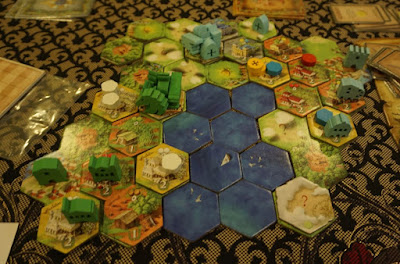
With 2 players, the map is set up using only 4 tiles. There are two ways to win. You either connect two temples with your buildings (the discs), or you construct all of your buildings. 


The player board is an important reference. It shows all the buildings you can construct, their costs, and which buildings can be built for free next to which other buildings. E.g. any ship built next to a harbour is free (bottom right group). I used the blue player buildings to mark which of my buildings have been constructed on the map. Some buildings are temporarily placed on the player board until you can construct them on the map. 


My copy is a German version, so all the building names are in German. It is slightly inconvenient since I don't know German, but the game is very much still playable. In fact I like that my copy is German because that makes me cool. Well, at least in Malaysia.  

Chen Rui started this game dominating the centre of the map, which had many resources. Resources on the map can be used by players when constructing buildings. You can use a resource when you construct a building next to it or directly on top of it. This reduces the number of resource cards you have to play from your hand. Once a building covers a resource on the map, that resource is exhausted. My buildings were divided into two groups. There wasn't enough space to go around so I was forced to establish a second group. 

There are four resource types in the game.


During the game you will get to place new tiles. This is important because you'll need the space for buildings, and resources that come with the new tiles will be useful too. You have to be careful when placing new tiles because you don't want to make it easy for your opponents to use "your" tiles. You want to position the new tiles where they would be convenient for you. Sometimes a new tile helps in connecting temples. Where there is new land, there may be new paths. 


The two temples were originally at two extreme ends of the map. Now the temple at the bottom was almost surrounded by land tiles. Due to competing for land and resources, Chen Rui and my buildings were split into groups. Normally you want to avoid creating separate groups of buildings. You need to pay an extra cost when creating a new group.

Chen Rui constructed her buildings in the backyard of the temple. 


22 Dec 2021. We played Attika again. This particular game above ended soon after this. I (green) was soon able to connect the two temples with my buildings. Chen Rui hadn't been alert about it and didn't defend against it. Actually even I didn't realise it until she noticed the opportunity for me and told me. When I taught her the game, I said it was usually hard to win by connecting temples. So she didn't pay much attention to the risk. Even I seldom allocate much effort to connect temples. 

This time I used glass beads to mark buildings already constructed.


This was another game. This time we each controlled half the map. We guarded our frontlines carefully. Neither of us jumped over each other's frontlines to create new groups. 


This game looked like multiplayer solitaire, with both of us carefully expanding in our own areas. However we did have to compete at the frontlines, and we also had to be careful how we placed new tiles so that the other party could not easily exploit them. 

An important way to discourage your opponents from stealing "your" new tile is to place it far away from them and near your own buildings. 


24 Dec 2021. I was very lucky with my initial building draws. I not only drew my capital Korinth, I also drew two buildings which could be constructed next to Korinth for free. This was very convenient. In this game I managed to construct all ten of the capital group connected to one another. This is usually hard to do because this is a big group. 


I (green) was close to connecting two temples. I had connected to the temple below, and was just two steps away from connecting to the temple above. Chen Rui was forced to stop me. She had to seal off access to that temple, even though it was a costly move. This is how threatening to connect temples can be effective. 

That tile at the bottom left was placed by me. Once I placed it, Chen Rui placed her three roads to steal it from me, blocking me off. She initially placed her road somewhere else. I saw that she could have placed it here and monopolised the new tile, so I advised her to do so. She gleefully accepted. I just screwed myself. 


I had not expected Attika to be among the fives and dimes for 2021. We had a spurt in December. The last time I played it was 2015. I didn't realise it had been that long ago. Now that Chen Rui and I have played a few games, she is getting more familiar with the tactics and I am remembering more too. Now we play in a more aggressive manner, actively grabbing land and resources, and always watching out for opportunities to jump behind enemy lines. 


I (green) had three groups of buildings, and Chen Rui (yellow) had two. During this game she sometimes had three groups, but later merged two of them by placing buildings to link them up. My capital Korinth was quickly surrounded by her buildings in the early game. Many of my buildings which could have been constructed for free next to Korinth then had to be constructed elsewhere at a cost. That was painful. I should not have constructed my capital that near the frontline. This was asking for trouble. It was a very close game. I beat Chen Rui by only one turn. After I constructed all my buildings, she only needed one more turn to construct all of hers. 


At the bottom left, I (green) had one "group" of buildings which consisted of just one single building. In hindsight, this was probably a lousy move. When I drew this building, I could build it here by spending just one resource, for starting a new building group. There were enough resources on the map which could be used for the building itself. So it seemed a good idea to do it. I saved an action. Otherwise the building would have gone to my player board, and I would later need another action to construct it. However having an additional group was a risk, because the next time I wanted to start yet another new group, it would be even more expensive. This single building group did seem rather wasteful. I didn't expand from there. 

Friday, 31 December 2021

my 2021

The most important milestone for me in 2021 is Dancing Queen winning the Best Overall Game at the BoardGameGeek.com 9-card Nanogame Design Contest. This was a great encouragement for me to continue working on game design. I became a boardgame hobbyist in 2003. Throughout the years I have mostly been a consumer and not a creator. I did dabble a little in game design a few times, but I never took it seriously until recent years. The first game I spent a lot of time and energy on was F My Life, a game about questionable life decisions which has some dark humour. I made a prototype and played it quite a few times with different people. However I was not able to get it to a stage I was satisfied with. Eventually I set it aside. I still like the premise. Hopefully I can think of some other way to make it work. Then I'll return to it. 

The whole idea behind Dancing Queen was inspired by the contest. The rules required that contestants use at most 9 cards to design a game. I found this an interesting challenge because I've always admired Love Letter. It only has 18 cards but it is a clever and compact design. I wanted to do something like that - create a fun game with minimal components. Dancing Queen went through many cycles of designing, playtesting and fine-tuning. It was a rewarding experience with many happy discoveries. 

In November I participated in the Game On Lah event. This was the first time I showcased my game design at a public event. It was a valuable experience. 

I have quite a few work-in-progress game designs. Some of them are portable 2-player games just like Dancing Queen. I toyed with the idea of making a 10-card game and an 11-card game as follow ups to Dancing Queen. These games are easier to work on because younger daughter Chen Rui is usually willing to playtest with me. She was my #1 playtester for Dancing Queen and even developed a strategy I hadn't seen myself. However I later shifted to work on games for bigger groups. 2-player games may be too niche. If I am aiming at the global market, the 2P target audience is big enough. However if I'm going to start with Malaysia, then a safer and easier bet is probably casual games for 4 to 6 players which can be played at boardgame cafes and at non-gaming-specific gatherings. Now I have some prototypes which are for this player range. Some game ideas started with using just a standard deck of cards. This makes creating prototypes easier, because I don't need to create a prototype. 

Jeff, Kareem and I are working on establishing a games studio to design, develop, publish and market Malaysian games. We are all busy with our other primary jobs so this is moving slowly, but we hope to make steady progress.

Work-wise, this year I joined a partnership with three other friends to work on an education business targeting young children aged 4 to 7 - Play with Purpose. We are now one of the distributors of HABA, the 80-year-old German company specialising in children's games, toys and other products. We will be bringing the HABA Learning Program to children in Malaysia. It's a blessing to work on something you are passionate about. As the saying goes - when you find a job you love, you never have to work another day in your life. You are doing what you enjoy, so it doesn't feel like "work" anymore. In 2015 when I joined a mobile game company, it was a most exciting time in my work life.  


The pandemic situation in Malaysia was much worse in 2021 compared to 2020. I attended even fewer boardgame meet-ups than last year. This year I have slightly more than 30 new-to-me games. One which stands out is MicroMacro: Crime City. It is certainly something very different from the typical boardgame. It is essentially a solo detective game. It's the kind of game you can only solve once, just like reading a detective story. 

MicroMacro: Crime City

This year I played quite a few new-to-me games on BoardGameArena.com. They were all played with Han and Allen. We play with a Zoom conference call on at the same time, so that we can chat. The experience feels much closer to playing face-to-face. The three of us used to game regularly some years ago. We all like to play fast, often starting our turns when the previous player is still wrapping up his moves. Our tastes in games overlap well enough. We clicked well as a small gaming group. Now Han lives in Johor Bahru, about 4 hours drive away, so we don't get to meet up often. Due to the pandemic we actually met up and played, albeit virtually, more than in recent years. Among the games played online this year, I liked Carnegie the most. I can't really justify why I like it better than other similar games. It's a strategic Eurogame. It is a development game in which you improve your abilities and get more and more powerful. You get a sense of achievement as you see your efforts pay off. You get to set long-term goals, and when you are able to achieve them, you get much satisfaction. Yet many heavy Eurogames have these too. 

Carnegie

I bought a used copy of Baseball Highlights 2045. I rarely play sports-themed games and generally don't find them interesting. I am not familiar with baseball. However I quite enjoyed this game. It's a tactical 2-player game with some deck-building. You gradually trade mediocre players for better and better ones, augmenting your team. You will leverage the abilities of your players. At the same time you watch what kind of players your opponent is buying, so that you know how to play against them, maybe even recruit new players who are good at defending against or even neutralising your opponent's strengths. 

Baseball Highlights 2045

I bought a copy of Imperial Struggle, designed by the makers of Twilight Struggle. It looks more intimidating than Twilight Struggle, but once you get into it, it is not that scary. I enjoyed this sweep of history game. 

Imperial Struggle

Traders of Osaka has the Japanese game signature - small box, few components, simple rules, but everything is intricately crafted and comes together as a clever and tightly-woven game. Often when I read the rules of these Japanese games, I cannot fathom what makes them fun. Only upon experiencing them first hand I am able to appreciate their brilliance. 

Traders of Osaka

In 2021 I have bought only six games. If declaring oneself a boardgamer requires a license, mine would have been revoked. I bought MicroMacro: Crime City, Imperial Struggle, A Kindly World and Pandemic Legacy: Season 0 because they promised a certain experience I was keen about. I have owned Pandemic Legacy: Season 0 for almost a year now, and still have not started playing the campaign, because of the actual pandemic happening around us. Hopefully next year I will at least get the campaign kicked off with the same team who accompanied me through seasons 1 and 2. 

I bought Priests of Ra because I was curious to see how it worked. Ra is a game full of happy memories for me. Priests of Ra is not new. In fact it is probably out of print in most places. I bought it mostly because of nostalgia for its predecessor. Strictly speaking it was my wife Michelle who bought JOME. For now I count all game purchases in the household as mine. Michelle bought JOME to support a local game designer. 

My most played games in 2021 were all played on digital platforms - Race for the Galaxy (played against AI's), Star Realms and Ascension. I played more than 400 games of Race for the Galaxy, and more than 100 games of both Star Realms and Ascension. Other games played more than 5 times include MicroMacro: Crime City (I solved all the crimes in the base game), Betrayal Legacy (my family and I continued the campaign late last year and completed it early this year), and Sky Towers. I have certainly played many games of Dancing Queen too, just that I didn't record them when I was still in the designing and playtesting stage. Because of that I didn't develop the habit of recording plays for it even after the game was done (as in submitted for the contest). Maybe I feel the game is never quite done because it is my own design. I can always decide to change it and improve it further. 

Race for the Galaxy

I was interviewed by Sinchew Daily again. The last time was 2017 and it was a different reporter then. This time round a few others in local boardgame circles were also interviewed. The reporter wrote a series of articles and they took up quite a lot of space. This was good exposure for boardgames. 

Here are my hopes for next year. I hope the pandemic situation gets better, and I can have more face-to-face gaming sessions. I hope to make more progress in game design and game publishing. I hope to introduce the boardgame education programme (HABA Learning Program) to more children, parents and educators. Here's wishing a happy new year to everyone! 

Tuesday, 28 December 2021

Dancing Queen in Italy


I blogger in Italy wrote a short review for Dancing Queen and contacted me to let me know. Go check it out if you know Italian. It's a great feeling to know that someone from the other side of the world, from a country I have never been to, spent the effort to download, print and craft a copy of my game to play it. It is very encouraging. 

Click for more information on Dancing Queen.

Friday, 24 December 2021

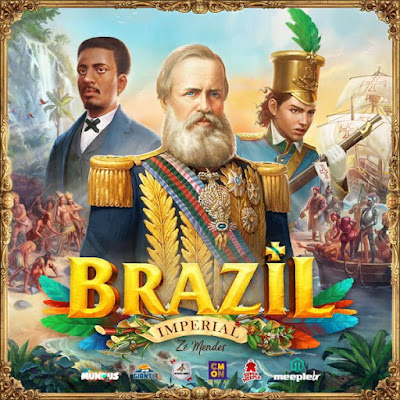
Brazil Imperial


The Game

Brazil Imperial is a game of colonisation and nation building set in the age of exploration. It is a 4X game and a civilisation game in which you start with a humble capital and grow into an empire, competing with other players for territory and resources. You construct buildings and cities. You produce resources and use them to expand your empire. You discover unknown secrets of the land. You raise troops and conduct battle to seize opponent cities, buildings and resources. The game is played over three eras. Every player gets one mission card per era. An era progresses to the next the first time anyone completes a mission of that era. Once anyone completes a mission of the third era, the game ends. Many things you do in the game give you points. The highest scorer at the end of the game wins. 


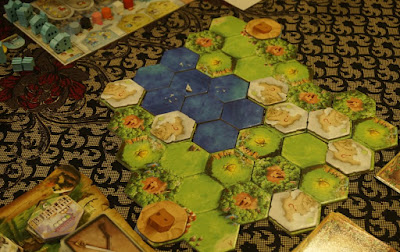
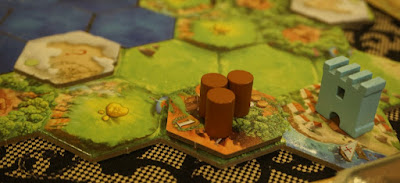
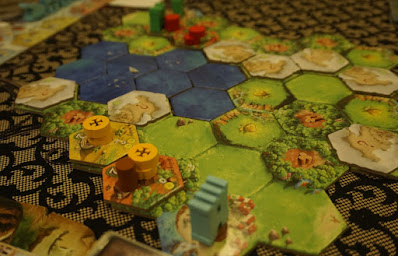
The game comes with many different setups. This above is one of the 2-player setups. The starting locations of the two capitals are fixed. The fog tiles are secrets you get to explore. They are usually good and the benefits are claimed on a first come first served basis. The map has different terrain types - plains, forests, gold deposits and lakes. Different terrain types allow different buildings. 


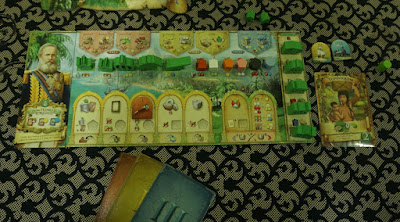
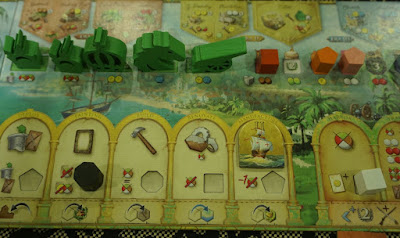
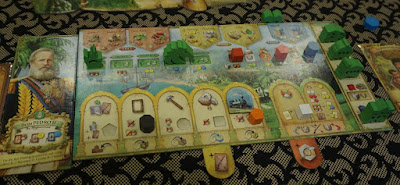
Everyone gets a player board like this. The large tile on the left is a monarch tile. You have a few options and every monarch gives a different bonus. The player board is mostly identical between players. The only differences are the army composition and costs. Each different coloured player board comes with a set of monarchs. 


The green player has two archers, a monarch, a cavalry and a cannon. The icons below the units are the costs to raise these troops. The units have different combat strengths and are also worth victory points the moment you create them. They never die. If they lose a battle, they just go to a waiting area. The next time you perform the deploy action, you may deploy them to your city or capital for free. 

The monarch unit is the only unit type which can establish a new city. The cavalry unit brings along any number of other units when it moves, which is very handy. The cannon can initiate a battle from an adjacent space. Normally you need to enter a space occupied by an opponent to initiate battle. 


A player turn is short and simple. You pick one action, and you march once or twice. You can always march a unit once. Whether you get a second march depends on the action you pick and what kind of extra march it gives. E.g. the buy painting action gives an extra march if a unit is going to march into an adjacent forest. So it's situational. 

The 7 action options are shown in arches on the player board (see above). You can deploy troops, buy paintings, construct buildings and cities, collect resources and convert resources. Paintings give you special abilities and are worth points. They augment your abilities and are good investments. There's one action called manufacturing. You spend resources to move a cube, a pentagon or an octagon (see above) to one of the action arches. This enhances the action designated by the arch, e.g. waiving the payment for producing goods. This is also good investment especially when you enhance an action you plan to perform many times. 


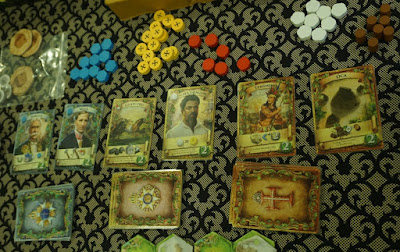
There are three types of paintings and two of each type will be made available at all times. The rightmost two are free, the others require payment. The leftmost two are the most expensive because you need to pay science. The blue resources are science, the most precious resource in the game. 


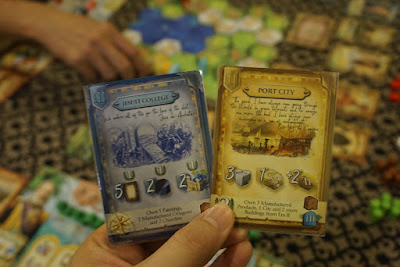
These are mission cards. They are what drive the core progression of the game. Think of them as a countdown mechanism. Whenever a mission of a particular era is completed and announced, everyone progresses to the next era. You must work on your missions so that you don't miss out on the point value and also the reward of building a palace. There are 6 types of palaces in the game. The first one is free and is used to mark your capital. The rest can be built only when you complete missions. They give various bonuses, and often these come in the form of extra victory points based on specific criteria being met at game end. Your choice of palace determines how you play. 

These are the palaces you get to build during play.


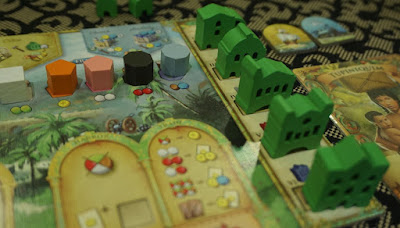
When you construct a building, it immediately produces resources. You place the resources on the building itself and you can use them any time. Once you exhaust them, you can make the building produce again by picking the renovate action. It's called renovate and not produce because before you produce, you may flip the building to the other side, transforming it into another building type which produces a different resource type. 


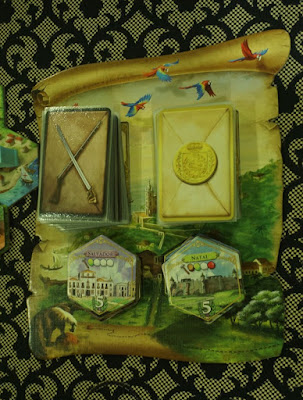
This little side board is for organising some of the components. At the top left you have the combat cards. You draw a combat card when you deploy a unit. Combat cards give you extra combat strength. During combat, the strength of units, buildings and cities are open information. The strength of combat cards is hidden information. Both combatants commit combat cards face-down. They are revealed when combat resolution is done. 

At the top right you have the gold cards. They have various abilities. Some may score you points at game end based on certain conditions being met. Some give one-time powers. If a gold card is not useful to you, you can simply spend it as a gold coin. 

The two stacks at the bottom are city tiles. When you build a city, you must pick from the top of one of these stacks. Cities are worth 5VP each, which is a lot. They are also expensive to build. 

Brazil Imperial is a game where you race to grow your nation, producing more resources which you then spend to construct more buildings and cities. Almost every other thing you do in the game scores you points - buildings, cities, military units, paintings and so on. Whoever does the best overall job of building his empire will be the ultimate winner. 

The Play

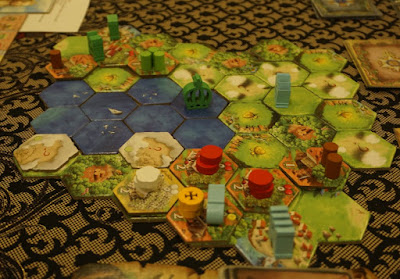
I did a 2-player game with Allen, so our map was small. We were both new to the game. 


Allen (light blue) picked the capital location at the bottom right, so I took the other one at the top left. One thing unique about the light blue empire is most military units are built with gold coins, so Allen focused on constructing buildings which produced gold coins. A new building can only be constructed next to a capital, a city or another building. Only new cities can be constructed without being adjacent to your territory. 

The mission of the first era was not very difficult and I completed it quickly. I had a strict focus and minimised the number of steps needed to complete the mission. The speed surprised Allen a little. However for both Eras 2 and 3 he beat me to the missions. 
 

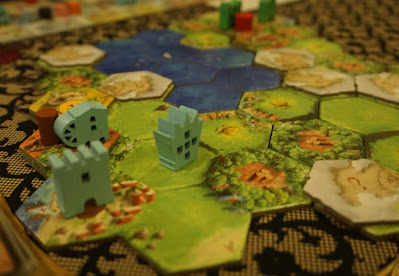
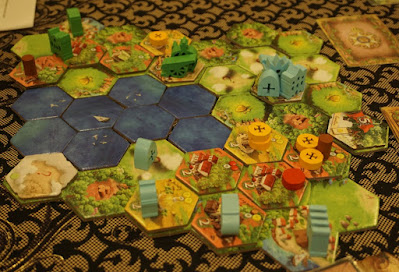
This piece in the middle is Allen's monarch. The monarch is a military unit and has combat strength. Its most important function is to build new cities. 


My (green) monarch was now deployed too and sailed towards the group of unexplored territories (fog tiles). Allen and I competed to uncover the secrets of these unexplored territories. He was faster than me in building construction. By now he had five buildings while I had only three. 


When you perform an action, you place your action marker inside the corresponding arch. This reminds you not to perform the same action next turn. You use a different action marker every era. When an era ends, you flip over the expired action marker and place it below one of your action arches. This boosts the action from then on. In the photo above you can tell this is the third era, because two action arches now have been boosted, with old action markers placed below them. 

My monarch tile (on the left of the player board) gave me resources when I purchased paintings. I picked this particular monarch because one of my missions required collecting many paintings. I wanted to create synergy.


At the top right Allen and I were now in a stalemate situation. We had both built cities, and now we both had armies stationed in our cities. No one dared to attack, because whoever attacked would be at a disadvantage. The defender could rely on the combat strength of his city. Fighting never broke out between these two cities until the end of the game. 

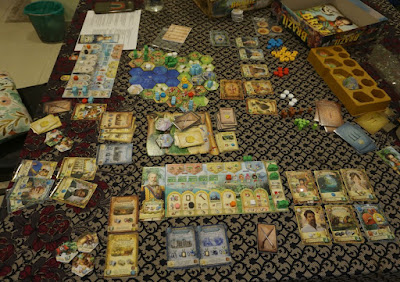
The map doesn't take up much space, but the rest of the game does. 


One of my (green) palaces scored points based on the number of cotton farms I had, so I build as many cotton farms as I could, and also renovated foundries to become cotton farms. The white resources on the map are cotton. 


When we did the final scoring, Allen and I both scored 76! I fell behind Allen in expanding my empire so I was not optimistic. I was the one who read the rules and I was more familiar with some of the intricacies. That gave me some advantage in some detailed execution aspects. The tiebreaker was science (blue resource) on the map. Allen had two and I had none, so he was the victor. I wasn't able to start constructing Era 3 buildings, and he already had two. 

The Thoughts

A turn in Brazil Imperial is very simple, and it makes the game feel accessible. You only perform one action and you may march up to twice. Down time between player turns is minimal. You always feel engaged. Actions are simple, and you usually have to plan a few steps ahead to complete a certain objective, e.g. renovate a certain building to produce resources, then spend those resources on manufacturing a product to enhance the deploy action, and then perform the deploy action to be able to deploy two units at once. 

You are always in a cycle of producing resources then spending them to expand your empire, be it in enhancing your abilities or building more and more stuff - buildings, military units and cities. You are always hungry and growing. That said, being big does not guarantee victory. You may have more space to construct cities and buildings, but smaller empires which are efficient in utilising their buildings can still do well in scoring points. 

There is a delicious tension between upgrading your abilities and racing to complete missions. On one hand it seems a no-brainer to upgrade your abilities in the early game, so that you get to enjoy the advantages for the rest of the game. But how far should you go? There is time pressure in completing the missions. If you spend too much time on upgrading many different abilities, you may not be utilising all of them enough. You may fall behind your opponents. Yet if you only focus on the race without developing a competitive edge, you will likely be outpaced by your opponents. There is pressure to grab land and to explore the unknown territories too. Finders keepers (usually)! 

Brazil Imperial is the type of game with many different ways to score points. Sometimes when playing such games I feel my strategic planning doesn't matter much. No matter what you do, you will score points. It's just a matter of being efficient and being clever with tactical execution. As long as you are efficient, you will end up scoring more points than your opponents. You try to be lazy. You want maximum gains with minimum effort. It comes down to an efficiency game. This is something that nags at me when I play. 

I like that the game makes me feel that there are many things I want to do, and I have a tough time deciding which I should do first, and which I may have to give up. You can't take your sweet time and do everything you like. There's a race going on. You need to pick a few areas and make sure your actions synergise well. Brazil Imperial is a development game. It is fulfilling to see your empire grow. You progress to construct better and better buildings. You accumulate wealth. You push your borders outwards. There is some combat but it won't be your primary focus. Raising troops gets you victory points, but killing opponents' soldiers doesn't. It takes much effort to capture your opponents' cities and buildings. It may not be worthwhile. The military aspect is an arms race. You can't afford to fall behind too far because your opponents are still threatening to steal your resources and points. You may not want to spend too much effort on planning an offensive because you may not get much out of it. It's not too hard to play defense and to match an aggressive neighbour in strength. 

The production of the game is top-notch, from the art to the game components. Allen said he decided to buy it because of how pretty it was, and that was before he even read the rules. 

I like how Brazil Imperial maintains a sense of urgency. You don't know your opponents' missions and how close they are to completing them. The clock is ticking and you always worry about falling behind and being unable to complete your own missions. Era 3 missions are broad and thus not easy to fulfil. You are often torn between focusing only on the main missions and going off on lucrative side quests. You want to do everything, and you are constantly worried you won't have enough time. 

Tuesday, 21 December 2021

Merry Christmas

Merry Christmas and Happy New Year! 

The theme for 2021 is mecha deities and this character is Dionysus from Greek mythology.